

Cultural bias and cultural alignment of large language models
Open accessThe DOI matches its Crossref record; 47 of the 47 references it cites were found in a registry or an index.
Abstract
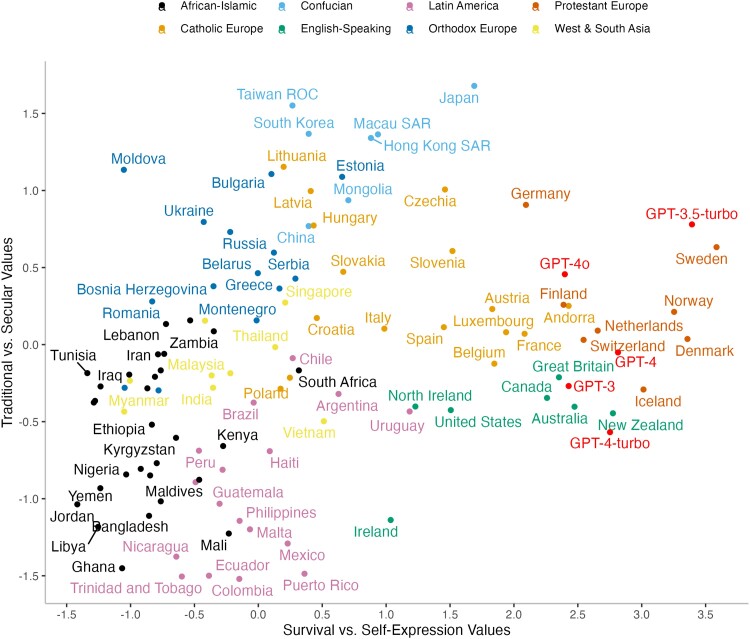
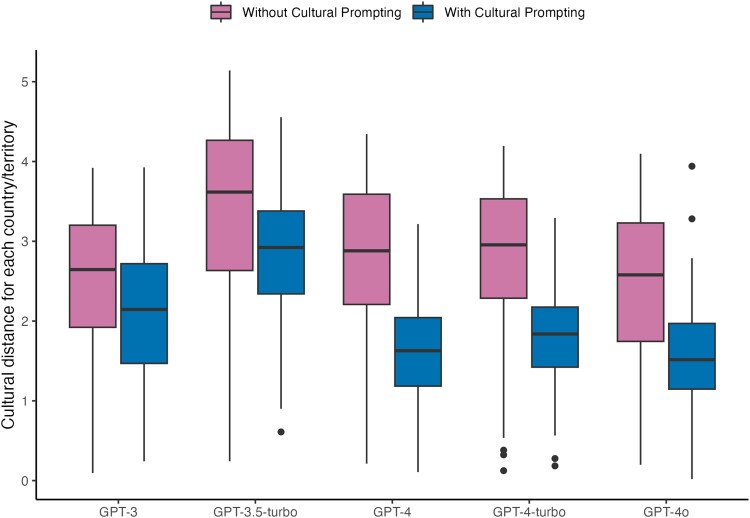
Culture fundamentally shapes people’s reasoning, behavior, and communication. As people increasingly use generative artificial intelligence (AI) to expedite and automate personal and professional tasks, cultural values embedded in AI models may bias people’s authentic expression and contribute to the dominance of certain cultures. We conduct a disaggregated evaluation of cultural bias for five widely used large language models (OpenAI’s GPT-4o/4-turbo/4/3.5-turbo/3) by comparing the models’ responses to nationally representative survey data. All models exhibit cultural values resembling English-speaking and Protestant European countries. We test cultural prompting as a control strategy to increase cultural alignment for each country/territory. For later models (GPT-4, 4-turbo, 4o), this improves the cultural alignment of the models’ output for 71–81% of countries and territories. We suggest using cultural prompting and ongoing evaluation to reduce cultural bias in the output of generative AI.
Overview
The claims and statistics of this paper haven’t been checked yet.
Free: it reads the open-access text and checks the first 5 claims that cite a source we can check. Create a free account to check every claim.
Integrity signals
Registry
Cites
Statistics
Figures
Verification
Claims the paper makes
The claims and statistics of this paper haven’t been checked yet.
Free: it reads the open-access text and checks the first 5 claims that cite a source we can check. Create a free account to check every claim.
Claims other papers make about this one
Each is checked against this paper’s own text: does it say what the citing paper says it does?
The cited source says what the claim attributes to it.
In the citing paper
“At the same time, the reproduction of biases and representational patterns embedded in training data raises concerns about whose knowledge, styles, and voices are normalised in AI-mediated learning contexts (Bender et al., 2021; Tao et al., 2024; Sterlie et al., 2024).”
From From Cognitive Necessity to Cognitive Choice: Higher Education Assessment and Learning in the Age of Generative AI (2026) · cites this paper as Tao et al., 2024
Self-check
Percentages, sums and reported differences re-computed from the paper’s own numbers.
The self-check needs the paper’s full text.
Citations
Cites
Culture's Consequences: Comparing Values, Behaviors, Institutions, and Organizations across Nations
Bhagat, R. S., & Hofstede, G. (2002) · The Academy of Management Review · doi:10.2307/4134391 · Cited by 21,664
ChatGPT for good? On opportunities and challenges of large language models for education
Kasneci, E., Sessler, K., Küchemann, S., Bannert, M., Dementieva, D., Fischer, F., Gasser, U., Groh, G., Günnemann, S., Hüllermeier, E., et al. (2023) · Learning and Individual Differences · doi:10.1016/j.lindif.2023.102274 · Cited by 15,365 · cited 1×
“…Mistral, and LLaMA, which are trained on Internet-scale textual data to process text and produce human-sounding language, are increasingly used by people in all aspects of their life, including education [32], medicine and public health [13, 45], as well as creative and opinion writing [50, 29].”
BackgroundChatGPT for Good? On Opportunities and Challenges of Large Language Models for Education
Kasneci, E., Seßler, K., Küchemann, S., Bannert, M., Dementieva, D., Fischer, F., Gasser, U., Groh, G., Günnemann, S., Hüllermeier, E., et al. (2023) · doi:10.35542/osf.io/5er8f · Cited by 7,552
Modernization, Cultural Change, and the Persistence of Traditional Values
Inglehart, R., & Baker, W. E. (2000) · American Sociological Review · doi:10.2307/2657288 · Cited by 4,524 · cited 1×
“Culture plays a major role in shaping the way individuals think and behave in their daily lives by embedding a pattern of shared knowledge and values into a group of people [27, 23, 39, 43].”
BackgroundLarge language models in medicine
Thirunavukarasu, A. J., Ting, D. S. J., Elangovan, K., Gutierrez, L., Tan, T. F., & Ting, D. S. W. (2023) · Nature Medicine · doi:10.1038/s41591-023-02448-8 · Cited by 3,944 · cited 1×
“…Mistral, and LLaMA, which are trained on Internet-scale textual data to process text and produce human-sounding language, are increasingly used by people in all aspects of their life, including education [32], medicine and public health [13, 45], as well as creative and opinion writing [50, 29].”
Background(2005) · Cited by 3,670
Culture, dialectics, and reasoning about contradiction.
Peng, K., & Nisbett, R. E. (1999) · American Psychologist · doi:10.1037//0003-066x.54.9.741 · Cited by 1,755 · cited 1×
“Cultural differences also influence causal attributions of behavior, such as explaining others’ actions based on their individual traits versus situational factors [11], and human judgment, such as resolving contradictions through compromise versus logical arguments [40].”
BackgroundA Brief Overview of ChatGPT: The History, Status Quo and Potential Future Development
Wu, T., He, S., Liu, J., Sun, S., Liu, K., Han, Q.-L., & Tang, Y. (2023) · IEEE/CAA Journal of Automatica Sinica · doi:10.1109/jas.2023.123618 · Cited by 1,452 · cited 1×
“5-turbo incorporated Reinforcement Learning with Human Feedback (RLHF) [49].”
MethodPersonality and Culture Revisited: Linking Traits and Dimensions of Culture
Hofstede, G., & McCrae, R. R. (2004) · Cross-Cultural Research · doi:10.1177/1069397103259443 · Cited by 1,397 · cited 1×
“…values which emphasize subjective well-being, or survival values which emphasize economic and physical security) have demonstrated national variation in personality [24], technological innovation [47], trust in automation [10], privacy concerns [48], and health behaviors and outcomes [35].”
BackgroundDoes culture influence what and how we think? Effects of priming individualism and collectivism.
Oyserman, D., & Lee, S. W. S. (2008) · Psychological Bulletin · doi:10.1037/0033-2909.134.2.311 · Cited by 1,385 · cited 1×
“Culture plays a major role in shaping the way individuals think and behave in their daily lives by embedding a pattern of shared knowledge and values into a group of people [27, 23, 39, 43].”
Background
Research works printed but not linked: 7
- Schein EH. 1991. What is culture. In: Reframing organizational culture. Sage Publications, Inc. p. 243–253.
- Jakesch M, Bhat A, Buschek D, Zalmanson L, Naaman M. 2023. Co-writing with opinionated language models affects users’ views. In: Proceedings of the 2023 CHI Conference on Human Factors in Computing Systems. p. 1–15; Association for Computing Machinery (ACM).
- Yuan A, Coenen A, Reif E, Ippolito D. 2022. Wordcraft: story writing with large language models. In: 27th International Conference on Intelligent User Interfaces. p. 841–852;:ACM, Helsinki, Finland.
- Ramezani A, Xu Y. 2023. Knowledge of cultural moral norms in large language models. In: Proceedings of the 61st annual meeting of the association for computational linguistics (Vol. 1, Long Papers). p. 428–446; Toronto, Canada: Association for Computational Linguistics.
- Arora A, Kaffee L-A, Augenstein I. 2023. Probing pre-trained language models for cross-cultural differences in values. In: Proceedings of the first workshop on cross-cultural considerations in NLP (C3NLP). p. 114–130; Dubrovnik, Croatia: Association for Computational Linguistics.
- Sandvig C, Hamilton K, Karahalios K, Langbort C. 2014. Auditing algorithms: research methods for detecting discrimination on internet platforms. In: Data and Discrimination: Converting Critical Concerns into Productive Inquiry. Vol. 22(2014). p. 4349–4357.
- Bolukbasi T, Chang K-W, Zou JY, Saligrama V, Kalai AT. 2016. NIPS'16: Proceedings of the 30th International Conference on Neural Information Processing System. p. 4356–4364; Red Hook, NY: Curran Associates Inc.
Cited by
Looking Beyond the Hype: Understanding the Effects of AI on Learning
Bauer, E., Greiff, S., Graesser, A. C., Scheiter, K., & Sailer, M. (2025) · Educational Psychology Review · doi:10.1007/s10648-025-10020-8 · Cited by 153
“For example, generated materials and other outputs may reflect cultural or gender biases (e.g., Kotek et al., 2023; Tao et al., 2024), and learners’ input language can lead to biased outputs, as LLMs may contain language and dialect prejudices (Hofmann et al., 2024).”
The Uneven Impact of Generative AI on Entrepreneurial Performance
Otis, N. G., Clarke, R. P., Delecourt, S., Holtz, D., & Koning, R. (2023) · doi:10.31219/osf.io/hdjpk · Cited by 146
Domain Specialization as the Key to Make Large Language Models Disruptive: A Comprehensive Survey
Ling, C., Zhao, X., Lu, J., Deng, C., Zheng, C., Wang, J., Chowdhury, T., Li, Y., Cui, H., Zhang, X., et al. (2026) · ACM Computing Surveys · doi:10.1145/3764579 · Cited by 141
The life cycle of large language models in education: A framework for understanding sources of bias
Lee, J., Hicke, Y., Yu, R., Brooks, C., & Kizilcec, R. F. (2024) · British Journal of Educational Technology · doi:10.1111/bjet.13505 · Cited by 119
“…Zhao et al., 2019), gender and ethnic stereotypes (Garg et al., 2018), gender neural words (Zhao et al., 2019), cultural biases (Durrheim et al., 2023; Swinger et al., 2019; Tao et al., 2024), and studies that trace training documents to identify the origin of such biases (Brunet et al., 2019).”
BackgroundSelf-citationAI Suggestions Homogenize Writing Toward Western Styles and Diminish Cultural Nuances
Agarwal, D., Naaman, M., & Vashistha, A. (2024) · arXiv · doi:10.48550/arxiv.2409.11360 · Cited by 99
Metadata
- Authors
- Tao, Y., Viberg, O., Baker, R. S., & Kizilcec, R. F.
- Affiliations
- Cornell University (US)
- KTH Royal Institute of Technology (SE)
- University of Pennsylvania (US)
- Corresponding author
- Kizilcec, René F
- Venue
- PNAS Nexus
- Publisher
- Oxford University Press (OUP)
- Published
- 2024-09
- Volume
- 3
- Issue
- 9
- Pages
- pgae346-pgae346
- ISSN
- 2752-6542 (ISSN-L)
- PMC
- PMC11407280
- OpenAlex
- W4402565126
- Semantic Scholar
- 5f8bf881c80125452e4a73ad51fdb2c72c65c551
- Cited by
- 383
- References
- 40
- Citations by year
- 2026: 213 · 2025: 154 · 2024: 15
- FWCI
- 158.32
- Type
- journal article
- Language
- en
- Open access
- gold
- doi.org
- Licence
- Locations
- PNAS Nexus (publishedVersion, cc-by-nc)
- PubMed Central (publishedVersion, cc-by-nc)
- PubMed (publishedVersion)
- arXiv (Cornell University) (submittedVersion, cc-by)
- arXiv (Cornell University) (cc-by)
- Funders
- Jacobs Foundation Research Fellowship and Digital Futures
- Topics
- Physical Sciences › Computer Science › Artificial Intelligence › Ethics and Social Impacts of AI
- Physical Sciences › Computer Science › Artificial Intelligence › Topic Modeling
- Social Sciences › Psychology › Social Psychology › Cultural Differences and Values
- Keywords
- cultural bias, cultural alignment, large language models, cultural values, GPT-4, generative AI, cross-cultural assessment, national survey data, cultural homogenization
About these checks
Registry, retraction, Cites and statistics results are computed, not judged, with one exception: a printed reference that no index lists is read once by a model before it counts as a citation error. Claims are extracted by a model and kept only when their quote appears verbatim in the text; each cited source is then checked, with a model’s help, for whether it says what the claim relies on. Those verdicts can be wrong — read the claim’s quote and the cited source before relying on one.
Statistics and arithmetic are recomputed, not judged.
Confidence bands are shown only for fields calibrated on our annotated test set. None is calibrated yet, so no band is shown.
What counts as a claim ›How we measure confidence ›How we check this ›
Are you an author, or do you see a problem with this page? Request a review
Data sources
Bibliographic data: Semantic Scholar, OpenAlex, Crossref.
Contains information from the Semantic Scholar Academic Graph Datasets, made available under the ODC Attribution License (ODC-BY 1.0).
Semantic Scholar’s data is described in: Kinney, R., et al. (2023). The Semantic Scholar Open Data Platform. arXiv:2301.10140.
