

Workplace Heterogeneity and the Rise of West German Wage Inequality*
The DOI matches its Crossref record; 144 of the 147 references it cites were found in a registry or an index, and 1 are not checked yet; none of the 8 sources its claims cite is checked for support yet.
Abstract
We study the role of establishment-specific wage premiums in generating recent increases in West German wage inequality. Models with additive fixed effects for workers and establishments are fit into four subintervals spanning the period from 1985 to 2009. We show that these models provide a good approximation to the wage structure and can explain nearly all of the dramatic rise in West German wage inequality. Our estimates suggest that the increasing dispersion of West German wages has arisen from a combination of rising heterogeneity between workers, rising dispersion in the wage premiums at different establishments, and increasing assortativeness in the assignment of workers to plants. In contrast, the idiosyncratic job-match component of wage variation is small and stable over time. Decomposing changes in mean wages between different education groups, occupations, and industries, we find that increasing plant-level heterogeneity and rising assortativeness in the assignment of workers to establishments explain a large share of the rise in inequality along all three dimensions.
Checked 2026-11-19 · 1 reference not checked yet
Overview
CoChat Summary
TL;DR
Using West German administrative data from 1985–2009, the paper shows that models with additive person and establishment fixed effects explain nearly all of the rise in wage inequality. The increase is driven by rising worker-effect variance, rising establishment-premium variance, and increased assortative matching of high-wage workers to high-wage plants.
Key findings
- In the AKM variance decomposition, total log-wage variance rose from 0.137 in interval 1 (1985–1991) to 0.249 in interval 4 (2002–2009). The variance of person effects rose from 0.084 to 0.127 and contributed 39% of the total rise; establishment-effect variance rose from 0.025 to 0.053 and contributed 25%; the covariance term rose from 0.003 to 0.041 and contributed 34%.
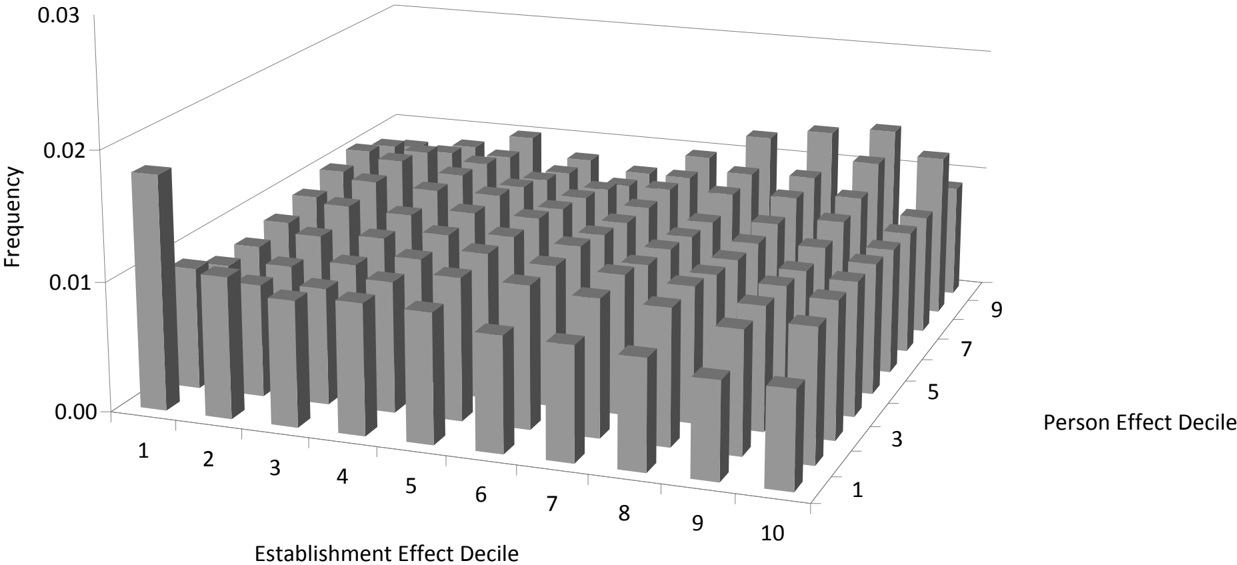
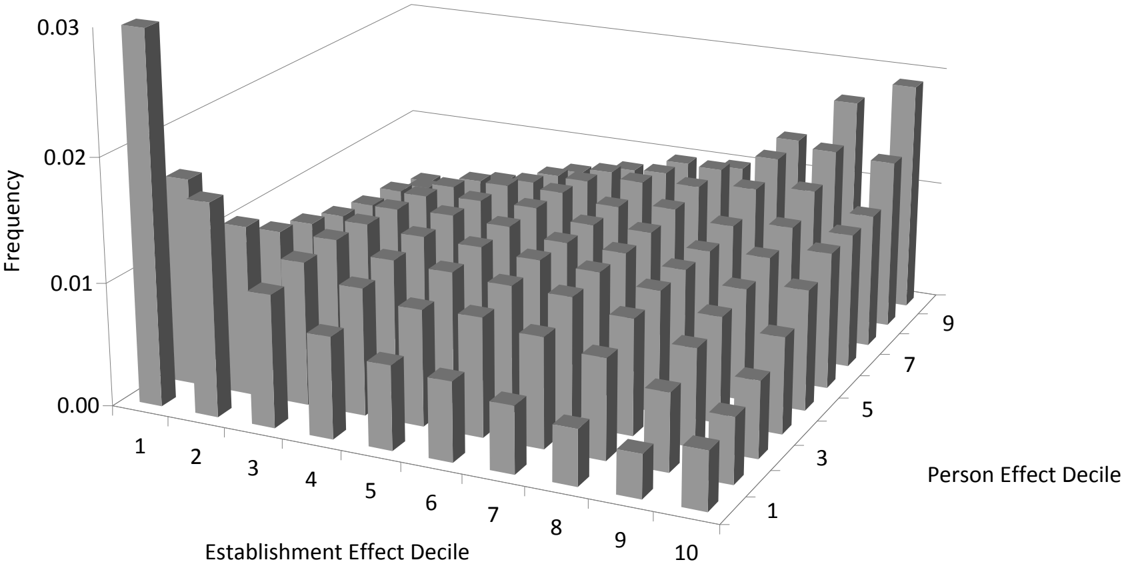
- Assortative matching increased: the correlation between person and establishment effects rose from 0.034 in interval 1 to 0.249 in interval 4. Counterfactuals imply that holding sorting constant would have produced 69% of the actual variance rise, while holding establishment-effect variance constant would have produced 64%.
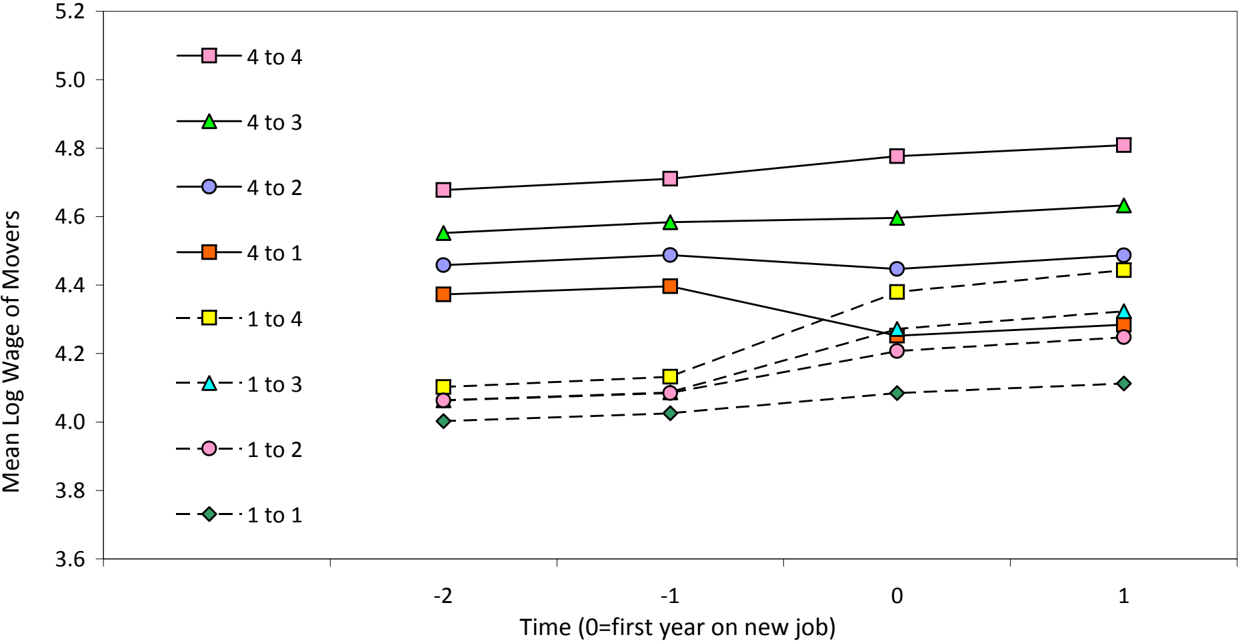
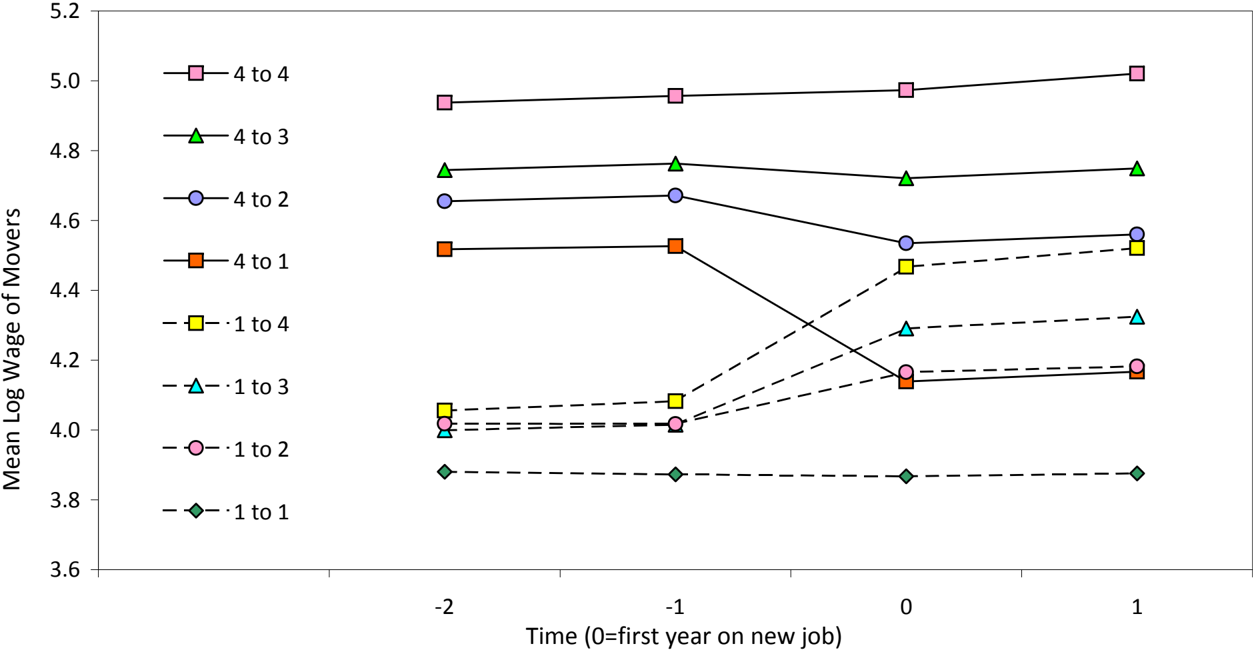
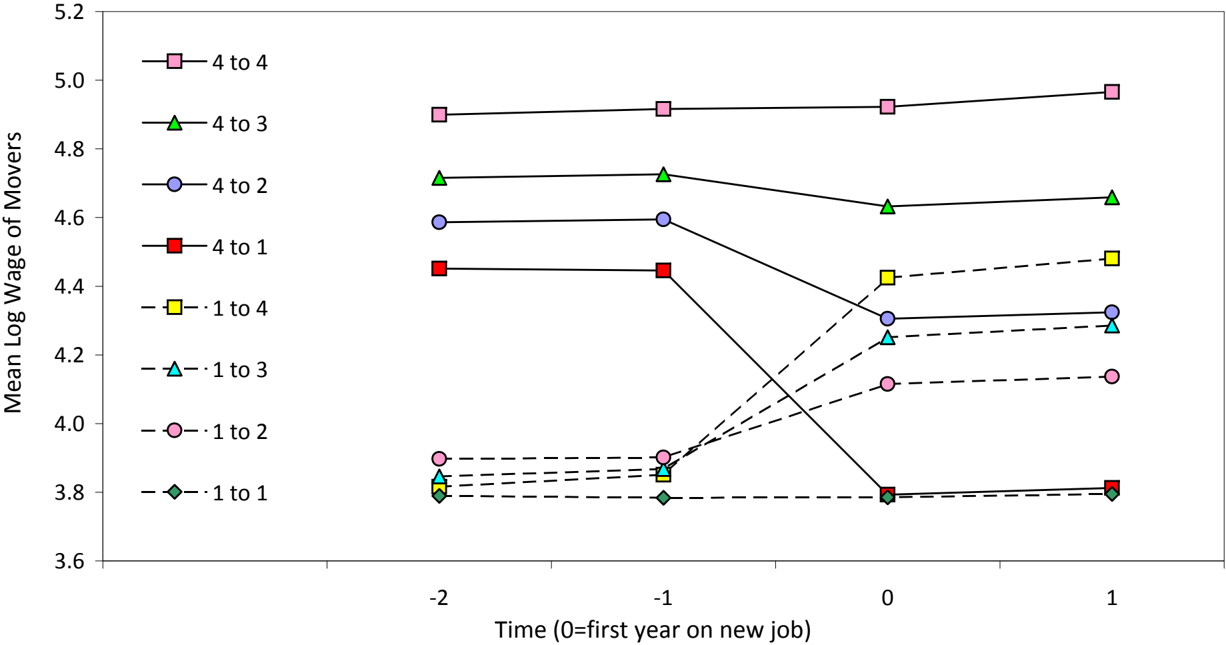
- Job-mobility event studies show growing establishment premia: a trend-adjusted move from quartile 1 to quartile 4 co-worker-wage establishments was associated with a 23 log-point gain in 1985–1991 versus 47 log points in 2002–2009; the reverse move yielded losses of 22 versus 43 log points.
- Between-group decompositions attribute 70% of the relative rise in university-educated men’s wages and 80% of the relative fall for workers with no/missing qualifications to establishment effects. For occupations, 42% of the rise in between-occupation variance is from person–establishment covariance, 28% from establishment variance, and about 30% from person variance; for industries, 44% is person variance, 19% establishment variance, and 42% sorting.
Methods
- Data: German Social Security records from the IEB, focusing on full-time West German men age 20–60 from 1985–2009, with parallel analyses for full-time women. The main sample has 85–90 million person-year observations per interval and about 17 million individual workers.
- Model: AKM-style log daily wage equation with additive person fixed effects, establishment fixed effects, time-varying covariates, and an error component; estimated by OLS on the largest connected set of establishments linked by worker mobility. Censored earnings are imputed using Tobit models.
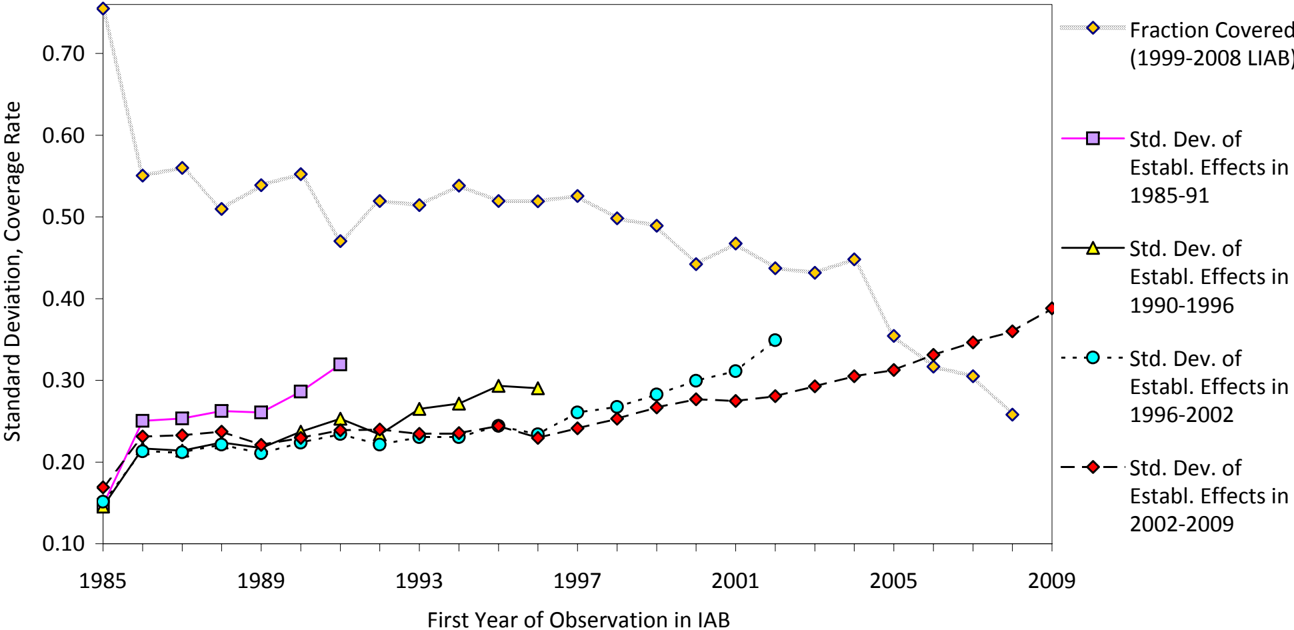
- Analyses: variance decompositions and counterfactuals across four overlapping intervals (1985–1991, 1990–1996, 1996–2002, 2002–2009); event studies of job changers; decompositions of between-group wage gaps by education, occupation, and industry; and establishment cohort/collective-bargaining analyses.
Limitations
- The paper states that earnings are censored at the Social Security maximum (10–12% of male observations and 1–3% of female observations per year), so it uses Tobit imputation and checks robustness using apprentice-trained men, who have lower censoring rates.
- The paper states that establishment identifiers are administrative: ownership changes can create new establishment IDs, and only about half of EID births/deaths are estimated to be true plant openings/closings. It also states that sampling errors bias estimated variances upward and the covariance downward, and it does not construct bias-corrected estimates, assuming biases are similar across intervals.
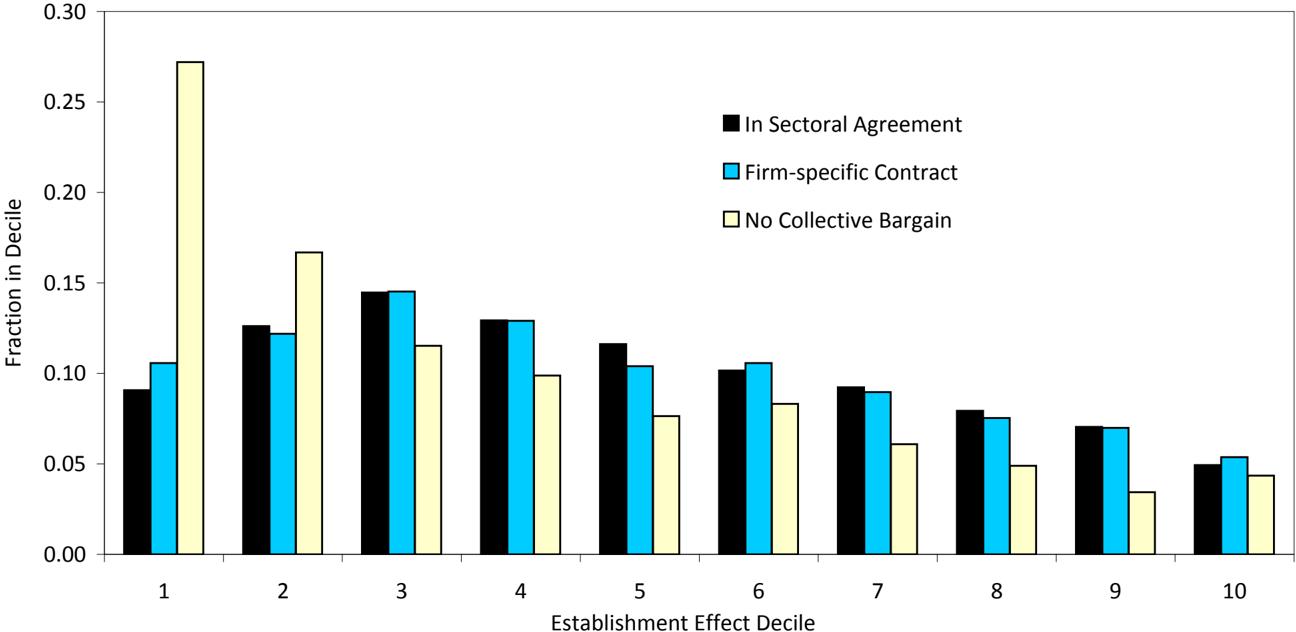
- The paper states that collective bargaining cannot be assigned a causal role because firms choose coverage, and that female estimates may have more negatively biased covariance terms due to fewer observed matches per plant/worker. Evident from the text: the main analysis is restricted to full-time workers in West Germany, excluding civil servants, self-employed, and many part-time/mini-job workers, which limits generalizability.
Model-written summary. Check it against the paper before relying on it.
Integrity signals
Registry
Cites
Statistics
Figures


Verification
Claims the paper makes
0 Valid · 0 Not valid · 8 Not checked · 191 Own results and interpretations
A result the paper reports from its own data — it cites no other source for it, so there is none to check. The quote shows it is in the paper.
In the paper
“In particular, generalized non-separable models with xed e/ects for each job yield only a small improvement in explanatory power relative to the AKM speci cation, both within narrow time intervals and between intervals.”
plain- Asserted: passes — The authors put it forward as true.
- Checkable: passes — It can be checked against evidence.
- Load-bearing: passes — The paper’s conclusions depend on it.
- Based: passes — The paper gives a reason why it holds.
A result the paper reports from its own data — it cites no other source for it, so there is none to check. The quote shows it is in the paper.
In the paper
“Classifying establishments by entry year, we nd a trend toward increasing heterogeneity among establishments that entered the labor market after the mid-1990s, coupled with relatively small changes in the variability of the premiums paid by continuing establishments.”
plain- Asserted: passes — The authors put it forward as true.
- Checkable: passes — It can be checked against evidence.
- Load-bearing: passes — The paper’s conclusions depend on it.
- Based: passes — The paper gives a reason why it holds.
A result the paper reports from its own data — it cites no other source for it, so there is none to check. The quote shows it is in the paper.
In the paper
“We nd that two-thirds of the increase in the pay gap between higher and lower-educated workers is attributable to a widening in the average workplace pay premiums received by di/erent education groups.”
plainstates a cause- Asserted: passes — The authors put it forward as true.
- Checkable: passes — It can be checked against evidence.
- Load-bearing: passes — The paper’s conclusions depend on it.
- Based: passes — The paper gives a reason why it holds.
A result the paper reports from its own data — it cites no other source for it, so there is none to check. The quote shows it is in the paper.
In the paper
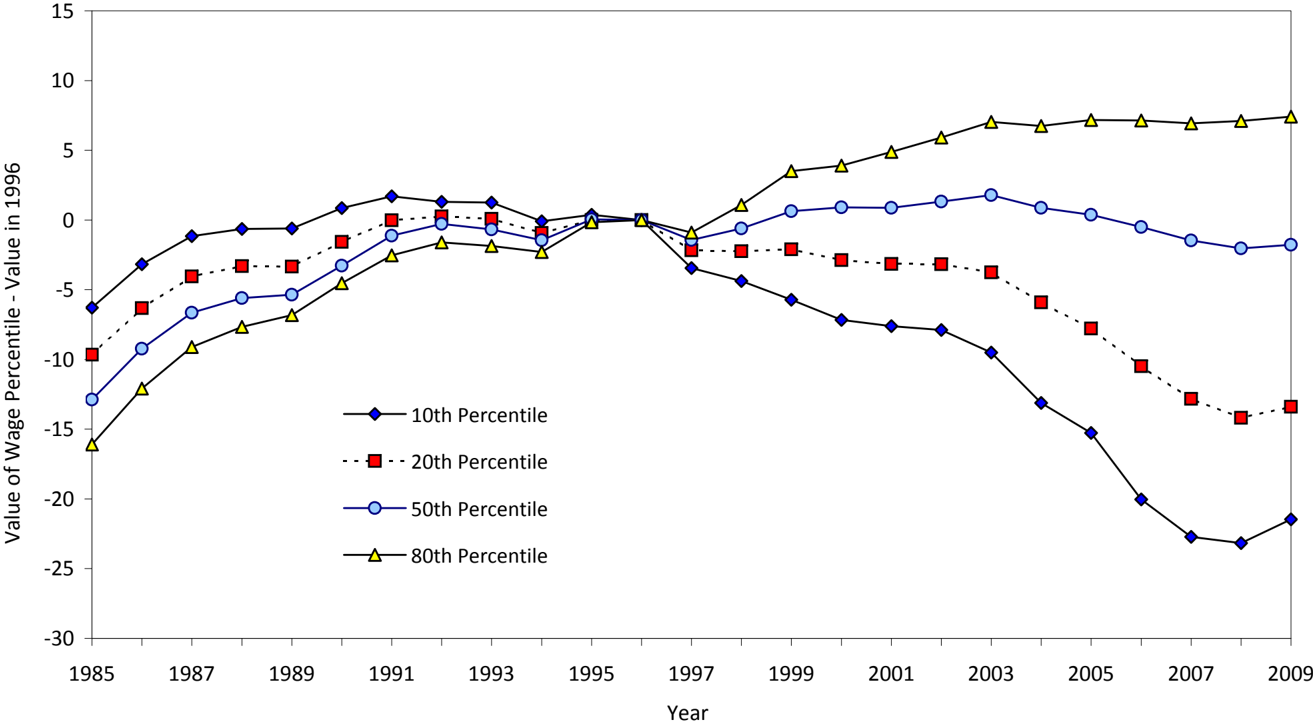
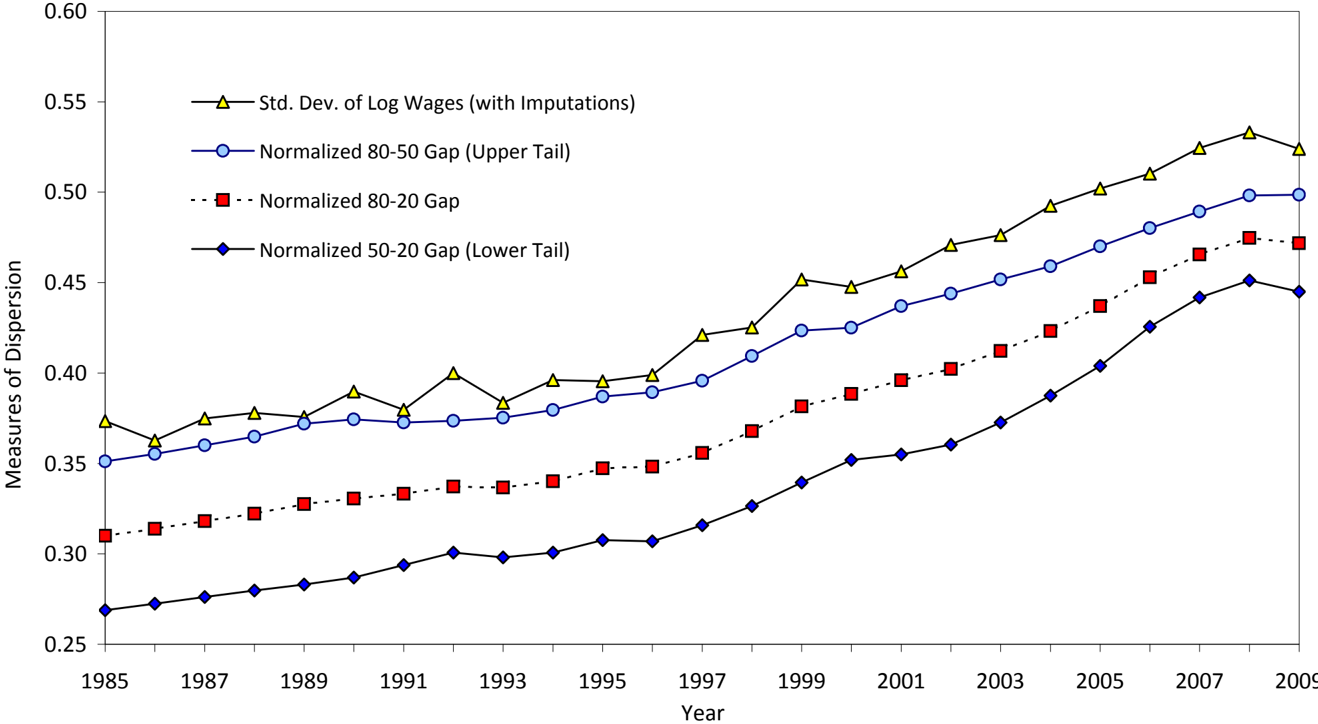
“In particular, the standard deviation rose by 15 log points from 1985 to 2009, the (normalized) 80-20 gap rose by 16 log points, the 80-50 gap rose by 15 log points, and the 50-20 gap rose by 18 log points.”
plain- Asserted: passes — The authors put it forward as true.
- Checkable: passes — It can be checked against evidence.
- Load-bearing: unclear — It is unclear whether the paper’s conclusions depend on it.
- Based: passes — The paper gives a reason why it holds.
118 more claims
Create a free account to see all 199 claims and to verify the 4 references still open.
- It may state two separate claims as one. 61
- Probably not a substantial claim. 17
- The quote only partly states this claim. 3
Claims other papers make about this one
Each is checked against this paper’s own text: does it say what the citing paper says it does?
The check wasn’t confident either way, so it gives no verdict — never disputed.
In the citing paper
“We estimate below that 75% is labor income.16”
From “Capitalists in the Twenty-First Century” (2019) · cites this paper as [16]
Experimental — accuracy not yet measured
Citations
Cites
A heteroskedasticity-consistent covariance matrix estimator and a direct test for heteroskedasticity
White, H. (1980) · Econometrica · doi:10.2307/1912934 · Cited by 25,861
The Skill Content of Recent Technological Change: An Empirical Exploration
Autor, D. H., Levy, F., & Murnane, R. J. (2003) · The Quarterly Journal of Economics · doi:10.1162/003355303322552801 · Cited by 6,205
On the Pooling of Time Series and Cross Section Data
Mundlak, Y. (1978) · Econometrica · doi:10.2307/1913646 · Cited by 5,412
Changes in Relative Wages, 1963-1987: Supply and Demand Factors
Katz, L. F., & Murphy, K. M. (1992) · The Quarterly Journal of Economics · doi:10.2307/2118323 · Cited by 4,793
Equilibrium Unemployment as a Worker Discipline Device
Shapiro, C., & Stiglitz, J. E. (1986) · Efficiency Wage Models of the Labor Market · doi:10.1017/cbo9780511559594.004 · Cited by 4,652
Misallocation and Manufacturing TFP in China and India*
Hsieh, C.-T., & Klenow, P. J. (2009) · Quarterly Journal of Economics · doi:10.1162/qjec.2009.124.4.1403 · Cited by 4,175
Job Creation and Job Destruction in the Theory of Unemployment
Mortensen, D. T., & Pissarides, C. A. (1994) · The Review of Economic Studies · doi:10.2307/2297896 · Cited by 3,840
Hybrid Corn: An Exploration in the Economics of Technological Change
Griliches, Z. (1957) · Econometrica · doi:10.2307/1905380 · Cited by 3,330
Labor Contracts as Partial Gift Exchange
Akerlof, G. A. (1982) · The Quarterly Journal of Economics · doi:10.2307/1885099 · Cited by 3,210
Plants and Productivity in International Trade
Bernard, A. B., Eaton, J., Jensen, J. B., & Kortum, S. (2003) · American Economic Review · doi:10.1257/000282803769206296 · Cited by 2,980
Research works printed but not linked: 1
- 70. Rees, Albert and George Schultz. 1970. Workers in an Urban Labor Market. Chicago: University of Chicago Press.
Cited by
Items 1,001–1,100 of 1,904
Inequality of earnings and housing costs – developments between and within regions
Breidenbach, P., Klick, L., & Schaffner, S. (2025) · Journal for Labour Market Research · doi:10.1186/s12651-024-00390-x · Cited by 4
Disaggregated Economic Accounts
Andersen, A. L., Huber, K., Johannesen, N., Straub, L., & Vestergaard, E. T. (2026) · The Quarterly Journal of Economics · doi:10.1093/qje/qjag010 · Cited by 4
Do outside options drive wage inequalities in retained jobs? Evidence from a natural experiment
Lukesch, V., & Zwick, T. (2023) · British Journal of Industrial Relations · doi:10.1111/bjir.12771 · Cited by 4
Brain over brawn: Job polarisation, structural change, and skill prices
Paweenawat, S. W., & Liao, L. (2024) · The Economic and Labour Relations Review · doi:10.1017/elr.2024.1 · Cited by 4
Mixed-Effects Methods for Search and Matching Research
Abowd, J. M., & McKinney, K. L. (2024) · Revue économique · doi:10.3917/reco.751.0055 · Cited by 4
Occupations and careers within organizations: Do organizations facilitate unequal wage growth?
Janietz, C. (2024) · Social Science Research · doi:10.1016/j.ssresearch.2024.103005 · Cited by 4
Dieckhoff, M., & Giesecke, J. A. (2024) · Social Science Research · doi:10.1016/j.ssresearch.2023.102960 · Cited by 4
Big data and inter-firm wage disparities: theory and evidence from China
Bu, H., Xun, Z., & Cai, S. (2024) · Economic Change and Restructuring · doi:10.1007/s10644-024-09729-3 · Cited by 4
Providers, Places, and Children’s Mental Health Care
Swagel, G. (2026) · The Journal of Human Resources · doi:10.3368/jhr.0925-14511r1 · Cited by 5
Janietz, C. (2025) · European Societies · doi:10.1162/euso_a_00020 · Cited by 4
Inequality in a global economy: evidence from Germany
Hesse, G. (2015) · Review of World Economics · doi:10.1007/s10290-015-0225-x · Cited by 4
Zimmermann, F. (2022) · Socius Sociological Research for a Dynamic World · doi:10.1177/23780231221136487 · Cited by 4
Job displacement effects and labor market sorting during COVID-19
Garita, J. G., Pastrana, G., & Slon, P. (2023) · Latin American Journal of Central Banking · doi:10.1016/j.latcb.2023.100109 · Cited by 4
Employment and Reallocation Effects of Higher Minimum Wages
Drechsel-Grau, M. (2026) · Journal of Political Economy Macroeconomics · doi:10.1086/741546 · Cited by 4
How Important are Firms in Explaining Wage Changes During a Recession?
Doris, A., O’Neill, D., & Sweetman, O. (2019) · Economica · doi:10.1111/ecca.12305 · Cited by 4
Worker–Plant Matching and Ownership Change*
Balsvik, R., & Haller, S. A. (2019) · Scandinavian Journal of Economics · doi:10.1111/sjoe.12376 · Cited by 4
Qualifikatorische Bildungsrenditen in verschiedenen Datenquellen
Friedrich, A., & Horn, S. (2018) · RePEc: Research Papers in Economics · Cited by 4
Search, Screening, and Sorting
Cai, X., Gautier, P. A., & Wolthoff, R. (2025) · American Economic Journal Macroeconomics · doi:10.1257/mac.20240026 · Cited by 7
Identifying Supervisory or Managerial Status in German Administrative Records
Collischon, M. (2022) · Jahrbücher für Nationalökonomie und Statistik · doi:10.1515/jbnst-2022-0035 · Cited by 4
Occupational Choice, Matching, and Earnings Inequality
Mak, E., & Siow, A. (2024) · Journal of Political Economy · doi:10.1086/732530 · Cited by 4
Differentially private publication of data on wages and job mobility
Schmutte, I. M. (2016) · Statistical Journal of the IAOS · doi:10.3233/sji-160962 · Cited by 4
Vuković, V. (2024) · Oxford University Press eBooks · doi:10.1093/oso/9780197774229.003.0009 · Cited by 4
Brazil: What Are the Main Drivers of Income Distribution Changes in the New Millennium?
Nerí, M. C. (2021) · Oxford University Press eBooks · doi:10.1093/oso/9780198863960.003.0005 · Cited by 4
Bargaining, Sorting and the Gender Wage Gap: The Role of Firms in the Relative Pay of Women
Card, D., Cardoso, A. R., & Kline, P. (2014) · DIGITAL.CSIC (Spanish National Research Council (CSIC)) · Cited by 4
Self-citationInteracting Product and Labor Market Regulation and the Impact of Immigration on Native WagesPreprint
Prantl, S., & Spitz‐Oener, A. (2013) · SSRN Electronic Journal · doi:10.2139/ssrn.2373058 · Cited by 4
Inequality Between and Within Firms: Evidence from BrazilPreprint
Benguria, F. (2015) · SSRN Electronic Journal · doi:10.2139/ssrn.2694693 · Cited by 4
Wage growth, urbanization, and firm characteristics: Evidence for GermanyPreprint
Kelle, M. (2016) · RePEc: Research Papers in Economics · doi:10.4419/86788733 · Cited by 4
Corporate Employee-Engagement and Merger OutcomesPreprint
Liang, H., Renneboog, L. D. R., & Vansteenkiste, C. (2017) · SSRN Electronic Journal · doi:10.2139/ssrn.2932021 · Cited by 4
Coordination of Hours Within the FirmPreprint
Labanca, C., & Pozzoli, D. (2018) · SSRN Electronic Journal · doi:10.2139/ssrn.3230532 · Cited by 6
Wage Rigidities and Business Cycle Fluctuations: A Linked Employer-Employee AnalysisPreprint
Adamopoulou, E., Bobbio, E., Philippis, M. D., & Giorgi, F. (2016) · SSRN Electronic Journal · doi:10.2139/ssrn.2845358 · Cited by 4
The Dynamics of Earnings in Germany: Evidence from Social Security RecordsPreprint
Bönke, T., Giesecke, M. N., & Lüthen, H. (2015) · RePEc: Research Papers in Economics · doi:10.4419/86788674 · Cited by 4
Adjusting to Globalization in GermanyPreprint
Dauth, W., Findeisen, S., & Suedekum, J. (2018) · RePEc: Research Papers in Economics · Cited by 4
Labor Demand Response to Labor Supply Incentives: Lessons from the German Mini-Job ReformPreprint
Galassi, G. (2021) · SSRN Electronic Journal · doi:10.2139/ssrn.3823615 · Cited by 4
Dawid, H., Harting, P., & Neugart, M. (2019) · SSRN Electronic Journal · doi:10.2139/ssrn.3383351 · Cited by 4
Structural Change Revisited: The Rise of Manufacturing Jobs in the Service SectorPreprint
Boddin, D., & Kroeger, T. (2021) · SSRN Electronic Journal · doi:10.2139/ssrn.3967818 · Cited by 4
Labor Market Networks and Asset ReturnsPreprint
Bali, T. G., Bae, J. W., Sharifkhani, A., & Zhao, X. (2021) · SSRN Electronic Journal · doi:10.2139/ssrn.3951333 · Cited by 4
Can the Labor Demand Curve Explain Job Polarization?Preprint
Peichl, A., & Popp, M. (2022) · SSRN Electronic Journal · doi:10.2139/ssrn.4137956 · Cited by 4
Declining Migration within the US: The Role of the Labor MarketPreprint
Molloy, R. S., Smith, C. L., & Wozniak, A. K. (2013) · SSRN Electronic Journal · doi:10.2139/ssrn.2269055 · Cited by 4
Direct and Spillover Effects of Provider Vaccination Facilitation
Cullen, J. B., Humlum, M. K., Suziedelyte, A., & Thingholm, P. (2023) · National Bureau of Economic Research · doi:10.3386/w30951 · Cited by 4
Manufacturing Investment and Employee Earnings: Evidence from Accelerated DepreciationPreprint
Duan, Y., & Moon, T. S. (2024) · SSRN Electronic Journal · doi:10.2139/ssrn.4692295 · Cited by 4
Estimating heterogeneous effects: applications to labor economics
Bonhomme, S., & Denis, A. (2024) · Documentos de trabajo/Documento de trabajo - Banco de España, Servicio de Estudios · doi:10.53479/36556 · Cited by 4
Entrepreneurs' Diversification and Labor Income Risk *Preprint
Bena, J., Ellul, A., Pagano, M., & Rutigliano, V. (2025) · SSRN Electronic Journal · doi:10.2139/ssrn.5280273 · Cited by 4
Person and Place Effects in Scientific Discovery
Chandra, A., & Xu, C. (2025) · National Bureau of Economic Research · doi:10.3386/w33996 · Cited by 4
Technology Adoption, Innovation, and Inequality in a Global World
Trouvain, F. (2024) · Oxford University Research Archive (ORA) (University of Oxford) · Cited by 4
Financialization More Than Globalization!:The Contribution of Global Cities to InequalitiesPreprint
Godechot, O., Neumann, N., Henriksen, L. F., Hermansen, S., Hou, F., Kodama, N., Lippényi, Z., Melzer, S. M., Sabanci, H. I., Thaning, M., et al. (2023) · HAL · Cited by 4
Complementarities in Sparse Two-Sided Interaction ModelsPreprint
Crippa, F. (2025) · arXiv (Cornell University) · doi:10.48550/arxiv.2510.22884 · Cited by 4
Teacher recruitment and management : current practices and future challenges
Hillion, M. (2018) · theses.fr (ABES) · doi:10.70675/fe0befe1zb7d0z4106zab14z2dda7f07c029 · Cited by 4
Estimating the gains from trade in frictional local labor markets
Pupato, G., Sand, B., & Tschopp, J. (2025) · Scandinavian Journal of Economics · doi:10.1111/sjoe.12592 · Cited by 3
The Distribution of Doctor Quality: Evidence from Cardiologists in England
Stoye, G. (2025) · Journal of Political Economy Microeconomics · doi:10.1086/737239 · Cited by 3
A Users’ Guide to Uncovering Worker and Firm Effects: The ABC of AKM
Bonhomme, S., Lamadon, T., & Manresa, E. (2026) · The Journal of Economic Perspectives · doi:10.1257/jep.20231372 · Cited by 3
Firm heterogeneity and the aggregate labour share
Richiardi, M. G., & Valenzuela, L. (2024) · Labour · doi:10.1111/labr.12265 · Cited by 3
Inequality and technological change
Macera, M., & Tsujiyama, H. (2024) · Quantitative Economics · doi:10.3982/qe1693 · Cited by 3
College Networks: The Importance of Employer Connections
Ost, B., Pan, W., & Webber, D. (2024) · Journal of Labor Economics · doi:10.1086/732821 · Cited by 3
The impact of a missing school graduation cohort on the training market
Dorner, M., Görlitz, K., & Jahn, E. J. (2024) · Economics of Education Review · doi:10.1016/j.econedurev.2024.102580 · Cited by 3
Employee Representation and the Manager-to-Worker Pay Ratio
Lin, C., Schmid, T. M., & Sun, Y. (2024) · The Review of Corporate Finance Studies · doi:10.1093/rcfs/cfae021 · Cited by 3
Janser, M., Lehmer, F., & Zierahn, U. (2024) · CESifo Economic Studies · doi:10.1093/cesifo/ifae021 · Cited by 3
How IT-specialized majors pay off: Evidence from an IT industry shock
Liu, T. (2025) · Labour Economics · doi:10.1016/j.labeco.2025.102785 · Cited by 3
Breaking barriers: The impacts of employer exposure to immigrants
Lehrer, S. F., Lepage, L.-P., & Pereira, N. S. (2025) · Labour Economics · doi:10.1016/j.labeco.2025.102805 · Cited by 3
Skill-biased wage effects of domestic outsourcing
Gürer, E., & Taymaz, E. (2025) · Labour Economics · doi:10.1016/j.labeco.2025.102849 · Cited by 3
The Urban Wage Premium in Imperfect Labour Markets
Hirsch, B., Jahn, E. J., & Oberfichtner, M. (2016) · London School of Economics and Political Science Research Online (London School of Economics and Political Science) · Cited by 3
Jäger, S., & Pischke, J. (2021) · Wirtschaftsdienst · doi:10.1007/s10273-021-3074-3 · Cited by 3
Hidden schooling: endogenous measurement error and bias in education and labor market experience
Kennedy, K. J. (2022) · Journal of Population Economics · doi:10.1007/s00148-022-00918-w · Cited by 3
Imputation strategies for rightcensored wages in longitudinal datasets
Drechsler, J., & Ludsteck, J. (2025) · Journal for Labour Market Research · doi:10.1186/s12651-025-00410-4 · Cited by 3
The Wage Premium in Italian Cities
Lamorgese, A. R., Olivieri, E., & Paccagnella, M. (2019) · Italian Economic Journal · doi:10.1007/s40797-019-00099-8 · Cited by 3
Unobserved Worker Quality and Inter-Industry Wage Differentials
Ge, S., & Macieira, J. C. (2014) · Journal of Industrial Economics · doi:10.1111/joie.12361 · Cited by 3
The Firm’s Role in Displaced Workers’ Earnings Losses
Moore, B., & Scott-Clayton, J. (2025) · Industrial and Labor Relations Review · doi:10.1177/00197939241310124 · Cited by 3
Do Co-Worker Networks Increase or Decrease Productivity Differences?
Lőrincz, L. (2021) · Entropy · doi:10.3390/e23111451 · Cited by 3
How does the position in business group hierarchies affect workers’ wages?
Egger, H., Jahn, E. J., & Kornitzky, S. (2022) · Journal of Economic Behavior & Organization · doi:10.1016/j.jebo.2021.12.011 · Cited by 3
Poder de negociación y brecha salarial de género: caso chileno
Cruz, G. (2016) · Revista Estudios de Políticas Públicas · doi:10.5354/0719-6296.2016.41822 · Cited by 3
Skill heterogeneity and market labour income inequality
Medrano‐Adán, L., Fumás, V. S., & Sánchez-Asín, J. J. (2023) · SERIEs · doi:10.1007/s13209-023-00287-x · Cited by 3
Which employers pay a higher college wage premium?
Ikeuchi, K., Fukao, K., & Perugini, C. (2023) · International Journal of Manpower · doi:10.1108/ijm-05-2023-0273 · Cited by 3
A 22 Percent Increase in the German Minimum Wage: Nothing Crazy!
Bossler, M., Chittka, L., & Schänk, T. (2026) · German Economic Review · doi:10.1515/ger-2025-0062 · Cited by 3
Employee Board Representation and Capital Investment
Jin, Q., Ma, H., Schmid, T. M., & Zhang, G. (2024) · Management Science · doi:10.1287/mnsc.2023.03495 · Cited by 3
The Covid-19 pandemic and international supply chains
Kleifgen, E., Roth, D. H. W., & Stepanok, I. (2026) · Review of World Economics · doi:10.1007/s10290-026-00662-3 · Cited by 3
The distribution of wages and wage inequality
Reis, H., Portugal, P., & Raposo, P. S. (2018) · Cited by 3
Labor Earnings Inequality in Manufacturing during the Great Depression
Benguria, F., Vickers, C., & Ziebarth, N. L. (2020) · The Journal of Economic History · doi:10.1017/s0022050720000108 · Cited by 3
Schäffer, T. (2020) · Forschungsberichte des Wissenschaftlichen Instituts für Gesundheitsökonomie und Gesundheitssystemforschung · doi:10.60019/uyro2677 · Cited by 3
Union Decline and the Coverage Wage Gap in GermanyPreprint
Addison, J. T., Teixeira, P., Stephani, J., & Bellmann, L. (2014) · SSRN Electronic Journal · doi:10.2139/ssrn.2460160 · Cited by 3
Silbersdorff, A. (2015) · SSRN Electronic Journal · doi:10.2139/ssrn.2698624 · Cited by 3
CORPORATE GOVERNANCE AND FIRM PERFORMANCE: THE SUSTAINABILITY EQUATION?
Roudaut, G. (2015) · HAL · Cited by 3
Export and Wages: Rent Sharing, Workforce Composition or Returns to Skills? - Online AppendixPreprint
Macis, M., & Schivardi, F. (2016) · SSRN Electronic Journal · doi:10.2139/ssrn.2543829 · Cited by 3
On the Link between Job Polarisation and Wage Inequality in GermanyPreprint
Reinhold, M. (2016) · RePEc: Research Papers in Economics · Cited by 3
Identifying Labor Market Sorting with Firm DynamicsPreprint
Gulyas, A. (2018) · RePEc: Research Papers in Economics · Cited by 3
Wage Inequality During the Long-Term Stagnation in Japan: Changes Within and Between EstablishmentsPreprint
Akesaka, M., & Miyoshi, K. (2018) · SSRN Electronic Journal · doi:10.2139/ssrn.3295471 · Cited by 3
New jobs, old jobs: the evolution of work in New Zealand’s cities and townsPreprint
Coleman, A., Maré, D. C., & Zheng, G. (2019) · RePEc: Research Papers in Economics · Cited by 3
The Organizational Production of Earnings Inequalities in Germany, 1994-2010Preprint
Tomaskovic‐Devey, D., Jacobebbinghaus, P., & Melzer, S. M. (2016) · SSRN Electronic Journal · doi:10.2139/ssrn.2879165 · Cited by 3
Per Capita Income and the Demand for Skills
Caron, J., Fally, T., & Markusen, J. R. (2017) · National Bureau of Economic Research · doi:10.3386/w23482 · Cited by 3
The Role of Establishments and the Concentration of Occupations in Wage InequalityPreprint
Handwerker, E. W., & Spletzer, J. R. (2015) · SSRN Electronic Journal · doi:10.2139/ssrn.2664570 · Cited by 3
Sources of Displaced Workers' Long-Term Earnings Losses
Lachowska, M., Mas, A., & Woodbury, S. A. (2017) · Upjohn Research (W.E. Upjohn Institute for Employment Research) · doi:10.17848/wp18-282 · Cited by 3
Doing well in reforming the labour market? Recent trends in job stability and wages in GermanyPreprint
Rothe, T., Giannelli, G. C., & Jaenichen, U. (2013) · RePEc: Research Papers in Economics · Cited by 4
Corporate Reorganization and the Reallocation of Labor in BankruptcyPreprint
Bonfim, D., & Nogueira, G. (2021) · SSRN Electronic Journal · doi:10.2139/ssrn.3761746 · Cited by 3
Searching for Customers, Finding PollutionPreprint
Bassi, V., Kahn, M. E., Lozano‐Gracia, N., Porzio, T., & Sorin, J. (2021) · SSRN Electronic Journal · doi:10.2139/ssrn.3887079 · Cited by 3
Dual Returns to ExperiencePreprint
Garcia‐Louzao, J., Hospido, L., & Ruggieri, A. (2022) · SSRN Electronic Journal · doi:10.2139/ssrn.4048998 · Cited by 3
Bunching and Taxing Multidimensional SkillsPreprint
Boerma, J., Tsyvinski, A., & Zimin, A. P. (2022) · SSRN Electronic Journal · doi:10.2139/ssrn.4104001 · Cited by 3
Inequality and Income Dynamics in GermanyPreprint
Drechsel-Grau, M., Peichl, A., Schmieden, J., Schmid, K. D., Walz, H., & Wolter, S. (2022) · SSRN Electronic Journal · doi:10.2139/ssrn.4114674 · Cited by 3
The Speed of Earnings Responses to Taxation and the Role of Firm Labor DemandPreprint
Gudgeon, M., & Trenkle, S. (2020) · RePEc: Research Papers in Economics · Cited by 3
Do Individual Directors Matter? Evidence of Director-Specific QualityPreprint
Bhattarai, D., Serfling, M. A., & Woidtke, T. (2022) · SSRN Electronic Journal · doi:10.2139/ssrn.4216979 · Cited by 3
Beyond Lost Earnings: Job Displacement and the Cost of CommutingPreprint
Duan, Y., Jost, O., Jost, R., & Siebert, H. (2022) · SSRN Electronic Journal · doi:10.2139/ssrn.4214987 · Cited by 4
The Slow Diffusion of Earnings Inequality
Sorkin, I., & Wallskog, M. (2023) · National Bureau of Economic Research · doi:10.3386/w30977 · Cited by 3
External Labor Market Punishment in FinancePreprint
Hamdi, N., Kalda, A., & Pal, A. (2023) · SSRN Electronic Journal · doi:10.2139/ssrn.4392382 · Cited by 3
Metadata
- Authors
- Card, D., Heining, J., & Kline, P.
- Affiliations
- University of California, Berkeley (US)
- Corresponding author
- Kline, Patrick
- ORCID
- Card, David
- Venue
- The Quarterly Journal of Economics
- Publisher
- Oxford University Press (OUP)
- Published
- 2013-05-02
- Volume
- 128
- Issue
- 3
- Pages
- 967-1015
- ISSN
- 0033-5533 (ISSN-L)
- 1531-4650
- OpenAlex
- W2141295263
- Cited by
- 1,904
- References
- 146
- Citations by year
- 2026: 153 · 2025: 204 · 2024: 228 · 2023: 156 · 2022: 185 · 2021: 178 · 2020: 143 · 2019: 125 · 2018: 156 · 2017: 113 · 2016: 105 · 2015: 71 · 2014: 58 · 2013: 22
- FWCI
- 118.40
- Type
- journal article
- Language
- en
- Open access
- closed
- Locations
- The Quarterly Journal of Economics (publishedVersion)
- RePEc: Research Papers in Economics (submittedVersion)
- Econstor (Econstor) (submittedVersion)
- Funders
- Washington Center for Equitable Growth
- Topics
- Social Sciences › Economics, Econometrics and Finance › Economics and Econometrics › Labor market dynamics and wage inequality
- Social Sciences › Economics, Econometrics and Finance › Economics and Econometrics › Historical Economic and Social Studies
- Social Sciences › Sociology and Political Science › Income, Poverty, and Inequality
- Keywords
- wage inequality, job matching, fixed effects model, education and wages
About these checks
Registry, retraction, Cites and statistics results are computed, not judged, with one exception: a printed reference that no index lists is read once by a model before it counts as a citation error. Claims are extracted by a model and kept only when their quote appears verbatim in the text; each cited source is then checked, with a model’s help, for whether it says what the claim relies on. Those verdicts can be wrong — read the claim’s quote and the cited source before relying on one.
A language model drew the claims from the paper on 2026-11-17, under version 3 of the claim definition (model deepseek-v4.1-flash, prompt extract-v3).
A second model labelled each claim on 2026-11-17 (model jev-1.13-20260917, definition revision gold-guideline-v0.2).
Statistics and arithmetic are recomputed, not judged.
Confidence bands are shown only for fields calibrated on our annotated test set. None is calibrated yet, so no band is shown.
What counts as a claim ›How we measure confidence ›How we check this ›
Are you an author, or do you see a problem with this page? Request a review
Data sources
Bibliographic data: Semantic Scholar, OpenAlex, Crossref.
Contains information from the Semantic Scholar Academic Graph Datasets, made available under the ODC Attribution License (ODC-BY 1.0).
Semantic Scholar’s data is described in: Kinney, R., et al. (2023). The Semantic Scholar Open Data Platform. arXiv:2301.10140.
