

A Systematic Review on the Use of Psychosocial Interventions in Conjunction With Medications for the Treatment of Opioid Addiction
Open accessThe DOI matches its Crossref record; 42 of the 42 references it cites were found in a registry or an index.
Abstract
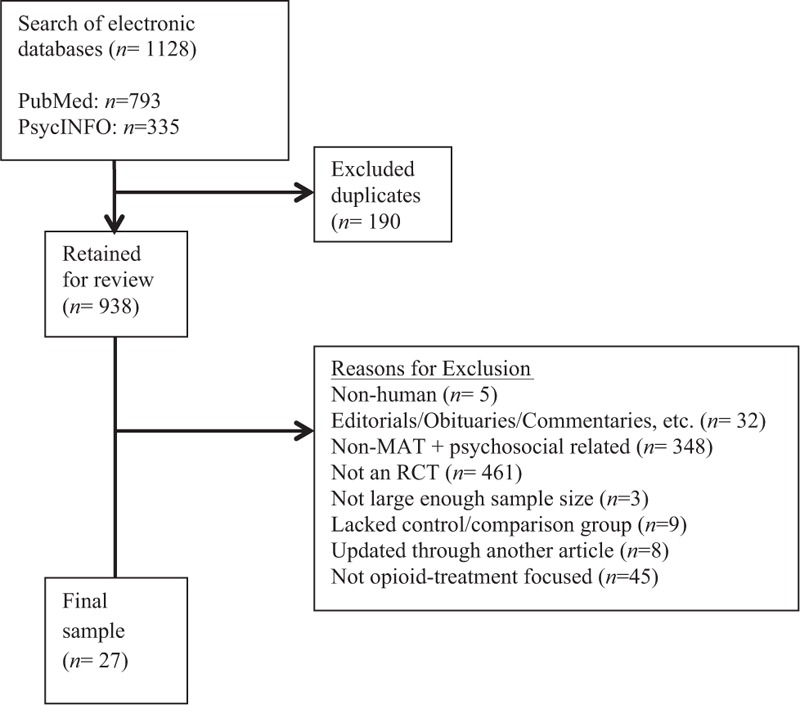
Opioid use and overdose rates have risen to epidemic levels in the United States during the past decade. Fortunately, there are effective medications (ie, methadone, buprenorphine, and oral and injectable naltrexone) available for the treatment of opioid addiction. Each of these medications is approved for use in conjunction with psychosocial treatment; however, there is a dearth of empirical research on the optimal psychosocial interventions to use with these medications. In this systematic review, we outline and discuss the findings of 3 prominent prior reviews and 27 recent publications of empirical studies on this topic. The most widely studied psychosocial interventions examined in conjunction with medications for opioid addiction were contingency management and cognitive behavioral therapy, with the majority focusing on methadone treatment. The results generally support the efficacy of providing psychosocial interventions in combination with medications to treat opioid addictions, although the incremental utility varied across studies, outcomes, medications, and interventions. The review highlights significant gaps in the literature and provides areas for future research. Given the enormity of the current opioid problem in the United States, it is critical to gain a better understanding of the most effective ways to deliver psychosocial treatments in conjunction with these medications to improve the health and well-being of individuals suffering from opioid addiction.
Overview
The claims and statistics of this paper haven’t been checked yet.
Free: it reads the open-access text and checks the first 5 claims that cite a source we can check. Create a free account to check every claim.
Integrity signals
Registry
Cites
Statistics
Figures
Verification
Claims the paper makes
The claims and statistics of this paper haven’t been checked yet.
Free: it reads the open-access text and checks the first 5 claims that cite a source we can check. Create a free account to check every claim.
Claims other papers make about this one
Each is checked against this paper’s own text: does it say what the citing paper says it does?
The source backs part of the claim, not all of it — or backs it for a different population, condition or comparison.
In the citing paper
“Recent reviews have highlighted the lack of research regarding psychological interventions (e.g., Integrated CBT) for patients with comorbid anxiety and opioid use and specifically the potential of psychological interventions to be paired with medication (e.g., suboxone) to address both anxiety and opioid use concurrently.(Dugosh et al., 2016; Langdon et al., 2019)”
From A systematic review and meta-analysis of psychosocial interventions for persons with comorbid anxiety and substance use disorders (2024) · cites this paper as Dugosh et al., 2016
Experimental — accuracy not yet measured
Self-check
Percentages, sums and reported differences re-computed from the paper’s own numbers.
The self-check needs the paper’s full text.
Citations
Cites
Preferred Reporting Items for Systematic Reviews and Meta-Analyses: the PRISMA statement
Moher, D., Liberati, A., Tetzlaff, J., Altman, D. G., & for the PRISMA Group (2009) · BMJ · doi:10.1136/bmj.b2535 · Cited by 83,823
Preferred reporting items for systematic reviews and meta-analyses: the PRISMA Statement.
(2009) · PubMed Central · Cited by 44,859
Preferred reporting items for systematic reviews and meta-analyses: The PRISMA statement
Moher, D., Liberati, A., Tetzlaff, J., Altman, D. G., & the PRISMA Group* (2009) · Annals of Internal Medicine · doi:10.7326/0003-4819-151-4-200908180-00135 · Cited by 37,554
Preferred Reporting Items for Systematic Reviews and Meta-Analyses: The PRISMA Statement
Moher, D., Liberati, A., Tetzlaff, J., & Altman, D. G. (2009) · Journal of Clinical Epidemiology · doi:10.1016/j.jclinepi.2009.06.005 · Cited by 19,575
Vital signs: overdoses of prescription opioid pain relievers---United States, 1999--2008.
Paulozzi, L. J., Jones, C. M., Mack, K. A., & Rudd, R. A. (2011) · PubMed · Cited by 1,540
A Meta-Analytic Review of Psychosocial Interventions for Substance Use Disorders
Dutra, L., Stathopoulou, G., Basden, S. L., Leyro, T. M., Powers, M. B., & Otto, M. W. (2008) · American Journal of Psychiatry · doi:10.1176/appi.ajp.2007.06111851 · Cited by 1,287 · cited 2×
“The goal of psychosocial treatment is to help patients control urges to use drugs and remain abstinent, while also serving to assist patients in coping with the emotional strife that often accompanies addiction (Dutra et al., 2008).”
BackgroundKampman, K., & Jarvis, M. (2015) · Journal of Addiction Medicine · doi:10.1097/adm.0000000000000166 · Cited by 678
Vital signs: overdoses of prescription opioid pain relievers---United States, 1999--2008.
(2011) · PubMed · Cited by 640
Vital Signs: Demographic and Substance Use Trends Among Heroin Users - United States, 2002-2013.
Jones, C. M., Logan, J. E., Gladden, R. M., & Bohm, M. K. (2015) · PubMed Central · Cited by 569
Weiss, R. D. (2011) · Archives of General Psychiatry · doi:10.1001/archgenpsychiatry.2011.121 · Cited by 540 · cited 3×
“One study (Weiss et al., 2011) examined the effectiveness of a manualized opioid dependence counseling intervention used in conjunction with buprenorphine during Phase 1 (brief treatment: buprenorphine-naloxone induction, 2 weeks of stabilization, 2 week taper, and 8 weeks of follow-up) and Phase 2…”
BackgroundMethodInfluential
Research works printed but not linked: 1
- Drummond DC Perryman K Psychosocial Interventions in Pharmacotherapy of Opioid Dependence: A Literature Review. London: St. George's University of London; 2007.
Cited by
Items 201–300 of 331
Küçükkarapınar, M., Eser, H. Y., Kotan, V. O., Yalçınay-İnan, M., Tarhan, R., & Arıkan, Z. (2018) · Substance Abuse Treatment Prevention and Policy · doi:10.1186/s13011-018-0166-1 · Cited by 4
Rao, R., Gupta, S., Swaminathan, P., Gupta, V., Dhawan, A., Agrawal, A. C., & Ambekar, A. (2020) · Journal of Substance Use · doi:10.1080/14659891.2020.1736666 · Cited by 3
Kameg, B., & Mitchell, A. M. (2020) · Issues in Mental Health Nursing · doi:10.1080/01612840.2020.1749917 · Cited by 3
MacNeil, A., & Fuller‐Thomson, E. (2021) · International Journal of Mental Health and Addiction · doi:10.1007/s11469-021-00579-y · Cited by 4
“…intervention in conjunction with opioid replacement therapy has been demonstrated to be more effective than opioid replacement therapy on its own (Amato et al. 2008; Dugosh et al. 2016), indicating that psychosocial interventions may be a valuable addition to pharmacological approaches.”
BackgroundKiburi, S. K., Kwobah, E., Paruk, S., & Chiliza, B. (2023) · BMC Digital Health · doi:10.1186/s44247-023-00014-3 · Cited by 6
Buckner, J. D., Scherzer, C. R., Crapanzano, K. A., & Morris, P. E. (2023) · Public Health Reports · doi:10.1177/00333549231170219 · Cited by 5
Mitchell, A. S. (2023) · Families in Society The Journal of Contemporary Social Services · doi:10.1177/10443894231166989 · Cited by 3
“…in treatment (Mattick et al., 2009; NIDA, 2019) and medication-assisted treat-ment combining psychotherapy and ORT/ MOUD is considered the “gold standard” (Lister et al., 2020, p. 273) of treatment for opioid use disorder (Amato et al., 2011; Dugosh et al., 2016; Lister et al., 2020; NIDA, 2019).”
Rosic, T., Babe, G., Rodrigues, M., Dennis, B. B., Perez, R., de Oliveira, C., Worster, A., Thabane, L., & Samaan, M. C. (2025) · PLoS ONE · doi:10.1371/journal.pone.0314296 · Cited by 3
Bolshakova, M., Simpson, K. A., Ganesh, S. S., Sussman, S. Y., & Bluthenthal, R. N. (2025) · Journal of Substance Use and Addiction Treatment · doi:10.1016/j.josat.2025.209742 · Cited by 5
Heinzerling, K. G. (2018) · Elsevier eBooks · doi:10.1016/b978-0-323-54856-4.00009-2 · Cited by 6
Chapter 14. Opioid Antagonist Treatment of Opioid-Related Disorders
Capata, M., & Hartwell, K. J. (2021) · American Psychiatric Association Publishing eBooks · doi:10.1176/appi.books.9781615373970.kb14 · Cited by 4
Fang, Y., Jeffery, A. D., Patrick, S. W., Young, J. L., Raffi, E. R., Harder, G. M., Osmundson, S. S., Phillippi, J. C., & Leech, A. A. (2024) · Journal of Addiction Medicine · doi:10.1097/adm.0000000000001434 · Cited by 2
Reflections on Person-Centered Group Therapy from Clients in Opioid Treatment
Ripley, D., & Welfare, L. E. (2021) · The Journal for Specialists in Group Work · doi:10.1080/01933922.2021.1950879 · Cited by 3
Song, M. J., Westenberg, J. N., Kianpoor, K., Nikoo, M., Kazemi, A., Schütz, C. G., Jang, K. L., Gholami, A., Akhondzadeh, S., & Krausz, M. R. (2022) · Drug and Alcohol Review · doi:10.1111/dar.13445 · Cited by 2
Alexander, K., Smith, J. M., Gerolamo, A. M., & Bernhardt, J. M. (2022) · Journal of Nursing Scholarship · doi:10.1111/jnu.12858 · Cited by 6
Applications of isradipine in human addiction studies: A systematic literature review.
Natal, S., Young, C. C., Kaur, K., Gebhardt, E. S., Perrone, A., Morikawa, H., Tirado, C., & Smits, J. A. J. (2023) · Experimental and Clinical Psychopharmacology · doi:10.1037/pha0000633 · Cited by 2
Nonopioid Substance Use among Patients Who Recently Initiated Office-based Buprenorphine Treatment
Dugosh, K. L., Lent, M. R., Burkley, S. B., Millard, C., McKay, J. R., & Kampman, K. M. (2023) · Journal of Addiction Medicine · doi:10.1097/adm.0000000000001168 · Cited by 2
Self-citationWiguna, Y., & Wijaya, S. (2024) · Educoretax · doi:10.54957/educoretax.v4i4.808 · Cited by 2
“By synthesizing and analyzing existing knowledge, the literature review sets the foundation for the current research, highlighting gaps, inconsistencies, and areas of interest that warrant further investigation (Dugosh, et al., 2016).”
MethodEffectiveness of a Behavioral Activation Intervention for Peripartum Women with Opioid Use Disorder
Vilensky, M. R., Arrato, N. A., & Carpenter, K. M. (2024) · Journal of Clinical Psychology in Medical Settings · doi:10.1007/s10880-023-09984-y · Cited by 2
“Psychosocial treatments have also been shown to enhance these outcomes when combined with pharmacotherapy (Dugosh et al., 2016).”
Opioid reward and deep brain stimulation of the lateral hypothalamic area
Fattahi, M., Rahimpour, M., & Riahi, E. (2024) · Vitamins and hormones · doi:10.1016/bs.vh.2024.10.004 · Cited by 3
Neeki, M. M., Dong, F., Issagholian, L., MacDowell, S., Cerda, M., Injijian, N., Minezaki, K., Neeki, C. C., Lay, R., Ngo, T., et al. (2024) · Journal of Correctional Health Care · doi:10.1089/jchc.23.02.0009 · Cited by 2
“Evidence also suggested that cognitive behavioral therapy alone may be insuf fi cient as a sole treatment modality but can offer additional bene-fi ts when combined with MOUD (Dugosh et al., 2016).”
Krawczyk, N., Miller, M. J., Gu, E. Y., Irvine, N. M., Ramirez, E., Santaella-Tenorio, J., Lippincott, T., Bogenschutz, M. P., Bunting, A. M., & Meacham, M. C. (2025) · Addiction · doi:10.1111/add.16767 · Cited by 3
Individuals 45 Years and Older in Opioid Agonist Treatment: A Scoping Review
Gaulen, Z., Lunde, L.-H., Alpers, S. E., & Carlsen, S.-E. L. (2025) · International Journal of Environmental Research and Public Health · doi:10.3390/ijerph22030458 · Cited by 4
“Conversely, longitudinal studies, though only two in number, offer evidence on the progression of comorbidities and the long-term effects of OAT.”
Zerden, L. D. S., Cooper, Z., & Sanii, H. (2021) · Social Work in Mental Health · doi:10.1080/15332985.2021.1896626 · Cited by 2
“PCBH and OBOT utilize similar treatment interventions such as cognitive behavioral therapy, motivational interviewing, and general supportive counseling (Dugosh et al., 2016).”
BackgroundZerden, L. D. S., Cooper, Z., & Sanii, H. (2021) · Social Work in Mental Health · doi:10.1080/15332985.2021.1971817 · Cited by 2
“PCBH and OBOT utilize similar treatment interventions such as cognitive behavioral therapy, motivational interviewing, and general supportive counseling (Dugosh et al., 2016).”
BackgroundScattone, V. V., & Tucci, A. M. (2018) · Estudos e Pesquisas em Psicologia · doi:10.12957/epp.2018.38817 · Cited by 2
Chaudhari, S., Somvanshi, P. R., & Fregni, F. (2019) · Principles and Practice of Clinical Research Journal · doi:10.21801/ppcrj.2019.52.3 · Cited by 2
Schottenfeld, R. S., Chawarski, M. C., & Mazlan, M. (2021) · Addiction · doi:10.1111/add.15399 · Cited by 3
The interaction of race and age in methadone treatment retention outcomes: A single-center analysis
Alexander, K., Reed, M. K., & Sterling, R. C. (2023) · Journal of Substance Use and Addiction Treatment · doi:10.1016/j.josat.2023.209020 · Cited by 1
Mahone, A., Enich, M., Treitler, P. C., Lloyd, J., & Crystal, S. (2023) · The American Journal of Drug and Alcohol Abuse · doi:10.1080/00952990.2023.2234075 · Cited by 2
“Respondents consistently highlighted psychological services as a crucial element of addiction treatment, despite mixed empirical evidence on effectiveness of psychotherapies for OUD and polysubstance disorders (35,36), or their potential to improve outcomes beyond MOUD alone (36–38).”
BackgroundAhmed, S., Faruqui, Z., Poddar, K., Bhivandkar, S., & Suzuki, J. (2023) · Journal of Opioid Management · doi:10.5055/jom.0819 · Cited by 2
Zavod, A., Akerman, S. C., Snow, M. M., Tierney, M., & Sullivan, M. A. (2018) · Journal of the American Psychiatric Nurses Association · doi:10.1177/1078390318820124 · Cited by 2
Substance Use Disorder and HIV
Slawek, D. E., & Cunningham, C. O. (2020) · Springer eBooks · doi:10.1007/978-3-030-48744-7_10 · Cited by 2
Establishing the Effectiveness of Enhanced Implementation Methods in Preventative Behavioral HealthPreprint
Stoddard, S. A., Montgomery, B. W., Maschino, L. D., Young, K. S., Felton, J. W., Drahota, A., Johnson, J. E., & Furr-Holden, D. (2020) · medRxiv · doi:10.1101/2020.09.25.20200444 · Cited by 2
“Although multiple effective substance use interventions exist for adults and youth (e.g., Dugosh et al., 2016; MacArthur et al., 2016), barriers remain for individual utilization of these programs (Liebling et al., 2016), organizations to adopt programs (Barclay et al., 2019), and community-wide…”
BackgroundPsychosocial Treatment Methods
Peirce, J. M., Antoine, D. G., Hammond, A. S., & KIDORF, M. S. (2023) · Oxford University Press eBooks · doi:10.1093/oxfordhb/9780197618431.013.25 · Cited by 2
Cruz, S. L., & Martín-del-Campo, R. (2022) · Springer eBooks · doi:10.1007/978-3-031-09936-6_5 · Cited by 2
Attitudinal barriers to buprenorphine prescription and former waiver training
Gannon, M. P., Tello, M. A., Wakeman, S. E., Charles, J.-P., Lipsitz, S. R., & Samal, L. (2024) · Journal of Opioid Management · doi:10.5055/jom.0827 · Cited by 2
Patent review of novel compounds targeting opioid use disorder (2018–2024)
Obeng, S., McMahon, L. R., & Ofori, E. (2025) · Expert Opinion on Therapeutic Patents · doi:10.1080/13543776.2024.2446230 · Cited by 1
“Naloxone is also used to reverse opioid-induced overdose [3,9].”
Çelik, F. G. H., Bayrak, N. G., & Uzun, S. (2025) · Public Health Nursing · doi:10.1111/phn.13544 · Cited by 4
Perceived Importance of Counseling Among Patients Receiving Methadone Treatment
Barry, D. T., Beitel, M., Gazzola, M. G., Agerwala, S. M., Saeed, G., Eggert, K. F., Roehrich, T., Hsaio, C., Covelli, M., Carmichael, I. D., et al. (2025) · Journal of Psychoactive Drugs · doi:10.1080/02791072.2025.2484374 · Cited by 1
Experiences of Women Prescribed Methadone
Wimberly, A. S., Rawlett, K. E., Smith, J., & Murray-Browne, S. (2025) · Substance Use & Misuse · doi:10.1080/10826084.2025.2499604 · Cited by 1
“MOUD alone is as effective as MOUD with psychotherapy (Schwartz et al., 2011), but there is research that points to the benefits of psychotherapy in conjunction with MOUDs, including greater treatment attendance, reduced substance use, and improved psychosocial wellbeing (Dugosh et al., 2016).”
Alexander, K., & Scialanca, M. (2025) · JMIR Formative Research · doi:10.2196/67401 · Cited by 1
“A personalized behavioral treatment responsive to the individual needs of young adults may increase retention by addressing coping skills associated with young adults with OUD stressors and thoughts of leaving treatment [5-8].”
HALYTSKA-PASICHNYK, N. (2025) · Ukrains kyi Visnyk Psykhonevrolohii · doi:10.36927/2079-0325-v33-is4-2025-5 · Cited by 1
Dugosh, K. L., Burkley, S. B., McKay, J. R., Kampman, K. M., Lynch, K. G., & Lent, M. R. (2026) · Journal of Addiction Medicine · doi:10.1097/adm.0000000000001643 · Cited by 1
Self-citationSondhi, A., Best, D. W., Leidi, A., Belanger, M. J., Best, J. M., Bunaciu, A., & White, W. L. (2026) · International Journal of Drug Policy · doi:10.1016/j.drugpo.2026.105218 · Cited by 1
Bailey, A., Kang, A. W. C., & Martin, R. A. (2026) · Substance Use & Addiction Journal · doi:10.1177/29767342261452648 · Cited by 1
“59,61 Alterna-tively, MI is used to initiate patients in treatment and enhance motivation to engage in treatment and related behaviors.”
Bose, F., Menzies, P., & Rottnek, F. (2021) · Journal of Drug Policy Analysis · doi:10.1515/jdpa-2020-0008 · Cited by 1
Registered clinical trials on addiction: a cross-sectional study on ClinicalTrials.gov
Liu, G., Chen, L., Yang, Y., Zhang, Y., & Luo, S. (2022) · Journal of Addictive Diseases · doi:10.1080/10550887.2021.2010972 · Cited by 1
Denno, J., Burns, S., Rucker-Christopher, Z., & Suriano, D. (2022) · Advanced Emergency Nursing Journal · doi:10.1097/tme.0000000000000407 · Cited by 1
“Research on optimal therapies for interventions includes cognitive behavioral therapy, contingency management, family counseling, mutual help 12-step programs, motivational interviewing, and social skills training (Dugosh et al., 2016).”
BackgroundMahu, I. T., Conrod, P., Barrett, S. P., Sako, A., Swansburg, J. E., & Stewart, S. H. (2023) · Frontiers in Psychiatry · doi:10.3389/fpsyt.2023.1129274 · Cited by 1
“(18) largely supports the use of psychosocial interventions in the context of OAT, although the added benefit does tend to vary across medications (methadone, buprenorphine/naloxone), outcomes (e.”
BackgroundSharp, A., Carlson, M., Vroom, E. B., Rigg, K. K., Hills, H. A., Harding, C., Moore, K. A., & Schuman‐Olivier, Z. (2023) · Implementation Research and Practice · doi:10.1177/26334895231205890 · Cited by 2
Cognitive Behavior Therapy as Relapse Prevention for Opioid Use Disorders
Shahzadi, M., Jabeen, M., Unbrin, A., Ul-Ain, Q., & Amin, Z. (2023) · THE THERAPIST (Journal of Therapies & Rehabilitation Sciences) · doi:10.54393/tt.v4i04.184 · Cited by 4
Kelley, A. T., Incze, M. A., Baumgärtner, M., Campbell, A. N. C., Nunes, E. V., & Scharfstein, D. O. (2024) · Drug and Alcohol Dependence · doi:10.1016/j.drugalcdep.2024.111368 · Cited by 1
Fischer, S. K. M., & Mutschler, J. (2025) · Fortschritte der Neurologie · Psychiatrie · doi:10.1055/a-2537-9595 · Cited by 1
“applied in the treatment of opioid and tobacco addiction [18, 19], and so it should perhaps come as no surprise that the use of stimulants is not only the most thoroughly researched but also the most promising pharmacological approach to treating cocaine addiction [10, 20, 21].”
Addressing Host Factors: Primary, Secondary, and Tertiary Prevention of Opioid Dependence
McAnally, H. B. (2017) · Springer eBooks · doi:10.1007/978-3-319-47497-7_11 · Cited by 2
Problematic use of prescription opioid drugs: Classification and effective treatments
Ruiz, A. I. H. (2019) · Medicina Clínica (English Edition) · doi:10.1016/j.medcle.2019.04.010 · Cited by 1
Matteo, E. (2019) · DOAJ (DOAJ: Directory of Open Access Journals) · Cited by 1
The Opioid Crisis: How Counselors Can and Should Respond
Doyle, K. S. (2021) · Journal of Mental Health Counseling · doi:10.17744/mehc.43.2.02 · Cited by 2
Treating Velopharyngeal Insufficiency in a Case of Substance Abuse: A New Client Population
Ruscello, D. M., & Armeni, M. A. (2021) · Perspectives of the ASHA Special Interest Groups · doi:10.1044/2021_persp-20-00284 · Cited by 1
Stratégies face à la crise des opioïdes : analyse des revues systématiques
Savard, I., Little, R., Benoît, M., Charette, S., Deschamps, A., & Bissonnet, H. (2021) · Drogues santé et société · doi:10.7202/1085170ar · Cited by 2
“En plus d’étudier une stratégie, certains auteurs (Behar et al., 2018 ; Dugosh et al., 2016 ; Mitchell et Higgins, 2016 ; Moride et al., 2019 ; Vyas et al., 2018 ; Wetzel et al., 2018) ont également tenté de comprendre les avantages, les risques et les coûts liés à celle-ci (n=6).”
BackgroundInfluentialEvidence based opioid weaning with behavioral support – Forum for Behavioral Science Edition
Hayes, J. R., Johnston, B., Barenboim, H., & Tempe, M. (2022) · The International Journal of Psychiatry in Medicine · doi:10.1177/00912174221114245 · Cited by 1
“Treating co-morbid mental health conditions has been shown to increase the likelihood of a successful taper(13) Cognitive-behavioral therapy (CBT) has been proven to help patients decrease the use of opiates.(13) Combined medical and psychotherapeutic care utilizing CBT could help our patient control the urges and tri…”
BackgroundNoroozi, A., & Rahimi‐Movaghar, A. (2023) · Addiction · doi:10.1111/add.16106 · Cited by 1
Dezhakam, H., Dezhakam, A., Dezhakam, S., & Haghighatfard, A. (2023) · Research Square · doi:10.21203/rs.3.rs-2410457/v1 · Cited by 1
Patent Review of Novel Compounds Targeting Opioid Use Disorder (2012‐Present)Preprint
Obeng, S., McMahon, L. R., & Ofori, E. (2024) · Preprints.org · doi:10.20944/preprints202407.1582.v1 · Cited by 1
Pasqualitto, F., Maidhof, C., Murtagh, D., Silva, D. D., Fernie, P., Panin, F., Michell, A. W., & Fachner, J. C. (2025) · Research Square · doi:10.21203/rs.3.rs-5837441/v1 · Cited by 1
Substance Use, Misuse, and Dependence
Lemsky, C. M., & Bogner, J. A. (2025) · Oxford University Press eBooks · doi:10.1093/oxfordhb/9780197525456.013.0013 · Cited by 1
Saitz, R. (2016) · Journal of Addiction Medicine · doi:10.1097/adm.0000000000000217
Komasi, S., Saeidi, M., & Soroush, A. (2017) · Middle East Journal of Rehabilitation and Health Studies · doi:10.5812/mejrh.57488
“Also, a psychiatrist can join this group for the diagnosis of psychosis and drug therapy which would be beneficial (5).”
BackgroundInfluentialNystrom, R. J., & Grut, G. (2017) · KTH Publication Database DiVA (KTH Royal Institute of Technology)
Trujols, J., Guàrdia‐Olmos, J., Iraugui, I., & Cobos, J. P. D. L. (2017) · Aloma: revista de psicologia, ciències de l'educació i de l'esport Blanquerna · doi:10.51698/aloma.2017.35.2.39-50
State-of-The-Art Treatment of Opioid Use Disorder
Mooney, L. J., & Saxon, A. J. (2018) · Elsevier eBooks · doi:10.1016/b978-0-323-54856-4.00006-7 · Cited by 3
When Naloxone is Too Little, Too Late by the Numbers
Labay, L. M. (2019) · Forensic Science & Addiction Research · doi:10.31031/fsar.2019.05.000611
PILOT RCT OF MBRP IN OUTPATIENT METHADONE CLINIC: A NEUROPSYCHOLOGICALLY-INFORMED APPROACH
Pommy, J. M. (2019) · UNM’s Digital Repository (University of New Mexico)
Epidemiology and Public Health Implications of the Opioid Crisis
Mendoza, M., & Russell, H. A. (2020) · Springer eBooks · doi:10.1007/978-3-030-36287-4_1
Peterkin, M. (2020) · University of Bridgeport ScholarWorks (University of Bridgeport) · Cited by 1
Zadeh, E. M., Ziafat, K., Yazdani, K., Mamdouh, M., Wong, J. S. H., Modabbernia, A., Blanken, P., Verthein, U., Schütz, C. G., Jang, K. L., et al. (2020) · medRxiv · doi:10.1101/2020.07.04.20146506
Pay for Performance and Treatment Outcome in Agonist Treatment for Opioid Use Disorder
Loscalzo, E., Levit, A., Sterling, R. C., & Weinstein, S. P. (2020) · American Journal on Addictions · doi:10.1111/ajad.13113 · Cited by 1
Dong, H. (2021) · cIRcle (University of British Columbia) · doi:10.14288/1.0401889 · Cited by 1
Principles of Integrating Opioid Use Disorder Treatment in Primary Care
Lu, T. Y., & Cunningham, C. O. (2021) · Springer eBooks · doi:10.1007/978-3-030-80818-1_3
Polysubstance use patterns among people with opioid use disorder in Vancouver, Canada
Karamouzian, M. (2021) · cIRcle (University of British Columbia) · doi:10.14288/1.0402658 · Cited by 1
Guidance for emergency medicine pharmacists to improve care for people with opioid use disorder
Kelsch, J., Bailey, A. M., Baum, R. A., Metts, E. L., & Weant, K. A. (2021) · JACCP JOURNAL OF THE AMERICAN COLLEGE OF CLINICAL PHARMACY · doi:10.1002/jac5.1567
“A systematic review evaluated the use of psychosocial treatments in conjunction with drugs for OUD and found they were associated with improved clinical outcomes.(74) The most recent guidelines from the American Society of Addiction”
Ferguson, S., & Teitelbaum, A. (2021) · Psychiatry update · doi:10.1007/978-3-030-86430-9_7
Khalfi, B., Cherif, R., Meddouri, N., & Maddouri, M. (2010) · EGC eBooks
Problematisk opioidanvändning: om opioidrelaterade dödsfall och LARO i södra Sverige
Andersson, L. (2021) · doi:10.24834/isbn.9789178772124 · Cited by 15
Fudalej, S. (2021) · Alcoholism and Drug Addiction · doi:10.5114/ain.2021.113513
Edwards, K. A., Vowles, K. E., & Witkiewitz, K. A. (2019) · Springer eBooks · doi:10.1007/978-3-319-28099-8_450-1
Therapeutic management of substance use disorders (II)
Vasiliu, O., Marinescu, I. P., & Vasile, D. (2020) · Psihiatru ro · doi:10.26416/psih.60.1.2020.3101
Edwards, K. A., Vowles, K. E., & Witkiewitz, K. A. (2020) · Springer eBooks · doi:10.1007/978-3-319-24612-3_450
Editor's Note: Congratulations to the 2017 Author and Reviewer Award Winners
Saitz, R. (2017) · Journal of Addiction Medicine · doi:10.1097/adm.0000000000000329
Non-Inferiority Clinical Trial of Adapted START NOW Psychotherapy for Office-Based Opioid TreatmentPreprint
Truong, A. Y.-Q., Kablinger, A. S., Hartman, C. W., Hartman, D., West, J. L., Hanlon, A., Lozano, A. J., McNamara, R. S., Seidel, R. W., & Trestman, R. L. (2022) · SSRN Electronic Journal · doi:10.2139/ssrn.4201842
Noninferiority Clinical Trial of Adapted START NOW Psychotherapy for Outpatient Opioid TreatmentPreprint
Truong, A. Y.-Q., Kablinger, A. S., Hartman, C. W., Hartman, D., West, J., Hanlon, A., Lozano, A. J., McNamara, R., Seidel, R. W., & Trestman, R. L. (2023) · Research Square · doi:10.21203/rs.3.rs-3229052/v1
Long-Term Treatment of Opioid Use Disorder with Medications
Wolfgang, A. S., Weimer, M. B., Na, P. J., Fiellin, D. A., & Muvvala, S. B. (2023) · Oxford University Press eBooks · doi:10.1093/oxfordhb/9780197618431.013.23
Bassett, S. S., & Delaney, D. J. (2023) · Springer eBooks · doi:10.1007/978-3-031-37480-7_11
Psychosocially-Assisted Pharmacological Treatment of Opioid Dependent Adults: A Systematic Review
Wayah, S. B., Waziri, P. M., Onyebuchi, C. M., Yahaya, G., & Chindo, B. A. (2022) · Ibom Medical Journal · doi:10.61386/imj.v15i3.264
van Oppen, D., Zell, M., & Berry, J. H. (2023) · Elsevier eBooks · doi:10.1016/b978-0-323-95702-1.00028-2
A pragmatic approach to mobile attention bias modification in a clinical setting
Zhang, M. W. (2023) · DR-NTU (Nanyang Technological University) · doi:10.32657/10356/170488
Shaffer, P. M., Smelson, D. A., Helm, A. F., Gaba, A., Marcus, S., & Shaffer, H. J. (2023) · Journal of Psychology and Psychotherapy Research · doi:10.12974/2313-1047.2023.10.08
“[76].”
Maina, G., Mousavian, G., Twum-Antwi, B., Mwangi, J., & Kiburi, S. K. (2024) · Discover Health Systems · doi:10.1007/s44250-024-00067-9
“Several studies report on effectiveness of different psychosocial interventions among individuals with OUD although the findings show mixed effects [52–54].”
Varol, B., & Öz, F. (2024) · Heroin addiction and related clinical problems · doi:10.62401/2531-4122-2024-25 · Cited by 1
Spoleti, C., George, G., & Marpuri, P. (2024) · Springer eBooks · doi:10.1007/978-3-031-55711-8_19
Metadata
- Authors
- Dugosh, K., Abraham, A., Seymour, B., McLoyd, K., Chalk, M., & Festinger, D.
- Affiliations
- University of Georgia (US)
- Corresponding author
- Dugosh, Karen
- Venue
- Journal of Addiction Medicine
- Published
- 2016-03
- Volume
- 10
- Issue
- 2
- Pages
- 93-103
- ISSN
- 1932-0620 (ISSN-L)
- PMC
- PMC4795974
- OpenAlex
- W2315302680
- Semantic Scholar
- 8311903b73169e3786878a76a3896e8dd8ec53aa
- Cited by
- 333
- References
- 42
- Citations by year
- 2026: 19 · 2025: 27 · 2024: 31 · 2023: 35 · 2022: 31 · 2021: 61 · 2020: 52 · 2019: 35 · 2018: 21 · 2017: 14 · 2016: 6
- FWCI
- 3.74
- Type
- journal article
- Language
- en
- Open access
- hybrid
- doi.org
- Licence
- cc-by-nc-nd
- Locations
- Journal of Addiction Medicine (publishedVersion, cc-by-nc-nd)
- Europe PMC (PubMed Central) (publishedVersion, cc-by-nc-nd)
- PubMed Central (publishedVersion, cc-by-nc-nd)
- PubMed (publishedVersion)
- Digital Commons - PCOM (Philadelphia College of Osteopathic Medicine) (submittedVersion)
- Funders
- National Institute on Drug Abuse (HHSN271201200001C)
- Topics
- Health Sciences › Medicine › Public Health, Environmental and Occupational Health › Opioid Use Disorder Treatment
- Health Sciences › Medicine › Epidemiology › Substance Abuse Treatment and Outcomes
- Health Sciences › Medicine › Anesthesiology and Pain Medicine › Pain Management and Opioid Use
- Keywords
- opioid use disorder, psychosocial interventions, medication-assisted treatment, methadone, buprenorphine, naltrexone, contingency management, cognitive behavioral therapy, opioid use disorder treatment
- MeSH terms
- Analgesics, Opioid, Buprenorphine, Combined Modality Therapy, Humans, Methadone, Naltrexone, Narcotic Antagonists, Opioid-Related Disorders, Cognitive Behavioral Therapy
About these checks
Registry, retraction, Cites and statistics results are computed, not judged, with one exception: a printed reference that no index lists is read once by a model before it counts as a citation error. Claims are extracted by a model and kept only when their quote appears verbatim in the text; each cited source is then checked, with a model’s help, for whether it says what the claim relies on. Those verdicts can be wrong — read the claim’s quote and the cited source before relying on one.
Statistics and arithmetic are recomputed, not judged.
Confidence bands are shown only for fields calibrated on our annotated test set. None is calibrated yet, so no band is shown.
What counts as a claim ›How we measure confidence ›How we check this ›
Are you an author, or do you see a problem with this page? Request a review
Data sources
Bibliographic data: Semantic Scholar, OpenAlex, Crossref.
Contains information from the Semantic Scholar Academic Graph Datasets, made available under the ODC Attribution License (ODC-BY 1.0).
Semantic Scholar’s data is described in: Kinney, R., et al. (2023). The Semantic Scholar Open Data Platform. arXiv:2301.10140.
