

A Systematic Review on the Use of Psychosocial Interventions in Conjunction With Medications for the Treatment of Opioid Addiction
Open accessThe DOI matches its Crossref record; 42 of the 42 references it cites were found in a registry or an index.
Abstract
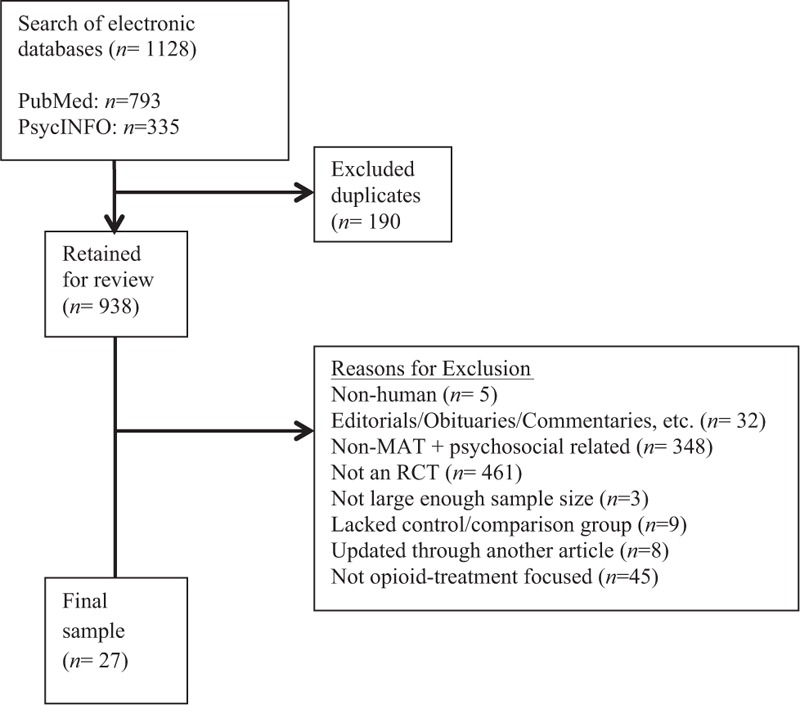
Opioid use and overdose rates have risen to epidemic levels in the United States during the past decade. Fortunately, there are effective medications (ie, methadone, buprenorphine, and oral and injectable naltrexone) available for the treatment of opioid addiction. Each of these medications is approved for use in conjunction with psychosocial treatment; however, there is a dearth of empirical research on the optimal psychosocial interventions to use with these medications. In this systematic review, we outline and discuss the findings of 3 prominent prior reviews and 27 recent publications of empirical studies on this topic. The most widely studied psychosocial interventions examined in conjunction with medications for opioid addiction were contingency management and cognitive behavioral therapy, with the majority focusing on methadone treatment. The results generally support the efficacy of providing psychosocial interventions in combination with medications to treat opioid addictions, although the incremental utility varied across studies, outcomes, medications, and interventions. The review highlights significant gaps in the literature and provides areas for future research. Given the enormity of the current opioid problem in the United States, it is critical to gain a better understanding of the most effective ways to deliver psychosocial treatments in conjunction with these medications to improve the health and well-being of individuals suffering from opioid addiction.
Overview
The claims and statistics of this paper haven’t been checked yet.
Free: it reads the open-access text and checks the first 5 claims that cite a source we can check. Create a free account to check every claim.
Integrity signals
Registry
Cites
Statistics
Figures
Verification
Claims the paper makes
The claims and statistics of this paper haven’t been checked yet.
Free: it reads the open-access text and checks the first 5 claims that cite a source we can check. Create a free account to check every claim.
Claims other papers make about this one
Each is checked against this paper’s own text: does it say what the citing paper says it does?
The source backs part of the claim, not all of it — or backs it for a different population, condition or comparison.
In the citing paper
“Recent reviews have highlighted the lack of research regarding psychological interventions (e.g., Integrated CBT) for patients with comorbid anxiety and opioid use and specifically the potential of psychological interventions to be paired with medication (e.g., suboxone) to address both anxiety and opioid use concurrently.(Dugosh et al., 2016; Langdon et al., 2019)”
From A systematic review and meta-analysis of psychosocial interventions for persons with comorbid anxiety and substance use disorders (2024) · cites this paper as Dugosh et al., 2016
Experimental — accuracy not yet measured
Self-check
Percentages, sums and reported differences re-computed from the paper’s own numbers.
The self-check needs the paper’s full text.
Citations
Cites
Preferred Reporting Items for Systematic Reviews and Meta-Analyses: the PRISMA statement
Moher, D., Liberati, A., Tetzlaff, J., Altman, D. G., & for the PRISMA Group (2009) · BMJ · doi:10.1136/bmj.b2535 · Cited by 83,823
Preferred reporting items for systematic reviews and meta-analyses: the PRISMA Statement.
(2009) · PubMed Central · Cited by 44,859
Preferred reporting items for systematic reviews and meta-analyses: The PRISMA statement
Moher, D., Liberati, A., Tetzlaff, J., Altman, D. G., & the PRISMA Group* (2009) · Annals of Internal Medicine · doi:10.7326/0003-4819-151-4-200908180-00135 · Cited by 37,554
Preferred Reporting Items for Systematic Reviews and Meta-Analyses: The PRISMA Statement
Moher, D., Liberati, A., Tetzlaff, J., & Altman, D. G. (2009) · Journal of Clinical Epidemiology · doi:10.1016/j.jclinepi.2009.06.005 · Cited by 19,575
Vital signs: overdoses of prescription opioid pain relievers---United States, 1999--2008.
Paulozzi, L. J., Jones, C. M., Mack, K. A., & Rudd, R. A. (2011) · PubMed · Cited by 1,540
A Meta-Analytic Review of Psychosocial Interventions for Substance Use Disorders
Dutra, L., Stathopoulou, G., Basden, S. L., Leyro, T. M., Powers, M. B., & Otto, M. W. (2008) · American Journal of Psychiatry · doi:10.1176/appi.ajp.2007.06111851 · Cited by 1,287 · cited 2×
“The goal of psychosocial treatment is to help patients control urges to use drugs and remain abstinent, while also serving to assist patients in coping with the emotional strife that often accompanies addiction (Dutra et al., 2008).”
BackgroundKampman, K., & Jarvis, M. (2015) · Journal of Addiction Medicine · doi:10.1097/adm.0000000000000166 · Cited by 678
Vital signs: overdoses of prescription opioid pain relievers---United States, 1999--2008.
(2011) · PubMed · Cited by 640
Vital Signs: Demographic and Substance Use Trends Among Heroin Users - United States, 2002-2013.
Jones, C. M., Logan, J. E., Gladden, R. M., & Bohm, M. K. (2015) · PubMed Central · Cited by 569
Weiss, R. D. (2011) · Archives of General Psychiatry · doi:10.1001/archgenpsychiatry.2011.121 · Cited by 540 · cited 3×
“One study (Weiss et al., 2011) examined the effectiveness of a manualized opioid dependence counseling intervention used in conjunction with buprenorphine during Phase 1 (brief treatment: buprenorphine-naloxone induction, 2 weeks of stabilization, 2 week taper, and 8 weeks of follow-up) and Phase 2…”
BackgroundMethodInfluential
Research works printed but not linked: 1
- Drummond DC Perryman K Psychosocial Interventions in Pharmacotherapy of Opioid Dependence: A Literature Review. London: St. George's University of London; 2007.
Cited by
Items 301–331 of 331
(2024) · Oxford University Press eBooks · doi:10.1093/med/9780192844088.003.0013
22. Opioid-Focused Interventions on College Campuses
Parks, K. A., & Lewis, M. A. (2024) · American Public Health Association eBooks · doi:10.2105/9780875533452ch22
Overdose, personality correlates and treatment utilization in opioid use disorder
Jones, M. (2024) · Cronfa (Swansea University) · doi:10.23889/suthesis.66936
Alexander, K., & Scialanca, M. (2024) · doi:10.2196/preprints.67401
POSITION STATEMENT: Support policies to address opioid use disorder among rural communities
LaRowe, L. R., Hardin, H. K., Goetzinger, A. M., Fox, K. R., Kilpatrick, R. L., Seng, E. K., & Figueroa, R. (2024) · The Journal of Rural Health · doi:10.1111/jrh.12899
Potik, D. (2024) · Journal of Progressive Human Services · doi:10.1080/10428232.2025.2459993
“Indeed, studies indicate that OMT with psychosocial treatment is more effective than opioid maintenance alone (Dugosh et al., 2016; McLellan et al., 1993).”
Alderson, K. G., & Gladding, S. T. (2025) · Wiley eBooks · doi:10.1002/9781394347131.ref
Gamage, K. K., Liu, S., Chiu, K., Wang, J., & Sud, A. (2025) · Contemporary Drug Problems · doi:10.1177/00914509251346144
“The overall evidence base for nonpharmacological interventions is comparatively less robust when contrasted with that for OAT (Brown, 2018; Dugosh et al., 2016; Samples et al., 2022; Zerden et al., 2020).”
Clinical States of Pain (Taxonomy)
Hooten, W. M., D'Souza, R. S., & Nelson, A. M. (2025) · Springer eBooks · doi:10.1007/978-3-031-88357-6_3 · Cited by 1
Matheson, C., Soyka, M., Hard, B., Brousse, G., Meyner, S., Seibold, C., & Torrens, M. (2025) · Heroin addiction and related clinical problems · doi:10.62401/2531-4122-2025-24
Saunders, E. C., Moore, S. K., Walsh, O., Metcalf, S. A., Budney, A. J., Cavazos-Rehg, P., Scherer, E. A., & Marsch, L. A. (2021) · Figshare · doi:10.6084/m9.figshare.13647170
Saunders, E. C., Moore, S. K., Walsh, O., Metcalf, S. A., Budney, A. J., Cavazos-Rehg, P., Scherer, E. A., & Marsch, L. A. (2021) · Figshare · doi:10.6084/m9.figshare.13647173
Leung, K., Xu, E., Rosic, T., Worster, A., Thabane, L., & Samaan, Z. (2021) · Figshare · doi:10.6084/m9.figshare.16851378
Ellis, S., Witzig, J., Basaldu, D., Rudd, B. N., Gastala, N., Tabachnick, A. R., Kang, S., Henry, T., Stackhouse, N., & Wardle, M. C. (2025) · Addiction Science & Clinical Practice · doi:10.1186/s13722-025-00621-7
Rossi, E., Waterman, R. W., Chorny, Y., Ahmed, S., & Remers, S. (2025) · The Canadian Journal of Addiction · doi:10.1097/cxa.0000000000000253
Psychosocial treatments for opioid use disorder: state of the qualitative literature
Loverock, A., Hammal, F., Adams, D., & Hodgins, D. C. (2026) · Addiction Research & Theory · doi:10.1080/16066359.2025.2605965 · Cited by 1
“While some reviews of available research have concluded that the addition adds no value (Amato et al. 2011), other reviews note the lack of high-quality randomized trials addressing this question (Dugosh et al. 2016; Rice et al. 2020).”
Integrating Medication and Psychosocial Support for Addiction Recovery: A Study of Congress 60
White, W. L., Dezhakam, H., Ranjbar, E., Sarapas, C., & Mouton, C. (2026) · Alcoholism Treatment Quarterly · doi:10.1080/07347324.2026.2617255
“Also unclear is how such service combinations and sequences might require adaptation across the stages of long-term recovery (Day & Mitcheson, 2017; Dugosh et al., 2016).”
Charron, E. M., Allshouse, A. A., Tak, C. R., Campbell, K. A., Gordon, A. J., Cochran, G., & Smid, M. C. (2026) · Journal of Substance Use and Addiction Treatment · doi:10.1016/j.josat.2026.209902
Association Between Heroin Use and Depression: NHANES 2005–2018
Li, B., Yang, Z., Zhang, X., Yang, M., Qiu, H., & Ren, Y. (2026) · Addiction Biology · doi:10.1111/adb.70127
Soyka, M., & Bolz, S. (2026) · Pharmaceuticals · doi:10.3390/ph19020270
Psychological counselling for heroin addicts in the Sri Lankan context
Silva, I. D., Darshana, N., & Silva, V. D. (2026) · Heroin addiction and related clinical problems · doi:10.62401/2531-4122-2026-3
Reyes, J., Ager, E. E., Ahmed, Z., Follman, S., Gonzalez, A., Quinley, K., & Agarwal, A. (2026) · Annals of Emergency Medicine · doi:10.1016/j.annemergmed.2026.02.019
Roberts, E., Sanderson, E., Santo, T., Hickman, M., Farrell, M., & Degenhardt, L. J. (2026) · Addiction · doi:10.1111/add.70502
“[34] Although the majority of included studies were conducted in investigational settings, almost all studies contributing data to the initiation outcome allowed participants a free choice of whether to commence naltrexone as a relapse prevention pharmacotherapy (e.g. investigational studies…”
Lent, M. R., Hurstak, E., Lynch, K. G., Loscalzo, E., Mazur, K., Lugo, H. L., & Dugosh, K. L. (2026) · JAMA Network Open · doi:10.1001/jamanetworkopen.2026.19826
Self-citationKedia, S., Sirohi, S., Ahuja, N. A., Entwistle, C., Dillon, P., Mahmood, A., Zhang, H., Chen, S., & Schmidt, M. (2026) · Journal of Substance Use and Addiction Treatment · doi:10.1016/j.josat.2026.210076
Silva, A. R., Montgomery, C., Frank, B., Herron, K., & Poole, H. (2026) · Medicine · doi:10.1097/md.0000000000050106
“[35–39] Such interventions incorporate behavior change techniques (BCTs), which are specific strategies that aid in modifying the processes that drive behavior.”
Li, M., Miao, D., Mo, Q., Chen, Q., & Lu, L. (2026) · Frontiers in Public Health · doi:10.3389/fpubh.2026.1901002
“While decades of research generally support combining non-pharmacological therapies with MOUD to improve clinical outcomes, critical reviews reveal profound methodological gaps in network systematic review is that hinder definitive conclusions (9, 10).”
Roderique‐Davies, G., Davies, N., Quelch, D. R., Jones, H., Nwozo, C., James, L., Melichar, J., Tucker, J., Jones, L., Dennie, E., et al. (2026) · Frontiers in Psychiatry · doi:10.3389/fpsyt.2026.1924312
Beyond Access: The Need for an Integrated Addiction Treatment System in Iran
Bakhshani, N. (2026) · international journal high risk behaviors & addiction · doi:10.5812/ijhrba-175080
Madde Kullanım Bozukluğunda Güncel Yaklaşımlar, Tartışmalar ve Sosyal Hizmet Uygulamaları
Akay, O., & CEBECİ, F. (2026) · Özgür Yayınları eBooks · doi:10.58830/ozgur.pub1485.c5925
Jones, H. E., & Ramage, M. (2026) · Expert Review of Clinical Pharmacology · doi:10.1080/17512433.2026.2756492
Metadata
- Authors
- Dugosh, K., Abraham, A., Seymour, B., McLoyd, K., Chalk, M., & Festinger, D.
- Affiliations
- University of Georgia (US)
- Corresponding author
- Dugosh, Karen
- Venue
- Journal of Addiction Medicine
- Published
- 2016-03
- Volume
- 10
- Issue
- 2
- Pages
- 93-103
- ISSN
- 1932-0620 (ISSN-L)
- PMC
- PMC4795974
- OpenAlex
- W2315302680
- Semantic Scholar
- 8311903b73169e3786878a76a3896e8dd8ec53aa
- Cited by
- 333
- References
- 42
- Citations by year
- 2026: 19 · 2025: 27 · 2024: 31 · 2023: 35 · 2022: 31 · 2021: 61 · 2020: 52 · 2019: 35 · 2018: 21 · 2017: 14 · 2016: 6
- FWCI
- 3.74
- Type
- journal article
- Language
- en
- Open access
- hybrid
- doi.org
- Licence
- cc-by-nc-nd
- Locations
- Journal of Addiction Medicine (publishedVersion, cc-by-nc-nd)
- Europe PMC (PubMed Central) (publishedVersion, cc-by-nc-nd)
- PubMed Central (publishedVersion, cc-by-nc-nd)
- PubMed (publishedVersion)
- Digital Commons - PCOM (Philadelphia College of Osteopathic Medicine) (submittedVersion)
- Funders
- National Institute on Drug Abuse (HHSN271201200001C)
- Topics
- Health Sciences › Medicine › Public Health, Environmental and Occupational Health › Opioid Use Disorder Treatment
- Health Sciences › Medicine › Epidemiology › Substance Abuse Treatment and Outcomes
- Health Sciences › Medicine › Anesthesiology and Pain Medicine › Pain Management and Opioid Use
- Keywords
- opioid use disorder, psychosocial interventions, medication-assisted treatment, methadone, buprenorphine, naltrexone, contingency management, cognitive behavioral therapy, opioid use disorder treatment
- MeSH terms
- Analgesics, Opioid, Buprenorphine, Combined Modality Therapy, Humans, Methadone, Naltrexone, Narcotic Antagonists, Opioid-Related Disorders, Cognitive Behavioral Therapy
About these checks
Registry, retraction, Cites and statistics results are computed, not judged, with one exception: a printed reference that no index lists is read once by a model before it counts as a citation error. Claims are extracted by a model and kept only when their quote appears verbatim in the text; each cited source is then checked, with a model’s help, for whether it says what the claim relies on. Those verdicts can be wrong — read the claim’s quote and the cited source before relying on one.
Statistics and arithmetic are recomputed, not judged.
Confidence bands are shown only for fields calibrated on our annotated test set. None is calibrated yet, so no band is shown.
What counts as a claim ›How we measure confidence ›How we check this ›
Are you an author, or do you see a problem with this page? Request a review
Data sources
Bibliographic data: Semantic Scholar, OpenAlex, Crossref.
Contains information from the Semantic Scholar Academic Graph Datasets, made available under the ODC Attribution License (ODC-BY 1.0).
Semantic Scholar’s data is described in: Kinney, R., et al. (2023). The Semantic Scholar Open Data Platform. arXiv:2301.10140.
