

Outcomes of Poly-4-hydroxybutyrate Mesh in Ventral Hernia Repair: A Systematic Review and Pooled Analysis
The DOI matches its Crossref record; 1 of the 1 references it cites were found in a registry or an index.
Abstract
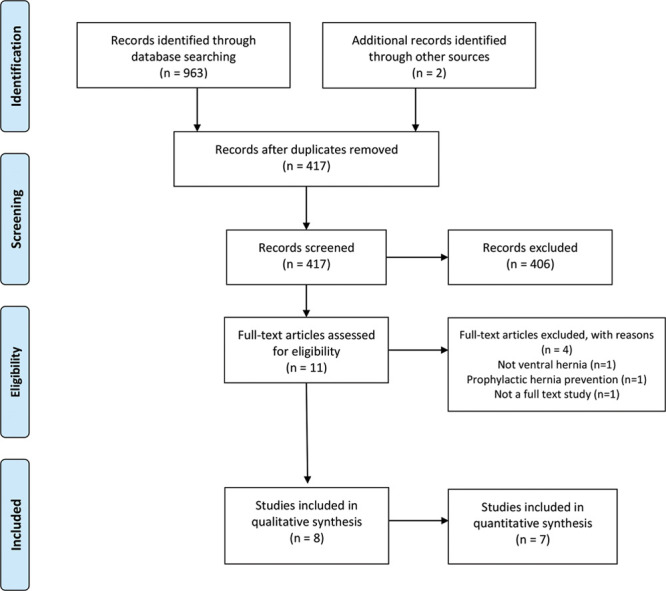
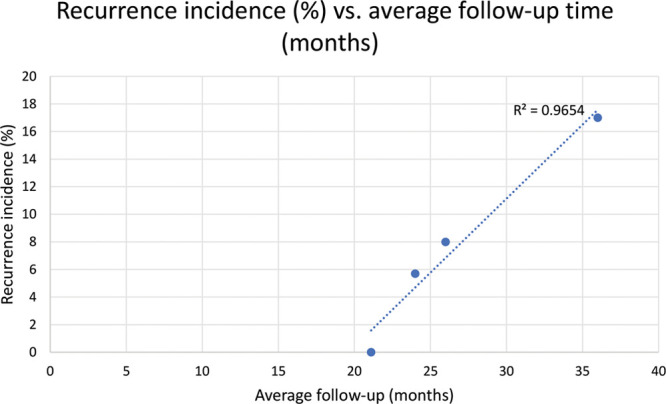
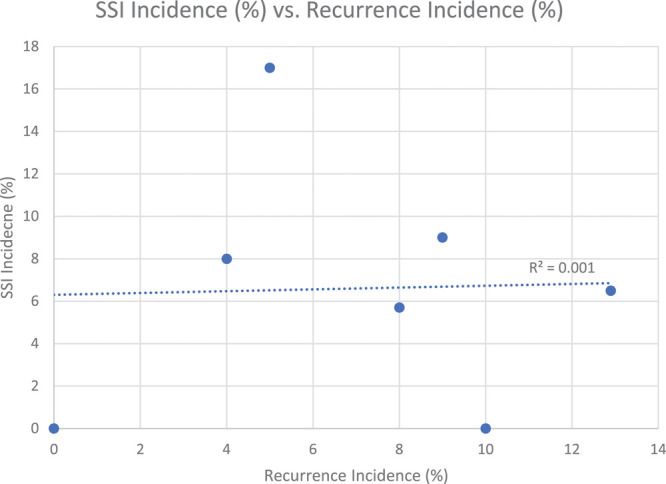
Background: Within the past decade, poly-4-hydroxybutyrate (P4HB) biosynthetic mesh has been introduced as a potential alternative to traditional biologic and synthetic mesh in ventral hernia repair (VHR). The aim of this study was to systematically assess clinical outcomes with the P4HB in VHR. Methods: A literature search identified all articles published in 2000 involving the use of P4HB in VHR. Descriptive statistics were used to synthesize collective data points, including postoperative outcomes. A pooled analysis of postoperative outcomes was performed using chi-square test and Fisher exact test. Results: Across 7 studies, the P4HB was used in 453 patients. The mean rate of surgical site infection (SSI) was 6.8% (31/453), reoperation 10.7% (30/281), and recurrence 9.1% (41/453). At an average follow-up of 26.8 months, the incidence of recurrence was 10.4% (28/270). Onlay was significantly associated with increased recurrence (14.2% versus 4.4%, P = 0.001). Among sublay placements, there was no difference in recurrence in clean (Center for Disease Control [CDC] 1) or contaminated (CDC >1) wounds (2.7% versus 6.1%, P = 0.585), but contaminated wounds were associated with increased SSI (2.7% versus 15.2%, P = 0.028). Ventral Hernia Working Group grade 2 and 3 did not have different incidences of recurrence (8.0% versus 5.1%, P = 0.526) nor SSI (5.1% versus 14.6%, P = 0.265). Conclusions: Overall, clinical outcomes of the P4HB mesh in VHR are acceptable. The P4HB mesh serves as a reliable alternative to traditional synthetic and biologic mesh across a range of defect characteristics and patient health conditions. Further research is needed to better understand the conditions in which it may provide a clinical benefit over traditional mesh types.
Overview
The claims and statistics of this paper haven’t been checked yet.
Free: it reads the open-access text and checks the first 5 claims that cite a source we can check. Create a free account to check every claim.
Integrity signals
Registry
Cites
Statistics
Figures
Verification
Claims the paper makes
The claims and statistics of this paper haven’t been checked yet.
Free: it reads the open-access text and checks the first 5 claims that cite a source we can check. Create a free account to check every claim.
Claims other papers make about this one
Each is checked against this paper’s own text: does it say what the citing paper says it does?
In the citing paper
“In a systematic review and pooled analysis by Mellia et al9 on outcomes of the Phasix mesh following ventral hernia repair, a recurrence rate of 28/270 (10.4%) was observed after 26.8 months, with significantly more frequent recurrences in the onlay position versus the sublay position (14.2% vs 4.4%).”
From Five-Year Follow-Up of a Slowly Resorbable Biosynthetic P4HB Mesh (Phasix) in VHWG Grade 3 Incisional Hernia Repair (2023) · cites this paper as [9]
In the citing paper
“Biosynthetic resorbable meshes have recently been developed to counter the disadvantages of biological and synthetic meshes.9”
From Five-Year Follow-Up of a Slowly Resorbable Biosynthetic P4HB Mesh (Phasix) in VHWG Grade 3 Incisional Hernia Repair (2023) · cites this paper as [9]
Self-check
Percentages, sums and reported differences re-computed from the paper’s own numbers.
The self-check needs the paper’s full text.
Citations
Cites
Rayyan-a web and mobile app for systematic reviews.
Ouzzani, M., Hammady, H., Fedorowicz, Z., & Elmagarmid, A. (2016) · Systematic Reviews · doi:10.1186/s13643-016-0384-4 · Cited by 26,092
Research works printed but not linked: 38
- Franz MG The biology of hernia formation. Surg Clin North Am. 2008; 88: 1– vii 15, 18267158 PMC2276402 · DOI · Paper page
- Xing L Culbertson EJ Wen Y Early laparotomy wound failure as the mechanism for incisional hernia formation. J Surg Res. 2013; 182: e35– e42. 23036516 PMC4492695 · DOI
- Burger JW Luijendijk RW Hop WC Long-term follow-up of a randomized controlled trial of suture versus mesh repair of incisional hernia. Ann Surg. 2004; 240: 578– 583; discussion 583. 15383785 PMC1356459 · DOI · Paper page
- Luijendijk RW Hop WC van den Tol MP A comparison of suture repair with mesh repair for incisional hernia. N Engl J Med. 2000; 343: 392– 398. 10933738 · DOI · Paper page
- Snyder CW Graham LA Gray SH Effect of mesh type and position on subsequent abdominal operations after incisional hernia repair. J Am Coll Surg. 2011; 212: 496– 502; discussion 502. 21463777 · DOI · Paper page
- Park AE Roth JS Kavic SM Abdominal wall hernia. Curr Probl Surg. 2006; 43: 326– 375. 16679124 · DOI
- Petro CC Rosen MJ A current review of long-acting resorbable meshes in abdominal wall reconstruction. Plast Reconstr Surg. 2018; 142: 84S– 91S. 30138274 · DOI
- Darehzereshki A Goldfarb M Zehetner J Biologic versus nonbiologic mesh in ventral hernia repair: a systematic review and meta-analysis. World J Surg. 2014; 38: 40– 50. 24101015 · DOI
- Burns NK Jaffari MV Rios CN Non-cross-linked porcine acellular dermal matrices for abdominal wall reconstruction. Plast Reconstr Surg. 2010; 125: 167– 176. 19910855 · DOI
- Huntington CR Cox TC Blair LJ Biologic mesh in ventral hernia repair: outcomes, recurrence, and charge analysis. Surgery. 2016; 160: 1517– 1527. 27528210 · DOI
- Totten CF Davenport DL Ward ND Cost of ventral hernia repair using biologic or synthetic mesh. J Surg Res. 2016; 203: 459– 465. 27363656 · DOI
- Stroup DF Berlin JA Morton SC Meta-analysis of observational studies in epidemiology: a proposal for reporting. Meta-analysis Of Observational Studies in Epidemiology (MOOSE) group. JAMA. 2000; 283: 2008– 2012. 10789670 · DOI · Paper page
- Stoikes NFN Scott JR Badhwar A Characterization of host response, resorption, and strength properties, and performance in the presence of bacteria for fully absorbable biomaterials for soft tissue repair. Hernia. 2017; 21: 771– 782. 28815398 PMC5608787 · DOI
- Deeken CR Matthews BD Characterization of the mechanical strength, resorption properties, and histologic characteristics of a fully absorbable material (Poly-4-hydroxybutyrate-PHASIX Mesh) in a porcine model of hernia repair. ISRN Surg. 2013; 2013: 238067. 23781348 PMC3679684 · DOI · Paper page
- Martin DP Badhwar A Shah DV Characterization of poly-4-hydroxybutyrate mesh for hernia repair applications. J Surg Res. 2013; 184: 766– 773. 23582230 · DOI · Paper page
- Williams SF Rizk S Martin DP Poly-4-hydroxybutyrate (P4HB): a new generation of resorbable medical devices for tissue repair and regeneration. Biomed Tech (Berl). 2013; 58: 439– 452. 23979121 · DOI · Paper page
- Buell JF Sigmon D Ducoin C Initial experience with biologic polymer scaffold (Poly-4-hydroxybuturate) in complex abdominal wall reconstruction. Ann Surg. 2017; 266: 185– 188. 28594679 · DOI · Paper page
- Roth JS Anthone GJ Selzer DJ Prospective evaluation of poly-4-hydroxybutyrate mesh in CDC class I/high-risk ventral and incisional hernia repair: 18-month follow-up. Surg Endosc. 2018; 32: 1929– 1936. 29063307 · DOI · Paper page
- Sahoo S Haskins IN Huang LC Early wound morbidity after open ventral hernia repair with biosynthetic or polypropylene mesh. J Am Coll Surg. 2017; 225: 472.e1– 480.e1. 28826804 · DOI · Paper page
- Plymale MA Davenport DL Dugan A Ventral hernia repair with poly-4-hydroxybutyrate mesh. Surg Endosc. 2018; 32: 1689– 1694. 28916979 · DOI · Paper page
- Messa CA IV Kozak G Broach RB When the mesh goes away: an analysis of poly-4-hydroxybutyrate mesh for complex hernia repair. Plast Reconstr Surg Glob Open. 2019; 7: e2576. 31942324 PMC6908335 · DOI
- Pakula A Skinner R Outcomes of open complex ventral hernia repairs with retromuscular placement of poly-4-hydroxybutyrate bioabsorbable mesh. Surg Innov. 2020; 27: 32– 37. 31617453 · DOI
- Levy AS Bernstein JL Premaratne ID Poly-4-hydroxybutyrate (Phasix™) mesh onlay in complex abdominal wall repair. Surg Endosc. 2020; 13: 12.4. 32385706
- Rognoni C Cuccurullo D Borsoi L Clinical outcomes and quality of life associated with the use of a biosynthetic mesh for complex ventral hernia repair: analysis of the “Italian Hernia Club” registry. Sci Rep. 2020; 10: 10706. 32612131 PMC7329869 · DOI
- Weissler JM Lanni MA Hsu JY Development of a clinically actionable incisional hernia risk model after colectomy using the healthcare cost and utilization project. J Am Coll Surg. 2017; 225: 274.e1– 284.e1. 28445797 · doi:10.1016/j.jamcollsurg.2017.04.007
- Tedelind S Westberg F Kjerrulf M Anti-inflammatory properties of the short-chain fatty acids acetate and propionate: a study with relevance to inflammatory bowel disease. World J Gastroenterol. 2007; 13: 2826– 2832. 17569118 PMC4395634 · DOI · Paper page
- Wang F Liu J Weng T The inflammation induced by lipopolysaccharide can be mitigated by short-chain fatty acid, butyrate, through upregulation of IL-10 in septic shock. Scand J Immunol. 2017; 85: 258– 263. 27943364 · DOI · Paper page
- Ortega G Rhee DS Papandria DJ An evaluation of surgical site infections by wound classification system using the ACS-NSQIP. J Surg Res. 2012; 174: 33– 38. 21962737 · DOI · Paper page
- Kummerow Broman K Huang LC Faqih A Hidden morbidity of ventral hernia repair with mesh: as concerning as common bile duct injury? J Am Coll Surg. 2017; 224: 35– 42. 27725219 · doi:10.1016/j.jamcollsurg.2016.09.016
- Liang MK Li LT Nguyen MT Abdominal reoperation and mesh explantation following open ventral hernia repair with mesh. Am J Surg. 2014; 208: 670– 676. 25241955 · DOI
- Cobb WS Warren JA Ewing JA Open retromuscular mesh repair of complex incisional hernia: predictors of wound events and recurrence. J Am Coll Surg. 2015; 220: 606– 613. 25797746 · DOI · Paper page
- Millikan KW Incisional hernia repair. Surg Clin North Am. 2003; 83: 1223– 1234. 14533912 · doi:10.1016/s0039-6109(03)00129-4
- Molina CP Giglio R Gandhi RM Comparison of the host macrophage response to synthetic and biologic surgical meshes used for ventral hernia repair. J Immunol Regen Med. 2019; 3: 13– 25.
- Sailes FC Walls J Guelig D Synthetic and biological mesh in component separation: a 10-year single institution review. Ann Plast Surg. 2010; 64: 696– 698. 20395790 · DOI · Paper page
- Albino FP Patel KM Nahabedian MY Does mesh location matter in abdominal wall reconstruction? A systematic review of the literature and a summary of recommendations. Plast Reconstr Surg. 2013; 132: 1295– 1304. 24165612 · DOI · Paper page
- Shankaran V Weber DJ Reed RL II A review of available prosthetics for ventral hernia repair. Ann Surg. 2011; 253: 16– 26. 21135699 · DOI · Paper page
- Breuing K Butler CE Ferzoco S Incisional ventral hernias: review of the literature and recommendations regarding the grading and technique of repair. J Surg. 2010; 148: 544– 558. 20304452
- Itani KM Rosen M Vargo D RICH Study Group. Prospective study of single-stage repair of contaminated hernias using a biologic porcine tissue matrix: the RICH Study. Surgery. 2012; 152: 498– 505. 22763262 · DOI · Paper page
Cited by
Roth, J. S., Anthone, G. J., Selzer, D. J., Poulose, B. K., Pierce, R. A., Bittner, J. G., Hope, W. W., Dunn, R. M., Martindale, R. G., Goldblatt, M. I., et al. (2022) · Journal of the American College of Surgeons · doi:10.1097/xcs.0000000000000363 · Cited by 38
Deeken, C. R., Chen, D. C., Lopez-Cano, M., Martin, D. P., & Badhwar, A. (2023) · Frontiers in Surgery · doi:10.3389/fsurg.2023.1157661 · Cited by 32
Van den Dop, L. M., Van Rooijen, M. M. J., Tollens, T., Jørgensen, L. N., De Vries-Reilingh, T. S., Piessen, G., Köckerling, F., Miserez, M., Dean, M., Berrevoet, F., et al. (2023) · Annals of Surgery Open · doi:10.1097/as9.0000000000000366 · Cited by 21
Talwar, A. A., Perry, N. J., McAuliffe, P. B., Desai, A. A., Thrippleton, S., Broach, R. B., & Fischer, J. P. (2022) · Hernia · doi:10.1007/s10029-022-02674-y · Cited by 13
Self-citationOthman, S., Christopher, A., Patel, V., Jia, H., Mellia, J. A., Kovach, S. J., & Fischer, J. P. (2022) · Plastic & Reconstructive Surgery · doi:10.1097/prs.0000000000009021 · Cited by 6
Self-citation
Metadata
- Authors
- Mellia, J. A., Othman, S., Naga, H. I., Messa, C. A., Elfanagely, O., Byrnes, Y. M., Basta, M. N., & Fischer, J. P.
- Affiliations
- Division of Plastic Surgery, Department of Surgery, University of Pennsylvania, Philadelphia, Pa.
- Department of Plastic and Reconstructive Surgery, Brown University, Providence, R.I.
- Venue
- Plastic and Reconstructive Surgery - Global Open
- Published
- 2020-12
- Volume
- 8
- Issue
- 12
- Pages
- e3158
- ISSN
- 2169-7574
- PMC
- PMC7787297
- Semantic Scholar
- 96fc76699d058a8d15e6c3bcbc05fe145ee7b13a
- Cited by
- 26
- References
- 1
- Language
- en
About these checks
Registry, retraction, Cites and statistics results are computed, not judged, with one exception: a printed reference that no index lists is read once by a model before it counts as a citation error. Claims are extracted by a model and kept only when their quote appears verbatim in the text; each cited source is then checked, with a model’s help, for whether it says what the claim relies on. Those verdicts can be wrong — read the claim’s quote and the cited source before relying on one.
Statistics and arithmetic are recomputed, not judged.
Confidence bands are shown only for fields calibrated on our annotated test set. None is calibrated yet, so no band is shown.
What counts as a claim ›How we measure confidence ›How we check this ›
Are you an author, or do you see a problem with this page? Request a review
Data sources
Bibliographic data: Semantic Scholar, OpenAlex, Crossref.
Contains information from the Semantic Scholar Academic Graph Datasets, made available under the ODC Attribution License (ODC-BY 1.0).
Semantic Scholar’s data is described in: Kinney, R., et al. (2023). The Semantic Scholar Open Data Platform. arXiv:2301.10140.
