

The global epidemiology of nonalcoholic fatty liver disease (NAFLD) and nonalcoholic steatohepatitis (NASH): a systematic review
Open accessThe DOI matches its Crossref record; 38 of the 38 references it cites were found in a registry or an index.
Abstract
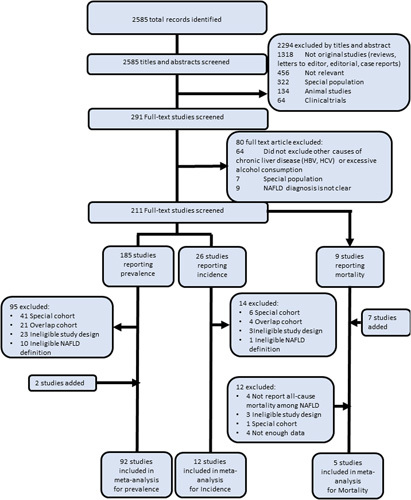
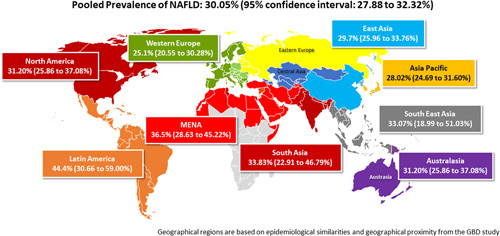
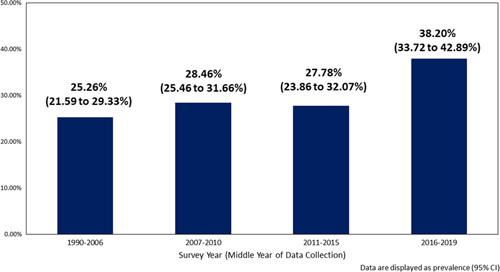
Background and Aims: NAFLD is a leading cause of liver-related morbidity and mortality. We assessed the global and regional prevalence, incidence, and mortality of NAFLD using an in-depth meta-analytic approach. Approach and Results: PubMed and Ovid MEDLINE were searched for NAFLD population-based studies from 1990 to 2019 survey year (last published 2022) per Preferred Reporting Items for Systematic Reviews and Meta-Analyses (PRISMA). Meta-analysis was conducted using random-effects models. Bias risk assessment was per Joanna Briggs Institute. Of 2585 studies reviewed, 92 studies (N=9,361,716) met eligibility criteria. Across the study period (1990–2019), meta-analytic pooling of NAFLD prevalence estimates and ultrasound-defined NAFLD yielded an overall global prevalence of 30.05% (95% CI: 27.88%–32.32%) and 30.69% (28.4–33.09), respectively. Global NAFLD prevalence increased by +50.4% from 25.26% (21.59–29.33) in 1990–2006 to 38.00% (33.71–42.49) in 2016–2019 ( p <0.001); ultrasound-defined NAFLD prevalence increased by +38.7% from 25.16% (19.46–31.87) in 1990–2006 to 34.59% (29.05–40.57) ( p =0.029). The highest NAFLD prevalence was in Latin America 44.37% (30.66%–59.00%), then Middle East and North Africa (MENA) (36.53%, 28.63%–45.22%), South Asia (33.83%, 22.91%–46.79%), South-East Asia (33.07%, 18.99%–51.03%), North America (31.20%, 25.86%–37.08%), East Asia (29.71%, 25.96%–33.76%), Asia Pacific 28.02% (24.69%–31.60%), Western Europe 25.10% (20.55%–30.28%). Among the NAFLD cohort diagnosed without a liver biopsy, pooled mortality rate per 1000 PY was 12.60 (6.68–23.67) for all-cause mortality; 4.20 (1.34–7.05) for cardiac-specific mortality; 2.83 (0.78–4.88) for extrahepatic cancer-specific mortality; and 0.92 (0.00–2.21) for liver-specific mortality. Conclusions: NAFLD global prevalence is 30% and increasing which requires urgent and comprehensive strategies to raise awareness and address all aspects of NAFLD on local, regional, and global levels.
Overview
The claims and statistics of this paper haven’t been checked yet.
Free: it reads the open-access text and checks the first 5 claims that cite a source we can check. Create a free account to check every claim.
Integrity signals
Registry
Cites
Statistics
Figures
Verification
Claims the paper makes
The claims and statistics of this paper haven’t been checked yet.
Free: it reads the open-access text and checks the first 5 claims that cite a source we can check. Create a free account to check every claim.
Claims other papers make about this one
Each is checked against this paper’s own text: does it say what the citing paper says it does?
The source backs part of the claim, not all of it — or backs it for a different population, condition or comparison.
In the citing paper
“Thus, MASLD is now the leading cause of chronic liver disease and hence liver fibrosis (47–49).”
From Targeting macrophages in liver fibrosis (2026) · cites this paper as [49]
Experimental — accuracy not yet measuredThe source backs part of the claim, not all of it — or backs it for a different population, condition or comparison.
In the citing paper
“The estimated global prevalence of MASLD in the general population has risen from 25% in 2016 12 to currently more than 30%, and the incidence is continually increasing. 12 -14”
From EASL-EASD-EASO Clinical Practice Guidelines on the management of metabolic dysfunction-associated steatotic liver disease (MASLD). (2024) · cites this paper as [12]
Experimental — accuracy not yet measuredThe source backs part of the claim, not all of it — or backs it for a different population, condition or comparison.
In the citing paper
“Compared to matched control populations, individuals with MASLD have increased all-cause mortality of 17.05/1,000 PY (range 10.31 -28.05). 12”
From EASL-EASD-EASO Clinical Practice Guidelines on the management of metabolic dysfunction-associated steatotic liver disease (MASLD). (2024) · cites this paper as [12]
Experimental — accuracy not yet measuredThe check wasn’t confident either way, so it gives no verdict — never disputed.
In the citing paper
“the “non-viral” subgroups probably consist of different proportions of HCCs due to each etiology across different trials, as the above example has shown [63–65]”
From Etiology-Based Treatment for Unresectable/Advanced Hepatocellular Carcinoma: Focus on Viral Hepatitis and Metabolic Dysfunction-Associated Steatohepatitis (2025) · cites this paper as [64]
Experimental — accuracy not yet measured
Self-check
Percentages, sums and reported differences re-computed from the paper’s own numbers.
The self-check needs the paper’s full text.
Citations
Cites
Bias in meta-analysis detected by a simple, graphical test
Egger, M., Smith, G. D., Schneider, M., & Minder, C. (1997) · BMJ · doi:10.1136/bmj.315.7109.629 · Cited by 56,722 · cited 1×
“[22] A funnel plot was used to investigate publication bias with the Egger regression test[23] and visual inspection to assess plot asymmetry.”
MethodMeta-analysis in clinical trials
DerSimonian, R., & Laird, N. (1986) · Controlled Clinical Trials · doi:10.1016/0197-2456(86)90046-2 · Cited by 39,552 · cited 1×
“Meta-analysis was performed on the adjusted NAFLD prevalence via random-effects models using the DerSimonian and Laird method[17] to estimate the pooled prevalence.”
MethodConducting Meta-Analyses in R with the metafor Package
Viechtbauer, W. (2010) · Journal of Statistical Software · doi:10.18637/jss.v036.i03 · Cited by 20,464 · cited 1×
“Analysis was conducted using the “metafor” package[24] in RStudio version 1.”
MethodYounossi, Z. M., Koenig, A. B., Abdelatif, D., Fazel, Y., Henry, L., & Wymer, M. (2016) · Hepatology · doi:10.1002/hep.28431 · Cited by 10,781 · cited 3×
“In 2016, a meta-analysis of studies published between 1990 and 2015 provided evidence that the global prevalence of NAFLD was about 25%, making it the most common cause of chronic liver disease (CLD).[1] The subsequent data from the Global Burden of Disease (GBD) study have supplemented this data and provided evidence…”
BackgroundResultSelf-citationMunn, Z., Moola, S., Lisy, K., Riitano, D., & Tufanaru, C. (2015) · International Journal of Evidence-Based Healthcare · doi:10.1097/xeb.0000000000000054 · Cited by 3,131 · cited 1×
“Quality assessment of the included studies was conducted using the Joanna Briggs Institute (JBI) critical appraisal instrument for prevalence studies against the following matrices: sample frame suitability, sampling strategy, sample size adequacy, study subjects and setting description, appropriate data analysis perf…”
MethodNon-alcoholic fatty liver disease
Powell, E. E., Wong, V. W.-S., & Rinella, M. (2021) · The Lancet · doi:10.1016/s0140-6736(20)32511-3 · Cited by 2,789 · cited 1×
“[6,7] In this context, the number of metabolic conditions that one carries not only increases the risk of having NAFLD but also the risk of progression to advanced liver disease and mortality.[8,9] Besides adverse clinical outcomes such as increased mortality, NAFLD is also associated with significant economic burden…”
BackgroundEstes, C., Razavi, H., Loomba, R., Younossi, Z., & Sanyal, A. J. (2018) · Hepatology · doi:10.1002/hep.29466 · Cited by 2,399 · cited 1×
“Nonetheless, these reported NAFLD incidence rates are in line with other incidence reports and is important information especially when forecasting the future burden of disease.[29,30,33] Our data showed that pooled mortality rate for NAFLD was 12.”
ResultSelf-citationThe prevalence and incidence of NAFLD worldwide: a systematic review and meta-analysis
Riazi, K., Azhari, H., Charette, J. H., Underwood, F. E., King, J. A., Afshar, E. E., Swain, M. G., Congly, S. E., Kaplan, G. G., & Shaheen, A.-A. (2022) · The Lancet Gastroenterology & Hepatology · doi:10.1016/s2468-1253(22)00165-0 · Cited by 2,246 · cited 3×
“Nonetheless, these reported NAFLD incidence rates are in line with other incidence reports and is important information especially when forecasting the future burden of disease.[29,30,33] Our data showed that pooled mortality rate for NAFLD was 12.”
BackgroundResultWilliams, C. D., Stengel, J., Asike, M. I., Torres, D. M., Shaw, J., Contreras, M., Landt, C. L., & Harrison, S. A. (2011) · Gastroenterology · doi:10.1053/j.gastro.2010.09.038 · Cited by 2,148 · cited 1×
“To reduce overestimation associated with a referral for liver biopsy, we only included studies with subjects who were not specifically referred for liver biopsy based on a clinical indication such as elevated liver enzymes.[26,27] Subsequently, the NASH prevalence in the general population was estimated by multiplying…”
MethodImproved tests for a random effects meta‐regression with a single covariate
Knapp, G., & Hartung, J. (2003) · Statistics in Medicine · doi:10.1002/sim.1482 · Cited by 2,075 · cited 1×
“Model coefficients were tested using the Knapp and Hartung adjustment.[21] Pairwise comparisons for categorical moderators were calculated using the Hommel method.”
Method
Cited by
Items 1,001–1,007 of 1,007
Deficiency of Epithelial PIEZO1 Alleviates Liver Steatosis Induced by High-Fat Diet in Mice
Xu, Z., Xu, S., Liu, X., Cheng, L., Liu, X., Xie, X., Zhou, D., Wang, D., Chen, J., Deng, X., et al. (2025) · International Journal of Biological Sciences · doi:10.7150/ijbs.102906 · Cited by 5
Jayabalan, D., Dhakal, S., Chandra, J., Fasser, D. A., Jeffrey, G. P., Garas, G., Vilar-Gomez, E., Calzadilla-Bertot, L., & Adams, L. A. (2026) · American Journal of Gastroenterology · doi:10.14309/ajg.0000000000003918 · Cited by 3
Sun, F. S. K., Wong, J. S. L., Mak, L.-Y., Wong, C. C.-L., Chew, V., Li, B. C. W., Leung, R., Cheung, T. T., & Yau, T. (2025) · Liver Cancer · doi:10.1159/000548536 · Cited by 3
“1), the “non-viral” subgroups probably consist of different proportions of HCCs due to each etiology across different trials, as the above example has shown [63–65].”
Targeting macrophages in liver fibrosis
González del Barrio, L., Ipsen, D. H., Pfister, D. R., Hancz, D., & Scott, C. L. (2026) · Frontiers in Immunology · doi:10.3389/fimmu.2026.1835489 · Cited by 3
“A systematic review and meta-analysis study from 1990 to 2019 estimated global MASLD prevalence in adults aged 20 and over at 30.05% (50).”
InfluentialIsfahani, M. M., Sepanlou, S. G., Joukar, F., Mansour-Ghanaei, F., & Taheri, E. (2025) · Scientific Reports · doi:10.1038/s41598-025-30226-8 · Cited by 3
Unravelling the memory of the extracellular matrix using MASH-derived decellularized scaffolds
Pinto, G. R., Braz, L. D. G., Pestana, Y., Filho, A. C. D. S., Gomes, M. I. M. D. A. C., de Barros, J. H. O., de Oliveira, T. S., Feng, I. Z. L. F., Santana, B. F., Carvalho, H. F., et al. (2026) · bioRxiv (preprint) · doi:10.64898/2026.03.17.712486
“In the period comprising 2002-2019, metabolic dysfunction-associated steatohepatitis (MASH) was the most non-hepatocellular carcinoma (HCC) cause of CLD among patients in the LT waiting list registered in the Scientific Registry of Transplant Recipients (SRTR) system [17, 19].”
InfluentialLoss of function of T-box 3 in the liver protects against MASLD
Maher, J. J. (2025) · Journal of Clinical Investigation · doi:10.1172/jci197143 · Cited by 1
“MASLD poses a public health threat because of its potential to progress — often silently — to steatohepatitis (MASH), liver fibrosis, and hepatocellular carcinoma (2).”
Metadata
- Authors
- Younossi, Z. M., Golabi, P., Paik, J. M., Henry, A., Van Dongen, C., & Henry, L.
- Affiliations
- Inova Health System (US)
- Betty and Guy Beatty Center for Integrated Research, Inova Health System, Falls Church, Virginia, USA
- Corresponding author
- Younossi, Zobair M.
- Venue
- Hepatology
- Published
- 2023-01-03
- Volume
- 77
- Issue
- 4
- Pages
- 1335-1347
- ISSN
- 0270-9139 (ISSN-L)
- PMC
- PMC10026948
- OpenAlex
- W4315619045
- Semantic Scholar
- e0a044235c08e95a83a81d9d88106233ad769e33
- Cited by
- 3,383
- References
- 38
- Citations by year
- 2026: 1056 · 2025: 1214 · 2024: 850 · 2023: 262
- FWCI
- 131.94
- Type
- journal article
- Language
- en
- Open access
- hybrid
- doi.org
- Licence
- Locations
- Hepatology (publishedVersion, cc-by-nc-nd)
- PubMed Central (publishedVersion, cc-by-nc-nd)
- PubMed (publishedVersion)
- Topics
- Health Sciences › Medicine › Hepatology › Liver Disease Diagnosis and Treatment
- Health Sciences › Medicine › Pathology and Forensic Medicine › Alcohol Consumption and Health Effects
- Health Sciences › Medicine › Hepatology › Liver Diseases and Immunity
- Keywords
- non-alcoholic fatty liver disease, nonalcoholic steatohepatitis, global prevalence, incidence, mortality, prevalence trends, regional variation, liver-related mortality, NAFLD risk factors
- MeSH terms
- Humans, North America, Prevalence, Risk Assessment, Non-alcoholic Fatty Liver Disease
About these checks
Registry, retraction, Cites and statistics results are computed, not judged, with one exception: a printed reference that no index lists is read once by a model before it counts as a citation error. Claims are extracted by a model and kept only when their quote appears verbatim in the text; each cited source is then checked, with a model’s help, for whether it says what the claim relies on. Those verdicts can be wrong — read the claim’s quote and the cited source before relying on one.
Statistics and arithmetic are recomputed, not judged.
Confidence bands are shown only for fields calibrated on our annotated test set. None is calibrated yet, so no band is shown.
What counts as a claim ›How we measure confidence ›How we check this ›
Are you an author, or do you see a problem with this page? Request a review
Data sources
Bibliographic data: Semantic Scholar, OpenAlex, Crossref.
Contains information from the Semantic Scholar Academic Graph Datasets, made available under the ODC Attribution License (ODC-BY 1.0).
Semantic Scholar’s data is described in: Kinney, R., et al. (2023). The Semantic Scholar Open Data Platform. arXiv:2301.10140.
