

The global epidemiology of nonalcoholic fatty liver disease (NAFLD) and nonalcoholic steatohepatitis (NASH): a systematic review
Open accessThe DOI matches its Crossref record; 38 of the 38 references it cites were found in a registry or an index.
Abstract
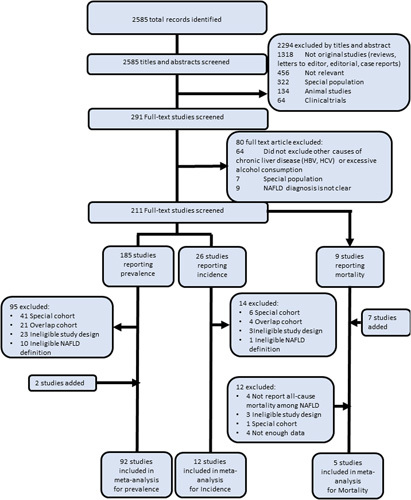
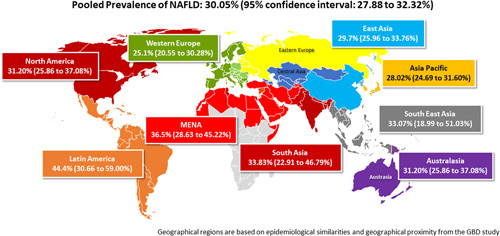
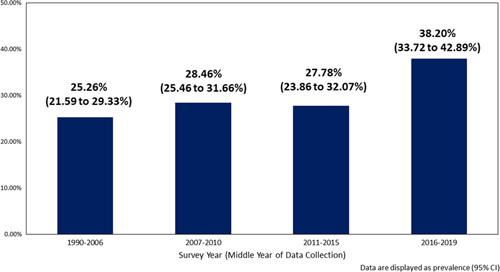
Background and Aims: NAFLD is a leading cause of liver-related morbidity and mortality. We assessed the global and regional prevalence, incidence, and mortality of NAFLD using an in-depth meta-analytic approach. Approach and Results: PubMed and Ovid MEDLINE were searched for NAFLD population-based studies from 1990 to 2019 survey year (last published 2022) per Preferred Reporting Items for Systematic Reviews and Meta-Analyses (PRISMA). Meta-analysis was conducted using random-effects models. Bias risk assessment was per Joanna Briggs Institute. Of 2585 studies reviewed, 92 studies (N=9,361,716) met eligibility criteria. Across the study period (1990–2019), meta-analytic pooling of NAFLD prevalence estimates and ultrasound-defined NAFLD yielded an overall global prevalence of 30.05% (95% CI: 27.88%–32.32%) and 30.69% (28.4–33.09), respectively. Global NAFLD prevalence increased by +50.4% from 25.26% (21.59–29.33) in 1990–2006 to 38.00% (33.71–42.49) in 2016–2019 ( p <0.001); ultrasound-defined NAFLD prevalence increased by +38.7% from 25.16% (19.46–31.87) in 1990–2006 to 34.59% (29.05–40.57) ( p =0.029). The highest NAFLD prevalence was in Latin America 44.37% (30.66%–59.00%), then Middle East and North Africa (MENA) (36.53%, 28.63%–45.22%), South Asia (33.83%, 22.91%–46.79%), South-East Asia (33.07%, 18.99%–51.03%), North America (31.20%, 25.86%–37.08%), East Asia (29.71%, 25.96%–33.76%), Asia Pacific 28.02% (24.69%–31.60%), Western Europe 25.10% (20.55%–30.28%). Among the NAFLD cohort diagnosed without a liver biopsy, pooled mortality rate per 1000 PY was 12.60 (6.68–23.67) for all-cause mortality; 4.20 (1.34–7.05) for cardiac-specific mortality; 2.83 (0.78–4.88) for extrahepatic cancer-specific mortality; and 0.92 (0.00–2.21) for liver-specific mortality. Conclusions: NAFLD global prevalence is 30% and increasing which requires urgent and comprehensive strategies to raise awareness and address all aspects of NAFLD on local, regional, and global levels.
Overview
The claims and statistics of this paper haven’t been checked yet.
Free: it reads the open-access text and checks the first 5 claims that cite a source we can check. Create a free account to check every claim.
Integrity signals
Registry
Cites
Statistics
Figures
Verification
Claims the paper makes
The claims and statistics of this paper haven’t been checked yet.
Free: it reads the open-access text and checks the first 5 claims that cite a source we can check. Create a free account to check every claim.
Claims other papers make about this one
Each is checked against this paper’s own text: does it say what the citing paper says it does?
The source backs part of the claim, not all of it — or backs it for a different population, condition or comparison.
In the citing paper
“Thus, MASLD is now the leading cause of chronic liver disease and hence liver fibrosis (47–49).”
From Targeting macrophages in liver fibrosis (2026) · cites this paper as [49]
Experimental — accuracy not yet measuredThe source backs part of the claim, not all of it — or backs it for a different population, condition or comparison.
In the citing paper
“The estimated global prevalence of MASLD in the general population has risen from 25% in 2016 12 to currently more than 30%, and the incidence is continually increasing. 12 -14”
From EASL-EASD-EASO Clinical Practice Guidelines on the management of metabolic dysfunction-associated steatotic liver disease (MASLD). (2024) · cites this paper as [12]
Experimental — accuracy not yet measuredThe source backs part of the claim, not all of it — or backs it for a different population, condition or comparison.
In the citing paper
“Compared to matched control populations, individuals with MASLD have increased all-cause mortality of 17.05/1,000 PY (range 10.31 -28.05). 12”
From EASL-EASD-EASO Clinical Practice Guidelines on the management of metabolic dysfunction-associated steatotic liver disease (MASLD). (2024) · cites this paper as [12]
Experimental — accuracy not yet measuredThe check wasn’t confident either way, so it gives no verdict — never disputed.
In the citing paper
“the “non-viral” subgroups probably consist of different proportions of HCCs due to each etiology across different trials, as the above example has shown [63–65]”
From Etiology-Based Treatment for Unresectable/Advanced Hepatocellular Carcinoma: Focus on Viral Hepatitis and Metabolic Dysfunction-Associated Steatohepatitis (2025) · cites this paper as [64]
Experimental — accuracy not yet measured
Self-check
Percentages, sums and reported differences re-computed from the paper’s own numbers.
The self-check needs the paper’s full text.
Citations
Cites
Bias in meta-analysis detected by a simple, graphical test
Egger, M., Smith, G. D., Schneider, M., & Minder, C. (1997) · BMJ · doi:10.1136/bmj.315.7109.629 · Cited by 56,722 · cited 1×
“[22] A funnel plot was used to investigate publication bias with the Egger regression test[23] and visual inspection to assess plot asymmetry.”
MethodMeta-analysis in clinical trials
DerSimonian, R., & Laird, N. (1986) · Controlled Clinical Trials · doi:10.1016/0197-2456(86)90046-2 · Cited by 39,552 · cited 1×
“Meta-analysis was performed on the adjusted NAFLD prevalence via random-effects models using the DerSimonian and Laird method[17] to estimate the pooled prevalence.”
MethodConducting Meta-Analyses in R with the metafor Package
Viechtbauer, W. (2010) · Journal of Statistical Software · doi:10.18637/jss.v036.i03 · Cited by 20,464 · cited 1×
“Analysis was conducted using the “metafor” package[24] in RStudio version 1.”
MethodYounossi, Z. M., Koenig, A. B., Abdelatif, D., Fazel, Y., Henry, L., & Wymer, M. (2016) · Hepatology · doi:10.1002/hep.28431 · Cited by 10,781 · cited 3×
“In 2016, a meta-analysis of studies published between 1990 and 2015 provided evidence that the global prevalence of NAFLD was about 25%, making it the most common cause of chronic liver disease (CLD).[1] The subsequent data from the Global Burden of Disease (GBD) study have supplemented this data and provided evidence…”
BackgroundResultSelf-citationMunn, Z., Moola, S., Lisy, K., Riitano, D., & Tufanaru, C. (2015) · International Journal of Evidence-Based Healthcare · doi:10.1097/xeb.0000000000000054 · Cited by 3,131 · cited 1×
“Quality assessment of the included studies was conducted using the Joanna Briggs Institute (JBI) critical appraisal instrument for prevalence studies against the following matrices: sample frame suitability, sampling strategy, sample size adequacy, study subjects and setting description, appropriate data analysis perf…”
MethodNon-alcoholic fatty liver disease
Powell, E. E., Wong, V. W.-S., & Rinella, M. (2021) · The Lancet · doi:10.1016/s0140-6736(20)32511-3 · Cited by 2,789 · cited 1×
“[6,7] In this context, the number of metabolic conditions that one carries not only increases the risk of having NAFLD but also the risk of progression to advanced liver disease and mortality.[8,9] Besides adverse clinical outcomes such as increased mortality, NAFLD is also associated with significant economic burden…”
BackgroundEstes, C., Razavi, H., Loomba, R., Younossi, Z., & Sanyal, A. J. (2018) · Hepatology · doi:10.1002/hep.29466 · Cited by 2,399 · cited 1×
“Nonetheless, these reported NAFLD incidence rates are in line with other incidence reports and is important information especially when forecasting the future burden of disease.[29,30,33] Our data showed that pooled mortality rate for NAFLD was 12.”
ResultSelf-citationThe prevalence and incidence of NAFLD worldwide: a systematic review and meta-analysis
Riazi, K., Azhari, H., Charette, J. H., Underwood, F. E., King, J. A., Afshar, E. E., Swain, M. G., Congly, S. E., Kaplan, G. G., & Shaheen, A.-A. (2022) · The Lancet Gastroenterology & Hepatology · doi:10.1016/s2468-1253(22)00165-0 · Cited by 2,246 · cited 3×
“Nonetheless, these reported NAFLD incidence rates are in line with other incidence reports and is important information especially when forecasting the future burden of disease.[29,30,33] Our data showed that pooled mortality rate for NAFLD was 12.”
BackgroundResultWilliams, C. D., Stengel, J., Asike, M. I., Torres, D. M., Shaw, J., Contreras, M., Landt, C. L., & Harrison, S. A. (2011) · Gastroenterology · doi:10.1053/j.gastro.2010.09.038 · Cited by 2,148 · cited 1×
“To reduce overestimation associated with a referral for liver biopsy, we only included studies with subjects who were not specifically referred for liver biopsy based on a clinical indication such as elevated liver enzymes.[26,27] Subsequently, the NASH prevalence in the general population was estimated by multiplying…”
MethodImproved tests for a random effects meta‐regression with a single covariate
Knapp, G., & Hartung, J. (2003) · Statistics in Medicine · doi:10.1002/sim.1482 · Cited by 2,075 · cited 1×
“Model coefficients were tested using the Knapp and Hartung adjustment.[21] Pairwise comparisons for categorical moderators were calculated using the Hommel method.”
Method
Cited by
Items 701–800 of 1,007
Zhang, J., & Chen, F. (2024) · Biomedicine & Pharmacotherapy · doi:10.1016/j.biopha.2024.116701 · Cited by 16
Li, F., Wu, J., Zhu, Y., Zhang, X., Wang, M., & Zhou, S. (2024) · Hereditas · doi:10.1186/s41065-024-00322-2 · Cited by 14
A mini-review on prebiotic inulin to prevent and treat non-alcoholic fatty liver disease
Kei, N., Lauw, S., Wong, V. W., & Cheung, P. C. K. (2024) · Food Bioscience · doi:10.1016/j.fbio.2024.104679 · Cited by 13
Breakthrough in the Treatment of Metabolic Associated Steatotic Liver Disease: Is it all over?
Petroni, M. L., Perazza, F., & Marchesini, G. (2024) · Digestive and Liver Disease · doi:10.1016/j.dld.2024.04.021 · Cited by 14
“Most recent estimates indicate that the overall global prevalence of MASLD in adults is 30-38% [ 3 , 4 ], with differences in relation to strategies to define liver fat (biomarkers, ultrasonography).”
Stratina, E., Stanciu, C., Năstasă, R., Zenovia, S., Stafie, R., Rotaru, A., Cuciureanu, T., Muzica, C. M., Sfarti, C. V., Gîrleanu, I., et al. (2024) · Diagnostics · doi:10.3390/diagnostics14141475 · Cited by 13
“Therefore, future studies conducted over an optimal period are needed to validate the data presented in this research and to accurately evaluate the impact of GLP-1 analogs on liver function in patients with T2DM and MASLD.”
BackgroundTincopa, M. A., & Loomba, R. S. (2024) · Seminars in Liver Disease · doi:10.1055/s-0044-1788277 · Cited by 15
Aghajani, T., Arefhosseini, S., Ebrahimi‐Mameghani, M., & Safaralizadeh, R. (2024) · Food Science & Nutrition · doi:10.1002/fsn3.4267 · Cited by 13
Rakusanova, S., & Čajka, T. (2024) · Physiological Research · doi:10.33549/physiolres.935443 · Cited by 17
Alqahtani, S. A., Yilmaz, Y. N., El‐Kassas, M., Alswat, K., Mawardi, M., Sanai, F. M., Abaakhail, F., Alghamdi, S. A., Al-hamoudi, W., Nader, F., et al. (2024) · Annals of Hepatology · doi:10.1016/j.aohep.2024.101569 · Cited by 18
Self-citationScoparone alleviates nonalcoholic fatty liver disease by modulating the PPARα signaling pathway
Huang, P., Yang, L., Liu, T., Jiang, Y., Chen, Z., Song, H., & Zheng, P. (2024) · European Journal of Pharmacology · doi:10.1016/j.ejphar.2024.177033 · Cited by 16
Leonurine Inhibits Hepatic Lipid Synthesis to Ameliorate NAFLD via the ADRA1a/AMPK/SCD1 Axis
Fan, W. H., Pan, M., Zheng, C., Shen, H., Pi, D., Song, Q., Zheng, L., Zhen, J., Pan, J., Liu, L., et al. (2024) · International Journal of Molecular Sciences · doi:10.3390/ijms251910855 · Cited by 15
“Recent systematic evaluations and meta‑analyses have found a 50.4% surge in prevalence over the past three years, affecting about 38% of the worldwide population [2].”
BackgroundInfluentialLin, K.-H., Gómez, E. V., Corey, K. E., Connelly, M. A., Gupta, S. K., Lake, J. E., Chalasani, N., & Gawrieh, S. (2024) · Lipids in Health and Disease · doi:10.1186/s12944-024-02317-4 · Cited by 12
“Metabolic dysfunction-associated steatotic liver disease (MASLD) is the most common chronic liver disease worldwide, affecting an estimated 30% of the world population [10].”
BackgroundStrategic design of GalNAc-helical peptide ligands for efficient liver targeting
Ito, T., Ohoka, N., Aoyama, M., Nishikaze, T., Misawa, T., Inoué, T., Ishii‐Watabe, A., & Demizu, Y. (2024) · Chemical Science · doi:10.1039/d4sc05606j · Cited by 15
“2 Additionally, hepatitis B infections remain prevalent in Asia and Africa, and a lack of e ff ective treatments poses a potential threat in the development of liver disease, 3 as these infections o en progress to liver cirrhosis and/or liver cancer.”
Meroni, M., Dongiovanni, P., Tiano, F., Piciotti, R., Alisi, A., & Panera, N. (2024) · Biomedicine & Pharmacotherapy · doi:10.1016/j.biopha.2024.117608 · Cited by 17
Zhang, Z., He, Y., Zhao, M., He, X., Zhou, Z., Yue, Y., Shen, T., Liu, J., Zhang, G., & Zhang, Y. (2024) · ACS Omega · doi:10.1021/acsomega.4c07463 · Cited by 13
Wang, X., Wang, Z., Du, W., Ma, X., Ma, J., Chen, Z., Gao, C., & Chen, X. (2024) · Journal of Clinical Medicine · doi:10.3390/jcm13237423 · Cited by 12
PNPLA3 in Alcohol‐Related Liver Disease
Galvanin, C., Buch, S., Nahon, P., & Trépo, E. (2024) · Liver International · doi:10.1111/liv.16211 · Cited by 15
Vu, Q. T., Nishimura, Y., Harada, K., Ito, H., Higashionna, T., Maruo, A., Harada, K., Takeda, T., Hamano, H., Zamami, Y., et al. (2024) · Hepatology · doi:10.1097/hep.0000000000001200 · Cited by 15
Augustijn, Q. J. J., Grefhorst, A., de Groen, P., Wortelboer, K., Seegers, J. F. M. L., Gül, I. S., Suenaert, P., Verheij, J., de Vos, W. M., Herrema, H., et al. (2025) · BMJ Open · doi:10.1136/bmjopen-2024-088290 · Cited by 13
Bernhard, J., Galli, L., Speidl, W. S., & Krychtiuk, K. A. (2025) · Current Cardiology Reports · doi:10.1007/s11886-024-02185-5 · Cited by 19
Fu, J., Chen, L., Jing Hua, H. U., Yu, C., & Yin, J. (2025) · Precision medicine and engineering. · doi:10.1016/j.preme.2025.100018 · Cited by 12
Nie, Q., Jiang, Y., Li, M., Liang, Q., Mo, X., Qiu, T., Jiang, Q., Huang, K., Xie, Y., Chen, Y., et al. (2025) · Frontiers in Public Health · doi:10.3389/fpubh.2025.1527328 · Cited by 14
Wang, J., Bao, S., An, Q., Li, C., & Feng, J. (2025) · Frontiers in Immunology · doi:10.3389/fimmu.2025.1544012 · Cited by 18
Zhang, X., & Nguyen, M. H. (2025) · Metabolism · doi:10.1016/j.metabol.2025.156190 · Cited by 14
Battistis, F. D., Djordjević, A. B., Saso, L., & Mantovani, A. (2025) · Frontiers in Endocrinology · doi:10.3389/fendo.2025.1472563 · Cited by 12
Zou, H., Wen, P., & Sun, X. (2025) · Frontiers in Nutrition · doi:10.3389/fnut.2025.1571487 · Cited by 12
Raverdy, V., Chatelain, E., Lassailly, G., Caiazzo, R. J., Vandel, J., Verkindt, H., Marciniak, C., Legendre, B. L., Bauvin, P., Daoud, N. O., et al. (2023) · Obesity · doi:10.1002/oby.23904 · Cited by 14
“This selective referral for biopsy based on clinical indications, such as elevated liver enzymes, can overestimate the prevalence of NASH [45, 46].”
BackgroundCopil, F., Campani, C., Lequoy, M., Sultanik, P., Blaise, L., Wagner, M., Ganne‐Carrié, N., Ozenne, V., Thabut, D., Nault, J., et al. (2024) · Liver International · doi:10.1111/liv.15833 · Cited by 16
“6,7 Hallmarked by hepatic inflammation, hepatocellular injury and fibrosis, NASH not only imposes a significant healthcare burden but also raises compelling questions about its potential impact on immune function and immunotherapy outcomes.”
BackgroundMao, Y., Du, J., Li, B., Wang, J., Xuan, S., Yang, S., Tang, Z., & Wang, M. (2025) · PLoS ONE · doi:10.1371/journal.pone.0330504 · Cited by 15
“In fact, NAFLD is more prevalent in regions that are still developing, such as South America, the Middle East and North Africa, Asia, and many other countries [3].”
InfluentialDunn, N., Verma, N., & Dunn, W. (2025) · Journal of Clinical and Experimental Hepatology · doi:10.1016/j.jceh.2025.103184 · Cited by 17
Dharshan, S. S., Haridevamuthu, B., Ramamurthy, K., Aswinanand, B., Dhivya, L. S., Soundharrajan, I., Gatasheh, M. K., Namasivayam, S. K. R., Kumaradoss, K. M., & Arockiaraj, J. (2025) · Journal of Biochemical and Molecular Toxicology · doi:10.1002/jbt.70547 · Cited by 12
Relationship between MASLD and women’s health: A review
Jančová, P., Ismail, K. M., & Vištějnová, L. (2025) · Women s Health · doi:10.1177/17455057251376883 · Cited by 24
Management of Metabolic Dysfunction-Associated Steatotic Liver Disease (MASLD): Facts and Hopes
Adinolfi, L. E., Marrone, A., Izzi, A., & Craxì, A. (2025) · Journal of Clinical and Experimental Hepatology · doi:10.1016/j.jceh.2025.103411 · Cited by 11
Sanyal, A. J., Nakajima, A., Bugianesi, E., Sebastiani, G., Schattenberg, J. M., Adams, L. A., Noureddin, M., Yoneda, M., Bédossa, P., Younossi, Z. M., et al. (2025) · Clinical Gastroenterology and Hepatology · doi:10.1016/j.cgh.2025.12.001 · Cited by 18
Self-citationNASH After Liver Transplantation: Impact of Immunosuppression
Taneja, S., Roy, A., & Duseja, A. K. (2023) · Journal of Clinical and Experimental Hepatology · doi:10.1016/j.jceh.2023.03.013 · Cited by 14
Wernberg, C. W., Kjer, M. F., Grønkjær, L. L., Jacobsen, B. G., & Lauridsen, M. M. (2023) · Liver International · doi:10.1111/liv.15761 · Cited by 11
Brodosi, L., Stecchi, M., Marchignoli, F., Lucia, E., Magnani, L., Guarneri, V., Petroni, M. L., Marchesini, G., & Pironi, L. (2023) · Eating and Weight Disorders - Studies on Anorexia Bulimia and Obesity · doi:10.1007/s40519-023-01628-2 · Cited by 13
“A very recent systematic review and meta-analysis reports an increase in the global worldwide prevalence from 25.3% (1990–2006) to 38% (2016–2019) [2], whereas the prevalence of metabolic dysfunction-associated steatohepatitis (MASH), the progressive form of metabolic liver disease, is well above…”
BackgroundInfluentialStauffer, W. T., Goodman, A. Z., Bobardt, M. D., Ure, D., Foster, R. T., & Gallay, P. A. (2024) · PLoS ONE · doi:10.1371/journal.pone.0298211 · Cited by 11
“While preventative lifestyle changes are helpful in halting or reversing the progression of NAFLD/NASH, new drug treatments are necessary to accelerate or augment this process [3–5].”
BackgroundChen, Y., Yu, M., Chen, L., Mao, J., Wang, W., Yang, Z., Cao, Z., Liu, Y., Wei, M., Zhang, L., et al. (2024) · European Journal of Medicinal Chemistry · doi:10.1016/j.ejmech.2024.116358 · Cited by 12
Yang, Z., Song, S., Li, L., Yuan, Z., & Li, Y. (2024) · Scientific Reports · doi:10.1038/s41598-024-63965-1 · Cited by 13
“A recent meta-analysis estimated that the prevalence of NAFLD among the global adult population was at least 30% between 1990 and 2019, and the estimated prevalence of NAFLD can reach as high as 38.2% when considering data for the period 2016–2019 only 8 .”
BackgroundInfluentialRetractedHermanson, J. B., Tolba, S. A., Chrisler, E. A., & Leone, V. (2024) · The Journal of Nutritional Biochemistry · doi:10.1016/j.jnutbio.2024.109704 · Cited by 14
Serum proteome signatures associated with liver steatosis in adolescents with obesity
Giraudi, P. J., Pascut, D., Banfi, C., Ghilardi, S., Tiribelli, C., Bondesan, A., Caroli, D., Minocci, A., & Sartório, A. (2024) · Journal of Endocrinological Investigation · doi:10.1007/s40618-024-02419-x · Cited by 11
Niu, M.-Y., Dong, G., Li, Y., Luo, Q., Cao, L.-L., Wang, X., Wang, Q.-W., Wang, Y.-T., Zhang, Z., Zhong, X.-W., et al. (2024) · World Journal of Gastroenterology · doi:10.3748/wjg.v30.i30.3584 · Cited by 13
The Metabolomic Footprint of Liver Fibrosis
Beyoğlu, D., Popov, Y. V., & Idle, J. R. (2024) · Cells · doi:10.3390/cells13161333 · Cited by 12
“Non-alcoholic fatty liver disease (NAFLD), now generally termed metabolic dysfunction-associated steatotic liver disease (MASLD) [97,98], is the most common liver disease world-wide, with a prevalence of 30% and growing, and is the leading cause of liver-related morbidity and mortality [99,100].”
BackgroundZiqubu, K., Dludla, P. V., Mthembu, S. X. H., Nkambule, B. B., & Mazibuko-Mbeje, S. E. (2024) · Adipocyte · doi:10.1080/21623945.2024.2390833 · Cited by 14
“Manifestation of MetS through ectopic fat accumulation can also severely affect the liver, resulting in the development of non-alcoholic fatty liver diseases (NAFLD) [6].”
BackgroundSaad, M., Ibrahim, W., Hasanin, A. H., Elyamany, A. M., & Matboli, M. (2024) · RSC Medicinal Chemistry · doi:10.1039/d4md00477a · Cited by 12
Zhao, J., Zhou, Q., Liu, K., Li, P., Jiang, Y., & Li, H. (2024) · Journal of Ethnopharmacology · doi:10.1016/j.jep.2024.118922 · Cited by 16
Lakkis, N. A., Mokalled, N. M., Osman, M. H., Musharrafieh, U. M., & El-Jammal, M. (2024) · Cancer Control · doi:10.1177/10732748241297346 · Cited by 14
Metabolic and hepatic phenotypes in sarcopenic obesity and impact of bariatric surgery
Azevedo, V. Z., Lassen, P. B., Aron‐Wisnewsky, J., Genser, L., Charlotte, F., Bédossa, P., Ponnaiah, M., Pais, R., Clément, K., Oppert, J., et al. (2024) · Clinical Nutrition · doi:10.1016/j.clnu.2024.10.037 · Cited by 14
Tang, M., Wang, X., Wang, S., Xing, C., Xu, Q., Mu, Y., Wu, X., Zhao, Z. A., & Li, F. (2024) · Biochemical Pharmacology · doi:10.1016/j.bcp.2024.116648 · Cited by 13
Prevention of liver cancer in the era of next-generation antivirals and obesity epidemic
Suzuki, H., Fujiwara, N., Singal, A. G., Baumert, T. F., Chung, R. T., Kawaguchi, T., & Hoshida, Y. (2025) · Hepatology · doi:10.1097/hep.0000000000001227 · Cited by 18
Tolouei, S. E. L., Marcon, R., Vilela, F. C., Freitas, C. S., Heller, M., de Andrade, E. L., Macedo, S. J., Santos, A. A., Rocha, R. F., Fadanni, G. P., et al. (2025) · Pharmacological Research · doi:10.1016/j.phrs.2025.107607 · Cited by 12
Peng, S., Moran, M., Luo, P., Liu, J., Wang, J., & Chen, Y. (2025) · International Journal of Molecular Sciences · doi:10.3390/ijms26030895 · Cited by 12
Zhu, W., Bao, X., Yang, Y., Xing, M., Xiong, S., Chen, S., Zhong, Y., Hu, X., Lu, Q. R., Wang, K., et al. (2025) · Journal of Medicinal Chemistry · doi:10.1021/acs.jmedchem.4c02648 · Cited by 16
Wang, S., Zhang, R., Guo, P., Yang, H., Liu, Y., & Zhu, H. (2025) · The EPMA Journal · doi:10.1007/s13167-025-00398-4 · Cited by 11
Lin, L., Lai, J., Luo, L., Ye, J., & Zhong, B. (2025) · Annals of Hepatology · doi:10.1016/j.aohep.2025.101780 · Cited by 15
Xiong, F.-X., Sun, L., Zhang, X.-J., Chen, J., Zhou, Y., Ji, X., Meng, P., Wu, T., Wang, X., & Hou, Y. (2025) · World Journal of Gastroenterology · doi:10.3748/wjg.v31.i9.101383 · Cited by 14
Li, B., Liu, Y., Ma, X., & Guo, X. (2025) · Scientific Reports · doi:10.1038/s41598-025-90773-y · Cited by 13
Post-COVID-19 Pandemic Sequelae in Liver Diseases
Stasi, C. (2025) · Life · doi:10.3390/life15030403 · Cited by 13
“…diseases from steatotic liver disease (SLD), characterized by ≥ 5% hepatic steatosis [9], to the MASH, its more severe and progressive manifestation, which affects about 5% of the adult population worldwide [10], as well as fibrosis, cirrhosis, and MASH-related hepatocellular carcinoma (HCC) [11].”
de Souza, M. H. G., Al‐Sharif, L., Diaz, I., Khalil, S. M., Lv, X., Mantovani, A., & Villela‐Nogueira, C. A. (2025) · Liver International · doi:10.1111/liv.70029 · Cited by 14
“Finally, we were unable to assess how variations in MASH epidemiology (e.g., the inclusion of lean MASH) influenced the inclusion criteria and further representativeness of the included trials [2, 54].”
Red Meat Amino Acids for Beginners: A Narrative Review
Barr, B., Levitt, D. E., & Gollahon, L. (2025) · Nutrients · doi:10.3390/nu17060939 · Cited by 20
“In 2023, the term metabolic-dysfunction-associated steatotic liver disease (MASLD) was proposed to replace metabolic associated fatty liver disease (MAFLD), formerly non-alcoholic fatty liver disease (NAFLD, 2020), and is the most common liver disease globally [80,81].”
Caviglia, G. P., Ferro, A., D’Ambrosio, R., Perbellini, R., Lampertico, P., Periti, G., Valenti, L. V. C., Ciccioli, C., Pennisi, G., Petta, S., et al. (2025) · The American Journal of Gastroenterology · doi:10.14309/ajg.0000000000003493 · Cited by 14
Yu, Y., Feng, M., Chen, Y., Jia, H., Zhang, Q., Tong, M., Li, Y.-M., Zhao, Y. C., Liu, X., Cao, S., et al. (2025) · Advanced Science · doi:10.1002/advs.202415846 · Cited by 23
Wang, X., Li, S., & Wang, X.-H. (2025) · Frontiers in Nutrition · doi:10.3389/fnut.2025.1582861 · Cited by 16
Yang, X., Guo, C., Yang, Y., Huang, L., Luo, L., Zhou, Y., Xiao, Y., Deng, L., & Li, S. (2025) · International Immunopharmacology · doi:10.1016/j.intimp.2025.114828 · Cited by 15
Emerging Roles of Periodontal Pathogen–Derived Outer Membrane Vesicles in NAFLD
Lv, C., Shi, K., Guo, Y.-D., Guo, Z., Luo, P., Wang, L., Wu, Z., & Yu, P. L. (2025) · International Dental Journal · doi:10.1016/j.identj.2025.03.029 · Cited by 13
Zhang, J., Wang, S., Zhang, T., Zi, M., Wang, S., & Zhang, Q. (2025) · Lipids in Health and Disease · doi:10.1186/s12944-025-02596-5 · Cited by 17
“%) and Europe (25– 28%), driven by obesity and metabolic syndrome disparities [19].”
Miryan, M., Azizi, A., Pasdar, Y., & Moradi, M. (2025) · Scientific Reports · doi:10.1038/s41598-025-02613-8 · Cited by 19
Zhang, Z., Kong, A. P. S., Wong, V. W., & Hui, X. H. (2025) · Cell & Bioscience · doi:10.1186/s13578-025-01406-w · Cited by 16
“Over the past two decades, MASLD has emerged as the most common chronic liver disease, with a global prevalence of 30.1% [5].”
InfluentialBril, F., Bolla, P., Huynh, K., & Bobba, S. S. (2025) · Journal of the Endocrine Society · doi:10.1210/jendso/bvaf110 · Cited by 14
Yu, C. H. J., & Rupasinghe, H. P. V. (2025) · Biochemical and Biophysical Research Communications · doi:10.1016/j.bbrc.2025.152300 · Cited by 12
Liang, S., Lin, M., Wang, J., Wei, H., Huang, S., Yin, T., Xiao, H. P., Shuai, X., & Ren, J. (2025) · Acta Biomaterialia · doi:10.1016/j.actbio.2025.07.010 · Cited by 17
Boustany, A., Rahhal, R., Mitri, J., Onwuzo, S., Zeid, H. K. A., Baffy, G., Martel, M., Barkun, A. N., & Asaad, I. (2023) · European Journal of Gastroenterology & Hepatology · doi:10.1097/meg.0000000000002607 · Cited by 11
Solomon, A., Cipăian, C. R., Negrea, M. O., Boicean, A., Mihăilă, R. G., Beca, C., Popa, M. L., Grama, S. M., Teodoru, M., & Neamtu, B. M. (2023) · Journal of Clinical Medicine · doi:10.3390/jcm12175657 · Cited by 11
Petroni, M. L., Colosimo, S., Brodosi, L., Armandi, A., Bertini, F., Montesi, D., Bugianesi, E., & Marchesini, G. (2023) · Alimentary Pharmacology & Therapeutics · doi:10.1111/apt.17768 · Cited by 13
Thilakarathna, W. P. D. W., & Rupasinghe, H. P. V. (2024) · Molecules · doi:10.3390/molecules29030709 · Cited by 12
“About 30% of the global population is affected by NAFLD [2], and the global prevalence of NAFLD among the adult population is predicted to increase up to 55.7% by 2040 [3].”
BackgroundInfluentialThe growing burden of non-alcoholic fatty liver disease on mortality
Cho, J., & Sohn, W. (2023) · Clinical and Molecular Hepatology · doi:10.3350/cmh.2023.0084 · Cited by 11
“The reported global prevalence of NAFLD is 30%, and it is rapidly increasing with a predicted rate of 50% of the population by 2040.(3,4) The overbearing burden of the disease requires an increased understanding of the disease.”
BackgroundKim, I., Kyun, M.-L., Jung, H., Kwon, J.-I., Kim, J., Kim, J.-K., Lee, Y. B., Kwon, Y.-I., & Moon, K.-S. (2024) · ACS Omega · doi:10.1021/acsomega.4c02433 · Cited by 10
González-Mendoza, D. E., Fernández-Nogueira, F., Uribe, M., Chávez-Tapia, N. C., & Nuño‐Lámbarri, N. (2025) · Thrombosis Research · doi:10.1016/j.thromres.2025.109395 · Cited by 11
Wang, Y., Kuang, S., Li, K., Chen, S., Yang, M., Deng, K., Li, M., Xie, S., Chen, Q., Wen, J. F., et al. (2025) · Communications Biology · doi:10.1038/s42003-025-08421-0 · Cited by 13
“Currently, the globalburdenofthesediseasesissubstantial,withmetabolicassociatedfatty liver disease (MAFLD) impacting approximately 38% of the global population 1 , making it the predominant cause of liver fi brosis.”
Huang, Z., Li, L., Dudley, K., Xiao, L., Huang, G., Subramaniam, V. N., Chen, C., Crawford, R., & Xiao, Y. (2025) · BME Frontiers · doi:10.34133/bmef.0181 · Cited by 10
“Metabolic dysfunction-associated steatotic liver disease (MASLD) represents a prevalent chronic condition, affecting approximately 30% of the global population [ 1 ].”
Kyhl, L. K., Nordestgaard, B. G., Tybjærg‐Hansen, A., & Nielsen, S. F. (2025) · Atherosclerosis · doi:10.1016/j.atherosclerosis.2025.120551 · Cited by 16
Weiskirchen, R. (2025) · Exploration of Drug Science · doi:10.37349/eds.2025.1008132 · Cited by 10
The pivotal role of cytokines in liver disease pathogenesis and therapeutic potential
Li, L., Li, X., & Zhang, F. (2025) · Frontiers in Immunology · doi:10.3389/fimmu.2025.1694582 · Cited by 15
Tan, Y., Hu, Y., Yang, Y., & Chu, H. (2025) · MedComm · doi:10.1002/mco2.70532 · Cited by 15
Wang, X., Yan, H. Y., Zhong, W., Xie, J., Chen, H., Wang, J., Song, W., Shen, D., Zhang, P., Zhang, X., et al. (2026) · Diabetes Obesity and Metabolism · doi:10.1111/dom.70536 · Cited by 10
“6,7 Insulin resistance (IR) is a metabolic condition in which insulin-targeting tissues exhibit a diminished response to physiological insulin levels.”
Castelnuovo, G., Pérez-Díaz-del-Campo, N., Rosso, C., Guariglia, M., Armandi, A., Nicolosi, A., Caviglia, G. P., & Bugianesi, E. (2023) · Nutrients · doi:10.3390/nu15143257 · Cited by 12
“Non-alcoholic fatty liver disease (NAFLD) is a rapidly growing epidemic worldwide [1,2].”
BackgroundHachuła, M., Kosowski, M., Basiak, M., & Okopień, B. (2023) · Pharmaceuticals · doi:10.3390/ph16091190 · Cited by 10
“This rapid growth is caused by the pandemic of obesity and type 2 diabetes [1,2].”
BackgroundMajeed, M. A., Nagabhushanam, K., Noureddin, M., Paulose, S., Barik, C., Saklecha, S., & Mundkur, L. (2023) · Frontiers in Nutrition · doi:10.3389/fnut.2023.1201186 · Cited by 11
Thilakarathna, W. P. D. W., & Rupasinghe, H. P. V. (2023) · Journal of Functional Foods · doi:10.1016/j.jff.2023.105961 · Cited by 10
Steatotic Liver Disease and Sepsis Outcomes—A Prospective Cohort Study (SepsisFAT)
Krznarić, J., Papić, N., Vrsaljko, N., Gjurašin, B., Kutleša, M., & Vince, A. (2024) · Journal of Clinical Medicine · doi:10.3390/jcm13030798 · Cited by 11
“Steatotic liver disease (SLD), until recently known as non-alcoholic fatty liver disease (NAFLD), is the most widespread chronic liver condition, impacting around 30% of the world’s population, with a vast majority of cases still undiagnosed [7–9].”
BackgroundYang, Y., Yuan, W., He, K., Lin, C., Du, S., Kou, Y., & Nie, B. (2024) · Frontiers in Pharmacology · doi:10.3389/fphar.2024.1366479 · Cited by 13
Verma, M., Tripathi, M., & Singh, B. K. (2024) · IntechOpen eBooks · doi:10.5772/intechopen.114832 · Cited by 24
Quick and easy assessment of sarcopenia in cirrhosis: Can ultrasound be the solution?
Campani, F., Cavoli, T. V. L., Arena, U., Marra, F., Lynch, E. N., & Campani, C. (2024) · World Journal of Gastroenterology · doi:10.3748/wjg.v30.i17.2287 · Cited by 11
“Sarcopenia is closely associated with metabolic dysfunction-associated steatotic liver disease (MASLD), the most common cause of chronic liver disease in Western countries[16,17].”
Dai, L., Jiang, R., Zhan, Z., Zhang, L., Qian, Y., Xu, X., Yang, W., & Zhang, Z. (2024) · Lipids in Health and Disease · doi:10.1186/s12944-024-02122-z · Cited by 10
“While liver biopsy serves as the benchmark for diagnosing NASH [10], its invasiveness and associated risks have led to poor patient acceptance [11], particularly considering the global increase in NASH prevalence [10, 12].”
BackgroundNishihara, T., Miyoshi, T., Nakashima, M., Takashi, M. I. K. I., Toda, H., Yoshida, M., Ichikawa, K., Osawa, K., & Yuasa, S. (2024) · Cardiovascular Diabetology · doi:10.1186/s12933-024-02268-1 · Cited by 15
“Non-alcoholic fatty liver disease (NAFLD) is a growing public health concern, with an increasing global prevalence of 30% [1].”
BackgroundApomorphine Suppresses the Progression of Steatohepatitis by Inhibiting Ferroptosis
Maeda, H., Miura, K., Aizawa, K., Bat-Erdene, O., Sashikawa, M., Noguchi, E., Watanabe, M., Yamada, N., Osaka, H., Morimoto, N., et al. (2024) · Antioxidants · doi:10.3390/antiox13070805 · Cited by 11
“In addition, 5.27% of the general population is affected by non-alcoholic steatohepatitis (NASH), an advanced form of NAFLD [2].”
BackgroundInfluentialReis-Costa, A., Belew, G. D., Viegas, I., Tavares, L. C., Meneses, M. J., Patrício, B. G., Gastaldelli, A., Macedo, M. P., & Jones, J. G. (2024) · Nutrients · doi:10.3390/nu16142186 · Cited by 16
Yang, R., Jiang, D., Xu, H., Yang, H., Feng, L., Wu, Q., & Xing, Y. (2024) · Current Computer - Aided Drug Design · doi:10.2174/0115734099305489240702075128 · Cited by 13
Ergenç, İ., Kara, E., Yilmaz, M. E., Demirtaş, C. Ö., Keklikkıran, Ç., Daş, T., Büyük, Y., Çelikel, Ç., Aslıyüksek, H., & Yilmaz, Y. N. (2024) · Heliyon · doi:10.1016/j.heliyon.2024.e34915 · Cited by 13
Metadata
- Authors
- Younossi, Z. M., Golabi, P., Paik, J. M., Henry, A., Van Dongen, C., & Henry, L.
- Affiliations
- Inova Health System (US)
- Betty and Guy Beatty Center for Integrated Research, Inova Health System, Falls Church, Virginia, USA
- Corresponding author
- Younossi, Zobair M.
- Venue
- Hepatology
- Published
- 2023-01-03
- Volume
- 77
- Issue
- 4
- Pages
- 1335-1347
- ISSN
- 0270-9139 (ISSN-L)
- PMC
- PMC10026948
- OpenAlex
- W4315619045
- Semantic Scholar
- e0a044235c08e95a83a81d9d88106233ad769e33
- Cited by
- 3,383
- References
- 38
- Citations by year
- 2026: 1056 · 2025: 1214 · 2024: 850 · 2023: 262
- FWCI
- 131.94
- Type
- journal article
- Language
- en
- Open access
- hybrid
- doi.org
- Licence
- Locations
- Hepatology (publishedVersion, cc-by-nc-nd)
- PubMed Central (publishedVersion, cc-by-nc-nd)
- PubMed (publishedVersion)
- Topics
- Health Sciences › Medicine › Hepatology › Liver Disease Diagnosis and Treatment
- Health Sciences › Medicine › Pathology and Forensic Medicine › Alcohol Consumption and Health Effects
- Health Sciences › Medicine › Hepatology › Liver Diseases and Immunity
- Keywords
- non-alcoholic fatty liver disease, nonalcoholic steatohepatitis, global prevalence, incidence, mortality, prevalence trends, regional variation, liver-related mortality, NAFLD risk factors
- MeSH terms
- Humans, North America, Prevalence, Risk Assessment, Non-alcoholic Fatty Liver Disease
About these checks
Registry, retraction, Cites and statistics results are computed, not judged, with one exception: a printed reference that no index lists is read once by a model before it counts as a citation error. Claims are extracted by a model and kept only when their quote appears verbatim in the text; each cited source is then checked, with a model’s help, for whether it says what the claim relies on. Those verdicts can be wrong — read the claim’s quote and the cited source before relying on one.
Statistics and arithmetic are recomputed, not judged.
Confidence bands are shown only for fields calibrated on our annotated test set. None is calibrated yet, so no band is shown.
What counts as a claim ›How we measure confidence ›How we check this ›
Are you an author, or do you see a problem with this page? Request a review
Data sources
Bibliographic data: Semantic Scholar, OpenAlex, Crossref.
Contains information from the Semantic Scholar Academic Graph Datasets, made available under the ODC Attribution License (ODC-BY 1.0).
Semantic Scholar’s data is described in: Kinney, R., et al. (2023). The Semantic Scholar Open Data Platform. arXiv:2301.10140.
