

Hypertension in India: a systematic review and meta-analysis of prevalence, awareness, and control of hypertension
Open accessThe DOI matches its Crossref record; 72 of the 76 references it cites were found in a registry or an index.
Abstract
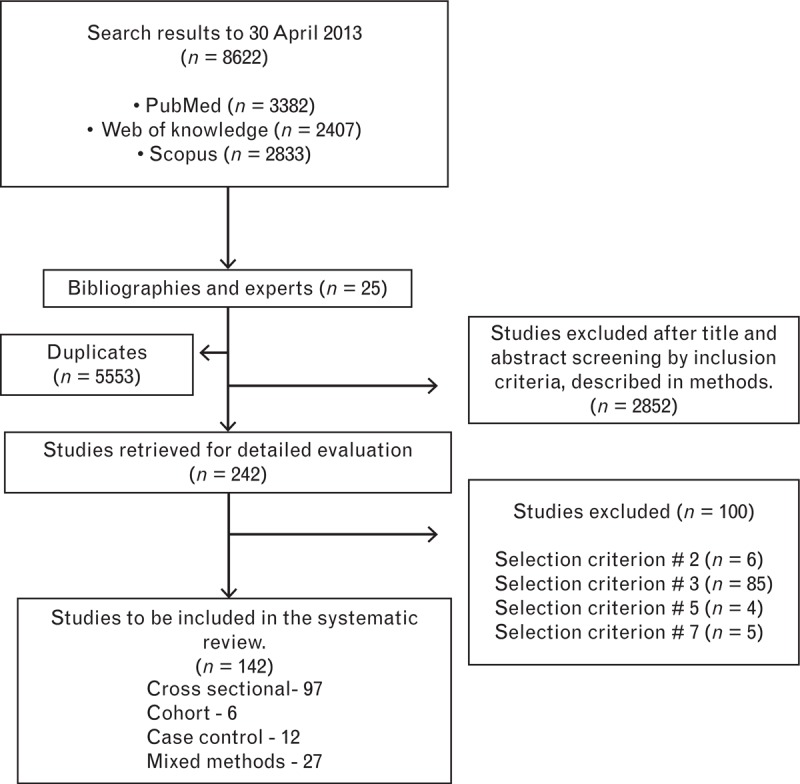
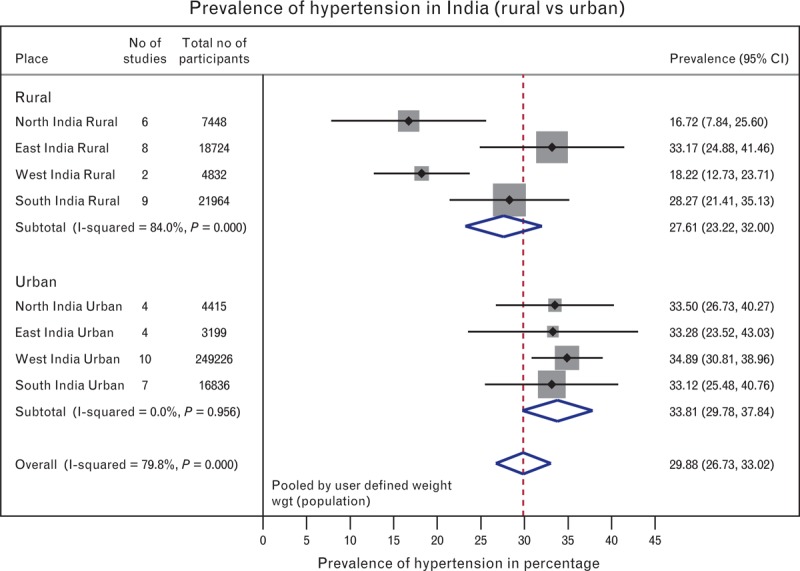
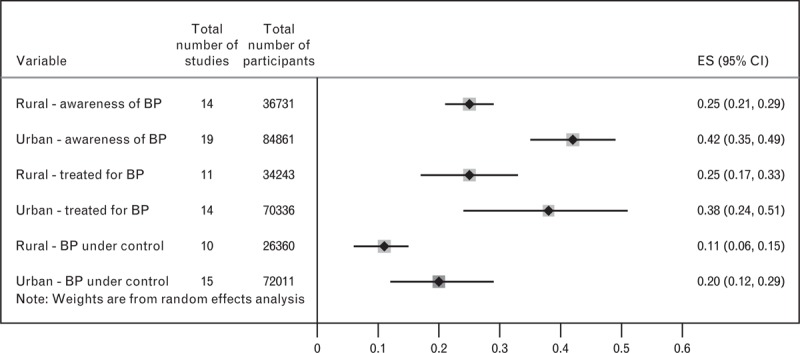
BACKGROUND: A region-specific (urban and rural parts of north, east, west, and south India) systematic review and meta-analysis of the prevalence, awareness, and control of hypertension among Indian patients have not been done before. METHODS: Medline, Web of Science, and Scopus databases from 1950 to 30 April 2013 were searched for 'prevalence, burden, awareness, and control of blood pressure (BP) or hypertension (≥140 SBP and or ≥90 DBP) among Indian adults' (≥18 years). Of the total 3047 articles, 142 were included. RESULTS: Overall prevalence for hypertension in India was 29.8% (95% confidence interval: 26.7-33.0). Significant differences in hypertension prevalence were noted between rural and urban parts [27.6% (23.2-32.0) and 33.8% (29.7-37.8); P = 0.05]. Regional estimates for the prevalence of hypertension were as follows: 14.5% (13.3-15.7), 31.7% (30.2-33.3), 18.1% (16.9-19.2), and 21.1% (20.1-22.0) for rural north, east, west, and south India; and 28.8% (26.9-30.8), 34.5% (32.6-36.5), 35.8% (35.2-36.5), and 31.8% (30.4-33.1) for urban north, east, west, and south India, respectively. Overall estimates for the prevalence of awareness, treatment, and control of BP were 25.3% (21.4-29.3), 25.1% (17.0-33.1), and 10.7% (6.5-15.0) for rural Indians; and 42.0% (35.2-48.9), 37.6% (24.0-51.2), and 20.2% (11.6-28.7) for urban Indians. CONCLUSION: About 33% urban and 25% rural Indians are hypertensive. Of these, 25% rural and 42% urban Indians are aware of their hypertensive status. Only 25% rural and 38% of urban Indians are being treated for hypertension. One-tenth of rural and one-fifth of urban Indian hypertensive population have their BP under control.
Overview
The claims and statistics of this paper haven’t been checked yet.
Free: it reads the open-access text and checks the first 5 claims that cite a source we can check. Create a free account to check every claim.
Integrity signals
Registry
Cites
Statistics
Figures
Verification
Claims the paper makes
The claims and statistics of this paper haven’t been checked yet.
Free: it reads the open-access text and checks the first 5 claims that cite a source we can check. Create a free account to check every claim.
Claims other papers make about this one
Each is checked against this paper’s own text: does it say what the citing paper says it does?
The source backs part of the claim, not all of it — or backs it for a different population, condition or comparison.
In the citing paper
“South Asian populations originating from the Indian subcontinent have a particularly high risk for cardiovascular and metabolic diseases, including CAD and type 2 DM.”
From 2020 International Society of Hypertension Global Hypertension Practice Guidelines (2020) · cites this paper as [141]
Experimental — accuracy not yet measuredThe cited source says what the claim attributes to it.
In the citing paper
“The prevalence of hypertension in rural India is estimated to be 27.6% [31], and the prevalence of type 2 diabetes in rural India is 16% [32], significantly contributing to the burden of disease.”
From Diagnostic Concordance of Telemedicine as Compared With Face-to-Face Care in Primary Health Care Clinics in Rural India: Randomized Crossover Trial (2023) · cites this paper as [31]
Self-check
Percentages, sums and reported differences re-computed from the paper’s own numbers.
The self-check needs the paper’s full text.
Citations
Cites
von Elm, E., Altman, D. G., Egger, M., Pocock, S. J., Gøtzsche, P. C., Vandenbroucke, J. P., & Initiative, F. T. S. (2007) · PLoS Medicine · doi:10.1371/journal.pmed.0040296 · Cited by 23,020
von Elm, E., Altman, D. G., Egger, M., Pocock, S. J., Gøtzsche, P. C., & Vandenbroucke, J. P. (2008) · Journal of Clinical Epidemiology · doi:10.1016/j.jclinepi.2007.11.008 · Cited by 17,893
von Elm, E., Altman, D. G., Egger, M., Pocock, S. J., Gøtzsche, P. C., Vandenbroucke, J. P., & Initiative, F. T. S. (2007) · Annals of Internal Medicine · doi:10.7326/0003-4819-147-8-200710160-00010 · Cited by 17,796
Lim, S. S., Vos, T., Flaxman, A. D., Danaei, G., Shibuya, K., Adair-Rohani, H., AlMazroa, M. A., Amann, M., Anderson, H. R., Andrews, K. G., et al. (2012) · The Lancet · doi:10.1016/s0140-6736(12)61766-8 · Cited by 11,805
Vandenbroucke, J. P., von Elm, E., Altman, D. G., Gøtzsche, P. C., Mulrow, C. D., Pocock, S. J., Poole, C., Schlesselman, J. J., Egger, M., & Initiative, F. T. S. (2007) · PLoS Medicine · doi:10.1371/journal.pmed.0040297 · Cited by 8,613 · cited 1×
“Quality scores were defined based on presence of eligibility criterion, sources and methods of selection of participants, reported numbers of outcome events or summary measures, and mentioned limitations of the study [62].”
Global burden of hypertension: analysis of worldwide data
Kearney, P. M., Whelton, M., Reynolds, K., Muntner, P., Whelton, P. K., & He, J. (2005) · The Lancet · doi:10.1016/s0140-6736(05)17741-1 · Cited by 8,594 · cited 3×
“An alarming rise in HTN projected by Global Burden of Hypertension 2005 study, [7] the GBD 2010 study [1] and WHO 2011 NCD India specific data [11] portray a grim picture for the 17.”
BackgroundLopez, A. D., Mathers, C. D., Ezzati, M., Jamison, D. T., & Murray, C. J. (2006) · The Lancet · doi:10.1016/s0140-6736(06)68770-9 · Cited by 5,630
Vandenbroucke, J. P., Elm, E. V., Altman, D. G., Gøtzsche, P. C., Mulrow, C. D., Pocock, S. J., Poole, C., Schlesselman, J. J., Egger, M., & initiative, F. T. S. (2007) · Annals of Internal Medicine · doi:10.7326/0003-4819-147-8-200710160-00010-w1 · Cited by 3,543
The Atlas of Heart Disease and Stroke
Mackay, J., Mensah, G. A., & Mendis, S. (2004) · Medical Entomology and Zoology · Cited by 1,550
Responding to the threat of chronic diseases in India
Srinath Reddy, K., Shah, B., Varghese, C., & Ramadoss, A. (2005) · The Lancet · doi:10.1016/s0140-6736(05)67343-6 · Cited by 728
Research works printed but not linked: 1
- Kaur M Blood pressure trends and hypertension among rural and urban Jat women of Haryana, India. Coll Antropol 2012; 36: 139– 144 22816211
Cited by
Items 701–787 of 787
Mir, U. Y., Parveen, S. A., Abbasi, S., Nayab, M., & Ansari, A. N. (2024) · Journal of Drug Delivery and Therapeutics · doi:10.22270/jddt.v14i8.6739
Alqahtani, T., Hakami, M., Alqahtani, A., Alotaibi, M. M., Alhussain, A. H., AlBattal, S. M., & Kofi, M. A. (2024) · European Journal of Medical and Health Research · doi:10.59324/ejmhr.2024.2(5).05
Semou, T., Monteiro, S. R., Hariharan, M., Padhy, M., & Chivukula, U. (2024) · Health Education Journal · doi:10.1177/00178969241289337 · Cited by 5
“In India, hypertension affects 29.8% of adults over 18 years, with only 25% of rural and 42% of urban hypertensive individuals being aware of their condition, and even fewer managing it successfully (Anchala et al., 2014).”
InfluentialKandpal, V., SACHDEVA, M. P., & Saraswathy, K. N. (2024) · Journal of the Practice of Cardiovascular Sciences · doi:10.4103/jpcs.jpcs_87_23
Das, U., & Kar, N. (2024) · Archives of Medicine and Health Sciences · doi:10.4103/amhs.amhs_101_24
Study of clinical and etiological profile of hypertension in young patients
Naik, S. R., Ramalingaiah, M. T., & Ram, A. (2025) · Asian Journal of Medical Sciences · doi:10.71152/ajms.v16i1.4358
Kulkarni, D., Patil, S. V., & Gondhali, G. (2025) · Electronic Journal of General Medicine · doi:10.29333/ejgm/15852 · Cited by 1
“This number has increased significantly since the COVID-19 pandemic [5].”
BHARADWAJ, A., Raj, D., & SHARMA, V. (2025) · International Journal of Current Pharmaceutical Research · doi:10.22159/ijcpr.2025v17i1.6032
“Data on hypertension in India, particularly concerning the underlying contributory factors, remains scant [6].”
Vashisht, B. M., Saha, A., Pratibha, N. A., Jyotsana, J., & Kumar, A. (2025) · Indian Journal of Community Medicine · doi:10.4103/ijcm.ijcm_270_23
“[1] Obesity, another often neglected noncommunicable disease (NCD), has a prevalence between 11.8 and 31.3% in India.”
InfluentialMittal, A., Gupta, S., Natt, H. K., Verma, M., Bharadwaz, M. P., & Goel, S. (2025) · Indian Journal of Community Medicine · doi:10.4103/ijcm.ijcm_748_23
The burden of hypertension in future doctors: a phase-wise cross-sectional study
Jilani, M. S. M., Asifali, S. A., Khan, M., Munaf, M. S., Solanke, S. N., Chhabda, D. S., & Javeriya, S. (2025) · International Journal of Research in Medical Sciences · doi:10.18203/2320-6012.ijrms20250667
Prevalence of Undiagnosed Hypertension in Bangladesh: A Systematic Review and Meta‐Analysis
Sultana, N., Afia, Z., Zoha, S., Mosharaf, M. P., Hossain, M. G., & Kibria, M. K. (2025) · Journal of Clinical Hypertension · doi:10.1111/jch.70026 · Cited by 4
“[33], Pakistan (26.34”
InfluentialRauf, E., Siddiqui, Z., Akhtar, J., Jahan, N., Khan, M. Q., & Khan, A. A. (2022) · Hippocratic Journal of Unani Medicine · doi:10.4103/hjum.hjum_4_25
Kumbang, N., & Oommen, A. M. (2024) · CHRISMED Journal of Health and Research · doi:10.4103/cjhr.cjhr_81_24
Effect of yoga and diet on cognitive functions among hypertensives: a review
Hasan, A. T. M. T., Saboo, N., & Kacker, S. (2025) · MGM Journal of Medical Sciences · doi:10.4103/mgmj.mgmj_305_24
Kumar, D. R., Thakur, N., Sharma, A., Mohmad, K., Majeed, M., Kabir, S., & Akhtar, T. (2025) · International Journal of Advance Research in Medical Surgical Nursing · doi:10.33545/surgicalnursing.2025.v7.i1b.229
Hypertension and Cognitive Trajectories: A Prospective Cohort Study in the Elderly Indian Population
Yadav, S., Sharma, S. D., Yadav, B. S., & Insa, R. (2025) · Indian Journal of Social Psychiatry · doi:10.4103/ijsp.ijsp_245_24
Maamor, N. H., Zainudin, N. A. Z., Nasir, N. L. M., Manoharan, K., Yunus, S. Z. S. A., Muhamad, N. A., & Lai, N. M. (2025) · JMIR Research Protocols · doi:10.2196/65807 · Cited by 1
“Whereas in the African and Asian continents, the pooled prevalence of HT among children is 5.5% (Africa) [8], 18.4% (China) [9], and 29.8% (India) [10].”
InfluentialFolayan, A., Fatt, Q. K., Cheong, W. L., & Su, T. T. (2025) · Health Science Reports · doi:10.1002/hsr2.70740
“This is not too far from the meta ‐ analysis of studies conducted in rural India, which stated hypertension control of 10.7% [26].”
InfluentialUnravelling the occupational factor and hypertension puzzle among Indian older adults
Maurya, P., Chattopadhyay, A., & Sharma, P. (2025) · Archives of Gerontology and Geriatrics Plus · doi:10.1016/j.aggp.2025.100172 · Cited by 1
Mathew, A. C., Joy, J., Chandy, J. A., & Lam, A. (2025) · Clinical Epidemiology and Global Health · doi:10.1016/j.cegh.2025.102080
Transforming Health: The role of mobile applications in lifestyle changes for hypertension
Ravali, A., Kumar, D. S., Shruddha, & Yadav, D. (2025) · Clinical Epidemiology and Global Health · doi:10.1016/j.cegh.2025.102097 · Cited by 1
Falvey, B., Mhatre, S., Bohrmann, B., Panse, N. S., Burrett, J. A., Chaturvedi, P., Oman, H., Karande, L., de Souza, R., Sherliker, P., et al. (2025) · Research Square · doi:10.21203/rs.3.rs-9748915/v1
Against the odds: Nivedita's fight for survival and hope
Shankar, M. (2025) · Journal of Nephrology · doi:10.1007/s40620-025-02300-x
Daneshzad, E., Hatami, S. E., Sobhani, S., Ghoreshi, B., Khonsari, N.-M., Shahrestanaki, E., Pezeshki, M., Kiaee, Z. F., Assar, O., & Qorbani, M. (2025) · BMJ Open · doi:10.1136/bmjopen-2024-090472
Agrawal, A., & Kumari, R. (2025) · International Journal of Community Medicine and Public Health · doi:10.18203/2394-6040.ijcmph20252113
Sood, T., & Raina, S. K. (2025) · Journal of Medical Society · doi:10.4103/jms.jms_99_23
Dixit, M., Chaurasia, R. C., Nim, D. K., & Mathur, M. (2025) · Perspectives in Clinical Research · doi:10.4103/picr.picr_165_24
“[11] The total sample size was 322, and considering the 10% loss of sample during the study, it was calculated to be = 354.”
Nigar, K., & Pathak, P. K. (2025) · Archives of Public Health · doi:10.1186/s13690-025-01546-y
“The lower chances of comorbidity among the older population residing in rural India are in fine tune with earlier evidence [70–72].”
Yadav, N. K., Singh, P. K., & Verma, S. (2025) · International Journal of Sports Health and Physical Education · doi:10.33545/26647559.2025.v7.i2b.237
Increased Prevalence of Comorbidities in Systemic Sclerosis Patients in India
Chandrashekara, S., Shenoy, P. D., Ghosh, A., Kumar, U., Pandya, S. C., Dudam, R., Khare, A., & Goswami, R. P. (2025) · Indian Journal of Rheumatology · doi:10.1177/09733698251366766
“4,13 This lower prevalence may be attributed to the study’s criteria, where patients were classified as hypertensive only if they had a prior diagnosis and required treatment intervention, rather than through proactive screening, as done in the ICMR survey and SPRING registry.”
Srivastava, G., Wadke, R. A., Wanje, S. D., Raut, S., Krishnaja, N. P., & Phadnis, K. (2025) · International Journal of Community Medicine and Public Health · doi:10.18203/2394-6040.ijcmph20252855
Mondal, A., & Kapoor, R. (2025) · Healthline · doi:10.51957/healthline_742_2025
Agbo, A. A., Idoko, P. O., Akwaras, N. A., Daniel, D. A., & Izeji, R. I. (2025) · International Journal of Research in Medical Sciences · doi:10.18203/2320-6012.ijrms20253578
Clinico-Etiological Profile of Young-Onset Dementia From a Tertiary Care Center in Northern India
Kumar, P., Bhat, A., Goel, D., & Mittal, M. (2025) · Cureus · doi:10.7759/cureus.96203
“Also, early-onset AD can present with a rapidly progressive course [18,19].”
Hariharan, M., Monteiro, S. R., Semou, T., Padhy, M., & Chivukula, U. V. (2025) · The Indian Journal of Medical Research · doi:10.25259/ijmr_1711_2024
Kumar, S., Khapre, M. P., Pathak, E. D., & Sakshi, G. (2025) · Cureus · doi:10.7759/cureus.97128
“A meta-analysis of hypertension across India noted that only 25.3% of rural hypertensive patients were aware of their diagnosis and were being treated, with control being achieved in only one-tenth of this population [4].”
InfluentialChauhan, S., Barwal, V. K., Ihsan, H., Masih, R., Chauhan, S., & Thakur, L. (2025) · Journal of Integrative Medicine and Research · doi:10.4103/jimr.jimr_50_25
Lakshmi, P. I., Shridhar, B., Sujatha, K. J., & Shetty, P. (2025) · CCRYN Indian Journal of Yoga & Naturopathy · doi:10.4103/ijyn.ijyn_13_25
Prevalence of Hypertension Among Young Adults: A Narrative Review
Datt, D., & Sharma, N. (2025) · International Journal of Health Sciences and Research · doi:10.52403/ijhsr.20251222
Garg, S., Dewangan, M., Nanda, P., Sahu, A., Xalxo, L., Bebarta, K. K., Gupta, V., Quereishi, M. J., Sahu, A. K., & Tandan, P. (2024) · Figshare · doi:10.6084/m9.figshare.26653230
Chauhan, S., Kumar, S., Patel, R., Simon, D. J., & Kumari, A. (2022) · Figshare · doi:10.6084/m9.figshare.21311036
Ross, S., Chadha, K., Mishra, S., Lewington, S., Shepperd, S., & Gathani, T. (2022) · Figshare · doi:10.6084/m9.figshare.20484946
Chauhan, S., Kumar, S., Patel, R., Simon, D. J., & Kumari, A. (2022) · Figshare · doi:10.6084/m9.figshare.21311039
Mishra, V. K., Srivastava, S., Muhammad, T., & Murthy, P. V. (2022) · Figshare · doi:10.6084/m9.figshare.19582558
Garg, S., Dewangan, M., Nanda, P., Sahu, A., Xalxo, L., Bebarta, K. K., Gupta, V., Quereishi, M. J., Sahu, A. K., & Tandan, P. (2024) · Figshare · doi:10.6084/m9.figshare.26653227
Das, A., & Dhillon, P. (2025) · Archives of Gerontology and Geriatrics Plus · doi:10.1016/j.aggp.2025.100241
Prasad, J. B., Sabhahit, G., & Biradar, R. A. (2025) · European Journal of Clinical and Experimental Medicine · doi:10.15584/ejcem.2025.4.22
Suryawanshi, J., Narayan, R., & Yadav, D. K. (2026) · International Journal of Community Medicine and Public Health · doi:10.18203/2394-6040.ijcmph20260304
Multi-task Model for Blood Pressure Assessment from Short PPG Measurements
Padmavilochanan, D., Pathinarupothi, R. K., Menon, K. A. U., Ramesh, M. V., & Rangan, P. V. (2026) · Lecture notes in networks and systems · doi:10.1007/978-981-95-2878-3_30
Shwetha, S. S., & Thomas, A. (2025) · Journal of Ecophysiology and Occupational Health · doi:10.18311/jeoh/2025/46284
Kanagasabapathy, E., Easwaran, M., & Basha, W. (2026) · Healthline · doi:10.51957/healthline_763_2026
“A cross-sectional study [33] conducted by Ragupathy et al has shown that consumption of low vegetables/fruits was one of the significant risk factors for hypertension among Indian population.”
Rastogi, P., Bhardwaj, A., Pandey, R., Kumar, P., Choudhary, S., & Sharma, S. (2026) · Journal of Primary Care Specialties · doi:10.4103/jopcs.jopcs_21_25
Khanna, S., Kubihal, S., Hassan, H. J. U., Thirumalai, S., Bajaj, S., Choudhary, B., Kumar, K., Srivastava, R., SINGH, R. K., Patel, L. A., et al. (2026) · International Journal of Research in Medical Sciences · doi:10.18203/2320-6012.ijrms20261073
Heart Failure in Low- and Middle-Income Countries
Bhat, V., Makri, H., & Baliga, R. R. (2026) · Elsevier eBooks · doi:10.1016/b978-0-443-15734-9.00081-9
Shrivastava, S., & Gupta, R. (2026) · The Journal of Medical Research · doi:10.4103/jmr.jmr_96_25
Patel, A. B., Patel, K. M., Anturlikar, S. S., Patel, N. N., Dudhia, S. H., & Desai, H. (2026) · International Journal of Basic & Clinical Pharmacology · doi:10.18203/2319-2003.ijbcp20261110
Ramanujam, K., Mahathi, A., Pawar, J. N., Matla, M., Ponnapalli, H., Soma, V. K., Gajjala, K., Chukkala, S. S., Mummadi, M. K., Gavaravarapu, S. M., et al. (2026) · Nutrients · doi:10.3390/nu18101617
“Due to its high incidence and sizable population, India alone is home to more than one-fifth of the world’s hypertensive population [4].”
Tripathi, Y. B., Tripathi, S., & Dube, S. K. (2026) · SSRN Electronic Journal · doi:10.2139/ssrn.6786424
Saikia, D., Debnath, R., & Sari, C. (2026) · Discover Public Health · doi:10.1186/s12982-026-02270-w · Cited by 1
“Among Indian women of reproductive age, a group in whom cardiometabolic risk has historically been under screened and underdiagnosed, hypertension affects 12–22% of individuals across states, and blood glucose dysregulation is present in a further 7–15% [4, 5].”
Tyagi, A., Kacker, S., Saboo, N., & Kumar, L. (2026) · Lifestyle Medicine Research & Reviews · doi:10.37897/lmrr.2026.2.2
Manirsha, P. V., Basavegowda, M., & Joy, J. (2026) · Journal of Datta Meghe Institute of Medical Sciences University · doi:10.4103/jdmimsu.jdmimsu_92_26
Sharma, D. P. (2023) · Vidhyayana · doi:10.58213/k5khg059
Thakur, B., Shrivastava, K., Diwan, P., Agrawal, A., Diwakar, A., & Verma, J. (2026) · Cureus · doi:10.7759/cureus.113238
“Furthermore, a systematic review estimated a pooled prevalence of 27.6% in rural India, indicating that hypertension is no longer confined to urban populations and has become an important public health concern across diverse settings [5].”
InfluentialRenal denervation triage tool: a practical approach to the management of resistant hypertension
Kalra, S., Schlaich, M. P., Bhalla, A. K., Almeida, A., Kapadia, A. A., Maheshwari, A., Saboo, B., Nadkar, M., Soni, N. K., Hazra, P. K., et al. (2026) · AsiaIntervention · doi:10.4244/aij-d-25-00045
Bhattacharya, S., Dasgupta, A., Jahnavi, G., Venugopal, V., Panigrahi, S., Ghosh, S., Richa, Kumari, A., Kumar, S., Dibyanshu, et al. (2026) · Journal of Family Medicine and Primary Care · doi:10.4103/jfmpc.jfmpc_341_26
Development and validation of a digital hypertension risk prediction model for urban Indian adultsPreprint
Rakesh, M., Sunil Kumar, D., Prakash, G. H., Ravali, A., Yadav, D., Gopi, A., & Manirsha, P. V. (2026) · Research Square · doi:10.21203/rs.3.rs-10377899/v1
Bhuyan, J. K., Pradhan, S. K., Panda, S. K., Behera, J., Sai, M., & Jena, R. K. (2026) · Healthline · doi:10.51957/healthline_829_2026
“Factors such as changing life styles and socio-economic transitions have contributed to the rising [12] prevalence of hypertension among these communities.”
Recalibrating Risk: A Call for South Asian-Focused Heart Failure Prediction Models
Nair, N., Du, D., Pillai, A. J., Mahesh, S., Munagala, M. R., Eisen, H. J., & Mahesh, B. (2026) · Journal of Clinical Medicine · doi:10.3390/jcm15166181
“HTH in India appears to follow a pattern of higher incidence in developed urban regions of the nation housing populations of the higher socioeconomic strata [51,52].”
Unveiling the Social Roots of Undiagnosed Hypertension: A Case Study of a 70-Year-Old Patient
JITENDRAKUMAR, P. D., Parmar, A. S., Malu, A., & Pandit, N. B. (2026) · Medical Journal of Dr D Y Patil Vidyapeeth · doi:10.4103/mjdrdypu.mjdrdypu_216_25
Hypertension among migrant workers in Saudi Arabia: results from a large epidemiological study
Suleman, A.-R., Saquib, J., Almazrou, A. A., Shahid, M. S., Kalas, A. G., Baroum, A. M. A., Binsaqr, M. A., Hassan, W., Alzaaq, R., Sahlol, M., et al. (2026) · International Journal of Migration Health and Social Care · doi:10.1108/ijmhsc-08-2025-0110
Prevalence of physical illnesses and lifestyle factors among severely mentally ill in a community
Govindan, R., Triptish Bhatia, A., Rangaswamy, T., & Deshpande, S. N. (2026) · Indian Journal of Psychiatry · doi:10.4103/indianjpsychiatry_1151_24
“The global prevalence of hypertension is 25%, [18] while in India it is 29%, [19] but PWSMI had a higher rate of hypertension, [9,10] 56.3% were either diabetic or hypertensive in our study.”
InfluentialÇelik, M., & Çelik, S. G. (2026) · CURARE Journal of Nursing · doi:10.26650/curare.2026.1846271
Sandeep, M., Prasad, M. S. D., Akshitha, D., Yella, S. S. T., Shamim, M. A., Ananthesh, L., Shamanna, B. R., Shailendra, D., & Akhter, M. S. (2026) · Clinical Epidemiology and Global Health · doi:10.1016/j.cegh.2026.102467
Anyakorah, P. E., Innocent, D. C., Chukwuemeka, P. S., Ezenwa, C. J., Nwaokoro, J. C., Emina, V. A., & Anuwe, J. C. (2026) · Discover Public Health · doi:10.1186/s12982-026-02780-7
“…in some South Asian settings, hypertension remains highly prevalent across both urban and rural populations, while in parts of Sub-Saharan Africa, rural prevalence is increasing but still lags behind urban rates, reflecting differing stages of transition and exposure to risk factors [13, 14].”
InfluentialTohorunnesa, Jannat, T., Yeasmin, F., & Kabir, S. N. (2026) · TAJ Journal of Teachers Association · doi:10.70818/taj.v39i03.0835
Efficacy of Terminalia arjuna in essential hypertension: A randomized controlled study
Nazir, A., Bhat, M. D. A., & Mir, U. Y. (2026) · EXPLORE · doi:10.1016/j.explore.2026.103535
Puri, R., Mehta, V., Sahoo, P. K., & Yusuf, J. (2026) · Journal of clinical lipidology · doi:10.1016/j.jacl.2026.09.010 · Cited by 1
Kumar, I., Jaiswal, R. K., Roy, N., Panesar, S., & Dhamnetiya, D. (2026) · SN Comprehensive Clinical Medicine · doi:10.1007/s42399-026-02682-4
“However, evidence suggests that a substantial proportion of hypertensive individuals demonstrate inadequate self-care practices, particularly in resource-constrained settings [3].”
Kori, S. K., Kolte, S., Kumar, N. D., Dubey, A., Karanwad, T. R., Jain, A. K., Jain, A., Rajoriya, V., Shukla, R., Pandey, V. K., et al. (2026) · Proceedings of the Indian National Science Academy · doi:10.1007/s43538-026-00836-5
Shah, J., Hiremath, J., Deshpande, A., Kudva, S., Patel, B., Biradar, R., Ponniah, S., Ahmad, A., Thomas, V., KUMAR, S., et al. (2026) · Sleep and Vigilance · doi:10.1007/s41782-026-00377-3
Bandyopadhyay, V., Tripathy, J. P., & Deshmukh, P. R. (2026) · Indian Journal of Community Medicine · doi:10.4103/ijcm.ijcm_573_25
Durga, T. A., Rajasekar, V. D., Surya, B., Sridharan, V., Srinivasan, S., & Shri, P. M. N. K. (2026) · Indian Journal of Community Medicine · doi:10.4103/ijcm.ijcm_481_25
Roy, A. (2026) · Journal of Applied Gerontology · doi:10.1177/07334648261497261
Bhat, A., Ikbal, F., Kumar, S., Sharma, P., Bakshi, S., & Sonune, M. (2026) · CHRISMED Journal of Health and Research · doi:10.4103/cjhr.cjhr_95_26
Metadata
- Authors
- Anchala, R., Kannuri, N. K., Pant, H., Khan, H., Franco, O. H., Di Angelantonio, E., & Prabhakaran, D.
- Affiliations
- University of Cambridge (GB)
- Public Health Foundation (US)
- Erasmus MC (NL)
- Corresponding author
- Anchala, Raghupathy
- Venue
- Journal of Hypertension
- Published
- 2014-06
- Volume
- 32
- Issue
- 6
- Pages
- 1170-1177
- ISSN
- 0263-6352 (ISSN-L)
- PMC
- PMC4011565
- OpenAlex
- W2028825584
- Semantic Scholar
- 8a62255c3f7b79f8f2a7a97f53b750141021c8c7
- Cited by
- 782
- References
- 76
- Citations by year
- 2026: 45 · 2025: 67 · 2024: 80 · 2023: 97 · 2022: 103 · 2021: 79 · 2020: 70 · 2019: 65 · 2018: 52 · 2017: 49 · 2016: 55 · 2015: 14 · 2014: 6
- FWCI
- 6.66
- Type
- journal article
- Language
- en
- Open access
- hybrid
- doi.org
- Licence
- cc-by-nc-nd
- Locations
- Journal of Hypertension (publishedVersion, cc-by-nc-nd)
- Europe PMC (PubMed Central) (publishedVersion, cc-by-nc-nd)
- PubMed Central (publishedVersion, cc-by-nc-nd)
- PubMed (publishedVersion)
- EUR Research Repository (Erasmus University Rotterdam) (publishedVersion)
- EUR Research Repository (Erasmus University Rotterdam) (submittedVersion)
- RePub (Erasmus University Rotterdam) (submittedVersion, other-oa)
- Funders
- Wellcome Trust (084754)
- National Institute for Health and Care Research (NF-SI-0512-10165)
- British Heart Foundation (RG/08/014/24067)
- Medical Research Council (MR/L003120/1)
- Topics
- Health Sciences › Medicine › Cardiology and Cardiovascular Medicine › Blood Pressure and Hypertension Studies
- Health Sciences › Nursing › Nutrition and Dietetics › Sodium Intake and Health
- Health Sciences › Medicine › Cardiology and Cardiovascular Medicine › Cardiovascular Health and Risk Factors
- Keywords
- hypertension, hypertension prevalence, hypertension awareness, hypertension control, blood pressure, urban-rural differences, regional variation, India
- MeSH terms
- Attitude to Health, Blood Pressure, Geography, Humans, Hypertension, India, Risk Factors, Rural Population, Urban Population, Reproducibility of Results, Prevalence, Asian People
About these checks
Registry, retraction, Cites and statistics results are computed, not judged, with one exception: a printed reference that no index lists is read once by a model before it counts as a citation error. Claims are extracted by a model and kept only when their quote appears verbatim in the text; each cited source is then checked, with a model’s help, for whether it says what the claim relies on. Those verdicts can be wrong — read the claim’s quote and the cited source before relying on one.
Statistics and arithmetic are recomputed, not judged.
Confidence bands are shown only for fields calibrated on our annotated test set. None is calibrated yet, so no band is shown.
What counts as a claim ›How we measure confidence ›How we check this ›
Are you an author, or do you see a problem with this page? Request a review
Data sources
Bibliographic data: Semantic Scholar, OpenAlex, Crossref.
Contains information from the Semantic Scholar Academic Graph Datasets, made available under the ODC Attribution License (ODC-BY 1.0).
Semantic Scholar’s data is described in: Kinney, R., et al. (2023). The Semantic Scholar Open Data Platform. arXiv:2301.10140.
