

Nocebo and pain: an overview of the psychoneurobiological mechanisms
Open accessThe DOI matches its Crossref record; 81 of the 82 references it cites were found in a registry or an index; 8 of the 102 sources its claims cite were checked for support.
Abstract
INTRODUCTION: Nocebo effects are defined as adverse events related to negative expectations and learning processes that are involved in the modulation of the descending pain pathways. Research over the last couple of decades has illustrated that behavioral, psychoneurobiological and functional changes occur during nocebo-induced pain processing. OBJECTIVES: We aimed to review published human and non-human research on algesia and hyperalgesia resulting from negative expectations and nocebo effects. METHODS: Herein, we searched and comprehensively reviewed scientific literature providing informative knowledge about the psychoneurobiological bases of the nocebo effect in the field of pain with an emphasis on how pain processes are shaped by both cognitive and non-cognitive factors. RESULTS: Negative expectations are formed through verbal suggestions of heightened pain, prior nociceptive and painful experiences and observation of pain in others. Susceptibility to the nocebo effect can be also influenced by genetic variants, conscious and nonconscious learning processes, personality traits and psychological factors. Moreover, providers' behaviors, environmental cues and the appearance of medical devices can induce negative expectations that dramatically influence pain perception and processing in a variety of pain modalities and patient populations. CONCLUSION: Importantly, we concluded that nocebo studies outline how individual expectations may lead to physiological changes underpinning the central integration and processing of magnified pain signaling. Further research is needed to develop strategies that can identify nocebo-vulnerable pain patients in order to optimize the psychosocial and therapeutic context in which the clinical encounter occurs, with the ultimate purpose of improving clinical outcomes.
Overview
CoChat Summary
TL;DR
This narrative review explains how negative expectations, conditioning, and social observation can produce nocebo-induced pain and hyperalgesia. It argues that these effects arise through psychological, neurochemical, and neurophysiological pathways that can also interfere with pain treatment outcomes.
Key findings
- Negative expectations from verbal suggestions can worsen pain and even reverse analgesic effects: e.g., 33% nitrous oxide was reversed from analgesia to hyperalgesia when participants were misled about increased pain, and misleading instructions ruled out the pain reduction from a verum medication in an ischemic arm-pain study.
- Conditioning and learning can generate persistent nocebo effects; the paper states that both partial and continuous classical conditioning produced nocebo effects that did not extinguish over the entire experimental sessions, and that nocebo effects can occur without conscious negative expectancies.
- Social observation can increase pain: in one study of 97 women, pain ratings were higher in the nocebo condition than in the control condition after observing a model’s pain responses; another study found hyperalgesic effects correlated with observed uncertainty and periaqueductal gray activity.
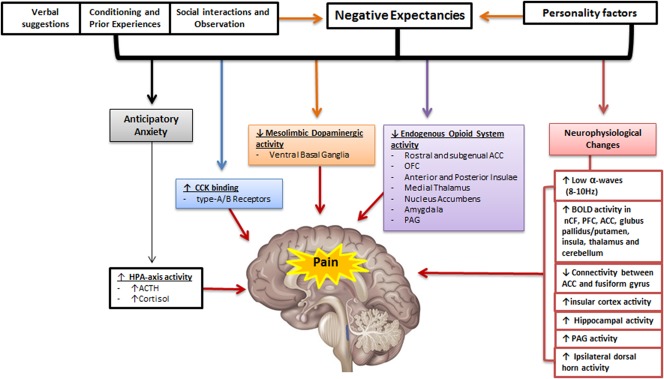
- Biochemical/neurophysiological findings linked nocebo hyperalgesia with increased cortisol and ACTH, blockade by diazepam and proglumide, reduced mesolimbic dopaminergic and opioid system activity, and in one experiment positive expectancy doubled remifentanil analgesia while expectancy of pain exacerbation blocked it.
Methods
- Narrative review of published human and nonhuman research on nocebo-related algesia and hyperalgesia in pain.
- Search strategy: PubMed was searched using “nocebo,” “pain,” and “negative expectancy”; abstracts were independently reviewed by 2 authors.
- The paper synthesizes experimental, psychopharmacological, neuroimaging, conditioning, and social-observation studies rather than reporting a single new dataset.
Limitations
- The paper explicitly states that the “paucity of studies linking the psychological and neurobiological changes limits the transfer of knowledge from bench to beside.”
- It also says more research is needed to define commonalities and differences across ways to elicit nocebo effects, and to better understand fear-, stress-, and anxiety-related nocebo mechanisms.
- Evident from the text: this is a narrative review, so conclusions depend on the scope and selection of studies described, not on a systematic meta-analysis or new primary data.
Model-written summary. Check it against the paper before relying on it.
Integrity signals
Registry
Cites
Statistics
Figures
Verification
Claims the paper makes
4 Valid · 5 Not valid · 67 Not checked · 15 Own results and interpretations
At least one cited source doesn’t support this claim or points to a different paper, and none confirmed it — see the verdicts below.
In the paper
“Another study documented that nocebo hyperalgesia was found in a group who observed a male or female model receive less painful stimulations with the appearance of a green-light, and higher pain intensities with appearance of a red-light, for a period of about 5 minutes prior to receiving the stimuli themselves.”
§ Nocebo and pain: an overview of the psychoneurobiological mechanisms > 6. Negative expectancies and social learning
What the sources say
- Misattributedcites [74] Swider K Babel P The effect of the sex of a model on nocebo hyperalgesia induced by social observational learning. PAIN 2013; 154: 1312– 17. 23725779 sourceExperimental — accuracy not yet measured
Split into 2 atoms — 0 confirmed, 0 partially supported, 0 disputed, 2 misattributed, 0 unverifiable. Expand the claim to see per-atom verdicts. It matches “The effect of the sex of a model on nocebo hyperalgesia induced by social observational learning” (2013) instead.
Checked by a reasoning model — may be wrong.
plainstates a cause- Asserted: passes — The authors put it forward as true.
- Checkable: passes — It can be checked against evidence.
- Load-bearing: unclear — It is unclear whether the paper’s conclusions depend on it.
- Based: passes — The paper gives a reason why it holds.
- Misattributed
The cited sources support only part of this claim — read each source’s verdict below.
In the paper
“have the potential to significantly influence pain pathways by triggering physiological changes that could consequently affect not only pain perception but also pharmacological efficacy and clinical outcomes in the context of pain management.28”
§ Nocebo and pain: an overview of the psychoneurobiological mechanisms > 1. Introduction
What the sources say
- Partly supportedcites [28] Colloca L Grillon C Understanding placebo and nocebo responses for pain management. Curr Pain Headache Rep 2014; 18: 419. 24771206 PMC4142751 sourceExperimental — accuracy not yet measured
The Introduction (page unavailable) says placebo responses involve physiological mechanisms that influence pain perception and modulate responses to active analgesics; the Concluding remarks also link placebo mechanisms to treatment effectiveness. These passages concern placebo analgesia, not the claimed effects of nocebo responses, so they do not establish the claim as stated. (LLM, conf=0.78)
hedgedstates a possible cause- Asserted: passes — The authors put it forward as true.
- Checkable: passes — It can be checked against evidence.
- Load-bearing: passes — The paper’s conclusions depend on it.
- Based: passes — The paper gives a reason why it holds.
- Partly supported
The cited sources that could be checked couldn’t confirm or dispute this claim.
In the paper
“In a different study, the same research group found that the nocebo response was positively associated with pain catastrophizing.77”
§ Nocebo and pain: an overview of the psychoneurobiological mechanisms > 6. Negative expectancies and social learning
What the sources say
- Could not verifycites [77] Vogtle E Barke A Kroner-Herwig B Nocebo hyperalgesia induced by social observational learning. PAIN 2013; 154: 1427– 33. 23707275 sourceExperimental — accuracy not yet measured
The Introduction discusses psychological predictors of nocebo responses, and the Methods describe measuring somatosensory amplification, but neither passage reports an association with pain catastrophizing. A search for “pain catastrophizing” and its association with nocebo responses found no such result in our copy. Page numbers were unavailable. (LLM, conf=0.72)
plainstates an association- Asserted: passes — The authors put it forward as true.
- Checkable: passes — It can be checked against evidence.
- Load-bearing: unclear — It is unclear whether the paper’s conclusions depend on it.
- Based: passes — The paper gives a reason why it holds.
- Could not verify
The cited sources that could be checked couldn’t confirm or dispute this claim.
In the paper
“The social observation (vicarious learning) played an important role in the development of placebo effects.”
§ Nocebo and pain: an overview of the psychoneurobiological mechanisms > 6. Negative expectancies and social learning
What the sources say
- Could not verifycites [26] Colloca L Benedetti F Placebo analgesia induced by social observational learning. PAIN 2009; 144: 28– 34. 19278785 sourceExperimental — accuracy not yet measured
The opening section says placebo effects can arise from verbal suggestions and past experience, but it does not discuss social observation or vicarious learning. Searches for those terms and for observing others developing placebo responses found no passage addressing the claimed role of vicarious learning. (LLM, conf=0.74)
plainstates a cause- Asserted: passes — The authors put it forward as true.
- Checkable: passes — It can be checked against evidence.
- Load-bearing: unclear — It is unclear whether the paper’s conclusions depend on it.
- Based: passes — The paper gives a reason why it holds.
- Could not verify
The cited sources that could be checked couldn’t confirm or dispute this claim.
In the paper
“In particular, the placebo analgesia generated in the observer positively correlated with the grade of empathy of the observer.”
§ Nocebo and pain: an overview of the psychoneurobiological mechanisms > 6. Negative expectancies and social learning
What the sources say
- Could not verifycites [26] Colloca L Benedetti F Placebo analgesia induced by social observational learning. PAIN 2009; 144: 28– 34. 19278785 sourceExperimental — accuracy not yet measured
The main text discusses placebo and nocebo effects in patient–clinician communication, but does not report placebo analgesia in observers or a correlation with empathy. Searches for observer empathy and observational learning returned no passage addressing that relationship. (LLM, conf=0.76)
plainstates an association- Asserted: passes — The authors put it forward as true.
- Checkable: passes — It can be checked against evidence.
- Load-bearing: unclear — It is unclear whether the paper’s conclusions depend on it.
- Based: passes — The paper gives a reason why it holds.
- Could not verify
56 more claims · 1 with their cited sources checked
Create a free account to see all 91 claims and to verify the 94 references still open.
- It may state two separate claims as one. 26
- Probably not a substantial claim. 4
- The quote only partly states this claim. 1
Claims other papers make about this one
Each is checked against this paper’s own text: does it say what the citing paper says it does?
The cited source says what the claim attributes to it.
In the citing paper
“Likewise, expecting high pain increases the perceived intensity of pain, as in nocebo hyperalgesia12.”
From Boundary effects of expectation in human pain perception (2019) · cites this paper as [12]
The cited source says what the claim attributes to it.
In the citing paper
“A well-established nocebo-conditioning paradigm combined with verbal suggestions was used for inducing nocebo hyperalgesia in the lab [22].”
From Nocebo hyperalgesia and other expectancy-related factors in daily fibromyalgia pain: Combining experimental and electronic diary methods (2024) · cites this paper as [22]
The check wasn’t confident either way, so it gives no verdict — never disputed.
In the citing paper
“If these manipulations affect the reinforcement signal used in calculating prediction errors, it would short-circuit learning by suppressing cue-inconsistent prediction errors.”
From Social information creates self-fulfilling prophecies in judgments of pain, vicarious pain, and cognitive effort (2026) · cites this paper as [39]
Experimental — accuracy not yet measured
Citations
Cites
Models and Mechanisms of Hyperalgesia and Allodynia
Sandkühler, J. (2009) · Physiological Reviews · doi:10.1152/physrev.00025.2008 · Cited by 1,148
COMT val 158 met Genotype Affects µ-Opioid Neurotransmitter Responses to a Pain Stressor
Zubieta, J.-K., Heitzeg, M. M., Smith, Y. R., Bueller, J. A., Xu, K., Xu, Y., Koeppe, R. A., Stohler, C. S., & Goldman, D. (2003) · Science · doi:10.1126/science.1078546 · Cited by 1,125
Exacerbation of Pain by Anxiety Is Associated with Activity in a Hippocampal Network
Ploghaus, A., Narain, C., Beckmann, C. F., Clare, S., Bantick, S., Wise, R., Matthews, P. M., Rawlins, J. N. P., & Tracey, I. (2001) · The Journal of Neuroscience · doi:10.1523/jneurosci.21-24-09896.2001 · Cited by 822 · cited 1×
“creating an augmentation of pain experience and processing.(52,58,63) For example, the mere expectation to feel more pain after the administration of an inert medication affects a laserinduced pain experience and related laser-evoked potential amplitude in the treated hand.”
BackgroundBingel, U., Wanigasekera, V., Wiech, K., Ni Mhuircheartaigh, R., Lee, M. C., Ploner, M., & Tracey, I. (2011) · Science Translational Medicine · doi:10.1126/scitranslmed.3001244 · Cited by 810
Benedetti, F., Pollo, A., Lopiano, L., Lanotte, M., Vighetti, S., & Rainero, I. (2003) · The Journal of Neuroscience · doi:10.1523/jneurosci.23-10-04315.2003 · Cited by 788 · cited 2×
“While the placebo procedure led to nearly the same pain reduction as the pain medication, the nocebo information ruled out this positive effect.(16)”
BackgroundNonspecific medication side effects and the nocebo phenomenon
Barsky, A. J. (2002) · JAMA · doi:10.1001/jama.287.5.622 · Cited by 784 · cited 2×
“Expectations about side effects, that produce nocebo effects, can be induced through verbal suggestion(15) or written information,(20) the latter including information provided during the informed consent process about potential adverse events.(7) The expectations of the patients receiving a treatment are of particula…”
BackgroundThe subjective experience of pain: where expectations become reality
Koyama, T., McHaffie, J. G., Laurienti, P. J., & Coghill, R. C. (2005) · Proceedings of the National Academy of Sciences · doi:10.1073/pnas.0408576102 · Cited by 747 · cited 1×
“creating an augmentation of pain experience and processing.(52,58,63) For example, the mere expectation to feel more pain after the administration of an inert medication affects a laserinduced pain experience and related laser-evoked potential amplitude in the treated hand.”
BackgroundPlacebo and Nocebo Effects Are Defined by Opposite Opioid and Dopaminergic Responses
Scott, D. J., Stohler, C. S., Egnatuk, C. M., Wang, H., Koeppe, R. A., & Zubieta, J.-K. (2008) · Archives of General Psychiatry · doi:10.1001/archgenpsychiatry.2007.34 · Cited by 637 · cited 1×
“The dopaminergic system showed reduced activity in areas of the brain such as the ventral basal ganglia, while the endogenous opioid system showed a reduction of activity in the rostral and subgenual ACC, orbitofrontal cortex, anterior and posterior insulae, medial thalamus, nucleus accumbens, amygdala, and periacqued…”
ResultWhen words are painful: unraveling the mechanisms of the nocebo effect
Benedetti, F., Lanotte, M., Lopiano, L., & Colloca, L. (2007) · Neuroscience · doi:10.1016/j.neuroscience.2007.02.020 · Cited by 636 · cited 1×
“Indeed, negative expectations that are induced by the medical staff also lead to the formation of nocebo effects.(15,31) In clinical settings, expecting side effects from medical treatments is consistently associated with higher reports of nocebo effects.”
BackgroundSelf-citationOvert versus covert treatment for pain, anxiety, and Parkinson's disease
Colloca, L., Lopiano, L., Lanotte, M., & Benedetti, F. (2004) · The Lancet Neurology · doi:10.1016/s1474-4422(04)00908-1 · Cited by 552 · cited 1×
“Information helps patients to direct their attention to these features, in turn forming expectations of effectiveness that would minimize nocebo effects.(11,12,30)”
BackgroundSelf-citation
Research works printed but not linked: 3
- Bandura A Social learning theory. New York: General Learning Press; 1977.
- Colloca L, Nocebo effects: the dilemma of disclosing adverse events. In: Ethics and Governance of biomedical research. Strech D Mertz M, eds. Switzerland: Springer; 2016: 47– 55. ISBN: 9783319287294.
- Klinger R Blasini M Schmitz J Colloca L Pain report 2017. PMC5639717 29034363
Cited by
(2020) · doi:10.1056/nejmra1907805 · Cited by 634
Self-citationRossettini, G., Carlino, E., & Testa, M. (2018) · BMC Musculoskeletal Disorders · doi:10.1186/s12891-018-1943-8 · Cited by 307
“considering that beliefs and behaviors could influence patients’ attitudes in a positive or negative way [7, 169].”
BackgroundUnraveling Negative Expectations and Nocebo-Related Effects in Musculoskeletal Pain
Rossettini, G., Colombi, A., Carlino, E., Manoni, M., Mirandola, M., Polli, A., Camerone, E. M., & Testa, M. (2022) · Frontiers in Psychology · doi:10.3389/fpsyg.2022.789377 · Cited by 268
Rossettini, G., Camerone, E. M., Carlino, E., Benedetti, F., & Testa, M. (2020) · Archives of Physiotherapy · doi:10.1186/s40945-020-00082-y · Cited by 158
The Role of Patient–Practitioner Relationships in Placebo and Nocebo Phenomena
Blasini, M., Peiris, N., Wright, T., & Colloca, L. (2018) · International Review of Neurobiology · doi:10.1016/bs.irn.2018.07.033 · Cited by 121
“HPA axis activation, anxiety, and the activity of the cholecystokinin system have been associated to the occurrence of nocebo effects (Benedetti, Amanzio, Casadio, Oliaro, & Maggi, 1997; Benedetti, Amanzio, Vighetti, & Asteggiano, 2006; Blasini et al., 2017).”
BackgroundSelf-citationPsychological therapy for centralized pain: an integrative assessment and treatment model
Lumley, M. A., & Schubiner, H. (2019) · Psychosomatic Medicine · doi:10.1097/psy.0000000000000654 · Cited by 116
The Clinical Implications of Nocebo Effects for Biosimilar Therapy
Colloca, L., Panaccione, R., & Murphy, T. K. (2019) · Frontiers in Pharmacology · doi:10.3389/fphar.2019.01372 · Cited by 121
Self-citationCorneille, O., & Lush, P. (2023) · Personality and Social Psychology Review · doi:10.1177/10888683221104368 · Cited by 90
“, increased sensitivity to pain) as strong as those elicited by direct experience (Blasini et al., 2018; RodriguezRaecke et al., 2010).”
BackgroundNocebos in rheumatology: emerging concepts and their implications for clinical practice
Kravvariti, E., Kitas, G. D., Mitsikostas, D. D., & Sfikakis, P. P. (2018) · Nature Reviews Rheumatology · doi:10.1038/s41584-018-0110-9 · Cited by 85
Boundary effects of expectation in human pain perception
Hird, E. J., Charalambous, C., El-Deredy, W., Jones, A. K. P., & Talmi, D. (2019) · Scientific Reports · doi:10.1038/s41598-019-45811-x · Cited by 68
Nocebo effects can make you feel pain
Colloca, L. (2017) · Science · doi:10.1126/science.aap8488 · Cited by 78
“Nocebo (and placebo) effects engage a complex set of neural circuits in the central nervous system that modulate the perception of touch, pressure, pain and temperature (1, 3, 4).”
Self-citationLindheimer, J. B., Szabo, A., Raglin, J. S., & Beedie, C. (2020) · European Journal of Sport Science · doi:10.1080/17461391.2019.1632937 · Cited by 64
Darnall, B. D., & Colloca, L. (2018) · International review of neurobiology · doi:10.1016/bs.irn.2018.07.022 · Cited by 76
Self-citationPain neuroscience education: Which pain neuroscience education metaphor worked best?
Louw, A., Puentedura, E. J., Diener, I., Zimney, K. J., & Cox, T. (2019) · South African Journal of Physiotherapy · doi:10.4102/sajp.v75i1.1329 · Cited by 78
“There is evidence to show that biomedical education, which often produces potential negative expectations through verbal suggestions, may influence pain perception in a negative way (Blasini et al. 2017).”
BackgroundTell Me the Truth and I Will Not Be Harmed: Informed Consents and Nocebo Effects
Colloca, L. (2017) · The American Journal of Bioethics · doi:10.1080/15265161.2017.1314057 · Cited by 52
“…fields of medicine unraveling cognitive and noncognitive processes underlying nocebo effects (Benedetti et al. 2007; Colloca and Miller 2011; Blasini et al. 2017), it is clear that vulnerability to the nocebo effect is determined by a variety of factors, including genetic variants,…”
BackgroundSelf-citationRooney, T., Sharpe, L., Todd, J., Richmond, B., & Colagiuri, B. (2022) · Health Psychology Review · doi:10.1080/17437199.2022.2125894 · Cited by 60
“Within the health context, negative expectancies are determined by the environmental and psychosocial factors under which the individual is exposed to a treatment (Blasini et al., 2017; Okusogu & Colloca, 2019).”
BackgroundThe Contemporary Management of Neck Pain in Adults
Fandim, J. V., Nitzsche, R., Michaleff, Z. A., Costa, L. O. P., & Saragiotto, B. T. (2020) · Pain Management · doi:10.2217/pmt-2020-0046 · Cited by 66
Affect and emotions in placebo and nocebo effects: What do we know so far?
Geers, A. L., Faasse, K., Guevarra, D. A., Clemens, K. S., Helfer, S. G., & Colagiuri, B. (2020) · Social and Personality Psychology Compass · doi:10.1111/spc3.12575 · Cited by 61
Schmitz, J., Müller, M., Stork, J., Eichler, I., Zöllner, C., Flor, H., & Klinger, R. (2019) · Psychotherapy and Psychosomatics · doi:10.1159/000501385 · Cited by 46
Self-citationPalese, A., Rossettini, G., Colloca, L., & Testa, M. (2019) · PAIN Reports · doi:10.1097/pr9.0000000000000716 · Cited by 56
“involved in the amplification of pain (eg, nocebo hyperalgesia) during health care patient encounter surrounded by negative contextual factors.(15,25)”
BackgroundSelf-citationBotvinik‐Nezer, R., Petre, B., Čeko, M., Lindquist, M. A., Friedman, N. P., & Wager, T. D. (2024) · Nature Communications · doi:10.1038/s41467-024-50103-8 · Cited by 54
Implications of nocebo in anaesthesia care
Arrow, K., Burgoyne, L. L., & Cyna, A. M. (2022) · Anaesthesia · doi:10.1111/anae.15601 · Cited by 43
“Increasing the awareness of nocebo in pain medicine [54], psychiatry [55], radiology [12], midwifery [56], paediatrics [57], obstetrics [58] and during informed consent [59, 60] has led to proposed strategies to mitigate or eliminate nocebo effects [20].”
BackgroundPicañol, J., & Castellanos, A. (2023) · Journal of Clinical Medicine · doi:10.3390/jcm12227080 · Cited by 50
“These learning processes also modulate nocebo and placebo effects arising in pain treatment through expectations, where prior conditioning and/or suggestion can influence both the exacerbation and alleviation of the patient’s pain experience [150–152].”
BackgroundNocebo Effects: Neurobiological Mechanisms and Strategies for Prevention and Optimizing Treatment
Kleine‐Borgmann, J., & Bingel, U. (2018) · International review of neurobiology · doi:10.1016/bs.irn.2018.02.005 · Cited by 41
Nocebo effects in health psychology
Faasse, K. (2019) · Australian Psychologist · doi:10.1111/ap.12392 · Cited by 44
Michnevich, T., Pan, Y., Hendi, A., Oechsle, K., Stein, A., & Nestoriuc, Y. (2022) · BMC Cancer · doi:10.1186/s12885-022-10089-2 · Cited by 45
“The physiological effects of expectations have been underpinned by neurobiological correlates, primarily in nocebo pain modulation [12, 13].”
BackgroundTriggers of migraine: where do we stand?
Martinelli, D., Pocora, M. M., Icco, R. D., Putortì, A., & Tassorelli, C. (2022) · Current Opinion in Neurology · doi:10.1097/wco.0000000000001065 · Cited by 38
“Attack severity Increased attack-associated disability Pain expectation increases the perceived intensity of pain, as in nocebo hyperalgesia [63,64] The idea that a specific trigger will cause a migraine attack may create similar expectancy mechanisms in the migraine field [65] Headache”
BackgroundPain Response to Open Label Placebo in Induced Acute Pain in Healthy Adult Males
Schneider, T., Luethi, J., Mauermann, E., Bandschapp, O., & Ruppen, W. (2019) · Anesthesiology · doi:10.1097/aln.0000000000003076 · Cited by 36
Zhang, H., Zhou, L., Wei, H., Lu, X., & Hu, L. (2017) · Journal of Pain Research · doi:10.2147/jpr.s147970 · Cited by 31
The potential role of illness expectations in the progression of medical diseases
Pagnini, F. (2019) · BMC Psychology · doi:10.1186/s40359-019-0346-4 · Cited by 30
“elaboration process of the information collected about the disease [14], can promote different physiological effects [15].”
BackgroundThe Placebo Phenomenon: A Narrow Focus on Psychological Models
Peiris, N., Blasini, M., Wright, T. B., & Colloca, L. (2018) · Perspectives in biology and medicine · doi:10.1353/pbm.2018.0051 · Cited by 32
Self-citationRisk factors associated with nocebo effects: A review of reviews
Grosso, F., Barbiani, D., Cavalera, C., Volpato, E., & Pagnini, F. (2024) · Brain Behavior & Immunity - Health · doi:10.1016/j.bbih.2024.100800 · Cited by 40
Sinyor, M., Cheung, C. P., Abraha, H. Y., Lanctôt, K. L., Saleem, M., Liu, C. S., Li, A., Juda, A., LEVITT, A. J., Cheung, A., et al. (2020) · Journal of Affective Disorders · doi:10.1016/j.jad.2020.02.013 · Cited by 27
Lindheimer, J. B., Szabó, A., Raglin, J. S., Beedie, C., Carmichael, K. E., & O’Connor, P. J. (2019) · European Journal of Sport Science · doi:10.1080/17461391.2019.1674926 · Cited by 29
Rossettini, G., Palese, A., Geri, T., Mirandola, M., Tortella, F., & Testa, M. (2019) · Frontiers in Psychiatry · doi:10.3389/fpsyt.2019.00478 · Cited by 33
“Placebo effects are the beneficial result of a patient’s exposure to a positive context (3), while nocebo effects are adverse consequences of a patient’s interaction with a negative context (4).”
BackgroundPlacebo Effect: Theory, Mechanisms and Teleological Roots
Hashmi, J. A. (2018) · International review of neurobiology · doi:10.1016/bs.irn.2018.07.017 · Cited by 25
Nocebo Responses in Brain Diseases: A Systematic Review of the Current Literature
Zis, P., & Mitsikostas, D. D. (2018) · International review of neurobiology · doi:10.1016/bs.irn.2018.07.025 · Cited by 28
Translating knowledge on placebo and nocebo effects into clinical practice
Caliskan, E. B., Bingel, U., & Kunkel, A. (2024) · PAIN Reports · doi:10.1097/pr9.0000000000001142 · Cited by 35
“21 Positive and negative expectation effects can be found in different clinical conditions and physiological systems, but most of our knowledge comes from the field of pain management.”
BackgroundCorneille, O., & Lush, P. (2021) · doi:10.31234/osf.io/jqyvx · Cited by 25
Nocebo hyperalgesia can be induced by classical conditioning without involvement of expectancy
Bajcar, E. A., Adamczyk, W. M., Wiercioch‐Kuzianik, K., & Bąbel, P. (2020) · PLoS ONE · doi:10.1371/journal.pone.0232108 · Cited by 26
Volpato, E., Banfi, P., & Pagnini, F. (2022) · Psychosomatic Medicine · doi:10.1097/psy.0000000000001053 · Cited by 24
“Indeed, expectations are driven by not only medication but also the disease itself and the elaboration process of the information collected by the patients about it (68,69).”
BackgroundMattarozzi, K., Fino, E., Panni, V., Agostini, A., MORGANTI, A. G., & Russo, P. M. (2019) · Patient Preference and Adherence · doi:10.2147/ppa.s214375 · Cited by 27
“For instance, placebo and nocebo effects arising from patients' positive or negative expectations about treatment and clinical outcomes are a case in point of how clinician–patient interaction can actually modulate patient pain perception.(7,8) Being in daily contact with the patient during RT, radiation therapists (R…”
BackgroundThe interplay of exercise, placebo and nocebo effects on experimental pain
Colloca, L., Corsi, N., & Fiorio, M. (2018) · Scientific Reports · doi:10.1038/s41598-018-32974-2 · Cited by 26
Self-citationRossettini, G., Geri, T., Palese, A., Marzaro, C., Mirandola, M., Colloca, L., Fiorio, M., Turolla, A., Manoni, M., & Testa, M. (2020) · Frontiers in Psychology · doi:10.3389/fpsyg.2020.582174 · Cited by 24
Self-citationTreatment Expectations—You Get What You Expect—and Depression Plays a Role
Levenig, C. G., Hasenbring, M. I., Günnewig, L., Titze, C., Elsenbruch, S., & Schulte, T. L. (2024) · Journal of Pain · doi:10.1016/j.jpain.2024.104582 · Cited by 18
Psychosoziale Faktoren bei Schmerz und Schmerzbehandlung: Eine Positionsbestimmung
Eich, W., Diezemann, A., Hasenbring, M. I., Hüppe, M., Kaiser, U., Nilges, P., Tesarz, J., & Klinger, R. (2022) · Der Schmerz · doi:10.1007/s00482-022-00633-1 · Cited by 20
Self-citationSaunders, C., Tan, W., Faasse, K., Colagiuri, B., Sharpe, L., & Barnes, K. (2024) · Health Psychology Review · doi:10.1080/17437199.2024.2394682 · Cited by 24
“In addition to social learning, nocebo e ff ects are known to be induced via other processes such as conditioning and explicit instruction (Blasini et al., 2017).”
Expectancies and avoidance: Towards an integrated model of chronic somatic symptoms
Nadinda, P. G., van Laarhoven, A. I. M., Van den Bergh, O., Vlaeyen, J. W. S., Peters, M. L., & Evers, A. W. M. (2024) · Neuroscience & Biobehavioral Reviews · doi:10.1016/j.neubiorev.2024.105808 · Cited by 15
“…taking a hot shower, the expectation of itch itself has the potential to lead to symptom induction or worsening (i.e., a nocebo effect), especially when the individual is fearful of the somatic symptom (e.g., Aslaksen and Lyby, 2015; Blasini et al., 2017; Weng et al., 2022; Wolters et al., 2019).”
Pre-Exposure, But Not Overshadowing, Inhibits Nocebo Hyperalgesia
Colagiuri, B., Park, J. I., Barnes, K., Sharpe, L., Boakes, R. A., Colloca, L., & Livesey, E. J. (2021) · Journal of Pain · doi:10.1016/j.jpain.2021.02.008 · Cited by 16
Self-citationJaltare, K. P., Meyers, E., & Torta, D. M. E. (2024) · Journal of Pain · doi:10.1016/j.jpain.2024.104567 · Cited by 16
Botvinik-Nezer, R., Petre, B., Čeko, M., et al. (2023) · bioRxiv · doi:10.1101/2023.09.21.558825 · Cited by 16
It is not just the drugs that matter: the nocebo effect
Wojtukiewicz, M. Z., Polityńska, B., Skalij, P., Tokajuk, P., Wojtukiewicz, A. M., & Honn, K. V. (2019) · Cancer and Metastasis Reviews · doi:10.1007/s10555-019-09800-w · Cited by 18
Colloca, L. (2018) · International review of neurobiology · doi:10.1016/s0074-7742(18)30087-4 · Cited by 14
Self-citationMitigating the Nocebo Effect in Biosimilar Use and Switching: A Systematic Review
Car, E., Vandenplas, Y., Lacosta, T. B., Simoens, S., Huys, I., Vulto, A. G., & Barbier, L. (2024) · Pharmaceutical Medicine · doi:10.1007/s40290-024-00541-y · Cited by 18
“On the other hand, the activation of cholecystokinin systems can induce algesic and hyperalgesic states in the brain [13].”
InfluentialHypohydration but not menstrual phase influences pain perception in healthy women
Tan, B., Philipp, M. C., Muhamed, A. M. C., & Mündel, T. (2022) · Journal of Applied Physiology · doi:10.1152/japplphysiol.00402.2021 · Cited by 15
Bisconti, M., Venturin, D., Bianco, A., Capurso, V., & Giovannico, G. (2021) · Healthcare · doi:10.3390/healthcare9060689 · Cited by 14
“, pain and anxiety) and objective results (feature and disability) in patients suffering from musculoskeletal pain [32,34].”
BackgroundThe Nocebo Effect and Pediatric Concussion
Kirkwood, M. W., Howell, D. R., Brooks, B. L., Wilson, J. C., & Meehan, W. P., III (2021) · Journal of Sport Rehabilitation · doi:10.1123/jsr.2020-0519 · Cited by 15
“31 In the context of concussion, the terminology used during discussions about the injury almost certainly affects symptom experience as well.”
BackgroundStatistical learning shapes pain perception and prediction independently of external cues
Onysk, J., Gregory, N., Whitefield, M., Jain, M., Turner, G., Seymour, B., & Mancini, F. (2024) · eLife · doi:10.7554/elife.90634 · Cited by 16
“The prime example would be placebo analgesia (i.e. the expectation of pain relief decreasing pain perception) and nocebo hyperalgesia (i.e. the expectation of high level of pain increasing its perception; [10, 37, 42, 43].”
BackgroundPreparing Children for Their First Dental Visit: A Guide for Parents
Bagattoni, S., Nascimben, F., Biondi, E., Fitzgibbon, R. M., Lardani, L., Gatto, M. R., Piana, G., & Mattarozzi, K. (2022) · Healthcare · doi:10.3390/healthcare10112321 · Cited by 17
“The choice of concepts and words was based on the literature on stress and the nocebo effect [13].”
BackgroundPain and satisfaction: healthcare providers’ facial appearance matters
Mattarozzi, K., Caponera, E., Russo, P. M., Colonnello, V., Bassetti, M., Farolfi, E., & Todorov, A. T. (2020) · Psychological Research · doi:10.1007/s00426-020-01330-3 · Cited by 12
Gül, H., Erel, S., Demır, P., & Fırat, S. Ç. (2022) · Physiotherapy Theory and Practice · doi:10.1080/09593985.2022.2048425 · Cited by 10
What does brain imaging tell us about itch?
Mochizuki, H., Hernandez, L. E. D. L. C., & Yosipovitch, G. (2019) · Itch · doi:10.1097/itx.0000000000000023 · Cited by 11
A New Way of Thinking About Pain
Loeser, J. D. (2018) · Pain Management · doi:10.2217/pmt-2018-0061 · Cited by 16
Nocebo language in anaesthetic patient written information
Guscoth, L. B., & Cyna, A. M. (2022) · Anaesthesia · doi:10.1111/anae.15824 · Cited by 12
“Additionally, individual patient factors such as personality traits [13], genetic variation [14] and psychosocial context [10] can contribute to the nocebo effect.”
BackgroundNocebo as a source of bias in the assessment of treatment effect
Wartolowska, K. A. (2019) · F1000Research · doi:10.12688/f1000research.17611.1 · Cited by 33
Expectation of pain and relief: A dynamical model of the neural basis for pain-trauma co-morbidity
Strigo, I. A., Craig, A. D., & Simmons, A. N. (2024) · Neuroscience & Biobehavioral Reviews · doi:10.1016/j.neubiorev.2024.105750 · Cited by 8
Overcoming patient reluctance to statin intolerance
Katamesh, B. E., Mickow, A., Huang, L., Dougan, B. M., Ratrout, B. M., Nanda, S., & Vincent, A. (2024) · Kardiologia Polska · doi:10.33963/v.phj.100526 · Cited by 14
Pain coping skills training un-locks patient-centered pain care during the COVID- 19 lockdown
O’Brien, M. C. (2021) · Pain Management Nursing · doi:10.1016/j.pmn.2021.10.007 · Cited by 10
“The impact of placebo and nocebo responses related to subjective symptoms is powerful in the context of self-management programs ( Blasini et al., 2017 ).”
BackgroundStrigo, I. A., Keltner, J. R., Ellis, R. J., & Simmons, A. N. (2021) · Brain Communications · doi:10.1093/braincomms/fcab260 · Cited by 8
Boundary effects of expectation in human pain perceptionPreprint
Hird, E., Charalambous, C., El-Deredy, W., et al. (2018) · bioRxiv (Cold Spring Harbor Laboratory) · doi:10.1101/467738 · Cited by 8
Stamp, G. E., Wadley, A. L., & Iacovides, S. (2024) · Journal of Pain · doi:10.1016/j.jpain.2024.104619 · Cited by 9
Doménech‐García, V., Pecos‐Martín, D., Blasco-Abadía, J., López, P. B., & López-Royo, M. P. (2024) · Frontiers in Medicine · doi:10.3389/fmed.2024.1381515 · Cited by 15
Yang, M., Li, Q. S., Baser, R. E., Li, X., Hou, Y.-N., & Mao, J. J. J. (2024) · Biomedicine & Pharmacotherapy · doi:10.1016/j.biopha.2024.116728 · Cited by 8
“In contrast, nocebo can be formed by verbal suggestions of pain worsening, previous experiences of pain and nociception, and witnessing pain in others [7,49].”
Nasiri‐Dehsorkhi, H., Vaziri, S., Esmaillzadeh, A., & Adibi, P. (2023) · Journal of Education and Health Promotion · doi:10.4103/jehp.jehp_221_23 · Cited by 10
“It may make therapeutic interventions more painful, reduce responses to treatment, worsen symptoms, or lead to adverse events, in turn causing therapeutic noncompliance, nonadherence, or discontinuation of treatment.[33] Considering the importance of the nocebo effect in the process of diagnosis, course, and treatment…”
BackgroundKaracaoglu, M., Meijer, S., Peerdeman, K. J., Dusseldorp, E., Jensen, K. B., Veldhuijzen, D. S., van Middendorp, H., & Evers, A. W. M. (2023) · Clinical Journal of Pain · doi:10.1097/ajp.0000000000001112 · Cited by 11
Gousset, S., Cayrol, T., Papleux, M., Meulders, A., Mouraux, A., & van den Broeke, E. N. (2024) · Journal of Pain · doi:10.1016/j.jpain.2024.104682 · Cited by 8
Socially Acquired Nocebo Effects Generalize but Are Not Attenuated by Choice
Saunders, C., Colagiuri, B., & Barnes, K. (2023) · Annals of Behavioral Medicine · doi:10.1093/abm/kaad056 · Cited by 10
“…the nocebo effect have been suggested to be similar across modes of induction (i.e., conditioning, social modeling, and explicit instruction) [15], it is of interest to determine whether socially modeled symptoms can generalize beyond identical interventions, as well as confirm the…”
BackgroundVinstrup, J., Bláfoss, R., López‐Bueno, R., Calatayud, J., Villadsen, E., Clausen, T., Doménech‐García, V., & Andersen, L. L. (2023) · Journal of Pain · doi:10.1016/j.jpain.2023.05.009 · Cited by 6
Mattarozzi, K., Bagnis, A., Kłosowska, J., Bąbel, P., Cremonini, V., Palma, A. D., Fabbri, A., Farinella, E., Puccini, L., Sambri, V., et al. (2023) · Psychological Science · doi:10.1177/09567976231163875 · Cited by 9
“In keeping with the nocebo literature (Blasini et al., 2017; Geers et al., 2022) and with more specific studies indicating that expectations are important determinants of unwanted effects of drugs (Bingel & Team, 2014; Webster et al.”
BackgroundResultOptimizing audiovisual itch induction: the role of attention and expectancy
van Laarhoven, A. I. M., & Holle, H. (2019) · British Journal of Dermatology · doi:10.1111/bjd.18596 · Cited by 5
Placebo hypoalgesic effects in pain: Potential applications in dental and orofacial pain management
Blasini, M., Movsas, S., & Colloca, L. (2018) · Seminars in Orthodontics · doi:10.1053/j.sodo.2018.04.001 · Cited by 6
Self-citationNegative expectations (nocebo phenomenon) in clinical interventions: A scoping review
Nasiri‐Dehsorkhi, H., Vaziri, S., Esmaillzadeh, A., & Adibi, P. (2024) · Journal of Education and Health Promotion · doi:10.4103/jehp.jehp_269_23 · Cited by 8
“[55] For example, in Varelmann, et al .”
MethodResultThomann, V., Gomaa, N., Stang, M., Funke, S. A., & Meißner, K. (2025) · BMC Women s Health · doi:10.1186/s12905-025-03784-2 · Cited by 12
“…of the hypothalamus-pituitary-adre-nal (HPA) axis has been reported in situations of both anticipatory anxiety [19] and nocebo hyperalgesia [20], we additionally tested whether the hypothesized larger anticipatory stress of women with high menstrual pain would be associated with an…”
Placebo response in chronic peripheral neuropathic pain trials: systematic review and meta-analysisPreprint
Duarte, G. S., Mainoli, B., Rodrigues, F. B., Rato, F., Machado, T. L. G. N., Ferreira, J. J., & Costa, J. (2022) · medRxiv · doi:10.1101/2022.02.18.22271196 · Cited by 4
“[25] There is evidence of a similar effect regarding nocebo.[5] Our meta-regressions showed statistically significant results for year of publication, which was positively correlated with PIR≥30% and negatively correlated with AEs.”
BackgroundSueki, D. G., Dunleavy, K., Puentedura, E. J., Heard, L., der Heide, P. V., & Cheng, M. S. (2022) · Journal of Behavioral and Brain Science · doi:10.4236/jbbs.2022.128021 · Cited by 4
Effects of ibuprofen administration timing on oral surgery pain: A randomized clinical trial
Monaca, G. L., Pranno, N., Annibali, S., Polimeni, A., Pompa, G., & Cristalli, M. P. (2021) · Oral Diseases · doi:10.1111/odi.13781 · Cited by 4
Placebo-Nocebo-Ethik für die Patientenkommunikation
Friedrich, D. R., Reichardt, J.-O., & Rittner, H. L. (2018) · AINS - Anästhesiologie · Intensivmedizin · Notfallmedizin · Schmerztherapie · doi:10.1055/s-0043-121685 · Cited by 3
“Merke Verminderte endogene Opioide und Dopamin sowie erhöhte Stressantwort und Cholezystokinin sind neurobiologische Mechanismen des Noceboeffekts, insbesondere bei Nocebo-Hyperalgesie.”
BackgroundInfluentialUnderstanding specific, contextual and non-specific effects in osteopathy
Tripodi, N., Lawton, A., Corcoran, D., & Feehan, J. (2025) · International journal of osteopathic medicine · doi:10.1016/j.ijosm.2025.100773 · Cited by 3
Pujji, S. D., Colloca, L., & Waltz, J. A. (2025) · Psychological Medicine · doi:10.1017/s0033291725100901 · Cited by 3
“There is some evidence to suggest that the perception of adverse events, consequent to nocebo effects, is related to elevated levels of psychiatric symptoms and may contribute to treatment noncompliance and attrition, in the context of RCTs (Blasini et al., 2017; Wartolowska, 2019).”
Self-citationFamiliarity From Facial Appearance Leads to Hypoalgesia
Bagnis, A., Todorov, A. T., Altizio, I., Colonnello, V., Fanti, S., Russo, P. M., & Mattarozzi, K. (2023) · Journal of Pain · doi:10.1016/j.jpain.2023.06.012 · Cited by 4
“Previous studies 61 point to a crucial role of expectations shaping the top-down modulation of pain perception.”
BackgroundGu, B., Williams, R., Rodgers, J., et al. (2023) · Journal of Hand Surgery Global Online · doi:10.1016/j.jhsg.2023.03.006 · Cited by 2
The Effects of Expectations and Worries on the Experience of COVID-19 SymptomsPreprint
Akintola, T., Chung, J. Y., & Atlas, L. Y. (2023) · medRxiv · doi:10.1101/2023.01.26.23284911 · Cited by 1
Thomaidou, M. A., Blythe, J. S., Veldhuijzen, D. S., Peerdeman, K. J., van Lennep, J. P. A., Giltay, E. J., Cremers, H. R., & Evers, A. W. M. (2022) · Scientific Reports · doi:10.1038/s41598-022-23769-7 · Cited by 2
Iwama, Y., Takamoto, K., Hibi, D., Nishimaru, H., Matsumoto, J., Setogawa, T., & Nishijo, H. (2022) · Frontiers in Neuroscience · doi:10.3389/fnins.2022.1001177 · Cited by 3
“Previous studies have suggested that deep brain regions, such as the insular cortex, hippocampus, and anterior cingulate cortex, are involved in nocebo effects (Kong et al., 2008; Rodriguez-Raecke et al., 2010; Blasini et al., 2017).”
BackgroundPlaceboeffekte in der Schmerzmedizin
Klinger, R., & Bingel, U. (2019) · Springer Reference Medizin · doi:10.1007/978-3-662-57487-4_3 · Cited by 5
Self-citationYazdanpanah, A., Jung, H., Soltani, A., & Wager, T. D. (2026) · Proceedings of the National Academy of Sciences · doi:10.1073/pnas.2513856123 · Cited by 1
Burgos-Tirado, J., Léonard, G., Hakimi, A., Vancraeynest, D., Lelard, T., & Cozette, M. (2025) · Frontiers in Human Neuroscience · doi:10.3389/fnhum.2025.1666804 · Cited by 2
Positive social modeling attenuates nocebo side effects
Saunders, C., Tan, W., Ng, D., Burchett, A., McNair, N. A., & Colagiuri, B. (2025) · Annals of Behavioral Medicine · doi:10.1093/abm/kaaf048 · Cited by 2
“17 Socially induced nocebo effects are robust and can influence a variety of symptom domains including pain, itch, nausea, and general side effects.”
Karacaoglu, M., Peerdeman, K. J., Karch, J. D., van Middendorp, H., & Evers, A. W. M. (2024) · Journal of Psychosomatic Research · doi:10.1016/j.jpsychores.2024.111676
Metadata
- Authors
- Blasini, M., Corsi, N., Klinger, R., & Colloca, L.
- Affiliations
- University of Maryland, Baltimore (US)
- University of Verona (IT)
- University Medical Center Hamburg-Eppendorf (DE)
- Corresponding author
- Colloca, Luana
- Venue
- PAIN Reports
- Published
- 2017-03
- Volume
- 2
- Issue
- 2
- Pages
- e585
- ISSN
- 2471-2531 (ISSN-L)
- PMC
- PMC5621640
- OpenAlex
- W2602188617
- Cited by
- 139
- References
- 82
- Citations by year
- 2026: 9 · 2025: 10 · 2024: 21 · 2023: 17 · 2022: 19 · 2021: 10 · 2020: 10 · 2019: 22 · 2018: 17 · 2017: 4
- FWCI
- 8.32
- Type
- journal article
- Language
- en
- Open access
- gold
- doi.org
- Licence
- Locations
- PAIN Reports (publishedVersion, cc-by-nc-nd)
- PubMed Central (publishedVersion, cc-by-nc-nd)
- PubMed (publishedVersion)
- DOAJ (DOAJ: Directory of Open Access Journals) (submittedVersion, cc-by-sa)
- Funders
- National Institute of Dental and Craniofacial Research (R01DE025946)
- Topics
- Life Sciences › Neuroscience › Cognitive Neuroscience › Pain Management and Placebo Effect
- Health Sciences › Medicine › Physiology (medical) › Pain Mechanisms and Treatments
- Health Sciences › Medicine › Anesthesiology and Pain Medicine › Pain Management and Treatment
- Keywords
- nocebo effect, pain perception, negative expectations, descending pain modulation, hyperalgesia, cognitive factors in pain, genetic susceptibility, personality traits, provider behavior, environmental cues, pain processing
About these checks
Registry, retraction, Cites and statistics results are computed, not judged, with one exception: a printed reference that no index lists is read once by a model before it counts as a citation error. Claims are extracted by a model and kept only when their quote appears verbatim in the text; each cited source is then checked, with a model’s help, for whether it says what the claim relies on. Those verdicts can be wrong — read the claim’s quote and the cited source before relying on one.
The claim verdicts this report counts are experimental: their accuracy is not yet measured.
A language model drew the claims from the paper on 2026-10-11, under version 3 of the claim definition (model deepseek-v4.1-flash, prompt extract-v3).
A second model labelled each claim on 2026-10-11 (model jev-1.13-20260917, definition revision gold-guideline-v0.2).
Cited sources are checked with a language model’s help (qwen3.8-omni-flash and gpt-6-sol).
Statistics and arithmetic are recomputed, not judged.
Confidence bands are shown only for fields calibrated on our annotated test set. None is calibrated yet, so no band is shown.
What counts as a claim ›How we measure confidence ›How we check this ›
Are you an author, or do you see a problem with this page? Request a review
Data sources
Bibliographic data: Semantic Scholar, OpenAlex, Crossref.
Contains information from the Semantic Scholar Academic Graph Datasets, made available under the ODC Attribution License (ODC-BY 1.0).
Semantic Scholar’s data is described in: Kinney, R., et al. (2023). The Semantic Scholar Open Data Platform. arXiv:2301.10140.
