

Long-Term Outcome of Bodily Distress Syndrome in Primary Care: A Follow-Up Study on Health Care Costs, Work Disability, and Self-Rated Health
Open accessThe DOI matches its Crossref record; 55 of the 55 references it cites were found in a registry or an index; 2 of the 11 sources its claims cite were checked for support.
Abstract
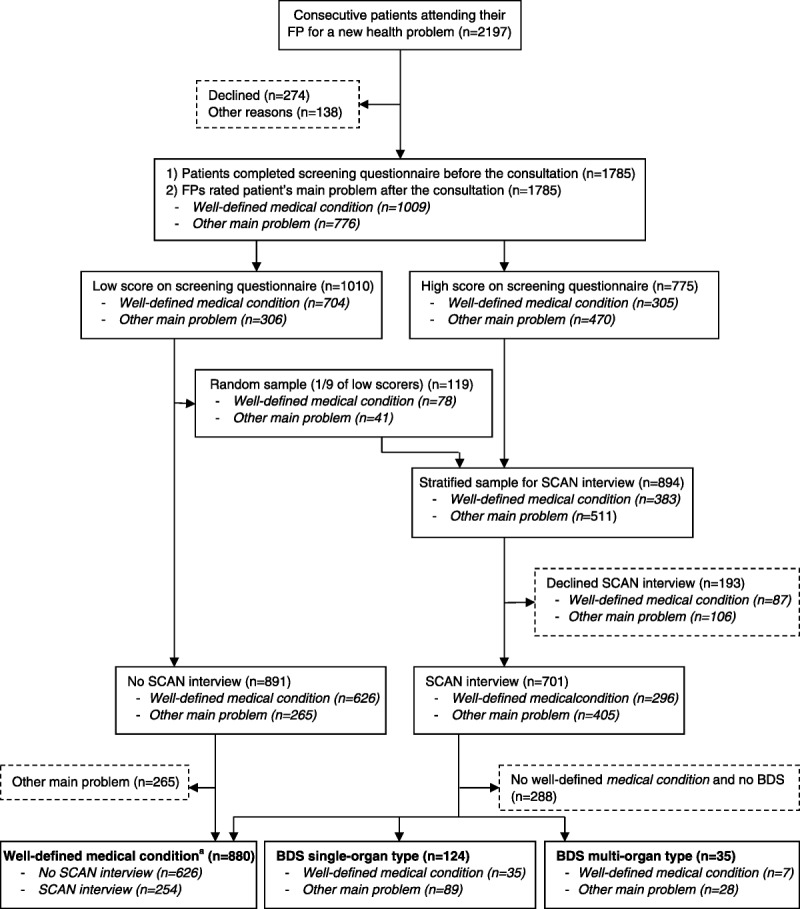
OBJECTIVE: The upcoming International Classification of Diseases, 11th Revision for primary care use suggests inclusion of a new diagnostic construct, bodily (di)stress syndrome (BDS), for individuals with medically unexplained symptoms. We aimed to explore the long-term outcome of BDS in health care costs, work disability, and self-rated health. METHODS: Consecutive patients consulting their family physician for a new health problem were screened for physical and mental symptoms by questionnaires (n = 1785). A stratified subsample was examined with a standardized diagnostic interview (n = 701). Patients with single-organ BDS (n = 124) and multiorgan BDS (n = 35), and a reference group with a family physician-verified medical condition (n = 880) were included. All included patients completed a questionnaire at 3, 12, and 24 months of follow-up. Register data on health care costs and work disability were obtained after 2 and 10 years of follow-up, respectively. RESULTS: Patients with BDS displayed poorer self-rated health and higher illness worry at index consultation and throughout follow-up than the reference group (p ≤ .001). The annual health care costs were higher in the BDS groups (2270 USD and 4066 USD) than in the reference group (1392 USD) (achieved significance level (ASL) ≤ 0.001). Both BDS groups had higher risk of sick leave during the first 2 years of follow-up (RRsingle-organ BDS = 3.0; 95% confidence interval [CI] = 1.8-5.0; RRmultiorgan BDS = 3.4; 95% CI = 1.5-7.5) and substantially higher risk of newly awarded disability pension than the reference group (HRsingle-organ BDS = 4.9; 95% CI = 2.8-8.4; HRmultiorgan BDS = 8.7; 95% CI = 3.7-20.7). CONCLUSIONS: Patients with BDS have poor long-term outcome of health care costs, work disability, and subjective suffering. These findings stress the need for adequate recognition and management of BDS.
Overview
CoChat Summary
## TL;DR
This follow-up study of primary care patients found that bodily distress syndrome (BDS) was associated with worse self-rated health, more illness worry, higher health care costs, and greater work disability over follow-up. The adverse outcomes were generally more pronounced for multiorgan BDS than for single-organ BDS.
## Key findings
- At baseline and all follow-up time points, patients with BDS had lower self-rated physical and mental health and higher illness worry than patients with a well-defined medical condition.
- Total annual health care costs were higher in both BDS groups than in the medical condition group: single-organ BDS mean = 2270 USD, ASL = 0.001; multiorgan BDS mean = 4066 USD, ASL < 0.001.
- In the first 3 months after the index consultation, risk of sick leave was higher for single-organ BDS (RR = 4.9; 95% CI = 2.7–8.9) and multiorgan BDS (RR = 6.7; 95% CI = 3.1–14.4) than for the medical condition group.
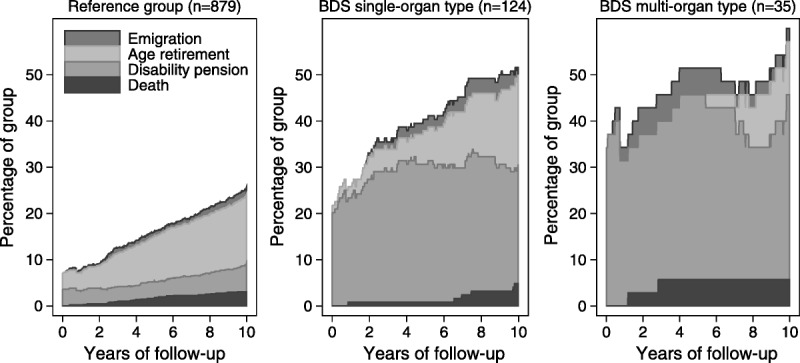
- Over 10 years, patients with multiorgan BDS (HR = 8.7; 95% CI = 3.7–20.7) and single-organ BDS (HR = 4.9; 95% CI = 2.8–8.4) were more likely to receive a new disability pension than patients with a well-defined medical condition.
## Methods
- Questionnaire- and register-based longitudinal follow-up of a cohort from the 2000 Functional Illness in Primary Care (FIP) study in Danish primary care; adult patients aged 18 to 65 years who consulted 38 family physicians for a new health problem were included (n = 1785).
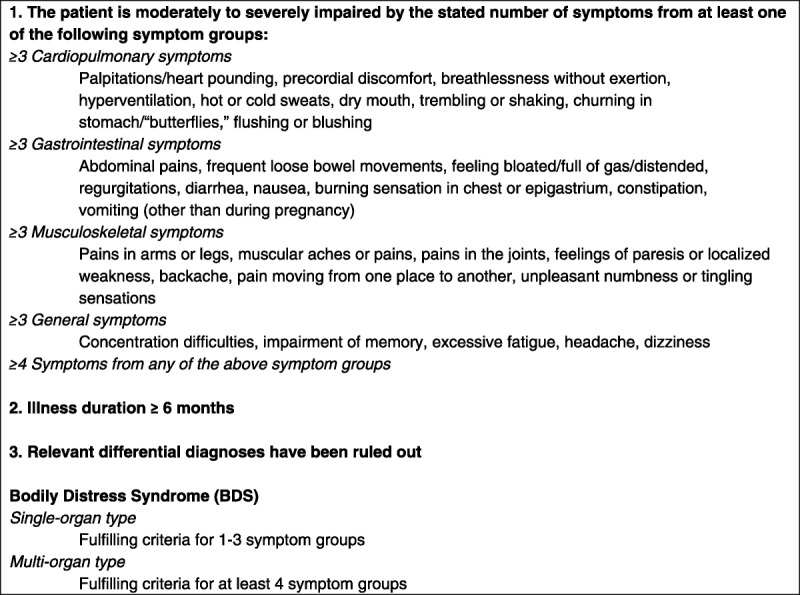
- BDS classification was based on SCAN psychiatric research interviews; final groups were 880 patients with a well-defined medical condition, 124 with single-organ BDS, and 35 with multiorgan BDS.
- Outcomes included self-rated health and illness worry at 3, 12, and 24 months; health care costs for 3 years before to 2 years after the index consultation; and sick leave/disability pension over 10 years. Analyses used mixed models, bootstrap cost comparisons, generalized linear models for sick leave, and Cox proportional hazards models for disability pension, adjusted for age, sex, chronic illness, depression, anxiety, and intervention.
## Limitations
- The paper states that health care cost analyses could not adjust for FP-rated chronic illness because the family physician did not specify the illness; thus, the share of costs attributable to comorbid medical conditions is unknown.
- The paper states that BDS status was not remeasured at follow-up, so it cannot conclude whether patients continued to meet BDS criteria or whether their condition worsened or improved over time.
- Evident from the text: some patients in the medical condition group were not SCAN interviewed, so some BDS cases may have been misclassified into the reference group; the authors note this would bias differences toward the null.
Model-written summary. Check it against the paper before relying on it.
Integrity signals
Registry
Cites
Statistics
Figures
Verification
Claims the paper makes
1 Valid · 2 Not valid · 4 Not checked · 27 Own results and interpretations
The cited sources that could be checked couldn’t confirm or dispute this claim.
In the paper
“The degree of impairment in both BDS groups was remarkably higher than previously found for chronic physical conditions such as arthritis, chronic lung disease, diabetes, and chronic heart disease in the general population (27).”
§ Long-Term Outcome of Bodily Distress Syndrome in Primary Care: A Follow-Up Study on Health Care Costs, Work Disability, and Self-Rated Health > DISCUSSION
What the sources say
- Could not verifycites [27] Alonso J Ferrer M Gandek B Ware JE Jr. Aaronson NK Mosconi P Rasmussen NK Bullinger M Fukuhara S Kaasa S Leplège A; IQOLA Project Group. Health-related quality of life associated with chronic conditions in eight countries: results from the International Quality of Life Assessment (IQOLA) Project. Qual Life Res 2004; 13: 283– 98. 15085901 sourceExperimental — accuracy not yet measured
The Methods and Discussion passages describe a focus-group study of general practitioners’ perceptions of patients with persistent medically unexplained symptoms. Searches for BDS-group impairment and comparisons with arthritis, lung disease, diabetes, and heart disease found no passage addressing the claimed comparison. (LLM, conf=0.76)
boostedstates an association- Asserted: passes — The authors put it forward as true.
- Checkable: passes — It can be checked against evidence.
- Load-bearing: unclear — It is unclear whether the paper’s conclusions depend on it.
- Based: passes — The paper gives a reason why it holds.
- Could not verify
The cited sources support only part of this claim — read each source’s verdict below.
In the paper
“A Dutch study found that sick-listed patients with a high somatic symptom burden and decreased functioning were at higher risk of redundancy (37).”
§ Long-Term Outcome of Bodily Distress Syndrome in Primary Care: A Follow-Up Study on Health Care Costs, Work Disability, and Self-Rated Health > DISCUSSION
What the sources say
- Partly supportedcites [37] Hoedeman R Blankenstein AH Krol B Koopmans PC Groothoff JW The contribution of high levels of somatic symptom severity to sickness absence duration, disability and discharge. J Occup Rehabil 2010; 20: 264– 73. 20373134 PMC2887510 sourceExperimental — accuracy not yet measured
Our copy of Rask et al. (2015) is a Danish, register-based 10-year follow-up of Danish primary care patients (FIP study, §2.1–2.2), with outcomes of temporary and permanent health-related benefits (sick leave, full/partial disability pension) from DREAM (§2.7, §3.2) — it contains no measure of redundancy/dismissal and no 'decreased functioning' predictor. The only Dutch sick-listed material it carries is reported second-hand: the Introduction states that severe MUS measured by the PHQ had a prevalence of 15% in a population of Dutch sick-listed employees and was associated with longer sick leave duration and continued work disability after 2 years [refs 15,16 = Hoedeman et al.], and §4.2 adds that somatoform disorder has been shown to be associated with more frequent sickness spells and discharge. Thus the 'Dutch sick-listed, high somatic symptom burden, adverse work outcome' element is present but as another study's result, while the specific redundancy finding attributed here is not supported by this source. (LLM, conf=0.68)
plainstates an association- Asserted: passes — The authors put it forward as true.
- Checkable: passes — It can be checked against evidence.
- Load-bearing: passes — The paper’s conclusions depend on it.
- Based: passes — The paper gives a reason why it holds.
- Partly supported
A result the paper reports from its own data — it cites no other source for it, so there is none to check. The quote shows it is in the paper.
In the paper
“The average risk of sick leave in the first 3 months after the index consultation was higher in patients with single-organ BDS (RR = 4.9; 95% CI = 2.7–8.9) and multiorgan BDS (RR = 6.7; 95% CI = 3.1–14.4) than in patients with a well-defined medical condition (Table 4).”
§ Long-Term Outcome of Bodily Distress Syndrome in Primary Care: A Follow-Up Study on Health Care Costs, Work Disability, and Self-Rated Health > RESULTS > Work Disability
plainstates an association- Asserted: passes — The authors put it forward as true.
- Checkable: passes — It can be checked against evidence.
- Load-bearing: passes — The paper’s conclusions depend on it.
- Based: passes — The paper gives a reason why it holds.
A result the paper reports from its own data — it cites no other source for it, so there is none to check. The quote shows it is in the paper.
In the paper
“A higher proportion of patients with BDS received disability pension, most pronounced in the multiorgan BDS group, compared to patients with a well-defined medical condition.”
§ Long-Term Outcome of Bodily Distress Syndrome in Primary Care: A Follow-Up Study on Health Care Costs, Work Disability, and Self-Rated Health > RESULTS > Work Disability
plainstates an association- Asserted: passes — The authors put it forward as true.
- Checkable: passes — It can be checked against evidence.
- Load-bearing: passes — The paper’s conclusions depend on it.
- Based: passes — The paper gives a reason why it holds.
A result the paper reports from its own data — it cites no other source for it, so there is none to check. The quote shows it is in the paper.
In the paper
“The total annual healthcare costs incurred by the 2 BDS groups were higher than the costs incurred by the medical condition group (follow-up estimates: single-organ BDS: mean = 2270 USD, ASL = 0.001; multiorgan BDS: mean = 4066 USD, ASL < 0.001) (Table 3).”
§ Long-Term Outcome of Bodily Distress Syndrome in Primary Care: A Follow-Up Study on Health Care Costs, Work Disability, and Self-Rated Health > RESULTS > Health Care Costs
plain- Asserted: passes — The authors put it forward as true.
- Checkable: passes — It can be checked against evidence.
- Load-bearing: passes — The paper’s conclusions depend on it.
- Based: passes — The paper gives a reason why it holds.
11 more claims
Create a free account to see all 34 claims and to verify the 9 references still open.
- Borderline: one of the tests for a substantial claim is unclear. 1
- It may state two separate claims as one. 16
- Probably not a substantial claim. 4
Claims other papers make about this one
Each is checked against this paper’s own text: does it say what the citing paper says it does?
The source backs part of the claim, not all of it — or backs it for a different population, condition or comparison.
In the citing paper
“The diagnosis is based on the identification of a characteristic symptom pattern as no diagnostic blood tests or other paraclinical tests, exist [1,2].”
From Internet-delivered treatment for patients suffering from severe functional somatic disorders: Protocol for a randomized controlled trial (2023) · cites this paper as [2]
Experimental — accuracy not yet measuredThe source backs part of the claim, not all of it — or backs it for a different population, condition or comparison.
In the citing paper
“The condition causes suffering and reduced quality of life and is associated with substantial socioeconomic costs, involving expensive diagnostic examinations, sick leave, and long-term disability [2,13,14].”
From Internet-delivered treatment for patients suffering from severe functional somatic disorders: Protocol for a randomized controlled trial (2023) · cites this paper as [2]
Experimental — accuracy not yet measuredThe source backs part of the claim, not all of it — or backs it for a different population, condition or comparison.
In the citing paper
“The course of FSD multi-organ type is often chronic as only few patients receive treatment [2,15,16].”
From Internet-delivered treatment for patients suffering from severe functional somatic disorders: Protocol for a randomized controlled trial (2023) · cites this paper as [2]
Experimental — accuracy not yet measuredThe source backs part of the claim, not all of it — or backs it for a different population, condition or comparison.
In the citing paper
“Moreover, adult patients presenting with multiple symptoms from several organ systems have a poorer prognosis and a higher risk of chronification.22–24”
From Comparing group-based acceptance and commitment therapy (ACT) with enhanced usual care for adolescents with functional somatic syndromes: A study protocol for a randomised trial (2016) · cites this paper as [24]
Experimental — accuracy not yet measured
1 more claim about this paper
Create a free account to see every claim other papers make about this one.
Citations
Cites
(1992) · PubMed · Cited by 33,716
The MOS 36-ltem Short-Form Health Survey (SF-36): I. Conceptual Framework and Item Selection
Ware, J. E., & Sherbourne, C. D. (1992) · Medical Care · doi:10.1097/00005650-199206000-00002 · Cited by 30,033 · cited 1×
“Included patients also completed the Medical Outcome Study's Short Form Health Survey (SF-36), which assesses physical and mental health (17), and sociodemographic data were obtained.”
MethodThe Structured Clinical Interview for DSM-III-R (SCID): I: History, Rationale, and Description
Spitzer, R. L. (1992) · Archives of General Psychiatry · doi:10.1001/archpsyc.1992.01820080032005 · Cited by 4,336 · cited 1×
“The SCID and WHO-CIDI are both diagnosis focused and include only symptoms that are relevant for DSM-IV or ICD-10 psychiatric diagnoses (48,49), whereas the SCAN interview is symptom driven with a bottom-up approach focusing on psychopathology rather than on specific diagnoses (18).”
MethodThe Danish National Patient Register
Lynge, E., Sandegaard, J. L., & Rebolj, M. (2011) · Scandinavian Journal of Public Health · doi:10.1177/1403494811401482 · Cited by 3,968 · cited 1×
“Danish Register for Evaluation of Marginalization has formerly been found to provide valid and high-quality data on disability pension and sickness benefits (22,44), and the completeness of the registers used for the calculations of health care costs are generally considered to be high because the data are continuousl…”
BackgroundRobins, L. N. (1988) · Archives of General Psychiatry · doi:10.1001/archpsyc.1988.01800360017003 · Cited by 2,909 · cited 1×
“The SCID and WHO-CIDI are both diagnosis focused and include only symptoms that are relevant for DSM-IV or ICD-10 psychiatric diagnoses (48,49), whereas the SCAN interview is symptom driven with a bottom-up approach focusing on psychopathology rather than on specific diagnoses (18).”
MethodRegression standard errors in clustered samples
Rogers, W. H. (1993) · Stata technical bulletin · Cited by 2,694
SCAN: Schedules fonr Clinical Assessment in Neuropsychiatry
Wing, J. K. (1990) · Archives of General Psychiatry · doi:10.1001/archpsyc.1990.01810180089012 · Cited by 2,517 · cited 1×
“The SCID and WHO-CIDI are both diagnosis focused and include only symptoms that are relevant for DSM-IV or ICD-10 psychiatric diagnoses (48,49), whereas the SCAN interview is symptom driven with a bottom-up approach focusing on psychopathology rather than on specific diagnoses (18).”
MethodPsychosomatic medicine in Germany: more timely than ever
Zipfel, S., Herzog, W., Kruse, J., & Henningsen, P. (2016) · Psychotherapy and Psychosomatics · doi:10.1159/000447701 · Cited by 2,323
Barsky, A. J., Orav, E. J., & Bates, D. W. (2005) · Archives of General Psychiatry · doi:10.1001/archpsyc.62.8.903 · Cited by 911 · cited 2×
“In general, our findings are consistent with the existing literature, as both former population-based studies and clinical studies demonstrate high health care use and increased costs for patients with functional somatic symptoms or somatoform disorders (4,33,34).”
BackgroundResultThe Danish National Health Service Register
Sahl Andersen, J., De Fine Olivarius, N., & Krasnik, A. (2011) · Scandinavian Journal of Public Health · doi:10.1177/1403494810394718 · Cited by 890 · cited 1×
“Danish Register for Evaluation of Marginalization has formerly been found to provide valid and high-quality data on disability pension and sickness benefits (22,44), and the completeness of the registers used for the calculations of health care costs are generally considered to be high because the data are continuousl…”
BackgroundMedically Unexplained Physical Symptoms, Anxiety, and Depression: A Meta-Analytic Review
Henningsen, P., Zimmermann, T., & Sattel, H. (2003) · Psychosomatic Medicine · doi:10.1097/01.psy.0000075977.90337.e7 · Cited by 829 · cited 1×
“Patients with persistent functional somatic symptoms constitute a vast challenge to both the health care system and the social security system; they are characterized by high rates of anxiety and depression (2,3), they are frequent attenders to health care services and contribute to high”
BackgroundAlonso, J., Ferrer, M., Gandek, B., Ware, J. E., Aaronson, N. K., Mosconi, P., Rasmussen, N. K., Bullinger, M., Fukuhara, S., Kaasa, S., et al. (2004) · Quality of Life Research · doi:10.1023/b:qure.0000018472.46236.05 · Cited by 786
Management of functional somatic syndromes
Henningsen, P., Zipfel, S., & Herzog, W. (2007) · The Lancet · doi:10.1016/s0140-6736(07)60159-7 · Cited by 741
Depression, anxiety and somatization in primary care: Syndrome overlap and functional impairment
Löwe, B., Spitzer, R. L., Williams, J. B. W., Mussell, M., Schellberg, D., & Kroenke, K. (2008) · General Hospital Psychiatry · doi:10.1016/j.genhosppsych.2008.01.001 · Cited by 706 · cited 1×
“Patients with persistent functional somatic symptoms constitute a vast challenge to both the health care system and the social security system; they are characterized by high rates of anxiety and depression (2,3), they are frequent attenders to health care services and contribute to high”
BackgroundHjollund, N. H., Larsen, F. B., & Andersen, J. H. (2007) · Scandinavian Journal of Public Health · doi:10.1080/14034940701271882 · Cited by 483 · cited 8×
“ASL = achieved significance level,BCa = bias-corrected and accelerated, BDS = bodily distress syndrome, CAGE = Cutting down, Annoyance by criticism, Guilty feeling, Eye openers Questionnaire, DREAM = Danish register for evaluation of marginalization, DRG = diagnosis-related group, DSM = Diagnostic and Statistical Manu…”
BackgroundInfluentialEfficacy of treatment for somatoform disorders: a review of randomized controlled trials
Kroenke, K. (2007) · Psychosomatic Medicine · doi:10.1097/psy.0b013e31815b00c4 · Cited by 450 · cited 1×
“Somatoform disorders and functional somatic syndromes may be treated effectively with combinations of cognitive behavioral therapy, antidepressants, graded exercise, and relaxation techniques (52,53).”
Background(1991) · American Journal of Psychiatry · doi:10.1176/ajp.148.7.a34 · Cited by 358 · cited 1×
“Such medically unexplained or functional somatic symptoms represent a spectrum ranging from normal or self-limiting symptoms to severe and persistent conditions (1).”
BackgroundKroenke, K. (1997) · Archives of General Psychiatry · doi:10.1001/archpsyc.1997.01830160080011 · Cited by 355
Fink, P., & Schröder, A. (2010) · Journal of Psychosomatic Research · doi:10.1016/j.jpsychores.2010.02.004 · Cited by 334 · cited 2×
“, fibromyalgia, chronic fatigue syndrome, and irritable bowel syndrome) (10,11).”
BackgroundInfluentialSelf-citationSomatization: a spectrum of severity
(1991) · American Journal of Psychiatry · doi:10.1176/ajp.148.1.34 · Cited by 315
Screening for somatization and hypochondriasis in primary care and neurological in-patients
Fink, P., Ewald, H., Jensen, J., Sørensen, L., Engberg, M., Holm, M., & Munk-Jørgensen, P. (1999) · Journal of Psychosomatic Research · doi:10.1016/s0022-3999(98)00092-0 · Cited by 314 · cited 1×
“The Physical Component Summary (PCS) and the Mental Component Summary (MCS) from the SF-36were used asmeasures of self-rated health (19), and the Whiteley-7 scale as a measure of illness worry (20,21).”
MethodSelf-citationFink, P., Toft, T., Hansen, M. S., Ørnbøl, E., & Olesen, F. (2007) · Psychosomatic Medicine · doi:10.1097/psy.0b013e31802e46eb · Cited by 314 · cited 3×
“The original patient sample in which the diagnostic criteria for BDS were developed was used in this study (11).”
BackgroundMethodSelf-citationResource Utilization of Patients With Hypochondriacal Health Anxiety and Somatization
Barsky, A. J., Ettner, S. L., Horsky, J., & Bates, D. W. (2001) · Medical Care · doi:10.1097/00005650-200107000-00007 · Cited by 309 · cited 1×
“In general, our findings are consistent with the existing literature, as both former population-based studies and clinical studies demonstrate high health care use and increased costs for patients with functional somatic symptoms or somatoform disorders (4,33,34).”
ResultDevelopment and Validation of the Somatic Symptom Disorder–B Criteria Scale (SSD-12)
Toussaint, A., Murray, A. M., Voigt, K., Herzog, A., Gierk, B., Kroenke, K., Rief, W., Henningsen, P., & Löwe, B. (2016) · Psychosomatic Medicine · doi:10.1097/psy.0000000000000240 · Cited by 291 · cited 1×
“, health anxiety) related to the symptom (criteria B) (42).”
BackgroundTOFT, T., FINK, P., OERNBOEL, E., CHRISTENSEN, K., FROSTHOLM, L., & OLESEN, F. (2005) · Psychological Medicine · doi:10.1017/s0033291705004459 · Cited by 252 · cited 4×
“Patients who were of non-Scandinavian origin, who were severely ill or demented, or who were not enlisted with the participating FPs were excluded from participation (15).”
BackgroundInfluentialSelf-citationSomatization in the community: relationship to disability and use of services.
Escobar, J. I., Golding, J. M., Hough, R. L., Karno, M., Burnam, M. A., & Wells, K. B. (1987) · American Journal of Public Health · doi:10.2105/ajph.77.7.837 · Cited by 244
Somatic symptom disorder: an important change in DSM
Dimsdale, J. E., Creed, F., Escobar, J., Sharpe, M., Wulsin, L., Barsky, A., Lee, S., Irwin, M. R., & Levenson, J. (2013) · Journal of Psychosomatic Research · doi:10.1016/j.jpsychores.2013.06.033 · Cited by 239 · cited 1×
“Somatic symptom disorder (SSD) has been introduced in the Diagnostic and Statistical Manual of Mental Disorders, Fifth Edition (DSM-V) (41).”
BackgroundEpstein, R. M., Hadee, T., Carroll, J., Meldrum, S. C., Lardner, J., & Shields, C. G. (2007) · Journal of General Internal Medicine · doi:10.1007/s11606-007-0416-9 · Cited by 207
Does the number of musculoskeletal pain sites predict work disability? A 14‐year prospective study
Kamaleri, Y., Natvig, B., Ihlebaek, C. M., & Bruusgaard, D. (2009) · European Journal of Pain · doi:10.1016/j.ejpain.2008.05.009 · Cited by 189
A brief case-finding questionnaire for common mental disorders: the CMDQ
Christensen, K. S., Fink, P., Toft, T., Frostholm, L., Ørnbøl, E., & Olesen, F. (2005) · Family Practice · doi:10.1093/fampra/cmi025 · Cited by 181 · cited 2×
“This questionnaire included the Symptom Check List (SCL-8), which assesses anxiety and depression; the somatization subscale of the SCL-90, which screens for 12 common physical symptoms, the Whitely Index (Whitely-7), which assesses illness worry, and the 4-item Cutting down, Annoyance by criticism, Guilty feeling, Ey…”
BackgroundMethodSelf-citationStability of Somatization Disorder and Somatization Symptoms Among Primary Care Patients
Simon, G. E., & Gureje, O. (1999) · Archives of General Psychiatry · doi:10.1001/archpsyc.56.1.90 · Cited by 163 · cited 1×
“Functional disorders have previously been shown to represent unstable conditions, depending on the diagnostic criteria applied (8,50,51).”
BackgroundNon-Specific, Functional, and Somatoform Bodily Complaints
Schaefert, R., Hausteiner-Wiehle, C., Häuser, W., Ronel, J., Herrmann, M., & Henningsen, P. (2012) · Deutsches Ärzteblatt international · doi:10.3238/arztebl.2012.0803 · Cited by 153 · cited 1×
“Somatoform disorders and functional somatic syndromes may be treated effectively with combinations of cognitive behavioral therapy, antidepressants, graded exercise, and relaxation techniques (52,53).”
BackgroundFink, P., Rosendal, M., & Toft, T. (2002) · Psychosomatics · doi:10.1176/appi.psy.43.2.93 · Cited by 152 · cited 1×
“The FIP study was an intervention study focusing on the effect of an educational program for training FPs in recognition and management of patients with functional symptoms (14).”
BackgroundSelf-citationMedically unexplained symptoms--GPs' attitudes towards their cause and management
Reid, S., Whooley, D., Crayford, T., & Hotopf, M. (2001) · Family Practice · doi:10.1093/fampra/18.5.519 · Cited by 150
Fjorback, L. O., Arendt, M., Ørnbøl, E., Walach, H., Rehfeld, E., Schröder, A., & Fink, P. (2013) · Journal of Psychosomatic Research · doi:10.1016/j.jpsychores.2012.09.006 · Cited by 144 · cited 1×
“Correspondingly, promising results have been shown for treatment of severe BDS (54,55).”
BackgroundSelf-citationStapelfeldt, C. M., Jensen, C., Andersen, N. T., Fleten, N., & Nielsen, C. V. (2012) · BMC Public Health · doi:10.1186/1471-2458-12-661 · Cited by 143 · cited 1×
“Danish Register for Evaluation of Marginalization has formerly been found to provide valid and high-quality data on disability pension and sickness benefits (22,44), and the completeness of the registers used for the calculations of health care costs are generally considered to be high because the data are continuousl…”
BackgroundA new questionnaire to identify bodily distress in primary care: the 'BDS checklist
Budtz-Lilly, A., Fink, P., Ørnbøl, E., Vestergaard, M., Moth, G., Christensen, K. S., & Rosendal, M. (2015) · Journal of Psychosomatic Research · doi:10.1016/j.jpsychores.2015.03.006 · Cited by 129 · cited 1×
“However, our 10-year clinical experience with BDS and the results from a new study in primary care indicate that it is obsolete to seek to define each symptom as either medically unexplained or not (43).”
BackgroundSelf-citationolde Hartman, T. C., Hassink-Franke, L. J., Lucassen, P. L., van Spaendonck, K. P., & van Weel, C. (2009) · BMC Family Practice · doi:10.1186/1471-2296-10-68 · Cited by 127
Somatization Increases Disability Independent of Comorbidity
Harris, A. M., Orav, E. J., Bates, D. W., & BARSKY, A. J. (2008) · Journal of General Internal Medicine · doi:10.1007/s11606-008-0845-0 · Cited by 125
Jackson, J. L., & Kroenke, K. (2008) · Psychosomatic Medicine · doi:10.1097/psy.0b013e31816aa0ee · Cited by 124
Rask, M. T., Rosendal, M., Fenger-Grøn, M., Bro, F., Ørnbøl, E., & Fink, P. (2015) · General Hospital Psychiatry · doi:10.1016/j.genhosppsych.2014.10.007 · Cited by 104
Self-citationCognitive–behavioural group treatment for a range of functional somatic syndromes: Randomised trial
Schröder, A., Rehfeld, E., Ørnbøl, E., Sharpe, M., Licht, R. W., & Fink, P. (2012) · British Journal of Psychiatry · doi:10.1192/bjp.bp.111.098681 · Cited by 95 · cited 1×
“Correspondingly, promising results have been shown for treatment of severe BDS (54,55).”
BackgroundSelf-citationStability of Somatoform Symptoms—Implications for Classification
Rief, W., & Rojas, G. (2007) · Psychosomatic Medicine · doi:10.1097/psy.0b013e31815b006e · Cited by 85 · cited 1×
“Instead of relying on subjective reports by the FPs or the patients on functional symptoms (47), trained physicians performed a systematic screening for a high number of symptoms and rated these as functional symptoms according to predefined criteria.”
MethodCourse and prediction of somatoform disorder and medically unexplained symptoms in primary care
Steinbrecher, N., & Hiller, W. (2011) · General Hospital Psychiatry · doi:10.1016/j.genhosppsych.2011.05.002 · Cited by 73 · cited 1×
“Functional disorders have previously been shown to represent unstable conditions, depending on the diagnostic criteria applied (8,50,51).”
BackgroundBurton, C. D., McGorm, K. J., Richardson, G. A., Weller, D., & Sharpe, M. (2012) · Journal of Psychosomatic Research · doi:10.1016/j.jpsychores.2011.12.009 · Cited by 65 · cited 1×
“health care costs (4,5), and they may have an increased risk of sickness absence and work disability (6–9).”
BackgroundHoedeman, R., Blankenstein, A. H., Krol, B., Koopmans, P. C., & Groothoff, J. W. (2010) · Journal of Occupational Rehabilitation · doi:10.1007/s10926-010-9239-3 · Cited by 64 · cited 1×
“A Dutch study found that sick-listed patients with a high somatic symptom burden and decreased functioning were at higher risk of redundancy (37).”
BackgroundThe somatization in primary care study: a tale of three diagnoses
Dickinson, W. P., Dickinson, L. M., deGruy, F. V., Candib, L. M., Main, D. S., Libby, A. M., & ROST, K. M. (2003) · General Hospital Psychiatry · doi:10.1016/s0163-8343(02)00247-5 · Cited by 61 · cited 1×
“Physical component summary scores of approximately 41 and MCS scores of approximately 47 have been demonstrated in samples of primary care patients who meet the criteria for either somatization disorder, abridged somatization disorder, or multisomatoform disorder (26).”
BackgroundLam, T. P., Goldberg, D. P., Dowell, A. C., Fortes, S., Mbatia, J. K., Minhas, F. A., & Klinkman, M. S. (2013) · Family Practice · doi:10.1093/fampra/cms037 · Cited by 59 · cited 3×
“ASL = achieved significance level,BCa = bias-corrected and accelerated, BDS = bodily distress syndrome, CAGE = Cutting down, Annoyance by criticism, Guilty feeling, Eye openers Questionnaire, DREAM = Danish register for evaluation of marginalization, DRG = diagnosis-related group, DSM = Diagnostic and Statistical Manu…”
BackgroundMethodSomatization and Health Anxiety as Predictors of Health Care Use
Tomenson, B., McBeth, J., Chew-Graham, C. A., MacFarlane, G., Davies, I., Jackson, J., Littlewood, A., & Creed, F. H. (2012) · Psychosomatic Medicine · doi:10.1097/psy.0b013e31825cb140 · Cited by 51 · cited 1×
“Illness worry and the related interaction with somatic symptom burden have been found to predict health care use (28).”
BackgroundGjesdal, S., Bratberg, E., & Mæland, J. G. (2009) · Spine · doi:10.1097/brs.0b013e3181a8dee3 · Cited by 43
Health Care Use by Patients with Somatoform Disorders: A Register-Based Follow-Up Study
Andersen, N. L., Eplov, L. F., Andersen, J. T., Hjorthøj, C. R., & Birket‐Smith, M. (2012) · Psychosomatics · doi:10.1016/j.psym.2012.07.007 · Cited by 36 · cited 1×
“In general, our findings are consistent with the existing literature, as both former population-based studies and clinical studies demonstrate high health care use and increased costs for patients with functional somatic symptoms or somatoform disorders (4,33,34).”
ResultVeddegjærde, K.-E. F., Sivertsen, B., Wilhelmsen, I., & Skogen, J. C. (2014) · Journal of Psychosomatic Research · doi:10.1016/j.jpsychores.2014.06.011 · Cited by 31 · cited 1×
“The Physical Component Summary (PCS) and the Mental Component Summary (MCS) from the SF-36were used asmeasures of self-rated health (19), and the Whiteley-7 scale as a measure of illness worry (20,21).”
MethodLeiknes, K. A., Finset, A., Moum, T., & Sandanger, I. (2008) · Psychosomatics · doi:10.1176/appi.psy.49.2.152 · Cited by 29
Markkula, R., Kalso, E. A., Huunan-Seppälä, A., Koskenvuol, M., Koskenvuol, K., Leino‐Arjas, P., & Kaprio, J. A. (2011) · European Journal of Pain · doi:10.1016/j.ejpain.2011.01.004 · Cited by 26
Bodily distress syndrome (BDS): the evolution from medically unexplained symptoms (MUS).
Ivbijaro, G. O., & Goldberg, D. P. (2013) · PubMed Central · Cited by 7
Cited by
Petersen, M. W., Schröder, A., Jørgensen, T., Ørnbøl, E., Meinertz Dantoft, T., Eliasen, M., Benros, M. E., & Fink, P. (2020) · Scientific Reports · doi:10.1038/s41598-020-60318-6 · Cited by 170
Self-citationRosendal, M., Olde Hartman, T. C., Aamland, A., van der Horst, H., Lucassen, P., Budtz-Lilly, A., & Burton, C. (2017) · BMC Family Practice · doi:10.1186/s12875-017-0592-6 · Cited by 129
Self-citationBodily distress syndrome: a new diagnosis for functional disorders in primary care?
Budtz-Lilly, A., Schröder, A., Rask, M. T., Fink, P., Vestergaard, M., & Rosendal, M. (2015) · BMC Family Practice · doi:10.1186/s12875-015-0393-8 · Cited by 115
Self-citationRoenneberg, C., Sattel, H., Schaefert, R., Henningsen, P., & Hausteiner-Wiehle, C. (2019) · Deutsches Ärzteblatt international · doi:10.3238/arztebl.2019.0553 · Cited by 111
Häuser, W., Hausteiner‐Wiehle, C., Henningsen, P., Brähler, E., Schmalbach, B., & Wolfe, F. (2020) · Journal of Psychosomatic Research · doi:10.1016/j.jpsychores.2020.110111 · Cited by 89
Metadata
- Authors
- Rask, M. T., Ørnbøl, E., Rosendal, M., & Fink, P.
- Affiliations
- Aarhus University (DK)
- Venue
- Psychosomatic Medicine
- Published
- 2017-04
- Volume
- 79
- Issue
- 3
- Pages
- 345-357
- ISSN
- 0033-3174 (ISSN-L)
- 1534-7796
- PMC
- PMC5642326
- OpenAlex
- W2537238316
- Semantic Scholar
- ac96577312f7793fafac8f457f57640c1168d815
- Cited by
- 81
- References
- 55
- Citations by year
- 2026: 8 · 2025: 11 · 2024: 4 · 2023: 7 · 2022: 8 · 2021: 9 · 2020: 7 · 2019: 9 · 2018: 8 · 2017: 7
- FWCI
- 7.69
- Type
- journal article
- Language
- en
- Open access
- hybrid
- doi.org
- Licence
- Locations
- Psychosomatic Medicine (publishedVersion, cc-by-nc-nd)
- PubMed Central (publishedVersion, cc-by-nc-nd)
- PubMed (publishedVersion)
- Scopus (Elsevier) (submittedVersion, other-oa)
- Topics
- Health Sciences › Medicine › Psychiatry and Mental health › Psychosomatic Disorders and Their Treatments
- Health Sciences › Medicine › Psychiatry and Mental health › Fibromyalgia and Chronic Fatigue Syndrome Research
- Health Sciences › Medicine › Epidemiology › Chronic Disease Management Strategies
- Keywords
- bodily distress syndrome, medically unexplained symptoms, long-term outcomes, health care costs, work disability, sick leave, disability pension, self-rated health, primary care, ICD-11
- MeSH terms
- Medically Unexplained Symptoms, Adult, Denmark, Female, Follow-Up Studies, Persons with Disabilities, Humans, Male, Middle Aged, Pensions, Primary Health Care, Registries, Somatoform Disorders, Health Care Costs, Outcome Assessment, Health Care, Sick Leave, Young Adult
About these checks
Registry, retraction, Cites and statistics results are computed, not judged, with one exception: a printed reference that no index lists is read once by a model before it counts as a citation error. Claims are extracted by a model and kept only when their quote appears verbatim in the text; each cited source is then checked, with a model’s help, for whether it says what the claim relies on. Those verdicts can be wrong — read the claim’s quote and the cited source before relying on one.
The claim verdicts this report counts are experimental: their accuracy is not yet measured.
A language model drew the claims from the paper on 2026-10-11, under version 3 of the claim definition (model deepseek-v4.1-flash, prompt extract-v3).
A second model labelled each claim on 2026-10-11 (model jev-1.13-20260917, definition revision gold-guideline-v0.2).
Cited sources are checked with a language model’s help (gpt-6-sol and qwen3.8-omni-flash).
Statistics and arithmetic are recomputed, not judged.
Confidence bands are shown only for fields calibrated on our annotated test set. None is calibrated yet, so no band is shown.
What counts as a claim ›How we measure confidence ›How we check this ›
Are you an author, or do you see a problem with this page? Request a review
Data sources
Bibliographic data: Semantic Scholar, OpenAlex, Crossref.
Contains information from the Semantic Scholar Academic Graph Datasets, made available under the ODC Attribution License (ODC-BY 1.0).
Semantic Scholar’s data is described in: Kinney, R., et al. (2023). The Semantic Scholar Open Data Platform. arXiv:2301.10140.
