

Enhancement of Meditation Analgesia by Opioid Antagonist in Experienced Meditators
Open accessThe DOI matches its Crossref record; 62 of the 62 references it cites were found in a registry or an index.
Abstract
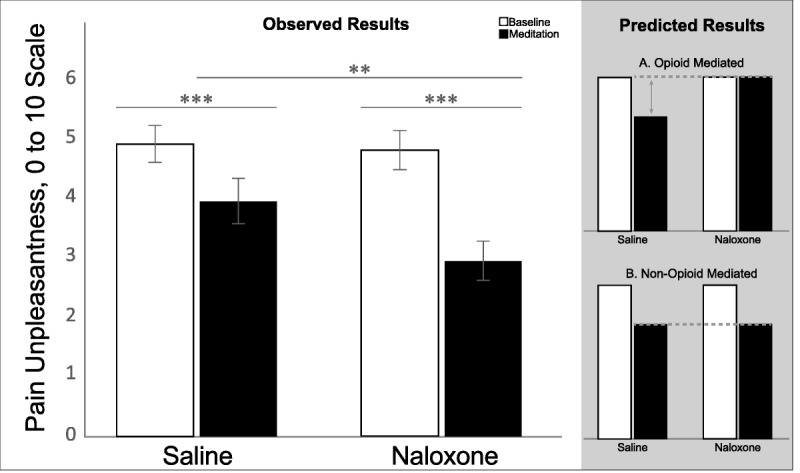
Objective: Studies have consistently shown that long-term meditation practice is associated with reduced pain, but the neural mechanisms by which long-term meditation practice reduces pain remain unclear. This study tested endogenous opioid involvement in meditation analgesia associated with long-term meditation practice. Methods: Electrical pain was induced with randomized, double-blind, cross-over administration of the opioid antagonist naloxone (0.15-mg/kg bolus dose, then 0.2-mg/kg per hour infusion dose) with 32 healthy, experienced meditation practitioners and a standardized open monitoring meditation. Results: Under saline, pain ratings were significantly lower during meditation (pain intensity: 6.41 ± 1.32; pain unpleasantness: 3.98 ± 2.17) than at baseline (pain intensity: 6.86 ±1.04, t(31) = 2.476, p = .019, Cohen's d = 0.46; pain unpleasantness: 4.96 ±1.75, t(31) = 3.746, p = .001, Cohen's d = 0.68), confirming the presence of meditation analgesia. Comparing saline and naloxone revealed significantly lower pain intensity (t(31) = 3.12, p = .004, d = 0.56), and pain unpleasantness (t(31) = 3.47, p = .002, d = 0.62), during meditation under naloxone (pain intensity: 5.53 ± 1.54; pain unpleasantness: 2.95 ± 1.88) than under saline (pain intensity: 6.41 ± 1.32; pain unpleasantness: 3.98 ± 2.17). Naloxone not only failed to eliminate meditation analgesia but also made meditation analgesia stronger. Conclusions: Long-term meditation practice does not rely on endogenous opioids to reduce pain. Naloxone's blockade of opioid receptors enhanced meditation analgesia; pain ratings during meditation were significantly lower under naloxone than under saline. Possible biological mechanisms by which naloxone-induced opioid receptor blockade enhances meditation analgesia are discussed.
Overview
The claims and statistics of this paper haven’t been checked yet.
Free: it reads the open-access text and checks the first 5 claims that cite a source we can check. Create a free account to check every claim.
Integrity signals
Registry
Cites
Statistics
Figures
Verification
Claims the paper makes
The claims and statistics of this paper haven’t been checked yet.
Free: it reads the open-access text and checks the first 5 claims that cite a source we can check. Create a free account to check every claim.
Claims other papers make about this one
Each is checked against this paper’s own text: does it say what the citing paper says it does?
The source backs part of the claim, not all of it — or backs it for a different population, condition or comparison.
In the citing paper
“Our recent study demonstrating that mindfulness-based analgesia is more pronounced during naloxone in long-term meditators (mean experience >4000 hours of meditation practice) potentially invalidates this interpretation.79”
From The neural mechanisms of mindfulness-based pain relief: a functional magnetic resonance imaging-based review and primer (2019) · cites this paper as [79]
Experimental — accuracy not yet measuredThe source backs part of the claim, not all of it — or backs it for a different population, condition or comparison.
In the citing paper
“Taken together, these findings are important because they provide supplementary evidence that mindfulness engages unique mechanisms to reduce pain that are distinct from those mediated by placebo analgesia (ie, endogenous opioids; ↓ PAG).”
From The neural mechanisms of mindfulness-based pain relief: a functional magnetic resonance imaging-based review and primer (2019) · cites this paper as [79]
Experimental — accuracy not yet measuredIn the citing paper
“Surprisingly, when compared with saline and the control group, high-dose IV naloxone infusion produced greater pain relief in the meditation group, providing further evidence that mindfulness across training levels produces analgesia independent of endogenous opioids.79”
From The neural mechanisms of mindfulness-based pain relief: a functional magnetic resonance imaging-based review and primer (2019) · cites this paper as [79]
Self-check
Percentages, sums and reported differences re-computed from the paper’s own numbers.
The self-check needs the paper’s full text.
Citations
Cites
Attention regulation and monitoring in meditation
Lutz, A., Slagter, H. A., Dunne, J. D., & Davidson, R. J. (2008) · Trends in Cognitive Sciences · doi:10.1016/j.tics.2008.01.005 · Cited by 2,659
Vital signs: overdoses of prescription opioid pain relievers---United States, 1999--2008.
Paulozzi, L. J., Jones, C. M., Mack, K. A., & Rudd, R. A. (2011) · PubMed · Cited by 1,540
Opioid-induced Hyperalgesia: A Qualitative Systematic Review
Angst, M. S., & Clark, J. D. (2006) · Anesthesiology · doi:10.1097/00000542-200603000-00025 · Cited by 1,188
Opioid Epidemic in the United States
Manchikanti, L. (2012) · Pain Physician · doi:10.36076/ppj.2012/15/es9 · Cited by 1,180
THE MECHANISM OF PLACEBO ANALGESIA
Levine, J., Gordon, N., & Fields, H. (1978) · The Lancet · doi:10.1016/s0140-6736(78)92762-9 · Cited by 1,094
Activation of the Opioidergic Descending Pain Control System Underlies Placebo Analgesia
Eippert, F., Bingel, U., Schoell, E. D., Yacubian, J., Klinger, R., Lorenz, J., & Büchel, C. (2009) · Neuron · doi:10.1016/j.neuron.2009.07.014 · Cited by 839
Placebo Effects Mediated by Endogenous Opioid Activity on μ-Opioid Receptors
Zubieta, J.-K., Bueller, J. A., Jackson, L. R., Scott, D. J., Xu, Y., Koeppe, R. A., Nichols, T. E., & Stohler, C. S. (2005) · The Journal of Neuroscience · doi:10.1523/jneurosci.0439-05.2005 · Cited by 779
Neurobiological Mechanisms of the Placebo Effect
Benedetti, F., Mayberg, H. S., Wager, T. D., Stohler, C. S., & Zubieta, J.-K. (2005) · The Journal of Neuroscience · doi:10.1523/jneurosci.3458-05.2005 · Cited by 777
Vital signs: overdoses of prescription opioid pain relievers---United States, 1999--2008.
(2011) · PubMed · Cited by 640
TREATMENT OF EXCESSIVE AXILLARY SWEATING
Gibbs, J. R. (1974) · The Lancet · doi:10.1016/s0140-6736(74)91979-5 · Cited by 559
Keverne, E. B., Martensz, N. D., & Tuite, B. (1989) · Psychoneuroendocrinology · doi:10.1016/0306-4530(89)90065-6 · Cited by 525
The binding spectrum of narcotic analgesic drugs with different agonist and antagonist properties
Magnan, J., Paterson, S. J., Tavani, A., & Kosterlitz, H. W. (1982) · Naunyn-Schmiedeberg's Archives of Pharmacology · doi:10.1007/bf00495865 · Cited by 509
How Placebos Change the Patient's Brain
Benedetti, F., Carlino, E., & Pollo, A. (2011) · Neuropsychopharmacology · doi:10.1038/npp.2010.81 · Cited by 446
Watkins, L. R., Hutchinson, M. R., Rice, K. C., & Maier, S. F. (2009) · Trends in Pharmacological Sciences · doi:10.1016/j.tips.2009.08.002 · Cited by 438
Addiction to opioids in chronic pain patients: A literature review
Højsted, J., & Sjøgren, P. (2007) · European Journal of Pain · doi:10.1016/j.ejpain.2006.08.004 · Cited by 424
Response variability to analgesics: a role for non-specific activation of endogenous opioids
Amanzio, M., Pollo, A., Maggi, G., & Benedetti, F. (2001) · Pain · doi:10.1016/s0304-3959(00)00486-3 · Cited by 421
The effects of brief mindfulness meditation training on experimentally induced pain
Zeidan, F., Gordon, N. S., Merchant, J., & Goolkasian, P. (2010) · The Journal of Pain · doi:10.1016/j.jpain.2009.07.015 · Cited by 364
Self-citationSomatotopic Activation of Opioid Systems by Target-Directed Expectations of Analgesia
Benedetti, F., Arduino, C., & Amanzio, M. (1999) · The Journal of Neuroscience · doi:10.1523/jneurosci.19-09-03639.1999 · Cited by 350
Crain, S. M., & Shen, K.-F. (2000) · Pain · doi:10.1016/s0304-3959(99)00223-7 · Cited by 306
Grant, J. A., Courtemanche, J., & Rainville, P. (2011) · Pain · doi:10.1016/j.pain.2010.10.006 · Cited by 297
Benedetti, F. (1996) · Pain · doi:10.1016/0304-3959(95)00179-4 · Cited by 297
Gard, T., Holzel, B. K., Sack, A. T., Hempel, H., Lazar, S. W., Vaitl, D., & Ott, U. (2012) · Cerebral Cortex · doi:10.1093/cercor/bhr352 · Cited by 276
Lutz, A., McFarlin, D. R., Perlman, D. M., Salomons, T. V., & Davidson, R. J. (2013) · NeuroImage · doi:10.1016/j.neuroimage.2012.09.030 · Cited by 233
Partial antagonism of placebo analgesia by naloxone
Grevert, P., Albert, L. H., & Goldstein, A. (1983) · Pain · doi:10.1016/0304-3959(83)90203-8 · Cited by 228
Potentiation of placebo analgesia by proglumide
Benedetti, F., Amanzio, M., & Maggi, G. (1995) · The Lancet · doi:10.1016/s0140-6736(95)92938-x · Cited by 221
Pain Sensitivity and Analgesic Effects of Mindful States in Zen Meditators: A Cross-Sectional Study
Grant, J. A., & Rainville, P. (2009) · Psychosomatic Medicine · doi:10.1097/psy.0b013e31818f52ee · Cited by 209
Attention modulates spinal cord responses to pain
Sprenger, C., Eippert, F., Finsterbusch, J., Bingel, U., Rose, M., & Büchel, C. (2012) · Current Biology · doi:10.1016/j.cub.2012.04.006 · Cited by 207
Differential effects on pain intensity and unpleasantness of two meditation practices.
Perlman, D. M., Salomons, T. V., Davidson, R. J., & Lutz, A. (2010) · Emotion · doi:10.1037/a0018440 · Cited by 202 · cited 2×
“” Open monitoring is a foundational practice ofmanyBuddhist contemplative traditions and secular derivatives and is thought to reduce pain by reducing emotionally reactive responses to pain by training nonjudgment and acceptance (5).”
Endorphins: Naloxone Fails to Alter Experimental Pain or Mood in Humans
Grevert, P., & Goldstein, A. (1978) · Science · doi:10.1126/science.343250 · Cited by 186
Brown, C. A., & Jones, A. K. P. (2010) · Pain · doi:10.1016/j.pain.2010.04.017 · Cited by 175 · cited 9×
“There was a main effect of drug for pain intensity, F(1,31) = 4.”
InfluentialWang, H.-Y., Friedman, E., Olmstead, M. C., & Burns, L. H. (2005) · Neuroscience · doi:10.1016/j.neuroscience.2005.06.003 · Cited by 174
Molecular and cellular basis of cannabinoid and opioid interactions
VIGANO, D., RUBINO, T., & PAROLARO, D. (2005) · Pharmacology Biochemistry and Behavior · doi:10.1016/j.pbb.2005.01.021 · Cited by 167
Handal, K. A., Schauben, J. L., & Salamone, F. R. (1983) · Annals of Emergency Medicine · doi:10.1016/s0196-0644(83)80343-6 · Cited by 136
Mindfulness-meditation-based pain relief is not mediated by endogenous opioids
Zeidan, F., Adler-Neal, A. L., Wells, R. E., Stagnaro, E., May, L. M., Eisenach, J. C., McHaffie, J. G., & Coghill, R. C. (2016) · The Journal of Neuroscience · doi:10.1523/jneurosci.4328-15.2016 · Cited by 132
Self-citationDepression in chronic pain patients: Prevalence and measurement
Poole, H., White, S., Blake, C., Murphy, P., & Bramwell, R. (2009) · Pain Practice · doi:10.1111/j.1533-2500.2009.00274.x · Cited by 129 · cited 1×
“Given the prevalence and costs of chronic pain (6-8), concomitant opioid medication abuse/addiction (9-12), and meditation’s potential for drug-free analgesia, developing a more complete picture of the pathway or pathways by which meditation can cause analgesia is an important public health priority.”
Petrovic, P., Pleger, B., Seymour, B., Klöppel, S., De Martino, B., Critchley, H., & Dolan, R. J. (2008) · The Journal of Neuroscience · doi:10.1523/jneurosci.2807-08.2008 · Cited by 125
Different contexts, different pains, different experiences
Carlino, E., & Benedetti, F. (2016) · Neuroscience · doi:10.1016/j.neuroscience.2016.01.053 · Cited by 125
The Role of Endogenous Opioids and Their Receptors in the Immune System
Carr, D. J. J. (1991) · Experimental Biology and Medicine · doi:10.3181/00379727-198-43309b · Cited by 122
Benedetti, F., Thoen, W., Blanchard, C., Vighetti, S., & Arduino, C. (2013) · Pain · doi:10.1016/j.pain.2012.11.007 · Cited by 109 · cited 1×
“The cannabinoid pathway is a promising candidate, given its known involvement in psychological analgesia (56) and possible interaction with opioids (57).”
Koppert, W., Angst, M., Alsheimer, M., Sittl, R., Albrecht, S., Schüttler, J., & Schmelz, M. (2003) · Pain · doi:10.1016/s0304-3959(03)00294-x · Cited by 106
King, C. D., Goodin, B., Kindler, L. L., Caudle, R. M., Edwards, R. R., Gravenstein, N., Riley, J. L., & Fillingim, R. B. (2013) · Journal of Behavioral Medicine · doi:10.1007/s10865-012-9424-2 · Cited by 79
Loeser, J. D. (2012) · The Clinical Journal of Pain · doi:10.1097/ajp.0b013e318230f6c1 · Cited by 78
Association between brain and low back pain
Konno, S., & Sekiguchi, M. (2017) · Journal of Orthopaedic Science · doi:10.1016/j.jos.2017.11.007 · Cited by 76
Disruption of opioid-induced placebo responses by activation of cholecystokinin type-2 receptors
Benedetti, F., Amanzio, M., & Thoen, W. (2010) · Psychopharmacology · doi:10.1007/s00213-010-2037-y · Cited by 75
Roy, C. L., Laboureyras, E., Gavello-Baudy, S., Chateauraynaud, J., Laulin, J., & Simonnet, G. (2011) · Journal of Pain · doi:10.1016/j.jpain.2011.04.011 · Cited by 73
Wiskerke, J., Schetters, D., van Es, I. E., van Mourik, Y., den Hollander, B. R. O., Schoffelmeer, A. N. M., & Pattij, T. (2011) · The Journal of Neuroscience · doi:10.1523/jneurosci.4794-10.2011 · Cited by 71 · cited 1×
“Bidirectional interactions with opioids are known for cannabinoid, TRPV1 (24,55), norepinephrine, and dopamine pathways (55).”
Endogenous opiates and behavior: 2009
Bodnar, R. J. (2010) · Peptides · doi:10.1016/j.peptides.2010.09.016 · Cited by 65
Karjalainen, T., Karlsson, H. K., Lahnakoski, J. M., Glerean, E., Nuutila, P., Jääskeläinen, I. P., Hari, R., Sams, M., & Nummenmaa, L. (2017) · Cerebral Cortex · doi:10.1093/cercor/bhx129 · Cited by 64
CB1 receptor antagonists: new discoveries leading to new perspectives
Kirilly, E., Gonda, X., & Bagdy, G. (2012) · Acta Physiologica · doi:10.1111/j.1748-1716.2012.02402.x · Cited by 63
Differential dopamine function in fibromyalgia
Albrecht, D. S., MacKie, P. J., Kareken, D. A., Hutchins, G. D., Chumin, E. J., Christian, B. T., & Yoder, K. K. (2016) · Brain Imaging and Behavior · doi:10.1007/s11682-015-9459-4 · Cited by 61
CB1receptor antagonists: new discoveries leading to new perspectives
Kirilly, E., Gonda, X., & Bagdy, G. (2012) · Acta Physiologica · doi:10.1111/j.1748-1716.2011.02402.x · Cited by 60
Role of the endogenous cannabinoid system in nicotine addiction: novel insights
Gamaleddin, I. H. (2015) · Frontiers in Psychiatry · doi:10.3389/fpsyt.2015.00041 · Cited by 58
Liu, S. S., Gerancher, J. C., Bainton, B. G., Kopacz, D. J., & Carpenter, R. L. (1996) · Anesthesia & Analgesia · doi:10.1097/00000539-199601000-00017 · Cited by 54
Psychological symptoms in children of parents with chronic pain—the HUNT study
Kaasbøll, J., Lydersen, S., & Indredavik, M. S. (2012) · Pain · doi:10.1016/j.pain.2012.02.013 · Cited by 44
Mindfulness Meditation Modulates Pain Through Endogenous Opioids
Sharon, H., Maron-Katz, A., Ben Simon, E., Flusser, Y., Hendler, T., Tarrasch, R., & Brill, S. (2016) · The American Journal of Medicine · doi:10.1016/j.amjmed.2016.03.002 · Cited by 44 · cited 1×
“A recent study investigated opioid-mediated meditation analgesia in experienced practitioners, and its authors concluded that naloxone reducedmeditation analgesia (58), an effect that is opposite of what we report here.”
Cruz, S. L., Villarreal, J. E., & Volkow, N. D. (1996) · Life Sciences · doi:10.1016/0024-3205(96)00250-0 · Cited by 40
Zádor, F., & Wollemann, M. (2015) · Pharmacological Research · doi:10.1016/j.phrs.2015.10.015 · Cited by 35
Liu, S. S., Gerancher, J. C., Bainton, B. G., Kopacz, D. J., & Carpenter, R. L. (1996) · Regional Anesthesia The Journal of Neural Blockade in Obstetrics Surgery & Pain Control · doi:10.1136/rapm-00115550-199621021-00098 · Cited by 30
Placebo-mediated, Naloxone-sensitive suggestibility of short-term memory performance
Stern, J., Candia, V., Porchet, R. I., Krummenacher, P., Folkers, G., Schedlowski, M., Ettlin, D. A., & Schönbächler, G. (2011) · Neurobiology of Learning and Memory · doi:10.1016/j.nlm.2011.01.005 · Cited by 20
Electric footshock-induced changes in behavior and opioid receptor function
Nabeshima, T., Matsuno, K., Kamei, H., Noda, Y., & Kameyama, T. (1985) · Pharmacology Biochemistry and Behavior · doi:10.1016/0091-3057(85)90070-x · Cited by 17
No, mindfulness meditation-based analgesia is not mediated by endogenous opioids
Zeidan, F. (2016) · The American Journal of Medicine · doi:10.1016/j.amjmed.2016.04.027 · Cited by 4
Self-citationSharon, H., Simon, E. B., & Tarrasch, R. (2016) · The American Journal of Medicine · doi:10.1016/j.amjmed.2016.06.051 · Cited by 2
Research works printed but not linked: 1
- Mayberg HS Frost JJ Opiate receptors. In: Frost JJ Wagner HN Jr, eds. Quantitative Imaging: Neuroreceptors, Neurotransmitters, and Enzymes, New York: Raven Press; 1990; 90– 3.30.
Cited by
Zeidan, F., Baumgartner, J. N., & Coghill, R. C. (2019) · PAIN Reports · doi:10.1097/pr9.0000000000000759 · Cited by 115
“4000 hours of meditation practice) potentially invalidates this interpretation.(79) Taken together, these findings are important because they provide supplementary evidence that”
BackgroundSelf-citationNeurophysiological Mechanisms Supporting Mindfulness Meditation–Based Pain Relief: an Updated Review
Jinich-Diamant, A., Garland, E., Baumgartner, J., Gonzalez, N., Riegner, G., Birenbaum, J., Case, L., & Zeidan, F. (2020) · Current Pain and Headache Reports · doi:10.1007/s11916-020-00890-8 · Cited by 69
Self-citationThe Role of Heart Rate Variability in Mindfulness-Based Pain Relief
Adler-Neal, A. L., Waugh, C. E., Garland, E. L., Shaltout, H. A., Diz, D. I., & Zeidan, F. (2020) · The Journal of Pain · doi:10.1016/j.jpain.2019.07.003 · Cited by 68
“As adapted in our laboratory, mindfulness meditation-based pain relief is associated with multiple neural mechanisms supporting the cognitive regulation of ascending nociceptive processing [" prefrontal (PFC) and "perigenual anterior cingulate cortex (pgACC); #thalamus]136 and engages nonopioidergic endogenous systems…”
BackgroundSelf-citationThe psychophysiology of music-based interventions and the experience of pain
Arnold, C. A., Bagg, M. K., & Harvey, A. R. (2024) · Frontiers in Psychology · doi:10.3389/fpsyg.2024.1361857 · Cited by 81
Riegner, G., Posey, G., Oliva, V. N. L. D. S., Jung, Y., Mobley, W. C., & Zeidan, F. Z. (2022) · Pain · doi:10.1097/j.pain.0000000000002731 · Cited by 56
Self-citation
Metadata
- Authors
- May, L. M., Kosek, P., Zeidan, F., & Berkman, E. T.
- Affiliations
- University of Oregon (US)
- Corresponding author
- May, Lisa M.
- Venue
- Psychosomatic Medicine
- Published
- 2018-11
- Volume
- 80
- Issue
- 9
- Pages
- 807-813
- ISSN
- 0033-3174 (ISSN-L)
- 1534-7796
- PMC
- PMC6162167
- OpenAlex
- W2801220158
- Cited by
- 24
- References
- 62
- Citations by year
- 2026: 2 · 2025: 1 · 2024: 6 · 2023: 3 · 2022: 2 · 2021: 3 · 2020: 4 · 2019: 2 · 2018: 1
- FWCI
- 2.93
- Type
- journal article
- Language
- en
- Open access
- hybrid
- doi.org
- Licence
- Locations
- Psychosomatic Medicine (publishedVersion, cc-by-nc-nd)
- Europe PMC (PubMed Central) (publishedVersion, other-oa)
- PubMed Central (publishedVersion, cc-by-nc-nd)
- PubMed (publishedVersion)
- Funders
- National Cancer Institute (R01CA211224)
- Topics
- Social Sciences › Psychology › Clinical Psychology › Mindfulness and Compassion Interventions
- Life Sciences › Neuroscience › Cognitive Neuroscience › Pain Management and Placebo Effect
- Health Sciences › Medicine › Physiology (medical) › Pain Mechanisms and Treatments
- Keywords
- naloxone, opioid antagonists, endogenous opioids, pain intensity, pain unpleasantness, opioid receptor blockade, experienced meditators, open monitoring meditation
- MeSH terms
- Adult, Analgesia, Double-Blind Method, Female, Humans, Male, Naloxone, Narcotic Antagonists, Pain, Cross-Over Studies, Meditation, Pain Perception
About these checks
Registry, retraction, Cites and statistics results are computed, not judged, with one exception: a printed reference that no index lists is read once by a model before it counts as a citation error. Claims are extracted by a model and kept only when their quote appears verbatim in the text; each cited source is then checked, with a model’s help, for whether it says what the claim relies on. Those verdicts can be wrong — read the claim’s quote and the cited source before relying on one.
Statistics and arithmetic are recomputed, not judged.
Confidence bands are shown only for fields calibrated on our annotated test set. None is calibrated yet, so no band is shown.
What counts as a claim ›How we measure confidence ›How we check this ›
Are you an author, or do you see a problem with this page? Request a review
Data sources
Bibliographic data: Semantic Scholar, OpenAlex, Crossref.
Contains information from the Semantic Scholar Academic Graph Datasets, made available under the ODC Attribution License (ODC-BY 1.0).
Semantic Scholar’s data is described in: Kinney, R., et al. (2023). The Semantic Scholar Open Data Platform. arXiv:2301.10140.
