

Sirolimus Use in Liver Transplant Recipients With Hepatocellular Carcinoma: A Randomized, Multicenter, Open-Label Phase 3 Trial
Open accessThe DOI matches its Crossref record; 39 of the 39 references it cites were found in a registry or an index.
Abstract
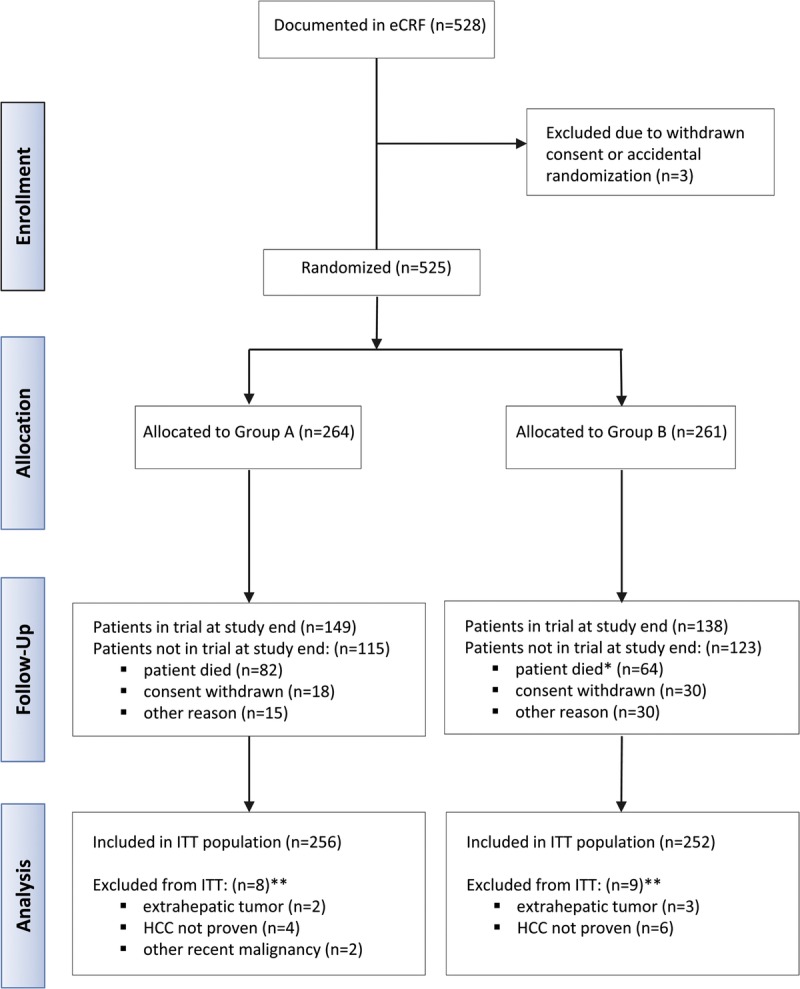
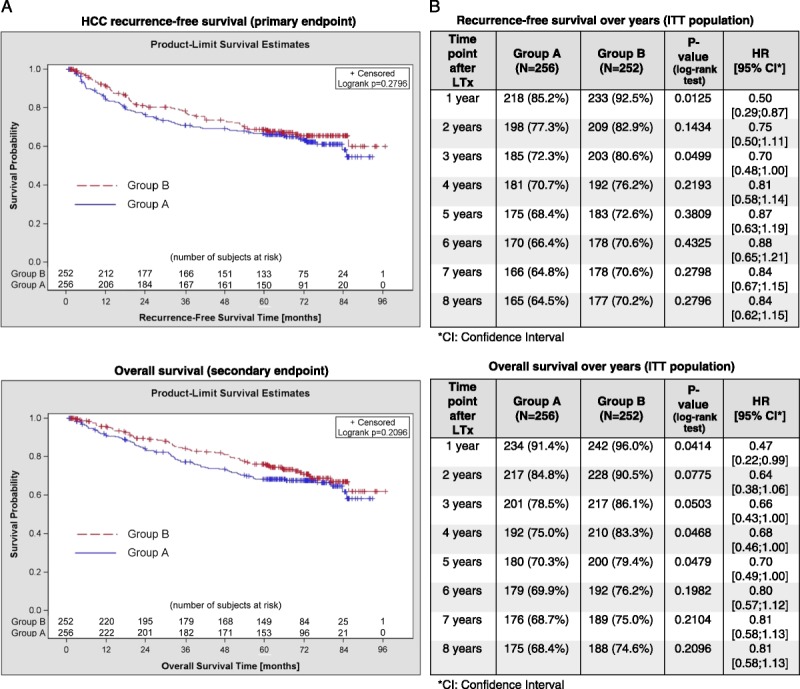
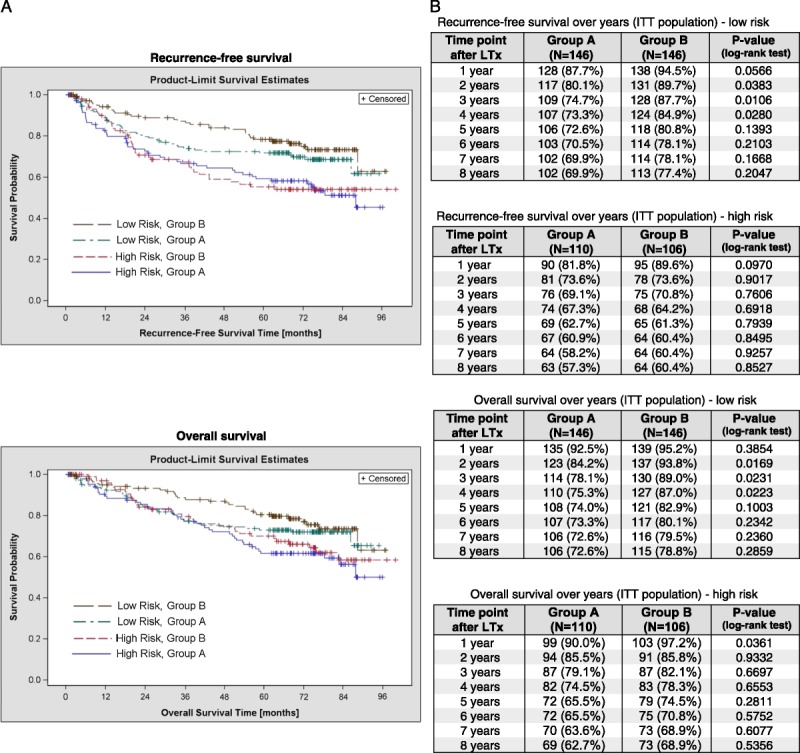
BACKGROUND: We investigated whether sirolimus-based immunosuppression improves outcomes in liver transplantation (LTx) candidates with hepatocellular carcinoma (HCC). METHODS: In a prospective-randomized open-label international trial, 525 LTx recipients with HCC initially receiving mammalian target of rapamycin inhibitor-free immunosuppression were randomized 4 to 6 weeks after transplantation into a group on mammalian target of rapamycin inhibitor-free immunosuppression (group A: 264 patients) or a group incorporating sirolimus (group B: 261). The primary endpoint was recurrence-free survival (RFS); intention-to-treat (ITT) analysis was conducted after 8 years. Overall survival (OS) was a secondary endpoint. RESULTS: Recurrence-free survival was 64.5% in group A and 70.2% in group B at study end, this difference was not significant (P = 0.28; hazard ratio [HR], 0.84; 95% confidence interval [95% CI], 0.62; 1.15). In a planned analysis of RFS rates at yearly intervals, group B showed better outcomes 3 years after transplantation (HR, 0.7; 95% CI, 0.48-1.00). Similarly, OS (P = 0.21; HR, 0.81; 95% CI, 0.58-1.13) was not statistically better in group B at study end, but yearly analyses showed improvement out to 5 years (HR, 0.7; 95% CI, 0.49-1.00). Interestingly, subgroup (Milan Criteria-based) analyses revealed that low-risk, rather than high-risk, patients benefited most from sirolimus; furthermore, younger recipients (age ≤60) also benefited, as well sirolimus monotherapy patients. Serious adverse event numbers were alike in groups A (860) and B (874). CONCLUSIONS: Sirolimus in LTx recipients with HCC does not improve long-term RFS beyond 5 years. However, a RFS and OS benefit is evident in the first 3 to 5 years, especially in low-risk patients. This trial provides the first high-level evidence base for selecting immunosuppression in LTx recipients with HCC.
Overview
The claims and statistics of this paper haven’t been checked yet.
Free: it reads the open-access text and checks the first 5 claims that cite a source we can check. Create a free account to check every claim.
Integrity signals
Registry
Cites
Statistics
Figures
Verification
Claims the paper makes
The claims and statistics of this paper haven’t been checked yet.
Free: it reads the open-access text and checks the first 5 claims that cite a source we can check. Create a free account to check every claim.
Claims other papers make about this one
Each is checked against this paper’s own text: does it say what the citing paper says it does?
The cited source says what the claim attributes to it.
In the citing paper
“The mTOR inhibitor sirolimus did not significantly change RFS in the SiLVER trial also, involving 525 patients with HCC undergoing liver transplantation91.”
From Adjuvant and neoadjuvant immunotherapies in hepatocellular carcinoma (2024) · cites this paper as [91]
Self-check
Percentages, sums and reported differences re-computed from the paper’s own numbers.
The self-check needs the paper’s full text.
Citations
Cites
Erdogan, D., Heijnen, B. H. M., Bennink, R. J., Kok, M., Dinant, S., Straatsburg, I. H., Gouma, D. J., & van Gulik, T. M. (2004) · Liver International · doi:10.1111/j.1478-3231.2004.00901.x · Cited by 11,700
Mazzaferro, V., Regalia, E., Doci, R., Andreola, S., Pulvirenti, A., Bozzetti, F., Montalto, F., Ammatuna, M., Morabito, A., & Gennari, L. (1996) · New England Journal of Medicine · doi:10.1056/nejm199603143341104 · Cited by 7,186
Self-citationA New Era of Systemic Therapy for Hepatocellular Carcinoma with Regorafenib and Lenvatinib
Kudo, M. (2017) · Liver Cancer · doi:10.1159/000462153 · Cited by 5,936
Acute Abdomen: A Rare Case of Ruptured Hepatocellular Carcinoma
Gloor, S., Jensen, K. O., Breitenstein, S., Binkert, C. A., Angst, E., & Hetzer, F. H. (2017) · Case Reports in Gastroenterology · doi:10.1159/000463378 · Cited by 5,370
Temsirolimus, Interferon Alfa, or Both for Advanced Renal-Cell Carcinoma
Hudes, G., Carducci, M., Tomczak, P., Dutcher, J., Figlin, R., Kapoor, A., Staroslawska, E., Sosman, J., McDermott, D., Bodrogi, I., et al. (2007) · New England Journal of Medicine · doi:10.1056/nejmoa066838 · Cited by 3,647 · cited 1×
“The mTOR inhibitors have proven effective in treating selective types of cancer, including renal cell adenocarcinoma.(13,14) Unfortunately, in HCC patients receiving LTx, the low level of evidence for a positive effect of mTOR inhibitors rests on retrospective data analyses 15-20 and small nonrandomized pilot”
BackgroundLlovet, J. M., Burroughs, A., & Bruix, J. (2003) · The Lancet · doi:10.1016/s0140-6736(03)14964-1 · Cited by 3,608
Motzer, R. J., Escudier, B., Oudard, S., Hutson, T. E., Porta, C., Bracarda, S., Grünwald, V., Thompson, J. A., Figlin, R. A., Hollaender, N., et al. (2008) · The Lancet · doi:10.1016/s0140-6736(08)61039-9 · Cited by 3,019 · cited 1×
“The mTOR inhibitors have proven effective in treating selective types of cancer, including renal cell adenocarcinoma.(13,14) Unfortunately, in HCC patients receiving LTx, the low level of evidence for a positive effect of mTOR inhibitors rests on retrospective data analyses 15-20 and small nonrandomized pilot”
BackgroundYao, F. Y., Ferrell, L., Bass, N. M., Watson, J. J., Bacchetti, P., Venook, A., Ascher, N. L., & Roberts, J. P. (2001) · Hepatology · doi:10.1053/jhep.2001.24563 · Cited by 2,262 · cited 1×
“In many of those surgical cases, liver transplantation (LTx) is the only potentially curative treatment option, especially in patients where the tumor size, number, and spread are limited according to the Milan Criteria,(2) or other defined parameters.(3,4) Because the vast majority of these patients have liver cirrho…”
BackgroundMazzaferro, V., Llovet, J. M., Miceli, R., Bhoori, S., Schiavo, M., Mariani, L., Camerini, T., Roayaie, S., Schwartz, M. E., Grazi, G. L., et al. (2009) · The Lancet Oncology · doi:10.1016/s1470-2045(08)70284-5 · Cited by 2,045 · cited 1×
“In many of those surgical cases, liver transplantation (LTx) is the only potentially curative treatment option, especially in patients where the tumor size, number, and spread are limited according to the Milan Criteria,(2) or other defined parameters.(3,4) Because the vast majority of these patients have liver cirrho…”
BackgroundSelf-citationGuba, M., von Breitenbuch, P., Steinbauer, M., Koehl, G., Flegel, S., Hornung, M., Bruns, C. J., Zuelke, C., Farkas, S., Anthuber, M., et al. (2002) · Nature Medicine · doi:10.1038/nm0202-128 · Cited by 1,739
Self-citation
Cited by
Items 201–300 of 456
Dennis, C. V., Prince, D. S., Moayed-Alaei, L., Remash, D., Carr‐Boyd, E., Bowen, D. G., Strasser, S. I., Crawford, M., Pulitanò, C., Kench, J. G., et al. (2022) · Frontiers in Oncology · doi:10.3389/fonc.2022.997093 · Cited by 14
Self-citationGrąt, M., Stypułkowski, J., Patkowski, W., Bik, E., Krasnodębski, M., Wronka, K. M., Lewandowski, Z., Wasilewicz, M. P., Grąt, K., Masior, Ł., et al. (2017) · Scientific Reports · doi:10.1038/srep39881 · Cited by 14
Tohyama, T., Sakamoto, K., Tamura, K., Nakamura, T., Watanabe, J., Wakisaka, H., & Takada, Y. (2020) · World Journal of Surgical Oncology · doi:10.1186/s12957-020-01873-0 · Cited by 14
Cholongitas, Ε., Antoniadis, N., Goulis, I., Theocharidou, E., Imvrios, G., Γιουλεμέ, Ό., Filis, D., Mouloudi, E. K., Akriviadis, E. A., & Fouzas, I. (2019) · Transplantation Proceedings · doi:10.1016/j.transproceed.2019.01.069 · Cited by 14
S3-Leitlinie „Diagnostik und Therapie des Hepatozellulären Karzinoms“ – Langversion 4.0
Bitzer, M., Groß, S., Albert, J., Blödt, S., Boda‐Heggemann, J., Brunner, T. B., Caspari, R., Toni, E. D., Dombrowski, F., Evert, M., et al. (2024) · Zeitschrift für Gastroenterologie · doi:10.1055/a-2189-6353 · Cited by 16
Self-citationRecent Advances in Liver Transplantation for Hepatocellular Carcinoma
Li, P. J., Shah, S., & Mehta, N. J. (2024) · Current Treatment Options in Oncology · doi:10.1007/s11864-024-01247-8 · Cited by 16
[Advances in basic and clinical research on hepatocellular carcinoma in 2016].
Dong, Z., Zhu, X., Li, Z., Mao, Y., Chai, Y., Yao, D., Sun, H., Zhu, J., & Ma, K. (2017) · PubMed Central · doi:10.3760/cma.j.issn.1007-3418.2017.02.002 · Cited by 13
Su, R., Ling, S., Shan, Q., Wei, X., Wang, R., Jia, C., Zhuang, L., Shen, T. H., Ding, L., Xu, Z., et al. (2021) · Hepatobiliary & pancreatic diseases international · doi:10.1016/j.hbpd.2021.09.001 · Cited by 13
Piñero, F., Thompson, M., Marín, J. I., & Silva, M. O. (2020) · World Journal of Transplantation · doi:10.5500/wjt.v10.i11.297 · Cited by 13
Magro, B., Pinelli, D., Giorgio, M. D., Lucà, M. G., Ghirardi, A., Carobbio, A., Baronio, G., Prete, L. D., Nounamo, F., Gianatti, A., et al. (2021) · Cancers · doi:10.3390/cancers13235976 · Cited by 13
“The SILVER study showed an improvement in recurrence-free survival in the first three to five years in patients that were treated with sirolimus vs calcineurin inhibitors (CNI) [36].”
BackgroundSelf-citationRoll, G. R., & Roberts, J. P. (2019) · Elsevier eBooks · doi:10.1016/b978-0-323-40232-3.00132-1 · Cited by 13
Rethinking Immune Check Point Inhibitors Use in Liver Transplantation: Implications and Resistance
Ortiz, V., & Loeuillard, E. J. (2024) · Cellular and Molecular Gastroenterology and Hepatology · doi:10.1016/j.jcmgh.2024.101407 · Cited by 14
Zhang, G., Duan, B., & Li, G. (2022) · Clinical Transplantation · doi:10.1111/ctr.14823 · Cited by 12
Cholongitas, Ε., Burra, P., Vourli, G., & Papatheodoridis, G. (2023) · Clinical Transplantation · doi:10.1111/ctr.14957 · Cited by 12
Self-citationFollow-up of the Post-Liver Transplantation Patient
Cheung, A. C., & Levitsky, J. (2017) · Clinics in Liver Disease · doi:10.1016/j.cld.2017.06.006 · Cited by 16
Essential updates 2018/2019: Liver transplantation
Ohira, M., Tanimine, N., Kobayashi, T., & Ohdan, H. (2020) · Annals of Gastroenterological Surgery · doi:10.1002/ags3.12321 · Cited by 12
Hepatocellular Carcinoma Chemoprevention with Generic Agents
Rasha, F. A., Paul, S., Simon, T. G., & Hoshida, Y. (2022) · Seminars in Liver Disease · doi:10.1055/a-1942-6693 · Cited by 12
Ettorre, G. M. (2022) · Updates in surgery/Updates in surgery series · doi:10.1007/978-3-031-09371-5 · Cited by 12
Au, K. P., & Chok, K. (2020) · World Journal of Gastrointestinal Surgery · doi:10.4240/wjgs.v12.i4.149 · Cited by 11
To, J. C., Ghosh, S., Zhao, X., Pasini, E., Fischer, S. E., Sapisochín, G., Ghanekar, A., Jaeckel, E., & Bhat, M. (2024) · Human Genomics · doi:10.1186/s40246-024-00624-6 · Cited by 13
“…investigation in the clinical setting for transplant recipients with hepatocellular carcinoma; prospective evaluation of sirolimus demonstrated benefits in overall short-term post-transplant survival and recurrence-free survival compared to calcineurin inhibitor-based immunosuppression [38].”
BackgroundAl‐Ameri, A. A. M., Wei, X., Lin, L., Shao, Z., Guo, H., Xie, H., Zhou, L., Zheng, S., & Xu, X. (2019) · BMC Cancer · doi:10.1186/s12885-019-6343-4 · Cited by 11
Kim, H. J., Lee, J., Lee, J. G., Joo, D. J., & Kim, M. S. (2022) · Scientific Reports · doi:10.1038/s41598-022-20636-3 · Cited by 13
Shah, T., Manas, D., Ford, S., Dasari, B. V. M., Gibbs, P., Venkataraman, H., Moore, J. K., Hughes, S., Elshafie, M., Karkhanis, S., et al. (2023) · Current Oncology Reports · doi:10.1007/s11912-022-01343-8 · Cited by 11
Nguyen, T. H., Nguyen, T. M., Ngoc, D. T. M., You, T., Park, M. K., & Lee, C. H. (2023) · International Journal of Molecular Sciences · doi:10.3390/ijms242216255 · Cited by 11
“Notably, patients with higher AFP levels benefited the most from additional mTOR inhibitors, experiencing improved overall survival, disease-free survival, and a reduced risk of HCC recurrence [236,237].”
BackgroundMarrone, G., Leone, M. S., Biolato, M., Liguori, A., Bianco, G., Spoletini, G., Gasbarrini, A., Miele, L., & Pompili, M. (2023) · Cancers · doi:10.3390/cancers15235593 · Cited by 11
“An initial benefit was observed in the first 5 years post-transplant, especially in subjects at lower risk of recurrence with tumors within the Milan criteria, though this was not maintained over time [79].”
BackgroundGrąt, M., Stypułkowski, J., Patkowski, W., Wronka, K. M., Bik, E., Krasnodębski, M., Masior, Ł., Lewandowski, Z., Wasilewicz, M. P., Grąt, K., et al. (2017) · Annals of Surgical Oncology · doi:10.1245/s10434-017-5989-x · Cited by 11
“The presented survival outcomes of high-risk HCC patients are even lower than that reported in the literature for patients beyond the Milan criteria, presumably due to more liberal selection policy applied in the authors department reducing selection bias.(5,7,12,25,26) The outcomes of highMELD non-HCC patients seem c…”
ResultMuhedier, M., Li, J., Liu, H., Ma, G., Amahong, K., Lin, R., & Lü, G. (2020) · Acta Tropica · doi:10.1016/j.actatropica.2020.105708 · Cited by 11
Sung, P. S., Han, J. W., Seo, C., Ahn, J., Lee, S. K., Nam, H. C., Choi, H. J., You, Y. K., Jang, J. W., Choi, J. Y., et al. (2021) · Frontiers in Pharmacology · doi:10.3389/fphar.2021.685176 · Cited by 11
“Previous studies demonstrated that mTOR inhibitors may reduce the recurrence of HCC after LT (Grigg et al., 2019), although most of these studies compared anmTOR inhibitor plus a low dose of TAC and a regular dose of TAC only.”
BackgroundResultFrancois‐Vaughan, H., Adebayo, A., Brilliant, K. E., Parry, N. M., Gruppuso, P. A., & Sanders, J. A. (2016) · Carcinogenesis · doi:10.1093/carcin/bgw016 · Cited by 11
ROBERTS, D. E., Kakar, S., Mehta, N. J., & Gill, R. M. (2018) · The American Journal of Surgical Pathology · doi:10.1097/pas.0000000000001053 · Cited by 11
Marco, L. D., Romanzi, A., Pivetti, A., Maria, N. D., Ravaioli, F., Salati, M., Villa, E., Benedetto, F. D., Magistri, P., Dominici, M., et al. (2024) · Critical Reviews in Oncology/Hematology · doi:10.1016/j.critrevonc.2024.104607 · Cited by 11
Jang, S., Kim, G., Lim, Y., Kim, H., & Lee, E. (2025) · American Journal of Transplantation · doi:10.1016/j.ajt.2025.01.005 · Cited by 10
Li, Z., Taner, T., Eaton, J. E., Smith, B. H., Ilyas, S. I., Hallemeier, C. L., Tran, N. H., Diwan, T. S., Mathur, A. K., Lizaola‐Mayo, B., et al. (2025) · Annals of Surgery · doi:10.1097/sla.0000000000006815 · Cited by 10
Jiang, J., Feng, K., Zhang, L., & Ma, K. (2025) · Oncology and Translational Medicine · doi:10.1097/ot9.0000000000000086 · Cited by 10
Translational Regulation in Hepatocellular Carcinogenesis
Bračič, S., Schatz, C., & Haybaeck, J. (2021) · Drug Design Development and Therapy · doi:10.2147/dddt.s255582 · Cited by 10
S3-Leitlinie: Diagnostik und Therapie des hepatozellulären Karzinoms
Voesch, S., Bitzer, M., Jörg, A., Bartenstein, P., Bechstein, W. O., Blödt, S., Thomas, B., Dombrowski, F., Evert, M., Follmann, M., et al. (2022) · Zeitschrift für Gastroenterologie · doi:10.1055/a-1589-7568 · Cited by 10
Self-citationManagement of pediatric hepatocellular carcinoma: A multimodal approach
Kohorst, M. A., Warad, D., Matsumoto, J. M. S., Heimbach, J. K., El‐Youssef, M., Arndt, C. A. S., Rodriguez, V., & Rao, A. A. N. (2017) · Pediatric Transplantation · doi:10.1111/petr.13007 · Cited by 10
Impact of immunosuppressant therapy on new-onset diabetes in liver transplant recipients
Liu, F.-C., Lin, H.-T., Lin, J., & Yu, H. (2017) · Therapeutics and Clinical Risk Management · doi:10.2147/tcrm.s142348 · Cited by 10
Barjon, C., Dahlqvist, G., Ghazal, K., Saliba, F., Durand, F., Duvoux, C., Aoudjehane, L., & Conti, F. (2020) · Clinics and Research in Hepatology and Gastroenterology · doi:10.1016/j.clinre.2020.10.004 · Cited by 10
Self-citationPiñero, F., Carrihlo, F. J., & Silva, M. O. (2017) · Liver International · doi:10.1111/liv.13417 · Cited by 10
Liver transplantation as a treatment for cancer: comprehensive review
Dasari, B. V. M., Line, P., Sapisochín, G., Hibi, T., Bhangui, P., Halazun, K. J., Shetty, S. R., Shah, T., Magyar, C. T. J., Donnelly, C. B., et al. (2025) · BJS Open · doi:10.1093/bjsopen/zraf034 · Cited by 9
“…trial, recurrence-free survival and OS were noted up to 5 years post-transplantation, particularly in those with low risk of HCC recurrence, and the greatest recurrence-free survival and OS was noted in those patients on sirolimus monotherapy compared with combined immunosuppression regimens 168 .”
Liu, P., Wang, X., Liu, H., Wang, S., Xu, Q., Wang, L., Xu, X., & Cai, J. (2022) · Hepatobiliary & pancreatic diseases international · doi:10.1016/j.hbpd.2022.11.010 · Cited by 9
Durkin, C., Schaubel, D. E., Xu, Y., Mahmud, N., Kaplan, D. E., Abt, P. L., & Bittermann, T. (2023) · Transplantation · doi:10.1097/tp.0000000000004487 · Cited by 9
Hepatocellular Carcinoma: Optimal Radiological Evaluation before Liver Transplantation
Burgio, M. D., Garzelli, L., Cannella, R., Ronot, M., & Vilgrain, V. (2023) · Life · doi:10.3390/life13122267 · Cited by 9
“Since the original publication, the Milan criteria have been adopted in LT centers worldwide and incorporated into staging systems (American Liver Tumor Study Group Modified Tumor-Node-Metastasis, Barcelona Clinic Liver Cancer [3]), and they are commonly used in subgroup analysis in RCT trials [4,5].”
Piñero, F., Lai, Q., Costentin, C. E., Degroote, H., Schnitzbauer, A. A., Geissler, E. K., Duvoux, C., & on behalf of the International SiLVER Study Group (2024) · Liver Transplantation · doi:10.1097/lvt.0000000000000487 · Cited by 9
“[20] The SiLVER study complied with all international ethical requirements, and the study protocol was approved by each ethics committee; it complied with all ethical standards, including the Declaration of Helsinki and the Good Clinical Practice guidelines.”
InfluentialSelf-citationHow much alcohol is in ketamine's antidepressant action?
Bonnet, U. (2016) · Life Sciences · doi:10.1016/j.lfs.2016.11.003 · Cited by 9
Foerster, F., Mittler, J., Darstein, F., Heise, M., Marquardt, J. U., Wörns, M., Weinmann, A., Salter, L., Hoppe‐Lotichius, M., Heinrich, S., et al. (2018) · European Journal of Internal Medicine · doi:10.1016/j.ejim.2018.05.024 · Cited by 9
Self-citationSmedman, T. M., Guren, T. K., Tveit, K. M., Thomsen, M., Andersen, M. H., Line, P., & Dueland, S. (2022) · Transplant International · doi:10.3389/ti.2022.10404 · Cited by 9
The Role of Immunosuppression for Recurrent Cholangiocellular Carcinoma after Liver Transplantation
Gül‐Klein, S., Schmitz, P., Schöning, W., Öllinger, R., Lurje, G., Jonas, S., Uluk, D., Pelzer, U., Tacke, F., Schmelzle, M., et al. (2022) · Cancers · doi:10.3390/cancers14122890 · Cited by 9
“A prospective study by Geissler et al. showed longer relapse-free survival and better overall survival for patients with sirolimus up to 5 years after LT [32].”
Self-citationYang, Z., Xie, H., Wan, J., Wang, Y., Zhang, L., Zhou, K., Tang, H., Zhao, W., Wang, H., Song, P., et al. (2023) · EBioMedicine · doi:10.1016/j.ebiom.2023.104594 · Cited by 10
Aloun, A., Abu-zeid, E. E. D., & Garzali, I. U. (2023) · Hepatology forum/Hepatology forum (Online) · doi:10.14744/hf.2022.2022.0049 · Cited by 9
“Hepatic Artery Thrombosis Two studies[19,25] consisting of 552 patients compared post-transplant hepatic artery thrombosis between patients that received mTORi-based immunosuppression and CNI-based immunosuppression.”
BackgroundMethodResultInfluentialLiver transplantation and BCLC classification: Limitations impede optimum treatment
Otto, G., Pitton, M. B., Hoppe‐Lotichius, M., & Weinmann, A. (2020) · Hepatobiliary & pancreatic diseases international · doi:10.1016/j.hbpd.2020.12.009 · Cited by 9
Self-citationÅberg, F. O., Abrahamsson, J., Schult, A., Bennet, W., Rizell, M., & Eilard, M. S. (2021) · Transplant International · doi:10.1111/tri.14159 · Cited by 9
“Although this has yet to be clearly defined, there may be subgroups of patients who could benefit from individualized immunosuppression after LT for HCC [3].”
BackgroundSelf-citationCillo, U., Carraro, A., Avolio, A. W., Cescon, M., Benedetto, F. D., Giannelli, V., Magistri, P., Nicolini, D., Vivarelli, M., Lanari, J., et al. (2024) · Updates in Surgery · doi:10.1007/s13304-024-01845-z · Cited by 10
Self-citationBadwei, N. (2024) · World Journal of Transplantation · doi:10.5500/wjt.v14.i3.96637 · Cited by 8
Han, J. W., & Park, S. (2024) · Clinical Transplantation and Research · doi:10.4285/ctr.24.0059 · Cited by 8
“Furthermore, the reduced risk of HCC recurrence makes this combination therapy particularly advantageous for patients with a history of HCC [71].”
Junger, H. H. G., Mühlbauer, M., Brennfleck, F. W., Schurr, L. A., Goetz, M., Eggenhofer, E., Kirchner, G. I., Evert, K., Fichtner‐Feigl, S., Geissler, E. K., et al. (2022) · Clinical Transplantation · doi:10.1111/ctr.14880 · Cited by 8
Self-citationYang, F., Wan, Y., Shen, X., Wu, Y., Xu, L., Meng, J., Wang, J., Liu, Z., Chen, J., Lu, D., et al. (2023) · Molecular Biomedicine · doi:10.1186/s43556-023-00133-3 · Cited by 9
Hepatocellular carcinoma progression during bridging before liver transplantation
Renner, P., Silva, T. D., Schnitzbauer, A. A., Verloh, N., Schlitt, H. J., & Geissler, E. K. (2021) · BJS Open · doi:10.1093/bjsopen/zrab005 · Cited by 8
Self-citationZhou, L., Du, G., Pan, L., Zheng, Y., Liu, Z., Shi, H., Yang, S., Shi, X., Xuan, M., Feng, L., et al. (2017) · Oncology Letters · doi:10.3892/ol.2017.7217 · Cited by 8
“LT may cause patients to acquire a distinct and unique immune status, with a need for lengthy or lifelong immunosuppressive treatment, and also a requirement for the combination of at least two immunosuppressive agents (28).”
Recurrence of Hepatocellular Carcinoma After Liver Transplantation: The Blind Spot of HCC Management
Ningarhari, M., Lassailly, G., Dharancy, S., Moreno, C., & Trépo, E. (2025) · United European Gastroenterology Journal · doi:10.1002/ueg2.70078 · Cited by 9
Yamada, T., Tateishi, R., & Fujishiro, M. (2026) · Clinical and Molecular Hepatology · doi:10.3350/cmh.2025.1179 · Cited by 7
“(96) In this randomized trial, sirolimus did not confer a sustained improvement in recurrence-free or overall survival in the overall cohort, although transient benefits were observed in selected low-risk patients during early follow-up.”
Menon, K. V., Vijayashanker, A., Murphy, J., Line, P., Isaac, J., Adair, A., Prasad, R. K., Thorburn, D., Adair, A., Parker, I., et al. (2023) · HPB · doi:10.1016/j.hpb.2023.02.011 · Cited by 7
An Update on Randomized Clinical Trials in Hepatocellular Carcinoma
Sim, H., Knox, J. J., & Dawson, L. A. (2017) · Surgical Oncology Clinics of North America · doi:10.1016/j.soc.2017.05.006 · Cited by 7
“A large contemporary randomized trial, the Sirolimus in Liver Transplant Recipients with HCC (SiLVER) study, investigated whether recurrence risk could be reduced by using sirolimus, a mammalian target of rapamycin (mTOR) inhibitor, instead of conventional immunosuppression with a calcineurin inhibitor following trans…”
BackgroundEffects of transplantation-related immunosuppression on co-existent neuroendocrine tumours
Shah, H. A., Faulkes, R., Coldham, C., Shetty, S., & Shah, T. (2022) · QJM · doi:10.1093/qjmed/hcac036 · Cited by 7
Li, J., Chen, T., Xing, H., Li, R., Shen, C., Zhang, Q., Tao, Y., & Wang, Z. (2022) · Hepatobiliary & pancreatic diseases international · doi:10.1016/j.hbpd.2022.04.003 · Cited by 7
Pang, L., Xu, L.-B., & Wu, W. (2024) · Transplantation Proceedings · doi:10.1016/j.transproceed.2024.05.041 · Cited by 7
Angelico, R., Riani, E. B., Martin, E. D., Parente, A., Foguenne, M., Sensi, B., Rodríguez‐Perálvarez, M., & on behalf of the Liver Transplant Immunology Special Interest Group of the International Liver Transplant Society (ILTS) (2024) · Liver Transplantation · doi:10.1097/lvt.0000000000000499 · Cited by 7
“[ 13,15 ] The beneficial effect of mTORi may be more pronounced in patients with HCC showing features of increased biological aggressiveness.”
Conversion From Sirolimus to Everolimus in Long-Term Liver Graft Recipients
Weiler, N., Bilge, N., Troetschler, S., Vermehren, J., Schnitzbauer, A. A., Herrmann, E. M., Sarrazin, C., Zeuzem, S., & Welker, M. (2017) · The Journal of Clinical Pharmacology · doi:10.1002/jcph.871 · Cited by 7
Self-citationWhen to Consider Liver Transplantation in Hepatocellular Carcinoma Patients?
Wing, K., & Cheung, T. T. (2017) · Hepatic Oncology · doi:10.2217/hep-2016-0010 · Cited by 7
Chemoprevention of hepatocellular carcinoma
Schwenk, S., & Kaplan, D. E. (2025) · Hepatology Communications · doi:10.1097/hc9.0000000000000836 · Cited by 7
“[146] Furthermore, a meta-analysis of RCTS and cohort studies involving sirolimus or everolimus-based immunosuppression found improved overall and recurrence-free survival in liver transplant recipients with HCC. [147] Regarding the safety profile of these medications, adverse effects associated…”
Transplantation for Peri-Hilar and Intrahepatic Cholangiocarcinoma With mTOR Immunosuppression
Semaan, S., Connor, A. A., Saharia, A., Kodali, S., Elaileh, A., Patel, K., Soliman, N., Basra, T., Victor, D. W., Simon, C. J., et al. (2025) · Transplantation Proceedings · doi:10.1016/j.transproceed.2025.02.001 · Cited by 6
Adjuvant 131I-metuximab in hepatocellular carcinoma: a new option for an old drug?
Vogel, A., & Saborowski, A. L. (2020) · The Lancet. Gastroenterology & hepatology · doi:10.1016/s2468-1253(20)30004-2 · Cited by 6
Trends of rapamycin in survival benefits of liver transplantation for hepatocellular carcinoma
Zhao, Y., Liu, Y., Zhou, L., Du, G., & He, Q. (2021) · World Journal of Gastrointestinal Surgery · doi:10.4240/wjgs.v13.i9.953 · Cited by 6
Liver transplantation for hepatocellular carcinoma: Current status in Hong Kong, China
Ho, K. K. Y., & Chan, A. C. Y. (2024) · Hepatobiliary & pancreatic diseases international · doi:10.1016/j.hbpd.2024.09.005 · Cited by 6
Mehta, N. J., Roberts, J. P., & Yao, F. Y. (2016) · Liver Transplantation · doi:10.1002/lt.24429 · Cited by 6
Yılmaz, S., & İnce, V. (2021) · Journal of Gastrointestinal Cancer · doi:10.1007/s12029-021-00716-9 · Cited by 6
“A large international randomized controlled trial (SILVER trial) was initiated to investigate whether sirolimus-based IS improves outcomes [19].”
BackgroundMulder, M. B., van Hoek, B., van den Berg, A. P., Polak, W. G., Alwayn, I. P. J., de Jong, K. P., de Winter, B. C. M., Verhey‐Hart, E., Erler, N. S., den Hoed, C. M., et al. (2023) · Liver Transplantation · doi:10.1097/lvt.0000000000000003 · Cited by 6
“Our results are in line with the findings of Buchholz et al,[16] who evaluated the effect of an SRL-based immunosuppressive regimen in combination with CNI minimization on renal function as a subset of the SiLVER study.[21] They showed that an SRL-based immunosuppressive regimen protects renal function in the short te…”
ResultPosition Is Destiny: Metabolism and Cell Identity
Goessling, W. (2019) · Cell Metabolism · doi:10.1016/j.cmet.2019.04.008 · Cited by 6
“Treatment with an immunosuppressive regimen containing an mTOR inhibitor after liver transplant for HCC, however, did result in improved overall survival initially, indicating the possible relevance of mTOR inhibition clinically (Geissler et al., 2016).”
BackgroundAndrassy, J., Guba, M. O., Habicht, A., Fischereder, M., Pratschke, J., Pascher, A., Heller, K. M., Banas, B., Hakenberg, O. W., Vogel, T., et al. (2020) · PLoS ONE · doi:10.1371/journal.pone.0234396 · Cited by 6
Self-citationSurgery of the Tumours of the Liver
Bober, J., & Samek, P. (2002) · Bratislavské lekárske listy/Bratislava medical journal · doi:10.1007/bf03657621 · Cited by 9
Simultaneous combined transplantation: Intricacies in immunosuppression management
Bello, A. D., Vionnet, J., Congy‐Jolivet, N., & Kamar, N. (2024) · Transplantation Reviews · doi:10.1016/j.trre.2024.100871 · Cited by 5
Pelizzaro, F., Ferrarese, A., Gambato, M., Zanetto, A., Russo, F. P., Germani, G., Senzolo, M., Rizzato, M. D., Soldà, C., Vitale, A., et al. (2024) · Hepatoma Research · doi:10.20517/2394-5079.2024.107 · Cited by 10
Self-citationKilling Two Birds With One Stone: Antineoplastic Immunosuppression
Pomfret, E. A. (2015) · Transplantation · doi:10.1097/tp.0000000000001035 · Cited by 5
“The report from Geissler and colleagues in this issue of Transplantation represents a significant contribution to the management of patients with HCC undergoing liver transplantation.(8) They report the results of a multicenter, multinational, prospective, randomized trial of 525 liver transplant recipients with HCC w…”
BackgroundAntitumor Effect of Low-Dose of Rapamycin in a Transgenic Mouse Model of Liver Cancer
Lee, H. S., Kim, J. Y., Ro, S. W., Kim, M. S., Kim, H., & Joo, D. J. (2022) · Yonsei Medical Journal · doi:10.3349/ymj.2022.0247 · Cited by 5
“8 However, sirolimus did not have a statistically significant effect on recurrence-free survival after 5 years.”
Kim, D. G., Yim, S. H., Min, E., Choi, M. C., Joo, D. J., Kim, M. S., & Lee, J. G. (2023) · Scientific Reports · doi:10.1038/s41598-023-46803-8 · Cited by 5
“Furthermore, subsequent RCTs did not show a definite increase in recurrence free survival 13,14 .”
BackgroundBürger, C., Maschmeier, M., Hüsing‐Kabar, A., Wilms, C., Köhler, M., Schmidt, M., Schmidt, H., & Kabar, I. (2019) · Canadian Journal of Gastroenterology and Hepatology · doi:10.1155/2019/5796074 · Cited by 5
Werner, J. M., Hornung, M., Krah, R. R., Götz, M., Schnitzbauer, A. A., Schlitt, H. J., Geissler, E. K., the International SiLVER study group, Zülke, C., Lamby, P. E., et al. (2020) · Transplant International · doi:10.1111/tri.13621 · Cited by 5
“regimen does not indefinitely improve long-term HCC recurrence-free (RFS) and overall survival (OS), outcomes are improved in the first 3–5 years after transplantation, especially in patients with tumors within Milan Criteria and on mTORi monotherapy [7].”
BackgroundMethodInfluentialSelf-citationLee, H. Y., Hong, S. K., Hong, S. Y., Suh, S., Han, E. S., Lee, J., Choi, Y., Yi, N., Lee, K., & Suh, K. (2021) · Frontiers in Surgery · doi:10.3389/fsurg.2021.722098 · Cited by 5
“However, the benefit of administering mTOR inhibitors in patients with HCC undergoing LT remains controversial (26, 27).”
BackgroundSaidy, R. R. O., Wegener, E., Uluk, D., Dittrich, L. S., Schöning, W., Lurje, G., Öllinger, R., Modest, D. P., Tacke, F., Haase, O., et al. (2022) · Medicina · doi:10.3390/medicina58121755 · Cited by 6
“However, side effects such as chronic kidney injury and neoplasms in the decade-long administration of CNI are well known, and the overall beneficial effects of mTORI are controversial [2,3].”
BackgroundSelf-citationHibi, T., & Sugawara, Y. (2018) · HepatoBiliary Surgery and Nutrition · doi:10.21037/hbsn.2018.01.07 · Cited by 5
“Their viral status and whether they had received antiviral therapy post-LT, especially with the interferon-free regimens using direct-acting antivirals (8), have not being analyzed; (V) antineoplastic immunosuppression (9) and a novel immunotherapy using natural killer cells (10) might open up a new horizon to Editori…”
BackgroundLosurdo, G., Gravina, A. G., Maroni, L., Gabrieletto, E. M., Ianiro, G., Ferrarese, A., Visintin, A., Frazzoni, L., Pellegatta, G., Sessa, A., et al. (2021) · Digestive and Liver Disease · doi:10.1016/j.dld.2021.08.008 · Cited by 5
Can hepatocellular carcinoma recurrence be prevented after liver transplantation?
Kim, J. M. (2021) · Clinical and Molecular Hepatology · doi:10.3350/cmh.2021.0276 · Cited by 5
“Although the primary endpoint of improved RFS with sirolimus was not met, better RFS and OS were noted for patients in the sirolimus-treatment arm in the first 3 to 5 years.(8) However, the differences in RFS and OS between the two groups were not statistically significant after 8 years.”
BackgroundAmino acid metabolic reprogramming: future prospects for cholangiocarcinoma therapy
Hua, S., Fei, F., Li, J., Liu, Y., Gao, Y., Wang, X., Dong, X., Liu, Q., & Yang, J. (2026) · Cell Death Discovery · doi:10.1038/s41420-025-02843-9 · Cited by 4
“The antitumour and immunosuppressive properties of mTOR inhibitors have been demonstrated in many clinical trials [80, 81].”
The rise of transplant oncology in primary liver cancer and metastatic disease
Wassmer, C., Gelli, M., Wong, T. C.-L., Li, Z., Zorigtbaatar, A., Marino, R., Aceituno, L., Adam, R. A., Chan, A. C. Y., Heimbach, J. K., et al. (2026) · Hepatology · doi:10.1097/hep.0000000000001723 · Cited by 5
Self-citationZavareh, M. S. R., & Yang, J. D. (2026) · Gastroenterology report · doi:10.1093/gastro/goag018 · Cited by 4
“Notably, sirolimus was associated with improved OS and RFS during the 3 to 5years after LT [131], and subgroup analyses suggested greater benefit among patients with AFP ≥ 10ng/mL and those treated with sirolimus for more than 3months [132].”
AASLD AST NASPGHAN Practice Guideline on pediatric liver transplantation: Posttransplant management
Perito, E. R., Chen, J. K., Danziger‐Isakov, L. A., Desai, M. S., Fawaz, R., Feldman, A. G., Lee, C. K., Magee, J. C., Sayed, B. A., Shemesh, E., et al. (2026) · Liver Transplantation · doi:10.1097/lvt.0000000000000939 · Cited by 4
Roles of Rictor alterations in gastrointestinal tumors (Review)
Cao, R., Guo, S., Min, L., & Li, P. (2024) · Oncology Reports · doi:10.3892/or.2024.8696 · Cited by 4
Immunology demystified: A guide for transplant hepatologists
Košuta, I., Kelava, T., Ostojic, A., Šeša, V., Mrzljak, A., & Lalić, H. (2024) · World Journal of Transplantation · doi:10.5500/wjt.v14.i1.89772 · Cited by 6
S3-Leitlinie Diagnostik und Therapie biliärer Karzinome – Langversion
Bitzer, M., Groß, S., Albert, J., Boda‐Heggemann, J., Brunner, T. B., Caspari, R., Toni, E. D., Dombrowski, F., Evert, M., Geier, A., et al. (2023) · Zeitschrift für Gastroenterologie · doi:10.1055/a-2026-1240 · Cited by 5
Self-citation
Metadata
- Authors
- Geissler, E. K., Schnitzbauer, A. A., Zülke, C., Lamby, P. E., Proneth, A., Duvoux, C., Burra, P., Jauch, K.-W., Rentsch, M., Ganten, T. M., Schmidt, J., Settmacher, U., Heise, M., Rossi, G., Cillo, U., Kneteman, N., Adam, R., van Hoek, B., Bachellier, P., Wolf, P., Rostaing, L., Bechstein, W. O., Rizell, M., Powell, J., Hidalgo, E., Gugenheim, J., Wolters, H., Brockmann, J., Roy, A., Mutzbauer, I., Schlitt, A., Beckebaum, S., Graeb, C., Nadalin, S., Valente, U., Turrión, V. S., Jamieson, N., Scholz, T., Colledan, M., Fändrich, F., Becker, T., Söderdahl, G., Chazouillères, O., Mäkisalo, H., Pageaux, G.-P., Steininger, R., Soliman, T., de Jong, K. P., Pirenne, J., Margreiter, R., Pratschke, J., Pinna, A. D., Hauss, J., Schreiber, S., Strasser, S., Klempnauer, J., Troisi, R. I., Bhoori, S., Lerut, J., Bilbao, I., Klein, C. G., Königsrainer, A., Mirza, D. F., Otto, G., Mazzaferro, V., Neuhaus, P., & Schlitt, H. J.
- Affiliations
- University of Padua (IT)
- University Hospital Regensburg (DE)
- Université Paris-Est Créteil (FR)
- LMU Klinikum (DE)
- University Hospital Heidelberg (DE)
- Jena University Hospital (DE)
- University Medical Center of the Johannes Gutenberg University Mainz (DE)
- Fondazione IRCCS Ca' Granda Ospedale Maggiore Policlinico (IT)
- University Hospital Frankfurt (DE)
- Corresponding author
- Geissler, Edward K.
- ORCID
- Geissler, Edward K.
- Schnitzbauer, Andreas A.
- Lamby, Philipp E.
- Duvoux, Christophe
- Burra, Patrizia
- Schmidt, Jan
- Settmacher, Utz
- Heise, Michael
- Rossi, Giorgio
- Cillo, Umberto
- Kneteman, Norman
- Adam, René
- Bachellier, Philippe
- Rostaing, Lionel
- Bechstein, Wolf O.
- Rizell, Magnus
- Powell, James
- Hidalgo, Ernest
- Gugenheim, Jean
- Wolters, Heiner
- Roy, André
- Graeb, Christian
- Nadalin, Silvio
- Valente, Umberto
- Colledan, Michele
- Becker, Thomas
- Söderdahl, Gunnar
- Chazouillères, Olivier
- Pageaux, Georges-Philippe
- Soliman, Thomas
- Pirenne, Jacques
- Pratschke, Johann
- Schreiber, Stefan
- Strasser, Simone
- Troisi, Roberto I.
- Bhoori, Sherrie
- Lerut, Jan
- Bilbao, Itxarone
- Königsrainer, Alfred
- Mirza, Darius F.
- Mazzaferro, Vincenzo
- Schlitt, Hans J.
- Venue
- Transplantation
- Published
- 2016-01
- Volume
- 100
- Issue
- 1
- Pages
- 116-125
- ISSN
- 0041-1337 (ISSN-L)
- PMC
- PMC4683033
- OpenAlex
- W2173253647
- Cited by
- 433
- References
- 39
- Citations by year
- 2026: 27 · 2025: 24 · 2024: 53 · 2023: 36 · 2022: 43 · 2021: 54 · 2020: 46 · 2019: 37 · 2018: 38 · 2017: 44 · 2016: 26
- FWCI
- 21.89
- Type
- journal article
- Language
- en
- Open access
- hybrid
- doi.org
- Licence
- cc-by-nc-nd
- Locations
- Transplantation (publishedVersion, cc-by-nc-nd)
- PubMed Central (publishedVersion, cc-by-nc-nd)
- PubMed (publishedVersion)
- Leiden Repository (Leiden University) (submittedVersion)
- Ghent University Academic Bibliography (Ghent University) (submittedVersion, cc-by-nc-nd)
- Työväentutkimus Vuosikirja (submittedVersion, other-oa)
- Data Archiving and Networked Services (DANS) (submittedVersion, other-oa)
- HAL (submittedVersion)
- BOA (University of Milano-Bicocca) (submittedVersion)
- Digital Access to Libraries (submittedVersion)
- University of Regensburg Publication Server (University of Regensburg) (submittedVersion)
- Lirias (KU Leuven) (submittedVersion)
- University of Birmingham Research Portal (University of Birmingham) (submittedVersion, cc-by)
- University of Groningen research database (University of Groningen / Centre for Information Technology) (submittedVersion, cc-by-nc-nd)
- Padua Research Archive (University of Padova) (submittedVersion)
- Funders
- Pfizer
- Universitätsklinikum Regensburg
- Universität Regensburg
- Topics
- Health Sciences › Medicine › Hepatology › Hepatocellular Carcinoma Treatment and Prognosis
- Health Sciences › Medicine › Surgery › Organ Transplantation Techniques and Outcomes
- Health Sciences › Medicine › Surgery › Transplantation: Methods and Outcomes
- Keywords
- rapamycin, liver transplantation, hepatocellular carcinoma, mTOR inhibitors, immunosuppression, recurrence-free survival, overall survival, Milan criteria, patient selection, adverse events
- MeSH terms
- Adult, Age Factors, Aged, Australia, Canada, Drug Therapy, Combination, Europe, Female, Carcinoma, Hepatocellular, Humans, Immunosuppressive Agents, Liver Neoplasms, Male, Middle Aged, Neoplasm Recurrence, Local, Prospective Studies, Risk Factors, Time Factors, Liver Transplantation, Treatment Outcome, Disease Progression, Risk Assessment, Disease-Free Survival, Sirolimus, Kaplan-Meier Estimate, Young Adult, Intention to Treat Analysis, TOR Serine-Threonine Kinases
About these checks
Registry, retraction, Cites and statistics results are computed, not judged, with one exception: a printed reference that no index lists is read once by a model before it counts as a citation error. Claims are extracted by a model and kept only when their quote appears verbatim in the text; each cited source is then checked, with a model’s help, for whether it says what the claim relies on. Those verdicts can be wrong — read the claim’s quote and the cited source before relying on one.
Statistics and arithmetic are recomputed, not judged.
Confidence bands are shown only for fields calibrated on our annotated test set. None is calibrated yet, so no band is shown.
What counts as a claim ›How we measure confidence ›How we check this ›
Are you an author, or do you see a problem with this page? Request a review
Data sources
Bibliographic data: Semantic Scholar, OpenAlex, Crossref.
Contains information from the Semantic Scholar Academic Graph Datasets, made available under the ODC Attribution License (ODC-BY 1.0).
Semantic Scholar’s data is described in: Kinney, R., et al. (2023). The Semantic Scholar Open Data Platform. arXiv:2301.10140.
