

Sirolimus Use in Liver Transplant Recipients With Hepatocellular Carcinoma: A Randomized, Multicenter, Open-Label Phase 3 Trial
Open accessThe DOI matches its Crossref record; 39 of the 39 references it cites were found in a registry or an index.
Abstract
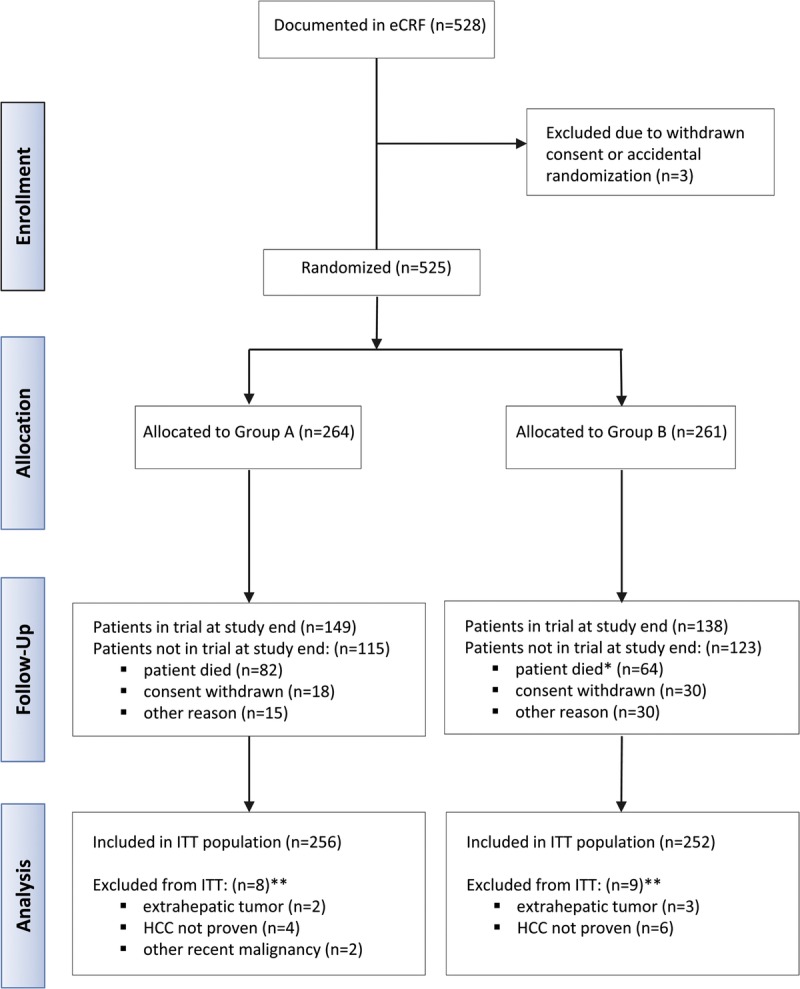
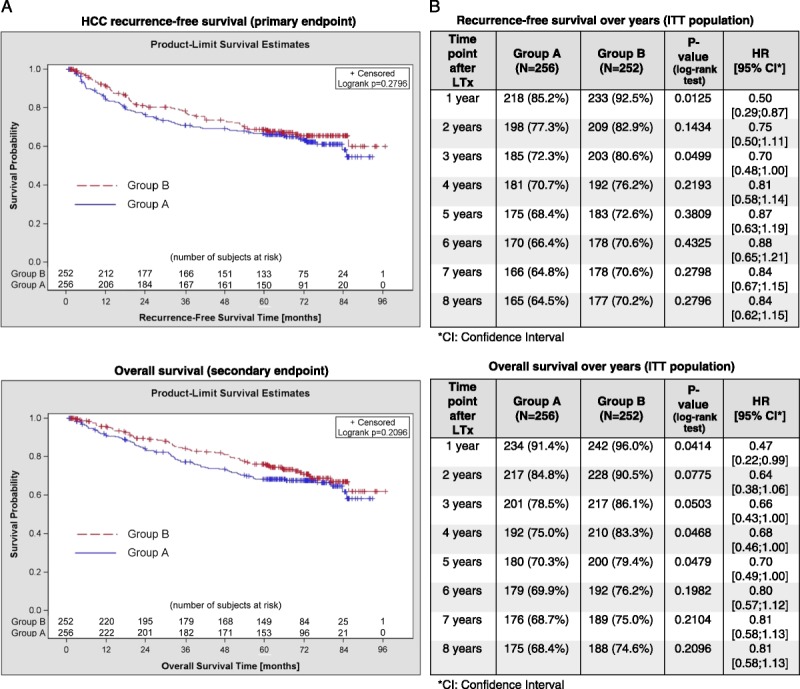
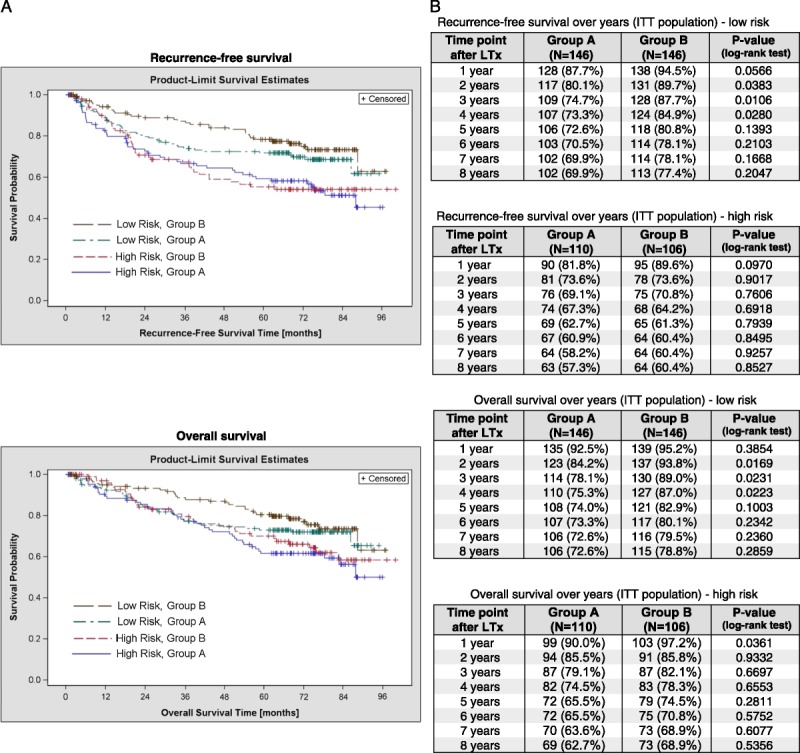
BACKGROUND: We investigated whether sirolimus-based immunosuppression improves outcomes in liver transplantation (LTx) candidates with hepatocellular carcinoma (HCC). METHODS: In a prospective-randomized open-label international trial, 525 LTx recipients with HCC initially receiving mammalian target of rapamycin inhibitor-free immunosuppression were randomized 4 to 6 weeks after transplantation into a group on mammalian target of rapamycin inhibitor-free immunosuppression (group A: 264 patients) or a group incorporating sirolimus (group B: 261). The primary endpoint was recurrence-free survival (RFS); intention-to-treat (ITT) analysis was conducted after 8 years. Overall survival (OS) was a secondary endpoint. RESULTS: Recurrence-free survival was 64.5% in group A and 70.2% in group B at study end, this difference was not significant (P = 0.28; hazard ratio [HR], 0.84; 95% confidence interval [95% CI], 0.62; 1.15). In a planned analysis of RFS rates at yearly intervals, group B showed better outcomes 3 years after transplantation (HR, 0.7; 95% CI, 0.48-1.00). Similarly, OS (P = 0.21; HR, 0.81; 95% CI, 0.58-1.13) was not statistically better in group B at study end, but yearly analyses showed improvement out to 5 years (HR, 0.7; 95% CI, 0.49-1.00). Interestingly, subgroup (Milan Criteria-based) analyses revealed that low-risk, rather than high-risk, patients benefited most from sirolimus; furthermore, younger recipients (age ≤60) also benefited, as well sirolimus monotherapy patients. Serious adverse event numbers were alike in groups A (860) and B (874). CONCLUSIONS: Sirolimus in LTx recipients with HCC does not improve long-term RFS beyond 5 years. However, a RFS and OS benefit is evident in the first 3 to 5 years, especially in low-risk patients. This trial provides the first high-level evidence base for selecting immunosuppression in LTx recipients with HCC.
Overview
The claims and statistics of this paper haven’t been checked yet.
Free: it reads the open-access text and checks the first 5 claims that cite a source we can check. Create a free account to check every claim.
Integrity signals
Registry
Cites
Statistics
Figures
Verification
Claims the paper makes
The claims and statistics of this paper haven’t been checked yet.
Free: it reads the open-access text and checks the first 5 claims that cite a source we can check. Create a free account to check every claim.
Claims other papers make about this one
Each is checked against this paper’s own text: does it say what the citing paper says it does?
The cited source says what the claim attributes to it.
In the citing paper
“The mTOR inhibitor sirolimus did not significantly change RFS in the SiLVER trial also, involving 525 patients with HCC undergoing liver transplantation91.”
From Adjuvant and neoadjuvant immunotherapies in hepatocellular carcinoma (2024) · cites this paper as [91]
Self-check
Percentages, sums and reported differences re-computed from the paper’s own numbers.
The self-check needs the paper’s full text.
Citations
Cites
Erdogan, D., Heijnen, B. H. M., Bennink, R. J., Kok, M., Dinant, S., Straatsburg, I. H., Gouma, D. J., & van Gulik, T. M. (2004) · Liver International · doi:10.1111/j.1478-3231.2004.00901.x · Cited by 11,700
Mazzaferro, V., Regalia, E., Doci, R., Andreola, S., Pulvirenti, A., Bozzetti, F., Montalto, F., Ammatuna, M., Morabito, A., & Gennari, L. (1996) · New England Journal of Medicine · doi:10.1056/nejm199603143341104 · Cited by 7,186
Self-citationA New Era of Systemic Therapy for Hepatocellular Carcinoma with Regorafenib and Lenvatinib
Kudo, M. (2017) · Liver Cancer · doi:10.1159/000462153 · Cited by 5,936
Acute Abdomen: A Rare Case of Ruptured Hepatocellular Carcinoma
Gloor, S., Jensen, K. O., Breitenstein, S., Binkert, C. A., Angst, E., & Hetzer, F. H. (2017) · Case Reports in Gastroenterology · doi:10.1159/000463378 · Cited by 5,370
Temsirolimus, Interferon Alfa, or Both for Advanced Renal-Cell Carcinoma
Hudes, G., Carducci, M., Tomczak, P., Dutcher, J., Figlin, R., Kapoor, A., Staroslawska, E., Sosman, J., McDermott, D., Bodrogi, I., et al. (2007) · New England Journal of Medicine · doi:10.1056/nejmoa066838 · Cited by 3,647 · cited 1×
“The mTOR inhibitors have proven effective in treating selective types of cancer, including renal cell adenocarcinoma.(13,14) Unfortunately, in HCC patients receiving LTx, the low level of evidence for a positive effect of mTOR inhibitors rests on retrospective data analyses 15-20 and small nonrandomized pilot”
BackgroundLlovet, J. M., Burroughs, A., & Bruix, J. (2003) · The Lancet · doi:10.1016/s0140-6736(03)14964-1 · Cited by 3,608
Motzer, R. J., Escudier, B., Oudard, S., Hutson, T. E., Porta, C., Bracarda, S., Grünwald, V., Thompson, J. A., Figlin, R. A., Hollaender, N., et al. (2008) · The Lancet · doi:10.1016/s0140-6736(08)61039-9 · Cited by 3,019 · cited 1×
“The mTOR inhibitors have proven effective in treating selective types of cancer, including renal cell adenocarcinoma.(13,14) Unfortunately, in HCC patients receiving LTx, the low level of evidence for a positive effect of mTOR inhibitors rests on retrospective data analyses 15-20 and small nonrandomized pilot”
BackgroundYao, F. Y., Ferrell, L., Bass, N. M., Watson, J. J., Bacchetti, P., Venook, A., Ascher, N. L., & Roberts, J. P. (2001) · Hepatology · doi:10.1053/jhep.2001.24563 · Cited by 2,262 · cited 1×
“In many of those surgical cases, liver transplantation (LTx) is the only potentially curative treatment option, especially in patients where the tumor size, number, and spread are limited according to the Milan Criteria,(2) or other defined parameters.(3,4) Because the vast majority of these patients have liver cirrho…”
BackgroundMazzaferro, V., Llovet, J. M., Miceli, R., Bhoori, S., Schiavo, M., Mariani, L., Camerini, T., Roayaie, S., Schwartz, M. E., Grazi, G. L., et al. (2009) · The Lancet Oncology · doi:10.1016/s1470-2045(08)70284-5 · Cited by 2,045 · cited 1×
“In many of those surgical cases, liver transplantation (LTx) is the only potentially curative treatment option, especially in patients where the tumor size, number, and spread are limited according to the Milan Criteria,(2) or other defined parameters.(3,4) Because the vast majority of these patients have liver cirrho…”
BackgroundSelf-citationGuba, M., von Breitenbuch, P., Steinbauer, M., Koehl, G., Flegel, S., Hornung, M., Bruns, C. J., Zuelke, C., Farkas, S., Anthuber, M., et al. (2002) · Nature Medicine · doi:10.1038/nm0202-128 · Cited by 1,739
Self-citation
Cited by
Items 301–400 of 456
Current Use of Immunosuppression in Liver Transplantation
Adjei, M. A., & Kim, I. K. (2023) · Surgical Clinics of North America · doi:10.1016/j.suc.2023.08.004 · Cited by 4
Liver Transplantation for Hepatocellular Carcinoma: A Narrative Review and A Glimpse into The Future
Liu, H., Sethi, V., Li, X., Xiao, Y., & Humar, A. (2024) · Seminars in Liver Disease · doi:10.1055/a-2242-7543 · Cited by 4
“163 Sirolimus usage for over 3 months after LT for HCC was found to reduce death risk, with the most signi fi cant bene fi ts seen in patients with an AFP level of 10ng/mL or greater.”
S3-Leitlinie Diagnostik und Therapie des Hepatozellulären Karzinoms – Langversion
Bitzer, M., Groß, S., Albert, J., Blödt, S., Boda‐Heggemann, J., Borucki, K., Brunner, T. B., Caspari, R., Dombrowski, F., Evert, M., et al. (2025) · Zeitschrift für Gastroenterologie · doi:10.1055/a-2460-6298 · Cited by 6
Self-citationThe impact of immunosuppressant therapy on the recurrence of hepatitis C post-liver transplantation.
Albekairy, A. M., Abdel-Razaq, W. S., Alkatheri, A. M., Debasi, T., Otaibi, N. E. A., & Qandil, A. M. (2018) · PubMed Central · Cited by 4
Kasi, M., Rashid, S., Wallace, S., Sujendran, V., Griffiths, B., Butler, A. J., Gibbs, P., Sreedharan, L., Zaitoun, A. M., Venkatachalapathy, S. V., et al. (2018) · Oxford Medical Case Reports · doi:10.1093/omcr/omy039 · Cited by 4
“However, Sirolimus is not shown to improve longterm recurrence free survival beyond 5 years [9].”
BackgroundObtaining Optimal Long-Term Outcomes from Liver Transplantation for Hepatocellular Cancer
Reichman, T., Bhati, C. S., & Battula, N. R. (2019) · Digestive Diseases and Sciences · doi:10.1007/s10620-019-05550-5 · Cited by 4
Research Progress in Targeted Therapy of Hepatocellular Carcinoma
Chen, Q., & Yang, X. (2021) · Chinese Medical Sciences Journal · doi:10.24920/003737 · Cited by 4
Au, K. P., Fung, J. Y. Y., Dai, W. C., Chan, A. C. Y., Lo, C. M., & Chok, K. (2021) · Liver Transplantation · doi:10.1002/lt.26251 · Cited by 4
Liver cell circuits and therapeutic discovery for advanced liver disease and cancer
Crouchet, É., Schuster, C., & Baumert, T. F. (2021) · Comptes Rendus Biologies · doi:10.5802/crbiol.64 · Cited by 4
“Par exemple, les inhibiteurs de la voie de la phosphoinositide 3-kinase (PI3K)/AKT/mTOR, le sirolimus ou l’évérolimus, sont actuellement étudiés pour la récidive du CHC dans des essais cliniques de phase III [36].”
BackgroundInfluentialA hepatocellularis carcinoma komplex kezelése. Konszenzuskonferencia, Budapest, 2021. április 24.
_, _., Hahn, O., Szíjártó, A., Pekli, D., Fulop, A. K., Kokas, B. A., Bárdos, D., András, C., Bartek, P., Battyáni, I., et al. (2022) · Orvosi Hetilap · doi:10.1556/650.2021.32431 · Cited by 5
Azhie, A., Grant, R. C., Herman, M., Wang, L. E., Knox, J. J., & Bhat, M. (2022) · Future Oncology · doi:10.2217/fon-2021-1635 · Cited by 4
Current status of liver transplantation for non‐B non‐C liver cirrhosis and hepatocellular carcinoma
Nishio, T., Ito, T., Hata, K., Taura, K., & Hatano, E. (2022) · Annals of Gastroenterological Surgery · doi:10.1002/ags3.12612 · Cited by 5
Recommendations of everolimus use in liver transplant
Suárez, A. R., Bilbao, I., Fernández-Castroagudín, J., Miñano, J. A. P., Plaza, M. S., Pérez, E. V., & Castillo, M. P. (2017) · Gastroenterología y Hepatología (English Edition) · doi:10.1016/j.gastre.2017.10.006 · Cited by 4
Self-citationCillo, U., Carlis, L. G. D., Gaudio, M. D., SIMONE, P. D., FAGIUOLI, S., Lupo, F., Tisone, G., Volpes, R., the Italian Liver Transplant Working Group, Avolio, A. W., et al. (2021) · Hepatology International · doi:10.1007/s12072-021-10178-7 · Cited by 4
Self-citationKim, S. H. (2025) · Cancers · doi:10.3390/cancers17223671 · Cited by 3
“…randomised trial showed that sirolimus-based regimens did not improve long-term RFS beyond 5 years but yielded benefits in the first 3–5 years, particularly in lower-risk subsets—supporting early mTOR-inhibitor incorporation when recurrence risk is salient and renal/metabolic profiles permit [21].”
Boot, G. F., Haak, F., Coto‐Llerena, M., Boldanova, T., Dazert, E., Sedlaczek, P., Rosenberger, G., Esposito, C., Ercan, C., Wieland, S. F., et al. (2026) · Molecular Cancer · doi:10.1186/s12943-026-02604-x · Cited by 4
“Preclinical studies high-light the potential of some of these as targets: TTK inhibitor CFI-402257 reduces HCC growth and metastasis by disrupting mitotic fidelity [39]; MTORC1 inhibitor siro-limus lowers recurrence post-transplant (NCT00355862) [40].”
Zorzetti, N., Lauro, A., Khouzam, S., & Marino, I. R. (2022) · Experimental and Clinical Transplantation · doi:10.6002/ect.mesot2021.l13 · Cited by 3
Liver Transplantation for Hepatocellular Carcinoma
Sposito, C., & Mazzaferro, V. (2022) · Updates in surgery/Updates in surgery series · doi:10.1007/978-3-031-09371-5_19 · Cited by 3
Self-citationFrager, S. Z., Cooper, W., Saenger, Y. M., & Schwartz, J. M. (2023) · World Journal of Meta-Analysis · doi:10.13105/wjma.v11.i2.47 · Cited by 3
Prostate cancer in solid organ transplant recipients: Results from a multicenter series
Hedhli, O., Marra, G., Georges, K., Glémain, P., Chelghaf, I., Vergie, S. D., Perrouin‐Verbe, M., Luigi, B., Paolo, G., Bouchot, O., et al. (2024) · The French Journal of Urology · doi:10.1016/j.fjurol.2024.102841 · Cited by 3
S3-Leitlinie Diagnostik und Therapie biliärer Karzinome – Langversion
Groß, S., Bitzer, M., Albert, J., Blödt, S., Boda‐Heggemann, J., Borucki, K., Brunner, T. B., Caspari, R., Dombrowski, F., Evert, M., et al. (2025) · Zeitschrift für Gastroenterologie · doi:10.1055/a-2460-6347 · Cited by 4
Self-citationRecomendaciones de uso de everolimus en el trasplante hepático
Suárez, A. R., Bilbao, I., Fernández-Castroagudín, J., Pons, J. A., Plaza, M. S., Pérez, E. V., & Castillo, M. P. (2017) · Gastroenterología y Hepatología · doi:10.1016/j.gastrohep.2017.05.008 · Cited by 3
Self-citationWei, J., Ye, L., Song, L., Tang, H., Zhang, T., Fu, B., Zhang, Y., Yang, Q., Yang, Y., & Yi, S. (2021) · Journal of Gastrointestinal Oncology · doi:10.21037/jgo-20-378 · Cited by 3
“Discussion Much attention has been paid to the application of mTOR pathway inhibitors , such as s irol imus, in liver transplantation patients because of the strong immunosuppressive effects and anti-cancer effects of these inhibitors (25-27).”
BackgroundTasoudis, P., Ziogas, I. A., Alexopoulos, S. P., Fung, J. J., & Tsoulfas, G. (2021) · World Journal of Clinical Oncology · doi:10.5306/wjco.v12.i12.1193 · Cited by 3
Abdelfattah, M. R., ElHadad, H. M., & Elsiesy, H. (2021) · Experimental and Clinical Transplantation · doi:10.6002/ect.2021.0378 · Cited by 3
Ahmed, F., Zakaria, F., Nya, G. E., & Mouchli, M. A. (2022) · World Journal of Gastrointestinal Surgery · doi:10.4240/wjgs.v14.i8.862 · Cited by 3
S3-Leitlinie „Diagnostik und Therapie biliärer Karzinome“ – Langversion 4.0
Groß, S., Bitzer, M., Albert, J., Blödt, S., Boda‐Heggemann, J., Brunner, T. B., Caspari, R., Toni, E. D., Dombrowski, F., Evert, M., et al. (2024) · Zeitschrift für Gastroenterologie · doi:10.1055/a-2189-8567 · Cited by 4
Self-citationMyth: Liver Transplant Provides a Cure for Liver Disease
VanHuis, A., & Loy, V. M. (2019) · Clinical Liver Disease · doi:10.1002/cld.770 · Cited by 3
Bhangui, P., Yadav, S. K., & Soin, A. S. (2020) · Hepatoma Research · doi:10.20517/2394-5079.2020.67 · Cited by 3
“Hence, an mTORi based immunosuppression strategy with reduced CNI has been proposed in HCC patients post LT to reduce recurrence([34]) and improve survival benefit as demonstrated in a meta analysis([35]).”
BackgroundGeissler, E. K., Schnitzbauer, A. A., Schlitt, H. J., & for the SiLVER Study Group (2016) · Liver Transplantation · doi:10.1002/lt.24464 · Cited by 3
Self-citationTwenty years after: from Milan criteria to a “blended” approach
Sandri, G. B. L., & Lai, Q. (2017) · Translational Gastroenterology and Hepatology · doi:10.21037/tgh.2017.07.01 · Cited by 3
“Immunosuppression (IS) represents another field in which no definitive data have been produced: new studies are required aimed at identifying both the connection of IS with the risk of recurrence or specific protocols able to protect against tumor progression (11,12).”
BackgroundSerenari, M., & Ravaioli, M. (2020) · HepatoBiliary Surgery and Nutrition · doi:10.21037/hbsn.2019.11.10 · Cited by 3
Shimata, K., Sugawara, Y., & Hibi, T. (2018) · Gland Surgery · doi:10.21037/gs.2018.09.11 · Cited by 3
Advances in liver transplantation for unresectable colon cancer liver metastasis
Cui, X., Geng, X., Zhou, D., Yang, M., & Hou, H. Y. (2021) · World Journal of Gastrointestinal Surgery · doi:10.4240/wjgs.v13.i12.1615 · Cited by 3
Anders, M. M., de Mattos, Â. Z., Debes, J. D., Beltrán, O., Coste, P., Marín, J. I., Chagas, A. L., Menéndez, J., Estupiñán, E. C., Ferrer, J. D., et al. (2025) · Annals of Hepatology · doi:10.1016/j.aohep.2025.101905 · Cited by 2
Romeo, M., Nardo, F. D., Napolitano, C., Vaia, P., Basile, C., Senese, G., Coppola, A., Iodice, P., Olivieri, S., Federico, A., et al. (2026) · Journal of Clinical Medicine · doi:10.3390/jcm15103579 · Cited by 2
“Several retrospective analyses and prospective trials suggest that mTOR-based regimens may reduce HCC recurrence compared with CNI-dominant strategies, particularly in patients within standard transplant criteria [99].”
Mini-review. Liver transplantation for hepatocellular carcinoma
Visag-Castillo, V. (2016) · Revista Médica Del Hospital General De México · doi:10.1016/j.hgmx.2016.10.003 · Cited by 2
Preserving Treg Function: Beyond mTOR Inhibitors
Adigbli, G., & Issa, F. (2018) · Transplantation · doi:10.1097/tp.0000000000002042 · Cited by 2
Post Liver Transplantation Diarrhea: Etiology, Evaluation and Treatment
Sinha, R., & Rahul Rahul, R. (2021) · International Journal of Medicine and Public Health · doi:10.5530/ijmedph.2021.3.23 · Cited by 2
Calinescu, A. M., Hery, G., de Goyet, J. D. V., & Branchereau, S. (2021) · Hepatoma Research · doi:10.20517/2394-5079.2021.26 · Cited by 2
Deng, Y., Yang, J., Chen, Y., Wang, J., Fu, B., Zhang, T., Yi, S., & Yang, Y. (2022) · Transplantation Proceedings · doi:10.1016/j.transproceed.2022.11.002 · Cited by 2
Tseng, H.-Y., Lin, Y., Lin, C., Chen, C., Yong, C., Lin, L., Wang, C., & Chan, Y. (2023) · Frontiers in Surgery · doi:10.3389/fsurg.2023.1116728 · Cited by 2
Non-surgical Treatment Options in Managing Recurrent Hepatocellular Carcinoma
Abdelhamed, W., & El‐Kassas, M. (2023) · Gene Expression · doi:10.14218/ge.2023.00010 · Cited by 2
Deguchi, H., Sakamoto, S., Shimizu, S., Fukuda, A., Uchida, H., Yanagi, Y., Nakao, T., Kodama, T., Komine, R., Nishi, K., et al. (2024) · Pediatric Transplantation · doi:10.1111/petr.14719 · Cited by 2
“18,19 However, the use of mTOR inhibitors in LT recipients with HCC did not improve long-term, recurrence-free survival.”
BackgroundCeldir, M. G., Wehby, G. L., Prakash, S., & Tanaka, T. (2025) · PLoS ONE · doi:10.1371/journal.pone.0316445 · Cited by 2
Deng, M., Chen, C., Wang, K., Li, B., & Yu, D. (2025) · Journal of Gastrointestinal Oncology · doi:10.21037/jgo-24-480 · Cited by 2
“However, a prospective phase III multicenter randomized trial failed to demonstrate a significant difference in HCC recurrence rates among LT patients, irrespective of the inclusion of sirolimus in the regimen (22).”
Czauderna, C., Marquardt, J. U., Galle, P. R., & Wörns, M. (2017) · Der Internist · doi:10.1007/s00108-017-0226-z · Cited by 2
Afroz, F., Jonkman, E., Jin, H., Kist, A., Zhou, Y., Sokoya, E. M., Padbury, R. T. A., Nieuwenhuijs, V. B., & Barritt, G. J. (2018) · European Journal of Pharmacology · doi:10.1016/j.ejphar.2018.08.043 · Cited by 2
Liver Transplantation for Locally Advanced Hepatocellular Carcinoma
Kawamura, N., & Taketomi, A. (2020) · Digestive Disease Interventions · doi:10.1055/s-0040-1702996 · Cited by 2
Advancement on Clinical Application of mTOR Inhibitors in Gastrointestinal Cancers
Feng, Y., Chen, Y.-S., Ren, Y., Cao, S., & Zhang, H. (2020) · Journal of Biosciences and Medicines · doi:10.4236/jbm.2020.84004 · Cited by 2
Frequent fragility of randomized controlled trials for HCC treatment
Zhang, H., Li, J., & Zeng, W. (2021) · BMC Cancer · doi:10.1186/s12885-021-08133-8 · Cited by 2
Selection Criteria and Outcome of Liver Transplantation for Neoplastic Liver Diseases
Duvoux, C., & Lerut, J. P. (2022) · Springer eBooks · doi:10.1007/978-3-030-82930-8_5 · Cited by 3
Self-citationChung, W., Wong, K., Ravindranayagam, N., Tang, L. C. Y., Grace, J., Wong, D. J., Con, D., Sinclair, M. J., Majumdar, A., Kutaiba, N., et al. (2024) · World Journal of Transplantation · doi:10.5500/wjt.v14.i3.94914 · Cited by 2
Cochannel Interference Reduction for CDMA Wireless Communication Systems.
Salam, M. A., Al-Khatib, M. M., & Alsharif, S. (2004) · Communications in Computing · Cited by 2
Medical Management after Liver Transplantation
Dave, S., & Ajmera, V. H. (2019) · Digestive Disease Interventions · doi:10.1055/s-0039-1697652 · Cited by 2
Krishnan, S. K., Mouleeswaran, K. S., Gopal, P. V., Patcha, R. V., Ramakrishna, S. H., Perumal, K., Malleeswaran, S., Varghese, J., & Reddy, M. S. (2021) · Journal of Clinical and Experimental Hepatology · doi:10.1016/j.jceh.2021.05.006 · Cited by 1
The Role of Liver Transplantation in Hepatocellular Carcinoma
Jakhete, N., Majeed, N. A., Maluf, D. G., & Shetty, K. (2024) · Clinics in Liver Disease · doi:10.1016/j.cld.2024.08.009 · Cited by 1
Pinto, E., Zanetto, A., Gambato, M., Ferrarese, A., Germani, G., Senzolo, M., Russo, F. P., & Burra, P. (2025) · European Journal of Transplantation · doi:10.57603/ejt-1749 · Cited by 1
Self-citationSystemic Treatment for Hepatocellular Carcinoma Recurrence After Liver Transplantation
Mazzarelli, C., Berardi, F., Bonfichi, A., Clemente, M., Orlando, M., Strollo, M., & Belli, L. S. (2026) · Current Oncology · doi:10.3390/curroncol33030141 · Cited by 1
“The Silver Trial, a large, randomized trial, found no overall benefit of sirolimus but did demonstrate improved outcomes in low-risk patients within Milan criteria at five years [91].”
Chaudhary, T., Das, S., Mazumder, A., & Aggarwal, S. (2026) · Current Cancer Therapy Reviews · doi:10.2174/0115733947391658251027060002 · Cited by 1
Wang, N., Zhu, Z., Zheng, H., Qi, C., Yuan, X., Li, X., Xu, Z. S., Qin, J., Wu, W., Wang, J., et al. (2026) · Health care science · doi:10.1002/hcs2.70071 · Cited by 1
“Despite these gaps, the SILVER trial [25] (ITT) and two randomized, prospective, controlled trials, the H2304 study [26], and the HEPHAISTOS study [27] provide a valuable framework for managing IS in high‐risk LT cohorts.”
InfluentialTan, C. K., Vogel, A., Wong, Y. F., Ho, G. F., Zhou, J., Atmakusuma, T. D., Kulkarni, P., Kodama, T., Chon, H. J., Bellò, M., et al. (2026) · ESMO Open · doi:10.1016/j.esmoop.2026.107771 · Cited by 2
“58 Subgroup analysis found that sirolimus improved the RFS rates per year from years 2-4 for patients with low-risk HCC based on Milan criteria.”
Kang, W., Hwang, S., Moon, D., Kim, K., Ahn, C., Ha, T., Song, G., Jung, D., Park, G., Yoon, Y., et al. (2026) · Transplant International · doi:10.3389/ti.2026.17121 · Cited by 1
“Our practice has been to transition after the third month; the present findings suggest this timing warrants reconsideration in high-burden ABOi recipients, although the SiLVER trial showed benefit mainly in lower-risk patients [14].”
Giakoustidis, A. E., & Giakoustidis, D. E. (2017) · Immunotherapy · doi:10.2217/imt-2016-0110 · Cited by 1
Hepatocellular Cancer: Is Recurrence Inevitable?
Doğanay, H. L. (2017) · Journal of Gastrointestinal Cancer · doi:10.1007/s12029-017-9967-0 · Cited by 1
Czauderna, C., Marquardt, J. U., Galle, P. R., & Wörns, M. (2018) · best practice onkologie · doi:10.1007/s11654-017-0061-7 · Cited by 1
“Ebenfalls existiert keine gesicherte Empfehlung bezüglich der Wahl des Immuntherapeutikums nach OLT [16].”
BackgroundKornberg, A., & Schernhammer, M. (2018) · Hepatoma Research · doi:10.20517/2394-5079.2018.86 · Cited by 1
“The only prospective, randomized, multicenter, open-label study recently finalized, however, did not find a significant improvement of OS and RFS beyond 5 years([153]).”
BackgroundEmerging Targeted Therapies for Treatment of Hepatocellular Carcinoma (HCC)
Fatima, S., Lee, N. P. Y., Kwan, H. Y., & Bian, Z. X. (2018) · IntechOpen eBooks · doi:10.5772/intechopen.71480 · Cited by 1
Post–Liver Transplant Management
Ghufran, A., & Lucey, M. R. (2018) · Elsevier eBooks · doi:10.1016/b978-0-323-37591-7.00052-5 · Cited by 1
Living donor liver transplantation for patients with advanced hepatocellular carcinoma
Cullen, J. M., Vargas, P. A., & Goldaracena, N. (2020) · Hepatoma Research · doi:10.20517/2394-5079.2020.69 · Cited by 1
“Inhibition of tumor growth mediated by properties such as antiangiogenic and antiproliferative effects makes mTOR an extraordinary class of immunosuppressants([53]).”
BackgroundAutophagy and Cancer: Current Biology and Drug Development
Theiss, A. L. (2021) · Physiology in health and disease · doi:10.1007/978-3-030-67951-4_12 · Cited by 1
Risk factors and management of post-liver transplant recurrence of hepatocellular carcinoma
Rammohan, A., & Rela, M. (2021) · Hepatoma Research · doi:10.20517/2394-5079.2020.160 · Cited by 1
Cholongitas, Ε. (2022) · Transplantation · doi:10.1097/tp.0000000000003980 · Cited by 1
Liver Transplantation for Colorectal Cancer Liver Metastases
Gelli, M., & Adam, R. A. (2022) · Springer eBooks · doi:10.1007/978-3-030-82930-8_41 · Cited by 1
Self-citationCAQ Corner: Disease recurrence after liver transplantation
Goel, A., & Kwong, A. J. (2022) · Liver Transplantation · doi:10.1002/lt.26492 · Cited by 1
“[47] Subgroup analysis suggested a potential benefit in patients within Milan criteria and/or age 60 years.”
The second Mexican consensus on hepatocellular carcinoma. Part II: Treatment
Cisneros-Garza, L. E., González-Huezo, M. S., Moctezuma‐Velázquez, C., de Guevara-Cetina, L. L., Vilatobá, M., García‐Juárez, I., Alvarado-Reyes, R., Álvarez-Treviño, G. A., Allende‐Pérez, S., Bornstein-Quevedo, L., et al. (2022) · Revista de Gastroenterología de México (English Edition) · doi:10.1016/j.rgmxen.2022.01.004 · Cited by 1
Rovgaliyev, B., Tan, M. Y., Lee, K., Oh, S. C., Park, M. Y., Seo, S., Choi, H., Hong, S. K., Cho, J., Lee, J., et al. (2022) · Transplantation Proceedings · doi:10.1016/j.transproceed.2022.04.027 · Cited by 1
Post-liver transplant HCC recurrence: patterns, treatment, and outcome
Abdelfattah, M. R., & Elsiesy, H. (2022) · Cellular Therapy and Transplantation · doi:10.18620/ctt-1866-8836-2022-11-2-39-44 · Cited by 1
Lerut, J. P., & Lai, Q. (2023) · Transplantation · doi:10.1097/tp.0000000000004488 · Cited by 1
Self-citationKim, J., Hong, S. K., Kim, J., Lee, J., Choi, H. H., Lee, S., Hong, S. Y., Lee, J., Choi, Y., Yi, N., et al. (2023) · Annals of Surgical Treatment and Research · doi:10.4174/astr.2023.105.1.47 · Cited by 1
“However, no consensus on the point of initiation of administration of rapamycin has been established and its benefit in high-risk groups remains controversial [27].”
BackgroundHCC in peri-transplant period: What a gastroenterologist needs to know
Rabiee, A., & Miller, J. B. (2023) · Clinical Liver Disease · doi:10.1097/cld.0000000000000071 · Cited by 1
“This is beneficial because elevated calcineurin inhibitors troughs are thought to contribute to the risk of HCC recurrence.[2,11,12]”
BackgroundChiang, H.-Y., Li, L., Hsu, C., Lin, C., Chan, Y., Wang, C., & Chen, C. (2023) · Pharmaceuticals · doi:10.3390/ph16081087 · Cited by 1
“published in 2016 that sirolimus in LT recipients with HCC did not improve long-term recurrence-free survival beyond 5 years [47].”
BackgroundEvans, J. B., Chou, L., Kaeberlein, M. R., Promislow, D., & Creevy, K. E. (2023) · Frontiers in Veterinary Science · doi:10.3389/fvets.2023.1285498 · Cited by 1
Dumortier, J., & Boillot, O. (2024) · Transplant Immunology · doi:10.1016/j.trim.2024.102014 · Cited by 1
Clinical challenges and research perspectives in liver transplant oncology
Xu, S., Shu, W., He, X., Ling, S., Wei, X., & Xu, X. (2024) · Chinese Medical Journal · doi:10.1097/cm9.0000000000003339 · Cited by 1
Erard, D., Steiner, A., Boillot, O., Thimonier, E., Vallin, M., Veyre, F., Guillaud, O., Radenne, S., & Dumortier, J. (2024) · Clinical Transplantation · doi:10.1111/ctr.70014 · Cited by 1
“In an international prospective randomized trial, patients transplanted with HCC within Milan criteria had improved HCC recurrence-freeandoverallsurvivaliftheyweretreatedwithearly introduction of sirolimus post-LT [38].”
[Review and prospect of clinical study on liver transplantation of hepatocellular carcinoma].
Huang, X., & Zhou, J. (2018) · PubMed Central · doi:10.3760/cma.j.issn.1007-3418.2018.02.001 · Cited by 1
Mehta, N. J., & Yao, F. Y. (2016) · Liver Transplantation · doi:10.1002/lt.24465 · Cited by 1
Cholongitas, Ε. (2016) · Transplantation · doi:10.1097/tp.0000000000001256 · Cited by 1
Cholongitas, Ε. (2019) · Alimentary Pharmacology & Therapeutics · doi:10.1111/apt.15310 · Cited by 1
Geissler, E. K., Schnitzbauer, A. A., & Schlitt, H. J. (2016) · Transplantation · doi:10.1097/tp.0000000000001255 · Cited by 1
Self-citationMukthinuthalapati, V. V. P. K., & Gupta, S. K. (2023) · Annals of Translational Medicine · doi:10.21037/atm-22-5875 · Cited by 1
“The benefit was also more commonly noted in those within Milan’s criteria for selection, keeping the importance of the original selection criteria for transplant (19).”
Immunosuppression in Liver Transplantation
Chan, A. J., & Lake, J. R. (2013) · Liver Transplantation · doi:10.1002/9781118675915.ch16
Mittler, J., & Lang, H. (2016) · Der Onkologe · doi:10.1007/s00761-016-0051-3
“Im Vergleich einer Sirolimus-basierten gegenüber einer Calcineurin-Inhibitor-basierten Immunsuppression wurde eine signifikante Verbesserung des rezidivfreien und des Gesamtüberlebens mittelfristig, jedoch nicht langfristig mehr als 5 Jahre nach Transplantation beobachtet [36].”
BackgroundArend, J., Schütte, K., Däberitz, T., Bretschneider, T., Benedix, F., Udelnow, A., Wolff, S., & Bruns, C. J. (2016) · Der Onkologe · doi:10.1007/s00761-016-0052-2
“ImDrei- undFünfjahres-DFS und -OS gab es einen Vorteil für Low-risk-Patienten [13].”
BackgroundmTOR Inhibition to Prevent Posttransplant Malignancies—Don't Stop Believin'
Renner, P. (2017) · Transplantation · doi:10.1097/tp.0000000000001805
“In liver transplantation, where hepatocellular carcinoma recurrence is a major issue, the recently published SiLVER study shows a positive effect of sirolimus in terms of tumor-free survival and overall survival during the first 3 to 5 years after transplantation, although the long-term (>5 years) HCCfree survival (pr…”
BackgroundLebertransplantation bei Erwachsenen – aktuelle Herausforderungen
Schnitzbauer, A. A., & Bechstein, W. O. (2017) · Allgemein- und Viszeralchirurgie up2date · doi:10.1055/s-0043-110832
“[27] Geissler EK, Schnitzbauer AA, Zülke C et al.”
BackgroundSelf-citationGrey, S. T., & Issa, F. (2017) · Transplantation · doi:10.1097/tp.0000000000001949
“Geissler and co-investigators' article, “Sirolimus Use in Liver Transplant Recipients With Hepatocellular Carcinoma: A Randomized, Multicenter, OpenLabel Phase 3Trial,” is a large 8-year prospective international clinical trial with important implications for the use of sirolimus in this patient cohort.(5) Mechanistic…”
BackgroundKang, S. H., Cho, H., Cho, E. J., Nam, J. Y., Chang, Y. H., Cho, Y. Y., Lee, J., Yu, S. J., Kim, Y. J., Yi, N., et al. (2017) · Oncotarget · doi:10.18632/oncotarget.23384
Lebertransplantation – Immunsuppression, Kurz- und Langzeitverlauf
Cicinnati, V. R., Maschmeier, M., Schmidt, H., & Beckebaum, S. (2018) · Gastroenterologie up2date · doi:10.1055/s-0043-119177
“Eine große prospektive, randomisierte, kontrollierte Studie zeigte: Eine Sirolimus-basierte Immunsuppression erbrachte bei HCC-Patienten innerhalb der MailandKriterien einen signifikanten Vorteil hinsichtlich des rekurrenzfreien Überlebens und des Gesamtüberlebens in den ersten 5 Jahren nach LTX [48].”
BackgroundSelf-citation
Metadata
- Authors
- Geissler, E. K., Schnitzbauer, A. A., Zülke, C., Lamby, P. E., Proneth, A., Duvoux, C., Burra, P., Jauch, K.-W., Rentsch, M., Ganten, T. M., Schmidt, J., Settmacher, U., Heise, M., Rossi, G., Cillo, U., Kneteman, N., Adam, R., van Hoek, B., Bachellier, P., Wolf, P., Rostaing, L., Bechstein, W. O., Rizell, M., Powell, J., Hidalgo, E., Gugenheim, J., Wolters, H., Brockmann, J., Roy, A., Mutzbauer, I., Schlitt, A., Beckebaum, S., Graeb, C., Nadalin, S., Valente, U., Turrión, V. S., Jamieson, N., Scholz, T., Colledan, M., Fändrich, F., Becker, T., Söderdahl, G., Chazouillères, O., Mäkisalo, H., Pageaux, G.-P., Steininger, R., Soliman, T., de Jong, K. P., Pirenne, J., Margreiter, R., Pratschke, J., Pinna, A. D., Hauss, J., Schreiber, S., Strasser, S., Klempnauer, J., Troisi, R. I., Bhoori, S., Lerut, J., Bilbao, I., Klein, C. G., Königsrainer, A., Mirza, D. F., Otto, G., Mazzaferro, V., Neuhaus, P., & Schlitt, H. J.
- Affiliations
- University of Padua (IT)
- University Hospital Regensburg (DE)
- Université Paris-Est Créteil (FR)
- LMU Klinikum (DE)
- University Hospital Heidelberg (DE)
- Jena University Hospital (DE)
- University Medical Center of the Johannes Gutenberg University Mainz (DE)
- Fondazione IRCCS Ca' Granda Ospedale Maggiore Policlinico (IT)
- University Hospital Frankfurt (DE)
- Corresponding author
- Geissler, Edward K.
- ORCID
- Geissler, Edward K.
- Schnitzbauer, Andreas A.
- Lamby, Philipp E.
- Duvoux, Christophe
- Burra, Patrizia
- Schmidt, Jan
- Settmacher, Utz
- Heise, Michael
- Rossi, Giorgio
- Cillo, Umberto
- Kneteman, Norman
- Adam, René
- Bachellier, Philippe
- Rostaing, Lionel
- Bechstein, Wolf O.
- Rizell, Magnus
- Powell, James
- Hidalgo, Ernest
- Gugenheim, Jean
- Wolters, Heiner
- Roy, André
- Graeb, Christian
- Nadalin, Silvio
- Valente, Umberto
- Colledan, Michele
- Becker, Thomas
- Söderdahl, Gunnar
- Chazouillères, Olivier
- Pageaux, Georges-Philippe
- Soliman, Thomas
- Pirenne, Jacques
- Pratschke, Johann
- Schreiber, Stefan
- Strasser, Simone
- Troisi, Roberto I.
- Bhoori, Sherrie
- Lerut, Jan
- Bilbao, Itxarone
- Königsrainer, Alfred
- Mirza, Darius F.
- Mazzaferro, Vincenzo
- Schlitt, Hans J.
- Venue
- Transplantation
- Published
- 2016-01
- Volume
- 100
- Issue
- 1
- Pages
- 116-125
- ISSN
- 0041-1337 (ISSN-L)
- PMC
- PMC4683033
- OpenAlex
- W2173253647
- Cited by
- 433
- References
- 39
- Citations by year
- 2026: 27 · 2025: 24 · 2024: 53 · 2023: 36 · 2022: 43 · 2021: 54 · 2020: 46 · 2019: 37 · 2018: 38 · 2017: 44 · 2016: 26
- FWCI
- 21.89
- Type
- journal article
- Language
- en
- Open access
- hybrid
- doi.org
- Licence
- cc-by-nc-nd
- Locations
- Transplantation (publishedVersion, cc-by-nc-nd)
- PubMed Central (publishedVersion, cc-by-nc-nd)
- PubMed (publishedVersion)
- Leiden Repository (Leiden University) (submittedVersion)
- Ghent University Academic Bibliography (Ghent University) (submittedVersion, cc-by-nc-nd)
- Työväentutkimus Vuosikirja (submittedVersion, other-oa)
- Data Archiving and Networked Services (DANS) (submittedVersion, other-oa)
- HAL (submittedVersion)
- BOA (University of Milano-Bicocca) (submittedVersion)
- Digital Access to Libraries (submittedVersion)
- University of Regensburg Publication Server (University of Regensburg) (submittedVersion)
- Lirias (KU Leuven) (submittedVersion)
- University of Birmingham Research Portal (University of Birmingham) (submittedVersion, cc-by)
- University of Groningen research database (University of Groningen / Centre for Information Technology) (submittedVersion, cc-by-nc-nd)
- Padua Research Archive (University of Padova) (submittedVersion)
- Funders
- Pfizer
- Universitätsklinikum Regensburg
- Universität Regensburg
- Topics
- Health Sciences › Medicine › Hepatology › Hepatocellular Carcinoma Treatment and Prognosis
- Health Sciences › Medicine › Surgery › Organ Transplantation Techniques and Outcomes
- Health Sciences › Medicine › Surgery › Transplantation: Methods and Outcomes
- Keywords
- rapamycin, liver transplantation, hepatocellular carcinoma, mTOR inhibitors, immunosuppression, recurrence-free survival, overall survival, Milan criteria, patient selection, adverse events
- MeSH terms
- Adult, Age Factors, Aged, Australia, Canada, Drug Therapy, Combination, Europe, Female, Carcinoma, Hepatocellular, Humans, Immunosuppressive Agents, Liver Neoplasms, Male, Middle Aged, Neoplasm Recurrence, Local, Prospective Studies, Risk Factors, Time Factors, Liver Transplantation, Treatment Outcome, Disease Progression, Risk Assessment, Disease-Free Survival, Sirolimus, Kaplan-Meier Estimate, Young Adult, Intention to Treat Analysis, TOR Serine-Threonine Kinases
About these checks
Registry, retraction, Cites and statistics results are computed, not judged, with one exception: a printed reference that no index lists is read once by a model before it counts as a citation error. Claims are extracted by a model and kept only when their quote appears verbatim in the text; each cited source is then checked, with a model’s help, for whether it says what the claim relies on. Those verdicts can be wrong — read the claim’s quote and the cited source before relying on one.
Statistics and arithmetic are recomputed, not judged.
Confidence bands are shown only for fields calibrated on our annotated test set. None is calibrated yet, so no band is shown.
What counts as a claim ›How we measure confidence ›How we check this ›
Are you an author, or do you see a problem with this page? Request a review
Data sources
Bibliographic data: Semantic Scholar, OpenAlex, Crossref.
Contains information from the Semantic Scholar Academic Graph Datasets, made available under the ODC Attribution License (ODC-BY 1.0).
Semantic Scholar’s data is described in: Kinney, R., et al. (2023). The Semantic Scholar Open Data Platform. arXiv:2301.10140.
