

Sirolimus Use in Liver Transplant Recipients With Hepatocellular Carcinoma: A Randomized, Multicenter, Open-Label Phase 3 Trial
Open accessThe DOI matches its Crossref record; 39 of the 39 references it cites were found in a registry or an index.
Abstract
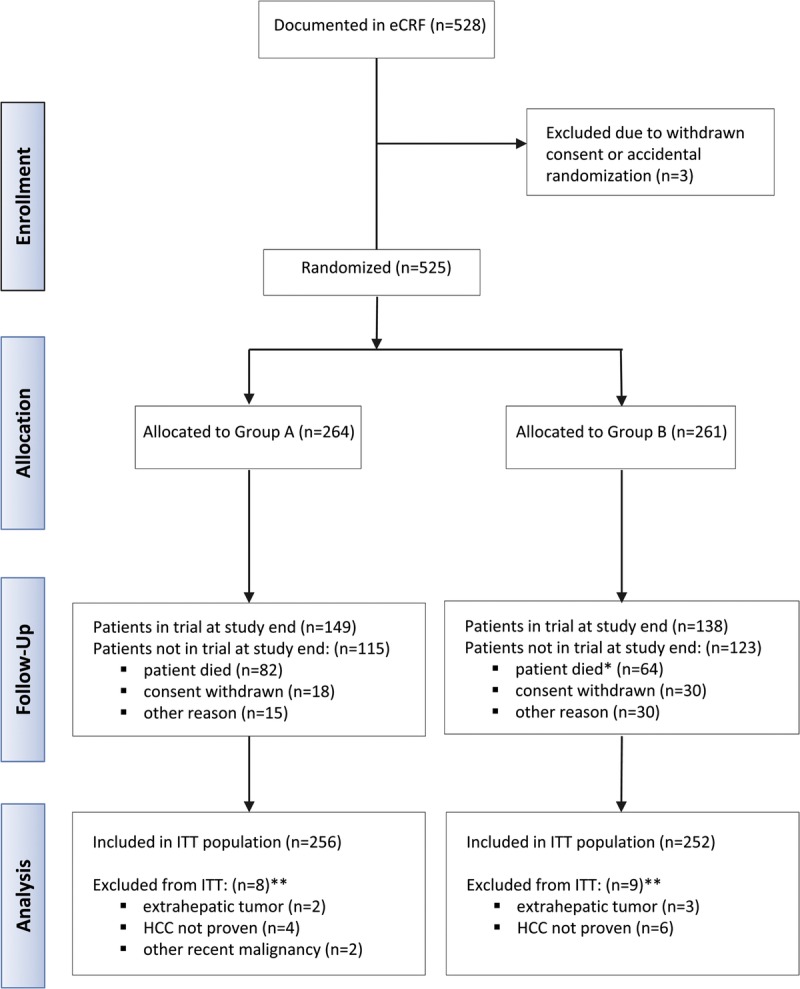
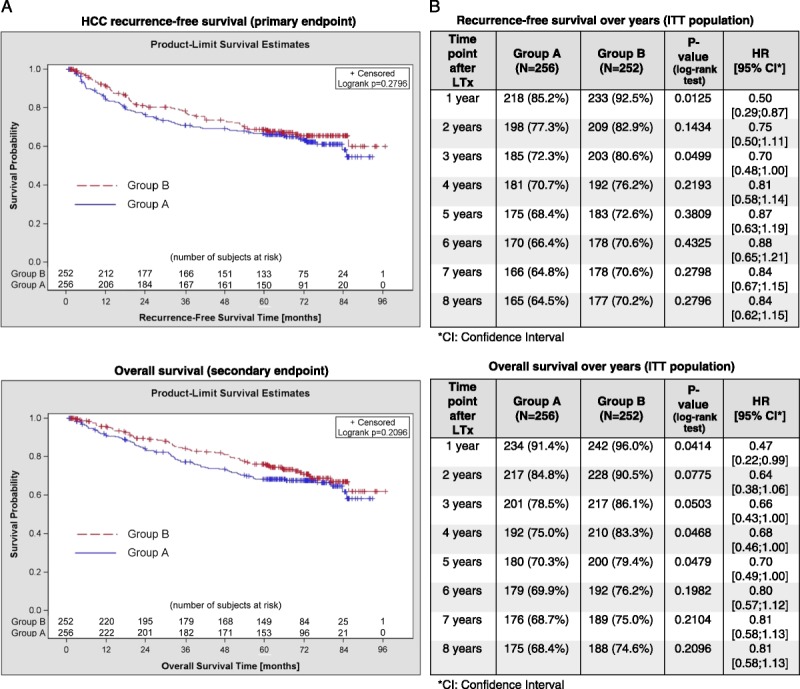
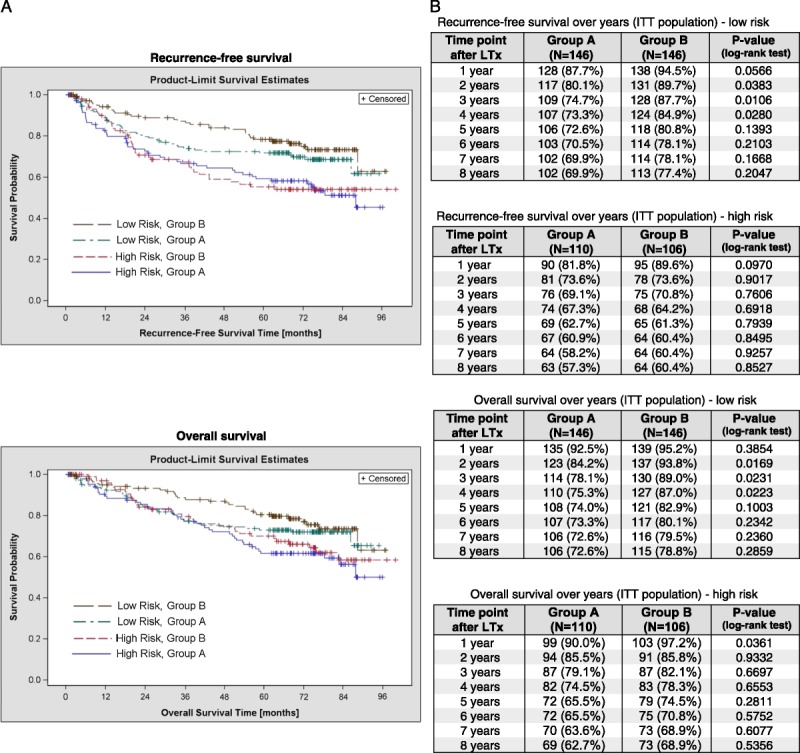
BACKGROUND: We investigated whether sirolimus-based immunosuppression improves outcomes in liver transplantation (LTx) candidates with hepatocellular carcinoma (HCC). METHODS: In a prospective-randomized open-label international trial, 525 LTx recipients with HCC initially receiving mammalian target of rapamycin inhibitor-free immunosuppression were randomized 4 to 6 weeks after transplantation into a group on mammalian target of rapamycin inhibitor-free immunosuppression (group A: 264 patients) or a group incorporating sirolimus (group B: 261). The primary endpoint was recurrence-free survival (RFS); intention-to-treat (ITT) analysis was conducted after 8 years. Overall survival (OS) was a secondary endpoint. RESULTS: Recurrence-free survival was 64.5% in group A and 70.2% in group B at study end, this difference was not significant (P = 0.28; hazard ratio [HR], 0.84; 95% confidence interval [95% CI], 0.62; 1.15). In a planned analysis of RFS rates at yearly intervals, group B showed better outcomes 3 years after transplantation (HR, 0.7; 95% CI, 0.48-1.00). Similarly, OS (P = 0.21; HR, 0.81; 95% CI, 0.58-1.13) was not statistically better in group B at study end, but yearly analyses showed improvement out to 5 years (HR, 0.7; 95% CI, 0.49-1.00). Interestingly, subgroup (Milan Criteria-based) analyses revealed that low-risk, rather than high-risk, patients benefited most from sirolimus; furthermore, younger recipients (age ≤60) also benefited, as well sirolimus monotherapy patients. Serious adverse event numbers were alike in groups A (860) and B (874). CONCLUSIONS: Sirolimus in LTx recipients with HCC does not improve long-term RFS beyond 5 years. However, a RFS and OS benefit is evident in the first 3 to 5 years, especially in low-risk patients. This trial provides the first high-level evidence base for selecting immunosuppression in LTx recipients with HCC.
Overview
The claims and statistics of this paper haven’t been checked yet.
Free: it reads the open-access text and checks the first 5 claims that cite a source we can check. Create a free account to check every claim.
Integrity signals
Registry
Cites
Statistics
Figures
Verification
Claims the paper makes
The claims and statistics of this paper haven’t been checked yet.
Free: it reads the open-access text and checks the first 5 claims that cite a source we can check. Create a free account to check every claim.
Claims other papers make about this one
Each is checked against this paper’s own text: does it say what the citing paper says it does?
The cited source says what the claim attributes to it.
In the citing paper
“The mTOR inhibitor sirolimus did not significantly change RFS in the SiLVER trial also, involving 525 patients with HCC undergoing liver transplantation91.”
From Adjuvant and neoadjuvant immunotherapies in hepatocellular carcinoma (2024) · cites this paper as [91]
Self-check
Percentages, sums and reported differences re-computed from the paper’s own numbers.
The self-check needs the paper’s full text.
Citations
Cites
Erdogan, D., Heijnen, B. H. M., Bennink, R. J., Kok, M., Dinant, S., Straatsburg, I. H., Gouma, D. J., & van Gulik, T. M. (2004) · Liver International · doi:10.1111/j.1478-3231.2004.00901.x · Cited by 11,700
Mazzaferro, V., Regalia, E., Doci, R., Andreola, S., Pulvirenti, A., Bozzetti, F., Montalto, F., Ammatuna, M., Morabito, A., & Gennari, L. (1996) · New England Journal of Medicine · doi:10.1056/nejm199603143341104 · Cited by 7,186
Self-citationA New Era of Systemic Therapy for Hepatocellular Carcinoma with Regorafenib and Lenvatinib
Kudo, M. (2017) · Liver Cancer · doi:10.1159/000462153 · Cited by 5,936
Acute Abdomen: A Rare Case of Ruptured Hepatocellular Carcinoma
Gloor, S., Jensen, K. O., Breitenstein, S., Binkert, C. A., Angst, E., & Hetzer, F. H. (2017) · Case Reports in Gastroenterology · doi:10.1159/000463378 · Cited by 5,370
Temsirolimus, Interferon Alfa, or Both for Advanced Renal-Cell Carcinoma
Hudes, G., Carducci, M., Tomczak, P., Dutcher, J., Figlin, R., Kapoor, A., Staroslawska, E., Sosman, J., McDermott, D., Bodrogi, I., et al. (2007) · New England Journal of Medicine · doi:10.1056/nejmoa066838 · Cited by 3,647 · cited 1×
“The mTOR inhibitors have proven effective in treating selective types of cancer, including renal cell adenocarcinoma.(13,14) Unfortunately, in HCC patients receiving LTx, the low level of evidence for a positive effect of mTOR inhibitors rests on retrospective data analyses 15-20 and small nonrandomized pilot”
BackgroundLlovet, J. M., Burroughs, A., & Bruix, J. (2003) · The Lancet · doi:10.1016/s0140-6736(03)14964-1 · Cited by 3,608
Motzer, R. J., Escudier, B., Oudard, S., Hutson, T. E., Porta, C., Bracarda, S., Grünwald, V., Thompson, J. A., Figlin, R. A., Hollaender, N., et al. (2008) · The Lancet · doi:10.1016/s0140-6736(08)61039-9 · Cited by 3,019 · cited 1×
“The mTOR inhibitors have proven effective in treating selective types of cancer, including renal cell adenocarcinoma.(13,14) Unfortunately, in HCC patients receiving LTx, the low level of evidence for a positive effect of mTOR inhibitors rests on retrospective data analyses 15-20 and small nonrandomized pilot”
BackgroundYao, F. Y., Ferrell, L., Bass, N. M., Watson, J. J., Bacchetti, P., Venook, A., Ascher, N. L., & Roberts, J. P. (2001) · Hepatology · doi:10.1053/jhep.2001.24563 · Cited by 2,262 · cited 1×
“In many of those surgical cases, liver transplantation (LTx) is the only potentially curative treatment option, especially in patients where the tumor size, number, and spread are limited according to the Milan Criteria,(2) or other defined parameters.(3,4) Because the vast majority of these patients have liver cirrho…”
BackgroundMazzaferro, V., Llovet, J. M., Miceli, R., Bhoori, S., Schiavo, M., Mariani, L., Camerini, T., Roayaie, S., Schwartz, M. E., Grazi, G. L., et al. (2009) · The Lancet Oncology · doi:10.1016/s1470-2045(08)70284-5 · Cited by 2,045 · cited 1×
“In many of those surgical cases, liver transplantation (LTx) is the only potentially curative treatment option, especially in patients where the tumor size, number, and spread are limited according to the Milan Criteria,(2) or other defined parameters.(3,4) Because the vast majority of these patients have liver cirrho…”
BackgroundSelf-citationGuba, M., von Breitenbuch, P., Steinbauer, M., Koehl, G., Flegel, S., Hornung, M., Bruns, C. J., Zuelke, C., Farkas, S., Anthuber, M., et al. (2002) · Nature Medicine · doi:10.1038/nm0202-128 · Cited by 1,739
Self-citation
Cited by
Llovet, J. M., Kelley, R. K., Villanueva, A., Singal, A. G., Pikarsky, E., Roayaie, S., Lencioni, R., Koike, K., Zucman-Rossi, J., & Finn, R. S. (2021) · Nature Reviews Disease Primers · doi:10.1038/s41572-020-00240-3 · Cited by 7,055
Llovet, J. M., Zucman-Rossi, J., Pikarsky, E., Sangro, B., Schwartz, M., Sherman, M., & Gores, G. (2016) · Nature Reviews Disease Primers · doi:10.1038/nrdp.2016.18 · Cited by 2,531
AASLD Practice Guidance on prevention, diagnosis, and treatment of hepatocellular carcinoma
Singal, A. G., Llovet, J. M., Yarchoan, M., Mehta, N., Heimbach, J. K., Dawson, L. A., Jou, J. H., Kulik, L. M., Agopian, V. G., Marrero, J. A., et al. (2023) · Hepatology · doi:10.1097/hep.0000000000000466 · Cited by 2,052
“…prospective international phase III SiLVER trial failed to demonstrate an overall benefit of sirolimus in improving long-term recurrence-free survival beyond 5 years after LT, [256] the subgroup within Milan criteria had improved recurrence-free survival with mTOR inhibitor-based immunosuppression.”
Evidence-Based Diagnosis, Staging, and Treatment of Patients With Hepatocellular Carcinoma
Bruix, J., Reig, M., & Sherman, M. (2016) · Gastroenterology · doi:10.1053/j.gastro.2015.12.041 · Cited by 1,694
EASL Clinical Practice Guidelines: Liver transplantation
(2016) · Journal of Hepatology · doi:10.1016/j.jhep.2015.10.006 · Cited by 1,082
Hepatocellular carcinoma: ESMO Clinical Practice Guidelines for diagnosis, treatment and follow-up
Vogel, A., Cervantes, A., Chau, I., Daniele, B., Llovet, J. M., Meyer, T., Nault, J. C., Neumann, U., Ricke, J., Sangro, B., et al. (2018) · Annals of Oncology · doi:10.1093/annonc/mdy308 · Cited by 1,048
“Mammalian target of rapamycin (mTOR) inhibitors are used as immunosuppressant to prevent graft rejection in liver transplantation (sirolimus) but have failed to improve recurrence-free survival in a recently published phase III study [65].”
BackgroundGuidelines for the Diagnosis and Treatment of Hepatocellular Carcinoma (2019 Edition)
Zhou, J., Sun, H., Wang, Z., Cong, W., Wang, J., Zeng, M., Zhou, W., Bie, P., Liu, L., Wen, T., et al. (2020) · Liver Cancer · doi:10.1159/000509424 · Cited by 800
Risk factors and prevention of hepatocellular carcinoma in the era of precision medicine
Fujiwara, N., Friedman, S. L., Goossens, N., & Hoshida, Y. (2018) · Journal of Hepatology · doi:10.1016/j.jhep.2017.09.016 · Cited by 659
Guidelines for the Diagnosis and Treatment of Primary Liver Cancer (2022 Edition)
Zhou, J., Sun, H., Wang, Z., Cong, W., Zeng, M., Zhou, W., Bie, P., Liu, L., Wen, T., Kuang, M., et al. (2023) · Liver Cancer · doi:10.1159/000530495 · Cited by 477
Liver transplantation for hepatocellular carcinoma: outcomes and novel surgical approaches
Sapisochin, G., & Bruix, J. (2017) · Nature Reviews Gastroenterology & Hepatology · doi:10.1038/nrgastro.2016.193 · Cited by 436
Mehta, N., Heimbach, J., Harnois, D. M., Sapisochin, G., Dodge, J. L., Lee, D., Burns, J. M., Sanchez, W., Greig, P. D., Grant, D. R., et al. (2017) · JAMA Oncology · doi:10.1001/jamaoncol.2016.5116 · Cited by 398
Adjuvant and neoadjuvant immunotherapies in hepatocellular carcinoma
Llovet, J. M., Pinyol, R., Yarchoan, M., Singal, A. G., Marron, T. U., Schwartz, M., Pikarsky, E., Kudo, M., & Finn, R. S. (2024) · Nature Reviews Clinical Oncology · doi:10.1038/s41571-024-00868-0 · Cited by 391
“…first published reports of neoadjuvant immunotherapy in HCC was the aforementioned phase I study in which patients with locally advanced disease received a combination of nivolumab plus the TKI cabozantinib for 3 months with the aim of downstaging tumours to enable curative-intent resection 14 .”
Neuberger, J. M., Bechstein, W. O., Kuypers, D. R. J., Burra, P., Citterio, F., De Geest, S., Duvoux, C., Jardine, A. G., Kamar, N., Krämer, B. K., et al. (2017) · Transplantation · doi:10.1097/tp.0000000000001651 · Cited by 315
“One recent randomized, phase 3 open-label study has shown that sirolimus in liver transplant recipients with HCC does not improve long-term (5-year) recurrence-free survival, but there may be some benefit in the first 3 to 5 years, especially in low-risk patients.(244) Although some studies suggest that T-cell antibod…”
BackgroundSelf-citationMolecular Signaling Pathways and Therapeutic Targets in Hepatocellular Carcinoma
Dimri, M., & Satyanarayana, A. (2020) · Cancers · doi:10.3390/cancers12020491 · Cited by 311
“PI3K/Akt/mTOR Sirolimus 3 [44] c-MET Cabozantinib 3”
Charlton, M., Levitsky, J., Aqel, B., O'Grady, J., Hemibach, J., Rinella, M., Fung, J., Ghabril, M., Thomason, R., Burra, P., et al. (2018) · Transplantation · doi:10.1097/tp.0000000000002147 · Cited by 310
“Based on these initial promising findings, a randomized controlled trial (RCT) was undertaken to study the effect of SRL on HCC recurrence.(79) Five hundred twenty-five liver transplant recipients with HCC were randomized at 4 to 8 weeks after transplant to SRL or non-SRL containing immunosuppressive regimens.”
BackgroundSelf-citationHepatocellular carcinoma: ESMO Clinical Practice Guideline for diagnosis, treatment and follow-up
Vogel, A., Chan, S. L., Dawson, L. A., Kelley, R. K., Llovet, J. M., Meyer, T., Ricke, J., Rimassa, L., Sapisochin, G., Vilgrain, V., et al. (2025) · Annals of Oncology · doi:10.1016/j.annonc.2025.02.006 · Cited by 281
EASL Clinical Practice Guidelines on liver transplantation
Samuel, D., De Martin, E., Berg, T., Berenguer, M., Burra, P., Fondevila, C., Heimbach, J. K., Pageaux, G.-P., Sanchez-Fueyo, A., & Toso, C. (2024) · Journal of Hepatology · doi:10.1016/j.jhep.2024.07.032 · Cited by 263
Self-citationHaber, P. K., Puigvehí, M., Castet, F., Lourdusamy, V., Montal, R., Tabrizian, P., Buckstein, M., Kim, E., Villanueva, A., Schwartz, M., et al. (2021) · Gastroenterology · doi:10.1053/j.gastro.2021.06.008 · Cited by 248
A 3D microfluidic model for preclinical evaluation of TCR-engineered T cells against solid tumors
Pavesi, A., Tan, A. T., Koh, S., Chia, A., Colombo, M., Antonecchia, E., Miccolis, C., Ceccarello, E., Adriani, G., Raimondi, M. T., et al. (2017) · JCI Insight · doi:10.1172/jci.insight.89762 · Cited by 241
“treated with mTOR inhibitors (27) and the improved survival in low-risk transplanted patients immunosuppressed with rapamycin (28) provided an immunological rationale for our observation.”
Roles of mTOR complexes in the kidney: implications for renal disease and transplantation
Fantus, D., Rogers, N. M., Grahammer, F., Huber, T. B., & Thomson, A. W. (2016) · Nature Reviews Nephrology · doi:10.1038/nrneph.2016.108 · Cited by 208
Liver transplantation immunology: immunosuppression, rejection, and immunomodulation
Montano-Loza, A. J., Rodríguez-Perálvarez, M. L., Pageaux, G.-P., Sanchez-Fueyo, A., & Feng, S. (2023) · Journal of Hepatology · doi:10.1016/j.jhep.2023.01.030 · Cited by 208
Self-citationAdvances in resection and transplantation for hepatocellular carcinoma
Vibert, E., Schwartz, M., & Olthoff, K. M. (2020) · Journal of Hepatology · doi:10.1016/j.jhep.2019.11.017 · Cited by 191
Bonney, G. K., Chew, C. A., Lodge, P., Hubbard, J., Halazun, K. J., Trunecka, P., Muiesan, P., Mirza, D. F., Isaac, J., Laing, R. W., et al. (2021) · The Lancet Gastroenterology & Hepatology · doi:10.1016/s2468-1253(21)00219-3 · Cited by 187
Self-citationNguyen, L. S., Vautier, M., Allenbach, Y., Zahr, N., Benvéniste, O., Funck‐Brentano, C., & Salem, J. (2019) · Drug Safety · doi:10.1007/s40264-019-00810-9 · Cited by 175
Liver transplantation for hepatocellular carcinoma: Management after the transplant
Verna, E. C., Patel, Y. A., Aggarwal, A., Desai, A. P., Frenette, C. T., Pillai, A. A., Salgia, R. J., Seetharam, A. B., Sharma, P., Sherman, C. B., et al. (2019) · American Journal of Transplantation · doi:10.1111/ajt.15697 · Cited by 159
Adebayo Michael, A. O., Ko, S., Tao, J., Moghe, A., Yang, H., Xu, M., Russell, J. O., Pradhan-Sundd, T., Liu, S., Singh, S., et al. (2019) · Cell Metabolism · doi:10.1016/j.cmet.2019.01.002 · Cited by 155
“effectiveness of Sirolimus (Rapamycin) as an immunosuppressive agent post liver transplantation for HCC (Geissler et al., 2016), may be useful.”
BackgroundFilgueira, N. A. (2019) · World Journal of Hepatology · doi:10.4254/wjh.v11.i3.261 · Cited by 161
Cancer and mTOR Inhibitors in Transplant Recipients
de Fijter, J. W. (2016) · Transplantation · doi:10.1097/tp.0000000000001447 · Cited by 157
Schnitzbauer, A. A., Filmann, N., Adam, R., Bachellier, P., Bechstein, W. O., Becker, T., Bhoori, S., Bilbao, I., Brockmann, J., Burra, P., et al. (2020) · Annals of Surgery · doi:10.1097/sla.0000000000004280 · Cited by 139
Self-citationImmunosuppression in liver transplant
Maira, T. D., Little, E. C., & Berenguer, M. (2020) · Best Practice & Research Clinical Gastroenterology · doi:10.1016/j.bpg.2020.101681 · Cited by 149
Liver Allograft Failure After Nivolumab Treatment—A Case Report With Systematic Literature Research
Gassmann, D., Weiler, S., Mertens, J. C., Reiner, C. S., Vrugt, B., Nägeli, M., Mangana, J., Müllhaupt, B., Jenni, F., & Misselwitz, B. (2018) · Transplantation Direct · doi:10.1097/txd.0000000000000814 · Cited by 148
“A change of immune suppression was not performed because a recent randomized controlled study failed to show survival benefits upon sirolimus treatment for patients with HCC treated after transplantation.(36) After administration of a single dose of 200 mg nivolumab (3 mg/kg body weight), an increase in liver function…”
BackgroundActivation of mTOR Signaling Pathway in Hepatocellular Carcinoma
Ferrín, G., Guerrero, M., Amado, V., Rodríguez-Perálvarez, M., & De la Mata, M. (2020) · International Journal of Molecular Sciences · doi:10.3390/ijms21041266 · Cited by 135
“However, the only prospective observational study (using everolimus) [112] and the only randomized trial (using sirolimus), which was sufficiently powered (n = 525) and with prolonged follow-up, have failed to demonstrate any benefit in reducing tumor recurrence rates after liver transplantation [113].”
BackgroundSystemic treatment of HCC in special populations
Rimassa, L., Personeni, N., Czauderna, C., Foerster, F., & Galle, P. R. (2020) · Journal of Hepatology · doi:10.1016/j.jhep.2020.11.026 · Cited by 138
Nelson, J., Alvey, N., Bowman, L., Schulte, J., Segovia, M. C., McDermott, J., Te, H. S., Kapila, N., Levine, D. J., Gottlieb, R. L., et al. (2022) · Pharmacotherapy: The Journal of Human Pharmacology and Drug Therapy · doi:10.1002/phar.2716 · Cited by 130
Lu, X., Paliogiannis, P., Calvisi, D. F., & Chen, X. (2020) · Hepatology · doi:10.1002/hep.31310 · Cited by 127
Mehta, N. J., Dodge, J. L., Roberts, J. P., & Yao, F. Y. (2017) · American Journal of Transplantation · doi:10.1111/ajt.14549 · Cited by 121
“immunosuppression at many centers as they may have anti-neoplastic properties (15, 16).”
Grigg, S. E., Sarri, G. L., Gow, P. J., & Yeomans, N. D. (2019) · Alimentary Pharmacology & Therapeutics · doi:10.1111/apt.15253 · Cited by 122
Cumulative exposure to tacrolimus and incidence of cancer after liver transplantation
Rodríguez‐Perálvarez, M., Colmenero, J., González, A., Gastaca, M., Curell, A. B., Marcos, A., Sánchez-Martínez, A., Maira, T. D., Herrero, J. I., Almohalla, C., et al. (2022) · American Journal of Transplantation · doi:10.1111/ajt.17021 · Cited by 125
Liver transplantation for hepatocellular carcinoma: Where do we stand?
Santopaolo, F., Lenci, I., Milana, M., Manzia, T. M., & Baiocchi, L. (2019) · World Journal of Gastroenterology · doi:10.3748/wjg.v25.i21.2591 · Cited by 126
Zhou, J., Sun, H., Wang, Z., Cong, W., Zeng, M., Zhou, W., Liu, L., Wen, T., Kuang, M., Zhang, B., et al. (2025) · Liver Cancer · doi:10.1159/000546574 · Cited by 154
New perspectives on mTOR inhibitors (rapamycin, rapalogs and TORKinibs) in transplantation
Waldner, M., Fantus, D., Solari, M., & Thomson, A. W. (2016) · British Journal of Clinical Pharmacology · doi:10.1111/bcp.12893 · Cited by 96
Immunosuppressive Drugs in Liver Transplant: An Insight
Panackel, C., Mathew, J. F., Mohamed Fawas, N., & Jacob, M. O. (2022) · Journal of Clinical and Experimental Hepatology · doi:10.1016/j.jceh.2022.06.007 · Cited by 107
Montaño‐Loza, A. J., Mazurak, V. C., Ebadi, M., Meza–Junco, J., Sawyer, M. B., Baracos, V. E., & Kneteman, N. M. (2018) · Hepatology · doi:10.1002/hep.29578 · Cited by 93
Self-citationThe management of post-transplantation recurrence of hepatocellular carcinoma
Rajendran, L., Ivanics, T., Claasen, M. P. A. W., Muaddi, H., & Sapisochín, G. (2021) · Clinical and Molecular Hepatology · doi:10.3350/cmh.2021.0217 · Cited by 94
“Contrarily, a large international multicentre randomized control trial (the SiLVER trial), investigating sirolimus-based versus mTORi-free immunosuppression in LT for HCC, demonstrated no significant difference in overall or recurrence-free survival with mTORi.(61) However, the benefits of mTORi may be dependent on ti…”
BackgroundLiver disease and heart failure: Back and forth
Correale, M., Tarantino, N. M., Petrucci, R., Tricarico, L., Laonigro, I., Biase, M. D., & Brunetti, N. D. (2017) · European Journal of Internal Medicine · doi:10.1016/j.ejim.2017.10.016 · Cited by 96
Colmenero, J., Tabrizian, P., Bhangui, P., Pinato, D. J., Rodríguez‐Perálvarez, M., Sapisochín, G., Bhoori, S., Pascual, S., Senzolo, M., Al‐Adra, D. P., et al. (2021) · Transplantation · doi:10.1097/tp.0000000000003998 · Cited by 94
Self-citationSuddle, A. R., Reeves, H. L., Hubner, R. A., Marshall, A., Rowe, I. A. C., TINIAKOS, D. G., Hübscher, S. G., Callaway, M. P., Sharma, D., See, T. C., et al. (2024) · Gut · doi:10.1136/gutjnl-2023-331695 · Cited by 95
Berenguer, M., Burra, P., Ghobrial, R. M., Hibi, T., Metselaar, H. J., Sapisochín, G., Bhoori, S., Man, N. K., Mas, V. R., Ohira, M., et al. (2020) · Transplantation · doi:10.1097/tp.0000000000003196 · Cited by 94
“The same holds true for switching to an mTORi.(36,42,45) Depending on the general condition of patient, treatment with one of the multityrosine kinase inhibitors is advocated.”
BackgroundSelf-citationAu, K. P., & Chok, K. (2018) · World Journal of Gastroenterology · doi:10.3748/wjg.v24.i45.5081 · Cited by 82
Transplant Oncology in Primary and Metastatic Liver Tumors: Principles, Evidence, and Opportunities
Sapisochín, G., Hibi, T., Toso, C., Man, K., Berenguer, M., Heimbach, J. K., Greten, T. F., Pugh, T. J., Dawson, L. A., & Mazzaferro, V. (2020) · Annals of Surgery · doi:10.1097/sla.0000000000004071 · Cited by 84
“date no prospective study has been able to confirm the benefits of tailored immunosuppression for cancer patients.(15) Immune checkpoint-inhibitors have been approved for the treatment of patients with HCC in the second line setting.”
BackgroundSelf-citationRenal Cell Carcinoma and Kidney Transplantation: A Narrative Review
Dahle, D. O., Skauby, M., Langberg, C. W., Brabrand, K., Wessel, N., & Midtvedt, K. (2021) · Transplantation · doi:10.1097/tp.0000000000003762 · Cited by 85
“Similarly, in a randomized study in liver transplant recipients, sirolimus conversion for hepatocellular carcinoma surprisingly only benefited patients with low-risk cancer.(95) Thus, the effect of mTOR conversion in KTRs with metastatic RCC would need confirmation in a randomized trial.”
Use of Everolimus in Liver Transplantation: Recommendations From a Working Group
SIMONE, P. D., FAGIUOLI, S., Cescon, M., Carlis, L. G. D., Tisone, G., Volpes, R., & Cillo, U. (2016) · Transplantation · doi:10.1097/tp.0000000000001438 · Cited by 79
“The trial showed no difference in overall survival between the 2 groups after 8 years, although there was significant benefit of mTORi-based immunosuppression in improving recurrence-free survival and overall survival in the first 3 to 5 years, especially in low-risk patients.(43) There is no evidence regarding the ro…”
BackgroundResultSelf-citationLi, M., Bhoori, S., Mehta, N. J., & Mazzaferro, V. (2024) · Journal of Hepatology · doi:10.1016/j.jhep.2024.05.037 · Cited by 81
Self-citationAdvances in management of hepatocellular carcinoma
Allaire, M., & Nault, J. (2017) · Current Opinion in Oncology · doi:10.1097/cco.0000000000000378 · Cited by 78
Manzia, T. M., Angelico, R., Gazia, C., Lenci, I., Milana, M., Ademoyero, O. T., Pedini, D., Toti, L., Spada, M., Tisone, G., et al. (2019) · World Journal of Gastroenterology · doi:10.3748/wjg.v25.i35.5356 · Cited by 76
Jeng, L., Lee, S., Soin, A. S., Lee, W., Suh, K., Joo, D. J., Üemoto, S., Joh, J., Yoshizumi, T., Yang, H.-R., et al. (2017) · American Journal of Transplantation · doi:10.1111/ajt.14623 · Cited by 72
Maintenance immunosuppression for adults undergoing liver transplantation: a network meta-analysis
Rodríguez‐Perálvarez, M., Misas, M. G., Thorburn, D., Davidson, B. R., Tsochatzis, E. A., & Gurusamy, K. S. (2017) · Cochrane Database of Systematic Reviews · doi:10.1002/14651858.cd011639.pub2 · Cited by 75
Straś, W. A., Wasiak, D., Łągiewska, B., Tronina, O., Hreńczuk, M. K., Gotlib, J., Lisik, W., & Małkowski, P. (2022) · Annals of Transplantation · doi:10.12659/aot.934924 · Cited by 76
Liver transplantation for hepatobiliary malignancies: a new era of “Transplant Oncology” has begun
Hibi, T., Itano, O., Shinoda, M., & Kitagawa, Y. (2016) · Surgery Today · doi:10.1007/s00595-016-1337-1 · Cited by 73
“In particular, low-risk patients (HCCs meeting the Milan criteria on a post-transplant histopathological assessment and with underlying liver cirrhosis) benefited the most [179].”
BackgroundRisk Factors and Prevention of Viral Hepatitis-Related Hepatocellular Carcinoma
Zhang, X., Guan, L., Tian, H., Zeng, Z., Chen, J., Huang, D., Sun, J., Guo, J., Cui, H., & Li, Y. (2021) · Frontiers in Oncology · doi:10.3389/fonc.2021.686962 · Cited by 75
Post-transplantation malignancies: here today, gone tomorrow?
Geissler, E. K. (2015) · Nature Reviews Clinical Oncology · doi:10.1038/nrclinonc.2015.186 · Cited by 75
Self-citationHibi, T., & Sapisochín, G. (2018) · Surgery · doi:10.1016/j.surg.2018.10.024 · Cited by 66
The therapeutic landscape of hepatocellular carcinoma
Gallage, S., Beccaria, M. G., Szydlowska, M., Rahbari, M., Mohr, R. U., Tacke, F., & Heikenwälder, M. F. (2021) · Med · doi:10.1016/j.medj.2021.03.002 · Cited by 64
Incidence of Malignancies in Patients Treated With Sirolimus Following Heart Transplantation
Asleh, R., Clavell, A. L., Pereira, N. L., Smith, B. H., Briasoulis, Α., Alnsasra, H., Kremers, W. K., Habermann, T. M., Otley, C. C., Li, X., et al. (2019) · Journal of the American College of Cardiology · doi:10.1016/j.jacc.2019.03.499 · Cited by 62
New landscapes and horizons in hepatocellular carcinoma therapy
Cervello, M., Emma, M. R., Augello, G., Cusimano, A., Giannitrapani, L., Soresi, M., Akula, S. M., Abrams, S. L., Steelman, L. S., Gulino, A., et al. (2020) · Aging · doi:10.18632/aging.102777 · Cited by 64
Cillo, U., Carlis, L. G. D., Gaudio, M. D., SIMONE, P. D., FAGIUOLI, S., Lupo, F., Tisone, G., & Volpes, R. (2020) · Hepatology International · doi:10.1007/s12072-020-10091-5 · Cited by 62
Self-citationNeoadjuvant and adjuvant systemic therapy in HCC: Current status and the future
Singal, A. G., Yarchoan, M. M., Yopp, A. C., Sapisochín, G., Pinato, D. J., & Pillai, A. A. (2024) · Hepatology Communications · doi:10.1097/hc9.0000000000000430 · Cited by 63
“[83] Recurrence of HCC after LT is associated with poor survival unless curative-intent treatments can be offered, specifically surgical resection or ablation.”
BackgroundLerut, J. P., Iesari, S., Foguenne, M., & Lai, Q. (2017) · Translational Gastroenterology and Hepatology · doi:10.21037/tgh.2017.09.06 · Cited by 60
“Unfortunately the protective effect of mTORi has been seriously weakened by the results of the, so far only, large, transcontinental, multicentre, prospective, randomized SILVER study (60).”
BackgroundSelf-citationGiannis, D., Sideris, G., Kakos, C. D., Katsaros, I., & Ziogas, I. A. (2020) · Transplantation Reviews · doi:10.1016/j.trre.2020.100570 · Cited by 60
Potential Effects of Coronaviruses on the Liver: An Update
Wang, X., Lei, J., Li, Z., & Yan, L. (2021) · Frontiers in Medicine · doi:10.3389/fmed.2021.651658 · Cited by 57
Adjuvant and neoadjuvant therapies for hepatocellular carcinoma
Vogel, A., Grant, R. C., Meyer, T., Sapisochín, G., O'Kane, G. M., & Saborowski, A. L. (2023) · Hepatology · doi:10.1097/hep.0000000000000726 · Cited by 60
Tran, B. V., Moris, D., Markovic, D., Zaribafzadeh, H., Henao, R., Lai, Q., Florman, S. S., Tabrizian, P., Haydel, B., Ruiz, R. M., et al. (2023) · Liver Transplantation · doi:10.1097/lvt.0000000000000145 · Cited by 55
“A large, phase 3 randomized study (SILVER trial) did not reveal any evidence of OS or RFS benefit at 5 years in the mTOR immunosuppression group.[39] A recent meta-analysis of 17 studies evaluating mTOR-based immunosuppression did reveal slight OS and RFS benefits of mTOR inhibition, but this may have been due to rena…”
BackgroundSelf-citationYan, X., Huang, S., Yang, Y., Lu, Z., Li, F., Jiang, L., Jiang, Y., & Liu, J. (2021) · Liver Transplantation · doi:10.1002/lt.26387 · Cited by 55
“Quality Assessment of RCTs Study Random Sequence Generation Allocation Concealment Blinding of Participants and Personnel Blinding of Assessment Incomplete Outcome Data Selective Reporting Other Bias Niu et al.(12) (2014) Low risk Low risk Unclear Unclear Low risk Low risk Unclear Geissler et al.(10) (2016) Low risk L…”
BackgroundInfluentialGrąt, M., Krawczyk, M., Wronka, K. M., Stypułkowski, J., Lewandowski, Z., Wasilewicz, M. P., Krawczyk, P., Grąt, K., Patkowski, W., & Zieniewicz, K. (2018) · Scientific Reports · doi:10.1038/s41598-018-27319-y · Cited by 54
Autophagy and Exosomes Relationship in Cancer: Friends or Foes?
Colletti, M., Ceglie, D., Giannatale, A. D., & Nazio, F. (2021) · Frontiers in Cell and Developmental Biology · doi:10.3389/fcell.2020.614178 · Cited by 56
Wolf, S., Hoffmann, V. S., Habicht, A., Kauke, T., Bucher, J. N., Schoenberg, M. B., Werner, J., Guba, M. O., & Andrassy, J. (2018) · PLoS ONE · doi:10.1371/journal.pone.0194975 · Cited by 54
Dong, Z., Qi, R., Guo, X., Zhao, X., Li, Y., Zeng, Z., Bai, W., Chang, X., Hao, L., Chen, Y., et al. (2016) · Biochemical and Biophysical Research Communications · doi:10.1016/j.bbrc.2016.12.091 · Cited by 52
Xu, X., Chen, J., Wei, Q., Liu, Z., Yang, Z., Zhang, M., Wang, G., Gao, J., Yang, Z.-X., Guo, W., et al. (2019) · Hepatobiliary & pancreatic diseases international · doi:10.1016/j.hbpd.2019.06.010 · Cited by 51
Therapeutic drug monitoring of immunosuppressive drugs in hepatology and gastroenterology
Udomkarnjananun, S., Francke, M. I., de Winter, B. C. M., Mulder, M. B., Baan, C. C., Metselaar, H. J., den Hoed, C. M., & Hesselink, D. A. (2021) · Best Practice & Research Clinical Gastroenterology · doi:10.1016/j.bpg.2021.101756 · Cited by 54
Yanik, E. L., Chinnakotla, S., Gustafson, S. K., Snyder, J. J., Israni, A. K., Segev, D. L., & Engels, E. A. (2016) · Liver Transplantation · doi:10.1002/lt.24395 · Cited by 50
Lee, S., Jeng, L., Saliba, F., Soin, A. S., Lee, W., SIMONE, P. D., Nevens, F., Suh, K., Fischer, L., Joo, D. J., et al. (2020) · Transplantation · doi:10.1097/tp.0000000000003394 · Cited by 52
“Recently, the SiLVER trial, a large, prospective, randomized trial involving 525 liver transplant recipients with HCC, compared recurrence-free survival and overall survival for mTORi-based (sirolimus) versus mTORi-free immunosuppression therapy.(38) At 8 years, recurrence-free survival (70% vs 65%) and overall surviv…”
BackgroundUpdate on Immunosuppression in Liver Transplantation
Gurakar, A. O., Tasdogan, B., Şimşek, C., Ma, M., & Saberi, B. (2017) · Euroasian Journal of Hepato-Gastroenterology · doi:10.5005/jp-journals-10018-1301 · Cited by 49
Kim, D.-S., Yoon, Y.-I., Kim, B. K., Choudhury, A., Kulkarni, A., Park, J. Y., Kim, J., Sinn, D. H., Joo, D. J., Choi, Y., et al. (2024) · Hepatology International · doi:10.1007/s12072-023-10629-3 · Cited by 47
Carcinoma hepatocelular: presente y futuro
Armengol, C., Sarrias, M., & Sala, M. (2017) · Medicina Clínica · doi:10.1016/j.medcli.2017.08.010 · Cited by 48
Kraaijeveld, R., Li, Y., Yan, L., de Leur, K., Dieterich, M., Peeters, A. M. A., Wang, L., Shi, Y., & Baan, C. C. (2019) · Transplantation Proceedings · doi:10.1016/j.transproceed.2019.08.039 · Cited by 49
Recurrence of hepatocellular carcinoma following liver transplantation
Hoffman, D. B., & Mehta, N. J. (2020) · Expert Review of Gastroenterology & Hepatology · doi:10.1080/17474124.2021.1823213 · Cited by 46
Management of Hepatocellular Carcinoma Recurrence after Liver Transplantation
Pelizzaro, F., Gambato, M., Gringeri, E., Vitale, A., Cillo, U., Farinati, F., Burra, P., & Russo, F. P. (2021) · Cancers · doi:10.3390/cancers13194882 · Cited by 45
Self-citationMolecular Targets in Hepatocarcinogenesis and Implications for Therapy
Wu, M., Yiang, G.-T., Cheng, P., Chu, P., & Li, C.-J. (2018) · Journal of Clinical Medicine · doi:10.3390/jcm7080213 · Cited by 43
“Moreover, a Phase III clinical trial has demonstrated that rapamycin is effective as a basic immunotherapy after hepatectomy [156].”
BackgroundManagement of hepatocellular carcinoma recurrence after liver transplantation
Agarwal, P. D., & Lucey, M. R. (2021) · Annals of Hepatology · doi:10.1016/j.aohep.2021.100654 · Cited by 44
Asian Liver Transplant Network Clinical Guidelines on Immunosuppression in Liver Transplantation
Tan, P. S., Muthiah, M. D., Koh, T., Teoh, Y. L., Chan, A. C. Y., Kow, A. W. C., Zheng, Q., Kwon, C. H. D., Lee, G. H., Lesmana, C. R. A., et al. (2018) · Transplantation · doi:10.1097/tp.0000000000002532 · Cited by 45
Rodríguez-Perálvarez, M., Guerrero, M., Barrera, L., Ferrín, G., Álamo, J. M., Ayllón, M. D., Artacho, G. S., Montero, J. L., Briceño, J., Bernal, C., et al. (2018) · Transplantation · doi:10.1097/tp.0000000000002270 · Cited by 41
Owoyemi, I. O., Vaughan, L. E., Costello, C. M., Thongprayoon, C., Markovic, S. N., Herrmann, J., Otley, C. C., Taner, T., Mangold, A. R., Leung, N., et al. (2020) · Cancer · doi:10.1002/cncr.33134 · Cited by 43
“The use of mTOR inhibitors in SOTRs with malignancies has been of interest in the field of transplantation due to its perceived anticarcinogenic effects.16 Several studies have suggested the use of mTOR inhibitors as part of the immunosuppressive strategy in transplant candidates with a history of urothelial carcinoma…”
BackgroundA National Survey of Hepatocellular Carcinoma Surveillance Practices Following Liver Transplantation
Aggarwal, A., Te, H. S., Verna, E. C., & Desai, A. P. (2020) · Transplantation Direct · doi:10.1097/txd.0000000000001086 · Cited by 40
“Data were also collected to capture the following main domains: (1) use of risk stratification methods for patients at risk of HCC recurrence after LT; (2) use of serum biomarkers such as alpha-fetoprotein (AFP), “cutoff” values, and optimal timing of measurement; (3) use of HCC surveillance protocols across centers,…”
MethodHepatocellular carcinoma: Present and future
Armengol, C., Sarrias, M., & Sala, M. (2018) · Medicina Clínica (English Edition) · doi:10.1016/j.medcle.2017.08.024 · Cited by 42
Costentin, C. E., Piñero, F., Degroote, H., Notarpaolo, A., Boin, I. D. F. S. F., Boudjéma, K., Baccaro, C., Podestá, L. G., Bachellier, P., Ettorre, G. M., et al. (2022) · JHEP Reports · doi:10.1016/j.jhepr.2022.100445 · Cited by 42
“Recent data indicate prognosis of HCC recurrence may have changed over the last decade, with increases in time from LT to recurrence and time from recurrence to death.(15) This phenomenon may be related to better post-LT surveillance strategies, aggressive surgical management in case of unique extrahepatic metastases,…”
BackgroundSelf-citationLiver Transplantation Criteria for Hepatocellular Carcinoma, Including Posttransplant Management
Mehta, N. J. (2021) · Clinical Liver Disease · doi:10.1002/cld.1054 · Cited by 37
Impact of everolimus on survival after liver transplantation for hepatocellular carcinoma
Kang, I., Lee, J. G., Choi, S. H., Kim, H. J., Han, D. H., Choi, G. H., Kim, M. S., Choi, J. S., Kim, S. I., & Joo, D. J. (2021) · Clinical and Molecular Hepatology · doi:10.3350/cmh.2021.0038 · Cited by 37
“These results are consistent with the findings of the recent multicenter randomized SILVER trial, which showed that sirolimus was associated with improved disease-free survival in the first 3–5 years after LT, particularly in low-risk patients.(31) Our results suggest that the anti-cancer effects of EVR are more prono…”
ResultPivotal Role of Fatty Acid Synthase in c-MYC Driven Hepatocarcinogenesis
Jia, J., Che, L., Cigliano, A., Wang, X., Peitta, G., Tao, J., Zhong, S., Ribback, S., Evert, M., Chen, X., et al. (2020) · International Journal of Molecular Sciences · doi:10.3390/ijms21228467 · Cited by 38
Shimata, K., Sugawara, Y., & Hibi, T. (2018) · Gland Surgery · doi:10.21037/gs.2017.12.11 · Cited by 36
“Although the study failed to meet its primary endpoint, it did show some survival benefit in a subset of low-risk patients (27).”
ResultDegroote, H., Callebout, E., Iesari, S., Dekervel, J., Schreiber, J., Pirenne, J., Verslype, C., Ysebaert, D., Michielsen, P. P., Lucidi, V., et al. (2019) · Surgical Oncology · doi:10.1016/j.suronc.2019.10.006 · Cited by 35
Self-citation
Metadata
- Authors
- Geissler, E. K., Schnitzbauer, A. A., Zülke, C., Lamby, P. E., Proneth, A., Duvoux, C., Burra, P., Jauch, K.-W., Rentsch, M., Ganten, T. M., Schmidt, J., Settmacher, U., Heise, M., Rossi, G., Cillo, U., Kneteman, N., Adam, R., van Hoek, B., Bachellier, P., Wolf, P., Rostaing, L., Bechstein, W. O., Rizell, M., Powell, J., Hidalgo, E., Gugenheim, J., Wolters, H., Brockmann, J., Roy, A., Mutzbauer, I., Schlitt, A., Beckebaum, S., Graeb, C., Nadalin, S., Valente, U., Turrión, V. S., Jamieson, N., Scholz, T., Colledan, M., Fändrich, F., Becker, T., Söderdahl, G., Chazouillères, O., Mäkisalo, H., Pageaux, G.-P., Steininger, R., Soliman, T., de Jong, K. P., Pirenne, J., Margreiter, R., Pratschke, J., Pinna, A. D., Hauss, J., Schreiber, S., Strasser, S., Klempnauer, J., Troisi, R. I., Bhoori, S., Lerut, J., Bilbao, I., Klein, C. G., Königsrainer, A., Mirza, D. F., Otto, G., Mazzaferro, V., Neuhaus, P., & Schlitt, H. J.
- Affiliations
- University of Padua (IT)
- University Hospital Regensburg (DE)
- Université Paris-Est Créteil (FR)
- LMU Klinikum (DE)
- University Hospital Heidelberg (DE)
- Jena University Hospital (DE)
- University Medical Center of the Johannes Gutenberg University Mainz (DE)
- Fondazione IRCCS Ca' Granda Ospedale Maggiore Policlinico (IT)
- University Hospital Frankfurt (DE)
- Corresponding author
- Geissler, Edward K.
- ORCID
- Geissler, Edward K.
- Schnitzbauer, Andreas A.
- Lamby, Philipp E.
- Duvoux, Christophe
- Burra, Patrizia
- Schmidt, Jan
- Settmacher, Utz
- Heise, Michael
- Rossi, Giorgio
- Cillo, Umberto
- Kneteman, Norman
- Adam, René
- Bachellier, Philippe
- Rostaing, Lionel
- Bechstein, Wolf O.
- Rizell, Magnus
- Powell, James
- Hidalgo, Ernest
- Gugenheim, Jean
- Wolters, Heiner
- Roy, André
- Graeb, Christian
- Nadalin, Silvio
- Valente, Umberto
- Colledan, Michele
- Becker, Thomas
- Söderdahl, Gunnar
- Chazouillères, Olivier
- Pageaux, Georges-Philippe
- Soliman, Thomas
- Pirenne, Jacques
- Pratschke, Johann
- Schreiber, Stefan
- Strasser, Simone
- Troisi, Roberto I.
- Bhoori, Sherrie
- Lerut, Jan
- Bilbao, Itxarone
- Königsrainer, Alfred
- Mirza, Darius F.
- Mazzaferro, Vincenzo
- Schlitt, Hans J.
- Venue
- Transplantation
- Published
- 2016-01
- Volume
- 100
- Issue
- 1
- Pages
- 116-125
- ISSN
- 0041-1337 (ISSN-L)
- PMC
- PMC4683033
- OpenAlex
- W2173253647
- Semantic Scholar
- 2f82f9224f53dca199e9f425d13b54048adc5922
- Cited by
- 433
- References
- 39
- Citations by year
- 2026: 27 · 2025: 24 · 2024: 53 · 2023: 36 · 2022: 43 · 2021: 54 · 2020: 46 · 2019: 37 · 2018: 38 · 2017: 44 · 2016: 26
- FWCI
- 21.89
- Type
- journal article
- Language
- en
- Open access
- hybrid
- doi.org
- Licence
- cc-by-nc-nd
- Locations
- Transplantation (publishedVersion, cc-by-nc-nd)
- PubMed Central (publishedVersion, cc-by-nc-nd)
- PubMed (publishedVersion)
- Leiden Repository (Leiden University) (submittedVersion)
- Ghent University Academic Bibliography (Ghent University) (submittedVersion, cc-by-nc-nd)
- Työväentutkimus Vuosikirja (submittedVersion, other-oa)
- Data Archiving and Networked Services (DANS) (submittedVersion, other-oa)
- HAL (submittedVersion)
- BOA (University of Milano-Bicocca) (submittedVersion)
- Digital Access to Libraries (submittedVersion)
- University of Regensburg Publication Server (University of Regensburg) (submittedVersion)
- Lirias (KU Leuven) (submittedVersion)
- University of Birmingham Research Portal (University of Birmingham) (submittedVersion, cc-by)
- University of Groningen research database (University of Groningen / Centre for Information Technology) (submittedVersion, cc-by-nc-nd)
- Padua Research Archive (University of Padova) (submittedVersion)
- Funders
- Pfizer
- Universitätsklinikum Regensburg
- Universität Regensburg
- Topics
- Health Sciences › Medicine › Hepatology › Hepatocellular Carcinoma Treatment and Prognosis
- Health Sciences › Medicine › Surgery › Organ Transplantation Techniques and Outcomes
- Health Sciences › Medicine › Surgery › Transplantation: Methods and Outcomes
- Keywords
- rapamycin, liver transplantation, hepatocellular carcinoma, mTOR inhibitors, immunosuppression, recurrence-free survival, overall survival, Milan criteria, patient selection, adverse events
- MeSH terms
- Adult, Age Factors, Aged, Australia, Canada, Drug Therapy, Combination, Europe, Female, Carcinoma, Hepatocellular, Humans, Immunosuppressive Agents, Liver Neoplasms, Male, Middle Aged, Neoplasm Recurrence, Local, Prospective Studies, Risk Factors, Time Factors, Liver Transplantation, Treatment Outcome, Disease Progression, Risk Assessment, Disease-Free Survival, Sirolimus, Kaplan-Meier Estimate, Young Adult, Intention to Treat Analysis, TOR Serine-Threonine Kinases
About these checks
Registry, retraction, Cites and statistics results are computed, not judged, with one exception: a printed reference that no index lists is read once by a model before it counts as a citation error. Claims are extracted by a model and kept only when their quote appears verbatim in the text; each cited source is then checked, with a model’s help, for whether it says what the claim relies on. Those verdicts can be wrong — read the claim’s quote and the cited source before relying on one.
Statistics and arithmetic are recomputed, not judged.
Confidence bands are shown only for fields calibrated on our annotated test set. None is calibrated yet, so no band is shown.
What counts as a claim ›How we measure confidence ›How we check this ›
Are you an author, or do you see a problem with this page? Request a review
Data sources
Bibliographic data: Semantic Scholar, OpenAlex, Crossref.
Contains information from the Semantic Scholar Academic Graph Datasets, made available under the ODC Attribution License (ODC-BY 1.0).
Semantic Scholar’s data is described in: Kinney, R., et al. (2023). The Semantic Scholar Open Data Platform. arXiv:2301.10140.
