

Sirolimus Use in Liver Transplant Recipients With Hepatocellular Carcinoma: A Randomized, Multicenter, Open-Label Phase 3 Trial
Open accessThe DOI matches its Crossref record; 39 of the 39 references it cites were found in a registry or an index.
Abstract
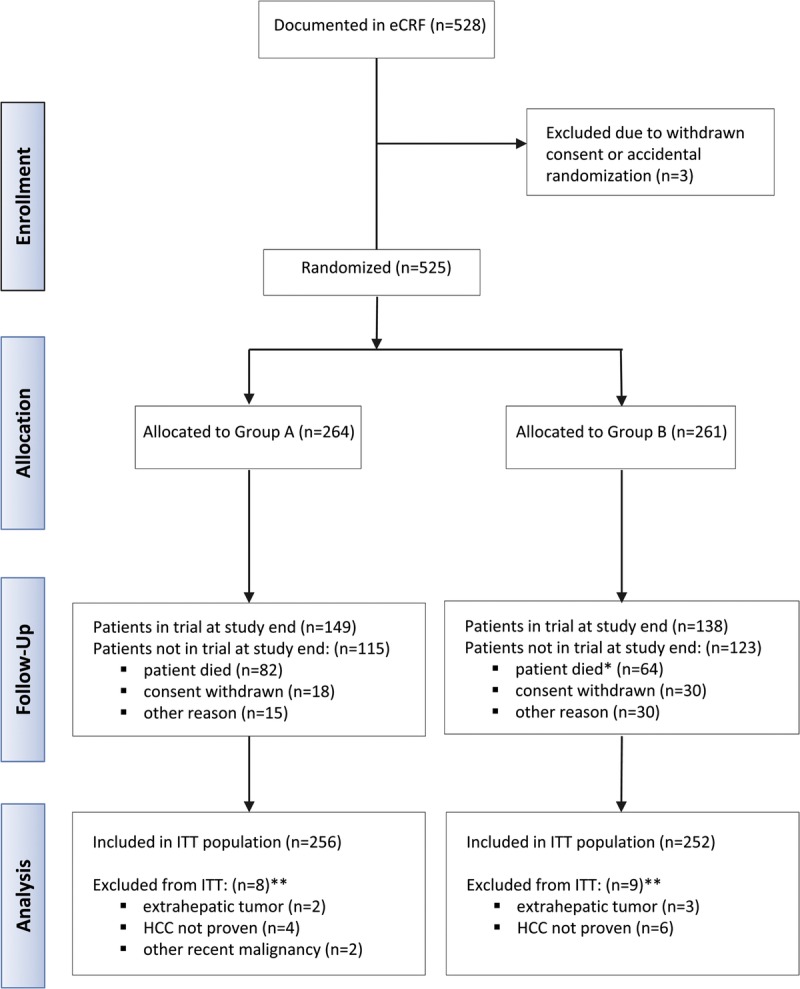
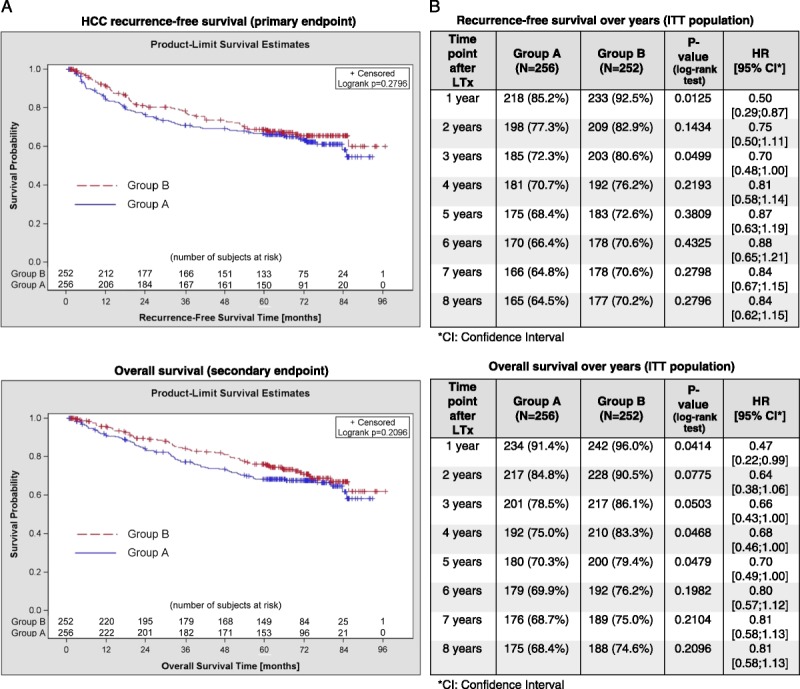
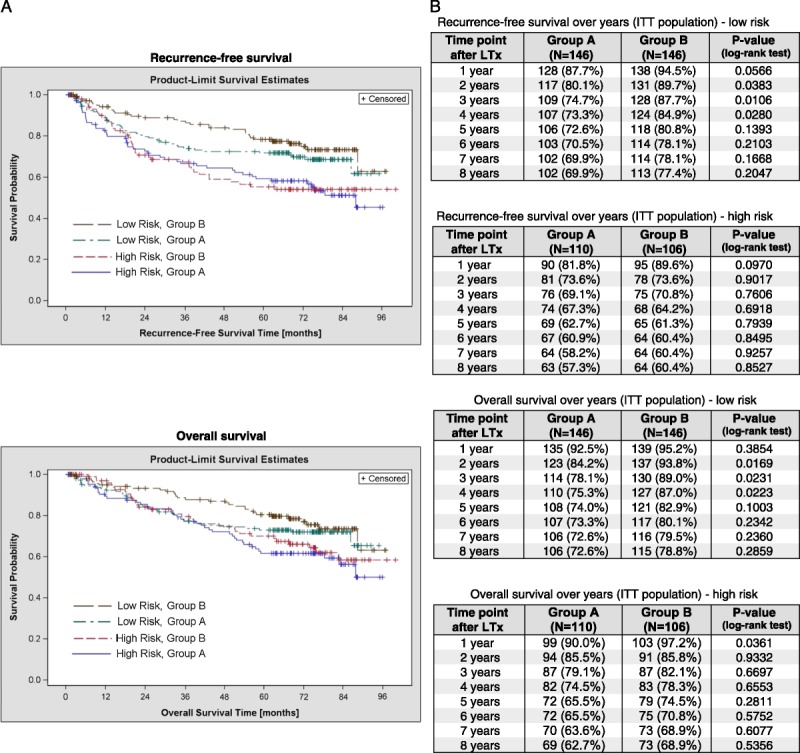
BACKGROUND: We investigated whether sirolimus-based immunosuppression improves outcomes in liver transplantation (LTx) candidates with hepatocellular carcinoma (HCC). METHODS: In a prospective-randomized open-label international trial, 525 LTx recipients with HCC initially receiving mammalian target of rapamycin inhibitor-free immunosuppression were randomized 4 to 6 weeks after transplantation into a group on mammalian target of rapamycin inhibitor-free immunosuppression (group A: 264 patients) or a group incorporating sirolimus (group B: 261). The primary endpoint was recurrence-free survival (RFS); intention-to-treat (ITT) analysis was conducted after 8 years. Overall survival (OS) was a secondary endpoint. RESULTS: Recurrence-free survival was 64.5% in group A and 70.2% in group B at study end, this difference was not significant (P = 0.28; hazard ratio [HR], 0.84; 95% confidence interval [95% CI], 0.62; 1.15). In a planned analysis of RFS rates at yearly intervals, group B showed better outcomes 3 years after transplantation (HR, 0.7; 95% CI, 0.48-1.00). Similarly, OS (P = 0.21; HR, 0.81; 95% CI, 0.58-1.13) was not statistically better in group B at study end, but yearly analyses showed improvement out to 5 years (HR, 0.7; 95% CI, 0.49-1.00). Interestingly, subgroup (Milan Criteria-based) analyses revealed that low-risk, rather than high-risk, patients benefited most from sirolimus; furthermore, younger recipients (age ≤60) also benefited, as well sirolimus monotherapy patients. Serious adverse event numbers were alike in groups A (860) and B (874). CONCLUSIONS: Sirolimus in LTx recipients with HCC does not improve long-term RFS beyond 5 years. However, a RFS and OS benefit is evident in the first 3 to 5 years, especially in low-risk patients. This trial provides the first high-level evidence base for selecting immunosuppression in LTx recipients with HCC.
Overview
The claims and statistics of this paper haven’t been checked yet.
Free: it reads the open-access text and checks the first 5 claims that cite a source we can check. Create a free account to check every claim.
Integrity signals
Registry
Cites
Statistics
Figures
Verification
Claims the paper makes
The claims and statistics of this paper haven’t been checked yet.
Free: it reads the open-access text and checks the first 5 claims that cite a source we can check. Create a free account to check every claim.
Claims other papers make about this one
Each is checked against this paper’s own text: does it say what the citing paper says it does?
The cited source says what the claim attributes to it.
In the citing paper
“The mTOR inhibitor sirolimus did not significantly change RFS in the SiLVER trial also, involving 525 patients with HCC undergoing liver transplantation91.”
From Adjuvant and neoadjuvant immunotherapies in hepatocellular carcinoma (2024) · cites this paper as [91]
Self-check
Percentages, sums and reported differences re-computed from the paper’s own numbers.
The self-check needs the paper’s full text.
Citations
Cites
Erdogan, D., Heijnen, B. H. M., Bennink, R. J., Kok, M., Dinant, S., Straatsburg, I. H., Gouma, D. J., & van Gulik, T. M. (2004) · Liver International · doi:10.1111/j.1478-3231.2004.00901.x · Cited by 11,700
Mazzaferro, V., Regalia, E., Doci, R., Andreola, S., Pulvirenti, A., Bozzetti, F., Montalto, F., Ammatuna, M., Morabito, A., & Gennari, L. (1996) · New England Journal of Medicine · doi:10.1056/nejm199603143341104 · Cited by 7,186
Self-citationA New Era of Systemic Therapy for Hepatocellular Carcinoma with Regorafenib and Lenvatinib
Kudo, M. (2017) · Liver Cancer · doi:10.1159/000462153 · Cited by 5,936
Acute Abdomen: A Rare Case of Ruptured Hepatocellular Carcinoma
Gloor, S., Jensen, K. O., Breitenstein, S., Binkert, C. A., Angst, E., & Hetzer, F. H. (2017) · Case Reports in Gastroenterology · doi:10.1159/000463378 · Cited by 5,370
Temsirolimus, Interferon Alfa, or Both for Advanced Renal-Cell Carcinoma
Hudes, G., Carducci, M., Tomczak, P., Dutcher, J., Figlin, R., Kapoor, A., Staroslawska, E., Sosman, J., McDermott, D., Bodrogi, I., et al. (2007) · New England Journal of Medicine · doi:10.1056/nejmoa066838 · Cited by 3,647 · cited 1×
“The mTOR inhibitors have proven effective in treating selective types of cancer, including renal cell adenocarcinoma.(13,14) Unfortunately, in HCC patients receiving LTx, the low level of evidence for a positive effect of mTOR inhibitors rests on retrospective data analyses 15-20 and small nonrandomized pilot”
BackgroundLlovet, J. M., Burroughs, A., & Bruix, J. (2003) · The Lancet · doi:10.1016/s0140-6736(03)14964-1 · Cited by 3,608
Motzer, R. J., Escudier, B., Oudard, S., Hutson, T. E., Porta, C., Bracarda, S., Grünwald, V., Thompson, J. A., Figlin, R. A., Hollaender, N., et al. (2008) · The Lancet · doi:10.1016/s0140-6736(08)61039-9 · Cited by 3,019 · cited 1×
“The mTOR inhibitors have proven effective in treating selective types of cancer, including renal cell adenocarcinoma.(13,14) Unfortunately, in HCC patients receiving LTx, the low level of evidence for a positive effect of mTOR inhibitors rests on retrospective data analyses 15-20 and small nonrandomized pilot”
BackgroundYao, F. Y., Ferrell, L., Bass, N. M., Watson, J. J., Bacchetti, P., Venook, A., Ascher, N. L., & Roberts, J. P. (2001) · Hepatology · doi:10.1053/jhep.2001.24563 · Cited by 2,262 · cited 1×
“In many of those surgical cases, liver transplantation (LTx) is the only potentially curative treatment option, especially in patients where the tumor size, number, and spread are limited according to the Milan Criteria,(2) or other defined parameters.(3,4) Because the vast majority of these patients have liver cirrho…”
BackgroundMazzaferro, V., Llovet, J. M., Miceli, R., Bhoori, S., Schiavo, M., Mariani, L., Camerini, T., Roayaie, S., Schwartz, M. E., Grazi, G. L., et al. (2009) · The Lancet Oncology · doi:10.1016/s1470-2045(08)70284-5 · Cited by 2,045 · cited 1×
“In many of those surgical cases, liver transplantation (LTx) is the only potentially curative treatment option, especially in patients where the tumor size, number, and spread are limited according to the Milan Criteria,(2) or other defined parameters.(3,4) Because the vast majority of these patients have liver cirrho…”
BackgroundSelf-citationGuba, M., von Breitenbuch, P., Steinbauer, M., Koehl, G., Flegel, S., Hornung, M., Bruns, C. J., Zuelke, C., Farkas, S., Anthuber, M., et al. (2002) · Nature Medicine · doi:10.1038/nm0202-128 · Cited by 1,739
Self-citation
Cited by
Items 401–456 of 456
Hepatozelluläres Karzinom – Stellenwert von Resektion, Lebertransplantation und Immunsuppression
Schnitzbauer, A. A., & Bechstein, W. O. (2018) · Der Onkologe · doi:10.1007/s00761-018-0421-0
Self-citationLiver Transplantation for Other Cancers
Garcia-Aroz, S., Xu, M., & Chapman, W. C. (2018) · Springer eBooks · doi:10.1007/978-3-319-91977-5_24
Liver Transplantation for the Treatment of Hepatocellular Carcinoma
Marshall, A. (2018) · Springer eBooks · doi:10.1007/978-3-319-92216-4_8
Revision of Clinical Practice Guidelines for Hepatocellular Carcinoma in 2017
Takemura, N., Hasegawa, K., & Kokudo, N. (2018) · Kanzo · doi:10.2957/kanzo.59.659
Can Mycophenolic Acid-based Immunosuppression Benefit Liver Transplant Patients With HCC?
Geissler, E. K., & Schlitt, H. J. (2019) · Transplantation · doi:10.1097/tp.0000000000002648
“For this purpose, mechanistic target of rapamycin (mTOR) inhibitors have shown promise against HCC in a prospective randomized trial but are not able to indefinitely prevent HCC recurrence.(4) The question is whether other immunosuppressants may have advantageous properties that could reduce HCC recurrence on their ow…”
Self-citationLiver Transplantation: Prevention and Treatment of Rejection
Durand, F., & Francoz, C. (2019) · Wiley eBooks · doi:10.1002/9781119211419.ch48
Grigg, S. E., Sarri, G. L., Gow, P. J., & Yeomans, N. D. (2019) · Alimentary Pharmacology & Therapeutics · doi:10.1111/apt.15324
Liver Transplantation for CRLM—Is It Ever Indicated?
Line, P., Hagness, M., & Dueland, S. (2019) · Springer eBooks · doi:10.1007/978-3-030-25486-5_39
Ogut, M. Z., Kılcı, M. B., İnce, V., Koç, C., Işık, B., & Yılmaz, S. (2020) · Journal of Gastrointestinal Cancer · doi:10.1007/s12029-020-00429-5
“SILVER study is the only prospective randomized controlled study for this topic, and it showed no survival benefit in long-term period in LT patients with HCC [8].”
BackgroundRejection and Immunosuppression
SIMONE, P. D., Bronzoni, J., & Bindi, M. L. (2022) · Springer eBooks · doi:10.1007/978-3-030-82930-8_17
De Novo Tumours After Liver Transplantation
Taborelli, M., Shalaby, S., & Serraino, D. (2022) · Springer eBooks · doi:10.1007/978-3-030-82930-8_23
Immunsuppression nach Organtransplantation: Essentials
Franke, F., Renders, L., Linecker, M., & Braun, F. (2022) · Allgemein- und Viszeralchirurgie up2date · doi:10.1055/a-1700-6682
DeVreese, L., Tsien, C. D., & Murthy, S. K. (2019) · Elsevier eBooks · doi:10.1016/b978-0-12-801238-3.65640-4
Immunosuppression: The Global Picture
Jadlowiec, C. C., Taner, T., & Wiesner, R. H. (2017) · Wiley eBooks · doi:10.1002/9781119251316.ch42
Immunosuppression in Liver Transplantation
Lim, N., & Lake, J. R. (2021) · Liver Transplantation · doi:10.1002/9781119634010.ch38
II Consenso mexicano de carcinoma hepatocelular. Parte II: tratamiento
Cisneros-Garza, L. E., González-Huezo, M. S., Moctezuma‐Velázquez, C., de Guevara-Cetina, L. L., Vilatobá, M., García-Juárez, I., Alvarado-Reyes, R., Álvarez-Treviño, G. A., Allende‐Pérez, S., Bornstein-Quevedo, L., et al. (2022) · Revista de Gastroenterología de México · doi:10.1016/j.rgmx.2022.01.006
Immunsuppression nach Organtransplantation: Essentials
Franke, F., Renders, L., Linecker, M., & Braun, F. (2022) · Transfusionsmedizin · doi:10.1055/a-1952-6749
Lebendspende Lebertransplantation für erwachsene Empfänger
Settmacher, U., Rauchfuß, F., Bauer, M. W., Bauschke, A., Beckebaum, S., Königsrainer, A., Malessa, C., Nadalin, S., Rummler, S., Kortgen, A., et al. (2023) · Springer eBooks · doi:10.1007/978-3-662-65736-2_8
Self-citationLiver transplantation meets gastrointestinal cancer
Loosen, S. H., Leyh, C., Neumann, U. P., Bock, H. H., Weigel, C., Luedde, T., & Roderburg, C. (2024) · Zeitschrift für Gastroenterologie · doi:10.1055/a-2226-0123
Liver transplantation: the recipient
(2024) · Elsevier eBooks · doi:10.1016/b978-0-443-23571-9.00034-7
The Effect of Sirolimus Immunosuppression on Cardiovascular Outcomes in Liver Transplantation
Jason, H., Breslin, Z., Lally, L. T., Marzio, D. H., & Tholey, D. M. (2024) · Journal of Liver Transplantation · doi:10.1016/j.liver.2024.100211
Liu, A. Y., Rao, W., & Watt, K. D. S. (2024) · Liver Transplantation · doi:10.1097/lvt.0000000000000509
Advances in Understanding the Complexities of Recurrent HCC Following Liver Transplantation
Tabrizian, P. (2024) · Transplantation · doi:10.1097/tp.0000000000005255
Challenges of liver transplantation for transplant oncology indications
Li, Z., Magyar, C. T. J., O'Kane, G. M., & Sapisochín, G. (2024) · Elsevier eBooks · doi:10.1016/b978-0-443-21901-6.00025-2
Immunotherapy in the era of transplant oncology: Risks and complications
Anouti, B., Abdel‐Wahab, R., & Diab, A. K. (2024) · Elsevier eBooks · doi:10.1016/b978-0-443-21901-6.00011-2
Ruan, W. H., Cerminara, D. N., Galván, N. T. N., Fishman, D. S., Harpavat, S., Hertel, P. M., Mysore, K. R., Tessier, M. E. M., Fuller, K., Faraone, M., et al. (2025) · Journal of Pediatric Gastroenterology and Nutrition · doi:10.1002/jpn3.70073
Hepatocellular carcinoma and liver transplantation
Berenguer, M. (2025) · Revisiones en cáncer · doi:10.20960/revcancer.00112
Murali, A. R., & Menon, K. V. (2025) · Springer eBooks · doi:10.1007/978-3-031-90225-3_30
Al-Breedy, A. M., Shaker, M. K., & Elsahhar, M. (2025) · Springer eBooks · doi:10.1007/978-981-96-3894-9_10
To, J. C., Ghosh, S., Zhao, X., Pasini, E., Fischer, S., Sapisochín, G., Ghanekar, A., Jaeckel, E., & Bhat, M. (2024) · Figshare · doi:10.6084/m9.figshare.25980495
Post-liver Transplant Malignancies
Aleali, M. S., & Watt, K. D. (2025) · Springer eBooks · doi:10.1007/978-3-032-07072-2_30
Liver Transplantation for Hepatocellular Carcinoma
Agrawal, D., Wadhwa, J., Kulkarni, A., & Saigal, S. (2026) · Springer eBooks · doi:10.1007/978-981-95-2624-6_11
Wijayasiri, P., Bhat, M., & Aravinthan, A. D. (2026) · Experimental Gerontology · doi:10.1016/j.exger.2026.113105 · Cited by 1
Conference recommendations on immunosuppression practice for adult liver transplantation in Egypt
Makhlouf, N. A., Montasser, I. F., Refaie, R., Massoud, Y. M., Marwan, A., Abdel‐Khalek, E. E., Eldeen, H. G., Tabbakh, M. E., Said, M., Doss, W. H., et al. (2026) · Egyptian Liver Journal · doi:10.1186/s43066-025-00426-y
“In contrast SILVER trial by Geissler et al. (2016) unfortunately did not demonstrate the expected benefit from mTOR use in HCC patients [42].”
Heinrich, S., Campos-Murguía, A., Mensah, A., Shmanko, K., Koliogiannis, D., Vollmann, K. H., Boedecker-Lips, S. C., Heinrich, B., Kirchner, T., Engel, B., et al. (2026) · Clinical Transplantation · doi:10.1111/ctr.70547
“Similarly, immunosuppressive regimens were heterogeneous in CCA patients, whereas HCC patients showed more uniform strategies, with increasing use of mTOR inhibitors over time, likely reflecting the influence of the SILVER trial [ 22 ].”
Amante, M. F., Wille, M. F. V., & Pestalardo, M. L. (2026) · World Journal of Transplantation · doi:10.5500/wjt.v16.i2.115879
Zhao, Q.-C., Cui, J.-N., Li, J.-H., Fu, Q., Yang, H.-J., & Zhu, S.-K. (2026) · World Chinese Journal of Digestology · doi:10.11569/wcjd.v34.i5.361
Targeted therapy advancements in tumor biology
Chaudhary, T., Das, S., Gupta, A., & Chourasia, M. (2026) · Elsevier eBooks · doi:10.1016/b978-0-443-44181-3.00005-9
Engineering CAR T Cells for Hepatocellular Carcinoma Recurrence after Liver TransplantationPreprint
Kocheise, L., Bacil, G. P., Bhimalli, P., Benmebarek, M.-R., Li, D. J., Huang, P., Ma, C., Muralidaran, V., Hernández-Félix, J. H., Bugliarelli, J. R., et al. (2026) · bioRxiv (Cold Spring Harbor Laboratory) · doi:10.64898/2026.06.30.735569
Kounis, I., Nguyen, T., Desterke, C., Goutté, N., Samuel, D., Azoulay, D., Vibert, É., Saliba, F., Coilly, A., Landais, P., et al. (2026) · JHEP Reports · doi:10.1016/j.jhepr.2026.101934
Smedman, T. M., Fretland, Å. A., Dueland, S., Solheim, J., Hagness, M., Lassen, K., Line, P., & Yaqub, S. (2026) · Cancers · doi:10.3390/cancers18142306
“In HCC, mTOR inhibitors combined with reduced-exposure calcineurin inhibitors have been associated with lower recurrence rates and improved OS following LT [27,28].”
Androutsopoulou, V. A., Magouliotis, D. E., Brecher, V., Sicouri, N., Zacharoulis, D., Minervini, F., Cioffi, U., & Scarci, M. (2026) · Diagnostics · doi:10.3390/diagnostics16152397
“…to sirolimus-based immuno-suppression was associated with improved recurrence-free survival, particularly in patients within Milan criteria [13]. mTOR inhibitors exert antiproliferative effects through inhibition of the PI3K/AKT/mTOR pathway, which is dysregulated in many solid tumors, and…”
Karampa, A. D., Goussia, A., Baltagiannis, E. G., Anastasopoulos, N.-A., Christodoulou, D. K., & Glantzounis, G. K. (2026) · Current Oncology · doi:10.3390/curroncol33080492
Liu, X., Liu, X.-A., Wang, D., Wang, J., Wang, H.-X., Lang, R., & Wu, A. (2026) · Frontiers in Oncology · doi:10.3389/fonc.2026.1885468
“Recurrence, vascular invasion, alpha-fetoprotein (AFP), pathological tumor burden, perioperative complications, and post-transplant immuno-suppression all contribute to subsequent risk (4 – 8).”
Kupke, P., Schmitt, K. C., Wohlfahrt, M. H., Wagner, B. J., Kupke, L. S., Kreiner, P., Müller, V., Bogovic, N., Acs, M., Geissler, E. K., et al. (2026) · Digestive and Liver Disease · doi:10.1016/j.dld.2026.07.082
Self-citationSucu, S., Longbottom, B., & Aziz, H. (2026) · Journal of Surgical Oncology · doi:10.1002/jso.70380
Perioperative strategies for the treatment of HCC
D’Alessio, A., Krendl, F. J., Parente, A., Marino, R., Veloz, M. G., & Tabrizian, P. (2026) · JHEP Reports · doi:10.1016/j.jhepr.2026.102021
Liver transplantation for primary liver cancers in the era of transplant oncology
Mazzaferro, V., Pinter, M., Pillai, A., Sposito, C., & Tabrizian, P. (2026) · Journal of Hepatology · doi:10.1016/j.jhep.2026.07.020
Self-citationVasileiadou, S., Neiros, S., Karageorgos, F. F., Kofinas, A., Palios, I. M., Antoniadis, N., Sinakos, E., & Tsoulfas, G. (2026) · Transplantology · doi:10.3390/transplantology7030020
“The risk and clinical course of recurrence are influenced by tumor-related factors, timing and pattern of relapse, and the post-transplant immunologic environment, including the type and intensity of immunosuppressive therapy [4,5].”
Ningarhari, M., Leray, M., Coilly, A., Vibert, É., Assénat, E., Herrero, A., Bedoya, J. U., Henry, C., Wandji, L. C. N., Lemaître, E., et al. (2026) · JHEP Reports · doi:10.1016/j.jhepr.2026.102062
Smedman, T. M., Guren, T. K., Tveit, K. M., Thomsen, M., Andersen, M. H., Line, P.-D., & Dueland, S. (2022) · doi:10.3389/ti.2022.10404.s001
Tseng, H.-Y., Lin, Y.-H., Lin, C.-C., Chen, C.-L., Yong, C.-C., Lin, L.-M., Wang, C.-C., & Chan, Y.-C. (2023) · doi:10.3389/fsurg.2023.1116728.s002
Dennis, C., Prince, D. S., Moayed-Alaei, L., Remash, D., Carr-Boyd, E., Bowen, D. G., Strasser, S. I., Crawford, M., Pulitano, C., Kench, J., et al. (2022) · doi:10.3389/fonc.2022.997093.s001
Self-citation
Metadata
- Authors
- Geissler, E. K., Schnitzbauer, A. A., Zülke, C., Lamby, P. E., Proneth, A., Duvoux, C., Burra, P., Jauch, K.-W., Rentsch, M., Ganten, T. M., Schmidt, J., Settmacher, U., Heise, M., Rossi, G., Cillo, U., Kneteman, N., Adam, R., van Hoek, B., Bachellier, P., Wolf, P., Rostaing, L., Bechstein, W. O., Rizell, M., Powell, J., Hidalgo, E., Gugenheim, J., Wolters, H., Brockmann, J., Roy, A., Mutzbauer, I., Schlitt, A., Beckebaum, S., Graeb, C., Nadalin, S., Valente, U., Turrión, V. S., Jamieson, N., Scholz, T., Colledan, M., Fändrich, F., Becker, T., Söderdahl, G., Chazouillères, O., Mäkisalo, H., Pageaux, G.-P., Steininger, R., Soliman, T., de Jong, K. P., Pirenne, J., Margreiter, R., Pratschke, J., Pinna, A. D., Hauss, J., Schreiber, S., Strasser, S., Klempnauer, J., Troisi, R. I., Bhoori, S., Lerut, J., Bilbao, I., Klein, C. G., Königsrainer, A., Mirza, D. F., Otto, G., Mazzaferro, V., Neuhaus, P., & Schlitt, H. J.
- Affiliations
- University of Padua (IT)
- University Hospital Regensburg (DE)
- Université Paris-Est Créteil (FR)
- LMU Klinikum (DE)
- University Hospital Heidelberg (DE)
- Jena University Hospital (DE)
- University Medical Center of the Johannes Gutenberg University Mainz (DE)
- Fondazione IRCCS Ca' Granda Ospedale Maggiore Policlinico (IT)
- University Hospital Frankfurt (DE)
- Corresponding author
- Geissler, Edward K.
- ORCID
- Geissler, Edward K.
- Schnitzbauer, Andreas A.
- Lamby, Philipp E.
- Duvoux, Christophe
- Burra, Patrizia
- Schmidt, Jan
- Settmacher, Utz
- Heise, Michael
- Rossi, Giorgio
- Cillo, Umberto
- Kneteman, Norman
- Adam, René
- Bachellier, Philippe
- Rostaing, Lionel
- Bechstein, Wolf O.
- Rizell, Magnus
- Powell, James
- Hidalgo, Ernest
- Gugenheim, Jean
- Wolters, Heiner
- Roy, André
- Graeb, Christian
- Nadalin, Silvio
- Valente, Umberto
- Colledan, Michele
- Becker, Thomas
- Söderdahl, Gunnar
- Chazouillères, Olivier
- Pageaux, Georges-Philippe
- Soliman, Thomas
- Pirenne, Jacques
- Pratschke, Johann
- Schreiber, Stefan
- Strasser, Simone
- Troisi, Roberto I.
- Bhoori, Sherrie
- Lerut, Jan
- Bilbao, Itxarone
- Königsrainer, Alfred
- Mirza, Darius F.
- Mazzaferro, Vincenzo
- Schlitt, Hans J.
- Venue
- Transplantation
- Published
- 2016-01
- Volume
- 100
- Issue
- 1
- Pages
- 116-125
- ISSN
- 0041-1337 (ISSN-L)
- PMC
- PMC4683033
- OpenAlex
- W2173253647
- Cited by
- 433
- References
- 39
- Citations by year
- 2026: 27 · 2025: 24 · 2024: 53 · 2023: 36 · 2022: 43 · 2021: 54 · 2020: 46 · 2019: 37 · 2018: 38 · 2017: 44 · 2016: 26
- FWCI
- 21.89
- Type
- journal article
- Language
- en
- Open access
- hybrid
- doi.org
- Licence
- cc-by-nc-nd
- Locations
- Transplantation (publishedVersion, cc-by-nc-nd)
- PubMed Central (publishedVersion, cc-by-nc-nd)
- PubMed (publishedVersion)
- Leiden Repository (Leiden University) (submittedVersion)
- Ghent University Academic Bibliography (Ghent University) (submittedVersion, cc-by-nc-nd)
- Työväentutkimus Vuosikirja (submittedVersion, other-oa)
- Data Archiving and Networked Services (DANS) (submittedVersion, other-oa)
- HAL (submittedVersion)
- BOA (University of Milano-Bicocca) (submittedVersion)
- Digital Access to Libraries (submittedVersion)
- University of Regensburg Publication Server (University of Regensburg) (submittedVersion)
- Lirias (KU Leuven) (submittedVersion)
- University of Birmingham Research Portal (University of Birmingham) (submittedVersion, cc-by)
- University of Groningen research database (University of Groningen / Centre for Information Technology) (submittedVersion, cc-by-nc-nd)
- Padua Research Archive (University of Padova) (submittedVersion)
- Funders
- Pfizer
- Universitätsklinikum Regensburg
- Universität Regensburg
- Topics
- Health Sciences › Medicine › Hepatology › Hepatocellular Carcinoma Treatment and Prognosis
- Health Sciences › Medicine › Surgery › Organ Transplantation Techniques and Outcomes
- Health Sciences › Medicine › Surgery › Transplantation: Methods and Outcomes
- Keywords
- rapamycin, liver transplantation, hepatocellular carcinoma, mTOR inhibitors, immunosuppression, recurrence-free survival, overall survival, Milan criteria, patient selection, adverse events
- MeSH terms
- Adult, Age Factors, Aged, Australia, Canada, Drug Therapy, Combination, Europe, Female, Carcinoma, Hepatocellular, Humans, Immunosuppressive Agents, Liver Neoplasms, Male, Middle Aged, Neoplasm Recurrence, Local, Prospective Studies, Risk Factors, Time Factors, Liver Transplantation, Treatment Outcome, Disease Progression, Risk Assessment, Disease-Free Survival, Sirolimus, Kaplan-Meier Estimate, Young Adult, Intention to Treat Analysis, TOR Serine-Threonine Kinases
About these checks
Registry, retraction, Cites and statistics results are computed, not judged, with one exception: a printed reference that no index lists is read once by a model before it counts as a citation error. Claims are extracted by a model and kept only when their quote appears verbatim in the text; each cited source is then checked, with a model’s help, for whether it says what the claim relies on. Those verdicts can be wrong — read the claim’s quote and the cited source before relying on one.
Statistics and arithmetic are recomputed, not judged.
Confidence bands are shown only for fields calibrated on our annotated test set. None is calibrated yet, so no band is shown.
What counts as a claim ›How we measure confidence ›How we check this ›
Are you an author, or do you see a problem with this page? Request a review
Data sources
Bibliographic data: Semantic Scholar, OpenAlex, Crossref.
Contains information from the Semantic Scholar Academic Graph Datasets, made available under the ODC Attribution License (ODC-BY 1.0).
Semantic Scholar’s data is described in: Kinney, R., et al. (2023). The Semantic Scholar Open Data Platform. arXiv:2301.10140.
