

Epidemiology of amyotrophic lateral sclerosis: an update of recent literature
Open accessThe DOI matches its Crossref record; 55 of the 55 references it cites were found in a registry or an index.
Abstract
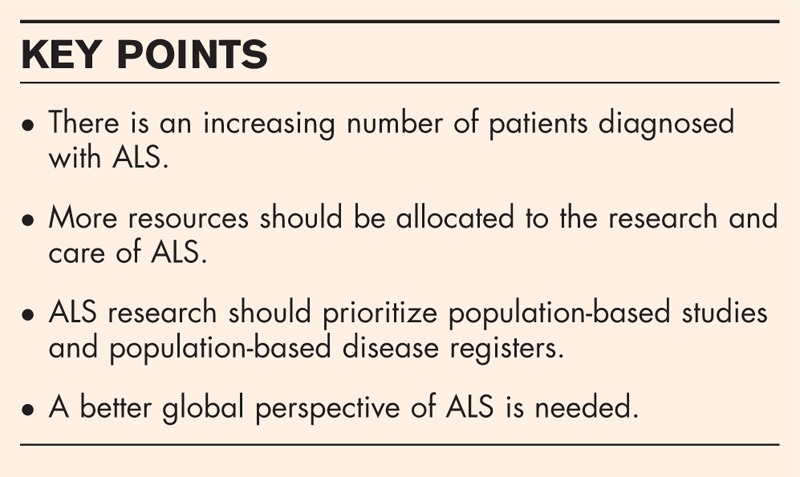
Purpose of review: The cause of amyotrophic lateral sclerosis (ALS) remains unknown for most of the patients with the disease. Epidemiologic studies can help describe disease burden and examine its potential risk factors, providing thereby evidence base for future mechanistic studies. With this review, we aimed to provide a summary of epidemiologic studies published during the past 18 months, which studied the incidence and risk factors for ALS. Recent findings: An increasing incidence and prevalence of ALS continue to be reported from different parts of the world. Several previously studied risk factors are confirmed as causally related to ALS by Mendelian randomization analysis. The previously known prognostic indicators for ALS appear to be the same across populations. Summary: Provided with the increasing number of patients diagnosed with ALS and the improved societal awareness of the disease, more resources should be allocated to the research and care of ALS. Population-based studies, especially population-based disease registers, should be the priorities in ALS research, and more data from outside Europe are needed in gaining a better global perspective of the disease.
Overview
The claims and statistics of this paper haven’t been checked yet.
Free: it reads the open-access text and checks the first 5 claims that cite a source we can check. Create a free account to check every claim.
Integrity signals
Registry
Cites
Statistics
Figures
Verification
Claims the paper makes
The claims and statistics of this paper haven’t been checked yet.
Free: it reads the open-access text and checks the first 5 claims that cite a source we can check. Create a free account to check every claim.
Claims other papers make about this one
Each is checked against this paper’s own text: does it say what the citing paper says it does?
The source backs part of the claim, not all of it — or backs it for a different population, condition or comparison.
In the citing paper
“These 4 common UMNDs result in a significant decline in physical function5,7,8,17,18 and often develop secondary complications that affect their quality of life (QOL), including cognitive impairment,19–21 fatigue,22 chronic pain,23,24 depression,25–27 and anxiety.25–27”
From Feasibility, Acceptability, and Efficacy of Mindfulness Training in People With Upper Motor Neuron Disorders: A Systematic Review (2022) · cites this paper as [7]
Experimental — accuracy not yet measuredThe source backs part of the claim, not all of it — or backs it for a different population, condition or comparison.
In the citing paper
“UMNDs may occur because of a traumatic event, nontraumatic event, or inherited or sporadic neurodegenerative disease.1,3–8”
From Feasibility, Acceptability, and Efficacy of Mindfulness Training in People With Upper Motor Neuron Disorders: A Systematic Review (2022) · cites this paper as [7]
Experimental — accuracy not yet measured
Self-check
Percentages, sums and reported differences re-computed from the paper’s own numbers.
The self-check needs the paper’s full text.
Citations
Cites
El Escorial revisited: revised criteria for the diagnosis of amyotrophic lateral sclerosis
Brooks, B. R., Miller, R. G., Swash, M., & Munsat, T. L. (2000) · Amyotrophic Lateral Sclerosis and Other Motor Neuron Disorders · doi:10.1080/146608200300079536 · Cited by 5,433
State of play in amyotrophic lateral sclerosis genetics
Renton, A. E., Chiò, A., & Traynor, B. J. (2014) · Nature Neuroscience · doi:10.1038/nn.3584 · Cited by 1,544
Hardiman, O., Al-Chalabi, A., Chio, A., Corr, E. M., Logroscino, G., Robberecht, W., Shaw, P. J., Simmons, Z., & van den Berg, L. H. (2017) · Nature Reviews Disease Primers · doi:10.1038/nrdp.2017.71 · Cited by 1,414
Clinical genetics of amyotrophic lateral sclerosis: what do we really know?
Andersen, P. M., & Al-Chalabi, A. (2011) · Nature Reviews Neurology · doi:10.1038/nrneurol.2011.150 · Cited by 687
Risk factors for amyotrophic lateral sclerosis
Fang, F., Ingre, C., Roos, P., Kamel, F., & Piehl, F. (2015) · Clinical Epidemiology · doi:10.2147/clep.s37505 · Cited by 462
Self-citationPrevalence of Amyotrophic Lateral Sclerosis — United States, 2014
Mehta, P., Kaye, W., Raymond, J., Wu, R., Larson, T., Punjani, R., Heller, D., Cohen, J., Peters, T., Muravov, O., et al. (2018) · MMWR. Morbidity and Mortality Weekly Report · doi:10.15585/mmwr.mm6707a3 · Cited by 458
Epidemiology of amyotrophic lateral sclerosis: A review of literature
Couratier, P., Corcia, P., Lautrette, G., Nicol, M., Preux, P., & Marin, B. (2015) · Revue Neurologique · doi:10.1016/j.neurol.2015.11.002 · Cited by 190
Molecular diagnostics of neurodegenerative disorders
Agrawal, M., & Biswas, A. (2015) · Frontiers in Molecular Biosciences · doi:10.3389/fmolb.2015.00054 · Cited by 164
Shared polygenic risk and causal inferences in amyotrophic lateral sclerosis
Bandres‐Ciga, S., Noyce, A. J., Hemani, G., Nicolas, A., Calvo, A., Mora, G., The ITALSGEN Consortium, The International ALS Genomics Consortium, Tienari, P. J., Stone, D. J., et al. (2019) · Annals of Neurology · doi:10.1002/ana.25431 · Cited by 162
Prevalence of Amyotrophic Lateral Sclerosis — United States, 2015
Mehta, P., Kaye, W., Raymond, J., Punjani, R., Larson, T., Cohen, J., Muravov, O., & Horton, K. (2018) · MMWR. Morbidity and Mortality Weekly Report · doi:10.15585/mmwr.mm6746a1 · Cited by 160
Cited by
Feldman, E. L., Goutman, S. A., Petri, S., Mazzini, L., Savelieff, M. G., Shaw, P. J., & Sobue, G. (2022) · The Lancet · doi:10.1016/s0140-6736(22)01272-7 · Cited by 1,129
Mead, R. J., Shan, N., Reiser, H. J., Marshall, F., & Shaw, P. J. (2023) · Nature Reviews Drug Discovery · doi:10.1038/s41573-022-00612-2 · Cited by 505
Hypoxia signaling in human health and diseases: implications and prospects for therapeutics
Luo, Z., Tian, M., Yang, G., Tan, Q., Chen, Y., Li, G., Zhang, Q., Li, Y., Wan, P., & Wu, J. (2022) · Signal Transduction and Targeted Therapy · doi:10.1038/s41392-022-01080-1 · Cited by 499
The good, the bad, and the opportunities of the complement system in neurodegenerative disease
Schartz, N. D., & Tenner, A. J. (2020) · Journal of Neuroinflammation · doi:10.1186/s12974-020-02024-8 · Cited by 286
Root, J., Merino, P., Nuckols, A., Johnson, M., & Kukar, T. (2021) · Neurobiology of Disease · doi:10.1016/j.nbd.2021.105360 · Cited by 238
“With a typical age of onset between 51 and 66 years of age, patients experience worsening paralysis in voluntary muscles leading to death around 2 to 5 years after disease onset (Al-Chalabi et al., 2016; Longinetti and Fang, 2019).”
SOD1, more than just an antioxidant
Eleutherio, E. C. A., Silva Magalhães, R. S., de Araújo Brasil, A., Monteiro Neto, J. R., & de Holanda Paranhos, L. (2021) · Archives of Biochemistry and Biophysics · doi:10.1016/j.abb.2020.108701 · Cited by 232
The molecular and cellular basis of copper dysregulation and its relationship with human pathologies
Maung, M. T., Carlson, A., Olea‐Flores, M., Elkhadragy, L., Schachtschneider, K. M., Navarro‐Tito, N., & Padilla‐Benavides, T. (2021) · The FASEB Journal · doi:10.1096/fj.202100273rr · Cited by 175
Tauroursodeoxycholic acid: a potential therapeutic tool in neurodegenerative diseases
Khalaf, K., Tornese, P., Cocco, A., & Albanese, A. (2022) · Translational Neurodegeneration · doi:10.1186/s40035-022-00307-z · Cited by 172
“ALS is the most fast-progressing neurodegenerative condition, with survival varying from 2 to 4 years from onset [3].”
BackgroundPeng, B., Yang, Q., B Joshi, R., Liu, Y., Akbar, M., Song, B.-J., Zhou, S., & Wang, X. (2020) · International Journal of Molecular Sciences · doi:10.3390/ijms21072316 · Cited by 156
Hypoxia-Inducible Factor (HIF) in Ischemic Stroke and Neurodegenerative Disease
Mitroshina, Е. V., Saviuk, M. O., Ponimaskin, E. G., & Vedunova, M. V. (2021) · Frontiers in Cell and Developmental Biology · doi:10.3389/fcell.2021.703084 · Cited by 147
Role of Edaravone as a Treatment Option for Patients with Amyotrophic Lateral Sclerosis
Cho, H., & Shukla, S. (2020) · Pharmaceuticals · doi:10.3390/ph14010029 · Cited by 124
“However, over time, it was seen that there is an increase in the number of patients who are getting diagnosed with ALS [10].”
BackgroundRiluzole for the Treatment of Amyotrophic Lateral Sclerosis
Saitoh, Y., & Takahashi, Y. (2020) · Neurodegenerative Disease Management · doi:10.2217/nmt-2020-0033 · Cited by 117
SOD1 in ALS: Taking Stock in Pathogenic Mechanisms and the Role of Glial and Muscle Cells
Peggion, C., Scalcon, V., Massimino, M. L., Nies, K., Lopreiato, R., Rigobello, M. P., & Bertoli, A. (2022) · Antioxidants · doi:10.3390/antiox11040614 · Cited by 119
“4 per 100,000 people, respectively [3], while in Western countries, the incidence is approximately 1–2 per 100,000 people/years and the prevalence is of 5 per 100,000 persons [4].”
BackgroundPun, F. W., Liu, B. H. M., Long, X., Leung, H. W., Leung, G. H. D., Mewborne, Q. T., Gao, J., Shneyderman, A., Ozerov, I. V., Wang, J., et al. (2022) · Frontiers in Aging Neuroscience · doi:10.3389/fnagi.2022.914017 · Cited by 115
“It is the most common MN disease (Roman, 1996), with the incidence ranging from 0.6 to 3.8 per 100,000 person-years (Longinetti and Fang, 2019).”
BackgroundInfluentialGiovannelli, L., Bari, E., Jommi, C., Tartara, F., Armocida, D., Garbossa, D., Cofano, F., Torre, M. L., & Segale, L. (2023) · Bioactive Materials · doi:10.1016/j.bioactmat.2023.06.013 · Cited by 102
The Global Burden of Motor Neuron Disease: An Analysis of the 2019 Global Burden of Disease Study
Park, J., Kim, J., & Song, T. (2022) · Frontiers in Neurology · doi:10.3389/fneur.2022.864339 · Cited by 99
Caenorhabditis elegans as a Model System to Study Human Neurodegenerative Disorders
Roussos, A., Kitopoulou, K., Borbolis, F., & Palikaras, K. (2023) · Biomolecules · doi:10.3390/biom13030478 · Cited by 92
Current State and Future Directions in the Diagnosis of Amyotrophic Lateral Sclerosis
Vidovic, M., Müschen, L. H., Brakemeier, S., Machetanz, G., Naumann, M., & Castro‐Gomez, S. (2023) · Cells · doi:10.3390/cells12050736 · Cited by 91
“Wi h up to 82% of all ALS patients [12], it is the most common phenotype, termed typical or classical ALS.”
BackgroundA perspective on therapies for amyotrophic lateral sclerosis: can disease progression be curbed?
Xu, X., Shen, D., Gao, Y., Zhou, Q., Ni, Y., Meng, H., Shi, H., Le, W., Chen, S., & Chen, S. (2021) · Translational Neurodegeneration · doi:10.1186/s40035-021-00250-5 · Cited by 90
“6 per 100,000 people year, and significant geographical heterogeneity exists [4, 5].”
BackgroundNewell, M. E., Adhikari, S., & Halden, R. U. (2021) · The Science of The Total Environment · doi:10.1016/j.scitotenv.2021.152504 · Cited by 90
Sever, B., Ciftci, H. I., DeMirci, H., Sever, H., Ocak, F., Yuluğ, B., Tateishi, H., Tateishi, T., Otsuka, M., Fujita, M., et al. (2022) · International Journal of Molecular Sciences · doi:10.3390/ijms23052400 · Cited by 91
Role of the Exposome in Neurodegenerative Disease: Recent Insights and Future Directions
Sakowski, S. A., Koubek, E. J., Chen, K. S., Goutman, S. A., & Feldman, E. L. (2024) · Annals of Neurology · doi:10.1002/ana.26897 · Cited by 87
“…sectors also did not confer increased risk for AD in a population with dementia, 132 but a study of trichlorophenol levels in the USA revealed that individuals with higher urinary levels of the agricultural chemical, 2,4,6-trichlorophenol, had increased risk of AD and of all-cause mortality.”
BackgroundProtein aggregation and therapeutic strategies in SOD1- and TDP-43- linked ALS
Tsekrekou, M., Giannakou, M., Papanikolopoulou, K., & Σκρέτας, Γ. (2024) · Frontiers in Molecular Biosciences · doi:10.3389/fmolb.2024.1383453 · Cited by 81
“The survival rate is highly variable, with a median rate of about 3 – 5 years after symptom onset; however, up to 10% of ALS patients survive for more than 10 years (Chio et al., 2009; van Es et al., 2017; Longinetti and Fang, 2019).”
BackgroundZhou, Y., Tang, J., Lan, J., Zhang, Y., Wang, H., Chen, Q., Kang, Y., Sun, Y., Feng, X., Wu, L., et al. (2023) · Acta Pharmaceutica Sinica B · doi:10.1016/j.apsb.2022.07.019 · Cited by 80
“In the behavioral test and survival record, mice were randomly divided into six groups: (1) control group: wild type mice treated with vehicle; (2) model group: SOD1-G93A transgenic mice treated with vehicle; (3) positive drug group: SOD1-G93A transgenic mice treated with 15 mg/kg edaravone; (4) 10 mg/kg honokiol grou…”
MethodBlood biomarkers and prognosis of amyotrophic lateral sclerosis
Sun, J., Carrero, J. J., Zagai, U., Evans, M., Ingre, C., Yudi Pawitan, Y., & Fang, F. (2020) · European Journal of Neurology · doi:10.1111/ene.14409 · Cited by 75
“The cause remains elusive for about 80% of ALS patients [2] and the survival of ALS patients varies greatly [3].”
BackgroundSelf-citationDiagnostics of Amyotrophic Lateral Sclerosis: Up to Date
Štětkářová, I., & Ehler, E. (2021) · Diagnostics · doi:10.3390/diagnostics11020231 · Cited by 75
“Viral effects, exotoxin effects, including glutamate- and homocysteine-mediated excitotoxicity, failure of proteostasis, mitochondrial dysfunction and oxidative stress, oligodendrocyte dysfunction, cytoskeletal disturbances and axonal transport defects, disturbed RNA metabolism, nucleocytoplasmic transport deficits an…”
BackgroundRonchi, S., Buccino, A. P., Prack, G., Kumar, S. S., Schröter, M. S., Michele, F., & Hierlemann, A. R. (2021) · Advanced Biology · doi:10.1002/adbi.202000223 · Cited by 71
Research progress on the role of extracellular vesicles in neurodegenerative diseases
Li, Z., Wang, X., Wang, X., Yi, X., Wong, Y. K., Wu, J., Xie, F., Hu, D., Wang, Q., Wang, J., et al. (2023) · Translational Neurodegeneration · doi:10.1186/s40035-023-00375-9 · Cited by 72
“Furthermore, about 20% of familial cases are caused by mutations in Cu/zinc superoxide dismutase ( SOD ) [134].”
BackgroundMultidisciplinary care in Amyotrophic Lateral Sclerosis: a systematic review and meta-analysis
de Almeida, F. E. O., Santana, A. K. D. C., & de Carvalho, F. O. (2021) · Neurological Sciences · doi:10.1007/s10072-020-05011-2 · Cited by 68
“8 cases per 100,000 person-year is reported in the world [3, 4].”
BackgroundSteinruecke, M., Lonergan, R. M., Selvaraj, B. T., Chandran, S., Castro, B. D., & Stavrou, M. (2023) · Journal of Cerebral Blood Flow & Metabolism · doi:10.1177/0271678x231153281 · Cited by 67
“ALS has an earlier onset than other NDDs, between the ages of 51 and 66 years, and carries a worse prognosis, with a median survival time of only 2–4 years from diagnosis.(10) Patients generally present with either muscular weakness of the limbs, or bulbar symptoms, such as dysarthria and dysphagia.”
BackgroundGrassano, M., Moglia, C., Palumbo, F., Koumantakis, E., Cugnasco, P., Callegaro, S., Canosa, A., Manera, U., Vasta, R., Mattei, F. D., et al. (2024) · Annals of Neurology · doi:10.1002/ana.26933 · Cited by 68
Gao, C., Shi, Q., Pan, X., Chen, J., Zhang, Y., Lang, J., Wen, S., Liu, X., Cheng, T., & Lei, K. (2024) · Cell Reports · doi:10.1016/j.celrep.2024.113892 · Cited by 66
Axonal regeneration and sprouting as a potential therapeutic target for nervous system disorders
Marshall, K. L., & Farah, M. H. (2021) · Neural Regeneration Research · doi:10.4103/1673-5374.308077 · Cited by 65
“ALS is a devastating disease, with a median life expectancy of 24–50 months (Longinetti and Fang, 2019), where dyingback axonopathy is a prominent characteristic (Fischer et al.”
BackgroundInfluentialChaytow, H., Carroll, E., Gordon, D., Huang, Y.-T., van der Hoorn, D., Smith, H. L., Becker, T., Becker, C. G., Faller, K. M. E., Talbot, K., et al. (2022) · EBioMedicine · doi:10.1016/j.ebiom.2022.104202 · Cited by 63
Glia: A major player in glutamate–GABA dysregulation‐mediated neurodegeneration
Sood, A., Kumari, P., Fernandes, V., Khatri, D. K., & Singh, S. B. (2021) · Journal of Neuroscience Research · doi:10.1002/jnr.24977 · Cited by 62
“…conditions, like Alzheimer's disease (AD), Parkinson's disease (PD), amyotrophic lateral sclerosis (ALS), Huntington's disease (HD), and multiple sclerosis (MS), affect over 100 million people worldwide (Longinetti & Fang, 2019; Prince et al., 2013; Schwab et al., 2020; Wallin et al., 2019).”
BackgroundAndrade, S., Nunes, D., Dabur, M., Ramalho, M. J., Pereira, M. D. C., & Loureiro, J. A. (2023) · Pharmaceutics · doi:10.3390/pharmaceutics15010212 · Cited by 61
“Although its origin is still unknown [23], this neurodegenerative disorder is believed to be caused by genetic, age-related, and environmental factors and is more prevalent in the male gender [24].”
BackgroundWen, J., Li, S., Zheng, C., Wang, F., Luo, Y., Wu, L., Cao, J., Guo, B., Yu, P., Zhang, G., et al. (2020) · Neuropharmacology · doi:10.1016/j.neuropharm.2020.108380 · Cited by 61
Drug discovery and amyotrophic lateral sclerosis: Emerging challenges and therapeutic opportunities
Soares, P., Silva, C., Chavarria, D., Silva, F. S. G., Oliveira, P. J., & Borges, F. (2022) · Ageing Research Reviews · doi:10.1016/j.arr.2022.101790 · Cited by 61
Ketabforoush, A. H. M. E., Chegini, R., Barati, S., Tahmasebi, F., Moghisseh, B., Joghataei, M. T., Faghihi, F., & Azedi, F. (2023) · Biomedicine & Pharmacotherapy · doi:10.1016/j.biopha.2023.114378 · Cited by 58
Smoking and amyotrophic lateral sclerosis: A mendelian randomization study
Zhan, Y., & Fang, F. (2019) · Annals of Neurology · doi:10.1002/ana.25443 · Cited by 56
Self-citationInterplay between immunity and amyotrophic lateral sclerosis: Clinical impact
Marchi, F. D., Munitić, I., Amedei, A., Berry, J. D., Feldman, E. L., Aronica, E., Nardo, G., Weehaeghe, D. V., Niccolai, E., Prtenjača, N., et al. (2021) · Neuroscience & Biobehavioral Reviews · doi:10.1016/j.neubiorev.2021.06.027 · Cited by 54
Detecting Oxidative Stress Biomarkers in Neurodegenerative Disease Models and Patients
Sidorova, Y. A., & Domanskyi, A. (2020) · Methods and Protocols · doi:10.3390/mps3040066 · Cited by 56
“The typical onset of the symptoms occurs at 51–66 years and the majority of patients die within 2–5 years after diagnosis [59,60].”
BackgroundPan, Y., & Nicolazzo, J. A. (2022) · British Journal of Pharmacology · doi:10.1111/bph.15802 · Cited by 54
“ALS typically occurs in late middle life (51–66 years), with an incidence of 0.6–3.8 per 100,000 person-years and a prevalence of 4.1–8.4 per 100,000 persons (Longinetti & Fang, 2019).”
BackgroundInfluentialMalaguarnera, M., & Cabrera‐Pastor, A. (2024) · International Journal of Molecular Sciences · doi:10.3390/ijms251810068 · Cited by 55
“Approximately 20% of familial cases of ALS result from mutations in the Cu/Zn superoxide dismutase ( SOD ) gene [110].”
BackgroundFeng, R., Zhu, Q., Wang, A., Wang, H., Wang, J., Chen, P., Zhang, R., Liang, D., Teng, J., Ma, M., et al. (2024) · BMC Medicine · doi:10.1186/s12916-024-03781-6 · Cited by 53
Brown, D. G., Shorter, J., & Wobst, H. J. (2019) · Bioorganic & Medicinal Chemistry Letters · doi:10.1016/j.bmcl.2019.126942 · Cited by 53
Incidence of amyotrophic lateral sclerosis in the United States, 2014–2016
Mehta, P., Raymond, J. S., Punjani, R., Larson, T. C., III, Han, M., Bove, F., & Horton, D. K. (2022) · Amyotrophic Lateral Sclerosis and Frontotemporal Degeneration · doi:10.1080/21678421.2021.2023190 · Cited by 53
“When compared to European countries, the current US findings show a lower incidence which is most likely attributable to a heterogenous population (21).”
BackgroundResultSphingolipids in neurodegenerative diseases
Pan, X., Dutta, D., Lu, S., & Bellen, H. J. (2023) · Frontiers in Neuroscience · doi:10.3389/fnins.2023.1137893 · Cited by 55
Role and therapeutic potential of liquid–liquid phase separation in amyotrophic lateral sclerosis
Pakravan, D., Orlando, G., Bercier, V., & Bosch, L. V. D. (2020) · Journal of Molecular Cell Biology · doi:10.1093/jmcb/mjaa049 · Cited by 51
“The average age of onset is between 51 and 66 years old (Longinetti and Fang, 2019).”
BackgroundEverett, W., & Bucelli, R. C. (2024) · Neurodegenerative Disease Management · doi:10.1080/17582024.2024.2402216 · Cited by 51
An amyotrophic lateral sclerosis hot spot in the French Alps associated with genotoxic fungi
Lagrange, É., Vernoux, J., Reis, J. J., Palmer, V. S., Camu, W., & Spencer, P. S. (2021) · Journal of the Neurological Sciences · doi:10.1016/j.jns.2021.117558 · Cited by 48
Argueti-Ostrovsky, S., Alfahel, L., Kahn, J., & Israelson, A. (2021) · Cells · doi:10.3390/cells10092438 · Cited by 48
Oskarsson, B., Maragakis, N. J., Bedlack, R., Goyal, N., Meyer, J., Genge, A. L., Bodkin, C. L., Maiser, S., Staff, N. P., Zinman, L. H., et al. (2021) · Neurodegenerative Disease Management · doi:10.2217/nmt-2021-0042 · Cited by 48
Gruchot, J., Herrero, F., Weber‐Stadlbauer, U., Meyer, U., & Küry, P. (2022) · Brain Behavior and Immunity · doi:10.1016/j.bbi.2022.10.007 · Cited by 47
Symptoms timeline and outcomes in amyotrophic lateral sclerosis using artificial intelligence
Segura, T., Medrano, I. H., Collazo, S., Maté, C., Sguera, C., Rio‐Bermudez, C. D., Casero, H., Salcedo, I., García‐García, J., Alcahut-Rodríguez, C., et al. (2023) · Scientific Reports · doi:10.1038/s41598-023-27863-2 · Cited by 47
Multi-functional role of apolipoprotein E in neurodegenerative diseases
Islam, S., Noorani, A. A., Sun, Y., Michikawa, M., & Zou, K. (2025) · Frontiers in Aging Neuroscience · doi:10.3389/fnagi.2025.1535280 · Cited by 47
Barceló, M. A., Povedano, M., Vazquez-Costa, J. F., Franquet, Á., Solans, M., & Sáez, M. (2021) · Scientific Reports · doi:10.1038/s41598-021-85395-z · Cited by 47
Berry, J. D., Blanchard, M., Bonar, K., Drane, E., Murton, M., Ploug, U. J., Ricchetti-Masterson, K., Savić, N., Worthington, E., & Heiman-Patterson, T. D. (2023) · Amyotrophic Lateral Sclerosis and Frontotemporal Degeneration · doi:10.1080/21678421.2023.2165947 · Cited by 48
Epidemiology of Amyotrophic Lateral Sclerosis
Aktekin, M. R., & Uysal, H. (2020) · Turkish Journal Of Neurology · doi:10.4274/tnd.2020.45549 · Cited by 47
Rate of speech decline in individuals with amyotrophic lateral sclerosis
Eshghi, M., Yunusova, Y., Connaghan, K. P., Perry, B. J., Maffei, M. F., Berry, J. D., Zinman, L. H., Kalra, S., Korngut, L. W., Genge, A. L., et al. (2022) · Scientific Reports · doi:10.1038/s41598-022-19651-1 · Cited by 46
The toxic metal hypothesis for neurological disorders
Pamphlett, R., & Bishop, D. (2023) · Frontiers in Neurology · doi:10.3389/fneur.2023.1173779 · Cited by 46
Xie, M., Pallegar, P. N., Parusel, S., Nguyen, A. T., & Wu, L. (2023) · Molecular Neurodegeneration · doi:10.1186/s13024-023-00665-w · Cited by 45
“The age of ALS onset is 51–66 years, with a later onset in European patients (65 years) [2, 9].”
BackgroundFly for ALS: Drosophila modeling on the route to amyotrophic lateral sclerosis modifiers
Liguori, F., Amadio, S., & Volonté, C. (2021) · Cellular and Molecular Life Sciences · doi:10.1007/s00018-021-03905-8 · Cited by 45
Amyotrophic lateral sclerosis and lead: A systematic update
Farace, C., Fenu, G., Lintas, S., Oggiano, R., Pisano, A., Sabalic, A., Solinas, G., Bocca, B., Forte, G., & Madeddu, R. (2020) · NeuroToxicology · doi:10.1016/j.neuro.2020.09.003 · Cited by 45
Therapeutic Potential of Polyphenols in Amyotrophic Lateral Sclerosis and Frontotemporal Dementia
Novak, V., Rogelj, B., & Župunski, V. (2021) · Antioxidants · doi:10.3390/antiox10081328 · Cited by 45
“75 with a reported mean age at diagnosis between 51 and 69 years [11,12].”
BackgroundGut microbiome and amyotrophic lateral sclerosis: a systematic review of current evidence
Sun, J., Huang, T., Debelius, J. W., & Fang, F. (2021) · Journal of Internal Medicine · doi:10.1111/joim.13336 · Cited by 43
Self-citationGut microbiota immune cross-talk in amyotrophic lateral sclerosis
Kaul, M., Mukherjee, D., Weiner, H. L., & Cox, L. M. (2024) · Neurotherapeutics · doi:10.1016/j.neurot.2024.e00469 · Cited by 42
Survival of patients with rare diseases: a population-based study in Tuscany (Italy)
Gorini, F., Coi, A., Mezzasalma, L., Baldacci, S., Pierini, A., & Santoro, M. C. (2021) · Orphanet Journal of Rare Diseases · doi:10.1186/s13023-021-01907-0 · Cited by 42
“In fact, recent literature has reported that the vast majority of patients with ALS have a mean or median survival time between 24 and 50 months from symptoms onset to death or invasive respiratory support [21].”
BackgroundPotential roles of branched-chain amino acids in neurodegeneration
Yoo, H.-S., Shanmugalingam, U., & Smith, P. D. (2022) · Nutrition · doi:10.1016/j.nut.2022.111762 · Cited by 42
Long Non-Coding RNAs: New Insights in Neurodegenerative Diseases
Anilkumar, A., Vij, P., Lopez, S., Leslie, S., Doxtater, K. D., Khan, M. M., Yallapu, M. M., Chauhan, S. C., Maestre, G. E., & Tripathi, M. K. (2024) · International Journal of Molecular Sciences · doi:10.3390/ijms25042268 · Cited by 41
“…disorder, ALS has an incidence rate of 2 in 100,000 people annually but The gradual erosion of these neuromuscular connections, often starting in distal muscles, encompasses loss in much of the motor functions necessary for daily tasks [76]. increases for older individuals [76–78].”
BackgroundInsights into the Role of Glutathione Peroxidase 3 in Non-Neoplastic Diseases
Zhang, N., Liao, H., Lin, Z., & Tang, Q. (2024) · Biomolecules · doi:10.3390/biom14060689 · Cited by 43
“Bone and joint diseases, such as osteoporosis, fracture healing, osteoarthritis, inflammatory arthritis, and bone metastasis, are influenced by oxidative stress, a key modulator of cell fate decisions in osteoarthritis and osteoporosis [202,203].”
BackgroundMohan, M., Mannan, A., Kakkar, C., & Singh, T. G. (2024) · Current Drug Targets · doi:10.2174/0113894501320839240918110656 · Cited by 41
Meszlényi, V., Patai, R., Polgár, T. F., Nógrádi, B., Körmöczy, L., Kristóf, R., Spisák, K., Tripolszki, K., Széll, M., Obál, I., et al. (2020) · International Journal of Molecular Sciences · doi:10.3390/ijms21155566 · Cited by 40
“In view of these numbers, and because of the low incidence of patients with familial history or identified mutations, similar examinations are not feasible, since according to the current epidemiological data [27], the worldwide prevalence of ALS is 4–8 persons/100,000 inhabitants.”
BackgroundIncidence and mortality of ALS: a 42-year population-based nationwide study
Levison, L. S., Blicher, J. U., & Andersen, H. (2024) · Journal of Neurology · doi:10.1007/s00415-024-12743-0 · Cited by 40
“The survival of ALS varies considerably, about 10% of ALS patients have a slowly progressive form with a survival of 10 years or longer [25].”
InfluentialKörner, S., Kammeyer, J., Zapf, A., Kuźma‐Kozakiewicz, M., Piotrkiewicz, M., Kuraszkiewicz, B., Goszczyńska, H., Gromicho, M., Großkreutz, J., Andersen, P. M., et al. (2018) · Aging and Disease · doi:10.14336/ad.2018.0327 · Cited by 41
Janus kinase inhibitors are potential therapeutics for amyotrophic lateral sclerosis
Richardson, P. J., Smith, D. P., de Giorgio, A., Snetkov, X., Almond-Thynne, J., Cronin, S., Mead, R. J., McDermott, C. J., & Shaw, P. J. (2023) · Translational Neurodegeneration · doi:10.1186/s40035-023-00380-y · Cited by 40
“ALS disease prevalence is approximately 9 per 100,000 persons [3], of which 5%–10% of individuals have familial ALS (fALS) defined by their family history.”
BackgroundMorata‐Tarifa, C., Azkona, G., Glass, J. D., Mazzini, L., & Sánchez‐Pernaute, R. (2021) · npj Regenerative Medicine · doi:10.1038/s41536-021-00131-5 · Cited by 40
Alternative platelet activation pathways and their role in neurodegenerative diseases
Ferrer-Raventós, P., & Beyer, K. (2021) · Neurobiology of Disease · doi:10.1016/j.nbd.2021.105512 · Cited by 39
Wightman, D. P., Savage, J. E., Tissink, E., Romero, C., Jansen, I. E., & Posthuma, D. (2023) · Neurobiology of Aging · doi:10.1016/j.neurobiolaging.2023.03.004 · Cited by 37
Sex biology in amyotrophic lateral sclerosis
Zamani, A., Thomas, E., & Wright, D. K. (2024) · Ageing Research Reviews · doi:10.1016/j.arr.2024.102228 · Cited by 39
“…Hodgkinson et al., 2018; Jun et al., 2019; Karanevich et al., 2018; Kim et al., 2018; S. Korner et al., 2019; Labra et al., 2016; Liu et al., 2014; Longinetti and Fang, 2019; Luna et al., 2019; Mehta et A. Zamani et al. 2018; Moglia et al., 2019; Nakken et al., 2018; Nalini et al., 2008; Ovidio…”
Hydrogen Peroxide and Amyotrophic Lateral Sclerosis: From Biochemistry to Pathophysiology
Sanghai, N., & Tranmer, G. K. (2021) · Antioxidants · doi:10.3390/antiox11010052 · Cited by 40
“These two parameters show that the burden of the disease is increasing globally [151].”
BackgroundHong, D., Zhang, C., Wu, W., Lu, X., & Zhang, L. (2023) · Frontiers in Neurology · doi:10.3389/fneur.2023.1133546 · Cited by 38
Mitochondria: A Promising Convergent Target for the Treatment of Amyotrophic Lateral Sclerosis
Cunha‐Oliveira, T., Montezinho, L., Simões, R. F., de Carvalho, M., Ferreiro, E. B., & Silva, F. S. G. (2024) · Cells · doi:10.3390/cells13030248 · Cited by 38
Mignani, S. M., Majoral, J., Desaphy, J., & Lentini, G. (2020) · Molecules · doi:10.3390/molecules25153320 · Cited by 39
Emerging Roles for Phase Separation of RNA-Binding Proteins in Cellular Pathology of ALS
Milicevic, K. D., Ranković, B., Anđjus, P. R., Bataveljić, D., & Milovanović, D. (2022) · Frontiers in Cell and Developmental Biology · doi:10.3389/fcell.2022.840256 · Cited by 38
Olesen, L. K., la Cour, K., With, H., & Handberg, C. (2022) · Palliative Care and Social Practice · doi:10.1177/26323524221077702 · Cited by 39
Stoccoro, A., & Coppedè, F. (2024) · Biomolecules · doi:10.3390/biom14111366 · Cited by 37
“Similarly, deaths due to motor neuron diseases, including amyotrophic lateral sclerosis (ALS), are estimated to have increased by 12.4% from 1990 to 2019 [3].”
InfluentialAmyotrophic Lateral Sclerosis Genes in Drosophila melanogaster
Layalle, S., They, L., Ourghani, S., Raoul, C., & Soustelle, L. (2021) · International Journal of Molecular Sciences · doi:10.3390/ijms22020904 · Cited by 37
“ALS is the most common motoneuron disorder with an incidence of two per 100,000 individuals, which varies according to geographical differences, and a mean onset at 65 [5,6].”
BackgroundDe-Bernardi-Ojuel, L., Collado, L. T., & de la Hera, M. G. (2021) · International Journal of Environmental Research and Public Health · doi:10.3390/ijerph18041432 · Cited by 37
Current Concepts on Genetic Aspects of Mitochondrial Dysfunction in Amyotrophic Lateral Sclerosis
Jankovic, M., Novakovic, I., Gamil Anwar Dawod, P., Gamil Anwar Dawod, A., Drinic, A., Abdel Motaleb, F. I., Ducic, S., & Nikolic, D. (2021) · International Journal of Molecular Sciences · doi:10.3390/ijms22189832 · Cited by 36
Rodrigues, F. G., Reis, M. A., Ferreira, L., Grosso, C., Ferraz, R., Vieira, M., Vasconcelos, V. M., & Martins, R. F. (2024) · Molecules · doi:10.3390/molecules29204799 · Cited by 36
“Amyotrophic lateral sclerosis, also known as Lou Gehrig’s disease, is a ND that affects upper and lower motor neurons as well as other brain neurons, such as the frontotemporal region [20].”
BackgroundVerma, R., Hoda, F., Arshad, M., Iqubal, A., Siddiqui, A. N., Khan, M. A., Haque, S. E., Akhtar, M., & Najmi, A. K. (2021) · Medical Cannabis and Cannabinoids · doi:10.1159/000515042 · Cited by 36
Cardiovascular comorbidities in amyotrophic lateral sclerosis: A systematic review
Xu, K., Ji, H., & Hu, N. (2021) · Journal of Clinical Neuroscience · doi:10.1016/j.jocn.2021.12.021 · Cited by 36
Islam, M. R., Rauf, A., Akter, S., Akter, H., Al‐Imran, M. I. K., Fakir, M. N. H., Thufa, G. K., Islam, M. T., Hemeg, H. A., Abdulmonem, W. A., et al. (2025) · Journal of Biochemical and Molecular Toxicology · doi:10.1002/jbt.70369 · Cited by 35
“With a prevalence of 6 – 9 per 100,000 people, an incidence of about 2 per 100,000 person ‐ year, and a lifetime risk of almost 1 in 350, ALS affects people worldwide [15 – 17].”
van der Geest, A. T., Jakobs, C. E., Ljubikj, T., Huffels, C. F. M., Luna, M. C., de Sá, R. V., Adolfs, Y., de Wit, M., Rutten, D. H., Kaal, M., et al. (2024) · Acta Neuropathologica Communications · doi:10.1186/s40478-024-01857-1 · Cited by 34
“ALS patients usually develop symptoms between 51 and 66 years of age [67], but accumulating evidence supports the idea that ALS, and other adult-onset neurodegenerative diseases such as for example Huntington’s disease [5, 8], are caused by a sequence of pathogenic events some of which may have a…”
BackgroundWeng, Y., Chang, Y., & Chern, Y. (2023) · International Journal of Molecular Sciences · doi:10.3390/ijms24043443 · Cited by 35
Zhu, Q., Zhou, J. W., Zhang, Y., Huang, H., Han, J., Cao, B., Xu, D., Zhao, Y., & Chen, G. (2023) · Frontiers in Neuroscience · doi:10.3389/fnins.2023.1196722 · Cited by 35
“About 80% of patients who suffer from the disease die within 5 years due to respiratory muscle failure, but only 10% of cases can survive for more than 10 years from diagnosis (Talbott et al., 2016; Longinetti and Fang, 2019).”
BackgroundUpdates on Disease Mechanisms and Therapeutics for Amyotrophic Lateral Sclerosis
Nguyen, L. (2024) · Cells · doi:10.3390/cells13110888 · Cited by 34
“The disease prevalence for ALS is 4–8 per 100,000, and is different among populations [1].”
BackgroundNeurodegenerative disorders, metabolic icebergs, and mitohormesis
Phillips, M. C. L., & Picard, M. A. (2024) · Translational Neurodegeneration · doi:10.1186/s40035-024-00435-8 · Cited by 33
“Amyotrophic lateral sclerosis (ALS) afflicts 4.1–8.4 of every 100,000 people, or roughly 500,000 people globally [5].”
BackgroundInfluentialCopper-ATSM as a Treatment for ALS: Support from Mutant SOD1 Models and Beyond
Nikseresht, S., Hilton, J. B. W., Kysenius, K., Liddell, J. R., & Crouch, P. J. (2020) · Life · doi:10.3390/life10110271 · Cited by 33
“4 per 100,000 persons, and has been increasing in recent years [2].”
Background
Metadata
- Authors
- Longinetti, E., & Fang, F.
- Affiliations
- Karolinska Institutet (SE)
- Corresponding author
- Fang, Fang
- Venue
- Current Opinion in Neurology
- Published
- 2019-10
- Volume
- 32
- Issue
- 5
- Pages
- 771-776
- ISSN
- 1350-7540 (ISSN-L)
- 1473-6551
- PMC
- PMC6735526
- OpenAlex
- W2965191972
- Semantic Scholar
- 04d12e5537f9a9934fab5cd648d8bec24c962d10
- Cited by
- 620
- References
- 55
- Citations by year
- 2026: 75 · 2025: 84 · 2024: 122 · 2023: 122 · 2022: 94 · 2021: 84 · 2020: 33 · 2019: 3
- FWCI
- 7.35
- Type
- journal article
- Language
- en
- Open access
- hybrid
- doi.org
- Locations
- Current Opinion in Neurology (publishedVersion, cc-by)
- PubMed Central (publishedVersion, cc-by)
- PubMed (publishedVersion)
- Funders
- National Health Insurance Service
- Topics
- Health Sciences › Medicine › Clinical Neurology › Amyotrophic Lateral Sclerosis Research
- Health Sciences › Medicine › Internal Medicine › Amyloidosis: Diagnosis, Treatment, Outcomes
- Health Sciences › Medicine › Psychiatry and Mental health › Dementia and Cognitive Impairment Research
- Keywords
- amyotrophic lateral sclerosis, incidence, prevalence, risk factors, Mendelian randomization, prognostic factors, disease burden, global epidemiology
- MeSH terms
- Amyotrophic Lateral Sclerosis, Europe, Humans, Risk Factors, Incidence, Prevalence
About these checks
Registry, retraction, Cites and statistics results are computed, not judged, with one exception: a printed reference that no index lists is read once by a model before it counts as a citation error. Claims are extracted by a model and kept only when their quote appears verbatim in the text; each cited source is then checked, with a model’s help, for whether it says what the claim relies on. Those verdicts can be wrong — read the claim’s quote and the cited source before relying on one.
Statistics and arithmetic are recomputed, not judged.
Confidence bands are shown only for fields calibrated on our annotated test set. None is calibrated yet, so no band is shown.
What counts as a claim ›How we measure confidence ›How we check this ›
Are you an author, or do you see a problem with this page? Request a review
Data sources
Bibliographic data: Semantic Scholar, OpenAlex, Crossref.
Contains information from the Semantic Scholar Academic Graph Datasets, made available under the ODC Attribution License (ODC-BY 1.0).
Semantic Scholar’s data is described in: Kinney, R., et al. (2023). The Semantic Scholar Open Data Platform. arXiv:2301.10140.
