

Epidemiology of amyotrophic lateral sclerosis: an update of recent literature
Open accessThe DOI matches its Crossref record; 55 of the 55 references it cites were found in a registry or an index.
Abstract
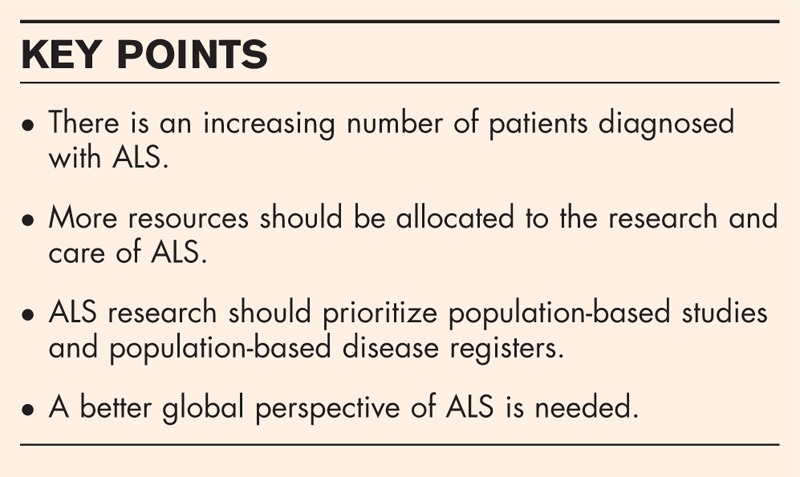
Purpose of review: The cause of amyotrophic lateral sclerosis (ALS) remains unknown for most of the patients with the disease. Epidemiologic studies can help describe disease burden and examine its potential risk factors, providing thereby evidence base for future mechanistic studies. With this review, we aimed to provide a summary of epidemiologic studies published during the past 18 months, which studied the incidence and risk factors for ALS. Recent findings: An increasing incidence and prevalence of ALS continue to be reported from different parts of the world. Several previously studied risk factors are confirmed as causally related to ALS by Mendelian randomization analysis. The previously known prognostic indicators for ALS appear to be the same across populations. Summary: Provided with the increasing number of patients diagnosed with ALS and the improved societal awareness of the disease, more resources should be allocated to the research and care of ALS. Population-based studies, especially population-based disease registers, should be the priorities in ALS research, and more data from outside Europe are needed in gaining a better global perspective of the disease.
Overview
The claims and statistics of this paper haven’t been checked yet.
Free: it reads the open-access text and checks the first 5 claims that cite a source we can check. Create a free account to check every claim.
Integrity signals
Registry
Cites
Statistics
Figures
Verification
Claims the paper makes
The claims and statistics of this paper haven’t been checked yet.
Free: it reads the open-access text and checks the first 5 claims that cite a source we can check. Create a free account to check every claim.
Claims other papers make about this one
Each is checked against this paper’s own text: does it say what the citing paper says it does?
The source backs part of the claim, not all of it — or backs it for a different population, condition or comparison.
In the citing paper
“These 4 common UMNDs result in a significant decline in physical function5,7,8,17,18 and often develop secondary complications that affect their quality of life (QOL), including cognitive impairment,19–21 fatigue,22 chronic pain,23,24 depression,25–27 and anxiety.25–27”
From Feasibility, Acceptability, and Efficacy of Mindfulness Training in People With Upper Motor Neuron Disorders: A Systematic Review (2022) · cites this paper as [7]
Experimental — accuracy not yet measuredThe source backs part of the claim, not all of it — or backs it for a different population, condition or comparison.
In the citing paper
“UMNDs may occur because of a traumatic event, nontraumatic event, or inherited or sporadic neurodegenerative disease.1,3–8”
From Feasibility, Acceptability, and Efficacy of Mindfulness Training in People With Upper Motor Neuron Disorders: A Systematic Review (2022) · cites this paper as [7]
Experimental — accuracy not yet measured
Self-check
Percentages, sums and reported differences re-computed from the paper’s own numbers.
The self-check needs the paper’s full text.
Citations
Cites
El Escorial revisited: revised criteria for the diagnosis of amyotrophic lateral sclerosis
Brooks, B. R., Miller, R. G., Swash, M., & Munsat, T. L. (2000) · Amyotrophic Lateral Sclerosis and Other Motor Neuron Disorders · doi:10.1080/146608200300079536 · Cited by 5,433
State of play in amyotrophic lateral sclerosis genetics
Renton, A. E., Chiò, A., & Traynor, B. J. (2014) · Nature Neuroscience · doi:10.1038/nn.3584 · Cited by 1,544
Hardiman, O., Al-Chalabi, A., Chio, A., Corr, E. M., Logroscino, G., Robberecht, W., Shaw, P. J., Simmons, Z., & van den Berg, L. H. (2017) · Nature Reviews Disease Primers · doi:10.1038/nrdp.2017.71 · Cited by 1,414
Clinical genetics of amyotrophic lateral sclerosis: what do we really know?
Andersen, P. M., & Al-Chalabi, A. (2011) · Nature Reviews Neurology · doi:10.1038/nrneurol.2011.150 · Cited by 687
Risk factors for amyotrophic lateral sclerosis
Fang, F., Ingre, C., Roos, P., Kamel, F., & Piehl, F. (2015) · Clinical Epidemiology · doi:10.2147/clep.s37505 · Cited by 462
Self-citationPrevalence of Amyotrophic Lateral Sclerosis — United States, 2014
Mehta, P., Kaye, W., Raymond, J., Wu, R., Larson, T., Punjani, R., Heller, D., Cohen, J., Peters, T., Muravov, O., et al. (2018) · MMWR. Morbidity and Mortality Weekly Report · doi:10.15585/mmwr.mm6707a3 · Cited by 458
Epidemiology of amyotrophic lateral sclerosis: A review of literature
Couratier, P., Corcia, P., Lautrette, G., Nicol, M., Preux, P., & Marin, B. (2015) · Revue Neurologique · doi:10.1016/j.neurol.2015.11.002 · Cited by 190
Molecular diagnostics of neurodegenerative disorders
Agrawal, M., & Biswas, A. (2015) · Frontiers in Molecular Biosciences · doi:10.3389/fmolb.2015.00054 · Cited by 164
Shared polygenic risk and causal inferences in amyotrophic lateral sclerosis
Bandres‐Ciga, S., Noyce, A. J., Hemani, G., Nicolas, A., Calvo, A., Mora, G., The ITALSGEN Consortium, The International ALS Genomics Consortium, Tienari, P. J., Stone, D. J., et al. (2019) · Annals of Neurology · doi:10.1002/ana.25431 · Cited by 162
Prevalence of Amyotrophic Lateral Sclerosis — United States, 2015
Mehta, P., Kaye, W., Raymond, J., Punjani, R., Larson, T., Cohen, J., Muravov, O., & Horton, K. (2018) · MMWR. Morbidity and Mortality Weekly Report · doi:10.15585/mmwr.mm6746a1 · Cited by 160
Cited by
Items 701–763 of 763
Implication du système nerveux autonome sympathique dans la sclérose latérale amyotrophique
Ollivier, M. (2025) · theses.fr (ABES) · doi:10.70675/1fedac1bzc6afz47c9za6a0z8619a99dea55
Gözüperk, E., & Bakırel, T. (2026) · Journal of Istanbul Veterinary Sciences · doi:10.30704/http-www-jivs-net.1909156
Brain-Computer Interfaces Technologies for Neurorehabilitation in Neurodegenerative Conditions
Aggarwal, A., Pradhan, S., & Sharma, A. (2026) · IGI Global eBooks · doi:10.4018/979-8-3373-6816-0.ch005
Abbasi, H., Rasekhi, H., Shafaatdoost, M., Mohajerani, A., Asadollahi, M., Rashidi, M., Malekahmadi, M., & Sarraf, P. (2026) · BMC Nutrition · doi:10.1186/s40795-026-01336-x
“The ALS prevalence has been estimated from 2.6 to 3.0 cases per 100,000 individuals, considering the poor survival rate of 30 months [3, 4].”
InfluentialYang, X., Yang, J. X., Li, R., Dong, H., & Liu, Y. (2026) · Experimental Biology and Medicine · doi:10.3389/ebm.2026.10987
Yoo, I., Yoo, J., Kim, D., Youn, I., Kim, H., Youn, M. S., Won, J. H., Cho, W., Myong, Y., Kim, S., et al. (2026) · PLoS ONE · doi:10.1371/journal.pone.0339691
Thyroid hormones and energy metabolism in amyotrophic lateral sclerosis
Novikova, L., Lang, C., Tumani, H., Klose, V., Kassubek, J., Dreyhaupt, J., Dupuis, L., Wabitsch, M., & Ludolph, A. (2026) · Brain Communications · doi:10.1093/braincomms/fcag198
“3,23,25,26 A family history of ALS was documented in 9% of patients.”
Cubillo, K. A., Azofeifa-Segura, M., Benavides-León, L., Rojas-Varela, J. A., Araya-Alpízar, C., & Arce, C. S.-H. (2026) · Acta Médica Costarricense · doi:10.51481/amc.v67i2.1442
Nanocarriers mediated DNA repair mechanism against neurological disorders
Bora, S., Jadav, M., Kulhari, H., & Pooja, D. (2026) · Elsevier eBooks · doi:10.1016/b978-0-443-33623-2.00009-x
Machine learning evaluation of gene expression-based ALS subtypes across brain and blood tissuesPreprint
Gómez, E. A., Khleifat, A. A., Troakes, C., Al‐Chalabi, A., & Iacoangeli, A. (2026) · bioRxiv (Cold Spring Harbor Laboratory) · doi:10.64898/2026.06.19.733362
“Amyotrophic lateral sclerosis (ALS) is a neurodegenerative disease causing the progressive loss of both upper and lower motor neurons, leading to muscle weakness, paralysis and ultimately death from respiratory failure 1 .”
Turkmenel, N., & Uşkun, E. (2026) · Quality of Life Research · doi:10.1007/s11136-026-04318-5
“Its prevalence is estimated at 4–8 per 100,000 worldwide [30 ], with regional data from Türkiye suggesting comparable rates to Europe [ 46 ].”
Saura, M. A. M. (2022) · TITULA
Thyroid function and catabolism in amyotrophic lateral sclerosis
Novikova, L. (2026) · doi:10.18725/oparu-60381
da Silva, A. M., Liborio, G. V., Correa, V. K. C., & Martini, C. S. D. S. (2026) · Periódicos Brasil Pesquisa Científica · doi:10.36557/2674-9432.2026v5n4p2000-2016
Stipa, G., Colosimo, C., & Vanacore, N. (2026) · Journal of Neural Transmission · doi:10.1007/s00702-026-03202-3
“The largest producer of PQ is China, with an annual production of approximately 100,000 tons (Longinetti and Fang 2019 ).”
Price, T. R., Chang, C., Skinner, K., Dinneny, M., Nafezi, P., Kuramoto, L., Vera, M. A. D., Cashman, N. R., & Cragg, J. J. (2026) · Expert Opinion on Drug Safety · doi:10.1080/14740338.2026.2687628
Genome-wide spectrum of coding DNA variations in Indian patients with amyotrophic lateral sclerosis
Kotambail, A., Arunachal, G., Keerthipriya, M. S., Mahima, R., Sukrutha, R., Ramyashree, M. B., Deekshitha, M., Rao, B. M., Biswas, P., Polavarapu, K., et al. (2026) · Journal of Neurology · doi:10.1007/s00415-026-13819-9
“The mean ALS age at onset in our cohort was 49.4 years, which is younger than that reported in many European series [3].”
InfluentialHsu, Y.-W., Lu, Y.-N., Liu, M., & Wang, J. (2026) · PLoS Genetics · doi:10.1371/journal.pgen.1012225
“Moreover, women also show a higher prevalence of bulbar-onset ALS [44,45], a clinical phenotype linked to accelerated cognitive decline, diminished quality of life, and shorten survival [46,47].”
Unusual presentation of amyotrophic lateral sclerosis years after a motor-vehicle collision
Pucciarelli, D. M., Patel, R., Sawicki, S., Jain, S., & Saulino, P. A. (2026) · BMJ Case Reports · doi:10.1136/bcr-2026-272139
“7 Despite this, ‘typical’ symptom presentations may still follow an abnormal course, making diagnosis challenging.”
ESPIRITUALIDADE E BEM-ESTAR EM PACIENTES COM ESCLEROSE LATERAL AMIOTRÓFICA
Péclat, S. C. S., da Silva, E. A. S., de Santana, T. S., & Barbosa, M. A. (2026) · Revista Tópicos · doi:10.70773/revistatopicos/783221396
Kennedy, J., Khleifat, A. A., King, A. P., Al-Sarraj, S., Al‐Chalabi, A., Mitchell, J. C., & Troakes, C. (2026) · Brain Communications · doi:10.1093/braincomms/fcag272
Alem, E., Abbasi, H., Malekahmadi, M., Khoshdooz, S., Bakhshimoghaddam, F., & Doaei, S. (2025) · Egyptian Journal of Basic and Applied Sciences · doi:10.1080/2314808x.2026.2696704
Phenotype of motoneurons with mutations in the NEK1 gene
Petrut, I. (2024) · doi:10.18725/oparu-60612
Амиотрофична латерална склероза клинико-генетична форма 9 (АЛС9) – представяне на клиничен случай
Angelov, T., Chamova, T., Чернинкова, С., & Tournev, I. (2023) · Българска неврология · doi:10.67667/neu.v24i2.142
SYNCRIP reguliert die Expression der Fragilen-X-Proteine
Haas, M. J. (2026) · doi:10.18725/oparu-60751
Distinct competitive and allosteric binding modes of nanobodies targeting EphA4
Jiang, H., Ding, L., Yang, C., Guo, G., Zhong, C., Ma, Z., Zhu, H., Zhang, J., Luo, Y., Liu, Z., et al. (2026) · Journal of Biological Chemistry · doi:10.1016/j.jbc.2026.113394
“Most patients die within 3 to 5 years after disease onset, and the incidence of ALS continues to increase worldwide, reflecting its complex and multifactorial etiology (4–6).”
Khazaal, M., Stretavská, P., Kuźma‐Kozakiewicz, M., Nieporęcki, K., Adam, B. A., Vlčková, E., Koprušáková, M. T., Petrovič, R., Çetin, H., Keritam, O., et al. (2026) · European Journal of Neurology · doi:10.1111/ene.70717
Wolf, J., Safer, A., Stefenelli, U., Wöhrle, J. C., Maschke, M., Nix, W. A., & Grau, A. (2026) · BMC Neurology · doi:10.1186/s12883-026-05325-2
“Median survival times in ALS vary considerably, ranging from 24 to 50 months from symptom onset in population-based prospective registries [3].”
Exploration of reliable assessment of respiratory function in amyotrophic lateral sclerosis
Hu, N., zhang, L., Tian, H., Ding, J., Shen, D., Yang, X., Cui, L., Niu, J., & Liu, M. (2026) · Neurological Sciences · doi:10.1007/s10072-026-09358-w
Chowdhury, S., Kar, K., Chakraborty, P., Kuilya, M., Prajapati, B. G., Ankul Singh, S., & Sridevi, S. (2026) · Current Proteomics · doi:10.1016/j.curpro.2026.100151
Zhu, Y., Zhang, Y., Yan, T., Li, Y., Haikuan, D. U., Zhang, S., ZHANG, T., & Zhou, W. (2026) · Free Radical Research · doi:10.1080/10715762.2026.2729677
Emergencies in Amyotrophic Lateral Sclerosis
Uysal, S. P., Dudley, K. A., Sullivan, S. L., Brizzi, K. T., Burke, K. M., Hall, S., Pease, K., Goldstein, J. N., Berry, J. D., & Ho, D. T. (2026) · Muscle & Nerve · doi:10.1002/mus.70398
Microbiome and Diseases: Gut–Brain Axis and Neurological Disorders
de Castilhos, J., & Stein‐Thoeringer, C. K. (2026) · Springer eBooks · doi:10.1007/978-3-032-26410-7_18
Padhiyar, D., Butani, S., & Patel, R. J. (2026) · Naunyn-Schmiedeberg s Archives of Pharmacology · doi:10.1007/s00210-026-05866-w
Amyotrophic Lateral Sclerosis (ALS)
(2026) · Elsevier eBooks · doi:10.1016/b978-3-437-15042-5.00020-5
Experiences of apathy in people with amyotrophic lateral sclerosis
Dremelj, M. (2026) · Repository of the University of Ljubljana (University of Ljubljana)
Intervención fisioterapéutica en ELA: Valoración y pautas de tratamiento
Cañete, C. B., & Polo, G. C. (2021) · EUG Institutional Repository
Bombaci, A. (2024) · Institutional Research Information System University of Turin (University of Turin)
Shen, C., Wu, X., Yin, H., Zuo, J.-L., Zhang, C., Cao, F., Zhang, Y., Tian, Z., Robinson, N., & Liu, J.-P. (2026) · Frontiers in Pharmacology · doi:10.3389/fphar.2026.1706211
Krzemień, P. A., Doroszko, D. N., Izdebska, A. B., & Siuda, J. S. (2026) · Aktualności Neurologiczne · doi:10.15557/an.2026.0007
Ros‐Arlanzón, P., Vazquez-Costa, J. F., Merchan-Cabanillas, A., Vilar-Ventura, R. M., Pareja, A., Lorente-Gomez, L., Ronda-Pérez, E., & Diaz-Marin, C. (2026) · medRxiv · doi:10.64898/2026.10.07.26364981
Gong, Z., & Wei, B. (2026) · Journal of Genetic Engineering and Biotechnology · doi:10.1016/j.jgeb.2026.100835
Gong, X., Wei, H., Shen, L., Wang, Q., Wu, J., Wang, W., & Xu, T. (2026) · Cells · doi:10.3390/cells15201890
“Incidence is roughly 1–2 per 100,000 person-years, and prevalence is 6–9 per 100,000, with onset peaking in the seventh decade [3–5].”
Park, J.-H., Yon, D. K., Kim, M. S., Chang, Y., Park, S., Collaborators, G. 2. M. N. D., Shin, J. I., & Song, T. (2026) · Ewha Medical Journal · doi:10.12771/emj.2026.01480
“In this study, the age-standardized DALY rate increased significantly after age 50, peaked at ages 70 – 79, and then declined rapidly in both men and women, consistent with the known age distribution of ALS [28,29].”
Bilgorai, J., Rafferty, G. F., Carobin, A., Scott, J., Chen, M., Zhou, P., Shaw, C. E., Vanhoestenberghe, A., & Bashford, J. A. (2026) · Clinical Neurophysiology · doi:10.1016/j.clinph.2026.2112448
Sanghai, N., Vuong, B., Afridi, M. S. K., Leggett, S., Roghzai, H., & Tranmer, G. K. (2026) · ChemMedChem · doi:10.1002/cmdc.70554
Oligonucleotide-mediated Modulation of C9ORF72 Repeat Expansion in Amyotrophic Lateral Sclerosis
Larcher, L. (n.d.) · Murdoch University Research Portal
Xu, Z., Fan, T., & Xu, R. (2026) · Reviews in the Neurosciences · doi:10.1515/revneuro-2026-0171
Fernández, L. A. (2026) · Deposito de Investigacion Universidad de Sevilla (University of Seville)
Cimmino, F. A., Comandini, G., Bigliazzi, C., d’Alessandro, M., Salvadori, E., Pianigiani, T., Stefano, N. D., Ginanneschi, F., Casali, S., & Bargagli, E. (2026) · Monaldi Archives for Chest Disease · doi:10.4081/monaldi.2026.4024
Crabé, R., Brodovitch, A., Gosset, P., Gavard, C., Brugioti, V., Challuau, D., Picot, A., Espinosa-Carrasco, G., Soustelle, L., Mouzat, K., et al. (2026) · Brain Behavior & Immunity - Health · doi:10.1016/j.bbih.2026.101401
Cayuela, L., García‐Muñoz, C., Machancoses, F. H., Librero, J., & Cayuela, A. (2026) · Spatial and Spatio-temporal Epidemiology · doi:10.1016/j.sste.2026.100861
The molecular pathology of the ALS-related G376D TARDBP mutation in iPSC-derived motor neurons
Mosca, V. (2026) · Nova Science Publishers (Nova Science Publishers, Inc.)
Lee, J. (2024) · TSpace (University of Toronto)
Lu, J. J., & Cheung, M. C. H. (2026) · Stem Cells · doi:10.1093/stmcls/sxag064
Barbalho, I. M. P., Fonseca, A. L. A., Fernandes, F., Henriques, J., Gil, P., Nagem, D., Lindquist, R., Lima, T., dos Santos, J. P. Q., Paiva, J., et al. (2023) · doi:10.3389/fpubh.2023.1209633.s001
Mitsi, E., Christodoulou, C. C., Nicolaou, P., Christodoulou, K., & Zamba-Papanicolaou, E. (2023) · doi:10.3389/fneur.2023.1264743.s001
Zhu, Q., Zhou, J., Zhang, Y., Huang, H., Han, J., Cao, B., Xu, D., Zhao, Y., & Chen, G. (2023) · doi:10.3389/fnins.2023.1196722.s001
Park, J., Kim, J.-E., & Song, T.-J. (2022) · doi:10.3389/fneur.2022.864339.s001
Targeting trimeric SOD1 with Amisodin mitigates TDP-43-associated ALS pathologyPreprint
Park, B.-J., Han, J., Woo, T., Mun, Y.-S., Kim, H. J., Park, S., Kang, S., Lee, M., Hong, B.-S., Kim, J., et al. (2026) · Research Square · doi:10.21203/rs.3.rs-11367184/v1
Metadata
- Authors
- Longinetti, E., & Fang, F.
- Affiliations
- Karolinska Institutet (SE)
- Corresponding author
- Fang, Fang
- Venue
- Current Opinion in Neurology
- Published
- 2019-10
- Volume
- 32
- Issue
- 5
- Pages
- 771-776
- ISSN
- 1350-7540 (ISSN-L)
- 1473-6551
- PMC
- PMC6735526
- OpenAlex
- W2965191972
- Semantic Scholar
- 04d12e5537f9a9934fab5cd648d8bec24c962d10
- Cited by
- 620
- References
- 55
- Citations by year
- 2026: 75 · 2025: 84 · 2024: 122 · 2023: 122 · 2022: 94 · 2021: 84 · 2020: 33 · 2019: 3
- FWCI
- 7.35
- Type
- journal article
- Language
- en
- Open access
- hybrid
- doi.org
- Locations
- Current Opinion in Neurology (publishedVersion, cc-by)
- PubMed Central (publishedVersion, cc-by)
- PubMed (publishedVersion)
- Funders
- National Health Insurance Service
- Topics
- Health Sciences › Medicine › Clinical Neurology › Amyotrophic Lateral Sclerosis Research
- Health Sciences › Medicine › Internal Medicine › Amyloidosis: Diagnosis, Treatment, Outcomes
- Health Sciences › Medicine › Psychiatry and Mental health › Dementia and Cognitive Impairment Research
- Keywords
- amyotrophic lateral sclerosis, incidence, prevalence, risk factors, Mendelian randomization, prognostic factors, disease burden, global epidemiology
- MeSH terms
- Amyotrophic Lateral Sclerosis, Europe, Humans, Risk Factors, Incidence, Prevalence
About these checks
Registry, retraction, Cites and statistics results are computed, not judged, with one exception: a printed reference that no index lists is read once by a model before it counts as a citation error. Claims are extracted by a model and kept only when their quote appears verbatim in the text; each cited source is then checked, with a model’s help, for whether it says what the claim relies on. Those verdicts can be wrong — read the claim’s quote and the cited source before relying on one.
Statistics and arithmetic are recomputed, not judged.
Confidence bands are shown only for fields calibrated on our annotated test set. None is calibrated yet, so no band is shown.
What counts as a claim ›How we measure confidence ›How we check this ›
Are you an author, or do you see a problem with this page? Request a review
Data sources
Bibliographic data: Semantic Scholar, OpenAlex, Crossref.
Contains information from the Semantic Scholar Academic Graph Datasets, made available under the ODC Attribution License (ODC-BY 1.0).
Semantic Scholar’s data is described in: Kinney, R., et al. (2023). The Semantic Scholar Open Data Platform. arXiv:2301.10140.
