

Epidemiology of amyotrophic lateral sclerosis: an update of recent literature
Open accessThe DOI matches its Crossref record; 55 of the 55 references it cites were found in a registry or an index.
Abstract
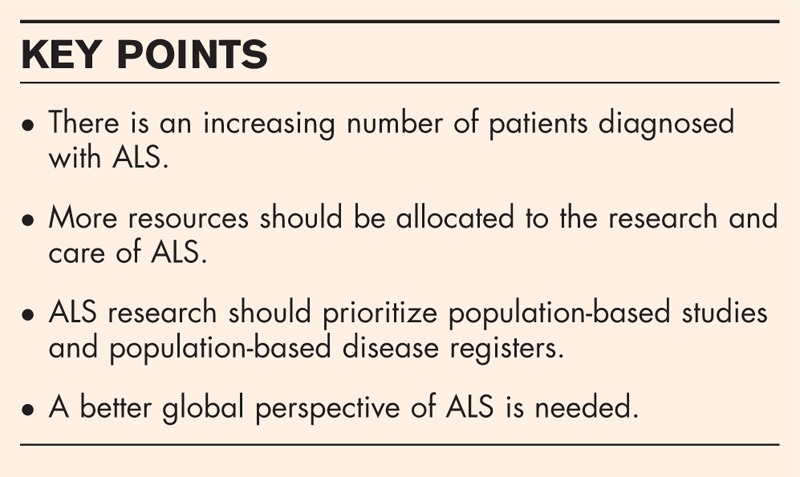
Purpose of review: The cause of amyotrophic lateral sclerosis (ALS) remains unknown for most of the patients with the disease. Epidemiologic studies can help describe disease burden and examine its potential risk factors, providing thereby evidence base for future mechanistic studies. With this review, we aimed to provide a summary of epidemiologic studies published during the past 18 months, which studied the incidence and risk factors for ALS. Recent findings: An increasing incidence and prevalence of ALS continue to be reported from different parts of the world. Several previously studied risk factors are confirmed as causally related to ALS by Mendelian randomization analysis. The previously known prognostic indicators for ALS appear to be the same across populations. Summary: Provided with the increasing number of patients diagnosed with ALS and the improved societal awareness of the disease, more resources should be allocated to the research and care of ALS. Population-based studies, especially population-based disease registers, should be the priorities in ALS research, and more data from outside Europe are needed in gaining a better global perspective of the disease.
Overview
The claims and statistics of this paper haven’t been checked yet.
Free: it reads the open-access text and checks the first 5 claims that cite a source we can check. Create a free account to check every claim.
Integrity signals
Registry
Cites
Statistics
Figures
Verification
Claims the paper makes
The claims and statistics of this paper haven’t been checked yet.
Free: it reads the open-access text and checks the first 5 claims that cite a source we can check. Create a free account to check every claim.
Claims other papers make about this one
Each is checked against this paper’s own text: does it say what the citing paper says it does?
The source backs part of the claim, not all of it — or backs it for a different population, condition or comparison.
In the citing paper
“These 4 common UMNDs result in a significant decline in physical function5,7,8,17,18 and often develop secondary complications that affect their quality of life (QOL), including cognitive impairment,19–21 fatigue,22 chronic pain,23,24 depression,25–27 and anxiety.25–27”
From Feasibility, Acceptability, and Efficacy of Mindfulness Training in People With Upper Motor Neuron Disorders: A Systematic Review (2022) · cites this paper as [7]
Experimental — accuracy not yet measuredThe source backs part of the claim, not all of it — or backs it for a different population, condition or comparison.
In the citing paper
“UMNDs may occur because of a traumatic event, nontraumatic event, or inherited or sporadic neurodegenerative disease.1,3–8”
From Feasibility, Acceptability, and Efficacy of Mindfulness Training in People With Upper Motor Neuron Disorders: A Systematic Review (2022) · cites this paper as [7]
Experimental — accuracy not yet measured
Self-check
Percentages, sums and reported differences re-computed from the paper’s own numbers.
The self-check needs the paper’s full text.
Citations
Cites
El Escorial revisited: revised criteria for the diagnosis of amyotrophic lateral sclerosis
Brooks, B. R., Miller, R. G., Swash, M., & Munsat, T. L. (2000) · Amyotrophic Lateral Sclerosis and Other Motor Neuron Disorders · doi:10.1080/146608200300079536 · Cited by 5,433
State of play in amyotrophic lateral sclerosis genetics
Renton, A. E., Chiò, A., & Traynor, B. J. (2014) · Nature Neuroscience · doi:10.1038/nn.3584 · Cited by 1,544
Hardiman, O., Al-Chalabi, A., Chio, A., Corr, E. M., Logroscino, G., Robberecht, W., Shaw, P. J., Simmons, Z., & van den Berg, L. H. (2017) · Nature Reviews Disease Primers · doi:10.1038/nrdp.2017.71 · Cited by 1,414
Clinical genetics of amyotrophic lateral sclerosis: what do we really know?
Andersen, P. M., & Al-Chalabi, A. (2011) · Nature Reviews Neurology · doi:10.1038/nrneurol.2011.150 · Cited by 687
Risk factors for amyotrophic lateral sclerosis
Fang, F., Ingre, C., Roos, P., Kamel, F., & Piehl, F. (2015) · Clinical Epidemiology · doi:10.2147/clep.s37505 · Cited by 462
Self-citationPrevalence of Amyotrophic Lateral Sclerosis — United States, 2014
Mehta, P., Kaye, W., Raymond, J., Wu, R., Larson, T., Punjani, R., Heller, D., Cohen, J., Peters, T., Muravov, O., et al. (2018) · MMWR. Morbidity and Mortality Weekly Report · doi:10.15585/mmwr.mm6707a3 · Cited by 458
Epidemiology of amyotrophic lateral sclerosis: A review of literature
Couratier, P., Corcia, P., Lautrette, G., Nicol, M., Preux, P., & Marin, B. (2015) · Revue Neurologique · doi:10.1016/j.neurol.2015.11.002 · Cited by 190
Molecular diagnostics of neurodegenerative disorders
Agrawal, M., & Biswas, A. (2015) · Frontiers in Molecular Biosciences · doi:10.3389/fmolb.2015.00054 · Cited by 164
Shared polygenic risk and causal inferences in amyotrophic lateral sclerosis
Bandres‐Ciga, S., Noyce, A. J., Hemani, G., Nicolas, A., Calvo, A., Mora, G., The ITALSGEN Consortium, The International ALS Genomics Consortium, Tienari, P. J., Stone, D. J., et al. (2019) · Annals of Neurology · doi:10.1002/ana.25431 · Cited by 162
Prevalence of Amyotrophic Lateral Sclerosis — United States, 2015
Mehta, P., Kaye, W., Raymond, J., Punjani, R., Larson, T., Cohen, J., Muravov, O., & Horton, K. (2018) · MMWR. Morbidity and Mortality Weekly Report · doi:10.15585/mmwr.mm6746a1 · Cited by 160
Cited by
Items 301–400 of 763
Arreola-Aldape, C. A., Moran-Guerrero, J. A., Monnier, G. P., Flores-Salcido, R. E., Martínez-Ledesma, E., Ruiz‐Manriquez, L. M., Razo-Alvarez, K. R., Mares-Custodio, D., Avalos-Montes, P. J., Figueroa-Sanchez, J. A., et al. (2025) · Frontiers in Neuroscience · doi:10.3389/fnins.2025.1598336 · Cited by 6
“Although affected by ethnicity, the global incidence of ALS is approximately 2 cases per 100,000 person-years with a prevalence of 6-9 per 100,000 individuals (Martínez et al., 2011; Mehta et al., 2018; Longinetti and Fang, 2019; Brown et al., 2021; Wolfson et al., 2023).”
AAV-mediated BDNF and GAS6 muscle delivery delays disease onset in SOD1G93A ALS mice
Le, Y., Liu, G., Wu, S., Nissenbaum, M., Kusnecov, A. W., Furmanski, P., Birge, R. B., & Zhou, R. (2025) · Gene Therapy · doi:10.1038/s41434-025-00577-y · Cited by 6
“Evidence suggests that the incidence of ALS is rising [1], possibly due to shifting population demographics and advancements in clinical services that enhance diagnostic accuracy.”
Autonomic Dysfunction in Amyotrophic Lateral Sclerosis – A Case-Control Study
Hasan, M., Alam, S. M., Rahman, H. Z., Khan, M. A. S., & Huq, M. R. (2024) · Acta Medica Academica · doi:10.5644/ama2006-124.440 · Cited by 6
“The mean and median age of ALS onset is between 51 and 66 years (4).”
BackgroundJoyce, E. E., Xu, S., Ingre, C., Potenza, R. L., Seitz, C., Yang, H., Zeng, Y., Song, H., & Fang, F. (2024) · Annals of Neurology · doi:10.1002/ana.27109 · Cited by 6
“5,6 Most patients with ALS have an unknown cause, which is likely the result of interactions among genetic, environmental, and lifestyle risk factors.”
Self-citationButna, K., Pyszora, A., Adamczyk, A., & Krajnik, M. (2021) · Palliative Medicine in Practice · doi:10.5603/pmpi.2021.0005 · Cited by 6
Chapman, C., Bayes, S. J., & Sim, M. (2021) · International Journal of Care Coordination · doi:10.1177/20534345211010132 · Cited by 6
“2 per 100 000 person years).(4) This represents an overall rise in recent years: in 2005 the estimate of the worldwide occurrence was 1.”
BackgroundSharma, A. K., Sane, H. M., Paranjape, A., Varghese, R., Nair, V., Biju, H., Sawant, D., Gokulchandran, N., & Badhe, P. B. (2021) · Journal of Neurorestoratology · doi:10.26599/jnr.2021.9040010 · Cited by 6
Choi, S., Park, C. H. K., Hong, Y., & Sung, J. (2022) · Amyotrophic Lateral Sclerosis and Frontotemporal Degeneration · doi:10.1080/21678421.2022.2035765 · Cited by 6
He, X., Feng, J., Cong, X., Huang, H., Zhao, Q., Shen, Q., Xu, F., & Xu, Y. (2022) · Frontiers in Public Health · doi:10.3389/fpubh.2022.899027 · Cited by 6
The Neuroepigenetic Landscape of Vertebrate and Invertebrate Models of Neurodegenerative Diseases
Sundaramoorthy, T. H., & Castanho, I. (2022) · Epigenetics Insights · doi:10.1177/25168657221135848 · Cited by 6
Gold, N. D., Mallard, A. J., Hermann, J. C., Zeifman, R. J., Pagni, B. A., Bogenschutz, M. P., & Ross, S. (2023) · Journal of Palliative Medicine · doi:10.1089/jpm.2022.0604 · Cited by 6
Naveed, M., Shabbir, M. A., Aziz, T. A., Hurraira, H. M., Zaidi, S. F., Athar, R., Chattha, H. A., Alharbi, M., Alshammari, A., & Alasmari, A. F. (2023) · Acta Biochimica Polonica · doi:10.18388/abp.2020_6789 · Cited by 6
“ALS has an estimated prevalence of approximately 4-8 cases per 100 000 individuals, although certain regions have reported higher rates (Longinetti & Fang, 2019).”
BackgroundSonographic Phrenic Nerve Changes in Amyotrophic Lateral Sclerosis
Laucius, O., Drūteika, J., Vaitkus, A., Balnytė, R., Petrikonis, K., & Ališauskienė, M. (2023) · Medicina · doi:10.3390/medicina59101745 · Cited by 6
Association of TRMT2B gene variants with juvenile amyotrophic lateral sclerosis
Liu, Y., He, X. J., Yuan, Y., Li, B., Liu, Z., Li, W., Li, K., Tan, S., Zhu, Q., Tang, Z., et al. (2023) · Frontiers of Medicine · doi:10.1007/s11684-023-1005-y · Cited by 7
Carrera‐Juliá, S., Estrela, J. M., Zacarés, M., Navarro, M. Á., Vega‐Bello, M. J., Ortí, J. E. D. L. R., Moreno, M. L., & Drehmer, E. (2024) · Nutrients · doi:10.3390/nu16030350 · Cited by 6
“Only 25% of patients survive beyond five years after diagnosis, although 5–10% may survive more than 10 years [12].”
BackgroundKamiya, K., Hanashiro, S., Kano, O., Uchida, W., Kamagata, K., Aoki, S., & Hori, M. (2024) · Magnetic Resonance in Medical Sciences · doi:10.2463/mrms.mp.2023-0138 · Cited by 6
Corneal nerves and amyotrophic lateral sclerosis: an in vivo corneal confocal imaging study
Khanna, R. K., Catanese, S., Blasco, H., Pisella, P., & Corcia, P. (2024) · Journal of Neurology · doi:10.1007/s00415-024-12282-8 · Cited by 6
“The disease caries poor prognosis with a survival time from onset of symptoms to death or invasive respiratory assistance ranging from 24 to 50 months [1].”
Disturbances in Muscle Energy Metabolism in Patients with Amyotrophic Lateral Sclerosis
Parvanovova, P., Hnilicová, P., Kolísek, M., Tatarková, Z., Halášová, E., Kurča, E., Holubcikova, S., Koprušáková, M. T., & Baranovičová, E. (2024) · Metabolites · doi:10.3390/metabo14070356 · Cited by 6
“ALS affects people worldwide, with an incidence of approximately 2/100,000 of the population, more commonly affecting men than women [1–3], with onset between 55 and 65 years.”
BackgroundAssociation between motor neuron disease and HIV infection: A systematic review of case reports
Fernandes, J. P. M., Garcia, L. P., Gouhie, F. A., Pereira, R. C., & dos Santos, D. F. (2024) · International Journal of STD & AIDS · doi:10.1177/09564624241288283 · Cited by 6
Mitsi, E., Christodoulou, C. C., Nicolaou, P., Christodoulou, K., & Zamba-Papanicolaou, E. (2023) · Frontiers in Neurology · doi:10.3389/fneur.2023.1264743 · Cited by 5
Dera, H. S. A., & AlQahtani, B. (2024) · Molecular Therapy — Nucleic Acids · doi:10.1016/j.omtn.2024.102271 · Cited by 5
Inhibition of SOD1 trimerization is a novel drug target for ALS disease
Woo, T., Han, J., Kim, Y., Hwang, Y. J., Lee, M. G., Kang, S., Park, S., Ji, Y., Chung, Y., Baek, S., et al. (2025) · Translational Neurodegeneration · doi:10.1186/s40035-025-00483-8 · Cited by 5
Temp, A. G. M., Tarakdjian, G. N., Kasper, E., Machts, J., Kaufmann, J., Vielhaber, S., Prudlo, J., Cole, J. H., Dyrba, M., Teipel, S. J., et al. (2025) · Scientific Reports · doi:10.1038/s41598-025-97509-y · Cited by 5
Air Pollution, MIND Diet, Risk of Neurodegenerative Diseases in Different Aging Status
Zhang, J., Gu, T., Jin, J., Han, W., Kong, Q., Huang, J., & Li, G. (2025) · Environment & Health · doi:10.1021/envhealth.4c00239 · Cited by 5
The geographic association of multiple sclerosis and amyotrophic lateral sclerosis
Schilling, M. A. (2025) · Scientific Reports · doi:10.1038/s41598-025-18755-8 · Cited by 5
“However, about 10% of those diagnosed with ALS experience a more slowly progressing version of the disease and may live for a decade or more (e.g., Stephen Hawking survived with the disease for 55 years) 44 .”
Kiecka, A., & Szczepanik, M. (2025) · Pharmacological Reports · doi:10.1007/s43440-025-00800-y · Cited by 6
“The incidence of this disease is 0.6 to 3.8 per 100,000 persons per year [ 2].”
InfluentialDynamic modelling of the ALSFRS-R: leveraging population-based scores using neural networks
McFarlane, R., Ross, R., Domhnaill, É. M., Chiò, A., Corcia, P., Ingre, C., McDermott, C. J., Panadés, M. P., Shaw, P. J., Damme, P. V., et al. (2025) · EBioMedicine · doi:10.1016/j.ebiom.2025.106029 · Cited by 5
Mohammadzadeh, S., Salmannejad, F., Mohammadzadeh, M., Ghari, T., Sadrai, S., & Zaringhalam, J. (2023) · Drug development & registration · doi:10.33380/2305-2066-2023-12-1-192-198 · Cited by 5
Cunha, T. A., Lopes, M. M. G. D., Brito, A. N. A., Vermeulen-Serpa, K. M., Vale, S. H. D. L., Brandão‐Neto, J., & Leite-Lais, L. (2024) · Applied Sciences · doi:10.3390/app14041545 · Cited by 5
Caulier‐Cisterna, R., Appelgren, J. P. G., Oyarzún, J. E., Valenzuela, F., Sitaram, R., Eblén-Zajjur, A., & Uribe, S. A. (2024) · Medical Engineering & Physics · doi:10.1016/j.medengphy.2024.104170 · Cited by 5
Drug Screening and Validation Targeting TDP-43 Proteinopathy for Amyotrophic Lateral Sclerosis
Xin, J., Huang, S., Wen, J., Li, Y., Li, A., Satyanarayanan, S. K., Yao, X., & Su, H. (2024) · Aging and Disease · doi:10.14336/ad.2024.0440 · Cited by 5
“Globally, ALS is diagnosed at a rate of approximately 2 cases per 100,000 individuals annually, with incidence rates differing between sexes [2].”
Registration of Amyotrophic Lateral Sclerosis: Validity in the Danish National Patient Registry
Levison, L. S., Jepsen, P., & Andersen, H. (2024) · Clinical Epidemiology · doi:10.2147/clep.s458661 · Cited by 5
ALS patients in otorhinolaryngology: A retrospective study
Rautiola, J., Laaksovirta, H., Geneid, A., Ilmarinen, T. T., Pietarinen, P., & Kinnari, T. J. (2022) · Laryngoscope Investigative Otolaryngology · doi:10.1002/lio2.859 · Cited by 5
“BuALS is associated with higher all-cause mortality, greater co-morbidities, and a lower quality of life.(1,2,4) Given the rarity and the lack of clear clinical markers, ALS and buALS specifically represent diagnostic challenges.”
BackgroundSaastamoinen, P., Laaksovirta, H., Leino‐Arjas, P., & Rahkonen, O. (2022) · Frontiers in Neurology · doi:10.3389/fneur.2022.859824 · Cited by 5
“The incidence of ALS has been ∼2– 3 cases/100,000 people, but a recent review suggests that the incidence is increasing in different parts of the world (1, 2).”
BackgroundEpidemiology of amyotrophic lateral sclerosis in the north east Tuscany in the 2018–2021 period
Matà, S., Bussotti, M., Mastio, M. D., Barilaro, A., Piersanti, P., Lombardi, M., Cincotta, M., Torricelli, S., Leccese, D., Sperti, M., et al. (2023) · eNeurologicalSci · doi:10.1016/j.ensci.2023.100457 · Cited by 5
Hamad, A. A., Amer, B. E., Mawla, A. M. A., Goufa, E., Abdelwahab, M. M., & Serag, I. (2023) · Neurological Sciences · doi:10.1007/s10072-023-06994-4 · Cited by 5
“Typically, ALS is diagnosed in middle age, with an average onset between 51 and 66 years, and is more prevalent in men than women [2].”
BackgroundVerma, S., Khurana, S., Gourie‐Devi, M., Anand, I., Vats, Y., Singh, A., Jothiramajayam, M., Kshetrapal, P., Sharma, A., Wajid, S., et al. (2023) · Annals of Neurosciences · doi:10.1177/09727531231194399 · Cited by 5
Colognesi, M., Shkodra, A., Gabbia, D., Kawamata, H., Manfredi, P. L., Manfredi, G., & Martin, S. D. (2024) · Frontiers in Neurology · doi:10.3389/fneur.2024.1384829 · Cited by 5
Current neuroprotective therapies and future prospects for motor neuron disease
Evans, L. J., O’Brien, D., & Shaw, P. J. (2024) · International review of neurobiology · doi:10.1016/bs.irn.2024.04.003 · Cited by 5
Çelik, M. H., Gagneur, J., Lim, R. G., Wu, J., Thompson, L. M., & Xie, X. S. (2024) · Human Genetics and Genomics Advances · doi:10.1016/j.xhgg.2024.100318 · Cited by 5
Perceived Pain in People Living with Amyotrophic Lateral Sclerosis—A Scoping Review
Rosa, D., Ingrande, L., Marcomini, I., Poliani, A., Villa, G., Sodano, M., & Manara, D. F. (2024) · Nursing Reports · doi:10.3390/nursrep14040220 · Cited by 5
“In Europe, the incidence of ALS is between 2.1 and 3.8 per 100,000 people [3].”
BackgroundInfluentialZheng, C., Blackwell, J. M., & Fontanini, A. (2025) · Neurobiology of Disease · doi:10.1016/j.nbd.2025.106850 · Cited by 5
“It is worth noting that the present investigation relied on a mouse model that overexpresses human TDP-43, a protein that abnormally accumulates in both FTD and in amyloid lateral sclerosis (ALS), a motor neuron disease that features progressive muscle weakness (Longinetti and Fang, 2019).”
A nationwide survey of facial onset sensory and motor neuronopathy in Japan
Ko, S., Yamasaki, R., Okui, T., Shiraishi, W., Watanabe, M., Hashimoto, Y., Kobayakawa, Y., Kusunoki, S., Kira, J., & Isobe, N. (2024) · Journal of the Neurological Sciences · doi:10.1016/j.jns.2024.122957 · Cited by 5
“Although the overall disease duration was longer than ALS [24,25], these cases had a more severe disease course than other FOSMN cases, especially sensory symptom dominant cases as originally reported [1].”
ResultFirstenfeld, A. J., Servicio de Neurociencias, U. D. B. A., Listorti, J., Servicio de Neurociencias, U. D. B. A., Jalaff, N., Servicio de Neurociencias, U. D. B. A., Orozco, C., Servicio de Neurociencias, U. D. B. A., Gosdenovich, F. N., Servicio de Neurociencias, U. D. B. A., et al. (2023) · Journal of Medicine and Life · doi:10.25122/jml-2023-0459 · Cited by 5
“ALS is a rare disease with an incidence of approximately 2 per 100,000 person-years and a prevalence be-tween 6 and 9 per 100,000 people, with studies indicating a rising incidence [4-6].”
BackgroundCunha‐Oliveira, T., Carvalho, M., Sardão, V. A., Ferreiro, E. B., Mena, D., Pereira, F. B., Borges, F., Oliveira, P. J., & Silva, F. S. G. (2022) · Molecular Neurobiology · doi:10.1007/s12035-022-02980-7 · Cited by 5
“On average, the disease affects people between 51 and 66 years of age, with a survival time, from symptoms onset to death, between 24 and 50 months [1].”
BackgroundA bibliometric analysis of gene editing and amyotrophic lateral sclerosis (from 2004 to 2024)
Wan, H., Qian, W., Wei, B., Tian, K., Chen, Z., Zhang, J., & Chen, F. (2024) · Frontiers in Neuroscience · doi:10.3389/fnins.2024.1499025 · Cited by 4
Rhodamine-B induces amyotrophic lateral sclerosis symptoms like -behaviours in zebrafish
Mamangam, S., & Brimson, J. M. (2025) · Aquatic Toxicology · doi:10.1016/j.aquatox.2025.107515 · Cited by 4
Ebrahimian, A., Moradi, A., Athari, S. Z., & Farajdokht, F. (2025) · BMC Neurology · doi:10.1186/s12883-025-04543-4 · Cited by 4
“On average, the survival period following symptom onset is reported to be between 24 and 50 months [6, 7].”
InfluentialLinse, K., Lulé, D. E., Schöberl, F., Reilich, P., Ilse, B., Metelmann, M., Eickhoff, C., Bublitz, S. K., Lorenzl, S., Boentert, M., et al. (2026) · Neurological Research and Practice · doi:10.1186/s42466-026-00481-9 · Cited by 4
“The rising number of ALS diagnoses underscores the necessity for ALS centres to be equipped with the capacity to deliver and coordinate comprehensive, flexible care for plwALS and their families at every stage of the disease [62].”
Prodromos, C. C., Villar, R. D., Striegel, A., Pena, G. R., & Dixit, R. (2026) · International Journal of Molecular Sciences · doi:10.3390/ijms27104483 · Cited by 4
“In addition to a decline in cognition, all these symptoms worsen over time leading to the patient becoming immobile and inevitably dying, with death usually occurring 24 to 50 months after symptom onset [6].”
An introduction to environmental neurotoxicology: Lessons from a clinical perspective
Reis, J. J., & Spencer, P. S. (2024) · Journal of the Neurological Sciences · doi:10.1016/j.jns.2024.123108 · Cited by 4
Neuroglia in neurodegeneration: Amyotrophic lateral sclerosis and frontotemporal dementia
Marchi, F. D., Spinelli, E. G., & Bendotti, C. (2025) · Handbook of clinical neurology · doi:10.1016/b978-0-443-19102-2.00004-1 · Cited by 4
Drug Combination to Slow Down the Progression of Amyotrophic Lateral Sclerosis
Torres-Rico, M., Marín-Rodríguez, B., Arasmou-Idrovo, M. S., García, A. G., & Pascual-Guerra, J. (2025) · Current Treatment Options in Neurology · doi:10.1007/s11940-025-00835-9 · Cited by 4
“For example, China has lower incidence rates around 0.4 per 100,000 person-years, whereas some European regions, like Stockholm and Scotland, report higher rates of approximately 3.8 per 100,000 person-years [3].”
InfluentialRecognition of Dysarthria in Amyotrophic Lateral Sclerosis Patients Using Hypernetworks
Ilias, L., & Askounis, D. (2025) · European Signal Processing Conference (EUSIPCO) · doi:10.23919/eusipco63237.2025.11226685 · Cited by 4
Johanson, G. A. S., Tysnes, O., & Bjerknes, T. L. (2022) · Neurology Research International · doi:10.1155/2022/1789946 · Cited by 4
“)e disease is progressive, with death resulting from respiratory failure 24–50 months from the time of diagnosis [1, 3, 4].”
BackgroundProtein Aggregation in Neurodegenerative Diseases
Chaudhary, R., Rehman, M., Agarwal, V., Kaushik, A. S., & Mishra, V. (2022) · BENTHAM SCIENCE PUBLISHERS eBooks · doi:10.2174/9789815040913122010005 · Cited by 4
Animal Models of FUS-Proteinopathy: A Systematic Review
Rezvykh, A. P., Shteinberg, D. A., Bronovitsky, E. V., Ustyugov, A. A., & Funikov, S. Y. (2024) · Biochemistry (Moscow) · doi:10.1134/s0006297924140037 · Cited by 4
“ALS is an orphan disease, with an incidence rate comprising 1.5 cases per 100,000 population in the USA [1, 2], 2.6-3.8 – in people of European descent [3], 0.8 – in China [4], and 1.2 in South Korea [5].”
InfluentialSeta, Y., Kimura, K., Goto, M., Tatsumori, K., & Murakami, Y. (2024) · Biomedicines · doi:10.3390/biomedicines12102193 · Cited by 4
“The disease progresses rapidly, with an average survival time from onset to death or the need for respiratory support of 24–50 months [1].”
BackgroundMetabolomics of basal tears in amyotrophic lateral sclerosis: A cross-sectional study
Khanna, R. K., Catanese, S., Mortemousque, G., Dupuy, C., Lefèvre, A., Emond, P., Beltran, S., Gissot, V., Pisella, P., Blasco, H., et al. (2024) · The Ocular Surface · doi:10.1016/j.jtos.2024.09.005 · Cited by 4
HIV associated motor neuron disease (MND): A case series with systematic review of literature
Mustafa, F., Mittal, S., Garg, D., Agarwal, A., Garg, A. K., Gupta, B. K., Soneja, M., & Srivastava, A. K. (2025) · Journal of NeuroVirology · doi:10.1007/s13365-025-01244-z · Cited by 4
“The prevalence of MND is 4.1–8.4 per 100,000 people (Longinetti and Fang 2019) and its prevalence was found to be higher among people living with HIV (PLHIV) (Fernandes et al. 2024).”
Influentialde Souza, A. A., da Silva, S. T., Régis, A. M. P., Aires, D. N., Pondofe, K. D. M., de Melo, L. P., Valentim, R. A. D. M., Lindquist, A. R. R., de Macêdo, L. R. D., & Ribeiro, T. S. (2025) · PLoS ONE · doi:10.1371/journal.pone.0320788 · Cited by 4
“Considered a rare disease, the worldwide prevalence is around 1.0–11.3 cases per 100,000 people [2], and the incidence is 0.6 to 3.8 per 100,000 people annually [3], affecting people with an average age of 60 years [2].”
InfluentialWändell, P. E., Fredrikson, S., Carlsson, A. C., Li, X., Sundquist, J., & Sundquist, K. (2021) · Journal of Neurology · doi:10.1007/s00415-021-10765-6 · Cited by 4
Patients’ experiences with methylcobalamin injections in amyotrophic lateral sclerosis
Zubair, A. S., Saab, L., Scharer, K., & Khokhar, B. (2024) · Brain Circulation · doi:10.4103/bc.bc_17_23 · Cited by 4
“[6] It is a sporadic disease in most affected patients, but about 10% of cases are familial.”
BackgroundRecruitment of population-based controls for ALS cases from the National ALS Registry
Bear, T., Malek, A. M., Foulds, A. L., Rager, J. R., DePerrior, S., Vena, J. E., Larson, T. C., III, Mehta, P., Horton, D. K., & Talbott, E. O. (2021) · Amyotrophic Lateral Sclerosis and Frontotemporal Degeneration · doi:10.1080/21678421.2021.1887262 · Cited by 4
“As older adults are more likely to have a landline phone, a landline sample is advantageous for studying ALS, which has a mean/ median onset age of 51-66 years (7).”
BackgroundGálvez-Llompart, M., Zanni, R., García‐Domenech, R., & Gálvez, J. (2022) · Pharmaceuticals · doi:10.3390/ph15010094 · Cited by 4
Lou Gehrig’s Disease: Amyotrophic Lateral Sclerosis
Joyce, E. E., González‐Hijón, J., Chourpiliadis, C. P., Lovik, A., Seitz, C., Cui, C., Sun, J., Hu, Y., Lu, P., & Andersson, J. (2022) · Frontiers for Young Minds · doi:10.3389/frym.2022.812576 · Cited by 4
“Individuals with several risk factors might have a higher risk of developing ALS compared with those who have only one risk factor present [3, 4].”
BackgroundLi, B., Liu, H., Li, C., Yang, M., & Zhang, T. (2023) · Medicine · doi:10.1097/md.0000000000033612 · Cited by 4
Rutin and its application to amyotrophic lateral sclerosis
Krishnan, U. M., & Banudevi, S. (2023) · Elsevier eBooks · doi:10.1016/b978-0-323-90052-2.00031-7 · Cited by 4
Pawlukowska, W., Baumert, B., Gołąb-Janowska, M., Meller, A., Machowska-Sempruch, K., Wełnicka, A., Paczkowska, E., Rotter, I., Machaliński, B., & Nowacki, P. (2020) · Medicina · doi:10.3390/medicina56080390 · Cited by 4
“It is worth mentioning that, despite the fact that patients were randomly selected to the study, the population distribution of the recruited patients was very similar to the mean distribution described in the literature [11,18].”
ResultLaucius, O., Drūteika, J., Vanagas, T., Balnytė, R., Radžiūnas, A., & Vaitkus, A. (2025) · Medicina · doi:10.3390/medicina61050902 · Cited by 3
Pavlenko, T. A., Chesnokova, N. B., Валерьевна, Б. О., Shikareva, N. N., Nodel, M. R., Викторовна, Ш. К., Panina, U. V., Shteinberg, D. A., Kukharskaya, O. A., Sukhanova, I. S., et al. (2025) · PeerJ · doi:10.7717/peerj.19623 · Cited by 3
Guo, L. T., Xu, I. Q., Nag, S., Xu, J., Chai, J. Y. H., Simmons, Z., Ramasamy, S., & Yeo, C. J. J. (2025) · Muscle & Nerve · doi:10.1002/mus.28487 · Cited by 4
Hu, Y., Chourpiliadis, C. P., Ingre, C., Ahlqvist, V. H., Sun, J., Song, H., Pawitan, Y., Piehl, F., & Fang, F. (2025) · Journal of Internal Medicine · doi:10.1111/joim.70008 · Cited by 3
“Body mass index (BMI) and educational level have also been proposed as risk factors; however, establishing a causal link is challenging [4].”
Self-citationThe Other Side of the Same Coin: Beyond the Coding Region in Amyotrophic Lateral Sclerosis
Ruffo, P., Perrone, B., Perrone, F., Amicis, F. D., Iuliano, R., Bucci, C., Messina, A. A., & Conforti, F. L. (2025) · Pharmaceuticals · doi:10.3390/ph18101573 · Cited by 3
“The incidence in Europe and North America is typically reported at ~2–3 per 100,000 person-years, with the highest prevalence documented in Northern Europe (up to 9 per 100,000) [3].”
Anjum, F., Hulbah, M. J., Shamsi, A., & Mohammad, T. (2025) · Life · doi:10.3390/life15111665 · Cited by 4
“This process eventually leads to muscle paralysis and death in most patients within three to five years of symptom onset [4,5].”
Trad, G., Lenglet, T., Ledoux, I., Querin, G., Blancho, S., Marchand‐Pauvert, V., Hogrel, J., & Pradat, P. (2026) · BMJ Open · doi:10.1136/bmjopen-2025-109620 · Cited by 3
Sligar, C., Sluyter, R., & Ooi, L. (2026) · Journal of Neuroinflammation · doi:10.1186/s12974-026-03764-9 · Cited by 5
“ALS is the most prominent form of motor neuron disease [4, 6], characterised by the progressive degeneration of upper and lower motor neurons in the brain and spinal cord [7].”
TDP-43 impairs glycolysis by sequestering hexokinase 1 in amyotrophic lateral sclerosis
Barone, C., Wang, R., Cooke, S., Ng, H. P., Ferreira, R. S., Miranda, H. C., & Qi, X. (2026) · Acta Neuropathologica · doi:10.1007/s00401-026-02996-6 · Cited by 3
Wei, X., Long, Z., Liu, C., He, X., & Chen, H. (2026) · Neuroepidemiology · doi:10.1159/000552312 · Cited by 3
ALS incidence and population aging in Northern Italy
Pupillo, E., Bianchi, E., Vitelli, E., Beghi, E., & For The Slalom Group (2021) · Amyotrophic Lateral Sclerosis and Frontotemporal Degeneration · doi:10.1080/21678421.2021.1953076 · Cited by 3
“ALS was increased in the last 10 years (2).”
BackgroundMan, K. E., Sawula, L. J., Gurd, B. J., Taylor, S. W., Allen, M. D., & Tomasone, J. R. (2022) · Qualitative Research in Sport Exercise and Health · doi:10.1080/2159676x.2022.2128397 · Cited by 3
Incidence of amyotrophic lateral sclerosis in Chile
Lillo, P., Pedro Zitko, M., Godoy-Reyes, G., Asenjo, G., Sáez, D., Cea, G., Navarrete, P. A., Valenzuela, D., Hughes, R., Heverin, M., et al. (2024) · Amyotrophic Lateral Sclerosis and Frontotemporal Degeneration · doi:10.1080/21678421.2024.2329706 · Cited by 3
Donohue, C., Perry, B. J., & Garand, K. L. (2024) · Perspectives of the ASHA Special Interest Groups · doi:10.1044/2024_persp-23-00271 · Cited by 3
Comorbidity of amyotrophic lateral sclerosis with the symptoms of progressive supranuclear palsy
Владимировна, П. Е., Kutlubaev, M. A., Валерьевна, К. О., & Закирова, Э. Н. (2025) · Russian neurological Journal · doi:10.30629/2658-7947-2025-30-1-40-45 · Cited by 3
Chen, Y., Yu, T., Song, Z.-Q., Lu, Q. Y., Jones, M. E. B., Nisar, M., Luo, J.-T., Xiao, Y. L., Lin, J., Heng, Q., et al. (2025) · Orphanet Journal of Rare Diseases · doi:10.1186/s13023-025-04084-6 · Cited by 3
“This observation is consistent with our trend analysis and earlier results, showing that DALYs associated with ASR and case number are highest in the 70–74 age group [28].”
Molaei, N., Alagha, P., Khanbazi, A., Beheshtian, M., Ahangari, F., Dehdahsi, S., Fadaee, M., Ashki, M., Ghaderi, Z., Elahi, Z., et al. (2025) · Scientific Reports · doi:10.1038/s41598-025-26836-x · Cited by 3
“For example, amyotrophic lateral sclerosis (ALS) and SMA are estimated to affect 4.1– 8.4/100,000 and 1–2/100,000 individuals, respectively 20,21 .”
InfluentialMarital Satisfaction and Sexual Quality of Life of Patients with Amyotrophic Lateral Sclerosis (ALS)
Duran, S., & ÇIRAK, Y. (2022) · Sexuality and Disability · doi:10.1007/s11195-022-09755-x · Cited by 3
Visual Analysis of Research Hotspots in Amyotrophic Lateral Sclerosis based on Bibliometrics
Yang, X., & Wang, T. (2023) · Future Integrative Medicine · doi:10.14218/fim.2023.00019 · Cited by 3
Epidemiology of amyotrophic lateral sclerosis in the Krasnoyarsk region
Ermilov, E. A., & Isaeva, N. V. (2024) · Neuromuscular Diseases · doi:10.17650/2222-8721-2023-13-4-20-29 · Cited by 3
Oculomotor atypicalities in motor neurone disease: a systematic review
Readman, M. R., Polden, M., Gibbs, M. C., Donohue, A., Chhetri, S. K., & Crawford, T. J. (2024) · Frontiers in Neuroscience · doi:10.3389/fnins.2024.1399923 · Cited by 3
de Souza, A. A., da Silva, S. T., de Macêdo, L. R. D., Aires, D. N., Pondofe, K. D. M., de Melo, L. P., Valentim, R. A. D. M., & Ribeiro, T. S. (2024) · PLoS ONE · doi:10.1371/journal.pone.0307470 · Cited by 3
Monteiro, A., Ali, A. M., & Laranjeira, C. (2025) · Behavioral Sciences · doi:10.3390/bs15040510 · Cited by 3
“In Europe, the incidence rate of ALS is 2–3 cases per 100,000 inhabitants and is considered a rare disease (Longinetti & Fang, 2019).”
InfluentialExercise and the elderly: Gait and balance
Nagano, H., Sparrow, W. A., & Begg, R. K. (2022) · Elsevier eBooks · doi:10.1016/b978-0-323-89843-0.00005-2 · Cited by 3
Nanomaterial-based drug delivery systems as tools for targeted therapy of neurodegenerative diseases
Shukla, R., Srivastava, V., Sethi, A., & Ruwali, M. (2022) · Elsevier eBooks · doi:10.1016/b978-0-323-85544-0.00003-4 · Cited by 3
Thyroid function and amyotrophic lateral sclerosis: a mendelian randomization studyPreprint
Jacobs, E. D., Akinade, A. T., & Obere, C. M. (2025) · medRxiv · doi:10.1101/2025.05.21.25328118 · Cited by 4
Edgar, J. A., Molyneux, R. J., & Colegate, S. M. (2022) · Chemical Research in Toxicology · doi:10.1021/acs.chemrestox.1c00384 · Cited by 2
Dhakal, D., Chen, C., Zhang, B., & Li, G. (2025) · Brain Sciences · doi:10.3390/brainsci15070696 · Cited by 2
“We found that approximately one-third of the patients were diagnosed after 1 year of symptom onset, which differs from the findings of other studies [37,38].”
ALS patients and PAD: description and comparison of patients from a neuromuscular clinic in Canada
Trudel, P., Quesnel‐Olivo, M., Blais, M., Ramanathan, U., & Dupré, N. (2025) · Amyotrophic Lateral Sclerosis and Frontotemporal Degeneration · doi:10.1080/21678421.2025.2539894 · Cited by 2
“The prevalence is estimated to be between 4.1 and 8.4 per 100,000 persons in various population-based studies (1).”
InfluentialLin, C., Nelson, A., Lee, W., Feng, Z., & Lee, Y. (2025) · Scientific Reports · doi:10.1038/s41598-025-15318-9 · Cited by 2
Programmable self-replicating JEV nanotherapeutics redefine RNA delivery in ALS
Loo, Y. S., Yusoh, N. A., Yap, K., & Ng, C. S. (2025) · Communications Biology · doi:10.1038/s42003-025-08579-7 · Cited by 2
“The global ALS incidence ranges from 0.6 to 3.8 cases per 100,000 person-years, with notably higher prevalence observed in European populations (2 – 4 cases per 100,000 person-years) 3 .”
Influential
Metadata
- Authors
- Longinetti, E., & Fang, F.
- Affiliations
- Karolinska Institutet (SE)
- Corresponding author
- Fang, Fang
- Venue
- Current Opinion in Neurology
- Published
- 2019-10
- Volume
- 32
- Issue
- 5
- Pages
- 771-776
- ISSN
- 1350-7540 (ISSN-L)
- 1473-6551
- PMC
- PMC6735526
- OpenAlex
- W2965191972
- Semantic Scholar
- 04d12e5537f9a9934fab5cd648d8bec24c962d10
- Cited by
- 620
- References
- 55
- Citations by year
- 2026: 75 · 2025: 84 · 2024: 122 · 2023: 122 · 2022: 94 · 2021: 84 · 2020: 33 · 2019: 3
- FWCI
- 7.35
- Type
- journal article
- Language
- en
- Open access
- hybrid
- doi.org
- Locations
- Current Opinion in Neurology (publishedVersion, cc-by)
- PubMed Central (publishedVersion, cc-by)
- PubMed (publishedVersion)
- Funders
- National Health Insurance Service
- Topics
- Health Sciences › Medicine › Clinical Neurology › Amyotrophic Lateral Sclerosis Research
- Health Sciences › Medicine › Internal Medicine › Amyloidosis: Diagnosis, Treatment, Outcomes
- Health Sciences › Medicine › Psychiatry and Mental health › Dementia and Cognitive Impairment Research
- Keywords
- amyotrophic lateral sclerosis, incidence, prevalence, risk factors, Mendelian randomization, prognostic factors, disease burden, global epidemiology
- MeSH terms
- Amyotrophic Lateral Sclerosis, Europe, Humans, Risk Factors, Incidence, Prevalence
About these checks
Registry, retraction, Cites and statistics results are computed, not judged, with one exception: a printed reference that no index lists is read once by a model before it counts as a citation error. Claims are extracted by a model and kept only when their quote appears verbatim in the text; each cited source is then checked, with a model’s help, for whether it says what the claim relies on. Those verdicts can be wrong — read the claim’s quote and the cited source before relying on one.
Statistics and arithmetic are recomputed, not judged.
Confidence bands are shown only for fields calibrated on our annotated test set. None is calibrated yet, so no band is shown.
What counts as a claim ›How we measure confidence ›How we check this ›
Are you an author, or do you see a problem with this page? Request a review
Data sources
Bibliographic data: Semantic Scholar, OpenAlex, Crossref.
Contains information from the Semantic Scholar Academic Graph Datasets, made available under the ODC Attribution License (ODC-BY 1.0).
Semantic Scholar’s data is described in: Kinney, R., et al. (2023). The Semantic Scholar Open Data Platform. arXiv:2301.10140.
