

Epidemiology of amyotrophic lateral sclerosis: an update of recent literature
Open accessThe DOI matches its Crossref record; 55 of the 55 references it cites were found in a registry or an index.
Abstract
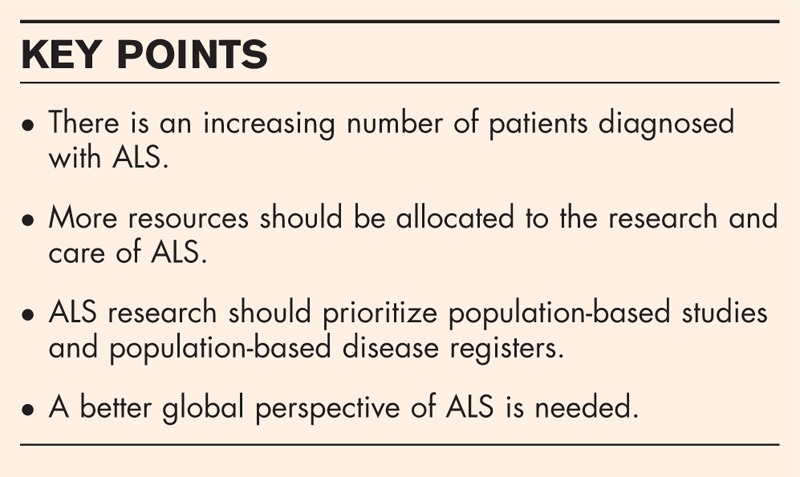
Purpose of review: The cause of amyotrophic lateral sclerosis (ALS) remains unknown for most of the patients with the disease. Epidemiologic studies can help describe disease burden and examine its potential risk factors, providing thereby evidence base for future mechanistic studies. With this review, we aimed to provide a summary of epidemiologic studies published during the past 18 months, which studied the incidence and risk factors for ALS. Recent findings: An increasing incidence and prevalence of ALS continue to be reported from different parts of the world. Several previously studied risk factors are confirmed as causally related to ALS by Mendelian randomization analysis. The previously known prognostic indicators for ALS appear to be the same across populations. Summary: Provided with the increasing number of patients diagnosed with ALS and the improved societal awareness of the disease, more resources should be allocated to the research and care of ALS. Population-based studies, especially population-based disease registers, should be the priorities in ALS research, and more data from outside Europe are needed in gaining a better global perspective of the disease.
Overview
The claims and statistics of this paper haven’t been checked yet.
Free: it reads the open-access text and checks the first 5 claims that cite a source we can check. Create a free account to check every claim.
Integrity signals
Registry
Cites
Statistics
Figures
Verification
Claims the paper makes
The claims and statistics of this paper haven’t been checked yet.
Free: it reads the open-access text and checks the first 5 claims that cite a source we can check. Create a free account to check every claim.
Claims other papers make about this one
Each is checked against this paper’s own text: does it say what the citing paper says it does?
The source backs part of the claim, not all of it — or backs it for a different population, condition or comparison.
In the citing paper
“These 4 common UMNDs result in a significant decline in physical function5,7,8,17,18 and often develop secondary complications that affect their quality of life (QOL), including cognitive impairment,19–21 fatigue,22 chronic pain,23,24 depression,25–27 and anxiety.25–27”
From Feasibility, Acceptability, and Efficacy of Mindfulness Training in People With Upper Motor Neuron Disorders: A Systematic Review (2022) · cites this paper as [7]
Experimental — accuracy not yet measuredThe source backs part of the claim, not all of it — or backs it for a different population, condition or comparison.
In the citing paper
“UMNDs may occur because of a traumatic event, nontraumatic event, or inherited or sporadic neurodegenerative disease.1,3–8”
From Feasibility, Acceptability, and Efficacy of Mindfulness Training in People With Upper Motor Neuron Disorders: A Systematic Review (2022) · cites this paper as [7]
Experimental — accuracy not yet measured
Self-check
Percentages, sums and reported differences re-computed from the paper’s own numbers.
The self-check needs the paper’s full text.
Citations
Cites
El Escorial revisited: revised criteria for the diagnosis of amyotrophic lateral sclerosis
Brooks, B. R., Miller, R. G., Swash, M., & Munsat, T. L. (2000) · Amyotrophic Lateral Sclerosis and Other Motor Neuron Disorders · doi:10.1080/146608200300079536 · Cited by 5,433
State of play in amyotrophic lateral sclerosis genetics
Renton, A. E., Chiò, A., & Traynor, B. J. (2014) · Nature Neuroscience · doi:10.1038/nn.3584 · Cited by 1,544
Hardiman, O., Al-Chalabi, A., Chio, A., Corr, E. M., Logroscino, G., Robberecht, W., Shaw, P. J., Simmons, Z., & van den Berg, L. H. (2017) · Nature Reviews Disease Primers · doi:10.1038/nrdp.2017.71 · Cited by 1,414
Clinical genetics of amyotrophic lateral sclerosis: what do we really know?
Andersen, P. M., & Al-Chalabi, A. (2011) · Nature Reviews Neurology · doi:10.1038/nrneurol.2011.150 · Cited by 687
Risk factors for amyotrophic lateral sclerosis
Fang, F., Ingre, C., Roos, P., Kamel, F., & Piehl, F. (2015) · Clinical Epidemiology · doi:10.2147/clep.s37505 · Cited by 462
Self-citationPrevalence of Amyotrophic Lateral Sclerosis — United States, 2014
Mehta, P., Kaye, W., Raymond, J., Wu, R., Larson, T., Punjani, R., Heller, D., Cohen, J., Peters, T., Muravov, O., et al. (2018) · MMWR. Morbidity and Mortality Weekly Report · doi:10.15585/mmwr.mm6707a3 · Cited by 458
Epidemiology of amyotrophic lateral sclerosis: A review of literature
Couratier, P., Corcia, P., Lautrette, G., Nicol, M., Preux, P., & Marin, B. (2015) · Revue Neurologique · doi:10.1016/j.neurol.2015.11.002 · Cited by 190
Molecular diagnostics of neurodegenerative disorders
Agrawal, M., & Biswas, A. (2015) · Frontiers in Molecular Biosciences · doi:10.3389/fmolb.2015.00054 · Cited by 164
Shared polygenic risk and causal inferences in amyotrophic lateral sclerosis
Bandres‐Ciga, S., Noyce, A. J., Hemani, G., Nicolas, A., Calvo, A., Mora, G., The ITALSGEN Consortium, The International ALS Genomics Consortium, Tienari, P. J., Stone, D. J., et al. (2019) · Annals of Neurology · doi:10.1002/ana.25431 · Cited by 162
Prevalence of Amyotrophic Lateral Sclerosis — United States, 2015
Mehta, P., Kaye, W., Raymond, J., Punjani, R., Larson, T., Cohen, J., Muravov, O., & Horton, K. (2018) · MMWR. Morbidity and Mortality Weekly Report · doi:10.15585/mmwr.mm6746a1 · Cited by 160
Cited by
Items 401–500 of 763
Zhang, J. Y., Han, F., Wang, X., Wu, F., Song, X., Liu, Q., Wang, J., Grecucci, A., Zhang, Y., Yi, X., et al. (2025) · European Journal of Nuclear Medicine and Molecular Imaging · doi:10.1007/s00259-025-07585-5 · Cited by 2
“There has been an increasing incidence of ALS [4, 5], highlighting the need for an understanding of its pathophysiology and for new treatment strategies.”
Age-period-cohort effect on motor neuron disease mortality in the United States, 2001–2020
Raymond, J. S., Larson, T. C., III, Nair, T., Kaufman, J., Horton, D. K., Weisskopf, M. G., Mohidul, S., & Mehta, P. (2026) · Frontiers in Neurology · doi:10.3389/fneur.2025.1751690 · Cited by 2
“Recent studies indicate a notable increase in the incidence and mortality rates for MND and ALS in the United States (7–10).”
Links between COVID-19, long COVID, and neurodegeneration: The role of glycosphingolipids
Spedding, M., Aerts, J. M. F. G., Alexander, S. P. H., Woestelandt, A.-G. B., Chiricozzi, E., Henriques, A., Lledo, P., Loeffler, J., Perera, R. M., Platt, F. M., et al. (2026) · Pharmacological Reviews · doi:10.1016/j.pharmr.2026.100113 · Cited by 2
Wang, Y., Zhang, H., Yang, T., Luo, J., Lin, T., Yan, X., Ding, J., Qiu, Y., Zhao, M., & Yang, G. (2026) · Journal of Neurology · doi:10.1007/s00415-026-13705-4 · Cited by 2
“Multiple population-based studies have demonstrated that the incidence of ALS increases with age, reaching its peak in older adults, especially between 60 and 80 years of age [3].”
da Silva, D. J., da Silveira, S. C., de Souza, L. C., Cruzeiro, M. M., & Vale, T. C. (2026) · Arquivos de Neuro-Psiquiatria · doi:10.1055/s-0046-1817037 · Cited by 2
“The number of patients with bulbar onset wasslightlylower than anticipated, in contrast to data from the current literature, 4,23,25 which reports rates ranging from 19.0 to 35.0% in different samples.”
InfluentialmiRNAs in Amyotrophic Lateral Sclerosis: Tiny Molecules, Tremendous Impact
Mageed, S. S. A., Sayed, G. A., Mahdy, A., El‐Dakroury, W. A., Abdulkader, A. O., Moustafa, H. A. M., Mansour, R. M., Mohammed, O. A., Elballal, M. S., Elesawy, A. E., et al. (2026) · Molecular Neurobiology · doi:10.1007/s12035-026-05880-2 · Cited by 2
Fluid-based biomarkers of amyotrophic lateral sclerosis: recent advances and future prospects
Jiang, Y., Hu, S., Yang, B., Zhang, L., Wang, ·., Yang, G., & Zhang, H. (2026) · Brain Research · doi:10.1016/j.brainres.2026.150395 · Cited by 2
Filho, R. R. F. D. M., & Torres, A. (2021) · Editora Conhecimento Livre eBooks · doi:10.37423/211205081 · Cited by 2
Rola steroidów płciowych w chorobach neurodegeneracyjnych
Sadowska, A., & Grzesiak, M. (2022) · Postępy Biochemii · doi:10.18388/pb.2021_468 · Cited by 2
IMPACTO DO TRATAMENTO COM RILUZOL NA EFICIÊNCIA E REGRESSÃO DA ESCLEROSE LATERAL AMIOTRÓFICA
Meneses, J. V. S., Cruz, V. D. S., Neto, J. P. O. B., Dória, L. R., Melo, G. S. P., Oliveira, E. F. R. D., Gama, R. K. B., & de Oliveira, J. S. (2023) · Revista Foco · doi:10.54751/revistafoco.v16n11-127 · Cited by 2
Καδένα, Κ., & Ouzounoglou, E. (2024) · BioMedInformatics · doi:10.3390/biomedinformatics4030093 · Cited by 2
“Age of on-set of disease was found to be between 51–66 years [6].”
BackgroundAtuação da fisioterapia aquática na esclerose lateral amiotrófica: revisão integrativa da literatura
Nishida, M. H., Saito, A. P. M. S., Braga, D. M., Freire, F. C., & da Silva, R. S. F. (2022) · Acta Fisiátrica · doi:10.11606/issn.2317-0190.v29i4a198613 · Cited by 2
Venous blood parameters in determination of respiratory impairment in amyotrophic lateral sclerosis
He, X., Yang, J., Feng, J., Huang, H., Dong, X., Zhao, Q., Shen, Q., Hu, C., & Xu, Y. (2023) · Scientific Reports · doi:10.1038/s41598-023-42075-4 · Cited by 2
Oh, J. E., Oh, J. A., Demopoulos, M., Clark, K. M., & Phillips, M. C. L. (2023) · Metabolic Brain Disease · doi:10.1007/s11011-023-01296-2 · Cited by 2
A holistic insight into neurodegeneration
Clerigué, J., & Martín-Cámara, O. (2023) · Anales de la Real Academia Nacional de Farmacia · doi:10.53519/analesranf.2023.89.03.07 · Cited by 2
Wormser, U., Sintov, A. C., Vinceti, M., Mandrioli, J., Brodsky, B., Proscura, E., & Finkelstein, Y. (2023) · Exploration of Neuroprotective Therapy · doi:10.37349/ent.2023.00060 · Cited by 2
Ethnopharmacology, phytochemistry and pharmaceutical uses of Cannabis sativa L.
Tariq, T., Rahman, L., Younis, T., Shinwari, A. K., & Shinwari, Z. K. (2024) · Pakistan Journal of Botany · doi:10.30848/pjb2024-5(30 · Cited by 2
Priyanka, P., Raymandal, B., & Mondal, S. (2024) · ChemMedChem · doi:10.1002/cmdc.202400244 · Cited by 2
Hu, N., Zhang, L., Shen, D., Yang, X., Cui, L., & Liu, M. (2024) · Neurology Asia · doi:10.54029/2024esc · Cited by 2
Comparison of Demographics: National Amyotrophic Lateral Sclerosis Registry and Clinical Trials Data
Han, M., Raymond, J. S., Larson, T. C., III, Mehta, P., & Horton, D. K. (2024) · Journal of Racial and Ethnic Health Disparities · doi:10.1007/s40615-024-02047-4 · Cited by 2
“Prevalence and incidence rates of ALS may vary globally [13, 16, 42, 43], owing to differences largely in genetic background, disease surveillance, and case ascertainment methods.”
Tankéré, P., Cascarano, E., Raymond, C. S., Mallaret, M., Ruiz, C. T., Herquelot, É., Denis, H., Cals-Maurette, M., Tamisier, R., & Pépin, J. (2025) · Amyotrophic Lateral Sclerosis and Frontotemporal Degeneration · doi:10.1080/21678421.2024.2447911 · Cited by 2
“Survivaldata for our overall study population were consistent with previous work (2, 4).”
Li, W., Liu, J., Li, W., Sun, L., Zhang, H., Gao, L., & Gao, C. (2025) · Acta Materia Medica · doi:10.15212/amm-2024-0077 · Cited by 2
“Greater than 30 at-risk genes have been identified concerning the pathogenesis of ALS [3-6], which accounts for the complex mechanisms leading to ALS [7].”
Buckett, L. E., Holdom, C. J., Howe, S. L., McCombe, P., Henderson, R. D., Al‐Chalabi, A., Steyn, F. J., & Ngo, S. T. (2025) · Amyotrophic Lateral Sclerosis and Frontotemporal Degeneration · doi:10.1080/21678421.2025.2471429 · Cited by 2
Headache types and characteristics in patients with Amyotrophic Lateral Sclerosis
Soliman, R., Fahmy, N. A., & Swelam, M. S. (2025) · The Journal of Headache and Pain · doi:10.1186/s10194-025-01987-4 · Cited by 2
“On the other hand, ALS is known to be more predominant in males [44], which was reported in a recent Egyptian study [45].”
Foucher, J., Wellander, T., Lovik, A., Öijerstedt, L., Juto, A., Fang, F., & Ingre, C. (2025) · Brain and Behavior · doi:10.1002/brb3.70570 · Cited by 2
“The European incidence of ALS ranges from 2.1 to 3.8 per 100,000 person-years (Longinetti and Fang 2019), but recent numbers in Sweden are higher and are estimated to around 4.0 per 100,000 person-years (Longinetti et al. 2018, Imrell et al., 2024 May 22).”
InfluentialSelf-citationPeggion, C., Bonadio, R. S., Stella, R., Scalabrin, S., Pasetto, L., Millino, C., Camporeale, L., Pacchioni, B., Bonetto, V., Bertoli, A., et al. (2025) · Molecular Therapy — Nucleic Acids · doi:10.1016/j.omtn.2025.102581 · Cited by 2
m6A Methylation‐Induced Autophagy Impairment by TFEB Regulation in SOD1 ‐ G93A ALS Cell Model
An, D., Wu, Y., Han, J., Fang, P., Bu, Y., Ji, G., Deng, J., & Song, X. (2025) · American Journal of Medical Genetics Part B Neuropsychiatric Genetics · doi:10.1002/ajmg.b.33048 · Cited by 2
Wang, H., & Hegde, M. L. (2020) · IntechOpen eBooks · doi:10.5772/intechopen.92637 · Cited by 2
Peters, N., Bello-Haas, V. P. M. D., Packham, T., Mehdipour, A., & Kuspinar, A. (2021) · Neurology Research International · doi:10.1155/2021/6681554 · Cited by 2
Psalidas, C. P., Kottaras, A., Lytras, D., Iakovidis, P., Leptourgos, G., & Moutaftsis, K. (2021) · International Journal of Advanced Community Medicine · doi:10.33545/comed.2021.v4.i2a.193 · Cited by 2
“Finally, there is a percentage of 823% that belongs to other forms of onset ([4]).”
BackgroundExploring Aromatic Medicinal Compounds for the Treatment of Amyotrophic Lateral Sclerosis
Shah, F. H., & Kim, S. J. (2021) · Natural Product Communications · doi:10.1177/1934578x211030815 · Cited by 2
“According to the latest analytical data, the disease prevalence of ALS is highest in America (12: 1 00 000 individuals) followed by Europe (2: 1 00 000 individuals), and lowest in Asia (1:1 00 000 individuals).(1) There are 2 forms of ALS, classified based on environmental and genetic factors.”
BackgroundTolonen, H. K., Andersson, A., Bicho, M., Capatão, C., Elonheimo, H., Haverinen, E., Martins, R. A., Mattila, T., Paalanen, L., Ramboud, L., et al. (2021) · Zenodo (CERN European Organization for Nuclear Research) · doi:10.5281/zenodo.6033257 · Cited by 2
Yoo, I., Yoo, J., Kim, D., Youn, I., Kim, H., Youn, M. S., Won, J. H., Cho, W., Myong, Y., Kim, S., et al. (2023) · medRxiv · doi:10.1101/2023.01.13.23284511 · Cited by 2
The gut microbiota is a determinant of sexual dimorphism in ALS-linked TDP43 micePreprint
Beraldi, E. J., Lee, S., Jiang, Y., Rea, I. M., Phull, R., Keenan, C. M., Stephens, M., Bardhi, M., Bankole, O. O., Pfeffer, G., et al. (2024) · bioRxiv (Cold Spring Harbor Laboratory) · doi:10.1101/2024.08.29.610355 · Cited by 2
Nutraceuticals and phytotherapeutics for holistic management of amyotrophic lateral sclerosis
Katiyar, D., Singhal, S., Bansal, P., Nagarajan, K., & Grover, P. (2023) · 3 Biotech · doi:10.1007/s13205-023-03475-5 · Cited by 1
Zhang, X., Yan, B., Fu, C., Li, L., Bai, R., Cheng, N., & Chen, J. (2023) · MEDS Clinical Medicine · doi:10.23977/medsc.2023.040713 · Cited by 1
“ALS occurs globally, with an incidence of approximately 2/100, 000 person-years and a prevalence of 6-9/100, 000 [27, 28], with a lifetime risk of approximately 1/350 [29].”
BackgroundRehabilitación basada en ejercicio físico en pacientes con esclerosis lateral amiotrófica
Gaitán-Caicedo, S. A., & Ruíz, D. M. C. (2024) · Revista Colombiana de Medicina Física y Rehabilitación · doi:10.28957/rcmfr.413 · Cited by 1
Tang, I. W., Hansen, J., Dickerson, A. S., & Weisskopf, M. G. (2024) · Amyotrophic Lateral Sclerosis and Frontotemporal Degeneration · doi:10.1080/21678421.2024.2399155 · Cited by 1
“Individuals are usually diagnosed with ALS after age 55, and the disease typically leads to death after about 3 – 5 years, although 10% of individuals with ALS may live over 10 years after diagnosis (3, 4).”
Laucius, O., Drūteika, J., Balnytė, R., Palačionytė, J., Ališauskienė, M., Petrikonis, K., & Vaitkus, A. (2024) · Journal of Clinical Medicine · doi:10.3390/jcm13216302 · Cited by 1
Abbasi, H., Jourabchi‐Ghadim, N., Asgarzadeh, A., Mirshekari, M., & Ebrahimi‐Mameghani, M. (2024) · Neuroscience · doi:10.1016/j.neuroscience.2024.11.003 · Cited by 1
Dhasmana, S., Dhasmana, A., Khan, S., Narula, A. S., Haque, S., Yallapu, M. M., & Chauhan, S. C. (2025) · Current Neuropharmacology · doi:10.2174/011570159x352364250212035802 · Cited by 1
“The reason for the decreasing male-to-female ratio may be due to equal almost exposure of men and women to ALS risk factors such as smoking, and occupational toxicants [29-31].”
Rodríguez-García, V., Venta-Sobero, J. A., & Chima-Galán, M. D. C. (2025) · Amyotrophic Lateral Sclerosis and Frontotemporal Degeneration · doi:10.1080/21678421.2025.2522403 · Cited by 1
“Most of the cases begin in the sixth decade of life with an incidence between 0.6-3.8 per 100,000 person-years; the incidence in pediatric population is even lower (2).”
InfluentialGeographic distribution of amyotrophic lateral sclerosis-related genes: a systematic review
García-Parra, B., Guiu, J. M., Povedano, M., & Modamio, P. (2025) · Neurodegenerative Disease Management · doi:10.1080/17582024.2025.2554382 · Cited by 1
Silva, S., Aires, D. N., Souza, A., Macedo, J., de Melo, L. P., da Câmara, S. M. A., Valentim, R. A. D. M., Lindquist, A. R. R., Samora, G., & Ribeiro, T. S. (2025) · Amyotrophic Lateral Sclerosis and Frontotemporal Degeneration · doi:10.1080/21678421.2025.2557971 · Cited by 1
“This study was conducted at the Neuromuscular Diseases Outpatient Clinic of the Onofre Lopes University Hospital of the Federal University of Rio Grande do Norte, Brazil; as well as through the online audio and video platforms Google Meet V R or Whatsapp V R .”
InfluentialTaule, T., Tysnes, O., Aßmus, J., Morland, A. S., Renså, M. A., Revheim, T., Glesnes, S., & Rekand, T. (2025) · Journal of Rehabilitation Medicine · doi:10.2340/jrm.v57.43483 · Cited by 1
“The majority of our participants were over 60 years old ( n = 26), reflecting the later age at ALS onset that has been reported in European countries (34).”
Akinade, A. T., Jacobs, E. D., Obere, C. M., Ogaji, V. O., Alakunle, E., & Awe, O. I. (2025) · Sclerosis · doi:10.3390/sclerosis3040037 · Cited by 1
“It is often characterized by the gradual paralysis of skeletal and respiratory muscles [1,2].”
MacDonald, C., Barnum, E., Pradeep, M., Rivera, V., SMITH, P. A. S., Dombrowski, M., Sparkman, J., & Manero, A. C. (2025) · Games for Health Journal · doi:10.1177/2161783x251397932 · Cited by 1
Liampas, I., Kimiskidis, V. Κ., Zouvelou, V., Veltsista, D., Moscholouri, A., Triantafyllou, E., Daponte, A., Xirou, S., Sterpi, A.-E., Salakou, S., et al. (2025) · European Journal of Neurology · doi:10.1111/ene.70403 · Cited by 1
Amyotrophic lateral sclerosis: A clinical review
Saware, U. S., Barewar, S. S., Bakal, R. L., Hatwar, P. R., Khansole, N. G., & Waghmare, N. D. (2025) · GSC Biological and Pharmaceutical Sciences · doi:10.30574/gscbps.2025.32.3.0359 · Cited by 1
Curtis, S. E., Tatlock, S., O’Hara, L., Seçinti, E., Mehdiyoun, N. F., Ayala‐Nunes, L., Flynn, J., Fernelius, K., Hodson, N., & Delbecque, L. (2025) · Amyotrophic Lateral Sclerosis and Frontotemporal Degeneration · doi:10.1080/21678421.2025.2604233 · Cited by 1
Khurana, S., Gourie‐Devi, M., Vats, Y., Verma, S., Ganguly, N. K., Chugh, P., Sharma, A., Khanna, L., Dhawan, U., & Taneja, V. (2026) · Brain Communications · doi:10.1093/braincomms/fcag003 · Cited by 2
“Globally, the mean age of ALS onset ranges from 51 to 66 years, 34-36 whereas younger age at onset (46.2 ± 14.1 years) has been reported from South India.”
InfluentialExploring the Efficacy of Natural Anti-inflammatory Compounds in Neurological Disorders
Samaddar, S., Redhwan, M. A. M., & Eraiah, M. M. (2026) · Springer eBooks · doi:10.1007/978-981-95-4169-0_7 · Cited by 1
González-Castro, G. G. (2026) · Revista de Trabajo y Seguridad Social CEF · doi:10.51302/rtss.2026.24773 · Cited by 1
Aynaashe, A., & Kursula, P. (2026) · Amino Acids · doi:10.1007/s00726-026-03500-w · Cited by 1
“This increase is likely due to better diagnosis and disease awareness (Longinetti and Fang 2019).”
InfluentialGarrigos, D., Martínez-Morga, M., Pombero, A., García‐López, R., Pastor, D., Riquelme, D., Blanquer, M., Iniesta, F., Valdor, R., Geijo‐Barrientos, E., et al. (2026) · Acta Neuropathologica Communications · doi:10.1186/s40478-026-02238-6 · Cited by 1
“The global prevalence and incidence are estimated at 4.1–8.4 per 100,000 individuals and 0.6–3.8 per 100,000 person-years, respectively [54], with approximately 30,000 deaths reported annually [72].”
InfluentialTofersen: A Novel Option for the Treatment of Amyotrophic Lateral Sclerosis
Karros, M., DiFulco, M., & Nogid, A. (2026) · Annals of Pharmacotherapy · doi:10.1177/10600280251408862 · Cited by 1
Amyotrophic Lateral Sclerosis: A Cross-sectional Survey on Sialorrhoea
Baby, P., John, J., Binesha, P., Keerthipriya, M. S., Ramazanu, S., Nashi, S., Menon, D., Vengalil, S., Thomas, P. T., & Nalini, A. (2026) · Indian Journal of Palliative Care · doi:10.25259/ijpc_369_2024 · Cited by 1
Sex‐Specific Genetic Architecture of ALS : Evidence of a Female Protective Effect?
Grassano, M., Palumbo, F., Mora, G., Gallone, S., Marco, G. D., Merulla, I., Paolantonio, C., Maccabeo, A., Canosa, A., Manera, U., et al. (2026) · Annals of Neurology · doi:10.1002/ana.78172 · Cited by 1
“1,2 Despite these well-documented sex differences, the biological mechanisms underlying this disparity remain poorly understood.”
Jana, P., Kundu, S., Roy, R., Sanyal, D., Ghosh, C. K., Mishra, S., & Chattopadhyay, K. (2026) · ACS Applied Nano Materials · doi:10.1021/acsanm.5c05351 · Cited by 1
Yang, Q., Wu, H., Huang, X., Xie, M., Shan, Y., Dou, Z., Li, Y., Wen, H., & Li, C. (2026) · Muscle & Nerve · doi:10.1002/mus.70188 · Cited by 1
“This observation aligns with established epidemiological trends, indicating the prevalence of ALS in European and North American populations is roughly twice that in other ethnicities [16, 17].”
Ahuja, V., Sahu, B., Khurana, S., Kumari, K., Ganguly, N. K., Gourie‐Devi, M., Verma, S., Dastidar, S. G., & Taneja, V. (2026) · Molecular Neurobiology · doi:10.1007/s12035-026-05736-9 · Cited by 1
Rahi, S., Sharma, A., & Sah, S. P. (2026) · Phytotherapy Research · doi:10.1002/ptr.70215 · Cited by 1
“The incidence of ALS is approximately 1–2.6 cases per 100,000 individuals per year, while the prevalence is around 6 cases per 100,000 (Longinetti and Fang 2019).”
InfluentialLi, X., Chen, Q., Fan, D., & Chen, L. (2026) · Neurology and Therapy · doi:10.1007/s40120-026-00912-4 · Cited by 1
“Evidence has shown that there are regional differences in ALS onset [4].”
Genetic contributions to mitochondrial dysfunction in amyotrophic lateral sclerosis etiology
Russell, N. D., Downie, J. M., Bromberg, M. B., Pulst, S. M., & Jorde, L. B. (2026) · Human Genetics and Genomics Advances · doi:10.1016/j.xhgg.2026.100614 · Cited by 1
Stem cell therapy for rare neurological diseases: translational research opportunities
Windsor, R. (2026) · Rare Disease and Orphan Drugs Journal · doi:10.20517/rdodj.2025.85 · Cited by 1
Toubasi, A. A., & Al‐Sayegh, T. N. (2026) · Clinical Neurology and Neurosurgery · doi:10.1016/j.clineuro.2026.109466 · Cited by 1
Melby, S. R., Kumar, J. N. A., Bigus, E. R., & Kellis, S. (2026) · Frontiers in Human Neuroscience · doi:10.3389/fnhum.2026.1771146 · Cited by 1
“There are an estimated 25,000 individuals in the US currently living with ALS, with an increasing prevalence and incidence of ALS diagnoses reported worldwide over the last decade (Longinetti and Fang, 2019).”
Abbasi, H., Shafaatdoost, M., Mohajerani, A., Asadollahi, M., Rashidi, M., Malekahmadi, M., & Sarraf, P. (2026) · BMC Neurology · doi:10.1186/s12883-026-04971-w · Cited by 1
“The prevalence of ALS is estimated to be between 2.6 and 3.0 cases per 100,000 individuals, with a median survival time of around 30 months [2, 3].”
InfluentialPérez‐Siles, G., Grosz, B. R., Ellis, M., Baets, J., Sabir, A., O’Driscoll, M., Horváth, R., Kleopa, K. A., Fontaine, S. L., Gourdon, P. E., et al. (2026) · Human Molecular Genetics · doi:10.1093/hmg/ddag061 · Cited by 1
“Population data from gnomAD v3 report a hemizygote frequency of 2.16% for p.M1311V in the Ashkenazi Jewish males (17/786 alleles) which is markedly higher than the reported prevalence of ALS (4.1 and 8.4 per 100 000 persons) [ 34] or HMN (2.1 per 100 000 individuals) [ 35].”
InfluentialMiR-7 in neurological disorders: beyond metabolic dysregulation
Puigdueta, C., Pardo, V., Torrecilla-Parra, M., Frutos, M. F.-D., López-Aceituno, J. L., Zamora, C., López-Manchedo, Y., Busto, R., & Ramírez, C. M. (2026) · Frontiers in Neuroscience · doi:10.3389/fnins.2026.1884638 · Cited by 1
“ALS is the most common MND in adults (Gwathmey et al., 2023) with an estimated worldwide prevalence ranging from 4.1 to 8.4 per 100,000 people (Longinetti and Fang, 2019).”
InfluentialMenopause and neurological disorders: a roadmap for research
Bove, R. M., & Dobson, R. (2026) · Nature Reviews Neurology · doi:10.1038/s41582-026-01244-5 · Cited by 2
Oxidative stress and inflammation in neurodegenerative disorders
Jomová, K., Alomar, S. Y., Valko, R., Nepovimová, E., Kuča, K., & Valko, M. (2026) · Archives of Toxicology · doi:10.1007/s00204-026-04518-5 · Cited by 2
Towards a deep-learning genomic tool for risk stratification and diagnostic support in sporadic ALS
Hu, J., Pain, O., Khleifat, A. A., Shatunov, A., Andersen, P. M., Başak, N. A., Cooper‐Knock, J., Corcia, P., Couratier, P., de Carvalho, M. A., et al. (2026) · Genome Medicine · doi:10.1186/s13073-026-01744-5 · Cited by 1
Protein Biomarkers in Risk and Prognosis of Amyotrophic Lateral Sclerosis
Pan, L., Hou, C., Seitz, C., Ingre, C., Hedman, Å. K., Laffita, J., Vu, T. N., Pawitan, Y., Ullgren, A., Yazdani, S., et al. (2026) · European Journal of Neurology · doi:10.1111/ene.70741 · Cited by 2
Self-citationUrusov, A. E., Gorobets, M. A., Aulova, K. S., Timofeeva, A. M., Toporkova, L. B., Orlovskaya, I. A., Ustyugov, A. A., & Nevinsky, G. A. (2026) · Inflammation Research · doi:10.1007/s00011-026-02358-8 · Cited by 1
“The global trend is an increase in the incidence of pathological nervous system disorders coupled with progressive degenerative processes, including Alzheimer’s and Parkinson’s diseases, Amyotrophic lateral sclerosis (ALS), multiple sclerosis (MS), and other NDDs [ 1 –6 ].”
ALS and fertility: does ALS affect number of children patients have?
Uysal, H., Bilge, U., İlhanlı, N., Gromicho, M., Großkreutz, J., Kuźma‐Kozakiewicz, M., Pinto, S., Petri, S., Szacka, K., Nieporęcki, K., et al. (2020) · Amyotrophic Lateral Sclerosis and Frontotemporal Degeneration · doi:10.1080/21678421.2020.1813313 · Cited by 1
“The incidence is 2 per 100,000 in a year, and the prevalence is around 3–4 per 100,000 population globally (1).”
BackgroundGülay, N. Ç., Uysal, H., Aliyeva, P., & Bilge, U. (2021) · Neurological Sciences and Neurophysiology · doi:10.4103/nsn.nsn_69_20 · Cited by 1
Keyless signature infrastructure solution for cloud attacks
Chandran, R., & Kumar, D. A. S. (2018) · International Journal of Engineering & Technology · doi:10.14419/ijet.v7i2.33.14822 · Cited by 1
Polese, J. C., Pessoa, B. P., Morais, L. C., & Harriman, M. (2020) · Conexão Ciência (Online) · doi:10.24862/cco.v15i2.1243 · Cited by 2
Relevancia del metabolismo del folato en el contexto de enfermedades neurodegenerativas
Saínz, Y. J., Almarales, D. A. C., & Mederos, L. E. A. (2021) · Revista Habanera de Ciencias Médicas · Cited by 3
Exploring the Genetics of Amyotrophic Lateral Sclerosis as a Pathway to a Cures
Dissanayake, W. M. (2021) · International journal of high school research · doi:10.36838/v3i6.10 · Cited by 1
Emerging Drugs for Amyotrophic Lateral Sclerosis
Boucher, M., & Mierzwinski‐Urban, M. (2022) · Canadian Journal of Health Technologies · doi:10.51731/cjht.2022.274 · Cited by 1
FUS positive juvenile ALS-diagnostic and therapeutic insights from a 16-year-old female patient
Philip, A., Sureshbabu, S., Nikitha, K., Pachat, D., Janardhanan, S., Narayanan, R., Peter, S., Chindrippu, S., Joseph, M., & Mohanlal, S. (2022) · Acta Neurologica Belgica · doi:10.1007/s13760-021-01825-9 · Cited by 1
Vadillo-Bermejo, A., Nieto, A. C., González, Á. O., Sánchez-Casado, M., & Hidalgo-Carvajal, R. (2022) · Revista de Patología Respiratoria · doi:10.24875/rpr.m22000002 · Cited by 1
Evolving markers in amyotrophic lateral sclerosis
Chen, X., Zhou, L., Cui, C., & Sun, J. (2023) · Advances in clinical chemistry · doi:10.1016/bs.acc.2023.02.002 · Cited by 1
Amyotrophic Lateral Sclerosis: When Nerve Cells Run Out of Power
Quatorze, M., Silva, F. S. G., Duarte, A. I., Cardoso, J. A., Caetano, C., Ramalho‐Santos, J., Oliveira, P. J., & Amaral, S. V. (2023) · Frontiers for Young Minds · doi:10.3389/frym.2023.974736 · Cited by 1
“ALS is generally diagnosed in people aged 54–69, and it a ects 4–8 people out of 100,000 [1].”
BackgroundBulbar Onset Amyotrophic Lateral Sclerosis in an African American Older Adult
Kasindi, A., & Carstarphen, K. J. (2023) · Ochsner Journal · doi:10.31486/toj.23.0045 · Cited by 1
Schaff, C., Kurent, J. E., Kolodziejczak, S., Milic, M. M., Foster, L. A., & Mehta, A. K. (2023) · Seminars in Neurology · doi:10.1055/s-0043-1775595 · Cited by 1
Amyotrophic Lateral Sclerosis: From Mechanisms to Current, Emerging, and Alternative Therapeutics
Kioutchoukova, I. P., Foster, D. T., Thakkar, R. N., Kurz, H., & Lucke-Wold, B. P. (2023) · Med Discoveries · doi:10.52768/2993-1142/1059 · Cited by 1
A Review of Apoptosis and Neuronal Differentiation
Rajeswari, G., Gautham Chakra, R., Jahnavi, P., M, P. P. K. R., & Chandhrashekar, K. (2023) · International Journal of Experimental and Biomedical Research · doi:10.26452/ijebr.v2i3.521 · Cited by 1
de Carvalho, L. M., Nascimento, H. R. D. C., Lima, J. P. M. D., Medeiros, H. P. D. S., Dantas, J. F., Araújo, J. N. D. M., Dantas, R. A. N., & Vítor, A. F. (2023) · Contribuciones a las Ciencias Sociales · doi:10.55905/revconv.16n.11-161 · Cited by 1
Geographical distribution of clinical trials in amyotrophic lateral sclerosis: a scoping review
García-Parra, B., Guiu, J. M., Povedano, M., Mariño, E. L., & Modamio, P. (2024) · Amyotrophic Lateral Sclerosis and Frontotemporal Degeneration · doi:10.1080/21678421.2024.2320881 · Cited by 1
“In Europe it ’ s from 2.1 to 3.8 per 100 ,000 person-years, although some differences have been reported between European populations (4).”
BackgroundInfluentialLi, J., Li, S., & Fei, G. (2024) · Neurodegenerative Diseases · doi:10.1159/000539590 · Cited by 1
“With the rapidly aging population across the world, the incidence and prevalence of ALS might be increasing each year [2, 3].”
Choi, E. S., Hnath, B., Sha, C. M., & Dokholyan, N. V. (2024) · Structure · doi:10.1016/j.str.2024.08.002 · Cited by 1
Drug Repurposing in CNS Disorders
Hussain, N., Singh, S., & Alexander, A. (2024) · Springer eBooks · doi:10.1007/978-981-97-5016-0_7 · Cited by 1
Respiratory Care of the ALS Patient
Berlinger, M. S., & Lechtzin, N. (2024) · Respiratory medicine · doi:10.1007/978-3-031-65335-3_10 · Cited by 1
Singh, K., Sethi, P., Jain, D., Gupta, J. K., Alsaidan, O. A., Alzarea, S. I., Kumar, A. H. S., Tabish, M., & Sharma, M. C. (2026) · Mini-Reviews in Medicinal Chemistry · doi:10.2174/0113895575429412260112060311 · Cited by 1
Yang, A., Zhao, X., Yang, Y. T., & Zhao, X. (2026) · PLoS Computational Biology · doi:10.1371/journal.pcbi.1014422 · Cited by 1
“Most neurological disorder eGenes were elevated in neural cells after birth; notably, amyotrophic lateral sclerosis (ALS) eGenes were exclusively neuronal and showed postnatal upregulation ( S14b Fig ), consistent with prior observations [106–108].”
Pawlukowska, W., Baumert, B., Gołąb-Janowska, M., Meller, A., Machowska-Sempruch, K., Wełnicka, A., Paczkowska, E., Rotter, I., Machaliński, B., & Nowacki, P. (2020) · Research Square · doi:10.21203/rs.3.rs-19421/v1 · Cited by 1
“It is worth mentioning that despite the fact that patients were randomly selected to the study, the population distribution of the recruited patients was very similar to the mean distribution described in the literature [11, 18].”
Amyotrophic Lateral SclerosisPreprint
Bambini, V., & Ceroni, M. (2020) · PsyArXiv (OSF Preprints) · doi:10.31234/osf.io/a8v3u · Cited by 1
Metadata
- Authors
- Longinetti, E., & Fang, F.
- Affiliations
- Karolinska Institutet (SE)
- Corresponding author
- Fang, Fang
- Venue
- Current Opinion in Neurology
- Published
- 2019-10
- Volume
- 32
- Issue
- 5
- Pages
- 771-776
- ISSN
- 1350-7540 (ISSN-L)
- 1473-6551
- PMC
- PMC6735526
- OpenAlex
- W2965191972
- Semantic Scholar
- 04d12e5537f9a9934fab5cd648d8bec24c962d10
- Cited by
- 620
- References
- 55
- Citations by year
- 2026: 75 · 2025: 84 · 2024: 122 · 2023: 122 · 2022: 94 · 2021: 84 · 2020: 33 · 2019: 3
- FWCI
- 7.35
- Type
- journal article
- Language
- en
- Open access
- hybrid
- doi.org
- Locations
- Current Opinion in Neurology (publishedVersion, cc-by)
- PubMed Central (publishedVersion, cc-by)
- PubMed (publishedVersion)
- Funders
- National Health Insurance Service
- Topics
- Health Sciences › Medicine › Clinical Neurology › Amyotrophic Lateral Sclerosis Research
- Health Sciences › Medicine › Internal Medicine › Amyloidosis: Diagnosis, Treatment, Outcomes
- Health Sciences › Medicine › Psychiatry and Mental health › Dementia and Cognitive Impairment Research
- Keywords
- amyotrophic lateral sclerosis, incidence, prevalence, risk factors, Mendelian randomization, prognostic factors, disease burden, global epidemiology
- MeSH terms
- Amyotrophic Lateral Sclerosis, Europe, Humans, Risk Factors, Incidence, Prevalence
About these checks
Registry, retraction, Cites and statistics results are computed, not judged, with one exception: a printed reference that no index lists is read once by a model before it counts as a citation error. Claims are extracted by a model and kept only when their quote appears verbatim in the text; each cited source is then checked, with a model’s help, for whether it says what the claim relies on. Those verdicts can be wrong — read the claim’s quote and the cited source before relying on one.
Statistics and arithmetic are recomputed, not judged.
Confidence bands are shown only for fields calibrated on our annotated test set. None is calibrated yet, so no band is shown.
What counts as a claim ›How we measure confidence ›How we check this ›
Are you an author, or do you see a problem with this page? Request a review
Data sources
Bibliographic data: Semantic Scholar, OpenAlex, Crossref.
Contains information from the Semantic Scholar Academic Graph Datasets, made available under the ODC Attribution License (ODC-BY 1.0).
Semantic Scholar’s data is described in: Kinney, R., et al. (2023). The Semantic Scholar Open Data Platform. arXiv:2301.10140.
