

Epidemiology of amyotrophic lateral sclerosis: an update of recent literature
Open accessThe DOI matches its Crossref record; 55 of the 55 references it cites were found in a registry or an index.
Abstract
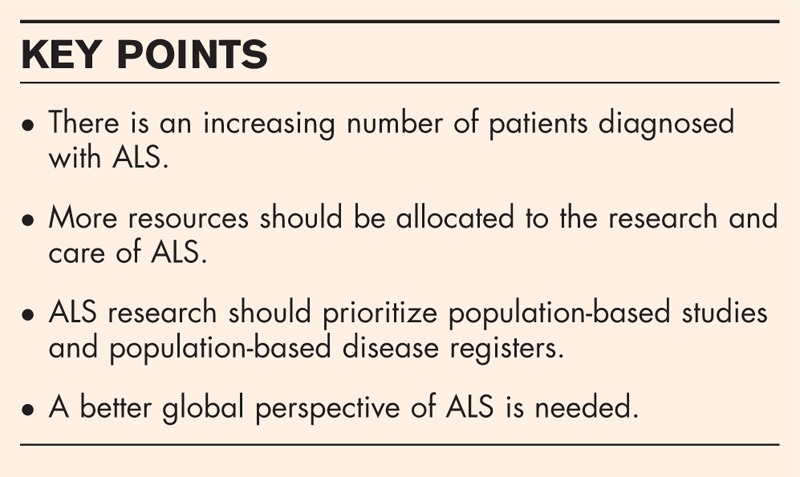
Purpose of review: The cause of amyotrophic lateral sclerosis (ALS) remains unknown for most of the patients with the disease. Epidemiologic studies can help describe disease burden and examine its potential risk factors, providing thereby evidence base for future mechanistic studies. With this review, we aimed to provide a summary of epidemiologic studies published during the past 18 months, which studied the incidence and risk factors for ALS. Recent findings: An increasing incidence and prevalence of ALS continue to be reported from different parts of the world. Several previously studied risk factors are confirmed as causally related to ALS by Mendelian randomization analysis. The previously known prognostic indicators for ALS appear to be the same across populations. Summary: Provided with the increasing number of patients diagnosed with ALS and the improved societal awareness of the disease, more resources should be allocated to the research and care of ALS. Population-based studies, especially population-based disease registers, should be the priorities in ALS research, and more data from outside Europe are needed in gaining a better global perspective of the disease.
Overview
The claims and statistics of this paper haven’t been checked yet.
Free: it reads the open-access text and checks the first 5 claims that cite a source we can check. Create a free account to check every claim.
Integrity signals
Registry
Cites
Statistics
Figures
Verification
Claims the paper makes
The claims and statistics of this paper haven’t been checked yet.
Free: it reads the open-access text and checks the first 5 claims that cite a source we can check. Create a free account to check every claim.
Claims other papers make about this one
Each is checked against this paper’s own text: does it say what the citing paper says it does?
The source backs part of the claim, not all of it — or backs it for a different population, condition or comparison.
In the citing paper
“These 4 common UMNDs result in a significant decline in physical function5,7,8,17,18 and often develop secondary complications that affect their quality of life (QOL), including cognitive impairment,19–21 fatigue,22 chronic pain,23,24 depression,25–27 and anxiety.25–27”
From Feasibility, Acceptability, and Efficacy of Mindfulness Training in People With Upper Motor Neuron Disorders: A Systematic Review (2022) · cites this paper as [7]
Experimental — accuracy not yet measuredThe source backs part of the claim, not all of it — or backs it for a different population, condition or comparison.
In the citing paper
“UMNDs may occur because of a traumatic event, nontraumatic event, or inherited or sporadic neurodegenerative disease.1,3–8”
From Feasibility, Acceptability, and Efficacy of Mindfulness Training in People With Upper Motor Neuron Disorders: A Systematic Review (2022) · cites this paper as [7]
Experimental — accuracy not yet measured
Self-check
Percentages, sums and reported differences re-computed from the paper’s own numbers.
The self-check needs the paper’s full text.
Citations
Cites
El Escorial revisited: revised criteria for the diagnosis of amyotrophic lateral sclerosis
Brooks, B. R., Miller, R. G., Swash, M., & Munsat, T. L. (2000) · Amyotrophic Lateral Sclerosis and Other Motor Neuron Disorders · doi:10.1080/146608200300079536 · Cited by 5,433
State of play in amyotrophic lateral sclerosis genetics
Renton, A. E., Chiò, A., & Traynor, B. J. (2014) · Nature Neuroscience · doi:10.1038/nn.3584 · Cited by 1,544
Hardiman, O., Al-Chalabi, A., Chio, A., Corr, E. M., Logroscino, G., Robberecht, W., Shaw, P. J., Simmons, Z., & van den Berg, L. H. (2017) · Nature Reviews Disease Primers · doi:10.1038/nrdp.2017.71 · Cited by 1,414
Clinical genetics of amyotrophic lateral sclerosis: what do we really know?
Andersen, P. M., & Al-Chalabi, A. (2011) · Nature Reviews Neurology · doi:10.1038/nrneurol.2011.150 · Cited by 687
Risk factors for amyotrophic lateral sclerosis
Fang, F., Ingre, C., Roos, P., Kamel, F., & Piehl, F. (2015) · Clinical Epidemiology · doi:10.2147/clep.s37505 · Cited by 462
Self-citationPrevalence of Amyotrophic Lateral Sclerosis — United States, 2014
Mehta, P., Kaye, W., Raymond, J., Wu, R., Larson, T., Punjani, R., Heller, D., Cohen, J., Peters, T., Muravov, O., et al. (2018) · MMWR. Morbidity and Mortality Weekly Report · doi:10.15585/mmwr.mm6707a3 · Cited by 458
Epidemiology of amyotrophic lateral sclerosis: A review of literature
Couratier, P., Corcia, P., Lautrette, G., Nicol, M., Preux, P., & Marin, B. (2015) · Revue Neurologique · doi:10.1016/j.neurol.2015.11.002 · Cited by 190
Molecular diagnostics of neurodegenerative disorders
Agrawal, M., & Biswas, A. (2015) · Frontiers in Molecular Biosciences · doi:10.3389/fmolb.2015.00054 · Cited by 164
Shared polygenic risk and causal inferences in amyotrophic lateral sclerosis
Bandres‐Ciga, S., Noyce, A. J., Hemani, G., Nicolas, A., Calvo, A., Mora, G., The ITALSGEN Consortium, The International ALS Genomics Consortium, Tienari, P. J., Stone, D. J., et al. (2019) · Annals of Neurology · doi:10.1002/ana.25431 · Cited by 162
Prevalence of Amyotrophic Lateral Sclerosis — United States, 2015
Mehta, P., Kaye, W., Raymond, J., Punjani, R., Larson, T., Cohen, J., Muravov, O., & Horton, K. (2018) · MMWR. Morbidity and Mortality Weekly Report · doi:10.15585/mmwr.mm6746a1 · Cited by 160
Cited by
Items 201–300 of 763
Neurologic orphan diseases: Emerging innovations and role for genetic treatments
Kioutchoukova, I. P., Foster, D. T., Thakkar, R. N., Foreman, M. A., Burgess, B. J., Toms, R., Valero, E., & Lucke-Wold, B. P. (2023) · World Journal of Experimental Medicine · doi:10.5493/wjem.v13.i4.59 · Cited by 13
“The onset of ALS symptoms typically occurs between 50-70 years old and is more common in males than females[111-113].”
The preferences of people with amyotrophic lateral sclerosis on riluzole treatment in Europe
Ludolph, A. C., Grandjean, H., Reviers, E., Micheli, V. D., Bianchi, C., Cardosi, L., Russ, H., & Silani, V. (2023) · Scientific Reports · doi:10.1038/s41598-023-49424-3 · Cited by 13
Mycobacterium paratuberculosis: A HERV Turn-On for Autoimmunity, Neurodegeneration, and Cancer?
Dow, C. T., Pierce, E. S., & Sechi, L. A. (2024) · Microorganisms · doi:10.3390/microorganisms12091890 · Cited by 13
“Currently, the underlying cause of ALS remains unknown, and there is no cure or therapy that can modify the course of the disease; the typical life expectancy for individuals diagnosed with ALS ranges from 2 to 5 years [113–115].”
BackgroundGenuis, S. K., Luth, W., Campbell, S., Bubela, T. M., & Johnston, W. S. W. (2021) · Frontiers in Neurology · doi:10.3389/fneur.2021.683197 · Cited by 13
“4 per 100,000 persons (7); it is considered a “rare disease” (8).”
BackgroundSupramolecular organizing centers at the interface of inflammation and neurodegeneration
Sušjan, P., Ramuta, T. Ž., Boršić, E., Orehek, S., & Hafner‐Bratkovič, I. (2022) · Frontiers in Immunology · doi:10.3389/fimmu.2022.940969 · Cited by 13
Racial Disparities in the Diagnosis and Prognosis of ALS Patients in the United States
Raymond, J. S., Nair, T., Gwathmey, K. G., Larson, T. C., III, Horton, D. K., & Mehta, P. (2024) · Journal of Racial and Ethnic Health Disparities · doi:10.1007/s40615-024-02099-6 · Cited by 12
“Global ALS prevalence rates vary widely ranging from 4.1 per 100,000 persons in Norway [5] to 8.4 per 100,000 persons in North-Eastern Italy [6, 7].”
InfluentialKhan, J. S., Mohammadi, M., Rasmussen, J., Bai, S., & Struijk, L. N. S. A. (2022) · Conference proceedings/Conference proceedings - IEEE International Conference on Systems, Man, and Cybernetics · doi:10.1109/smc53654.2022.9945523 · Cited by 12
“8 per 100,000 person-years [3] and it is estimated that there will be a hike of 20% by 2040 [4].”
BackgroundExploring the Role of Axons in ALS from Multiple Perspectives
Chen, X., Lv, S., Liu, J., Guan, Y., Xu, C., Ma, X., Li, M., Bai, X., Liu, K., Zhang, H., et al. (2024) · Cells · doi:10.3390/cells13242076 · Cited by 12
Peters, N., Bello-Haas, V. P. M. D., Packham, T., Chum, M., O’Connell, C. M., Johnston, W. S. W., MacDermid, J. C., Turnbull, J., Damme, J. V., & Kuspinar, A. (2021) · Patient Related Outcome Measures · doi:10.2147/prom.s313512 · Cited by 12
Antunes, M., Folgado, D., Barandas, M., Carreiro, A. V., Quintão, C., de Carvalho, M. A., & Gamboa, H. F. S. (2022) · Biomedical Signal Processing and Control · doi:10.1016/j.bspc.2022.104011 · Cited by 12
Young, C. A., Ealing, J., McDermott, C. J., Williams, T. L., Al‐Chalabi, A., Majeed, T., Talbot, K., Harrower, T., Faull, C., Malaspina, A., et al. (2022) · Amyotrophic Lateral Sclerosis and Frontotemporal Degeneration · doi:10.1080/21678421.2022.2096410 · Cited by 12
“The cohort showed the male preponderance, age at diagnosis, and limb site of onset anticipated in ALS (24).”
BackgroundSwaroop, R. S., Pradhan, S. S., M., D. D. V., Kanikaram, S. P., & Sivaramakrishnan, V. (2022) · 3 Biotech · doi:10.1007/s13205-022-03401-1 · Cited by 12
“8 in China] (Longinetti and Fang 2019) and a prevalence of 3–5 per 1,00,000 individuals (Pandey and Sarma 2017).”
BackgroundInfluentialTa, D., Ishaque, A. H., Elamy, A., Anand, T., Wu, A., Eurich, D. T., Luk, C., Yang, Y., & Kalra, S. (2023) · European Journal of Neurology · doi:10.1111/ene.15686 · Cited by 12
“Twentyfour months was selected for stratification as ALS population studies have estimated 24 months as the low end for the range of median survival times from symptom onset [31].”
BackgroundRetinal vessels as a window on amyotrophic lateral sclerosis pathophysiology: A systematic review
Vautier, A., Lebreton, A., Codron, P., Awada, Z., Gohier, P., & Cassereau, J. (2023) · Revue Neurologique · doi:10.1016/j.neurol.2022.11.010 · Cited by 12
What do we know about the variability in survival of patients with amyotrophic lateral sclerosis?
McCombe, P., Garton, F. C., Katz, M., Wray, N. R., & Henderson, R. D. (2020) · Expert Review of Neurotherapeutics · doi:10.1080/14737175.2020.1785873 · Cited by 13
Shen, Z., Zhang, S., Yu, W., Yue, M., & Hong, C. (2024) · Aging and Disease · doi:10.14336/ad.2024.0112 · Cited by 11
Altered Metabolism in Motor Neuron Diseases: Mechanism and Potential Therapeutic Target
Barone, C., & Qi, X. (2023) · Cells · doi:10.3390/cells12111536 · Cited by 11
“The mean age of onset is between 50–66 years of age, with variation between continents [15].”
BackgroundDigital health solution for monitoring and surveillance of Amyotrophic Lateral Sclerosis in Brazil
Barbalho, I. M. P., Fonsêca, A. L. A., Fernandes, F. R. D. S., Henriques, J. M. O., Gil, P. S., Nagem, D. A. P., Lindquist, R. R., Lima, T. S., dos Santos, J. P. Q., de Paiva, J. C., et al. (2023) · Frontiers in Public Health · doi:10.3389/fpubh.2023.1209633 · Cited by 11
Verde, F., Aiello, E. N., Adobbati, L., Poletti, B., Solca, F., Tiloca, C., Sangalli, D., Maranzano, A., Muscio, C., Ratti, A., et al. (2023) · Journal of Alzheimer s Disease · doi:10.3233/jad-230562 · Cited by 11
“…female predominance was more in agreement with the epidemiology of AD [23] than with that of ALS (showing a clearly higher incidence in males [24]); 3) the appearance of cognitive deficits often preceded the onset of ALS (namely, in more than two-thirds of patients for whom the chronological…”
Tarot, P., Lasbleiz, C., & Liévens, J.-C. (2023) · Neural Regeneration Research · doi:10.4103/1673-5374.385283 · Cited by 11
Gascón, E., Zaragoza, P., Calvo, A. C., & Osta, R. (2024) · Biomolecules · doi:10.3390/biom14030377 · Cited by 11
“The disease exhibits an estimated prevalence of 4–8 cases per 100,000 individuals across most populations [1].”
BackgroundEvaluating emerging drugs in phase II & III for the treatment of amyotrophic lateral sclerosis
Li, X., & Bedlack, R. (2024) · Expert Opinion on Emerging Drugs · doi:10.1080/14728214.2024.2333420 · Cited by 12
“ALS is considered a rare disease with a global incidence rate of 1–2 per 100,000 person-years and low prevalence rate of 4–8 per 100,000 due to rapid disease progression and death, but the data varies significantly between geographic locations and ancestral backgrounds [9–11].”
BackgroundThe Neuromuscular Disorder Mediated by Extracellular Vesicles in Amyotrophic Lateral Sclerosis
Carata, E., Muci, M., Giulio, S. D., Giulio, T. D., Mariano, S., & Panzarini, E. (2024) · Current Issues in Molecular Biology · doi:10.3390/cimb46060358 · Cited by 11
“Typically, respiratory failure ensues 2–5 years following symptom onset [2,3], representing the primary cause of mortality.”
BackgroundInfluentialClinical characteristics in young-adult ALS – results from a Portuguese cohort study
Santos, M. O., Gromicho, M., Pinto, S., & de Carvalho, M. A. (2020) · Amyotrophic Lateral Sclerosis and Frontotemporal Degeneration · doi:10.1080/21678421.2020.1790611 · Cited by 11
He, D., & Cui, L. (2021) · Frontiers in Genetics · doi:10.3389/fgene.2021.724903 · Cited by 11
Lin, F., Lin, W., Zhu, C., Lin, J., Zhu, J., Li, X., Wang, Z., Wang, C., & Huang, H. (2021) · BMC Medical Genomics · doi:10.1186/s12920-021-01073-z · Cited by 11
Drosophila as a model to study autophagy in neurodegenerative diseases and digestive tract
Tzou, F., Wen, J., Yeh, J., Huang, S., Chen, G., & Chan, C. (2021) · IUBMB Life · doi:10.1002/iub.2583 · Cited by 11
High incidence of amyotrophic lateral sclerosis in the Faroe Islands 2010–2020
Johansen, M., Svenstrup, K., Joensen, P., Steig, B. Á., Andorsdóttir, G., Hansen, T. F., & Petersen, M. S. (2022) · Annals of Clinical and Translational Neurology · doi:10.1002/acn3.51501 · Cited by 11
“It is likely that the observed variation correlates with genetic ancestry and differences in exposure to environmental risk.(2,3) Some studies indicate that the incidence of ALS may have increased over the last three decades, which may be attributed to changing population structures with increased longevity and improv…”
BackgroundAhmad, M., Genuis, S. K., Luth, W., Bubela, T. M., & Johnston, W. S. W. (2022) · Amyotrophic Lateral Sclerosis and Frontotemporal Degeneration · doi:10.1080/21678421.2022.2119869 · Cited by 11
Amyotrophic Lateral Sclerosis Risk Genes and Suppressor
Ponnusamy, K., Haider, S., Kumar, R., Malik, M. Z., Singh, M., Rachana, R., & Mani, S. (2022) · Current Gene Therapy · doi:10.2174/1566523223666221108113330 · Cited by 11
Monov, D., & Molodozhnikova, N. (2024) · Frontiers in Neurology · doi:10.3389/fneur.2023.1258224 · Cited by 11
“The global incidence of ALS ranges from 4 to 8 new cases per 100,000 people, with a higher prevalence in economically developed countries (4).”
BackgroundAdiao, K. J., Espiritu, A. I., & Bagnas, M. A. C. (2020) · Neurodegenerative Disease Management · doi:10.2217/nmt-2020-0026 · Cited by 11
Morando, M. A., D’Alessandro, V., Spinello, A., Sollazzo, M., Monaca, E., Sabbatella, R., Volpe, M. C., Gervaso, F., Polini, A., Mizielinska, S., et al. (2025) · Scientific Reports · doi:10.1038/s41598-025-02035-6 · Cited by 10
de Oliveira, R. T. G., Santana, G. C., Gonçalves, M. D. J., Fregonezi, G., Vale, S. H. D. L., Leite-Lais, L., & Júnior, M. E. T. D. (2022) · Amyotrophic Lateral Sclerosis and Frontotemporal Degeneration · doi:10.1080/21678421.2022.2102429 · Cited by 10
“Males presented a higher ALS incidence than females and the male gender has been considered a risk factor for ALS (18).”
Backgroundda Silva, S. T., Costa, I. M., de Souza, A. A., Pondofe, K. D. M., de Melo, L. P., Resqueti, V., Valentim, R. A. D. M., Gonçalves, F., & Ribeiro, T. S. (2024) · BMJ Open · doi:10.1136/bmjopen-2023-076541 · Cited by 10
Nurturing hope: Uncovering the potential of herbal remedies against amyotrophic lateral sclerosis
Gupta, M., Hussain, M. S., Thapa, R., Bhat, A. A., & Kumar, N. (2024) · PharmaNutrition · doi:10.1016/j.phanu.2024.100406 · Cited by 10
López‐Royo, T., Moreno‐Martínez, L., Zaragoza, P., García‐Redondo, A., Manzano, R., & Osta, R. (2024) · Open Biology · doi:10.1098/rsob.240015 · Cited by 10
Steinfurth, L., Grehl, T., Weyen, U., Kettemann, D., Steinbach, R., Rödiger, A., Großkreutz, J., Petri, S., Boentert, M., Weydt, P., et al. (2025) · Amyotrophic Lateral Sclerosis and Frontotemporal Degeneration · doi:10.1080/21678421.2025.2468404 · Cited by 10
“It is worth mentioning though, that compared to other epidemiological data on ALS cohorts, the mean disease duration in this cohort was relatively long (38).”
Acetyl-L-carnitine and Amyotrophic Lateral Sclerosis: Current Evidence and Potential use
Marchi, F. D., Venkatesan, S., Saraceno, M., Mazzini, L., & Grossini, E. (2023) · CNS & Neurological Disorders - Drug Targets · doi:10.2174/1871527322666230330083757 · Cited by 10
Kuźma‐Kozakiewicz, M., Andersen, P. M., Elahi, E., Alavi, A., Sapp, P. C., Morita, M., Żekanowski, C., & Berdyński, M. (2020) · Amyotrophic Lateral Sclerosis and Frontotemporal Degeneration · doi:10.1080/21678421.2020.1803359 · Cited by 10
“cigarette smoking, exposure to dioxins and related chemical compounds, occupational risks, geographic regions) contribute to the risk of ALS and modify the disease course (11).”
BackgroundNeurodegenerative Diseases - Molecular Mechanisms and Current Therapeutic Approaches
Tunalı, N. E. (2020) · IntechOpen eBooks · doi:10.5772/intechopen.83153 · Cited by 10
HDAC6 and TDP-43 promote autophagy impairment in amyotrophic lateral sclerosis
Bordoni, M., Scarian, E., Jacchetti, E., Viola, C., Diamanti, L., Dragoni, F., Gerlando, R. D., Rizzo, B., Raimondi, M. T., Gagliardi, S., et al. (2025) · Neurobiology of Disease · doi:10.1016/j.nbd.2025.107079 · Cited by 9
Dučić, T., & Koch, J. C. (2023) · Cells · doi:10.3390/cells12111451 · Cited by 9
“This corresponds very well with the previously published epidemiological data of ALS [33] in a broader population where age and gender are very similar and distributed to our study population.”
ResultAn electronic health record cohort of Veterans with amyotrophic lateral sclerosis
Reimer, R. J., Gonçalves, A. R., Soper, B., Pico, J. E. C., Wilson, J. L., Gryshuk, A. L., Suarez, P., Osborne, T. F., Grimes, K., & Ray, P. (2023) · Amyotrophic Lateral Sclerosis and Frontotemporal Degeneration · doi:10.1080/21678421.2023.2239300 · Cited by 9
“The older median age for our cohort may in turn explain the shorter median survival than typically reported (24).”
BackgroundResultPathomechanistic Networks of Motor System Injury in Amyotrophic Lateral Sclerosis
Dey, B., Kumar, A., & Patel, A. B. (2023) · Current Neuropharmacology · doi:10.2174/1570159x21666230824091601 · Cited by 10
“The presence of a prodromal delay, respiratory or genitourinary comorbidities, gradual weight loss or poor nutritional status, and cognitive impairment or depressive disorders tend to negatively affect survival in ALS patients [3].”
BackgroundInfluentialLauria, G., Curcio, R., & Tucci, P. (2023) · Biomolecules · doi:10.3390/biom14010047 · Cited by 9
Alzahrani, A. K., Alsheikhy, A. A., Shawly, T., Azzahrani, A. S., & AbuEid, A. I. (2024) · Journal of King Saud University - Computer and Information Sciences · doi:10.1016/j.jksuci.2024.101960 · Cited by 9
“( Longinetti and Fang, 2019; Logroscino et al., 2022).”
Introduction to Neurodegenerative Diseases
Seyedebrahimi, R., Yang, P., Azimzadeh, M., Farsani, M. E., Ababzadeh, S., Kalhor, N., & Sheykhhasan, M. (2024) · Advances in medical diagnosis, treatment, and care (AMDTC) book series · doi:10.4018/979-8-3693-1281-0.ch002 · Cited by 9
Couturier, N., Hörner, S. J., Nürnberg, E., Joazeiro, C. A. P., Hafner, M., & Rudolf, R. (2024) · Frontiers in Cell and Developmental Biology · doi:10.3389/fcell.2024.1429759 · Cited by 10
“Amyotrophic lateral sclerosis (ALS) is an adult-onset neuromuscular disorder which is characterized by progressive muscle atrophy and weakness and a survival time after diagnosis of two to 4 years (Longinetti and Fang, 2019).”
BackgroundAn, D., Han, J., Fang, P., Bu, Y., Ji, G., Liu, M., Deng, J., & Song, X. (2024) · CytoJournal · doi:10.25259/cytojournal_101_2024 · Cited by 10
Fighting Amyotrophic Lateral Sclerosis by Protecting the Liver? A Prospective Cohort Study
Zhu, L., Li, Y., Yu, X., Chen, Y., Zhang, J., Pang, C., Xie, J., Gao, L., Du, L., Cao, W., et al. (2024) · Annals of Neurology · doi:10.1002/ana.27115 · Cited by 9
Orlova, A. S., Malygin, Y. V., Gofman, A. A., Sotulenko, S., Gandalian, V., Kartashov, I., Brylev, L., Bolevich, S., Turnić, T. N., & Jakovljevic, V. L. (2024) · Life · doi:10.3390/life14121664 · Cited by 9
Marzetti, E., Lorenzo, R. D., Calvani, R., Pesce, V., Landi, F., Coelho‐Júnior, H. J., & Picca, A. (2025) · International Journal of Molecular Sciences · doi:10.3390/ijms26031100 · Cited by 10
Kierkegaard, M., Gottberg, K., Johansson, S., Littorin, S., Sandstedt, P., Ytterberg, C., & Holmqvist, L. W. (2021) · Journal of Neuromuscular Diseases · doi:10.3233/jnd-210687 · Cited by 9
Bao, Y., Chen, Y., Piao, S., Hu, B., Yang, L., Li, H., Geng, D., & Li, Y. (2022) · European Radiology · doi:10.1007/s00330-022-09045-2 · Cited by 9
“Nonspecific early symptoms, heterogeneous manifestations, and various progression rates exacerbate the difficulties of clinical diagnosis [3], which is frequently delayed by 14 months [4].”
BackgroundPunjani, R., Larson, T. C., III, Wagner, L., Davis, B., Horton, D. K., & Kaye, W. (2022) · Amyotrophic Lateral Sclerosis and Frontotemporal Degeneration · doi:10.1080/21678421.2022.2121167 · Cited by 9
“An additional review also suggests lower incidence rates in Asian populations compared with non-Asian populations (28).”
ResultProspective study to evaluate quality of life in amyotrophic lateral sclerosis
Caballero‐Eraso, C., Carrera-Cueva, C., Zorrero, E. D. B., Ramírez, C. L., Marín-Romero, S., Asensio-Cruz, M. I., Barrot‐Cortés, E., & Jara‐Palomares, L. (2023) · Scientific Reports · doi:10.1038/s41598-023-39147-w · Cited by 9
A New Artificial Intelligence‐Based Model for Amyotrophic Lateral Sclerosis Prediction
Alzahrani, A., Alsheikhy, A. A., Shawly, T., Barr, M., & Ahmed, H. E. (2023) · International Journal of Intelligent Systems · doi:10.1155/2023/1172288 · Cited by 9
“It is found that 5%–10% of positive diagnosed cases occurred due to mutations in C9orf72, SOD1, and FUS genes, while the remaining were sporadic [21, 22].”
BackgroundMethodInfluentialIshizaki, K., Yoshimura, K., Yoshida, K., Matsuda, M., Kawaguchi, Y., Yuki, S., & Sobue, G. (2021) · Neurology and Clinical Neuroscience · doi:10.1111/ncn3.12490 · Cited by 9
Zhang, J., Qiu, W., Hu, F., Zhang, X., Deng, Y., Nie, H., & Xu, R. (2021) · Frontiers in Genetics · doi:10.3389/fgene.2021.679204 · Cited by 9
Geographical clusters of amyotrophic lateral sclerosis and the Bradford Hill criteria
Longinetti, E., Pupillo, E., Belometti, C., Bianchi, E., Poloni, M., Fang, F., & Beghi, E. (2021) · Amyotrophic Lateral Sclerosis and Frontotemporal Degeneration · doi:10.1080/21678421.2021.1980891 · Cited by 9
Self-citationBambini, V., & Ceroni, M. (2021) · Springer eBooks · doi:10.1007/978-3-030-74985-9_17 · Cited by 9
Korupolu, R., Malik, A., Ratcliff, C., Robinson-Whelen, S., & Taylor, H. B. (2022) · Archives of Physical Medicine and Rehabilitation · doi:10.1016/j.apmr.2022.05.020 · Cited by 8
Corcia, P., Stenson, K., Doutriaux, A., Hadjrabia, H., Boer, F., Issa, S., Marguet, S., Bernard, F., Nasanbat, E., Nowacki, G., et al. (2025) · Brain Communications · doi:10.1093/braincomms/fcaf292 · Cited by 8
Alhajeri, M. M., Abukhaled, Y., Alkhanjari, R. R., Bassiouni, W., Al-Ali, H., Baig, A., Sembaij, S. H., Muhairi, F. A. A., Dimassi, Z., Hamdan, H., et al. (2026) · Cellular and Molecular Neurobiology · doi:10.1007/s10571-026-01674-1 · Cited by 8
“ALS incidence ranges from 0.6 to 3.8 cases per 100,000 persons every year, typically presenting between ages 50 and 70 (Longinetti and Fang 2019 ).”
InfluentialAssociation of the practice of contact sports with the development of amyotrophic lateral sclerosis
Henriques, A. R., Gromicho, M., Großkreutz, J., Kuźma‐Kozakiewicz, M., Petri, S., Uysal, H., Pinto, S., Antunes, M. C. D. S., de Carvalho, M. A., & Ribeiro, R. M. (2023) · Amyotrophic Lateral Sclerosis and Frontotemporal Degeneration · doi:10.1080/21678421.2023.2189911 · Cited by 8
“Despite the existence of multiple studies (2), data are still controversial, and more in-depth epidemiological investigation is critical.”
BackgroundRetrotransposon-derived transcripts and their functions in immunity and disease
Ueda, M. T. (2023) · Genes & Genetic Systems · doi:10.1266/ggs.23-00187 · Cited by 8
From suspicion to diagnosis: exploration strategy for suspected amyotrophic lateral sclerosis
Garnier, M., Camdessanché, J., Cassereau, J., & Codron, P. (2024) · Annals of Medicine · doi:10.1080/07853890.2024.2398199 · Cited by 8
“The recent development of gene therapies led to systematic genetic analyses in France: any patient suffering from ALS, whether sporadic or familial, should benefit from a molecular biological study of the C9orf72 and SOD1 genes as soon as the disease is diagnosed [27].”
BackgroundExploring amyotrophic lateral sclerosis through the visual system: A systematic review
Khanna, R. K., Catanese, S., Mortemousque, G., Mureau, N., Emond, P., Pisella, P., Blasco, H., & Corcia, P. (2024) · European Journal of Neurology · doi:10.1111/ene.16475 · Cited by 8
Epidemiology of amyotrophic lateral sclerosis: a population-based analysis, 2015–2020
Recasens, B. B., Vidal-Notari, S., Guillamet, G. H., Seguí, F. L., Vidal‐Alaball, J., Jiménez-Baladó, J., & Rubio, M. Á. (2025) · Amyotrophic Lateral Sclerosis and Frontotemporal Degeneration · doi:10.1080/21678421.2025.2527887 · Cited by 8
“Recent studies suggest that ALS incidence may be increasing among women, potentially due to changes in life-style and behavior over the past few decades (5,8,36,37).”
Warner, R. (2021) · IntechOpen eBooks · doi:10.5772/intechopen.92724 · Cited by 8
Functional ambulation decline and factors associated in amyotrophic lateral sclerosis
Alencar, M. A., Guedes, M. C. B., Pereira, T. A. L., Rangel, M. F. D. A., Abdo, J. S., & de Souza, L. C. (2022) · Fisioterapia em Movimento · doi:10.1590/fm.2022.35127 · Cited by 9
Clinical gene therapy development for the central nervous system: Candidates and challenges for AAVs
Leong, T. W., Pal, A., Cai, Q., Gao, Z., Li, X., Bleris, L. G., Hayenga, H. N., & Qin, Z. (2023) · Journal of Controlled Release · doi:10.1016/j.jconrel.2023.04.009 · Cited by 8
Pino, M. G., Rich, K. A., Hall, N. J., Jones, M. L., Fox, A., Musier‐Forsyth, K., & Kolb, S. J. (2023) · Human Molecular Genetics · doi:10.1093/hmg/ddad134 · Cited by 8
Migliorelli, L., Massini, L. S., Coccia, M., Villani, L., Frontoni, E., & Squartini, S. (2023) · Computer Methods and Programs in Biomedicine · doi:10.1016/j.cmpb.2023.107840 · Cited by 8
Kwon, S., Kim, B., Han, K., Jung, W., Cho, E. B., Yang, J. H., Shin, D. W., & Min, J. (2023) · Journal of the Neurological Sciences · doi:10.1016/j.jns.2023.120829 · Cited by 8
Hughes, L. S., Fröhlich, A., Pfaff, A. L., Bubb, V. J., Quinn, J. P., & Kõks, S. (2024) · Biomolecules · doi:10.3390/biom14030358 · Cited by 8
“The incidence of this disease is 1.75–3 per 100,000 people per year and an increased incidence of 4–8 per 100,000 people per year in the highest ALS-risk age group (45–75 years old) [5,6].”
BackgroundInfluentialZahir, F., Hanman, A., Yazdani, N., Rosa, S. L., Sleik, G., Sullivan, B., Mehdipour, A., Malouka, S., & Kuspinar, A. (2023) · Quality of Life Research · doi:10.1007/s11136-023-03377-2 · Cited by 9
Immunization with Neural-Derived Peptides in Neurodegenerative Diseases: A Narrative Review
Monroy, G. R., Pérez, R. M., Ben-Zión, E. W., Alcantar-Garibay, O., Loza-López, E. C., Marion, E. T., Blancarte-Hernández, E., Navarro-Torres, L. K., & Ibarra, A. (2023) · Biomedicines · doi:10.3390/biomedicines11030919 · Cited by 8
Sobieraj, J., Strzelecka, K., Sobczak, M., & Olędzka, E. (2024) · International Journal of Nanomedicine · doi:10.2147/ijn.s458907 · Cited by 7
“84,85 Although the exact cause and mechanisms that lead to the onset of ALS are yet to be fully understood, it is believed that factors such as excitotoxicity, oxidative stress, and neuroinflammation contribute to the development of the condition.”
BackgroundJin, W., Boss, J., Bakulski, K. M., Goutman, S. A., Feldman, E. L., Fritsche, L. G., & Mukherjee, B. (2024) · Journal of Neurology · doi:10.1007/s00415-024-12644-2 · Cited by 7
“Multiple demographic, genetic, environmental, and phenotype factors correlate with ALS [5, 6].”
Clinical and epidemiological characteristics of amyotrophic lateral sclerosis in an Egyptian cohort
Soliman, R., Onbool, E., Omran, K., & Fahmy, N. A. (2024) · Neurological Sciences · doi:10.1007/s10072-024-07760-w · Cited by 7
Arango-Cortes, M. L., Giraldo‐Cadavid, L. F., Quintana, M. L., Forero-Cubides, J. D., & Gonzalez‐Bermejo, J. (2024) · Expert Review of Respiratory Medicine · doi:10.1080/17476348.2024.2421846 · Cited by 7
Estimating the minimum important difference in the ALSFRS-R-instrument in people living with MND
Boddy, S. L., Simpson, R. M., Walters, S. J., Bamford, H., Walsh, T., McDermott, C. J., PROSEC3 STUDY GROUP, Christopher, M., Chhetri, S. K., Turner, M. R., et al. (2025) · Amyotrophic Lateral Sclerosis and Frontotemporal Degeneration · doi:10.1080/21678421.2024.2447916 · Cited by 8
Amyotrophic lateral sclerosis in the Faroe Islands – a genealogical study
Johansen, M., Svenstrup, K., Mortensen, Ó., Andorsdóttir, G., Steig, B. Á., Joensen, P., Hansen, T. F., & Petersen, M. S. (2020) · Amyotrophic Lateral Sclerosis and Frontotemporal Degeneration · doi:10.1080/21678421.2020.1813311 · Cited by 7
Introductory Chapter: Neurological Disorders - Therapy Approaches
de Sá-Caputo, D. D. C., Bernardo-Filho, M., Seixas, A., & Taïar, R. (2021) · IntechOpen eBooks · doi:10.5772/intechopen.97178 · Cited by 7
Overexpression of mTOR in Leukocytes from ALS8 Patients
Gomes, N. A., Silva, F. D. C. L. E., Volpe, C. M. O., Villar-Delfino, P. H., de Sousa, C. F., Rocha-Silva, F., & Nogueira‐Machado, J. A. (2023) · Current Neuropharmacology · doi:10.2174/1570159x21666230201151016 · Cited by 7
“A meta-analysis study [36] aimed to compare cytokine expression in ALS participants and volunteers without the disease, and high levels of IL-6, TNF-α, IL-1β, IL-8, and VEGF (vascular endothelial growth factor) were observed.”
Potential role of vitamin D levels in amyotrophic lateral sclerosis cognitive impairment
Marchi, F. D., Saraceno, M., Sarnelli, M. F., Virgilio, E., Cantello, R. M., & Mazzini, L. (2023) · Neurological Sciences · doi:10.1007/s10072-023-06751-7 · Cited by 7
The implications of DNA methylation for amyotrophic lateral sclerosis
Reis, A. H. D. O., Figalo, L. B., Orsini, M. A., & Lemos, B. (2023) · Anais da Academia Brasileira de Ciências · doi:10.1590/0001-3765202320230277 · Cited by 7
“ALS incidence ranges from 0.6 to 3.8 per 100 ,000 person-years (Longinetti & Fang 2019), and the average age of ALS onset varies from 50 to 65 years old, with less than 5% of the cases showing an onset in individuals under 30 years old (Abhinav et al. 2007, Logroscino et al. 2010).”
BackgroundInfluentialSopranzi, F. M., Faragalli, A., Pompili, M., Carle, F., Gesuita, R., & Ceravolo, M. G. (2024) · Amyotrophic Lateral Sclerosis and Frontotemporal Degeneration · doi:10.1080/21678421.2024.2336127 · Cited by 7
Ultra-high dose methylcobalamin and other emerging therapies for amyotrophic lateral sclerosis
Kaji, R., Izumi, Y., & Oki, R. (2024) · Current Opinion in Neurology · doi:10.1097/wco.0000000000001311 · Cited by 7
Stipa, G., Ancidoni, A., Mazzola, M., Testai, E., Funari, E., Spera, C., Fanelli, C., Mancini, A., & Vanacore, N. (2021) · Brain Sciences · doi:10.3390/brainsci11020193 · Cited by 7
“ratio between 1 and 2 [5,6], with few studies reporting a risk ratio even 3-fold higher in men [7].”
BackgroundLunetta, C., Lizio, A., Cabona, C., Gerardi, F., Sansone, V., Corbo, M., Scialò, C., Angelucci, E., Gualandi, F., Marenco, P., et al. (2022) · Journal of Neurology · doi:10.1007/s00415-022-11185-w · Cited by 7
“Secondly, the range for age at enrollment allowed for inclusion (30- to 60-year-old) was slightly below the well-known mean or median age at onset of ALS patients (between 51 and 66 years [31]).”
Backgroundda Silva, S. T., de Souza, A. A., Pondofe, K. D. M., de Melo, L. P., Resqueti, V., Valentim, R. A. D. M., & Ribeiro, T. S. (2022) · BMJ Open · doi:10.1136/bmjopen-2022-063689 · Cited by 7
Gianferrari, G., Martinelli, I., Simonini, C., Zucchi, E., Fini, N., Caputo, M. D., Ghezzi, A., Gessani, A., Canali, E., Casmiro, M., et al. (2023) · Life · doi:10.3390/life13040942 · Cited by 7
“Several papers have reported an increased frequency of bulbar cases and comorbidity with dementia among the elderly [7], but other clinical features are quite unexplored.”
BackgroundAmyotrophic lateral sclerosis in Antalya, Turkey. A prospective study, 2016–2018
Uysal, H., Taghiyeva, P., Türkay, M., Köse, F., & Aktekin, M. R. (2020) · Amyotrophic Lateral Sclerosis and Frontotemporal Degeneration · doi:10.1080/21678421.2020.1817089 · Cited by 7
Faggioli, G., Menotti, L., Marchesin, S., Chiò, A., Dagliati, A., de Carvalho, M. A., Gromicho, M., Manera, U., Tavazzi, E., Nunzio, G. M. D., et al. (2024) · Journal of Biomedical Semantics · doi:10.1186/s13326-024-00317-y · Cited by 6
“Global estimates indicate that the incidence of ALS ranges between 4.1 and 8.4 per 100,000 persons [50].”
BackgroundInfluentialLi, Z., Zhang, Y. N., Li, D., Du, X., Chen, L., & Guo, Y. (2024) · Neuroscience · doi:10.1016/j.neuroscience.2024.11.053 · Cited by 6
Ghaderi, S., Fatehi, F., Kalra, S., Mohammadi, S., & Batouli, S. A. H. (2024) · Brain Structure and Function · doi:10.1007/s00429-024-02884-3 · Cited by 6
“ALS is a global occurrence, with an approximate incidence of 2 cases per 100,000 person-years and a prevalence of 6–9 cases per 100,000 individuals (Longinetti and Fang 2019; Brown et al. 2021).”
Genetic epidemiology of amyotrophic lateral sclerosis in Cyprus: a population-based study
Mitsi, E., Votsi, C., Koutsou, P., Georghiou, A., Christodoulou, C. C., Kleopa, K. A., Zamba‐Papanicolaou, E., Christodoulou, K., & Nicolaou, P. (2024) · Scientific Reports · doi:10.1038/s41598-024-80851-y · Cited by 6
Metadata
- Authors
- Longinetti, E., & Fang, F.
- Affiliations
- Karolinska Institutet (SE)
- Corresponding author
- Fang, Fang
- Venue
- Current Opinion in Neurology
- Published
- 2019-10
- Volume
- 32
- Issue
- 5
- Pages
- 771-776
- ISSN
- 1350-7540 (ISSN-L)
- 1473-6551
- PMC
- PMC6735526
- OpenAlex
- W2965191972
- Semantic Scholar
- 04d12e5537f9a9934fab5cd648d8bec24c962d10
- Cited by
- 620
- References
- 55
- Citations by year
- 2026: 75 · 2025: 84 · 2024: 122 · 2023: 122 · 2022: 94 · 2021: 84 · 2020: 33 · 2019: 3
- FWCI
- 7.35
- Type
- journal article
- Language
- en
- Open access
- hybrid
- doi.org
- Locations
- Current Opinion in Neurology (publishedVersion, cc-by)
- PubMed Central (publishedVersion, cc-by)
- PubMed (publishedVersion)
- Funders
- National Health Insurance Service
- Topics
- Health Sciences › Medicine › Clinical Neurology › Amyotrophic Lateral Sclerosis Research
- Health Sciences › Medicine › Internal Medicine › Amyloidosis: Diagnosis, Treatment, Outcomes
- Health Sciences › Medicine › Psychiatry and Mental health › Dementia and Cognitive Impairment Research
- Keywords
- amyotrophic lateral sclerosis, incidence, prevalence, risk factors, Mendelian randomization, prognostic factors, disease burden, global epidemiology
- MeSH terms
- Amyotrophic Lateral Sclerosis, Europe, Humans, Risk Factors, Incidence, Prevalence
About these checks
Registry, retraction, Cites and statistics results are computed, not judged, with one exception: a printed reference that no index lists is read once by a model before it counts as a citation error. Claims are extracted by a model and kept only when their quote appears verbatim in the text; each cited source is then checked, with a model’s help, for whether it says what the claim relies on. Those verdicts can be wrong — read the claim’s quote and the cited source before relying on one.
Statistics and arithmetic are recomputed, not judged.
Confidence bands are shown only for fields calibrated on our annotated test set. None is calibrated yet, so no band is shown.
What counts as a claim ›How we measure confidence ›How we check this ›
Are you an author, or do you see a problem with this page? Request a review
Data sources
Bibliographic data: Semantic Scholar, OpenAlex, Crossref.
Contains information from the Semantic Scholar Academic Graph Datasets, made available under the ODC Attribution License (ODC-BY 1.0).
Semantic Scholar’s data is described in: Kinney, R., et al. (2023). The Semantic Scholar Open Data Platform. arXiv:2301.10140.
