

Epidemiology of amyotrophic lateral sclerosis: an update of recent literature
Open accessThe DOI matches its Crossref record; 55 of the 55 references it cites were found in a registry or an index.
Abstract
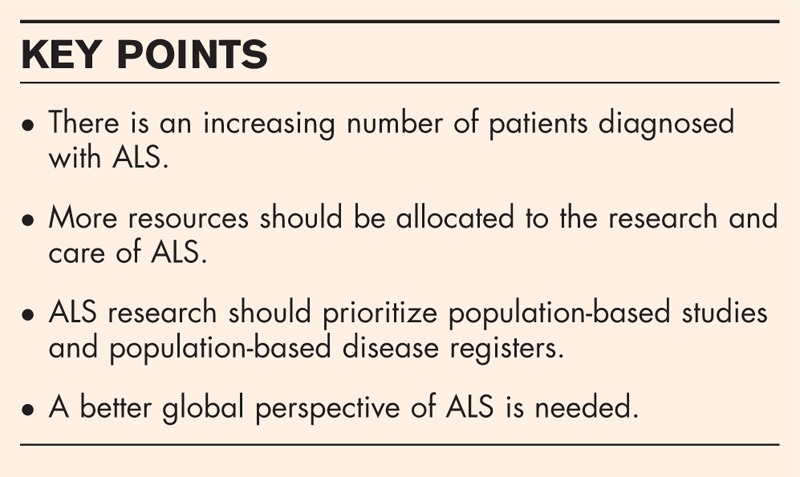
Purpose of review: The cause of amyotrophic lateral sclerosis (ALS) remains unknown for most of the patients with the disease. Epidemiologic studies can help describe disease burden and examine its potential risk factors, providing thereby evidence base for future mechanistic studies. With this review, we aimed to provide a summary of epidemiologic studies published during the past 18 months, which studied the incidence and risk factors for ALS. Recent findings: An increasing incidence and prevalence of ALS continue to be reported from different parts of the world. Several previously studied risk factors are confirmed as causally related to ALS by Mendelian randomization analysis. The previously known prognostic indicators for ALS appear to be the same across populations. Summary: Provided with the increasing number of patients diagnosed with ALS and the improved societal awareness of the disease, more resources should be allocated to the research and care of ALS. Population-based studies, especially population-based disease registers, should be the priorities in ALS research, and more data from outside Europe are needed in gaining a better global perspective of the disease.
Overview
The claims and statistics of this paper haven’t been checked yet.
Free: it reads the open-access text and checks the first 5 claims that cite a source we can check. Create a free account to check every claim.
Integrity signals
Registry
Cites
Statistics
Figures
Verification
Claims the paper makes
The claims and statistics of this paper haven’t been checked yet.
Free: it reads the open-access text and checks the first 5 claims that cite a source we can check. Create a free account to check every claim.
Claims other papers make about this one
Each is checked against this paper’s own text: does it say what the citing paper says it does?
The source backs part of the claim, not all of it — or backs it for a different population, condition or comparison.
In the citing paper
“These 4 common UMNDs result in a significant decline in physical function5,7,8,17,18 and often develop secondary complications that affect their quality of life (QOL), including cognitive impairment,19–21 fatigue,22 chronic pain,23,24 depression,25–27 and anxiety.25–27”
From Feasibility, Acceptability, and Efficacy of Mindfulness Training in People With Upper Motor Neuron Disorders: A Systematic Review (2022) · cites this paper as [7]
Experimental — accuracy not yet measuredThe source backs part of the claim, not all of it — or backs it for a different population, condition or comparison.
In the citing paper
“UMNDs may occur because of a traumatic event, nontraumatic event, or inherited or sporadic neurodegenerative disease.1,3–8”
From Feasibility, Acceptability, and Efficacy of Mindfulness Training in People With Upper Motor Neuron Disorders: A Systematic Review (2022) · cites this paper as [7]
Experimental — accuracy not yet measured
Self-check
Percentages, sums and reported differences re-computed from the paper’s own numbers.
The self-check needs the paper’s full text.
Citations
Cites
El Escorial revisited: revised criteria for the diagnosis of amyotrophic lateral sclerosis
Brooks, B. R., Miller, R. G., Swash, M., & Munsat, T. L. (2000) · Amyotrophic Lateral Sclerosis and Other Motor Neuron Disorders · doi:10.1080/146608200300079536 · Cited by 5,433
State of play in amyotrophic lateral sclerosis genetics
Renton, A. E., Chiò, A., & Traynor, B. J. (2014) · Nature Neuroscience · doi:10.1038/nn.3584 · Cited by 1,544
Hardiman, O., Al-Chalabi, A., Chio, A., Corr, E. M., Logroscino, G., Robberecht, W., Shaw, P. J., Simmons, Z., & van den Berg, L. H. (2017) · Nature Reviews Disease Primers · doi:10.1038/nrdp.2017.71 · Cited by 1,414
Clinical genetics of amyotrophic lateral sclerosis: what do we really know?
Andersen, P. M., & Al-Chalabi, A. (2011) · Nature Reviews Neurology · doi:10.1038/nrneurol.2011.150 · Cited by 687
Risk factors for amyotrophic lateral sclerosis
Fang, F., Ingre, C., Roos, P., Kamel, F., & Piehl, F. (2015) · Clinical Epidemiology · doi:10.2147/clep.s37505 · Cited by 462
Self-citationPrevalence of Amyotrophic Lateral Sclerosis — United States, 2014
Mehta, P., Kaye, W., Raymond, J., Wu, R., Larson, T., Punjani, R., Heller, D., Cohen, J., Peters, T., Muravov, O., et al. (2018) · MMWR. Morbidity and Mortality Weekly Report · doi:10.15585/mmwr.mm6707a3 · Cited by 458
Epidemiology of amyotrophic lateral sclerosis: A review of literature
Couratier, P., Corcia, P., Lautrette, G., Nicol, M., Preux, P., & Marin, B. (2015) · Revue Neurologique · doi:10.1016/j.neurol.2015.11.002 · Cited by 190
Molecular diagnostics of neurodegenerative disorders
Agrawal, M., & Biswas, A. (2015) · Frontiers in Molecular Biosciences · doi:10.3389/fmolb.2015.00054 · Cited by 164
Shared polygenic risk and causal inferences in amyotrophic lateral sclerosis
Bandres‐Ciga, S., Noyce, A. J., Hemani, G., Nicolas, A., Calvo, A., Mora, G., The ITALSGEN Consortium, The International ALS Genomics Consortium, Tienari, P. J., Stone, D. J., et al. (2019) · Annals of Neurology · doi:10.1002/ana.25431 · Cited by 162
Prevalence of Amyotrophic Lateral Sclerosis — United States, 2015
Mehta, P., Kaye, W., Raymond, J., Punjani, R., Larson, T., Cohen, J., Muravov, O., & Horton, K. (2018) · MMWR. Morbidity and Mortality Weekly Report · doi:10.15585/mmwr.mm6746a1 · Cited by 160
Cited by
Items 101–200 of 763
Cardiac troponin T is elevated and increases longitudinally in ALS patients
Kläppe, U., Chamoun, S., Shen, Q., Finn, A., Evertsson, B., Zetterberg, H., Blennow, K., Press, R., Samuelsson, K., Månberg, A., et al. (2021) · Amyotrophic Lateral Sclerosis and Frontotemporal Degeneration · doi:10.1080/21678421.2021.1939384 · Cited by 33
“To assess the prognostic values independent of known prognostic indicators of ALS, we adjusted for sex, site of onset, age at onset, diagnostic delay, body mass index at diagnosis, disease progression rate at diagnosis, and C9orf72 status in the analysis (25,26).”
MethodSelf-citationBenson, B. C., Shaw, P. J., Azzouz, M., Highley, J. R., & Hautbergue, G. M. (2021) · Frontiers in Neuroscience · doi:10.3389/fnins.2021.783624 · Cited by 33
Saleki, K., Mohamadi, M. H., Banazadeh, M., Alijanizadeh, P., Javanmehr, N., Pourahmad, R., & Nouri, H. R. (2022) · Journal of Leukocyte Biology · doi:10.1002/jlb.6ma0721-376rr · Cited by 33
Filippini, T., Mandrioli, J., Malagoli, C., Costanzini, S., Cherubini, A., Maffeis, G., & Vinceti, M. (2021) · International Journal of Environmental Research and Public Health · doi:10.3390/ijerph18030973 · Cited by 33
“nutritional failure [1], with a median survival time from symptoms onset to death or invasive respiratory support between 24 and 50 months [2].”
BackgroundEstimating mortality in rare diseases using a population-based registry, 2002 through 2019
Mazzucato, M., Pozza, L. V. D., Minichiello, C., Toto, E., Vianello, A., & Facchin, P. (2023) · Orphanet Journal of Rare Diseases · doi:10.1186/s13023-023-02944-7 · Cited by 32
“Several studies have investigated ALS survival in selected populations, using data either from disease registries or from population-based registries [32].”
BackgroundMedicinal Cannabis and Central Nervous System Disorders
Ortiz, Y. T., McMahon, L. R., & Wilkerson, J. L. (2022) · Frontiers in Pharmacology · doi:10.3389/fphar.2022.881810 · Cited by 33
History of ALS and the competing theories on pathogenesis: IFCN handbook chapter
Eisen, A., Vucic, S., & Mitsumoto, H. (2023) · Clinical Neurophysiology Practice · doi:10.1016/j.cnp.2023.11.004 · Cited by 31
“But, older age and male sex so far remain the only definitive non-genetic risks for ALS (Longinetti and Fang, 2019).”
BackgroundOlfactory dysfunction as potential biomarker in neurodegenerative diseases: a narrative review
Cleene, N. D., Schwarzová, K., Labrecque, S., Cerejo, C., Djamshidian, A., Seppi, K., & Heim, B. (2025) · Frontiers in Neuroscience · doi:10.3389/fnins.2024.1505029 · Cited by 31
Novel therapeutic targets for amyotrophic lateral sclerosis
Medhi, B., Batra, G., Jain, M., Singh, R. S., Sharma, A. R., Singh, A. K., & Prakash, A. (2019) · Indian Journal of Pharmacology · doi:10.4103/ijp.ijp_823_19 · Cited by 31
“4 per 100,000 people.[3] Around 90%–95% cases are sporadic (sALS) and 5%–10% are inherited (fALS).”
BackgroundUnveiling the hidden connection: the blood-brain barrier’s role in epilepsy
Han, J., Wang, Y., Wei, P., Lu, D., & Shan, Y. (2024) · Frontiers in Neurology · doi:10.3389/fneur.2024.1413023 · Cited by 30
“ALS usually occurs in the middle-aged and elderly population, with a prevalence of 4.1–8.4 per 100,000 people, and is characterized by progressive loss of upper and lower motor neurons at the spinal cord or medullary level (259, 260).”
BackgroundInfluentialRecent Advances in Extracellular Vesicles in Amyotrophic Lateral Sclerosis and Emergent Perspectives
Afonso, G. J. M., Cavaleiro, C., Valero, J., Mota, S. I., & Ferreiro, E. B. (2023) · Cells · doi:10.3390/cells12131763 · Cited by 29
“4 per 100,000 individuals, with an average age of onset between 51 and 66 years [5].”
BackgroundArjmand, B., Hamidpour, S. K., Rabbani, Z. H., Tayanloo-Beik, A., Rahim, F., Aghayan, H. R., & Larijani, B. A. (2022) · Frontiers in Neurology · doi:10.3389/fneur.2021.788462 · Cited by 29
“Accordingly, errors or delays in ALS diagnosis can be problematic for rapid treatment, which can finally lead to considerable effects on patients’ survival rates (32).”
BackgroundDysautonomia in Amyotrophic Lateral Sclerosis
Oprisan, A. L., & Popescu, B. O. (2023) · International Journal of Molecular Sciences · doi:10.3390/ijms241914927 · Cited by 31
“The ALS incidence is estimated to be between 0.6 and 3.8 per 100,000 persons per year, and its prevalence ranges between 4.1 and 8.4 per 100,000 persons, with high morbidity and mortality [4].”
BackgroundInfluentialAgah, E., Mojtabavi, H., Behkar, A., Heidari, A., Ajdari, A., Shaka, Z., Mousavi, S. V., Firoozeh, N., Tafakhori, A., & Rezaei, N. (2024) · Journal of Translational Medicine · doi:10.1186/s12967-024-05767-7 · Cited by 28
“It affects motor neurons in the brain and spinal cord, causing progressive painless muscle weakness, and death usually occurs due to respiratory failure [1].”
BackgroundTrends in survival of ALS from a population-based registry
Bianchi, E., Pupillo, E., Feudis, A. D., Enia, G., Vitelli, E., & Beghi, E. (2021) · Amyotrophic Lateral Sclerosis and Frontotemporal Degeneration · doi:10.1080/21678421.2021.2004167 · Cited by 28
“In addition, the variability of ALS phenotypes in studies from different countries could be reflected by different ethnic groups (18).”
BackgroundThe glymphatic system and Amyotrophic lateral sclerosis
Eisen, A., Nedergaard, M., Gray, E., & Kiernan, M. C. (2024) · Progress in Neurobiology · doi:10.1016/j.pneurobio.2024.102571 · Cited by 28
The connection between gut microbiota and its metabolites with neurodegenerative diseases in humans
Fabi, J. P. (2024) · Metabolic Brain Disease · doi:10.1007/s11011-024-01369-w · Cited by 28
Tofersen: A Review in Amyotrophic Lateral Sclerosis Associated with SOD1 Mutations
McGuigan, A., & Blair, H. A. (2025) · CNS Drugs · doi:10.1007/s40263-025-01204-5 · Cited by 27
“The global prevalence of ALS is estimated at 4.1–8.4 per 100,000 people, though incidence varies between populations [3].”
InfluentialAutoimmune response to C9orf72 protein in amyotrophic lateral sclerosis
Michaelis, T., Arlehamn, C. S. L., Johansson, E., Frazier, A., Williams, G. P., Berry, J. D., Cudkowicz, M., Goyal, N., Fournier, C. N., Snyder, A., et al. (2025) · Nature · doi:10.1038/s41586-025-09588-6 · Cited by 27
Methacrylated gellan gum and hyaluronic acid hydrogel blends for image-guided neurointerventions
Vieira, S., Strymecka, P., Stanaszek, L., Silva‐Correia, J., Drela, K., Fiedorowicz, M., Małysz‐Cymborska, I., Rogujski, P., Janowski, M., Reis, R. L., et al. (2020) · Journal of Materials Chemistry B · doi:10.1039/d0tb00877j · Cited by 27
Genetic architecture of motor neuron diseases
Chaudhary, R., Agarwal, V., Rehman, M., Kaushik, A. S., & Mishra, V. (2021) · Journal of the Neurological Sciences · doi:10.1016/j.jns.2021.120099 · Cited by 27
Hu, N., & Ji, H. (2022) · Neurological Sciences · doi:10.1007/s10072-022-06131-7 · Cited by 27
“The median survival time from symptom onset to death or invasive respiratory support is less than 3 years and only a small percentage of patients can survive for decades after the onset of clinical signs [4].”
BackgroundLin, J., Huang, P., Chen, W., Ye, C., Su, H., & Yao, X. (2020) · Frontiers in Genetics · doi:10.3389/fgene.2020.578143 · Cited by 27
“TIMP1 is secreted in the soluble form in ECM and plays the role as a strong inhibitor for MMP1, MMP3, MMP7, and MMP9 (Lukaszewicz-Zajac et al., 2014).”
BackgroundInfluentialFirdaus, Z., & Li, X. (2024) · International Journal of Molecular Sciences · doi:10.3390/ijms252111658 · Cited by 27
“Recent studies show that the prevalence of ALS is slightly increased and varies between 4.1 and 8.4/100,000 [11].”
BackgroundInfluentialTang, Y., Liu, P., Li, W., Liu, Z., Zhou, M., Li, J., Yuan, Y., Fang, L., Wang, M., Shen, L. H., et al. (2022) · European Journal of Neurology · doi:10.1111/ene.15451 · Cited by 26
Malek, A. M., Arena, V. C., Song, R., Whitsel, E. A., Rager, J. R., Stewart, J. D., Yanosky, J. D., Liao, D., & Talbott, E. O. (2022) · SSRN Electronic Journal · doi:10.2139/ssrn.4102818 · Cited by 26
Olesen, L. K., la Cour, K., With, H., Mahoney, A., & Handberg, C. (2022) · BMC Health Services Research · doi:10.1186/s12913-022-07986-4 · Cited by 25
“Most participants in the present study were between 51 and 67 years of age, and thereby represented the general family caregiver [52].”
BackgroundParks, R. M., Nunez, Y., Balalian, A. A., Gibson, E. A., Hansen, J., Raaschou‐Nielsen, O., Ketzel, M., Khan, J., Brandt, J. G., Vermeulen, R. C. H., et al. (2022) · Epidemiology · doi:10.1097/ede.0000000000001536 · Cited by 25
Time for optimism in amyotrophic lateral sclerosis
Corcia, P., Lunetta, C., Vourc’h, P., Pradat, P., & Blasco, H. (2023) · European Journal of Neurology · doi:10.1111/ene.15738 · Cited by 25
“This clinical heterogeneity combined with the lack of reliable diagnostic biomarkers mainly explains the delay of diagnosis of approximately 9– 12 months, which represents approximately one third of the total duration of the disease from the onset of the first symptoms [9].”
BackgroundGut-Brain Axis Deregulation and Its Possible Contribution to Neurodegenerative Disorders
Villavicencio-Tejo, F., Olesen, M. A., Navarro, L., Calisto, N., Iribarren, C., GARCÍA, K. P., Corsini, G., & Quintanilla, R. A. (2023) · Neurotoxicity Research · doi:10.1007/s12640-023-00681-0 · Cited by 25
“This disease is more prevalent in women than men, with an age of onset between ~ 51 and 66 years (Longinetti and Fang 2019; Turner et al. 2012).”
Newell, M. E., Aravindan, A., Babbrah, A., & Halden, R. U. (2025) · Toxics · doi:10.3390/toxics13020114 · Cited by 24
“However, current means of diagnosis of neurodegenerative diseases generally require progressed pathological symptoms to present in a patient, which on average delays diagnosis from the true age of onset by 18 months for AD [14], 6 months for PD [15], and 3 years for ALS [16].”
Aqeel, A., Akram, A., Ali, M., Iqbal, M., Aslam, M., Rukhma, & Shah, F. I. (2025) · Diabetes Research and Clinical Practice · doi:10.1016/j.diabres.2025.112129 · Cited by 24
Fowler, M., Theunissen, F., Carr, J. M., & Rogers, M. (2023) · Molecular Neurobiology · doi:10.1007/s12035-023-03472-y · Cited by 24
“At present, the underlying cause of ALS remains elusive, and with no cure or disease-modifying therapy, the typical life expectancy lies between 2 and 5 years from diagnosis [5–7].”
BackgroundJia, F., Zhang, B., Yu, W., Chen, Z., Xu, W., Zhao, W., & Wang, Z. (2023) · Computers in Biology and Medicine · doi:10.1016/j.compbiomed.2023.107776 · Cited by 24
Bayesian Network as a Decision Tool for Predicting ALS Disease
Karaboğa, H. A., Günel, A., Korkut, Ş. V., Demir, İ., & Çelik, R. (2021) · Brain Sciences · doi:10.3390/brainsci11020150 · Cited by 26
“In addition, the ALS disease is expressed largely as an adult-onset disease in the literature [9].”
BackgroundRowe, H. P., Shellikeri, S., Yunusova, Y., Chenausky, K. V., & Green, J. R. (2022) · International Journal of Speech-Language Pathology · doi:10.1080/17549507.2022.2089234 · Cited by 23
Singh, S., Chib, S., Akhtar, M. J., Kumar, B., Chawla, P. A., & Bhatia, R. (2023) · Current Neuropharmacology · doi:10.2174/1570159x21666230105110834 · Cited by 23
“Besides, the prevalence of Friedreich ataxia in Central Europe has been reported to be 1:20000 to 1:50000 [17], and the incidence of ALS to be between 0.6 and 3.8 per 100000 person-1875-6190 years, which was higher in Europe ranging from 2.1 to 3.8 per 100 000 person-years [18].”
BackgroundInfluentialReceptor tyrosine kinases (RTKs)
Batool, Z., Azfal, A., Liaquat, L., Sadir, S., Nisar, R., Inamullah, A., Ghalib, A. U. F., & Haider, S. (2023) · Elsevier eBooks · doi:10.1016/b978-0-443-18677-6.00012-9 · Cited by 23
Prabhu, S., Kalaimathi, K., Jayasree, S., Ayyanar, M., Kadaikunnan, S., Thiruvengadam, M., Amalraj, S., Ceasar, S. A., Alharbi, N. S. H. A., Sanjeevi, S. B., et al. (2024) · Journal of Computational Biophysics and Chemistry · doi:10.1142/s2737416524500133 · Cited by 23
Barbalho, I. M. P., Valentim, R. A. D. M., Júnior, M. E. D., Barros, D. M. S., Júnior, H. P., Fernandes, F. R. D. S., Teixeira, C., Lima, T. S., de Paiva, J. C., & Nagem, D. A. P. (2021) · BMC Neurology · doi:10.1186/s12883-021-02298-2 · Cited by 23
Chen, L., Wang, N., Zhang, Y. N., Li, D., He, C., Li, Z., Zhang, J., & Guo, Y. (2022) · Journal of Proteomics · doi:10.1016/j.jprot.2022.104776 · Cited by 22
Identifying and Diagnosing TDP-43 Neurodegenerative Diseases in Psychiatry
Ducharme, S., Pijnenburg, Y. A. L., Rohrer, J. D., Huey, E. D., Finger, E. C., & Tatton, N. A. (2023) · American Journal of Geriatric Psychiatry · doi:10.1016/j.jagp.2023.08.017 · Cited by 22
Review of disease-modifying drug trials in amyotrophic lateral sclerosis
Tornese, P., Lalli, S., Cocco, A., & Albanese, A. (2022) · Journal of Neurology Neurosurgery & Psychiatry · doi:10.1136/jnnp-2021-328470 · Cited by 22
Dieckmann, N., Roediger, A., Prell, T., Schuster, S., Herdick, M. L., Mayer, T. E., Witte, O. W., Steinbach, R., & Großkreutz, J. (2022) · NeuroImage Clinical · doi:10.1016/j.nicl.2022.103162 · Cited by 22
“Amyotrophic Lateral Sclerosis (ALS) is a progressive neurodegenerative disease and survival rates are short with patients succumbing three years after the onset of symptoms on average (Kiernan et al., 2011; Longinetti and Fang, 2019; van Es et al., 2017).”
Epigenetic Mechanisms Underlying Sex Differences in Neurodegenerative Diseases
Stoccoro, A. (2025) · Biology · doi:10.3390/biology14010098 · Cited by 19
“Likewise, the number of people affected by motor neuron diseases, such as amyotrophic lateral sclerosis (ALS), has risen by approximately 12.4% between 1990 and 2019 [3].”
InfluentialCathepsins in Neurological Diseases
Lewandowski, D., Konieczny, M., Różycka, A., Chrzanowski, K., Owecki, W., Kalinowski, J., Stepura, M., Jagodziński, P. P., & Dorszewska, J. (2025) · International Journal of Molecular Sciences · doi:10.3390/ijms26167886 · Cited by 21
“Gender differences have also been noted, with men being significantly more affected than women (male-to-female ratio 1 between 2) [136,138].”
Kläppe, U., Sennfält, S., Lovik, A., Finn, A., Bofaisal, U., Zetterberg, H., Blennow, K., Piehl, F., Kmezic, I., Press, R., et al. (2023) · Amyotrophic Lateral Sclerosis and Frontotemporal Degeneration · doi:10.1080/21678421.2023.2263874 · Cited by 21
“…model, biomarker concentrations were divided into tertiles, and adjustments were made for sex, age at diagnosis, site of onset, classification according to the revised El Escorial criteria, diagnostic delay, baseline ALSFRS-R, baseline progression rate, BMI, and signs of FTD at diagnosis (33, 34).”
MethodSelf-citationNeurotoxicity of Pyrethroids in neurodegenerative diseases: From animals' models to humans’ studies
Arsuffi-Marcon, R., Souza, L. G., Santos‐Miranda, A., & Joviano‐Santos, J. V. (2024) · Chemico-Biological Interactions · doi:10.1016/j.cbi.2024.110911 · Cited by 21
Split hand in amyotrophic lateral sclerosis: A systematic review and meta-analysis
Hu, N., Wang, J., & Liu, M. (2021) · Journal of Clinical Neuroscience · doi:10.1016/j.jocn.2021.06.015 · Cited by 21
Protein Arginine Methyltransferases in Neuromuscular Function and Diseases
Lee, J., An, S., Lee, S.-J., & Kang, J. (2022) · Cells · doi:10.3390/cells11030364 · Cited by 21
Primary progressive aphasia and motor neuron disease: A review
Aiello, E. N., Feroldi, S., Luca, G. D., Guidotti, L., Arrigoni, E., Appollonio, I. M., Solca, F., Carelli, L., Poletti, B., Verde, F., et al. (2022) · Frontiers in Aging Neuroscience · doi:10.3389/fnagi.2022.1003792 · Cited by 21
Enhanced axonal regeneration of ALS patient iPSC-derived motor neurons harboring SOD1A4V mutation
Marshall, K. L., Rajbhandari, L., Venkatesan, A., Maragakis, N. J., & Farah, M. H. (2023) · Scientific Reports · doi:10.1038/s41598-023-31720-7 · Cited by 22
(2023) · Advances in magnetic resonance technology and applications · doi:10.1016/b978-0-323-91771-1.00016-2 · Cited by 21
Increased incidence of motor neuron disease in Sweden: a population-based study during 2002–2021
Imrell, S., Fang, F., Ingre, C., & Sennfält, S. (2024) · Journal of Neurology · doi:10.1007/s00415-024-12219-1 · Cited by 20
“A significant increase in the incidence rate of ALS during the latter half of the twentieth century has also been reported in various Western countries, [18] including Norway, [19] Finland, [20] Scotland, [21] and New Zeeland, [22] which is unlikely solely attributed to an ageing population.”
Self-citationC. elegans : a prominent platform for modeling and drug screening in neurological disorders
Romussi, S., Giunti, S., Andersen, N., & Rosa, M. J. D. (2024) · Expert Opinion on Drug Discovery · doi:10.1080/17460441.2024.2329103 · Cited by 20
“C. elegans models of ALS have been employed to explore genes involved in both sporadic and familial forms of the disease, including chromosome 9 open reading frame 72 ( C9orf72 ), superoxide dismutase 1 ( sod-1 ), TAR DNA-binding protein ( tdp-43 ) and Fused in Sarcoma ( fus ) [133] (Suppl.”
BackgroundMethodJericó, I., Beiras, I. E., Pagola, I., Torné, L., Galbete, A., Osinaga, J. D., & Vicente, E. F. (2021) · Amyotrophic Lateral Sclerosis and Frontotemporal Degeneration · doi:10.1080/21678421.2021.1891249 · Cited by 20
“incidence of (16) individuals with ALS.”
Nunez, Y., Boehme, A. K., Goldsmith, J., Li, M., van Donkelaar, A., Weisskopf, M. G., Ré, D. B., Martin, R. V., & Kioumourtzoglou, M. (2022) · Environmental Epidemiology · doi:10.1097/ee9.0000000000000204 · Cited by 20
UK case control study of smoking and risk of amyotrophic lateral sclerosis
Opie-Martin, S., Jones, A., Iacoangeli, A., Al-Khleifat, A., Oumar, M., Shaw, P. J., Shaw, C. E., Morrison, K. E., Wootton, R. E., Davey-Smith, G., et al. (2020) · Amyotrophic Lateral Sclerosis and Frontotemporal Degeneration · doi:10.1080/21678421.2019.1706580 · Cited by 19
Antonioni, A., Govoni, V., Brancaleoni, L., Donà, A., Granieri, E., Bergamini, M., Gerdol, R., & Pugliatti, M. (2023) · International Journal of Environmental Research and Public Health · doi:10.3390/ijerph20085591 · Cited by 19
“disease and the cases considered are consequently small in number [84].”
BackgroundPiccoli, T., Castro, F., Bella, V. L., Meraviglia, S., Simone, M. D., Salemi, G., Dieli, F., & Spataro, R. (2023) · BMC Neurology · doi:10.1186/s12883-023-03255-x · Cited by 19
Zheng, C., Li, W., Ali, T., Peng, Z., Liu, J., Pan, Z., Feng, J., & Li, S. (2023) · Journal of Neuroimmune Pharmacology · doi:10.1007/s11481-023-10068-9 · Cited by 19
“Amyotrophic Lateral Sclerosis (ALS), also known as motor neuron disease (MND), is a fatal disorder of the human motor system with an incidence of 1/1000,00 world widely (Longinetti and Fang 2019; Rowland and Shneider 2001).”
BackgroundEpidemiologic Trends of Amyotrophic Lateral Sclerosis in Ireland, 1996–2021
McFarlane, R. M., Peelo, C., Galvin, M., Heverin, M., & Hardiman, O. M. (2023) · Neurology · doi:10.1212/wnl.0000000000207797 · Cited by 19
Time-restricted ketogenic diet in amyotrophic lateral sclerosis: a case study
Phillips, M. C. L., Johnston, S. E., Simpson, P., Chang, D. K., Mather, D., & Dick, R. J. (2024) · Frontiers in Neurology · doi:10.3389/fneur.2023.1329541 · Cited by 20
Kolomeytseva, A. T. A., Brylev, L., Eshghi, M., Bottaeva, Z., Zhang, J., Fachner, J. C., & Street, A. J. (2022) · Brain Sciences · doi:10.3390/brainsci12040494 · Cited by 19
“85) per 100,000 person-years [1], and prevalence is increasing [2].”
BackgroundChoi, S.-H., Yousefian-Jazi, A., Hyeon, S. J., Nguyen, P. T., Chu, J., Kim, S., Kim, S., Ryu, H. L., Kowall, N. W., Ryu, H., et al. (2022) · Journal of Biomedical Science · doi:10.1186/s12929-022-00890-3 · Cited by 18
“ALS has an annual incidence of 1–2 per 100,000 and is usually fatal within 2–5 years of diagnosis [1].”
BackgroundGenuis, S. K., Luth, W., Weber, G., Bubela, T. M., & Johnston, W. S. W. (2023) · BMC Medical Research Methodology · doi:10.1186/s12874-023-02051-y · Cited by 18
“For example, similar to other population-based ALS studies [61], our sample was weighted neither towards younger age of onset, nor long-term survivors.”
ResultWu, F., Malek, A. M., Buchanich, J. M., Arena, V. C., Rager, J. R., Sharma, R. K., Vena, J. E., Bear, T., & Talbott, E. O. (2023) · Environmental Research · doi:10.1016/j.envres.2023.117719 · Cited by 18
Talbott, E. O., Malek, A. M., Arena, V. C., Wu, F., Steffes, K., Sharma, R. K., Buchanich, J. M., Rager, J. R., Bear, T., Hoffman, C. A., et al. (2024) · Amyotrophic Lateral Sclerosis and Frontotemporal Degeneration · doi:10.1080/21678421.2024.2336108 · Cited by 18
Hu, Y., Hruscha, A., Pan, C., Schifferer, M., Schmidt, M. K., Nuscher, B., Giera, M. A., Kostidis, S., Burhan, Ö. P., van Bebber, F., et al. (2024) · Molecular Neurodegeneration · doi:10.1186/s13024-024-00735-7 · Cited by 19
Advance directives in amyotrophic lateral sclerosis – a systematic review and meta-analysis
Mangal, A. L., Mücke, M., Rolke, R., & Appelmann, I. (2024) · BMC Palliative Care · doi:10.1186/s12904-024-01524-1 · Cited by 18
“The incidence of ALS ranges from 0.6 to 3.8 / 100.000 and year, and prevalence is stated between 4.1 and 8.4 / 100.000, with both incidence and prevalence increasing [10–12].”
BackgroundInfluentialNunez, Y., Balalian, A. A., Parks, R. M., He, M. Z., Hansen, J., Raaschou‐Nielsen, O., Ketzel, M., Khan, J., Brandt, J., Vermeulen, R. C. H., et al. (2023) · American Journal of Epidemiology · doi:10.1093/aje/kwad099 · Cited by 17
Carrera‐Juliá, S., Estrela, J. M., Zacarés, M., Navarro, M. Á., Vega‐Bello, M. J., Ortí, J. E. D. L. R., Moreno, M. L., & Drehmer, E. (2023) · Frontiers in Nutrition · doi:10.3389/fnut.2023.1232184 · Cited by 17
Sex-driven variability in TSPO-expressing microglia in MS patients and healthy individuals
Laaksonen, S., Saraste, M., Nylund, M., Hinz, R., Snellman, A., Rinne, J. O., Matilainen, M., & Airas, L. M. (2024) · Frontiers in Neurology · doi:10.3389/fneur.2024.1352116 · Cited by 17
“The same phenomenon may contribute to the higher male prevalence and incidence of other neurodegenerative diseases, such as Parkinson’s disease and amyotrophic lateral sclerosis (30, 31).”
BackgroundZelina, P., Ruiter, A. A. D., Kolsteeg, C., van Ginneken, I., Vos, H. R., Supiot, L. F., Burgering, B. M. T., Meye, F. J., Veldink, J. H., van den Berg, L. H., et al. (2024) · Acta Neuropathologica Communications · doi:10.1186/s40478-024-01852-6 · Cited by 17
“The majority of ALS patients starts to develop symptoms between 51–66 years of age and median survival is 3–5 years after symptom onset [3].”
BackgroundPrognostic Factors and Epidemiology of Amyotrophic Lateral Sclerosis in Southeastern United States
Engelberg-Cook, E., Shah, J., Hucke, A. T. D. S., Vera-Garcia, D. V., Dagher, J. E., Donahue, M. H., Belzil, V., & Oskarsson, B. (2024) · Mayo Clinic Proceedings Innovations Quality & Outcomes · doi:10.1016/j.mayocpiqo.2024.07.008 · Cited by 17
Rubio, A. D., Hamilton, L. L., Bausch, M., Jin, M., Papetti, A. V., Jiang, P., & Yelamanchili, S. V. (2025) · Journal of Neuroimmune Pharmacology · doi:10.1007/s11481-025-10181-x · Cited by 17
“Owing to the loss of upper and lower motor neurons (MNs), patients experience gradual limb muscle weakness, slurred speech, and difficulties swallowing and chewing (Longinetti and Fang 2019).”
Ferraro, P. M., Cabona, C., Meo, G., Rolla‐Bigliani, C., Castellan, L., Pardini, M., Inglese, M., Caponnetto, C., & Roccatagliata, L. (2021) · Neuroradiology · doi:10.1007/s00234-021-02681-3 · Cited by 17
“This variability is also influenced by genetic factors, with younger age of onset reported in familial forms of ALS, and older age of onset observed in patients with sporadic forms of the disease [1], who represent the vast majority of cases [3].”
BackgroundEpidemiology and survival trends of motor neurone disease in Northern Ireland from 2015 to 2019
McCluskey, G., Duddy, W. J., Haffey, S., Morrison, K. E., Donaghy, C. G., & Duguez, S. (2021) · European Journal of Neurology · doi:10.1111/ene.15172 · Cited by 17
“The number of MND cases is projected to increase by 69% over the next 20 years [4] and indeed multiple recent population studies have demonstrated an increasing incidence of MND [5,7,8].”
BackgroundMedication use and risk of amyotrophic lateral sclerosis—a systematic review
Cui, C., Sun, J., McKay, K. A., Ingre, C., & Fang, F. (2022) · BMC Medicine · doi:10.1186/s12916-022-02442-w · Cited by 16
“Although various risk factors have been proposed, older age, male gender, family history, and specific genetic mutations are the only established risk factors [3].”
BackgroundSelf-citationIranian clinical practice guideline for amyotrophic lateral sclerosis
Boostani, R., Olfati, N., Shamshiri, H., Salimi, Z., Fatehi, F., Hedjazi, S. A., Fakharian, A., Ghasemi, M., Okhovat, A. A., Basiri, K., et al. (2023) · Frontiers in Neurology · doi:10.3389/fneur.2023.1154579 · Cited by 18
Soumya, B. S., Shreenidhi, V. P., Agarwal, A., Gandhirajan, R. K., Dharmarajan, A., & Warrier, S. R. (2023) · Cellular Signalling · doi:10.1016/j.cellsig.2023.110807 · Cited by 16
Development of a targeted BioPROTAC degrader selective for misfolded SOD1
Chisholm, C. G., Bartlett, R., Brown, M. L., Proctor, E., Farrawell, N. E., Gorman, J., Delerue, F., Ittner, L. M., Vine, K. L., Ecroyd, H. W., et al. (2025) · Nature Communications · doi:10.1038/s41467-025-65481-w · Cited by 16
“Thereisalsoincreasing evidencethat sex plays a signi fi cant role in ALS in both humans 76 and the SOD1 G93A mouse model 77,78 .”
Traditional East Asian Herbal Medicine for Amyotrophic Lateral Sclerosis: A Scoping Review
Suh, W. J., Seo, Y., Jin, C., Cho, S., Park, S.-U., Jung, W., Moon, S., Park, J., Ko, C., Kwon, S., et al. (2021) · Evidence-based Complementary and Alternative Medicine · doi:10.1155/2021/5674142 · Cited by 16
Ecovoiu, A. A., Rațiu, A. C., Micheu, M. M., & Chifiriuc, M. C. (2022) · International Journal of Molecular Sciences · doi:10.3390/ijms23052613 · Cited by 17
“ALS is arguably the most prevalent motoneuron disorder that leads to fatal adult-onset neurodegenerative progression [34,35].”
BackgroundDynamic Bayesian networks for stratification of disease progression in amyotrophic lateral sclerosis
Gromicho, M., Leão, T., Santos, M. O., Pinto, S., Carvalho, A. M., Madeira, S. C., & de Carvalho, M. A. (2022) · European Journal of Neurology · doi:10.1111/ene.15357 · Cited by 16
Sánchez‐Tejerina, D., Llauradó, A., Sotoca, J., López‐Diego, V., Vidal-Taboada, J. M., Salvadó, M., & Morales, R. J. (2023) · Cells · doi:10.3390/cells12081180 · Cited by 16
“It is established that body mass index (BMI) is related to ALS risk and prognosis [3].”
BackgroundZhu, Q., Xu, D., Huang, H., Li, D., Yang, D., Zhou, J. W., & Zhao, Y. (2023) · Journal of Neurology · doi:10.1007/s00415-023-11838-4 · Cited by 16
“6 cases per 100,000 individuals annually [3], and the median survival period is only 30 months [4].”
BackgroundGoldstein, O., Inbar, T. C., Kedmi, M., Gana‐Weisz, M., Abramovich, B., Orr‐Urtreger, A., & Drory, V. E. (2022) · Neurology Genetics · doi:10.1212/nxg.0000000000200009 · Cited by 16
“8 per 100,000 person-years.(2) Five to ten percent of patients with ALS develop comorbid symptoms of frontotemporal dementia (FTD), and up to 50% show mild cognitive impairments or behavioral changes that do not meet the FTD diagnostic criteria in parallel to their motor symptoms.”
BackgroundThe incidence and prevalence of motor neurone disease in South Australia
Luker, J., Woodman, R. J., & Schultz, D. W. (2022) · Amyotrophic Lateral Sclerosis and Frontotemporal Degeneration · doi:10.1080/21678421.2022.2108326 · Cited by 15
“Motor neurone disease registries have been validated internationally as effective research tools for epidemiological data (9).”
BackgroundKlebbe, R., Scherzinger, S., & Eicher, C. (2022) · JMIR Rehabilitation and Assistive Technologies · doi:10.2196/35304 · Cited by 15
“The average age of onset is between 58 and 63 years [4,5], with the youngest patients being aged between 20 and 30 years [1,6].”
BackgroundDevelopment of neurodegeneration in amyotrophic lateral sclerosis: from up or down?
Geser, F., Fellner, L., Haybaeck, J., & Wenning, G. K. (2020) · Journal of Neural Transmission · doi:10.1007/s00702-020-02213-y · Cited by 15
Young carers and ALS/MND: exploratory data from families in South Africa
Kavanaugh, M. S., Henning, F., & Mochan, A. (2020) · Vulnerable Children and Youth Studies · doi:10.1080/17450128.2020.1837409 · Cited by 14
“Incidence of ALS in South Africa is approximately 1.09/100 000, with a median age of onset of 59.4 years (Henning et al., 2020), in line with the global incidence of ALS which ranges from 0.6 and 3.8 per 100 000 (Longinetti & Fang, 2019).”
InfluentialPalliative care at any stage of amyotrophic lateral sclerosis: a prospective feasibility study
Zwicker, J. C., Smith, I. C. P., Rice, J., Murphy, R., Breiner, A., McNeely, S., Duff, M. L. V., Buenger, U., Zehrt, B., Nogo, D., et al. (2023) · Frontiers in Medicine · doi:10.3389/fmed.2023.1204816 · Cited by 14
Prodromos, C. C., Villar, R., Jin, M. Y., Abd-Elsayed, A. A., & Candido, K. D. (2025) · American Journal of Stem Cells · doi:10.62347/ftxa8845 · Cited by 14
Central nervous system organoids for modeling neurodegenerative diseases
Hou, P., & Kuo, H. (2022) · IUBMB Life · doi:10.1002/iub.2595 · Cited by 14
“Patients suffer progressive limb muscle weakness, slurred speech, and difficulty in swallowing and chewing due to the loss of upper and lower motor neurons.(70) During disease progression, unstable protein and aggregation of ubiquitinated protein are thought to cause motor neuron death in multiple brain regions, espec…”
Pathological Sequelae Associated with Skeletal Muscle Atrophy and Histopathology in G93A*SOD1 Mice
Aishwarya, R., Abdullah, C. S., Remex, N. S., Nitu, S. S., Hartman, B., King, J., Bhuiyan, M. A. N., Rom, O., Miriyala, S., Panchatcharam, M., et al. (2023) · Muscles · doi:10.3390/muscles2010006 · Cited by 14
“Amyotrophic lateral sclerosis (ALS) is a fatal neuromuscular disease having an annual prevalence of about 4 to 6 per 100,000 people with a median age of onset between 51 and 66 years [1].”
BackgroundRamos, V., Reis, M. A., Ferreira, L., Silva, A. M., Ferraz, R., Vieira, M., Vasconcelos, V. M., & Martins, R. F. (2023) · Biomolecules · doi:10.3390/biom13101444 · Cited by 15
“It is caused by the expansion of a cytosine–adenine–guanine (GAG) trinucleotide repeat in the huntingtin (HTT) gene, resulting in a mutant huntingtin protein (mHTT) with an abnormally long polyQ tract.”
BackgroundALS: A Silent Slayer of Motor Neurons. Traditional Chinese Herbal Medicine as an Effective Therapy
Rai, A., Shukla, S., Gupta, R. K., & Mishra, A. (2025) · Current Pharmaceutical Design · doi:10.2174/0113816128329141241205063352 · Cited by 13
Perioperative management of patients with amyotrophic lateral sclerosis: A narrative review
Paul, D., Wright, M., Palmer, J. M., & Russell, T. B. (2022) · Anaesthesia and Intensive Care · doi:10.1177/0310057x211065042 · Cited by 13
“The median time from diagnosis to death is two and a half to three years,(9) but around 20% of patients live for five to ten years(2) and 10% have a slow form of the disease with survival of ten years or longer.(9,10) At first presentation 50% of patients have a functional vital capacity (FVC) less than 75% predicted.”
BackgroundAydemir, D., Surucu, S., Başak, A. N., & Ulusu, N. N. (2022) · Cells · doi:10.3390/cells11223569 · Cited by 13
“Thus, developing prognostic and diagnostic biomarkers for ALS is urgently needed for effective and rapid diagnoses of the disease [11,12].”
Background
Metadata
- Authors
- Longinetti, E., & Fang, F.
- Affiliations
- Karolinska Institutet (SE)
- Corresponding author
- Fang, Fang
- Venue
- Current Opinion in Neurology
- Published
- 2019-10
- Volume
- 32
- Issue
- 5
- Pages
- 771-776
- ISSN
- 1350-7540 (ISSN-L)
- 1473-6551
- PMC
- PMC6735526
- OpenAlex
- W2965191972
- Semantic Scholar
- 04d12e5537f9a9934fab5cd648d8bec24c962d10
- Cited by
- 620
- References
- 55
- Citations by year
- 2026: 75 · 2025: 84 · 2024: 122 · 2023: 122 · 2022: 94 · 2021: 84 · 2020: 33 · 2019: 3
- FWCI
- 7.35
- Type
- journal article
- Language
- en
- Open access
- hybrid
- doi.org
- Locations
- Current Opinion in Neurology (publishedVersion, cc-by)
- PubMed Central (publishedVersion, cc-by)
- PubMed (publishedVersion)
- Funders
- National Health Insurance Service
- Topics
- Health Sciences › Medicine › Clinical Neurology › Amyotrophic Lateral Sclerosis Research
- Health Sciences › Medicine › Internal Medicine › Amyloidosis: Diagnosis, Treatment, Outcomes
- Health Sciences › Medicine › Psychiatry and Mental health › Dementia and Cognitive Impairment Research
- Keywords
- amyotrophic lateral sclerosis, incidence, prevalence, risk factors, Mendelian randomization, prognostic factors, disease burden, global epidemiology
- MeSH terms
- Amyotrophic Lateral Sclerosis, Europe, Humans, Risk Factors, Incidence, Prevalence
About these checks
Registry, retraction, Cites and statistics results are computed, not judged, with one exception: a printed reference that no index lists is read once by a model before it counts as a citation error. Claims are extracted by a model and kept only when their quote appears verbatim in the text; each cited source is then checked, with a model’s help, for whether it says what the claim relies on. Those verdicts can be wrong — read the claim’s quote and the cited source before relying on one.
Statistics and arithmetic are recomputed, not judged.
Confidence bands are shown only for fields calibrated on our annotated test set. None is calibrated yet, so no band is shown.
What counts as a claim ›How we measure confidence ›How we check this ›
Are you an author, or do you see a problem with this page? Request a review
Data sources
Bibliographic data: Semantic Scholar, OpenAlex, Crossref.
Contains information from the Semantic Scholar Academic Graph Datasets, made available under the ODC Attribution License (ODC-BY 1.0).
Semantic Scholar’s data is described in: Kinney, R., et al. (2023). The Semantic Scholar Open Data Platform. arXiv:2301.10140.
