

Long-Term, Prospective, Multicenter Study of Poly-4-Hydroxybutyrate Mesh (Phasix Mesh) for Hernia Repair in Cohort at Risk for Complication: 60-Month Follow-Up
The DOI matches its Crossref record; 20 of the 20 references it cites were found in a registry or an index.
Abstract
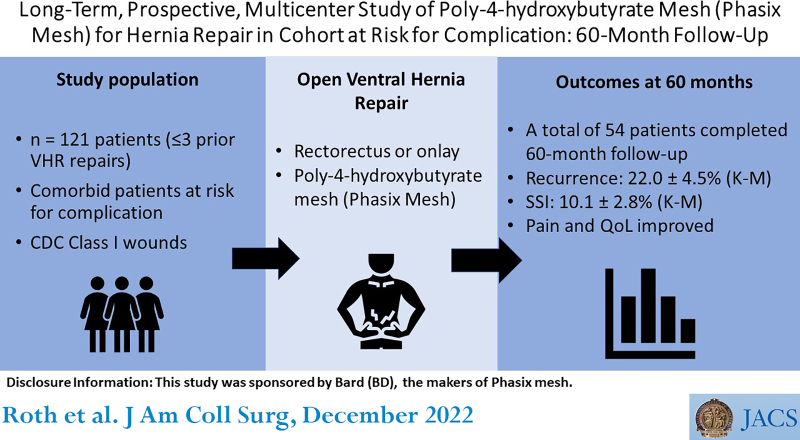
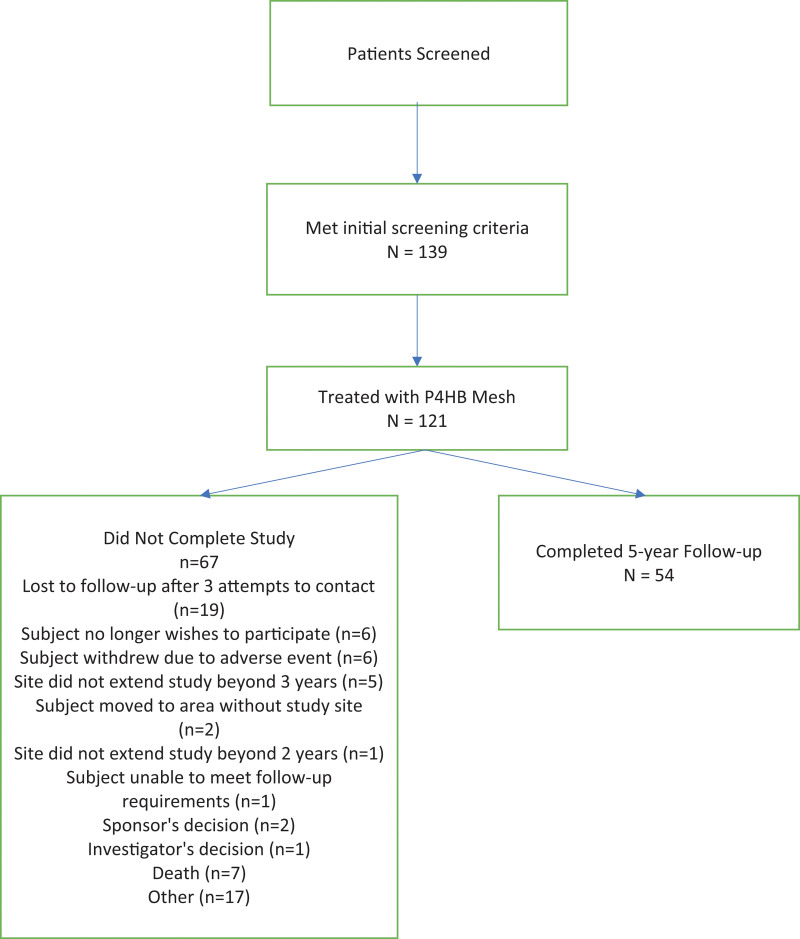
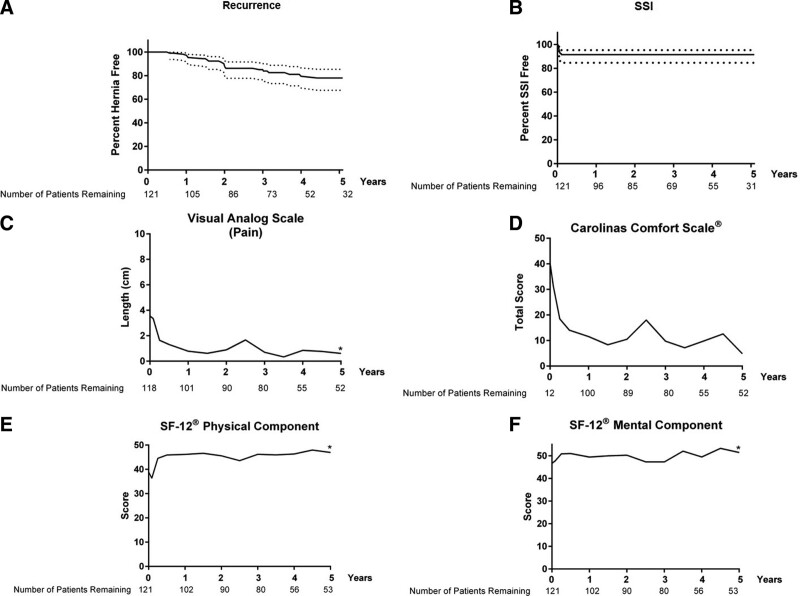
BACKGROUND: Long-term resorbable mesh represents a promising technology for ventral and incisional hernia repair (VIHR). This study evaluates poly-4-hydroxybutyrate mesh (P4HB; Phasix Mesh) among comorbid patients with CDC class I wounds. STUDY DESIGN: This prospective, multi-institutional study evaluated P4HB VIHR in comorbid patients with CDC class I wounds. Primary outcomes included hernia recurrence and surgical site infection. Secondary outcomes included pain, device-related adverse events, quality of life, reoperation, procedure time, and length of stay. Evaluations were scheduled at 1, 3, 6, 12, 18, 24, 30, 36, and 60 months. A time-to-event analysis (Kaplan-Meier) was performed for primary outcomes; secondary outcomes were reported as descriptive statistics. RESULTS: A total of 121 patients (46 male, 75 female) 54.7 ± 12.0 years old with a BMI of 32.2 ± 4.5 kg/m 2 underwent VIHR with P4HB Mesh (mean ± SD). Fifty-four patients (44.6%) completed the 60-month follow-up. Primary outcomes (Kaplan-Meier estimates at 60 months) included recurrence (22.0 ± 4.5%; 95% CI 11.7% to 29.4%) and surgical site infection (10.1 ± 2.8%; 95% CI 3.3 to 14.0). Secondary outcomes included seroma requiring intervention (n = 9), procedure time (167.9 ± 82.5 minutes), length of stay (5.3 ± 5.3 days), reoperation (18 of 121, 14.9%), visual analogue scale–pain (change from baseline –3.16 ± 3.35 cm at 60 months; n = 52), and Carolinas Comfort Total Score (change from baseline –24.3 ± 21.4 at 60 months; n = 52). CONCLUSIONS: Five-year outcomes after VIHR with P4HB mesh were associated with infrequent complications and durable hernia repair outcomes. This study provides a framework for anticipated long-term hernia repair outcomes when using P4HB mesh.
Overview
The claims and statistics of this paper haven’t been checked yet.
Free: it reads the open-access text and checks the first 5 claims that cite a source we can check. Create a free account to check every claim.
Integrity signals
Registry
Cites
Statistics
Figures
Verification
Claims the paper makes
The claims and statistics of this paper haven’t been checked yet.
Free: it reads the open-access text and checks the first 5 claims that cite a source we can check. Create a free account to check every claim.
Claims other papers make about this one
Each is checked against this paper’s own text: does it say what the citing paper says it does?
The source backs part of the claim, not all of it — or backs it for a different population, condition or comparison.
In the citing paper
“Notably, the cumulative incidence curve indicated a peak in recurrence following the expected resorption period of the P4HB mesh, after which recurrence rates plateaued [4, 8].”
From Long‐Term Outcomes After Slowly Resorbable P4HB Mesh Implantation: A Multicenter Analysis From European Registry (2026) · cites this paper as [4]
Experimental — accuracy not yet measuredThe source backs part of the claim, not all of it — or backs it for a different population, condition or comparison.
In the citing paper
“A recently published 5-year follow-up study of a cohort undergoing incisional hernia repair with Phasix mesh by Roth et al19 reported a recurrence rate of 22.0%.”
From Five-Year Follow-Up of a Slowly Resorbable Biosynthetic P4HB Mesh (Phasix) in VHWG Grade 3 Incisional Hernia Repair (2023) · cites this paper as [19]
Experimental — accuracy not yet measuredIn the citing paper
“Poly‐4‐hydroxybutyrate (P4HB) mesh is a fully resorbable mesh designed to provide temporary reinforcement of the abdominal wall during the healing process [4].”
From Long‐Term Outcomes After Slowly Resorbable P4HB Mesh Implantation: A Multicenter Analysis From European Registry (2026) · cites this paper as [4]
In the citing paper
“In both this study and the American long-term Phasix study, no long-term mesh-related complications were found.19”
From Five-Year Follow-Up of a Slowly Resorbable Biosynthetic P4HB Mesh (Phasix) in VHWG Grade 3 Incisional Hernia Repair (2023) · cites this paper as [19]
Self-check
Percentages, sums and reported differences re-computed from the paper’s own numbers.
The self-check needs the paper’s full text.
Citations
Cites
Dindo, D., Demartines, N., & Clavien, P.-A. (2004) · Annals of Surgery · doi:10.1097/01.sla.0000133083.54934.ae · Cited by 31,378
von Elm, E., Altman, D. G., Egger, M., Pocock, S. J., Gøtzsche, P. C., & Vandenbroucke, J. P. (2007) · The Lancet · doi:10.1016/s0140-6736(07)61602-x · Cited by 21,320
Burger, J. W. A., Luijendijk, R. W., Hop, W. C. J., Halm, J. A., Verdaasdonk, E. G. G., & Jeekel, J. (2004) · Annals of Surgery · doi:10.1097/01.sla.0000141193.08524.e7 · Cited by 1,340
Long-term recurrence and complications associated with elective incisional hernia repair.
Kokotovic, D., Bisgaard, T., & Helgstrand, F. (2016) · JAMA · doi:10.1001/jama.2016.15217 · Cited by 391
Mesh location in open ventral hernia repair: a systematic review and network meta-analysis
Holihan, J. L., Nguyen, D. H., Nguyen, M. T., Mo, J., Kao, L. S., & Liang, M. K. (2016) · World Journal of Surgery · doi:10.1007/s00268-015-3252-9 · Cited by 314
Use of an Absorbable Mesh to Repair Contaminated Abdominal-Wall Defects
Dayton, M. T., Buchele, B. A., Shirazi, S. S., & Hunt, L. B. (1986) · Archives of Surgery · doi:10.1001/archsurg.1986.01400080100019 · Cited by 186
Deeken, C. R., & Matthews, B. D. (2013) · ISRN Surgery · doi:10.1155/2013/238067 · Cited by 139
Self-citationCharacterization of poly-4-hydroxybutyrate mesh for hernia repair applications
Martin, D. P., Badhwar, A., Shah, D. V., Rizk, S., Eldridge, S. N., Gagne, D. H., Ganatra, A., Darois, R. E., Williams, S. F., Tai, H.-C., et al. (2013) · Journal of Surgical Research · doi:10.1016/j.jss.2013.03.044 · Cited by 118
Self-citationRoth, J. S., Anthone, G. J., Selzer, D. J., Poulose, B. K., Bittner, J. G., Hope, W. W., Dunn, R. M., Martindale, R. G., Goldblatt, M. I., Earle, D. B., et al. (2018) · Surgical Endoscopy · doi:10.1007/s00464-017-5886-1 · Cited by 76
Self-citationBuell, J. F., Sigmon, D., Ducoin, C., Shapiro, M., Teja, N., Wynter, E., Hanisee, M. K., Parker, G., Kandil, E., & Darden, M. (2017) · Annals of Surgery · doi:10.1097/sla.0000000000001916 · Cited by 66
When the Mesh Goes Away: An Analysis of Poly-4-Hydroxybutyrate Mesh for Complex Hernia Repair
Messa, C. A., Kozak, G. M., Broach, R. B., & Fischer, J. P. (2019) · Plastic & Reconstructive Surgery Global Open · doi:10.1097/gox.0000000000002576 · Cited by 44
Rognoni, C., Cuccurullo, D., Borsoi, L., Bonavina, L., Asti, E., Crovella, F., Bassi, U. A., Carbone, G., Guerini, F., Paolis, P. D., et al. (2020) · Scientific Reports · doi:10.1038/s41598-020-67821-w · Cited by 43
Ventral hernia repair with poly-4-hydroxybutyrate mesh
Plymale, M. A., Davenport, D. L., Dugan, A., Zachem, A., & Roth, J. S. (2018) · Surgical Endoscopy · doi:10.1007/s00464-017-5848-7 · Cited by 43
Self-citationRoth, J. S., Anthone, G. J., Selzer, D. J., Poulose, B. K., Pierce, R. A., Bittner, J. G., Hope, W. W., Dunn, R. M., Martindale, R. G., Goldblatt, M. I., et al. (2021) · Annals of Medicine and Surgery · doi:10.1016/j.amsu.2020.12.002 · Cited by 40
Self-citationPoly-4-hydroxybutyrate (Phasix™) mesh onlay in complex abdominal wall repair
Levy, A. S., Bernstein, J. L., Premaratne, I. D., Rohde, C. H., Otterburn, D. M., Morrison, K. A., Lieberman, M., Pomp, A., & Spector, J. A. (2021) · Surgical Endoscopy · doi:10.1007/s00464-020-07601-9 · Cited by 32
Mellia, J. A., Othman, S., Naga, H. I., Messa, C. A., Elfanagely, O., Byrnes, Y. M., Basta, M. N., & Fischer, J. P. (2020) · Plastic and Reconstructive Surgery - Global Open · doi:10.1097/gox.0000000000003158 · Cited by 26
Outcomes specific to patient sex after open ventral hernia repair
Schlosser, K. A., Maloney, S. R., Thielan, O. N., Prasad, T., Kercher, K. W., Colavita, P. D., Heniford, B. T., & Augenstein, V. A. (2019) · Surgery · doi:10.1016/j.surg.2019.11.016 · Cited by 24
Otero, J. A., Huber, A. T., & Heniford, B. T. (2019) · Advances in Surgery · doi:10.1016/j.yasu.2019.04.001 · Cited by 16
Christopher, A. N., Patel, V., Othman, S., Jia, H., Mellia, J. A., Broach, R. B., & Fischer, J. P. (2021) · Journal of Surgical Research · doi:10.1016/j.jss.2021.02.012 · Cited by 15
Pakula, A. M., & Skinner, R. A. (2019) · Surgical Innovation · doi:10.1177/1553350619881066
Research works printed but not linked: 3
- Mangram A Horan T Pearson M. Guideline for prevention of surgical site infection, 1999. Am J Infect Control. 2014; 20: 250– 280. 10219875
- Buell J Flaris A Raju S Hauch A. Long-term outcomes in complex abdominal wall reconstruction repaired with absorbable biologic polymer scaffold (poly-4-hydroxybutyrate). Ann Surg. 2021; 1: 1– 7. PMC10455061 37638247
- Rosen MJ Bauer JJ Harmaty M. Multicenter, prospective, longitudinal study of the recurrence, surgical site infection, and quality of life after contaminated ventral hernia repair using biosynthetic absorbable mesh: the COBRA study. Ann Surg. 2017; 265: 205– 211. 28009747 PMC5181129 · DOI · Paper page
Cited by
Deeken, C. R., Chen, D. C., Lopez-Cano, M., Martin, D. P., & Badhwar, A. (2023) · Frontiers in Surgery · doi:10.3389/fsurg.2023.1157661 · Cited by 32
Self-citationVan den Dop, L. M., Van Rooijen, M. M. J., Tollens, T., Jørgensen, L. N., De Vries-Reilingh, T. S., Piessen, G., Köckerling, F., Miserez, M., Dean, M., Berrevoet, F., et al. (2023) · Annals of Surgery Open · doi:10.1097/as9.0000000000000366 · Cited by 21
van den Berg, R., Wieser, M., López‐Cano, M., Bueno‐Lledó, J., Köckerling, F., Chatzimavroudis, G., Gonella‐Pacchiotti, C., Stabilini, C., Ortega‐Deballon, P., Romain, B., et al. (2026) · World Journal of Surgery · doi:10.1002/wjs.70331 · Cited by 1
Metadata
- Authors
- Roth, J. S., Anthone, G. J., Selzer, D. J., Poulose, B. K., Pierce, R. A., Bittner, J. G., Hope, W. W., Dunn, R. M., Martindale, R. G., Goldblatt, M. I., Earle, D. B., Romanelli, J. R., Mancini, G. J., Greenberg, J. A., Linn, J. G., Parra-Davila, E., Sandler, B. J., Deeken, C. R., Badhwar, A., Salluzzo, J. L., & Voeller, G. R.
- Affiliations
- From the Department of Surgery, University of Kentucky Medical Center, Lexington, KY (Roth)
- Department of Surgery, Methodist Health System, Omaha, NE (Anthone)
- Department of Surgery, Indiana University School of Medicine, Indianapolis, IN (Selzer)
- Center for Abdominal Core Health, Ohio State Wexner Medical Center, Columbus, OH (Poulose)
- Department of Surgery, Vanderbilt University Medical Center, Nashville, TN (Pierce)
- Department of Surgery, Saint Francis Hospital, Hartford, CT (Bittner)
- Department of Surgery, New Hanover Regional Medical Center, Wilmington, NC (Hope)
- Department of Surgery, University of Massachusetts Worcester, Worcester, MA (Dunn)
- Department of Surgery, Oregon Health & Science University, Portland, OR (Martindale)
- Department of Surgery, Medical College of Wisconsin, Inc, Milwaukee, WI (Goldblatt)
- Department of Surgery, New England Hernia Center, Lowell, MA (Earle)
- Department of Surgery, Baystate Medical Center, Springfield, MA (Romanelli)
- Department of Surgery, University of Tennessee Health Science Center, Memphis, TN (Mancini, Voeller)
- Department of Surgery, Board of Regents of the University of Wisconsin System, Madison, WI (Greenberg)
- Department of Surgery, North Shore University Health System, Evanston, IL (Linn)
- Department of Surgery, Celebration Health, Celebration, FL (Parra-Davila)
- Department of Surgery, Regents of the University of California, San Diego, CA (Sandler)
- Covalent Bio, LLC, St Louis, MO (Deeken)
- BD Interventional (Surgery), Warwick, RI (Badhwar)
- Department of Surgery, Virginia Commonwealth University, Richmond, VA (Salluzzo).
- Venue
- Journal of the American College of Surgeons
- Published
- 2022-11-15
- Volume
- 235
- Issue
- 6
- Pages
- 894-904
- ISSN
- 1072-7515
- PMC
- PMC9653100
- Semantic Scholar
- 5962e45124cb3439d53a040710f3918afacb3f04
- Cited by
- 38
- References
- 20
- Language
- en
About these checks
Registry, retraction, Cites and statistics results are computed, not judged, with one exception: a printed reference that no index lists is read once by a model before it counts as a citation error. Claims are extracted by a model and kept only when their quote appears verbatim in the text; each cited source is then checked, with a model’s help, for whether it says what the claim relies on. Those verdicts can be wrong — read the claim’s quote and the cited source before relying on one.
Statistics and arithmetic are recomputed, not judged.
Confidence bands are shown only for fields calibrated on our annotated test set. None is calibrated yet, so no band is shown.
What counts as a claim ›How we measure confidence ›How we check this ›
Are you an author, or do you see a problem with this page? Request a review
Data sources
Bibliographic data: Semantic Scholar, OpenAlex, Crossref.
Contains information from the Semantic Scholar Academic Graph Datasets, made available under the ODC Attribution License (ODC-BY 1.0).
Semantic Scholar’s data is described in: Kinney, R., et al. (2023). The Semantic Scholar Open Data Platform. arXiv:2301.10140.
