

The DOI matches its Crossref record; 12 of the 12 references it cites were found in a registry or an index.
Evolutionary dynamics of group interactions on structured populations: a review
Abstract
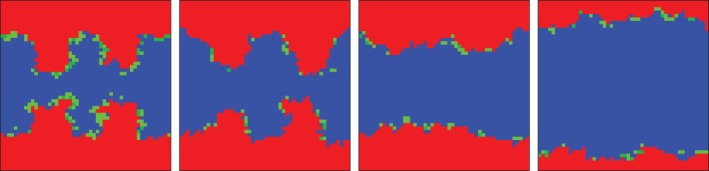
Interactions among living organisms, from bacteria colonies to human societies, are inherently more complex than interactions among particles and non-living matter. Group interactions are a particularly important and widespread class, representative of which is the public goods game. In addition, methods of statistical physics have proved valuable for studying pattern formation, equilibrium selection and self-organization in evolutionary games. Here, we review recent advances in the study of evolutionary dynamics of group interactions on top of structured populations, including lattices, complex networks and coevolutionary models. We also compare these results with those obtained on well-mixed populations. The review particularly highlights that the study of the dynamics of group interactions, like several other important equilibrium and non-equilibrium dynamical processes in biological, economical and social sciences, benefits from the synergy between statistical physics, network science and evolutionary game theory.
Overview
The claims and statistics of this paper haven’t been checked yet.
Run the check — free, no account needed. It reads the open-access text and checks the sources it cites.
Integrity signals
Registry
Cites
Statistics
Figures
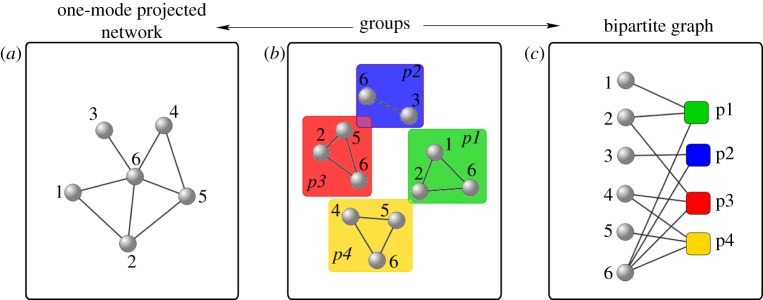
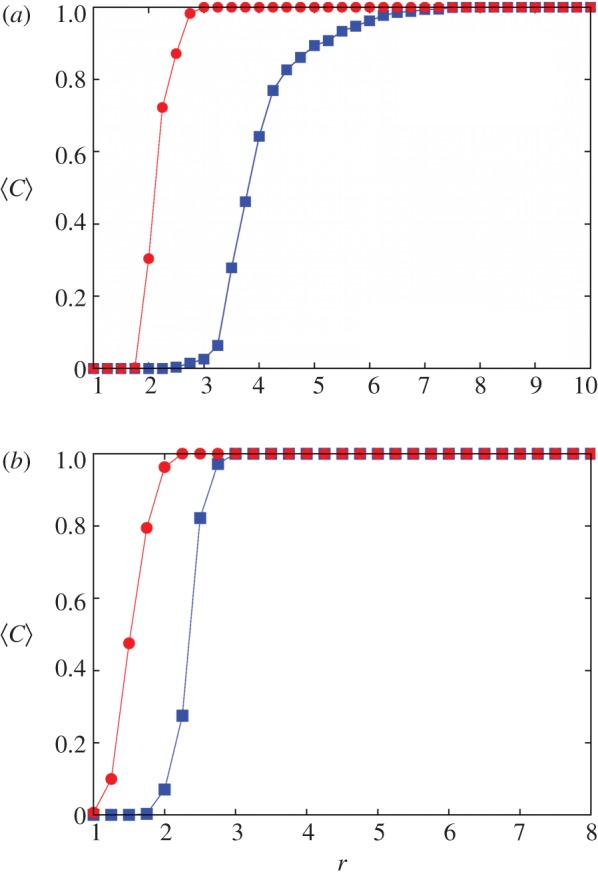
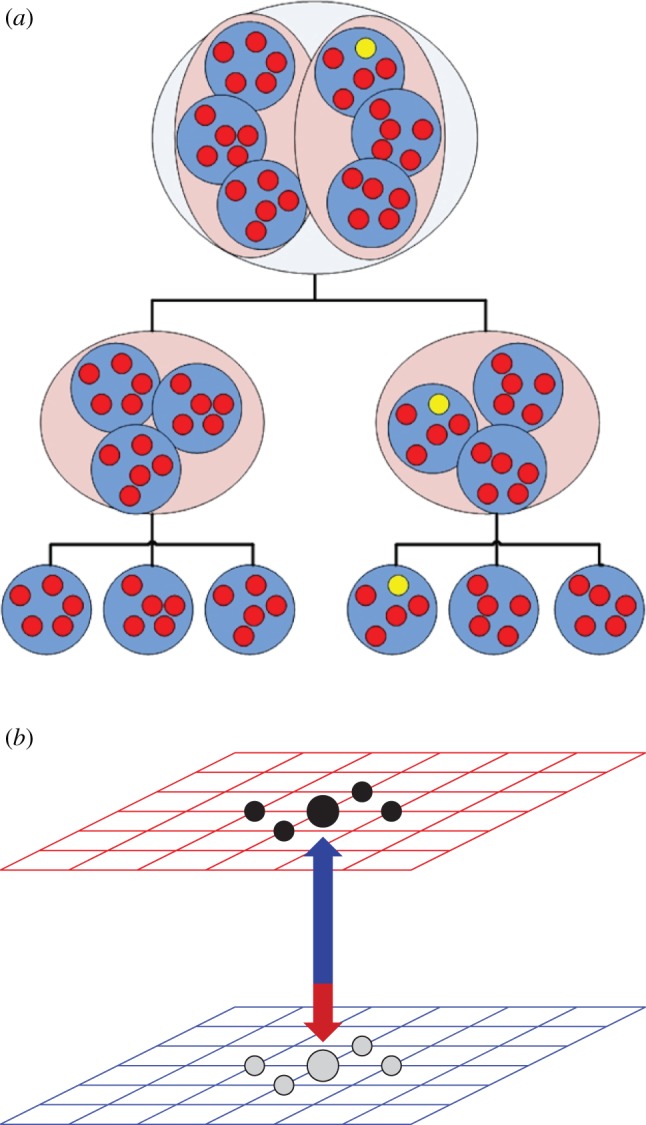
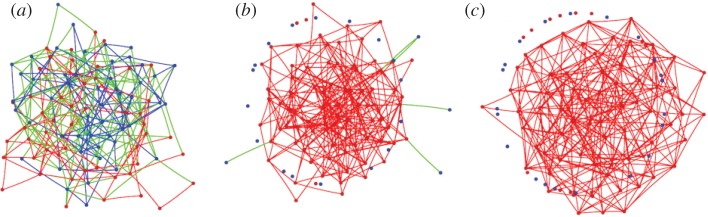
Verification
Claims the paper makes
The claims and statistics of this paper haven’t been checked yet.
Run the check — free, no account needed. It reads the open-access text and checks the sources it cites.
Claims other papers make about this one
Each is checked against this paper’s own text: does it say what the citing paper says it does?
In the citing paper
“Network agreements are fundamental since, without a change in in centives, in games of common goods, non-cooperative behaviors would empirically prevail, leading to the natural selection of, or adaptation into, non-cooperative agents (Burton-Chellew et al., 2015; Perc et al., 2013).”
From Win Together or Lose Alone: Circular Economy and Hybrid Governance for Natural Resource Commons (2024) · cites this paper as Perc et al., 2013
Self-check
Percentages, sums and reported differences re-computed from the paper’s own numbers.
The self-check needs the paper’s full text.
Citations
Cites
Social Network Analysis: Methods and Applications
Wasserman, S., & Faust, K. (1994) · doi:10.1017/cbo9780511815478 · Cited by 17,557
Cooperation and Punishment in Public Goods Experiments
Fehr, E., & Gächter, S. (2000) · American Economic Review · doi:10.1257/aer.90.4.980 · Cited by 4,547
Statistical physics of social dynamics
Castellano, C., Fortunato, S., & Loreto, V. (2009) · Reviews of Modern Physics · doi:10.1103/revmodphys.81.591 · Cited by 4,119
Evolutionary Dynamics: Exploring the Equations of Life
NOWAK, M. A. (2006) · doi:10.2307/j.ctvjghw98 · Cited by 2,438
A simple rule for the evolution of cooperation on graphs and social networks
Ohtsuki, H., Hauert, C., Lieberman, E., & Nowak, M. A. (2006) · Nature · doi:10.1038/nature04605 · Cited by 2,208
Antisocial Punishment Across Societies
Herrmann, B., Thöni, C., & Gächter, S. (2008) · Science · doi:10.1126/science.1153808 · Cited by 2,038
Reputation helps solve the ‘tragedy of the commons’
Milinski, M., Semmann, D., & Krambeck, H.-J. (2002) · Nature · doi:10.1038/415424a · Cited by 1,371
Indirect reciprocity can stabilize cooperation without the second-order free rider problem
Panchanathan, K., & Boyd, R. (2004) · Nature · doi:10.1038/nature02978 · Cited by 865
Dreber, A., Rand, D. G., Fudenberg, D., & Nowak, M. A. (2008) · Nature · doi:10.1038/nature06723 · Cited by 718
Sigmund, K. (2010) · doi:10.1515/9781400832255 · Cited by 570
The evolution of antisocial punishment in optional public goods games
Rand, D. G., & Nowak, M. A. (2011) · Nature Communications · doi:10.1038/ncomms1442 · Cited by 350
Fehr, E. (2004) · Nature · doi:10.1038/432449a · Cited by 219
Research works printed but not linked: 144
- Archetti,, 2012, Review: game theory of public goods in one-shot social dilemmas without assortment, J. Theor. Biol., 299, 9, 10.1016/j.jtbi.2011.06.018 · DOI
- Chuang,, 2009, Simpson's paradox in a synthetic microbial system, Science, 323, 272, 10.1126/science.1166739 · DOI
- Gore,, 2009, Snowdrift game dynamics and facultative cheating in yeast, Nature, 459, 253, 10.1038/nature07921 · DOI
- Chuang,, 2010, Cooperation and Hamilton's rule in a simple synthetic microbial system, Mol. Syst. Biol., 6, 398, 10.1038/msb.2010.57 · DOI
- Frey,, 2010, Evolutionary game theory: theoretical concepts and applications to microbial communities, Physica A, 389, 4265, 10.1016/j.physa.2010.02.047 · DOI
- Schuster,, 2011, Combining metabolic pathway analysis with evolutionary game theory. Explaining the occurrence of low-yield pathways by an analytic optimization approach, BioSystems, 105, 147, 10.1016/j.biosystems.2011.05.007 · DOI
- Archetti,, 2011, Contract theory for the evolution of cooperation: the right incentives attract the right partner, J. Theor. Biol., 269, 201, 10.1016/j.jtbi.2010.10.025 · DOI
- Cremer,, 2012, Growth dynamics and the evolution of cooperation in microbial populations, Sci. Rep., 2, 281, 10.1038/srep00281 · DOI
- Motro,, 1991, Co-operation and defection: playing the field and the ESS, J. Theor. Biol., 151, 145, 10.1016/S0022-5193(05)80358-3 · DOI
- Hardin,, 1968, The tragedy of the commons, Science, 162, 1243, 10.1126/science.162.3859.1243 · DOI · Paper page
- Hofbauer,, 1988, The theory of evolution and dynamical systems
- Gintis,, 2000, Game theory evolving
- Archetti,, 2011, Coexistence of cooperation and defection in public goods games, Evolution, 65, 1140, 10.1111/j.1558-5646.2010.01185.x · DOI
- Cressman,, 2012, Cooperation and evolutionary dynamics in the public goods game with institutional incentives, J. Theor. Biol., 299, 144, 10.1016/j.jtbi.2011.07.030 · DOI
- Peña,, 2012, Group-size diversity in public goods games, Evolution, 66, 623, 10.1111/j.1558-5646.2011.01504.x · DOI
- Nowak,, 1992, Evolutionary games and spatial chaos, Nature, 359, 826, 10.1038/359826a0 · DOI
- Floría,, 2009, Social network reciprocity as a phase transition in evolutionary cooperation, Phys. Rev. E, 79, 026106, 10.1103/PhysRevE.79.026106 · DOI
- Taylor,, 2000, Overlapping generations can promote altruistic behaviour, Evolution, 54, 1135, 10.1111/j.0014-3820.2000.tb00549.x · DOI
- Irwin,, 2000, Evolution of dispersal in a stepping-stone population with overlapping generations, Theor. Popul. Biol., 58, 321, 10.1006/tpbi.2000.1490 · DOI
- Irwin,, 2001, Evolution of altruism in stepping-stone populations with overlapping generations, Theor. Popul. Biol., 60, 315, 10.1006/tpbi.2001.1533 · DOI
- Szabó,, 2007, Evolutionary games on graphs, Phys. Rep., 446, 97, 10.1016/j.physrep.2007.04.004 · DOI
- Roca,, 2009, Evolutionary game theory: temporal and spatial effects beyond replicator dynamics, Phys. Life Rev., 6, 208, 10.1016/j.plrev.2009.08.001 · DOI
- Kessler,, 1993, Pattern formation in Dictyostelium via the dynamics of cooperative biological entities, Phys. Rev. E, 48, 4801, 10.1103/PhysRevE.48.4801 · DOI
- Iwasa,, 1998, Allelopathy of bacteria in a lattice population: competition between colicin sensitive and colicin-producing strains, Evol. Ecol., 12, 785, 10.1023/A:1006590431483 · DOI
- Szolnoki,, 2009, Topology-independent impact of noise on cooperation in spatial public goods games, Phys. Rev. E, 80, 056109, 10.1103/PhysRevE.80.056109 · DOI
- Huberman,, 1993, Evolutionary games and computer simulations, Proc. Natl Acad. Sci. USA, 90, 7716, 10.1073/pnas.90.16.7716 · DOI
- Szabó,, 2005, Phase diagrams for an evolutionary prisoner's dilemma game on two-dimensional lattices, Phys. Rev. E, 72, 047107, 10.1103/PhysRevE.72.047107 · DOI
- Vukov,, 2006, Cooperation in the noisy case: prisoner's dilemma game on two types of regular random graphs, Phys. Rev. E, 73, 067103, 10.1103/PhysRevE.73.067103 · DOI
- Szolnoki,, 2011, Group-size effects on the evolution of cooperation in the spatial public goods game, Phys. Rev. E, 84, 047102, 10.1103/PhysRevE.84.047102 · DOI
- Szabó,, 2009, Cooperation in spatial prisoner's dilemma with two types of players for increasing number of neighbors, Phys. Rev. E, 79, 016106, 10.1103/PhysRevE.79.016106 · DOI
- Isaac,, 1988, Group size effects in public goods provision: the voluntary contributions mechanism, Q. J. Econ., 103, 179, 10.2307/1882648 · DOI
- Shi,, 2010, Group diversity promotes cooperation in the spatial public goods game, EPL, 90, 58003, 10.1209/0295-5075/90/58003 · DOI
- Perc,, 2007, Does strong heterogeneity promote cooperation by group interactions? New J. Phys., 13, 123027, 10.1088/1367-2630/13/12/123027 · DOI
- Perc,, 2008, Social diversity and promotion of cooperation in the spatial prisoner's dilemma game, Phys. Rev. E, 77, 011904, 10.1103/PhysRevE.77.011904 · DOI
- Gao,, 2010, Diversity of contribution promotes cooperation in public goods games, Physica A, 389, 3166, 10.1016/j.physa.2010.04.018 · DOI
- Vukov,, 2011, Escaping the tragedy of the commons via directed investments, J. Theor. Biol., 287, 37, 10.1016/j.jtbi.2011.07.022 · DOI
- Cao,, 2010, Evolutionary public goods game on scale-free networks with heterogeneous investment, Physica A, 389, 1273, 10.1016/j.physa.2009.11.044 · DOI
- Peng,, 2010, Promotion of cooperation induced by nonuniform payoff allocation in spatial public goods game, Eur. Phys. J. B, 73, 455, 10.1140/epjb/e2010-00008-7 · DOI
- Lei,, 2010, Heterogeneity of allocation promotes cooperation in public goods games, Physica A, 389, 4708, 10.1016/j.physa.2010.06.002 · DOI
- Guan,, 2007, Effects of inhomogeneous activity of players and noise on cooperation in spatial public goods games, Phys. Rev. E, 76, 056101, 10.1103/PhysRevE.76.056101 · DOI
- Szolnoki,, 2007, Cooperation enhanced by inhomogeneous activity of teaching for evolutionary prisoner's dilemma games, EPL, 77, 30004, 10.1209/0295-5075/77/30004 · DOI
- Boza,, 2010, Beneficial laggards: multilevel selection, cooperative polymorphism and division of labour in threshold public good games, BMC Evol. Biol., 10, 336, 10.1186/1471-2148-10-336 · DOI
- Wang,, 2009, Emergence of social cooperation in threshold public good games with collective risk, Phys. Rev. E, 80, 016101, 10.1103/PhysRevE.80.016101 · DOI
- Deng,, 2011, Adaptive evolution of cooperation through Darwinian dynamics in public goods games, PLoS ONE, 6, 10.1371/journal.pone.0025496 · DOI
- Szolnoki,, 2010, Impact of critical mass on the evolution of cooperation in spatial public goods games, Phys. Rev. E, 81, 057101, 10.1103/PhysRevE.81.057101 · DOI
- Shi,, 2011, Depreciation of public goods in spatial public goods games, J. Stat. Mech., 2011, P10007, 10.1088/1742-5468/2011/10/P10007 · DOI
- Shi,, 2011, Effect of depreciation of the public goods in spatial public goods games, Physica A, 391, 1636, 10.1016/j.physa.2011.10.006 · DOI
- Wang,, 2010, Evolutionary dynamics of public goods games with diverse contributions in finite populations, Phys. Rev. E, 81, 056103, 10.1103/PhysRevE.81.056103 · DOI
- Fischbacher,, 2001, Are people conditionally cooperative? Evidence from a public goods experiment, Econ. Lett., 71, 397, 10.1016/S0165-1765(01)00394-9 · DOI · Paper page
- Szolnoki,, 2012, Conditional strategies and the evolution of cooperation in spatial public goods games, Phys. Rev. E, 85, 026104, 10.1103/PhysRevE.85.026104 · DOI
- Szabó,, 2002, Phase transitions and volunteering in spatial public goods games, Phys. Rev. Lett., 89, 118101, 10.1103/PhysRevLett.89.118101 · DOI
- Hauert,, 2002, Volunteering as red queen mechanism for cooperation in public goods game, Science, 296, 1129, 10.1126/science.1070582 · DOI
- Semmann,, 2003, Volunteering leads to rock-paper-scissors dynamics in a public goods game, Nature, 425, 390, 10.1038/nature01986 · DOI
- Hinrichsen,, 2000, Non-equilibrium critical phenomena and phase transitions into absorbing states, Adv. Phys., 49, 815, 10.1080/00018730050198152 · DOI
- Liggett,, 1985, Interacting particle systems, 10.1007/978-1-4613-8542-4 · DOI
- Helbing,, 2010, Evolutionary establishment of moral and double moral standards through spatial interactions, PLoS Comput. Biol., 6, e1000758, 10.1371/journal.pcbi.1000758 · DOI
- Helbing,, 2010, Punish, but not too hard: how costly punishment spreads in the spatial public goods game, New J. Phys., 12, 083005, 10.1088/1367-2630/12/8/083005 · DOI
- Helbing,, 2010, Defector-accelerated cooperativeness and punishment in public goods games with mutations, Phys. Rev. E, 81, 057104, 10.1103/PhysRevE.81.057104 · DOI
- Szolnoki,, 2011, Phase diagrams for the spatial public goods game with pool punishment, Phys. Rev. E, 83, 036101, 10.1103/PhysRevE.83.036101 · DOI
- Perc,, 2012, Sustainable institutionalized punishment requires elimination of second-order free-riders, Sci. Rep., 2, 344, 10.1038/srep00344 · DOI
- Szolnoki,, 2011, Competition of individual and institutional punishments in spatial public goods games, Phys. Rev. E, 84, 046106, 10.1103/PhysRevE.84.046106 · DOI
- Szolnoki,, 2010, Reward and cooperation in the spatial public goods game, EPL, 92, 38003, 10.1209/0295-5075/92/38003 · DOI
- Fowler,, 2005, Second-order free-riding problem solved?, Nature, 437, E8, 10.1038/nature04201 · DOI
- Perc,, 2012, Self-organization of punishment in structured populations, New J. Phys., 14, 043013, 10.1088/1367-2630/14/4/043013 · DOI
- Rand,, 2009, Positive interactions promote public cooperation, Science, 325, 1272, 10.1126/science.1177418 · DOI · Paper page
- Sigmund,, 2007, Punish or perish? Retaliation and collaboration among humans, Trends Ecol. Evol., 22, 593, 10.1016/j.tree.2007.06.012 · DOI
- Binder,, 1988, Monte Carlo simulations in statistical phyisics, 10.1007/978-3-662-08854-8 · DOI
- Landau,, 2000, A guide to Monte Carlo simulations in statistical physics
- Brandt,, 2003, Punishment and reputation in spatial public goods games, Proc. R. Soc. Lond. B, 270, 1099, 10.1098/rspb.2003.2336 · DOI
- Nakamaru,, 2005, Evolution of altruism by costly punishment in lattice-structured population: score-dependent viability versus score-dependent fertility, Evol. Ecol. Res., 7, 853
- Rand,, 2010, Anti-social punishment can prevent the co-evolution of punishment and cooperation, J. Theor. Biol., 265, 624, 10.1016/j.jtbi.2010.06.010 · DOI · Paper page
- Sigmund,, 2001, Reward and punishment, Proc. Natl Acad. Sci. USA, 98, 10.1073/pnas.161155698 · DOI · Paper page
- Hauert,, 2008, Public goods with punishment and abstaining in finite and infinite populations, Biol. Theor., 3, 114, 10.1162/biot.2008.3.2.114 · DOI
- Albert,, 2002, Statistical mechanics of complex networks, Rev. Mod. Phys., 74, 47, 10.1103/RevModPhys.74.47 · DOI · Paper page
- Newman,, 2003, The structure and function of complex networks, SIAM Rev., 45, 167, 10.1137/S003614450342480 · DOI · Paper page
- Boccaletti,, 2006, Complex networks: structure and dynamics, Phys. Rep., 424, 175, 10.1016/j.physrep.2005.10.009 · DOI · Paper page
- Clauset,, 2009, Power-law distributions in empirical data, SIAM Rev., 51, 661, 10.1137/070710111 · DOI · Paper page
- Santos,, 2005, Scale-free networks provide a unifying framework for the emergence of cooperation, Phys. Rev. Lett., 95, 098104, 10.1103/PhysRevLett.95.098104 · DOI
- Santos,, 2006, Graph topology plays a determinant role in the evolution of cooperation, Proc. R. Soc. B, 273, 51, 10.1098/rspb.2005.3272 · DOI
- Santos,, 2006, Evolutionary dynamics of social dilemmas in structured heterogeneous populations, Proc. Natl Acad. Sci. USA, 103, 3490, 10.1073/pnas.0508201103 · DOI
- Gómez-Gardeñes,, 2007, Dynamical organization of cooperation in complex networks, Phys. Rev. Lett., 98, 108103, 10.1103/PhysRevLett.98.108103 · DOI
- Gómez-Gardeñes,, 2008, Natural selection of cooperation and degree hierarchy in heterogeneous populations, J. Theor. Biol., 253, 296, 10.1016/j.jtbi.2008.03.007 · DOI
- Santos,, 2008, Social diversity promotes the emergence of cooperation in public goods games, Nature, 454, 213, 10.1038/nature06940 · DOI
- Abramson,, 2001, Social games in a social network, Phys. Rev. E, 63, 10.1103/PhysRevE.63.030901 · DOI
- Pusch,, 2008, Impact of topology on the dynamical organization of cooperation in the prisoner's dilemma game, Phys. Rev. E, 77, 036120, 10.1103/PhysRevE.77.036120 · DOI
- Assenza,, 2008, Enhancement of cooperation in highly clustered scale-free networks, Phys. Rev. E, 78, 017101, 10.1103/PhysRevE.78.017101 · DOI
- Devlin,, 2009, Cooperation in an evolutionary prisoner's dilemma with degree–degree correlations, Phys. Rev. E, 80, 026105, 10.1103/PhysRevE.80.026105 · DOI
- Rong,, 2009, Effect of the degree correlation in public goods game on scale-free networks, EPL, 87, 30001, 10.1209/0295-5075/87/30001 · DOI
- Rong,, 2010, Feedback reciprocity mechanism promotes the cooperation of highly clustered scale-free networks, Phys. Rev. E, 82, 047101, 10.1103/PhysRevE.82.047101 · DOI
- Yang,, 2009, Diversity-optimized cooperation on complex networks, Phys. Rev. E, 79, 056107, 10.1103/PhysRevE.79.056107 · DOI
- Li,, 2012, Selective investment promotes cooperation in public goods game, Physica A, 391, 3924, 10.1016/j.physa.2012.03.016 · DOI
- Zhang,, 2010, Evolutionary public goods games on scale-free networks with unequal payoff allocation mechanism, Physica A, 389, 1099, 10.1016/j.physa.2009.11.029 · DOI
- Yang,, 2012, Effects of aspiration on public cooperation in structured populations, Physica A, 391, 4043, 10.1016/j.physa.2012.03.018 · DOI
- Newman,, 2004, Coauthorship networks and patterns of scientific collaboration, Proc. Natl Acad. Sci. USA, 101, 5200, 10.1073/pnas.0307545100 · DOI
- Gómez-Gardeñes,, 2011, Evolutionary games defined at the network mesoscale: the public goods game, Chaos, 21, 016113, 10.1063/1.3535579 · DOI
- Ramasco,, 2004, Self-organization of collaboration networks, Phys. Rev. E, 70, 036106, 10.1103/PhysRevE.70.036106 · DOI
- Gómez-Gardeñes,, 2011, Disentangling social and group heterogeneities: public goods games on complex networks, EPL, 95, 68003, 10.1209/0295-5075/95/68003 · DOI
- Peña,, 2012, Bipartite graphs as models of population structures in evolutionary multiplayer games, PLoS ONE, 7, 10.1371/journal.pone.0044514 · DOI
- Wang,, 2011, Evolution of cooperation in multilevel public goods games with community structures, EPL, 93, 58001, 10.1209/0295-5075/93/58001 · DOI
- Wang,, 2012, Evolution of public cooperation on interdependent networks: the impact of biased utility functions, EPL, 97, 48001, 10.1209/0295-5075/97/48001 · DOI
- Buldyrev,, 2010, Catastrophic cascade of failures in interdependent networks, Nature, 464, 1025, 10.1038/nature08932 · DOI · Paper page
- Gao,, 2012, Networks formed from interdependent networks, Nat. Phys., 8, 40, 10.1038/nphys2180 · DOI
- Parshani,, 2010, Interdependent networks: reducing the coupling strength leads to a change from a first to second order percolation transition, Phys. Rev. Lett., 105, 048701, 10.1103/PhysRevLett.105.048701 · DOI · Paper page
- Gómez-Gardeñes,, 2012, Evolution of cooperation in multiplex networks, Sci. Rep., 2, 620, 10.1038/srep00620 · DOI
- Meloni,, 2009, Effects of mobility in a population of prisoner's dilemma players, Phys. Rev. E, 79, 067101, 10.1103/PhysRevE.79.067101 · DOI
- Chen,, 2011, Evolution of cooperation among mobile agents, Physica A, 390, 1615, 10.1016/j.physa.2011.01.004 · DOI
- Zhang,, 2011, Evolution of cooperation among mobile agents with heterogenous view radius, Physica A, 390, 2251, 10.1016/j.physa.2011.02.036 · DOI
- Cardillo,, 2012, Velocity-enhanced cooperation of moving agents playing public goods games, Phys. Rev. E, 85, 067101, 10.1103/PhysRevE.85.067101 · DOI
- Helbing,, 2009, The outbreak of cooperation among success-driven individuals under noisy conditions, Proc. Natl Acad. Sci. USA, 106, 3680, 10.1073/pnas.0811503106 · DOI
- Jiang,, 2010, Role of adaptive migration in promoting cooperation in spatial games, Phys. Rev. E, 81, 036108, 10.1103/PhysRevE.81.036108 · DOI
- Yang,, 2010, Role of aspiration-induced migration in cooperation, Phys. Rev. E, 81, 10.1103/PhysRevE.81.065101 · DOI
- Lin,, 2011, Promotion of cooperation by aspiration-induced migration, Physica A, 390, 77, 10.1016/j.physa.2010.07.034 · DOI
- Roca,, 2011, Emergence of social cohesion in a model society of greedy, mobile individuals, Proc. Natl Acad. Sci. USA, 108, 10.1073/pnas.1101044108 · DOI
- Cong,, 2012, Evolution of cooperation driven by reputation-based migration, PLoS ONE, 7, 10.1371/journal.pone.0035776 · DOI
- Xia,, 2012, Effects of environment knowledge on agglomeration and cooperation in spatial public goods games, Adv. Complex Syst., 15, 1250056, 10.1142/S0219525912500567 · DOI
- Chen,, 2012, Risk-driven migration and the collective-risk social dilemma, Phys. Rev. E, 86, 036101, 10.1103/PhysRevE.86.036101 · DOI
- Wang,, 2012, Percolation threshold determines the optimal population density for public cooperation, Phys. Rev. E, 85, 037101, 10.1103/PhysRevE.85.037101 · DOI
- Zhang,, 2011, The evolution of cooperation in spatial groups, Chaos Solitons Fractals, 44, 131, 10.1016/j.chaos.2011.01.002 · DOI
- Wu,, 2009, Individual's expulsion to nasty environment promotes cooperation in public goods games, EPL, 88, 30011, 10.1209/0295-5075/88/30011 · DOI
- Wu,, 2009, Partner selections in public goods games with constant group size, Phys. Rev. E, 80, 026121, 10.1103/PhysRevE.80.026121 · DOI
- Zhang,, 2011, Aspiration-induced reconnection in spatial public-goods game, EPL, 94, 18006, 10.1209/0295-5075/94/18006 · DOI
- Zhang,, 2011, Coevolving agent strategies and network topology for the public goods games, Eur. Phys. J. B, 80, 217, 10.1140/epjb/e2011-10470-2 · DOI
- Janssen,, 2006, Dynamic-persistence of cooperation in public good games when group size dynamic, J. Theor. Biol., 243, 134, 10.1016/j.jtbi.2006.06.012 · DOI
- Liu,, 2010, Heritability promotes cooperation in spatial public goods games, Physica A, 389, 5719, 10.1016/j.physa.2010.08.043 · DOI
- Shi,, 2009, Preferential selection promotes cooperation in spatial public goods game, Physica A, 388, 4646, 10.1016/j.physa.2009.07.031 · DOI
- Zhang,, 2012, Dynamic allocation of investments promotes cooperation in spatial public goods game, Physica A, 391, 2617, 10.1016/j.physa.2011.12.005 · DOI
- Perc,, 2011, Success-driven distribution of public goods promotes cooperation but preserves defection, Phys. Rev. E, 84, 037102, 10.1103/PhysRevE.84.037102 · DOI
- Perc,, 2010, Coevolutionary games: a mini review, BioSystems, 99, 109, 10.1016/j.biosystems.2009.10.003 · DOI
- Smaldino,, 2011, An institutional mechanism for assortment in an ecology of games, PLoS ONE, 6, 10.1371/journal.pone.0023019 · DOI
- Wakano,, 2007, Evolution of cooperation in spatial public goods games with common resource dynamics, J. Theor. Biol., 247, 616, 10.1016/j.jtbi.2007.04.008 · DOI
- Wakano,, 2009, Spatial dynamics of ecological public goods, Proc. Natl Acad. Sci. USA, 106, 7910, 10.1073/pnas.0812644106 · DOI
- Wakano,, 2011, Pattern formation and chaos in spatial ecological public goods games, J. Theor. Biol., 268, 30, 10.1016/j.jtbi.2010.09.036 · DOI
- Andreoni,, 2003, The carrot or the stick: rewards, punishments, cooperation, Am. Econ. Rev., 93, 893, 10.1257/000282803322157142 · DOI
- Hilbe,, 2010, Incentives and opportunism: from the carrot to the stick, Proc. R. Soc. B, 277, 2427, 10.1098/rspb.2010.0065 · DOI
- Gneezy,, 2012, Conflict, sticks and carrots: war increases prosocial punishments and rewards, Proc. R. Soc. B, 279, 219, 10.1098/rspb.2011.0805 · DOI
- Nakamaru,, 2006, The evolution of altruism and punishment: role of selfish punisher, J. Theor. Biol., 240, 475, 10.1016/j.jtbi.2005.10.011 · DOI
- Hauert,, 2010, Replicator dynamics of reward and reputation in public goods games, J. Theor. Biol., 267, 22, 10.1016/j.jtbi.2010.08.009 · DOI
- Semmann,, 2004, Strategic investment in reputation, Behav. Ecol. Sociobiol., 56, 248, 10.1007/s00265-004-0782-9 · DOI
- Santos,, 2011, Risk of collective failure provides an escape from the tragedy of the commons, Proc. Natl Acad. Sci. USA, 108, 10 421, 10.1073/pnas.1015648108 · DOI
- Van Segbroeck,, 2012, Emergence of fairness in repeated group interactions, Phys. Rev. Lett., 108, 158104, 10.1103/PhysRevLett.108.158104 · DOI
- Traulsen,, 2006, Evolution of cooperation by multilevel selection, Proc. Natl Acad. Sci. USA, 103, 10 952, 10.1073/pnas.0602530103 · DOI
- Bowles,, 2011, A cooperative species: human reciprocity and its evolution
- Hrdy,, 2011, Mothers and others: the evolutionary origins of mutual understanding, 10.2307/j.ctt1c84czb · DOI
- Nowak,, 2011, Supercooperators: altruism, evolution, and why we need each other to succeed
Cited by
Sorted by citations
The structure and dynamics of multilayer networks
Boccaletti, S., Bianconi, G., Criado, R., del Genio, C. I., Gómez-Gardeñes, J., Romance, M., Sendiña-Nadal, I., Wang, Z., & Zanin, M. (2014) · Physics Reports · doi:10.1016/j.physrep.2014.07.001 · Cited by 3,125
Self-citationDeterminants of residents' e-waste recycling behaviour intentions: evidence from China
Wang, Z., Guo, D., & Wang, X. (2016) · Journal of Cleaner Production · doi:10.1016/j.jclepro.2016.07.155 · Cited by 306
The Multilayer Connectome of Caenorhabditis elegans
Bentley, B., Branicky, R., Barnes, C. L., Chew, Y. L., Yemini, E., Bullmore, E. T., Vértes, P. E., & Schafer, W. R. (2016) · PLOS Computational Biology · doi:10.1371/journal.pcbi.1005283 · Cited by 269
Household food waste in Greece: A questionnaire survey
Ponis, S. T., Papanikolaou, P.-A., Katimertzoglou, P., Ntalla, A. C., & Xenos, K. I. (2017) · Journal of Cleaner Production · doi:10.1016/j.jclepro.2017.02.165 · Cited by 158
A Networked ${N}$ -Player Trust Game and Its Evolutionary Dynamics
Chica, M., Chiong, R., Kirley, M., & Ishibuchi, H. (2018) · IEEE Transactions on Evolutionary Computation · doi:10.1109/tevc.2017.2769081 · Cited by 95
Metadata
- Authors
- Perc, M., Gómez-Gardeñes, J., Szolnoki, A., Floría, L. M., & Moreno, Y.
- Affiliations
- 1
- 2
- 5
- 3
- Venue
- Journal of The Royal Society Interface
- Publisher
- The Royal Society
- Published
- 2013-03-06
- Volume
- 10
- Issue
- 80
- ISSN
- 1742-5689
- 1742-5662
- PMC
- PMC3565747
- Cited by
- 1,340
- References
- 12
- Language
- en
About these checks
Registry, retraction, Cites and statistics results are computed, not judged, with one exception: a printed reference that no index lists is read once by a model before it counts as a citation error. Claims are extracted by a model and kept only when their quote appears verbatim in the text; each cited source is then checked, with a model’s help, for whether it says what the claim relies on. Those verdicts can be wrong — read the claim’s quote and the cited source before relying on one.
Statistics and arithmetic are recomputed, not judged.
Confidence bands are shown only for fields calibrated on our annotated test set. None is calibrated yet, so no band is shown.
What counts as a claim ›How we measure confidence ›How we check this ›
Are you an author, or do you see a problem with this page? Request a review
