

The DOI matches its Crossref record; 221 of the 221 references it cites were found in a registry or an index.
Neural systems that facilitate the representation of social rank
Open accessAbstract
Across species, animals organize into social dominance hierarchies that serve to decrease aggression and facilitate survival of the group. Neuroscientists have adopted several model organisms to study dominance hierarchies in the laboratory setting, including fish, reptiles, rodents and primates. We review recent literature across species that sheds light onto how the brain represents social rank to guide socially appropriate behaviour within a dominance hierarchy. First, we discuss how the brain responds to social status signals. Then, we discuss social approach and avoidance learning mechanisms that we propose could drive rank-appropriate behaviour. Lastly, we discuss how the brain represents memories of individuals (social memory) and how this may support the maintenance of unique individual relationships within a social group. This article is part of the theme issue ‘The centennial of the pecking order: current state and future prospects for the study of dominance hierarchies’.
Overview
The claims and statistics of this paper haven’t been checked yet.
Run the check — free, no account needed. It reads the open-access text and checks the sources it cites.
Integrity signals
Registry
Cites
Statistics
Figures
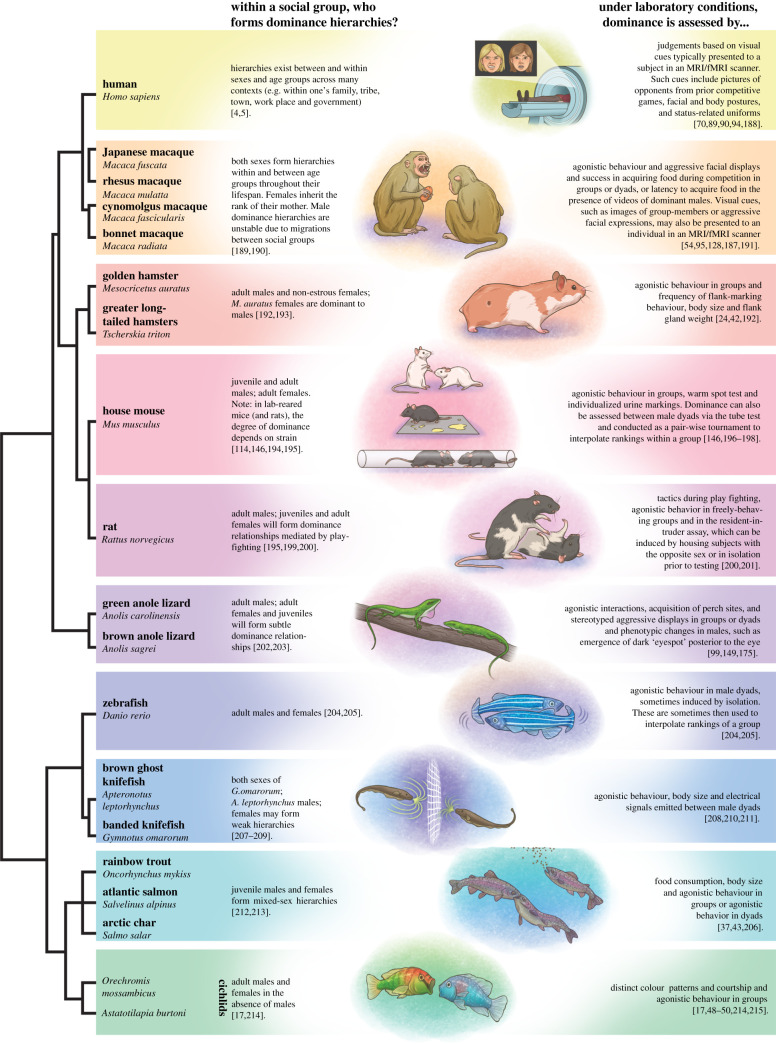
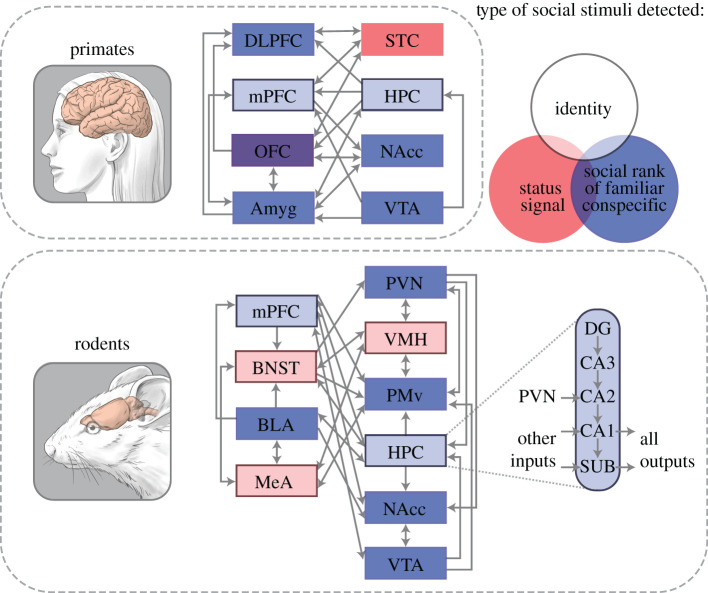
Verification
Claims the paper makes
The claims and statistics of this paper haven’t been checked yet.
Run the check — free, no account needed. It reads the open-access text and checks the sources it cites.
Claims other papers make about this one
Each is checked against this paper’s own text: does it say what the citing paper says it does?
The source backs part of the claim, not all of it — or backs it for a different population, condition or comparison.
In the citing paper
“Such transitions in social rank are associated with significant modifications to individual behavior and physiology [4–8].”
From Rapid changes in plasma corticosterone and medial amygdala transcriptome profiles during social status change reveal molecular pathways associated with a major life history transition in mouse dominance hierarchies (2025) · cites this paper as [4]
Experimental — accuracy not yet measured
Self-check
Percentages, sums and reported differences re-computed from the paper’s own numbers.
The self-check needs the paper’s full text.
Citations
Cites
Are the Dorsal and Ventral Hippocampus Functionally Distinct Structures?
Fanselow, M. S., & Dong, H.-W. (2010) · Neuron · doi:10.1016/j.neuron.2009.11.031 · Cited by 3,358
Social perception from visual cues: Role of the STS region
Allison, T., Puce, A., & McCarthy, G. (2000) · Trends in Cognitive Sciences · doi:10.1016/s1364-6613(00)01501-1 · Cited by 2,461
Essential role of BDNF in the mesolimbic dopamine pathway in social defeat stress
Berton, O., McClung, C. A., DiLeone, R. J., Krishnan, V., Renthal, W., Russo, S. J., Graham, D., Tsankova, N. M., Bolanos, C. A., Rios, M., et al. (2006) · Science · doi:10.1126/science.1120972 · Cited by 2,129
From circuits to behaviour in the amygdala
Janak, P. H., & Tye, K. M. (2015) · Nature · doi:10.1038/nature14188 · Cited by 2,011 · cited 1×
“It should be noted that other neuropeptides, serotonin and OT, are also important for social reward learning within this circuit in mice [59,60].”
BackgroundSelf-citationPreliminary analysis of functions of the temporal lobes in monkeys
KLÜVER, H. (1939) · Archives of Neurology And Psychiatry · doi:10.1001/archneurpsyc.1939.02270240017001 · Cited by 1,696 · cited 1×
“Human lesion studies, such as those characterizing Klüver– Bucy syndrome [55], further support the amygdala’s broad role in contextually appropriate social behaviour.”
BackgroundLeDoux, J., Iwata, J., Cicchetti, P., & Reis, D. (1988) · The Journal of Neuroscience · doi:10.1523/jneurosci.08-07-02517.1988 · Cited by 1,580
The contextual brain: implications for fear conditioning, extinction and psychopathology
Maren, S., Phan, K. L., & Liberzon, I. (2013) · Nature Reviews Neuroscience · doi:10.1038/nrn3492 · Cited by 1,547
The role of medial prefrontal cortex in memory and decision making
Euston, D. R., Gruber, A. J., & McNaughton, B. L. (2012) · Neuron · doi:10.1016/j.neuron.2012.12.002 · Cited by 1,541
Recognizing emotion from facial expressions: psychological and neurological mechanisms
Adolphs, R. (2002) · Behavioral and Cognitive Neuroscience Reviews · doi:10.1177/1534582302001001003 · Cited by 1,432
The lateral amygdaloid nucleus: sensory interface of the amygdala in fear conditioning
LeDoux, J., Cicchetti, P., Xagoraris, A., & Romanski, L. (1990) · The Journal of Neuroscience · doi:10.1523/jneurosci.10-04-01062.1990 · Cited by 1,167
Research works printed but not linked: 2
- Senar, 2006, Bird colors as intrasexual signals of aggression and dominance, 87
- Maynard-Smith, 2003, Animal signals, 10.1093/oso/9780198526841.001.0001 · DOI · Paper page
Cited by
Sorted by citations
Neural mechanism underlying depressive-like state associated with social status loss
Fan, Z., Chang, J., Liang, Y., Zhu, H. L., Zhang, C., Zheng, D., Wang, J., Xu, Y., Li, Q.-J., & Hu, H. (2023) · Cell · doi:10.1016/j.cell.2022.12.033 · Cited by 149
Behavioural and physiological plasticity in social hierarchies
Milewski, T. M., Lee, W., Champagne, F. A., & Curley, J. P. (2022) · Philosophical Transactions of the Royal Society B · doi:10.1098/rstb.2020.0443 · Cited by 105
Self-citationThe cognitive impact of light: illuminating ipRGC circuit mechanisms
Mahoney, H. L., & Schmidt, T. M. (2024) · Nature reviews. Neuroscience · doi:10.1038/s41583-023-00788-5 · Cited by 83
Dynamic influences on the neural encoding of social valence
Padilla-Coreano, N., Tye, K. M., & Zelikowsky, M. (2022) · Nature reviews. Neuroscience · doi:10.1038/s41583-022-00609-1 · Cited by 59
Self-citationStrauss, E. D., Curley, J. P., Shizuka, D., & Hobson, E. A. (2022) · Philosophical Transactions of the Royal Society B Biological Sciences · doi:10.1098/rstb.2020.0432 · Cited by 62
Self-citation
Metadata
- Authors
- Dwortz, M. F., Curley, J. P., Tye, K. M., & Padilla-Coreano, N.
- Affiliations
- Institute for Neuroscience (CH)
- The University of Texas at Austin (US)
- Salk Institute for Biological Studies (US)
- Corresponding author
- Padilla-Coreano, Nancy
- Venue
- Philosophical Transactions of the Royal Society B
- Publisher
- The Royal Society
- Published
- 2022-01-10
- Volume
- 377
- Issue
- 1845
- Pages
- 20200444-20200444
- ISSN
- 0962-8436 (ISSN-L)
- 1471-2970
- PMC
- PMC8743891
- OpenAlex
- W4206698489
- Cited by
- 64
- References
- 216
- Citations by year
- 2026: 7 · 2025: 11 · 2024: 15 · 2023: 21 · 2022: 10
- FWCI
- 2.13
- Type
- journal article
- Language
- en
- Open access
- hybrid
- doi.org
- Licence
- Locations
- Philosophical Transactions of the Royal Society B Biological Sciences (publishedVersion, cc-by)
- PubMed Central (publishedVersion, cc-by)
- PubMed (publishedVersion)
- Funders
- National Center for Complementary and Integrative Health (DP1-502 AT009925)
- Burroughs Wellcome Fund
- National Institute of Mental Health (K99 MH124435, R01-MH115920)
- Topics
- Life Sciences › Neuroscience › Endocrine and Autonomic Systems › Neuroendocrine regulation and behavior
- Life Sciences › Agricultural and Biological Sciences › Ecology, Evolution, Behavior and Systematics › Primate Behavior and Ecology
- Life Sciences › Neuroscience › Cognitive Neuroscience › Memory and Neural Mechanisms
- Keywords
- social dominance hierarchy, social rank, social memory, individual recognition, pecking order, aggression, comparative neurobiology
- MeSH terms
- Aggression, Animals, Hierarchy, Social, Social Dominance
About these checks
Registry, retraction, Cites and statistics results are computed, not judged, with one exception: a printed reference that no index lists is read once by a model before it counts as a citation error. Claims are extracted by a model and kept only when their quote appears verbatim in the text; each cited source is then checked, with a model’s help, for whether it says what the claim relies on. Those verdicts can be wrong — read the claim’s quote and the cited source before relying on one.
Statistics and arithmetic are recomputed, not judged.
Confidence bands are shown only for fields calibrated on our annotated test set. None is calibrated yet, so no band is shown.
What counts as a claim ›How we measure confidence ›How we check this ›
Are you an author, or do you see a problem with this page? Request a review
