

The DOI matches its Crossref record; 27 of the 27 references it cites were found in a registry or an index.
Genomic characterization of a novel SARS-CoV-2 lineage from Rio de Janeiro, Brazil
Open accessPreprint — published as 10.1128/jvi.00119-21 · Paper page
Abstract
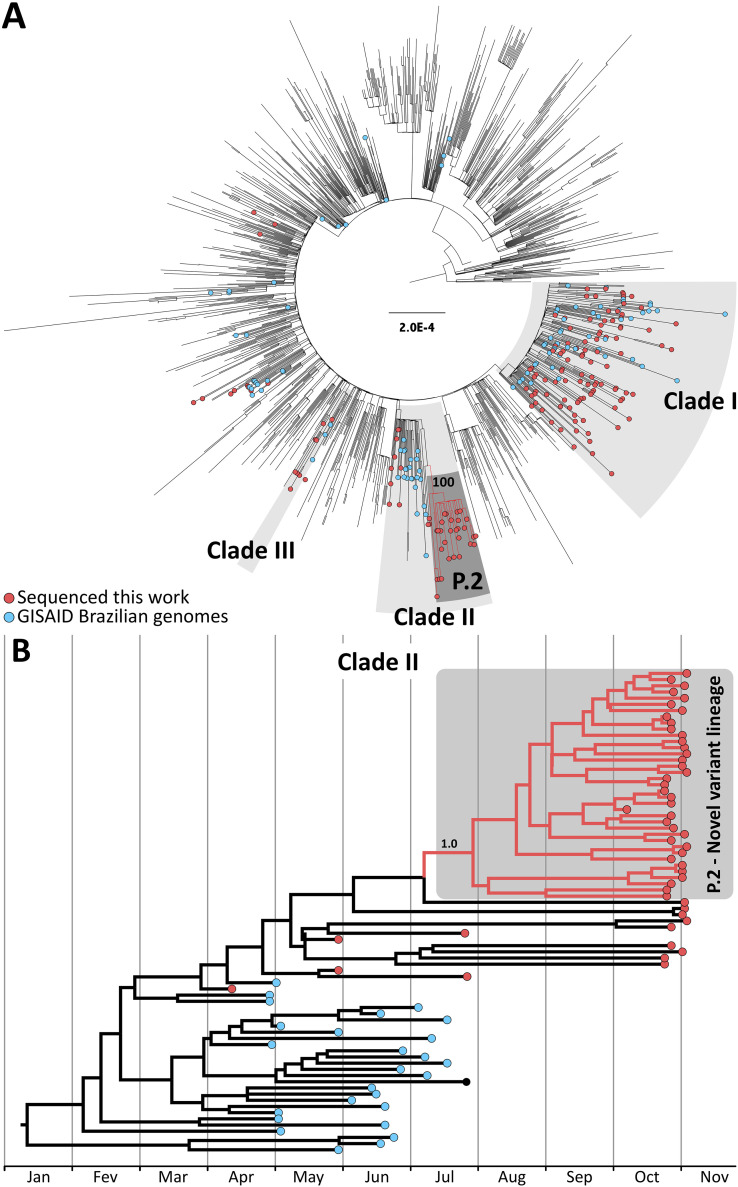
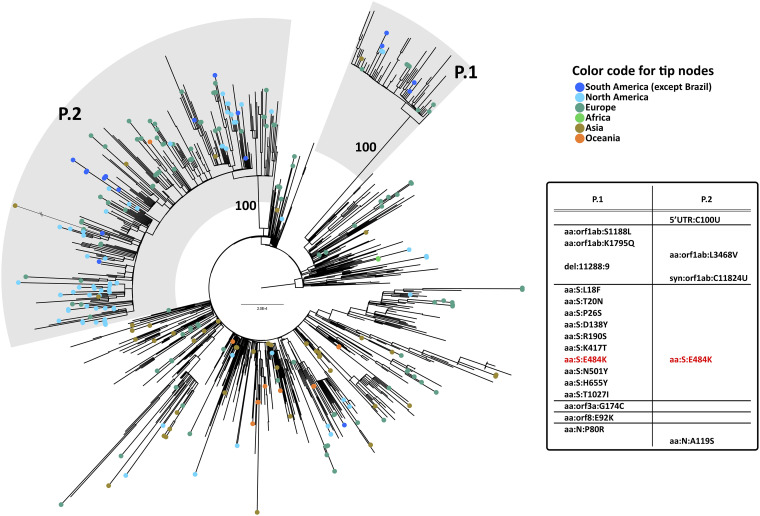
In this study, we report the sequencing of 180 new viral genomes obtained from different municipalities of the state of Rio de Janeiro from April to December 2020. We identified a novel lineage of SARS-CoV-2, originated from B.1.1.28, distinguished by five single-nucleotide variants (SNVs): C100U, C28253U, G28628U, G28975U, and C29754U. The SNV G23012A (E484K), in the receptor-binding domain of Spike protein, was widely spread across the samples. This mutation was previously associated with escape from neutralizing antibodies against SARS-CoV-2. This novel lineage emerged in late July being first detected by us in late October and still mainly restricted to the capital of the state. However, as observed for other strains it can be rapidly spread in the state. The significant increase in the frequency of this lineage raises concerns about public health management and continuous need for genomic surveillance during the second wave of infections. Article Summary Line: We identified a novel circulating lineage of SARS-CoV-2 in the state of Rio de Janeiro Brazil originated from B.1.1.28 lineage.
Overview
The claims and statistics of this paper haven’t been checked yet.
Run the check — free, no account needed. It reads the open-access text and checks the sources it cites.
Integrity signals
Registry
Cites
Statistics
Figures
Verification
Claims the paper makes
The claims and statistics of this paper haven’t been checked yet.
Run the check — free, no account needed. It reads the open-access text and checks the sources it cites.
Claims other papers make about this one
Each is checked against this paper’s own text: does it say what the citing paper says it does?
In the citing paper
“Additionally, K417N, Y453F, S477R, N501Y, and D614G represent circulating variants some of which have been associated with rapidly increasing case numbers14,15,19,33–35.”
From mRNA vaccine-elicited antibodies to SARS-CoV-2 and circulating variants (2021) · cites this paper as [35]
Self-check
Percentages, sums and reported differences re-computed from the paper’s own numbers.
The self-check needs the paper’s full text.
Citations
Cites
Trimmomatic: a flexible trimmer for Illumina sequence data
Bolger, A. M., Lohse, M., & Usadel, B. (2014) · Bioinformatics · doi:10.1093/bioinformatics/btu170 · Cited by 65,548
BEDTools: a flexible suite of utilities for comparing genomic features
Quinlan, A. R., & Hall, I. M. (2010) · Bioinformatics · doi:10.1093/bioinformatics/btq033 · Cited by 27,437
IQ-TREE 2: New Models and Efficient Methods for Phylogenetic Inference in the Genomic Era
Minh, B. Q., Schmidt, H. A., Chernomor, O., Schrempf, D., Woodhams, M. D., von Haeseler, A., & Lanfear, R. (2020) · Molecular Biology and Evolution · doi:10.1093/molbev/msaa015 · Cited by 16,873
A framework for variation discovery and genotyping using next-generation DNA sequencing data
DePristo, M. A., Banks, E., Poplin, R. E., Garimella, K. V., Maguire, J., Hartl, C., Philippakis, A., del Angel, G., Rivas, M. A., Hanna, M., et al. (2011) · Nature Genetics · doi:10.1038/ng.806 · Cited by 11,457
Posterior summarization in Bayesian phylogenetics using tracer 1.7
Rambaut, A., Drummond, A. J., Xie, D., Baele, G., & Suchard, M. A. (2018) · Systematic Biology · doi:10.1093/sysbio/syy032 · Cited by 11,159
Application of Phylogenetic Networks in Evolutionary Studies
Huson, D. H., & Bryant, D. (2005) · Molecular Biology and Evolution · doi:10.1093/molbev/msj030 · Cited by 8,895
Dating of the human–ape splitting by a molecular clock of mitochondrial DNA.
Hasegawa, M., Kishino, H., & Yano, T.-A. (1985) · Journal of Molecular Evolution · doi:10.1007/bf02101694 · Cited by 8,687
adegenet : a R package for the multivariate analysis of genetic markers
Jombart, T. (2008) · Bioinformatics · doi:10.1093/bioinformatics/btn129 · Cited by 8,335
Li, H. (2011) · Bioinformatics · doi:10.1093/bioinformatics/btr509 · Cited by 6,454
Bayesian phylogenetic and phylodynamic data integration using BEAST 1.10
Suchard, M. A., Lemey, P., Baele, G., Ayres, D. L., Drummond, A. J., & Rambaut, A. (2018) · Virus Evolution · doi:10.1093/ve/vey016 · Cited by 3,749
adegenet 1.3-1 : new tools for the analysis of genome-wide SNP data
Jombart, T., & Ahmed, I. (2011) · Bioinformatics · doi:10.1093/bioinformatics/btr521 · Cited by 3,233
(1986) · Cited by 2,570
Tegally, H., Wilkinson, E., Giovanetti, M., Iranzadeh, A., Fonseca, V., Giandhari, J., Doolabh, D., Pillay, S., San, E. J., Msomi, N., et al. (2020) · doi:10.1101/2020.12.21.20248640 · Cited by 2,535
Exploring the temporal structure of heterochronous sequences using TempEst (formerly Path-O-Gen)
Rambaut, A., Lam, T. T., Carvalho, L. M., & Pybus, O. G. (2016) · Virus Evolution · doi:10.1093/ve/vew007 · Cited by 2,048
Bayesian Phylogeography Finds Its Roots
Lemey, P., Rambaut, A., Drummond, A. J., & Suchard, M. A. (2009) · PLoS Computational Biology · doi:10.1371/journal.pcbi.1000520 · Cited by 1,784
A Simple and Robust Statistical Test for Detecting the Presence of Recombination
Bruen, T. C., Philippe, H., & Bryant, D. (2006) · Genetics · doi:10.1534/genetics.105.048975 · Cited by 1,366
Greaney, A. J., Loes, A. N., Crawford, K. H. D., Starr, T. N., Malone, K. D., Chu, H. Y., & Bloom, J. D. (2021) · doi:10.1101/2020.12.31.425021 · Cited by 1,178 · cited 1×
“(8, 9) emphasize the importance of monitoring the spread of this new strain.”
BackgroundGreaney, A. J., Starr, T. N., Gilchuk, P., Zost, S. J., Binshtein, E., Loes, A. N., Hilton, S. K., Huddleston, J., Eguia, R., Crawford, K. H. D., et al. (2021) · Cell Host & Microbe · doi:10.1016/j.chom.2020.11.007 · Cited by 1,016
Phylogeography Takes a Relaxed Random Walk in Continuous Space and Time
Lemey, P., Rambaut, A., Welch, J. J., & Suchard, M. A. (2010) · Molecular Biology and Evolution · doi:10.1093/molbev/msq067 · Cited by 687
SpreaD3: Interactive Visualization of Spatiotemporal History and Trait Evolutionary Processes
Bielejec, F., Baele, G., Vrancken, B., Suchard, M. A., Rambaut, A., & Lemey, P. (2016) · Molecular Biology and Evolution · doi:10.1093/molbev/msw082 · Cited by 593
Evolution and epidemic spread of SARS-CoV-2 in Brazil
Candido, D. S., Claro, I. M., de Jesus, J. G., Souza, W. M., Moreira, F. R. R., Dellicour, S., Mellan, T. A., du Plessis, L., Pereira, R. H. M., Sales, F. C. S., et al. (2020) · Science · doi:10.1126/science.abd2161 · Cited by 573 · cited 2×
“Interestingly, this division of three clades was also observed in Brazil during the beginning of the SARS-CoV-2 pandemic (1).”
BackgroundSelf-citationEmergence and spread of a SARS-CoV-2 variant through Europe in the summer of 2020Preprint
Hodcroft, E. B., Zuber, M., Nadeau, S., Vaughan, T. G., Crawford, K. H. D., Althaus, C. L., Reichmuth, M. L., Bowen, J. E., Walls, A. C., Corti, D., et al. (2020) · medRxiv · doi:10.1101/2020.10.25.20219063 · Cited by 326
Improving SNP discovery by base alignment quality
Li, H. (2011) · Bioinformatics · doi:10.1093/bioinformatics/btr076 · Cited by 321
Dellicour, S., Durkin, K., Hong, S. L., Vanmechelen, B., Martí‐Carreras, J., Gill, M. S., Meex, C., Bontems, S., André, E., Gilbert, M., et al. (2020) · Molecular Biology and Evolution · doi:10.1093/molbev/msaa284 · Cited by 92
Author response: Escape from neutralizing antibodies by SARS-CoV-2 spike protein variants
Weisblum, Y., Schmidt, F., Zhang, F., DaSilva, J., Poston, D., Lorenzi, J. C., Muecksch, F., Rutkowska, M., Hoffmann, H.-H., Michailidis, E., et al. (2020) · eLife · doi:10.7554/elife.61312.sa2 · Cited by 53
Deng, X., Gu, W. J., Federman, S., et al. (2020) · medRxiv · doi:10.1101/2020.03.27.20044925 · Cited by 36
Intra-host evolution during SARS-CoV-2 persistent infectionPreprint
Voloch, C., F, R. D. S., de Almeida, L. D., et al. (2020) · medRxiv · doi:10.1101/2020.11.13.20231217 · Cited by 15
Self-citation
Cited by
Sorted by citations
SARS-CoV-2 variants, spike mutations and immune escape
Harvey, W. T., Carabelli, A. M., Jackson, B., Gupta, R. K., Thomson, E. C., Harrison, E. M., Ludden, C., Reeve, R., Rambaut, A., COVID-19 Genomics UK (COG-UK) Consortium, et al. (2021) · Nature Reviews Microbiology · doi:10.1038/s41579-021-00573-0 · Cited by 3,528
Mechanisms of SARS-CoV-2 entry into cells
Jackson, C. B., Farzan, M., Chen, B., & Choe, H. (2022) · Nature Reviews Molecular Cell Biology · doi:10.1038/s41580-021-00418-x · Cited by 3,022
Genomics and epidemiology of the P.1 SARS-CoV-2 lineage in Manaus, Brazil
Faria, N. R., Mellan, T. A., Whittaker, C., Claro, I. M., Candido, D. D. S., Mishra, S., Crispim, M. A. E., Sales, F. C. S., Hawryluk, I., McCrone, J. T., et al. (2021) · Science · doi:10.1126/science.abh2644 · Cited by 1,461
mRNA vaccine-elicited antibodies to SARS-CoV-2 and circulating variants
Wang, Z., Schmidt, F., Weisblum, Y., Muecksch, F., Barnes, C. O., Finkin, S., Schaefer-Babajew, D., Cipolla, M., Gaebler, C., Lieberman, J. A., et al. (2021) · Nature · doi:10.1038/s41586-021-03324-6 · Cited by 1,343
Greaney, A. J., Loes, A. N., Crawford, K. H. D., Starr, T. N., Malone, K. D., Chu, H. Y., & Bloom, J. D. (2021) · Cell Host & Microbe · doi:10.1016/j.chom.2021.02.003 · Cited by 1,178
“In particular, our results predict that the emerging 20H/501Y.V2 and 20J/501Y.V3 viral lineages (originally identified in South Africa and Brazil, respectively) carrying the E484K mutation will have reduced susceptibility to neutralization by the polyclonal plasma antibodies of some individuals.”
Influential
Metadata
- Authors
- Voloch, C. M., Silva F, R. D., de Almeida, L. G. P., Cardoso, C. C., Brustolini, O. J., Gerber, A. L., Guimarães, A. P. D. C., Mariani, D., Costa, R. M. D., Ferreira, O. C., Workgroup, C.-U., LNCC-Workgroup, Cavalcanti, A. C., Frauches, T. S., de Mello, C. M. B., Galliez, R. M., Faffe, D. S., Castiñeiras, T. M. P. P., Tanuri, A., & de Vasconcelos, A. T. R.
- Affiliations
- Universidade Federal do Rio de Janeiro (BR)
- Laboratório Nacional de Computação Científica (BR)
- Secretaria de Estado de Saúde do Rio de Janeiro (BR)
- ORCID
- Venue
- Journal of Virology
- Publisher
- openRxiv
- Published
- 2020-12-26
- Volume
- 95
- Issue
- 10
- ISSN
- 0022-538X (ISSN-L)
- PMC
- PMC8139668
- OpenAlex
- W3135409471
- Cited by
- 372
- References
- 31
- Citations by year
- 2026: 5 · 2025: 8 · 2024: 25 · 2023: 34 · 2022: 93 · 2021: 206
- FWCI
- 28.43
- Type
- journal article
- Language
- en
- Open access
- hybrid
- doi.org
- Licence
- cc-by
- Locations
- Journal of Virology (publishedVersion, cc-by)
- medRxiv (acceptedVersion)
- PubMed Central (publishedVersion, cc-by)
- PubMed (publishedVersion)
- Funders
- Ministério da Ciência, Tecnologia e Inovação (01.20.0029.000462/20, 303170/2017-4, 404096/2020-4)
- Conselho Nacional de Desenvolvimento Científico e Tecnológico (= 404,096/2020–4, # 303170/2017-4)
- Fundação Carlos Chagas Filho de Amparo à Pesquisa do Estado do Rio de Janeiro (E-26/202.791/2019, E-26/010.002278/2019, E-26/, E‐26/210.178/2020, E-26/210, =E-26/210.179/2020, E-26/202.903/20, E-26/010.002434/2019)
- Financiadora de Estudos e Projetos (01.20.0029.000462/20)
- Instituto Serrapilheira
- Topics
- Health Sciences › Medicine › Infectious Diseases › SARS-CoV-2 and COVID-19 Research
- Health Sciences › Medicine › Infectious Diseases › COVID-19 Clinical Research Studies
- Health Sciences › Medicine › Infectious Diseases › SARS-CoV-2 detection and testing
- Keywords
- SARS-CoV-2, novel viral lineages, genomic profiling, phylogenetic analysis, genetic divergence, Rio de Janeiro, COVID-19 pandemic
About these checks
Registry, retraction, Cites and statistics results are computed, not judged, with one exception: a printed reference that no index lists is read once by a model before it counts as a citation error. Claims are extracted by a model and kept only when their quote appears verbatim in the text; each cited source is then checked, with a model’s help, for whether it says what the claim relies on. Those verdicts can be wrong — read the claim’s quote and the cited source before relying on one.
Statistics and arithmetic are recomputed, not judged.
Confidence bands are shown only for fields calibrated on our annotated test set. None is calibrated yet, so no band is shown.
What counts as a claim ›How we measure confidence ›How we check this ›
Are you an author, or do you see a problem with this page? Request a review
