

Early effectiveness of COVID-19 vaccination with BNT162b2 mRNA vaccine and ChAdOx1 adenovirus vector vaccine on symptomatic disease, hospitalisations and mortality in older adults in England
Open accessPreprint — published as 10.1136/bmj.n1088 · Paper page
The DOI matches its Crossref record; 26 of the 26 references it cites were found in a registry or an index.
Abstract
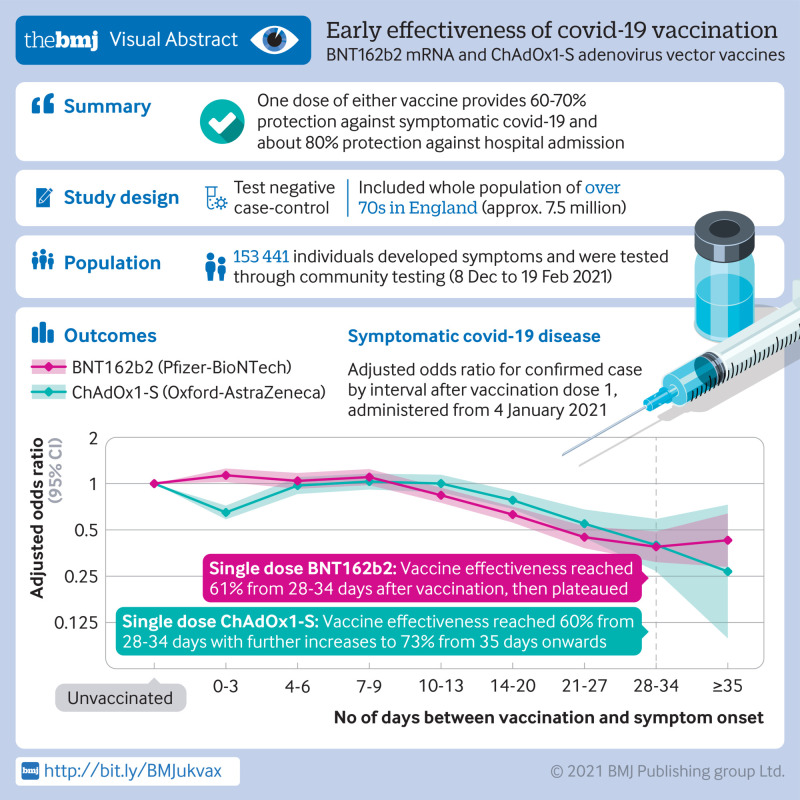
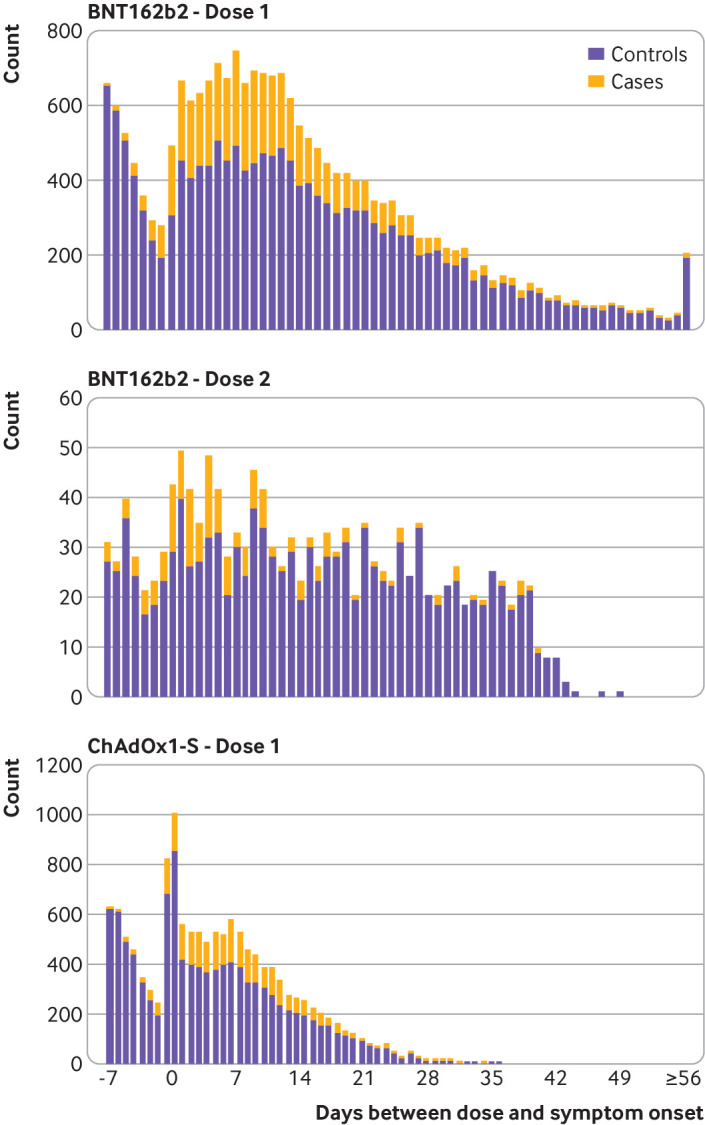
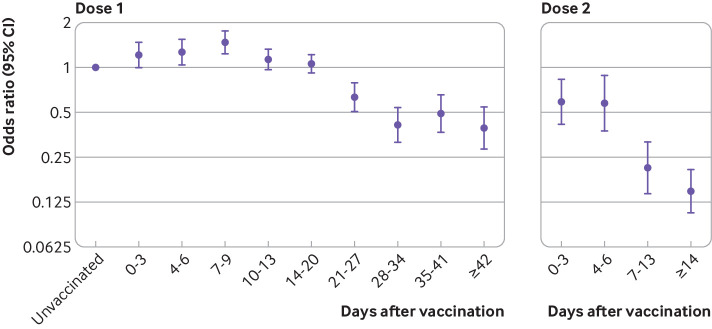
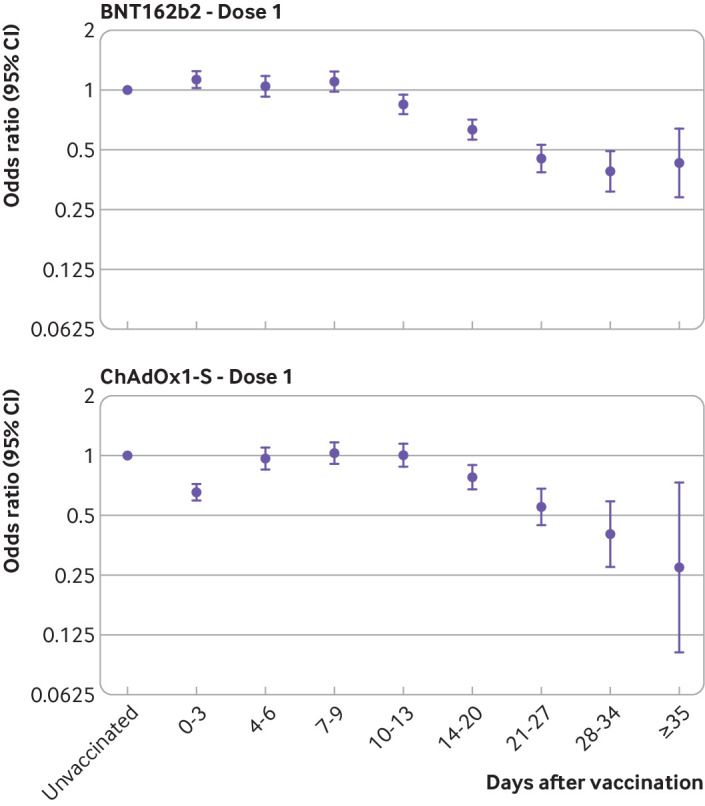
Objectives: To estimate the real-world effectiveness of the Pfizer/BioNTech BNT162b2 vaccine and Astrazeneca ChAdOx1 vaccine against Confirmed COVID-19, hospitalisations and deaths. To estimate effectiveness on the UK variant of concern. Design: Test negative case control design Setting: Community COVID-19 PCR testing in England Participants: All adults in England aged 70 years and older (over 7.5 million). All COVID-19 testing in the community among eligible individuals who reported symptoms between 8 th December 2020 and 19 th February 2021 was included in the analysis. Interventions: One and two doses of BNT162b2 vaccine. One dose of ChAdOx1 vaccine. Main outcome measures: Symptomatic PCR confirmed SARS-CoV-2 infection, hospitalisations and deaths with COVID-19. Results: Individuals aged >=80 years vaccinated with BNT162b2 prior to 4 th January, had a higher odds of testing positive in the first 9 days after vaccination (odds ratio up to 1.48, 95%CI 1.23-1.77), indicating that those initially targeted had a higher underlying risk of infection. Vaccine effectiveness was therefore estimated relative to the baseline post-vaccination period. Vaccine effects were noted from 10-13 days after vaccination, reaching an effectiveness of 70% (95% CI 59-78%) from 28-34 days, then plateauing. From 14 days after the second dose a vaccine effectiveness of 89% (95%CI: 85-93%) was seen. Individuals aged >=70 years vaccinated from 4 th January had a similar underlying risk of COVID-19 to unvaccinated individuals. With BNT162b2, vaccine effectiveness reached 61% (95%CI 51-69%) from 28-34 days after vaccination then plateaued. With the ChAdOx1 vaccine, vaccine effects were seen from 14-20 days after vaccination reaching an effectiveness of 60% (95%CI 41-73%) from 28-34 days and further increasing to 73% (95%CI 27-90%) from day 35 onwards. On top of the protection against symptomatic disease, cases who had been vaccinated with one dose of BNT162b2 had an additional 43% (95%CI 33-52%) lower risk of emergency hospitalisation and an additional 51% (95%CI 37-62%) lower risk of death. Cases who had been vaccinated with one dose of ChAdOx1 had an additional 37% (95% CI 3-59%) lower risk of emergency hospitalisation. There was insufficient follow-up to assess the effect of ChAdOx1 on mortality due to the later rollout of this vaccine. Combined with the effect against symptomatic disease, this indicates that a single dose of either vaccine is approximately 80% effective at preventing hospitalisation and a single dose of BNT162b2 is 85% effective at preventing death with COVID-19. Conclusion: Vaccination with either a single dose of BNT162b2 or ChAdOx1 COVID-19 vaccination was associated with a significant reduction in symptomatic SARS-CoV2 positive cases in older adults with even greater protection against severe disease. Both vaccines show similar effects. Protection was maintained for the duration of follow-up (>6 weeks). A second dose of BNT162b2 provides further protection against symptomatic disease but second doses of ChAdOx1 have not yet been rolled out in England. There is a clear effect of the vaccines against the UK variant of concern.
Overview
The claims and statistics of this paper haven’t been checked yet.
Free: it reads the open-access text and checks the first 5 claims that cite a source we can check. Create a free account to check every claim.
Integrity signals
Registry
Cites
Statistics
Figures
Verification
Claims the paper makes
The claims and statistics of this paper haven’t been checked yet.
Free: it reads the open-access text and checks the first 5 claims that cite a source we can check. Create a free account to check every claim.
Claims other papers make about this one
Each is checked against this paper’s own text: does it say what the citing paper says it does?
The source backs part of the claim, not all of it — or backs it for a different population, condition or comparison.
In the citing paper
“In the meantime, vaccine rollout in the UK has enabled planning subsequent gradual release of NPIs38,39.”
From Modeling vaccination rollouts, SARS-CoV-2 variants and the requirement for non-pharmaceutical interventions in Italy (2021) · cites this paper as [38]
Experimental — accuracy not yet measuredThe source backs part of the claim, not all of it — or backs it for a different population, condition or comparison.
In the citing paper
“more than 29 million people have received at least one vaccine dose as of 25 March, which has reduced deaths and hospital admissions38.”
From Modeling vaccination rollouts, SARS-CoV-2 variants and the requirement for non-pharmaceutical interventions in Italy (2021) · cites this paper as [38]
Experimental — accuracy not yet measuredThe cited source says what the claim attributes to it.
In the citing paper
“However, given that strong reductions in COVID hospitalisations after vaccination were observed in nationwide studies in Scotland12 and England,11 we believe that collider bias is unlikely to underlie the reduction in infections seen in our data.”
From Vaccine side-effects and SARS-CoV-2 infection after vaccination in users of the COVID Symptom Study app in the UK: a prospective observational study (2021) · cites this paper as [11]
In the citing paper
“The overall mean age of the vaccinated app users was higher than that of the general population (40·3 years)24 yet was lower than those of the samples within other UK COVID-19 effectiveness studies,11, 12 largely because of the presence of a small proportion of health-care workers among the participants of this study.”
From Vaccine side-effects and SARS-CoV-2 infection after vaccination in users of the COVID Symptom Study app in the UK: a prospective observational study (2021) · cites this paper as [11]
Self-check
Percentages, sums and reported differences re-computed from the paper’s own numbers.
The self-check needs the paper’s full text.
Citations
Cites
Safety and Efficacy of the BNT162b2 mRNA Covid-19 Vaccine
Polack, F. P., Thomas, S. J., Kitchin, N., Absalon, J., Gurtman, A., Lockhart, S., Perez, J. L., Pérez Marc, G., Moreira, E. D., Zerbini, C., et al. (2020) · New England Journal of Medicine · doi:10.1056/nejmoa2034577 · Cited by 14,592 · cited 2×
“6% in the early post-vaccination period.(6) Furthermore, with other vaccines an extended interval between the prime and booster doses typically provides a better immune response to the booster dose.”
BackgroundMethodVoysey, M., Clemens, S. A. C., Madhi, S. A., Weckx, L. Y., Folegatti, P. M., Aley, P. K., Angus, B., Baillie, V. L., Barnabas, S. L., Bhorat, Q. E., et al. (2021) · The Lancet · doi:10.1016/s0140-6736(20)32661-1 · Cited by 4,616 · cited 4×
“There are similarities between our results and those seen in the phase 3 clinical trials.(4, 5, 27) With BNT162b2, as in the trial, we begin to see a decline in the odds of testing positive among vaccinees from 10-13 days after the first dose.”
BackgroundResultInfluentialRNA-Based COVID-19 Vaccine BNT162b2 Selected for a Pivotal Efficacy Study
Walsh, E. E., Frenck, R., Falsey, A. R., Kitchin, N., Absalon, J., Gurtman, A., Lockhart, S., Neuzil, K., Mulligan, M. J., Bailey, R., et al. (2020) · doi:10.1101/2020.08.17.20176651 · Cited by 2,615
Estimated transmissibility and impact of SARS-CoV-2 lineage B.1.1.7 in England
Davies, N. G., Abbott, S., Barnard, R. C., Jarvis, C. I., Kucharski, A. J., Munday, J. D., Pearson, C. A. B., Russell, T. W., Tully, D. C., Washburne, A. D., et al. (2020) · doi:10.1101/2020.12.24.20248822 · Cited by 2,557 · cited 3×
“This study provides the first real world evidence of COVID-19 vaccine effectiveness against symptomatic COVID-19 in older people in the UK.”
BackgroundInfluentialFolegatti, P. M., Ewer, K. J., Aley, P. K., Angus, B., Becker, S., Belij-Rammerstorfer, S., Bellamy, D., Bibi, S., Bittaye, M., Clutterbuck, E. A., et al. (2020) · The Lancet · doi:10.1016/s0140-6736(20)31604-4 · Cited by 2,419
Ramasamy, M. N., Minassian, A. M., Ewer, K. J., Flaxman, A. L., Folegatti, P. M., Owens, D. R., Voysey, M., Aley, P. K., Angus, B., Babbage, G., et al. (2020) · The Lancet · doi:10.1016/s0140-6736(20)32466-1 · Cited by 1,324 · cited 2×
“(5) Efficacy results for older adults have not been reported but immune response was similar.(26) An analysis by duration of interval between doses suggested that a longer duration provided increased protection.”
BackgroundSinganayagam, A., Patel, M., Charlett, A., Lopez Bernal, J., Saliba, V., Ellis, J., Ladhani, S., Zambon, M., & Gopal, R. (2020) · Eurosurveillance · doi:10.2807/1560-7917.es.2020.25.32.2001483 · Cited by 846
Self-citationSafety and Efficacy of the BNT162b2 mRNA Covid-19 Vaccine
(2021) · New England Journal of Medicine · doi:10.1056/nejmc2036242 · Cited by 831
Neutralization of SARS-CoV-2 lineage B.1.1.7 pseudovirus by BNT162b2 vaccine-elicited human sera
Muik, A., Wallisch, A.-K., Sänger, B., Swanson, K. A., Mühl, J., Chen, W., Cai, H., Sarkar, R., Türeci, Ö., Dormitzer, P. R., et al. (2021) · doi:10.1101/2021.01.18.426984 · Cited by 515
Neutralization of SARS-CoV-2 lineage B.1.1.7 pseudovirus by BNT162b2 vaccine–elicited human sera
Muik, A., Wallisch, A.-K., Sänger, B., Swanson, K. A., Mühl, J., Chen, W., Cai, H., Maurus, D., Sarkar, R., Türeci, Ö., et al. (2021) · Science · doi:10.1126/science.abg6105 · Cited by 515 · cited 1×
“This is supported by recent evidence that sera from vaccinated individuals elicits equivalent neutralising titres to VOC 202012/01 and similar variants to that seen with previous strains.(32, 33)”
Result
Research works printed but not linked: 2
- Ramsay M. COVID-19: the green book, chapter 14a. Immunisation against infectious diseases: Public Health England,; 2020.
- 2021, Lancet, 396, 1979
Cited by
Items 101–167 of 167
Fournier, P., Houhamdi, L., Colson, P., Cortaredona, S., Delorme, L., Cassagne, C., Lagier, J., Chaudet, H., Tissot‐Dupont, H., Giraud‐Gatineau, A., et al. (2022) · Frontiers in Microbiology · doi:10.3389/fmicb.2021.796807 · Cited by 8
Meyer, E. D., Sandfort, M., Bender, J. K., Matysiak‐Klose, D., Dörre, A., Bojara, G., Beyrer, K., & Hellenbrand, W. (2021) · medRxiv · doi:10.1101/2021.09.13.21262519 · Cited by 12
“However, we did not observe higher effectiveness among cases with a longer interval 150 between the second vaccine and diagnosis, in line with findings from the UK [5].”
ResultMeggiolaro, A., Schepisi, M. S., Nikolaidis, G., et al. (2021) · medRxiv · doi:10.1101/2021.08.25.21262529 · Cited by 7
Gao, J., Lun, P., Ding, Y. Y., & George, P. P. (2022) · The Journal of Frailty & Aging · doi:10.14283/jfa.2022.12 · Cited by 7
Golec, M., Zembala-John, J., Fronczek, M., Konka, A., Bochenek, A., Wystyrk, K., Botor, H., Zalewska−Ziob, M., Chrapiec, M., Kasperczyk, S., et al. (2023) · PLoS ONE · doi:10.1371/journal.pone.0287128 · Cited by 8
Bradley, D., Murphy, S., McWilliams, P., Arnold, S. J., Lavery, S., Murphy, J., de Lusignan, S., Hobbs, R. F., Tsang, R. S. M., Akbari, A., et al. (2021) · Public Health · doi:10.1016/j.puhe.2021.12.010 · Cited by 8
Self-citationDo Vaccinated People Reduce Their Precautionary Behaviours? A Test on a British Cohort
Desrichard, O., Moussaoui, L., & Ofosu, N. (2021) · doi:10.21203/rs.3.rs-796025/v1 · Cited by 5
COVID-19 vaccination: the reality after clinical trials
Ruiz‐Galiana, J., Cantón, R., Ramos, P. D. L., Botella, A. G., García‐Lledó, A., Gómez‐Pavón, J., del Castillo, J. M. G., Hernández‐Sampelayo, T., Delgado, M. C. M., Martín‐Sánchez, F. J., et al. (2021) · Revista Española de Quimioterapia · doi:10.37201/req/035.2021 · Cited by 6
“Datos recientes procedentes de Reino Unido indican que, tras la primera dosis, se reduce la incidencia de la enfermedad en un 90% [12].”
BackgroundSymptom study app provides real-world data on COVID-19 vaccines
Drury, R. E., & O’Connor, D. (2021) · The Lancet Infectious Diseases · doi:10.1016/s1473-3099(21)00264-4 · Cited by 5
King, H. A. D., Joyce, M., Naouar, I. E., et al. (2021) · bioRxiv · doi:10.1101/2021.04.09.439166 · Cited by 5
Luzuriaga, J. P., Marsico, F., García, E., et al. (2021) · doi:10.1590/scielopreprints.2068 · Cited by 5
MODUS-COVID Bericht vom 19.03.2021
Müller, S., Charlton, W., Conrad, N. D., et al. (2021) · doi:10.14279/depositonce-11678 · Cited by 5
AlQahtani, S. Y., Alabdulqader, A. A., Mashhour, W. A. A., Aldawood, Z. M., Masari, O. A. A., Alotaibi, T., AlGhamdi, Z. M., Alzahrani, I. M., & Albaloushi, N. (2023) · Infection and Drug Resistance · doi:10.2147/idr.s411299 · Cited by 6
“Moreover, two studies from the United Kingdom revealed that the vaccine efficacy of a single dose of BNT162b2 reached up to 80–91% in preventing hospitalization.(9,10) In Saudi Arabia, since the beginning of the vaccination campaign, more than 65 million vaccine doses have been given.”
BackgroundDevi, R., Daffu-O’Reilly, A., Haunch, K. J., Griffiths, A. W., Jones, L., Meyer, J. E., & Spilsbury, K. (2022) · Health & Social Care in the Community · doi:10.1111/hsc.13941 · Cited by 7
Bolt, T. A., Tufman, A., Sellmer, L., Kahnert, K., Mertsch, P., Kovács, J., Kauffmann-Guerrero, D. E., Munker, D., Manapov, F., Schneider, C., et al. (2022) · Clinical Medicine Insights Oncology · doi:10.1177/11795549221123618 · Cited by 4
Short-Term Steroid Treatment of Rhesus Macaque Increases Transduction
Yanda, M. K., Tomar, V., Cebotaru, C. V., Guggino, W. B., & Cebotaru, L. (2022) · Human Gene Therapy · doi:10.1089/hum.2021.239 · Cited by 8
Modelling the impact of extending dose intervals for COVID-19 vaccines in CanadaPreprint
Nam, A., Ximenes, R., Yeung, M. W., Mishra, S., Wu, J., Tunis, M. C., & Sander, B. (2021) · medRxiv · doi:10.1101/2021.04.07.21255094 · Cited by 5
Michie, S., POTTS, H. W. W., West, R., Amlôt, R., Smith, L., Fear, N. T., & Rubin, G. J. (2021) · Public Health · doi:10.1016/j.puhe.2021.07.002 · Cited by 6
Global disparities in the introduction, scale-up, and effectiveness evaluation of COVID-19 vaccines
Pesce, M., Feikin, D. R., Higdon, M. M., O’Brien, K. L., Patel, M. K., Rearte, A., Vizzotti, C., Wilder‐Smith, A., & Parker, E. P. K. (2025) · Nature Communications · doi:10.1038/s41467-025-63950-w · Cited by 8
“Together, these fi ndings suggest that the protection offered by COVID-19 vaccines against severe disease is generalisable across populations with diverse demographic and clinical characteristics.”
Protocol for a living evidence synthesis on variants of concern and COVID-19 vaccine effectiveness
Shaver, N., Katz, M., Asamoah, G. D., Linkins, L., Abdelkader, W., Beck, A., Bennett, A., Hughes, S., Smith, M., Begin, M., et al. (2023) · Vaccine · doi:10.1016/j.vaccine.2023.09.012 · Cited by 3
“Depending on the study design, we will document (a) the length of follow-up and (b) how the immediate post-vaccine window is handled (for example to exclude confounding by oversampling tested symptomatic vaccinated individuals, resulting in apparent early vaccine protection [45]).”
MethodChyzh, O. V. (2023) · The Journal of Politics · doi:10.1086/726933 · Cited by 3
“Day of Treatment is a count variable that starts at 1 on March 14, two weeks since grocery employees became eligible for vaccination in California — the date when those who had received the fi rst dose would have achieved partial immunity (between 50% and 80%; Bernal et al. 2021; Polack et al. 2020).”
BackgroundThe impact of the acceleration of COVID-19 vaccine deployment in two border regions in Oman
Rawahi, B. A., Wahaibi, A. A. A., Khalili, S. A., et al. (2022) · IJID Regions · doi:10.1016/j.ijregi.2022.03.020 · Cited by 3
Efficacy of Pfizer-BioNTech in SARS-CoV-2 Delta cluster
Landsberg, H., Turcinovic, J., Sullivan, M., et al. (2021) · International Journal of Infectious Diseases · doi:10.1016/j.ijid.2021.10.053 · Cited by 3
“Despite potentially reduced effectiveess in individuals, the BNT162b vaccine is still protective at the opulational level ( Bernal et al., 2021 ).”
Schultze, A., Nightingale, E., Evans, D., et al. (2021) · medRxiv · doi:10.1101/2021.07.07.21253295 · Cited by 3
“Nevertheless, it is not in doubt that the UK’s rapid vaccination roll out has markedly reduced the risk of becoming severely ill or dying due to COVID-19 for older adults, including care home residents (19).”
BackgroundTransmissibility of COVID-19 among Vaccinated Individuals: A Rapid Literature Review - Update #1Preprint
Egunsola, O., Mastikhina, L., Dowsett, L. E., Farkas, B., Hofmeister, M., Saxinger, L. M., & Clement, F. M. (2021) · medRxiv · doi:10.1101/2021.06.29.21255526 · Cited by 4
Effectiveness of ChAdOx1 nCOV-19 Vaccine: Experience of a tertiary care institute
Bobdey, S., Kaushik, S. K., Sahu, R., Naithani, N., Vaidya, R., Sharma, M., Vashishtha, K., Yadav, A. K., Sen, S., & Karade, S. K. (2021) · Medical Journal Armed Forces India · doi:10.1016/j.mjafi.2021.06.006 · Cited by 23
“Studies from the United Kingdom indicate that post-vaccination drive deaths from COVID 19 among the older population (more than 80 years) fell by 62% and by 51% among people between 65 and 79 years.(6,7) To resolve the enigma surrounding the efficacy of the ChAdOx1 nCoV- 19 vaccine, there is a need to study the occurr…”
Nguyen, V. G., Liu, Y., Mumford, R., Flanagan, B., Patel, P., Braithwaite, I., Shrotri, M., Byrne, T., Beale, S., Aryee, A., et al. (2021) · medRxiv · doi:10.1101/2021.06.21.21259237 · Cited by 3
“Further evidence also suggests that those over the age of 80 are more likely to have a positive polymerase chain reaction test in the first 9 days of a vaccination compared to a control group, which might be explained by increased mobility and contacts between people in the period following vaccination(7).”
BackgroundSaraswat, B., Ansumali, S., & Prakash, M. K. (2021) · medRxiv · doi:10.1101/2021.04.14.21255468 · Cited by 3
“We further assume an 80% reduction in age-dependent mortality due to the vaccination [Bernal et al. 2021; Public Health England 01 March 2021].”
BackgroundChu, Q., Ma, H., Hu, M., Xu, X., & Ji, C. (2024) · Frontiers in Public Health · doi:10.3389/fpubh.2024.1371852 · Cited by 3
Gerhards, C., Steingass, M., Heininger, A., Lange, B., Hetjens, M., Gerigk, M., Neumaier, M., Evliyaoğlu, O., & Kittel, M. (2024) · Vaccines · doi:10.3390/vaccines12020163 · Cited by 3
“Several studies have already demonstrated a reduction in the severity of COVID-19 as a result of SARS-CoV-2 vaccination [16,17].”
ResultThe Impact of Meso-Level Factors on SARS-CoV-2 Vaccine Early Hesitancy in the United States
Kaliba, A. R. M., & Andrews, D. R. (2023) · International Journal of Environmental Research and Public Health · doi:10.3390/ijerph20136313 · Cited by 3
Trajman, A., Lachapelle-Chisholm, S., Zikos, T., Werneck, G. L., & Benedetti, A. (2022) · PLoS ONE · doi:10.1371/journal.pone.0265414 · Cited by 3
Gańczak, M., Korzeń, M., Sobieraj, E., Goławski, J., Pasek, O., & Biesiada, D. (2022) · International Journal of Environmental Research and Public Health · doi:10.3390/ijerph19053111 · Cited by 2
“This regulation was in opposition to the policies issued by the United Kingdom and several other countries that suggested an extended interval, where the second dose of the ChAdOx1 nCoV-19 vaccine was delayed for 10–12 weeks following the first dose [6,24].”
ResultMarco, A., Teixidó, N., Guerrero, R., Puig, L., Rué, X., Cobo, A., Barnés, I., & Turú, E. (2021) · medRxiv · doi:10.1101/2021.08.03.21258337 · Cited by 2
Impffortschritt in Deutschland und der Welt: Chancen und Risiken
Grimm, V., Lembcke, F. K., & Schwarz, M. (2021) · Wirtschaftsdienst · doi:10.1007/s10273-021-2894-5 · Cited by 5
Ulaya, G., Kabaghe, A. N., Saussier, C., MacLachlan, E., Smith-Sreen, J., Katumbi, C., Bello, G., Tafatatha, T., Chaponda, L., Mvula, B., et al. (2026) · PLOS Global Public Health · doi:10.1371/journal.pgph.0004158 · Cited by 1
“Nonetheless, it is important to affirm that the efficacy and effectiveness of SARS-CoV-2 vaccines—particularly for preventing symptomatic disease—are well-established in scientific literature [25,26].”
Pandemic Preparedness: Lessons Learned from Covid-19
G., F. M. (2024) · RESEARCH INVENTION JOURNAL OF SCIENTIFIC AND EXPERIMENTAL SCIENCES · doi:10.59298/rijses/2024/434247 · Cited by 1
“Successful monitoring and outbreak management are impossible without tracking contacts of individuals with diseases [13, 14].”
Hypothesis testing and sample size considerations for the test-negative design
Huo, Y., Yang, Y., Halloran, M. E., Longini, I. M., & Dean, N. E. (2024) · BMC Medical Research Methodology · doi:10.1186/s12874-024-02277-4 · Cited by 3
“The test-negative design (TND) is an observational vaccine study that is commonly used to monitor the effectiveness of influenza vaccines [1, 2] as well as vaccines targeting rotavirus [3], cholera [4] and COVID-19 [5–7].”
MethodEzati, E., Barati, M., Darabı, F., et al. (2024) · Health Science Monitor · doi:10.61186/hsm.3.2.120 · Cited by 1
Hushmandi, K., Tabatabaee, S. S., Saghari, S., Roudi, K. S., & Raesi, R. (2023) · The Open Public Health Journal · doi:10.2174/18749445-v16-e20230713-2023-38 · Cited by 2
“Researchers believe a lack of knowledge and awareness regarding the safety of the vaccination process contributes to vaccine refusal and postponement [8, 9].”
Mousapour, R., Assarroudi, M., Khanchemehr, Y., Mehrbarjou, M., Abdolmohammadi, G., Gharebakhshi, F., Ghanbarzadeh, E., & Soleimantabar, H. (2023) · Journal of Nephropharmacology · doi:10.34172/npj.2023.10591
“A study in England (5) demonstrated that 92% effectiveness of vaccine injection.”
BackgroundNguyen, V. G., Liu, Y., Mumford, R., Flanagan, B., Patel, P., Braithwaite, I., Shrotri, M., Byrne, T., Beale, S., Aryee, A., et al. (2023) · JMIR Public Health and Surveillance · doi:10.2196/38072 · Cited by 4
“Further evidence also suggests that those aged >80 years are more likely to have a positive polymerase chain reaction test in the first 9 days after vaccination compared to a control group, which might be explained by increased mobility and contacts between people in the period following vaccination [11].”
BackgroundAbdelhamid, M. H. M., Almsellati, I. A., Annajar, B. B., Abdulhamid, A., Alemam, H. A., & Etikar, M. (2022) · PLoS ONE · doi:10.1371/journal.pone.0276425 · Cited by 3
Vaccines against COVID-19 – Catching the Rays of Hope
Srinivasamurthy, S. K., & Bairy, L. K. (2021) · Journal of Pharmaceutical Research International · doi:10.9734/jpri/2021/v33i47a33035 · Cited by 1
“dose vaccines of both BNT162b2 or ChAdOx1 COVID-19 in causing significant reduction of symptomatic cases and severe COVID-19 infection in elderly participants [62].”
BackgroundDonzelli, A., Alessandria, M., & Orlando, L. (2021) · F1000Research · doi:10.12688/f1000research.73132.1 · Cited by 1
“For example, the BMJ(9) reported a Public Health England study of vaccination in over 70s, which found a “noticeable" increase in COVID-19 infections immediately after receiving the AstraZeneca vaccine.(10)”
BackgroundAlkhafaji, D. M., Argan, R. J. A., Alwaheed, A. J., et al. (2021) · doi:10.21203/rs.3.rs-903562/v2 · Cited by 1
Impfstoffe gegen das SARS-Coronavirus-2
Welte, T. (2021) · Pneumo News · doi:10.1007/s15033-021-2716-x · Cited by 1
Rana, E. A., Dutta, P., Islam, M. S., Nizami, T. A., Das, T., Chowdhury, S., & Das, G. B. (2021) · medRxiv · doi:10.1101/2021.05.10.21256529 · Cited by 1
Adibi, A., Mozafarihashjin, M., & Sadatsafavi, M. (2021) · medRxiv · doi:10.1101/2021.04.11.21255138 · Cited by 2
Can a second booster dose be delayed in patients who have had COVID-19?Preprint
Täubel, J., Spencer, C. S., Freier, A., Camilleri, D., Garitaonandia, I., & Lorch, U. (2021) · medRxiv · doi:10.1101/2021.04.09.21255200 · Cited by 1
Abbott, R. B. (2020) · Cambridge University Press eBooks · doi:10.1017/9781108631761.009
Hospital admissions due to COVID-19 in Scotland after one dose of vaccine
Dean, N. E. (2021) · The Lancet · doi:10.1016/s0140-6736(21)00765-0 · Cited by 6
Poolchanuan, P., Tiacharoen, V., Dulsuk, A., Phunpang, R., Runcharoen, C., Boonprakob, T., Hemtong, O., Chowplijit, S., Chuapaknam, V., Siripoon, T., et al. (2026) · Scientific Reports · doi:10.1038/s41598-025-33388-7 · Cited by 2
“Meanwhile, populations in European and American countries have predominantly been immunized using ChAdOx1-S, BNT162b2, and mRNA-1273 vaccines 20,21 .”
Impact of COVID 19 vaccination on long COVID symptoms in Ecuador a nationwide cross sectional study
Loaiza, S. I. B., Jeong, H., Park, S. E., Parra, T. V. C., & Kang, S. (2025) · Discover Public Health · doi:10.1186/s12982-025-00709-0
Sabuni, P., Ruwaichi, T., & Mwangu, M. (2024) · eajahme · doi:10.58498/eajahme.v7i1.43
“…notable impact in reducing symptomatic infection, disease severity, hospitalization, and deaths among vaccinated individuals, even in the settings with emerging variants compared to the unvaccinated population (Belongia et al., 2007; Bernal et al., 2021; Haas et al., 2021; Pritchard et al., 2021).”
BackgroundThe Persistence of Mother-To-Child Transmission of HIV in Njombe Town Council in Tanzania
Genda, E. L., & Mkute, T. (2024) · eajahme · doi:10.58498/eajahme.v7i1.42
Aryal, D., Pokharel, P. K., Ghimire, A., Khanal, V. K., Gurung, G. N., Chalise, B. S., Neupane, S., & Basnet, S. (2024) · PLOS Global Public Health · doi:10.1371/journal.pgph.0002516
Gubae, K., Wondm, S. A., Birhane, W., Desalew, A. F., Moges, T. A., & Kiflu, M. (2022) · Risk Management and Healthcare Policy · doi:10.2147/rmhp.s388668 · Cited by 1
“Vaccination reduces hospitalizations and deaths after infection;(19,21,24) the manifestation of symptoms;(18,21) and the severity of illness.(19,23,25) Vaccination also reduces the risk of infectiousness.”
BackgroundAlghamdi, A., Al-Sanea, N. A., Alraey, M. A., Joseph, M. V., Aboud, M., Almangour, T. A., Alharbi, W., Alhumidan, H., Alanizi, A. H., & Al-Jedai, A. H. (2022) · Annals of Saudi Medicine · doi:10.5144/0256-4947.2022.223
SARS-CoV-2 vaccines breakthrough infection hospitalizations after one dose in Libya: cohort studyPreprint
Abdelhamid, M. H. M., Almsellati, I. A., Annajar, B. B., Abdelhamid, A. H., Alemam, H. A., & Etikar, M. (2021) · medRxiv · doi:10.1101/2021.09.26.21263691
Predicting the Effectiveness of Covid-19 Vaccines from SARS-CoV-2 Variants Neutralisation DataPreprint
Volkov, O., Borozdenkova, S., & Gray, A. (2021) · medRxiv · doi:10.1101/2021.09.06.21263160 · Cited by 1
Die urologische Praxis in der Corona-Pandemie
Stephan-Odenthal, M. (2021) · Aktuelle Urologie · doi:10.1055/a-1426-9037
“Erste Daten aus der Versorgungsforschung in England sprechen für einen schon ausreichenden Impfschutz nach nur einer Dosis der bisher zugelassenen Impfstoffe und damit einem Vorteil für die MaximierungsStrategie [32].”
BackgroundPriority of the elderly and patients with chronic diseases in COVID-19 vaccination: Letter to Editor
Sheykhangafshe, F. B., & Fathi-Ashtiani, A. (2021) · مجله علمی دانشگاه علوم پزشکی بیرجند · doi:10.32592/jbirjandunivmedsci.2021.28.3.109 · Cited by 3
Roberts, C. H., Brindle, H. E., Rogers, N. T., et al. (2021) · doi:10.17037/data.00002337
Vaccine Antagonism in COVID-19 Pandemic: An Appraisal of Statistics and Foundations
Shafti, S. S. (2021) · Journal of Clinical Research and Reports · doi:10.31579/2690-1919/171
Reporting of AstraZeneca studies may have caused vaccine reservations
Bignardi, G. E. (2021) · BMJ · doi:10.1136/bmj.n937
Vaccine Antipathy thru SARS-CoV-2 Pandemic: A Systematic Review of Roots and Results
Shafti, S. S. (2021) · Journal of Virology Research & Reports · doi:10.47363/jvrr/2021(2)127 · Cited by 1
“[27] 2021 A recent study from the UK estimated vaccine effectiveness against symptomatic COVID-19 to be approximately 60-70% in individuals aged 70 and older after the first dose.”
Background
Metadata
- Authors
- Bernal, J. L., Andrews, N., Gower, C., Stowe, J., Robertson, C., Tessier, E., Simmons, R., Cottrell, S., Roberts, R., O’Doherty, M., Brown, K., Cameron, C., Stockton, D., McMenamin, J., & Ramsay, M.
- Affiliations
- Public Health England (GB)
- University of Strathclyde (GB)
- Public Health Wales (GB)
- Public Health Agency (GB)
- Health Protection Scotland (GB)
- Corresponding author
- Bernal, Jamie Lopez
- ORCID
- Venue
- BMJ
- Publisher
- openRxiv
- Published
- 2021-03-02
- Volume
- 373
- Pages
- n1088-n1088
- ISSN
- 1756-1833 (ISSN-L)
- PMC
- PMC8116636
- OpenAlex
- W3160138987
- Cited by
- 1,389
- References
- 19
- Citations by year
- 2026: 17 · 2025: 74 · 2024: 183 · 2023: 289 · 2022: 481 · 2021: 342
- FWCI
- 102.76
- Type
- journal article
- Language
- en
- Open access
- hybrid
- doi.org
- Licence
- cc-by-nc
- Locations
- BMJ (publishedVersion, cc-by-nc)
- medRxiv (acceptedVersion, cc-by-nc-nd)
- PubMed Central (publishedVersion, cc-by-nc)
- PubMed (publishedVersion)
- Strathprints: The University of Strathclyde institutional repository (University of Strathclyde) (acceptedVersion)
- Funders
- Public Health England
- Topics
- Health Sciences › Medicine › Infectious Diseases › SARS-CoV-2 and COVID-19 Research
- Social Sciences › Health › Vaccine Coverage and Hesitancy
- Health Sciences › Medicine › Infectious Diseases › COVID-19 Clinical Research Studies
- Keywords
- COVID-19 vaccines, BNT162b2, ChAdOx1 nCoV-19 vaccine, vaccine effectiveness, older adults, SARS-CoV-2, COVID-19 hospitalization, COVID-19 mortality, breakthrough infection, B.1.1.7 variant, community-based testing, test-negative case-control, real-world effectiveness, second dose
- MeSH terms
- COVID-19, SARS-CoV-2, COVID-19 Vaccines, COVID-19 Testing, BNT162 Vaccine, ChAdOx1 nCoV-19, Aged, Aged, 80 and over, England, Female, Hospitalization, Humans, Male, Vaccination, Case-Control Studies, Treatment Outcome
About these checks
Registry, retraction, Cites and statistics results are computed, not judged, with one exception: a printed reference that no index lists is read once by a model before it counts as a citation error. Claims are extracted by a model and kept only when their quote appears verbatim in the text; each cited source is then checked, with a model’s help, for whether it says what the claim relies on. Those verdicts can be wrong — read the claim’s quote and the cited source before relying on one.
Statistics and arithmetic are recomputed, not judged.
Confidence bands are shown only for fields calibrated on our annotated test set. None is calibrated yet, so no band is shown.
What counts as a claim ›How we measure confidence ›How we check this ›
Are you an author, or do you see a problem with this page? Request a review
Data sources
Bibliographic data: Semantic Scholar, OpenAlex, Crossref.
Contains information from the Semantic Scholar Academic Graph Datasets, made available under the ODC Attribution License (ODC-BY 1.0).
Semantic Scholar’s data is described in: Kinney, R., et al. (2023). The Semantic Scholar Open Data Platform. arXiv:2301.10140.
