

The DOI matches its Crossref record; 71 of the 71 references it cites were found in a registry or an index; 19 of the 29 sources its claims cite were checked for support.
Improved prediction of protein-protein interactions using AlphaFold2
Open accessPreprint — published as 10.1038/s41467-022-28865-w · Paper page
Abstract
Predicting the structure of interacting protein chains is a fundamental step towards understanding protein function. Unfortunately, no computational method can produce accurate structures of protein complexes. AlphaFold2, has shown unprecedented levels of accuracy in modelling single chain protein structures. Here, we apply AlphaFold2 for the prediction of heterodimeric protein complexes. We find that the AlphaFold2 protocol together with optimized multiple sequence alignments, generate models with acceptable quality (DockQ≥0.23) for 63% of the dimers. From the predicted interfaces we create a simple function to predict the DockQ score which distinguishes acceptable from incorrect models as well as interacting from non-interacting proteins with state-of-art accuracy. We find that, using the predicted DockQ scores, we can identify 51% of all interacting pairs at 1% FPR. The protocol can be found at: https://gitlab.com/ElofssonLab/FoldDock .
Overview
AI snapshot
Written from the paper’s full text.
TL;DR
AlphaFold2, combined with optimized paired MSAs, can fold-and-dock many heterodimeric protein complexes and predict model quality from the resulting interfaces. The derived pDockQ score separates acceptable from incorrect models and interacting from non-interacting proteins with state-of-art accuracy.
Key findings
- On the test set, AF2 + paired MSAs reached a success rate of 57.8% (856/1481), rising to 61.7% when five seeds were ranked by pDockQ; block diagonalization + paired MSAs with top-ranked models reached 62.7%. The best development-set result was 39.4% for AF2 + paired MSAs.
- pDockQ, a sigmoidal fit to interface pLDDT × log(interface contacts), predicted DockQ with an average error of 0.11 and separated acceptable models (DockQ ≥ 0.23) from incorrect ones with AUC 0.95; 31% of models were acceptable at 1% error and 54% at 10% error.
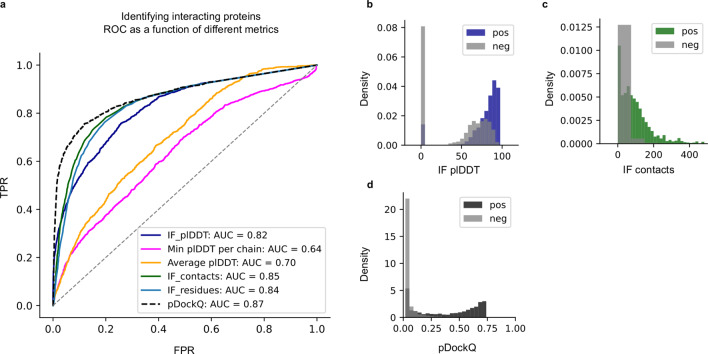
- For interacting vs non-interacting proteins (1481 positives, 5694 negatives), pDockQ gave AUC 0.87 and identified 51% of interacting pairs at 1% FPR, compared with 27%, 18%, and 13% for interface pLDDT, interface contacts, and interface residues, respectively.
- Performance varied by group: bacteria 73.7%, archaea 84.5%, eukarya 61%, virus 60%; E. coli 76.4%, S. cerevisiae 66.2%, H. sapiens 58.1%; helix interfaces 62%, sheet 59%, loop 53%; largest interface tertile 74% vs smallest 47%. AF2 outperformed tested docking methods, while AF-multimer reached 72.2% but was trained on the same data as the test set.
Methods
- AF2 was used to model heterodimeric complexes with a chain break, no templates, and relaxation off. The development set contained 216 Dockground complexes; the test set contained 1481 complexes; additional sets included six CASP14 heterodimers, eight novel PDB complexes, and 5694 non-interacting pairs (3989 E. coli + 1705 mammalian).
- MSA strategies compared default AF2 MSAs, organism-paired MSAs, block diagonalization MSAs, and combinations; AF2 model_1 vs model_1_ptm and different recycle/ensemble configurations were tested, with five seeds for the best strategy.
- Models were assessed with DockQ (acceptable ≥ 0.23), ROC/AUC, and pDockQ; comparisons included RoseTTAFold, GRAMM, MDockPP, TMdock, and AF-multimer.
Limitations
- Stated: only heterodimeric states are considered; alternative oligomeric states and larger biological assemblies are outside scope. Stated: interaction/non-interaction separation needs extension to compare interactions within individual organisms. Stated: the development vs test success-rate discrepancy (39.4% vs 57.8%) suggests unknown selection bias, and the development set is much smaller (216 vs 1481).
- Evident: AF-multimer comparison is difficult because it was trained using the same data as the test set. Evident: the initial non-interacting set was only E. coli while positives were mainly eukaryotic, so the authors added mammalian negatives to obtain a more realistic estimate.
- Evident: several analyses excluded complexes due to memory limits, MSA errors, missing Cβs, or DSSP failures (e.g., final test set 1481; DSSP 1391; RoseTTAFold 1455; AF-multimer 1458), which may affect generalizability.
Model-written summary. Check it against the paper before relying on it.
Integrity signals
Registry
Cites
Statistics
Figures
Verification
Claims the paper makes
39 Own result · 21 Own method · 13 Own interpretation · 12 Couldn’t confirm · 4 Supported · 4 No full text of the sources · 4 No basis given · 1 Supported so far · 1 Partly supported · 1 Not supported · 1 Sources not found · accuracy not yet measured
The sources with a verdict support this claim; the rest weren’t checked yet, have no full text we could read, or their verdicts aren’t rated yet.
In the paper
“We find that the MSA generation process can be sped up substantially at no performance loss (performance increase of 1% SR) by simply fusing MSAs from two HHblits34 runs on Uniclust3035 instead of using the MSAs from AF2.”
§ Improved prediction of protein-protein interactions using AlphaFold2 > Results and discussion > Findings and future prospects
What the sources say
- Supportedcites [34] source
The citation is attached to “HHblits,” while “We find” presents the speed and success-rate comparison as the citing authors’ own result. The source’s Software section describes using HHblits to build query MSAs, supporting that method citation. (LLM, conf=0.88)
- Not checked — no full text of the sourcecites [35] source
plaindirect- Asserted: passes — The authors put it forward as true.
- Checkable: passes — It can be checked against evidence.
- Load-bearing: passes — The paper’s conclusions depend on it.
- Based: passes — The paper gives a reason why it holds.
- Supported
The cited sources that could be checked couldn’t confirm or dispute this claim.
In the paper
“The higher performance in prokaryotes is consistent with previous observations regarding the availability of evolutionary information in prokaryotes compared to Eukarya27 (Supplementary Fig. 1).”
§ Improved prediction of protein-protein interactions using AlphaFold2 > Results and discussion > Bacterial complexes are predicted more accurately
What the sources say
- Could not verifycites [27] sourceExperimental — accuracy not yet measured
The Results section on PNN removal and the Discussion address grid-cell activity in rats, not evolutionary information or performance comparisons between prokaryotes and Eukarya. Searches for those terms and the claim’s distinctive phrase found no passage addressing the claim in our copy. (LLM, conf=0.78)
plaincorrelationaln = 1,481- Asserted: passes — The authors put it forward as true.
- Checkable: passes — It can be checked against evidence.
- Load-bearing: unclear — It is unclear whether the paper’s conclusions depend on it.
- Based: passes — The paper gives a reason why it holds.
- Could not verify
The cited sources that could be checked couldn’t confirm or dispute this claim.
In the paper
“The study of AF2s ability to separate interacting and non-interacting proteins here contains more extensive data than recent studies27.”
§ Improved prediction of protein-protein interactions using AlphaFold2 > Results and discussion > Limitations
What the sources say
- Could not verifycites [27] sourceExperimental — accuracy not yet measured
The Results section, “Reduced pairwise grid cell stability in a novel environment” (page unavailable), discusses correlations between rat grid cells after perineuronal-net degradation. Searches for AF2 and for interacting versus non-interacting proteins found no passage addressing that topic or comparing the extent of data with recent studies. (LLM, conf=0.78)
plain- Asserted: passes — The authors put it forward as true.
- Checkable: passes — It can be checked against evidence.
- Load-bearing: unclear — It is unclear whether the paper’s conclusions depend on it.
- Based: passes — The paper gives a reason why it holds.
- Could not verify
The cited sources that could be checked couldn’t confirm or dispute this claim.
In the paper
“Another recently published method obtains AUC 0.76 on this set27.”
§ Improved prediction of protein-protein interactions using AlphaFold2 > Results and discussion > Identifying interacting proteins
What the sources say
- Could not verifycites [27] sourceExperimental — accuracy not yet measured
The Results section reports 0.76 as a median spatial correlation for control grid cells, not as an AUC. A search for “AUC 0.76” and “area under the curve” found no passage reporting an AUC for a method on the cited set; the paper’s reported analyses concern grid-cell activity. (LLM, conf=0.76)
plain- Asserted: passes — The authors put it forward as true.
- Checkable: passes — It can be checked against evidence.
- Load-bearing: unclear — It is unclear whether the paper’s conclusions depend on it.
- Based: passes — The paper gives a reason why it holds.
- Could not verify
The cited sources that could be checked couldn’t confirm or dispute this claim.
In the paper
“There are currently 64,006 pairwise human protein interactions in the human reference interactome36.”
§ Improved prediction of protein-protein interactions using AlphaFold2 > Results and discussion > Findings and future prospects
What the sources say
- Could not verifycites [36] sourceExperimental — accuracy not yet measured
The Results section reports counts for the E. coli interactome, not a human reference interactome. Searches for “64,006 pairwise human protein interactions” and “human reference interactome” found no passage in our copy giving the claimed human interaction count. (LLM, conf=0.76)
plain- Asserted: passes — The authors put it forward as true.
- Checkable: passes — It can be checked against evidence.
- Load-bearing: passes — The paper’s conclusions depend on it.
- Based: passes — The paper gives a reason why it holds.
- Could not verify
The cited sources that could be checked couldn’t confirm or dispute this claim.
In the paper
“Pairing the correct sequences should result in MSAs containing inter-chain co-evolutionary information27.”
§ Improved prediction of protein-protein interactions using AlphaFold2 > Methods > Paired MSA generation
What the sources say
- Could not verifycites [27] sourceExperimental — accuracy not yet measured
The Methods section on spatiotemporal pairwise cross-correlations and the Results section on grid-cell stability concern correlations between neuronal firing patterns, not paired sequences. Searches for MSAs, inter-chain co-evolutionary information, and protein-sequence pairing found no passage addressing the claim; page numbers were not available in our copy. (LLM, conf=0.78)
hedgeddirect- Asserted: passes — The authors put it forward as true.
- Checkable: passes — It can be checked against evidence.
- Load-bearing: passes — The paper’s conclusions depend on it.
- Based: passes — The paper gives a reason why it holds.
- Could not verify
The cited sources that could be checked couldn’t confirm or dispute this claim.
In the paper
“The second set contains 1964 unique mammalian protein complexes filtered against the IntAct43 dataset from Negatome31.”
§ Improved prediction of protein-protein interactions using AlphaFold2 > Methods > Non-interacting proteins
What the sources say
- Could not verifycites [43] sourceExperimental — accuracy not yet measured
The Abstract and §2.1 Source data describe UniRef protein-sequence clusters built from UniProtKB and UniParc, not a set of non-interacting mammalian protein complexes. Searches for “1964,” “Negatome,” and “IntAct” found no passage in our copy addressing the claimed set or filtering step. (LLM, conf=0.78)
- Not matchedcites [31] 1997, Evaluation of GRAMM low-resolution docking methodology on the hemagglutinin-antibody complex, Proteins
Couldn’t be matched to a paper in Crossref, so it can’t be checked.
plain- Asserted: passes — The authors put it forward as true.
- Checkable: passes — It can be checked against evidence.
- Load-bearing: passes — The paper’s conclusions depend on it.
- Based: passes — The paper gives a reason why it holds.
- Could not verify
The cited sources that could be checked couldn’t confirm or dispute this claim.
In the paper
“Two methods were used to identify non-interacting proteins, first a set of proteins with no reported interaction signal in Yeast Two-Hybrid Experiments41 and secondly complexes whose individual proteins were found in different APMS benchmark complexes42. This dataset contains in total 3989 non-interacting pairs.”
§ Improved prediction of protein-protein interactions using AlphaFold2 > Methods > Non-interacting proteins
What the sources say
- Could not verifycites [41] sourceExperimental — accuracy not yet measured
The Results (‘Sensitivity benchmark’; page unavailable) describe a SCOP-domain benchmark for detecting homologous sequences, not a dataset of non-interacting E. coli protein pairs. Searches for ‘3989 non-interacting pairs’ and for yeast two-hybrid and APMS methods found no passage supporting the claimed dataset or its construction. (LLM, conf=0.76)
- Not matchedcites [42] 2020, MGnify: the microbiome analysis resource in 2020, Nucleic Acids Res
Couldn’t be matched to a paper in Crossref, so it can’t be checked.
plain- Asserted: passes — The authors put it forward as true.
- Checkable: passes — It can be checked against evidence.
- Load-bearing: passes — The paper’s conclusions depend on it.
- Based: passes — The paper gives a reason why it holds.
- Could not verify
A result the paper reports from its own data — it cites no other source for it, so there is none to check. The quote shows it is in the paper.
In the paper
“It is thereby evident that combining both paired and AF2 MSAs is superior to using them separately.”
- Also stated in: § Test set performance · hedged
“Using the combination of AF2 and paired MSAs increases performance, suggesting that AF2 gains both from larger and paired MSAs, although it often can manage with less information.”
hedgeddirect- Asserted: passes — The authors put it forward as true.
- Checkable: passes — It can be checked against evidence.
- Load-bearing: passes — The paper’s conclusions depend on it.
- Based: passes — The paper gives a reason why it holds.
- Also stated in: § Test set performance · hedged
A result the paper reports from its own data — it cites no other source for it, so there is none to check. The quote shows it is in the paper.
In the paper
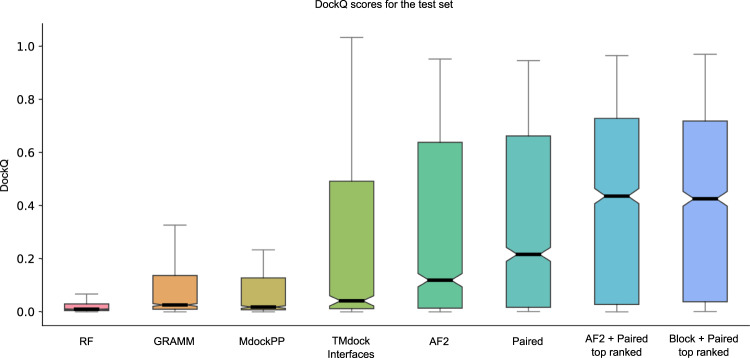
“What is most striking is that AF2 outperforms all other tested docking methods by a large margin (Fig. 1, Table 2).”
- Also stated in: § Findings and future prospects · boosted
“Even using the default settings, it is clear that AF2 is superior to all other tested docking methods, including other Fold and Dock methods17,24, methods based on shape complementarity30,32 and template-based docking.”
boosteddirect- Asserted: passes — The authors put it forward as true.
- Checkable: passes — It can be checked against evidence.
- Load-bearing: passes — The paper’s conclusions depend on it.
- Based: passes — The paper gives a reason why it holds.
- Also stated in: § Findings and future prospects · boosted
- It may state two separate claims as one. 38
- Probably not a substantial claim. 36
- The quote only partly states this claim. 1
At least one cited source doesn’t support this claim or points to a different paper, and none confirmed it — see the verdicts below.
In the paper
“This method was trained using the same data as the test set, which makes a direct comparison difficult.”
§ Improved prediction of protein-protein interactions using AlphaFold2 > Results and discussion > Test set performance
What the sources say
- Disputedcites [28] sourceExperimental — accuracy not yet measured
The Training Regimen (p. 4) limits training structures to those released by 2018-04-30. The Results (p. 5) say Benchmark 2 contains structures released after that cutoff and that the reported Recent-PDB-Multimers pairs were filtered for similarity to the training set. The paper therefore contradicts the claim that AlphaFold-Multimer was trained on the same data as its test set; it does not attribute difficulty in direct comparison to such overlap. (LLM, conf=0.90)
Checked by a reasoning model — may be wrong.
plaindirect- Asserted: passes — The authors put it forward as true.
- Checkable: passes — It can be checked against evidence.
- Load-bearing: passes — The paper’s conclusions depend on it.
- Based: passes — The paper gives a reason why it holds.
It may state two separate claims as one.
- Disputed
Every source the paper cites for this claim was checked and supports it.
In the paper
“The recently developed AF-multimer28 has the best performance (SR = 72.2%, median = 0.560, Table 2).”
§ Improved prediction of protein-protein interactions using AlphaFold2 > Results and discussion > Test set performance
What the sources say
- Supportedcites [28] source
The paper identifies the system as AlphaFold-Multimer and reports improved performance over comparison systems (p. 1; Results, p. 6). In the citing sentence, reference 28 identifies AF-multimer; the 72.2% success rate and 0.560 median are attributed to the citing paper’s Table 2, not to this source. (LLM, conf=0.90)
plain- Asserted: passes — The authors put it forward as true.
- Checkable: passes — It can be checked against evidence.
- Load-bearing: passes — The paper’s conclusions depend on it.
- Based: passes — The paper gives a reason why it holds.
It may state two separate claims as one.
- Supported
Every source the paper cites for this claim was checked and supports it.
In the paper
“Here we show that AlphaFold216 (AF2) can predict the structure of many heterodimeric protein complexes, although it is trained to predict the structure of individual protein chains.”
§ Improved prediction of protein-protein interactions using AlphaFold2 > Results and discussion > Findings and future prospects
What the sources say
- Supportedcites [16] 2021, Highly accurate protein structure prediction with AlphaFold, Nature source
The citation identifies AlphaFold2 and supports the statement that it was trained on individual protein chains: Methods > Training regimen says that chains were sampled from PDB structures for training. The claim that it can predict many heterodimeric complexes is introduced as the citing authors’ own finding (‘Here we show’), not attributed to this source. (LLM, conf=0.90)
plain- Asserted: passes — The authors put it forward as true.
- Checkable: passes — It can be checked against evidence.
- Load-bearing: passes — The paper’s conclusions depend on it.
- Based: passes — The paper gives a reason why it holds.
It may state two separate claims as one.
- Supported
The cited sources that could be checked couldn’t confirm or dispute this claim.
In the paper
“We used 1661 protein complexes with known interfaces from a recent study27 to test the developed pipeline.”
§ Improved prediction of protein-protein interactions using AlphaFold2 > Methods > Test set
What the sources say
- Could not verifycites [27] sourceExperimental — accuracy not yet measured
The Results section on grid cell representations in familiar environments reports recorded neuronal units, not protein complexes. Searches for “1661 protein complexes with known interfaces” and “protein complexes interface pipeline test set” found no passage in our copy addressing the claimed test set. (LLM, conf=0.78)
plain- Asserted: passes — The authors put it forward as true.
- Checkable: passes — It can be checked against evidence.
- Load-bearing: passes — The paper’s conclusions depend on it.
- Based: passes — The paper gives a reason why it holds.
Probably not a substantial claim.
- Could not verify
The cited sources that could be checked couldn’t confirm or dispute this claim.
In the paper
“Interestingly, no additional constraints are implemented in AF2 to pull two chains in contact, meaning that chain interactions (and subsequently interface sizes) are exclusively determined by the amount of inter-chain signals extracted by the predictor.”
§ Improved prediction of protein-protein interactions using AlphaFold2 > Results and discussion > Findings and future prospects
What the sources say
- Could not verifycites [16] 2021, Highly accurate protein structure prediction with AlphaFold, Nature sourceExperimental — accuracy not yet measured
The “MSA depth and cross-chain contacts” section discusses how contacts with other chains affect prediction accuracy and shows a homotrimer predicted without input stoichiometry. It does not say whether AF2 applies constraints to bring chains together or whether inter-chain signals exclusively determine interactions and interface sizes. Searches for those constraints, signals, and interface size found no passage addressing that claim. (LLM, conf=0.73)
plaindirect- Asserted: passes — The authors put it forward as true.
- Checkable: passes — It can be checked against evidence.
- Load-bearing: passes — The paper’s conclusions depend on it.
- Based: passes — The paper gives a reason why it holds.
It may state two separate claims as one.
- Could not verify
Every source the paper cites for this claim was checked and supports it.
In the paper
“We note that performing model relaxation did not increase performance in the AF2 paper16 and was, therefore, ignored to save computational cost.”
§ Improved prediction of protein-protein interactions using AlphaFold2 > Methods > AlphaFold2
What the sources say
- Supportedcites [16] 2021, Highly accurate protein structure prediction with AlphaFold, Nature source
The End-to-end structure prediction section states that final relaxation did not improve accuracy as measured by GDT or lDDT-Cα. The decision to omit relaxation to save computational cost is the citing authors’ own choice, not a claim attributed to the AF2 paper; the AF2 paper says it performed relaxation. (LLM, conf=0.93)
plain- Asserted: passes — The authors put it forward as true.
- Checkable: passes — It can be checked against evidence.
- Load-bearing: passes — The paper’s conclusions depend on it.
- Based: passes — The paper gives a reason why it holds.
It may state two separate claims as one.
- Supported
Every source the paper cites for this claim was checked and supports it.
In the paper
“Further, AF2 has been shown to perform well for single chains without templates and has reported higher accuracy than template-based methods even when robust templates are available16.”
§ Improved prediction of protein-protein interactions using AlphaFold2 > Methods > AlphaFold2
What the sources say
- Supportedcites [16] 2021, Highly accurate protein structure prediction with AlphaFold, Nature source
The Main section (page unavailable) reports high accuracy for full-chain predictions, including new folds, and says AlphaFold considerably improves on template-based methods even when strong templates are available. The Methods section states that some models were trained without templates. (LLM, conf=0.90)
boostedcorrelational- Asserted: passes — The authors put it forward as true.
- Checkable: passes — It can be checked against evidence.
- Load-bearing: fails — The paper’s conclusions may not depend on it.
- Based: passes — The paper gives a reason why it holds.
Probably not a substantial claim. The paper’s conclusions may not depend on it. It may state two separate claims as one.
- Supported
The cited sources that could be checked couldn’t confirm or dispute this claim.
In the paper
“As the bound form of the proteins is used, this should represent an easy case for GRAMM-based docking, and performance drops significantly when unbound structures or models are used53.”
§ Improved prediction of protein-protein interactions using AlphaFold2 > Methods > GRAMM
What the sources say
- Could not verifycites [53] 2016, DockQ: A Quality Measure for Protein-Protein Docking Models, PLoS One sourceExperimental — accuracy not yet measured
The Materials and Methods (Training set; page unavailable) describes docking models generated with SwarmDock, while the Results and Discussion evaluates DockQ as a quality measure. Searches for GRAMM and bound-versus-unbound docking performance found no passage supporting the claimed performance drop. (LLM, conf=0.76)
plaindirect- Asserted: passes — The authors put it forward as true.
- Checkable: passes — It can be checked against evidence.
- Load-bearing: fails — The paper’s conclusions may not depend on it.
- Based: passes — The paper gives a reason why it holds.
Probably not a substantial claim. The paper’s conclusions may not depend on it. It may state two separate claims as one.
- Could not verify
The cited sources support only part of this claim — read each source’s verdict below.
In the paper
“The second model, model_1_ptm, is a fine-tuned version of model_1 that predicts the TMscore52 and alignment errors16.”
§ Improved prediction of protein-protein interactions using AlphaFold2 > Methods > AlphaFold2
What the sources say
- Partly supportedcites [16] 2021, Highly accurate protein structure prediction with AlphaFold, Nature sourceExperimental — accuracy not yet measured
The Methods > Training regimen section says the authors fine-tuned five models to add a pTM prediction objective. End-to-end structure prediction says the TM-score estimate is obtained from a pairwise error prediction. Our copy does not identify the fine-tuned model specifically as model_1_ptm or establish its relationship to a model named model_1. (LLM, conf=0.82)
- Not checked — no full text of the sourcecites [52] 2018, Contact Potential for Structure Prediction of Proteins and Protein Complexes from Potts Model, Biophys. J source
plain- Asserted: passes — The authors put it forward as true.
- Checkable: passes — It can be checked against evidence.
- Load-bearing: fails — The paper’s conclusions may not depend on it.
- Based: passes — The paper gives a reason why it holds.
Probably not a substantial claim. The paper’s conclusions may not depend on it.
- Partly supported
The cited sources that could be checked couldn’t confirm or dispute this claim.
In the paper
“The RoseTTAFold pipeline for complex modelling only generates MSAs for bacterial protein complexes, while the proteins in our test set are mainly Eukaryotic.”
§ Improved prediction of protein-protein interactions using AlphaFold2 > Methods > RoseTTAFold
What the sources say
- Could not verifycites [17] sourceExperimental — accuracy not yet measured
The ‘Direct generation of protein-protein complex models’ section says RoseTTAFold was tested on paired sequence alignments and describes a model of a human complex, but it does not say that its pipeline generates MSAs only for bacterial complexes. The source also cannot establish the composition of the citing authors’ test set. Searches for bacterial-only MSA generation and eukaryotic complexes did not resolve either point. (LLM, conf=0.72)
plain- Asserted: passes — The authors put it forward as true.
- Checkable: passes — It can be checked against evidence.
- Load-bearing: passes — The paper’s conclusions depend on it.
- Based: passes — The paper gives a reason why it holds.
It may state two separate claims as one.
- Could not verify
The cited sources that could be checked couldn’t confirm or dispute this claim.
In the paper
“The atom-atom contact energy AACE18 is used to score and rank all poses, as this has been shown to provide better results than shape-complementarity alone54.”
§ Improved prediction of protein-protein interactions using AlphaFold2 > Methods > GRAMM
What the sources say
- Could not verifycites [18] sourceExperimental — accuracy not yet measured
The Introduction discusses predicting inter-residue contacts, and §2.4.2 describes ranking structural matches by TM-score. Neither addresses AACE, docking-pose ranking, or a comparison with shape complementarity. Searches for those terms in our copy found no supporting passage; page numbers were not available. (LLM, conf=0.76)
- Not checked — no full text of the sourcecites [54] source
boosteddirect- Asserted: passes — The authors put it forward as true.
- Checkable: passes — It can be checked against evidence.
- Load-bearing: fails — The paper’s conclusions may not depend on it.
- Based: passes — The paper gives a reason why it holds.
Probably not a substantial claim. The paper’s conclusions may not depend on it. It may state two separate claims as one.
- Could not verify
The paper states this without a source or data behind it here, so there is nothing to check it against. The quote shows it is in the paper.
In the paper
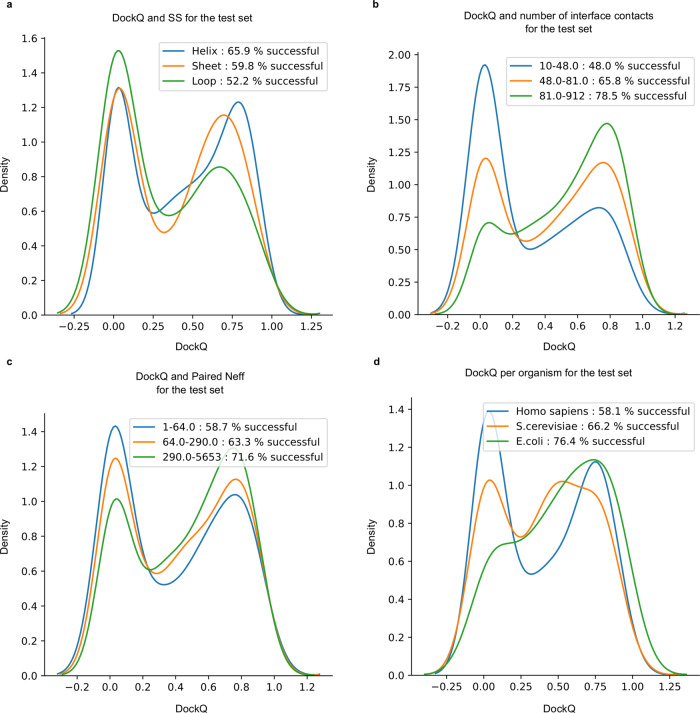
“It is clear that the fraction of correctly modelled sequences increases with larger Neff scores (Fig. 3c).”
direct- Asserted: fails — The authors may not put it forward as true.
- Checkable: passes — It can be checked against evidence.
- Load-bearing: fails — The paper’s conclusions may not depend on it.
- Based: fails — The paper may give no reason why it holds.
Probably not a substantial claim. The authors may not put it forward as true. The paper’s conclusions may not depend on it. The paper may give no reason why it holds.
A result the paper reports from its own data — it cites no other source for it, so there is none to check. The quote shows it is in the paper.
In the paper
“We find that the AlphaFold2 protocol together with optimised multiple sequence alignments, generate models with acceptable quality (DockQ ≥ 0.23) for 63% of the dimers.”
- Also stated in: § Findings and future prospects · plain
“Using optimised MSAs with AF2, we can accurately predict the structure of heterodimeric complexes for an unprecedented SR of 62.7% on a large test set.”
§ Improved prediction of protein-protein interactions using AlphaFold2 > Abstract
plaindirect- Asserted: passes — The authors put it forward as true.
- Checkable: passes — It can be checked against evidence.
- Load-bearing: passes — The paper’s conclusions depend on it.
- Based: passes — The paper gives a reason why it holds.
The quote only partly states this claim.
- Also stated in: § Findings and future prospects · plain
A result the paper reports from its own data — it cites no other source for it, so there is none to check. The quote shows it is in the paper.
In the paper
“The highest SR is obtained mainly for helix interfaces (62%), followed by interfaces containing mainly sheets (59%). The loop interface SR of 53% is substantially lower than the others, suggesting that interfaces with more flexible structures are harder to predict.”
§ Improved prediction of protein-protein interactions using AlphaFold2 > Results and discussion > Bacterial complexes are predicted more accurately
plaincorrelational- Asserted: passes — The authors put it forward as true.
- Checkable: passes — It can be checked against evidence.
- Load-bearing: unclear — It is unclear whether the paper’s conclusions depend on it.
- Based: passes — The paper gives a reason why it holds.
It may state two separate claims as one.
A result the paper reports from its own data — it cites no other source for it, so there is none to check. The quote shows it is in the paper.
In the paper
“The SRs for each kingdom is; Eukarya 61%, Bacteria 73.7%, Archaea 84.5%, and Virus 60% (Supplementary Fig. 1b).”
§ Improved prediction of protein-protein interactions using AlphaFold2 > Results and discussion > Bacterial complexes are predicted more accurately
plain- Asserted: passes — The authors put it forward as true.
- Checkable: passes — It can be checked against evidence.
- Load-bearing: passes — The paper’s conclusions depend on it.
- Based: passes — The paper gives a reason why it holds.
It may state two separate claims as one.
A result the paper reports from its own data — it cites no other source for it, so there is none to check. The quote shows it is in the paper.
In the paper
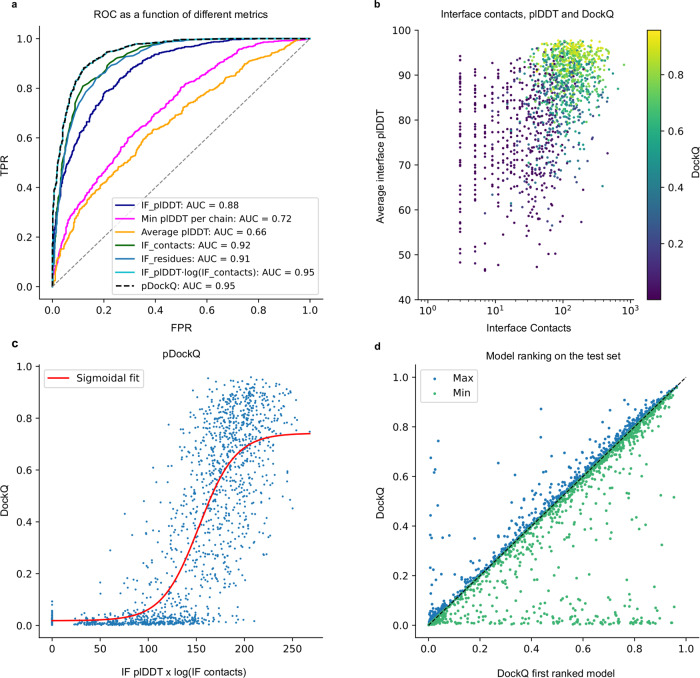
“At FPR 5%, the number of interface contacts and residues report TPRs of 49 and 42%, respectively, compared to 43% for the average interface plDDT and 66% for pDockQ.”
§ Improved prediction of protein-protein interactions using AlphaFold2 > Results and discussion > Identifying interacting proteins
plain- Asserted: passes — The authors put it forward as true.
- Checkable: passes — It can be checked against evidence.
- Load-bearing: passes — The paper’s conclusions depend on it.
- Based: passes — The paper gives a reason why it holds.
It may state two separate claims as one.
- Rests on an assumption: The 3989 E. coli proteins used as negatives are truly non-interacting.
- Rests on an assumption: The 1481 test set proteins used as positives are truly interacting.
A result the paper reports from its own data — it cites no other source for it, so there is none to check. The quote shows it is in the paper.
In the paper
“Between the five different initialisations, the average difference in the DockQ score is 0.03, and there is no deviation in SR, i.e., ranking did not improve the SR.”
§ Improved prediction of protein-protein interactions using AlphaFold2 > Results and discussion > CASP14 and novel proteins without templates
plain- Asserted: passes — The authors put it forward as true.
- Checkable: passes — It can be checked against evidence.
- Load-bearing: unclear — It is unclear whether the paper’s conclusions depend on it.
- Based: passes — The paper gives a reason why it holds.
It may state two separate claims as one.
A result the paper reports from its own data — it cites no other source for it, so there is none to check. The quote shows it is in the paper.
In the paper
“The best performance is 33.3% for the AF2 MSAs and 39.4% for the AF2+ paired MSAs (Table 1).”
§ Improved prediction of protein-protein interactions using AlphaFold2 > Results and discussion > Identifying the best AlphaFold2 model
plain- Asserted: passes — The authors put it forward as true.
- Checkable: passes — It can be checked against evidence.
- Load-bearing: passes — The paper’s conclusions depend on it.
- Based: passes — The paper gives a reason why it holds.
It may state two separate claims as one.
A result the paper reports from its own data — it cites no other source for it, so there is none to check. The quote shows it is in the paper.
In the paper
“The average SR (57.2% ± 0.0%) is similar for all five runs.”
§ Improved prediction of protein-protein interactions using AlphaFold2 > Results and discussion > Model variation and ranking for the test set
plain- Asserted: passes — The authors put it forward as true.
- Checkable: passes — It can be checked against evidence.
- Load-bearing: unclear — It is unclear whether the paper’s conclusions depend on it.
- Based: passes — The paper gives a reason why it holds.
It may state two separate claims as one.
In the paper
“The computational cost to run all of this is ~5 days on an Nvidia A100 system and has since the development of the pipeline presented here, deemed FoldDock, been applied37.”
§ Improved prediction of protein-protein interactions using AlphaFold2 > Results and discussion > Findings and future prospects
What the sources say
- Not checked — no full text of the sourcecites [37] source
plain- Asserted: passes — The authors put it forward as true.
- Checkable: passes — It can be checked against evidence.
- Load-bearing: fails — The paper’s conclusions may not depend on it.
- Based: passes — The paper gives a reason why it holds.
Probably not a substantial claim. The paper’s conclusions may not depend on it. It may state two separate claims as one.
A result the paper reports from its own data — it cites no other source for it, so there is none to check. The quote shows it is in the paper.
In the paper
“The AUC using the same metric for the ranked test set is 0.93, which means that 31% of all models are acceptable at an error rate of 1% and 54% at an error rate of 10% (Supplementary Table 2).”
§ Improved prediction of protein-protein interactions using AlphaFold2 > Results and discussion > Model variation and ranking for the test set
plaincorrelational- Asserted: passes — The authors put it forward as true.
- Checkable: passes — It can be checked against evidence.
- Load-bearing: passes — The paper’s conclusions depend on it.
- Based: passes — The paper gives a reason why it holds.
It may state two separate claims as one.
A result the paper reports from its own data — it cites no other source for it, so there is none to check. The quote shows it is in the paper.
In the paper
“Further, running five initialisations with random seeds and ranking the models using the predicted DockQ score (pDockQ, Fig. 2c), increases the SR to 61.7% and 62.7% for the AF2 + paired and block diagonalization+paired MSAs, respectively (model variation and ranking, Fig. 2).”
§ Improved prediction of protein-protein interactions using AlphaFold2 > Results and discussion > Test set performance
plaindirect- Asserted: passes — The authors put it forward as true.
- Checkable: passes — It can be checked against evidence.
- Load-bearing: passes — The paper’s conclusions depend on it.
- Based: passes — The paper gives a reason why it holds.
It may state two separate claims as one.
A result the paper reports from its own data — it cites no other source for it, so there is none to check. The quote shows it is in the paper.
In the paper
“The best outcome using this modelling strategy results in an SR of 57.8% (856 out of 1481 correctly modelled complexes) for the AF2 + paired MSAs compared with 45.0% using the AF2 MSAs alone (Fig. 1, Table 2).”
§ Improved prediction of protein-protein interactions using AlphaFold2 > Results and discussion > Test set performance
plain- Asserted: passes — The authors put it forward as true.
- Checkable: passes — It can be checked against evidence.
- Load-bearing: passes — The paper’s conclusions depend on it.
- Based: passes — The paper gives a reason why it holds.
It may state two separate claims as one.
A result the paper reports from its own data — it cites no other source for it, so there is none to check. The quote shows it is in the paper.
In the paper
“This enables the prediction of the DockQ scores (pDockQ) in a continuous manner with an overall average error of 0.11 on the test set.”
§ Improved prediction of protein-protein interactions using AlphaFold2 > Results and discussion > Distinguishing acceptable from incorrect models
plain- Asserted: passes — The authors put it forward as true.
- Checkable: passes — It can be checked against evidence.
- Load-bearing: passes — The paper’s conclusions depend on it.
- Based: passes — The paper gives a reason why it holds.
It may state two separate claims as one.
A result the paper reports from its own data — it cites no other source for it, so there is none to check. The quote shows it is in the paper.
In the paper
“We divide the dataset by interface size, and find that pairs with larger interfaces are easier to predict, as the SR increases from 47 to 74% between the smallest and biggest tertiles (Fig. 3b).”
§ Improved prediction of protein-protein interactions using AlphaFold2 > Results and discussion > Bacterial complexes are predicted more accurately
plaindirect- Asserted: passes — The authors put it forward as true.
- Checkable: passes — It can be checked against evidence.
- Load-bearing: unclear — It is unclear whether the paper’s conclusions depend on it.
- Based: passes — The paper gives a reason why it holds.
It may state two separate claims as one.
- The authors state this as an assumption: All residues in an interface contribute to the interaction energy.
A result the paper reports from its own data — it cites no other source for it, so there is none to check. The quote shows it is in the paper.
In the paper
“On this combined set of 1481 interacting and 5694 non-interacting proteins, we obtain an AUC of 0.82 for the average interface plDDT and slightly higher (0.84 and 0.85) for the number of interface contacts and residues, respectively (Fig. 5a). pDockQ results in an ROC curve with an AUC of 0.87.”
§ Improved prediction of protein-protein interactions using AlphaFold2 > Results and discussion > Identifying interacting proteins
plaincorrelational- Asserted: passes — The authors put it forward as true.
- Checkable: passes — It can be checked against evidence.
- Load-bearing: passes — The paper’s conclusions depend on it.
- Based: passes — The paper gives a reason why it holds.
It may state two separate claims as one.
A result the paper reports from its own data — it cites no other source for it, so there is none to check. The quote shows it is in the paper.
In the paper
“It took 7884 s for generating the AF2 MSAs, the single-chain searches took 338 s on average and the pairing 2 s.”
§ Improved prediction of protein-protein interactions using AlphaFold2 > Methods > Computational cost
plain- Asserted: passes — The authors put it forward as true.
- Checkable: passes — It can be checked against evidence.
- Load-bearing: fails — The paper’s conclusions may not depend on it.
- Based: passes — The paper gives a reason why it holds.
Probably not a substantial claim. The paper’s conclusions may not depend on it.
The paper states this without a source or data behind it here, so there is nothing to check it against. The quote shows it is in the paper.
In the paper
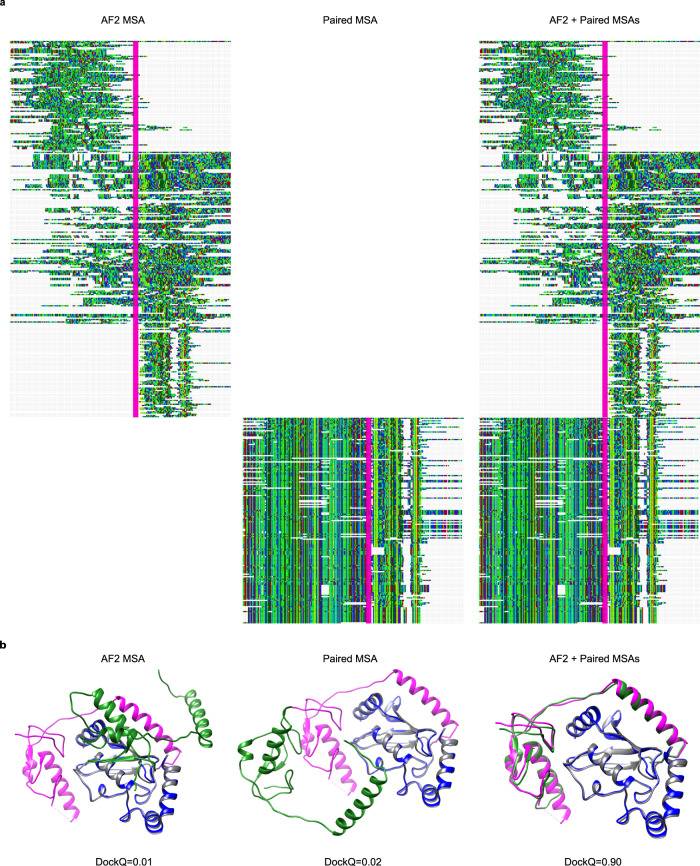
“The resulting MSAs will thus mainly contain gaps for one of the two query proteins in each row, as only single chains can obtain hits in the searched databases (Fig. 6).”
§ Improved prediction of protein-protein interactions using AlphaFold2 > Methods > AlphaFold2 default MSA generation methodology
plaindirect- Asserted: passes — The authors put it forward as true.
- Checkable: passes — It can be checked against evidence.
- Load-bearing: passes — The paper’s conclusions depend on it.
- Based: passes — The paper gives a reason why it holds.
It may state two separate claims as one.
The paper states this without a source or data behind it here, so there is nothing to check it against. The quote shows it is in the paper.
In the paper
“Together there are 5694 non-interacting protein complexes.”
§ Improved prediction of protein-protein interactions using AlphaFold2 > Methods > Non-interacting proteins
plain- Asserted: passes — The authors put it forward as true.
- Checkable: passes — It can be checked against evidence.
- Load-bearing: fails — The paper’s conclusions may not depend on it.
- Based: passes — The paper gives a reason why it holds.
Probably not a substantial claim. The paper’s conclusions may not depend on it.
A result the paper reports from its own data — it cites no other source for it, so there is none to check. The quote shows it is in the paper.
In the paper
“Fusing the MSAs took 3 s on average per tested complex.”
§ Improved prediction of protein-protein interactions using AlphaFold2 > Methods > Computational cost
plain- Asserted: passes — The authors put it forward as true.
- Checkable: passes — It can be checked against evidence.
- Load-bearing: fails — The paper’s conclusions may not depend on it.
- Based: passes — The paper gives a reason why it holds.
Probably not a substantial claim. The paper’s conclusions may not depend on it.
A result the paper reports from its own data — it cites no other source for it, so there is none to check. The quote shows it is in the paper.
In the paper
“It took 7884 s for generating the AF2 MSAs, the single-chain searches took 338 s on average and the pairing 2 s.”
§ Improved prediction of protein-protein interactions using AlphaFold2 > Methods > Computational cost
plain- Asserted: passes — The authors put it forward as true.
- Checkable: passes — It can be checked against evidence.
- Load-bearing: fails — The paper’s conclusions may not depend on it.
- Based: passes — The paper gives a reason why it holds.
Probably not a substantial claim. The paper’s conclusions may not depend on it.
A result the paper reports from its own data — it cites no other source for it, so there is none to check. The quote shows it is in the paper.
In the paper
“The pairing and fusing are thereby negligible compared to searching, resulting in a speedup of 24 times for the hhblits searches.”
§ Improved prediction of protein-protein interactions using AlphaFold2 > Methods > Computational cost
plaindirect- Asserted: passes — The authors put it forward as true.
- Checkable: passes — It can be checked against evidence.
- Load-bearing: unclear — It is unclear whether the paper’s conclusions depend on it.
- Based: passes — The paper gives a reason why it holds.
It may state two separate claims as one.
A result the paper reports from its own data — it cites no other source for it, so there is none to check. The quote shows it is in the paper.
In the paper
“In comparison, folding using the m1-10-1 strategy took 191 s on average for these pairs.”
§ Improved prediction of protein-protein interactions using AlphaFold2 > Methods > Computational cost
plain- Asserted: passes — The authors put it forward as true.
- Checkable: passes — It can be checked against evidence.
- Load-bearing: fails — The paper’s conclusions may not depend on it.
- Based: passes — The paper gives a reason why it holds.
Probably not a substantial claim. The paper’s conclusions may not depend on it.
A result the paper reports from its own data — it cites no other source for it, so there is none to check. The quote shows it is in the paper.
In the paper
“It took 7884 s for generating the AF2 MSAs, the single-chain searches took 338 s on average and the pairing 2 s.”
§ Improved prediction of protein-protein interactions using AlphaFold2 > Methods > Computational cost
plain- Asserted: passes — The authors put it forward as true.
- Checkable: passes — It can be checked against evidence.
- Load-bearing: fails — The paper’s conclusions may not depend on it.
- Based: passes — The paper gives a reason why it holds.
Probably not a substantial claim. The paper’s conclusions may not depend on it.
In the paper
“This score is created by fitting a sigmoidal curve (Fig. 2c) using “curve_fit” from SciPy v.1.4.156, to the DockQ scores using the average interface plDDT multiplied with the logarithm of the number of interface contacts, with the following sigmoidal equation:”
§ Improved prediction of protein-protein interactions using AlphaFold2 > Methods > pDockQ
What the sources say
- Not checked — no full text of the sourcecites [56] source
plaindirect- Asserted: passes — The authors put it forward as true.
- Checkable: passes — It can be checked against evidence.
- Load-bearing: passes — The paper’s conclusions depend on it.
- Based: passes — The paper gives a reason why it holds.
Probably not a substantial claim.
What the paper did — it cites no source for this, so there is none to check. The quote shows it is in the paper.
In the paper
“Some structures failed to be modelled for various reasons (see limitations of data generation), resulting in a total of 1481 structures.”
§ Improved prediction of protein-protein interactions using AlphaFold2 > Methods > Test set
plaindirect- Asserted: passes — The authors put it forward as true.
- Checkable: passes — It can be checked against evidence.
- Load-bearing: fails — The paper’s conclusions may not depend on it.
- Based: passes — The paper gives a reason why it holds.
Probably not a substantial claim. The paper’s conclusions may not depend on it. It may state two separate claims as one.
What the paper did — it cites no source for this, so there is none to check. The quote shows it is in the paper.
In the paper
“AF2 MSAs could not be generated for three of the complexes due to memory limitations (1gg2, 2nqd and 2xwb) using a computational node with 128 Gb RAM for the MSA generation and were thus disregarded, resulting in a total of 216 complexes.”
§ Improved prediction of protein-protein interactions using AlphaFold2 > Methods > Development set
plaindirect- Asserted: passes — The authors put it forward as true.
- Checkable: passes — It can be checked against evidence.
- Load-bearing: fails — The paper’s conclusions may not depend on it.
- Based: passes — The paper gives a reason why it holds.
Probably not a substantial claim. The paper’s conclusions may not depend on it. It may state two separate claims as one.
What the paper did — it cites no source for this, so there is none to check. The quote shows it is in the paper.
In the paper
“Unbound chains share at least 97% sequence identity with the bound counterpart and, to facilitate comparisons, non-matching residues are deleted and renumbered to become identical to the unbound counterpart.”
§ Improved prediction of protein-protein interactions using AlphaFold2 > Methods > Development set
plain- Asserted: passes — The authors put it forward as true.
- Checkable: passes — It can be checked against evidence.
- Load-bearing: passes — The paper’s conclusions depend on it.
- Based: passes — The paper gives a reason why it holds.
Probably not a substantial claim.
A conclusion the paper draws from its own results — it cites no other source for it, so there is none to check. The quote shows it is in the paper.
In the paper
“This leads us to believe that there may be some unknown selection bias in how the sets were chosen.”
§ Improved prediction of protein-protein interactions using AlphaFold2 > Results and discussion > Limitations
hedged- Asserted: passes — The authors put it forward as true.
- Checkable: passes — It can be checked against evidence.
- Load-bearing: fails — The paper’s conclusions may not depend on it.
- Based: passes — The paper gives a reason why it holds.
Probably not a substantial claim. The paper’s conclusions may not depend on it.
What the paper did — it cites no source for this, so there is none to check. The quote shows it is in the paper.
In the paper
“107 of the complexes in the test set lack beta carbons (Cβs), and 50 have overlapping PDB codes with the development set and were therefore excluded.”
§ Improved prediction of protein-protein interactions using AlphaFold2 > Methods > Test set
plaindirect- Asserted: passes — The authors put it forward as true.
- Checkable: passes — It can be checked against evidence.
- Load-bearing: passes — The paper’s conclusions depend on it.
- Based: passes — The paper gives a reason why it holds.
Probably not a substantial claim.
What the paper did — it cites no source for this, so there is none to check. The quote shows it is in the paper.
In the paper
“This set contains protein pairs, with each chain having at least 50 residues, sharing <30% sequence identity and no crystal packing artefacts.”
§ Improved prediction of protein-protein interactions using AlphaFold2 > Methods > Development set
plain- Asserted: passes — The authors put it forward as true.
- Checkable: passes — It can be checked against evidence.
- Load-bearing: fails — The paper’s conclusions may not depend on it.
- Based: passes — The paper gives a reason why it holds.
Probably not a substantial claim. The paper’s conclusions may not depend on it.
What the paper did — it cites no source for this, so there is none to check. The quote shows it is in the paper.
In the paper
“This set contains protein pairs, with each chain having at least 50 residues, sharing <30% sequence identity and no crystal packing artefacts.”
§ Improved prediction of protein-protein interactions using AlphaFold2 > Methods > Development set
plain- Asserted: passes — The authors put it forward as true.
- Checkable: passes — It can be checked against evidence.
- Load-bearing: fails — The paper’s conclusions may not depend on it.
- Based: passes — The paper gives a reason why it holds.
Probably not a substantial claim. The paper’s conclusions may not depend on it.
A conclusion the paper draws from its own results — it cites no other source for it, so there is none to check. The quote shows it is in the paper.
In the paper
“Interestingly, the average plDDT of the entire complex only results in an AUC of 0.66, suggesting that both single chains in a complex are often predicted very well, while their relative orientation may still be incorrect.”
§ Improved prediction of protein-protein interactions using AlphaFold2 > Results and discussion > Distinguishing acceptable from incorrect models
hedgedconditional- Asserted: passes — The authors put it forward as true.
- Checkable: passes — It can be checked against evidence.
- Load-bearing: passes — The paper’s conclusions depend on it.
- Based: passes — The paper gives a reason why it holds.
It may state two separate claims as one.
What the paper did — it cites no source for this, so there is none to check. The quote shows it is in the paper.
In the paper
“107 of the complexes in the test set lack beta carbons (Cβs), and 50 have overlapping PDB codes with the development set and were therefore excluded.”
§ Improved prediction of protein-protein interactions using AlphaFold2 > Methods > Test set
plain- Asserted: passes — The authors put it forward as true.
- Checkable: passes — It can be checked against evidence.
- Load-bearing: fails — The paper’s conclusions may not depend on it.
- Based: passes — The paper gives a reason why it holds.
Probably not a substantial claim. The paper’s conclusions may not depend on it.
A conclusion the paper draws from its own results — it cites no other source for it, so there is none to check. The quote shows it is in the paper.
In the paper
“The higher performance in S. cerevisiae compared to H. sapiens suggests a similar relationship between higher and lower order organisms within the same kingdom.”
§ Improved prediction of protein-protein interactions using AlphaFold2 > Results and discussion > Bacterial complexes are predicted more accurately
hedgedcorrelational- Asserted: passes — The authors put it forward as true.
- Checkable: passes — It can be checked against evidence.
- Load-bearing: fails — The paper’s conclusions may not depend on it.
- Based: passes — The paper gives a reason why it holds.
Probably not a substantial claim. The paper’s conclusions may not depend on it.
What the paper did — it cites no source for this, so there is none to check. The quote shows it is in the paper.
In the paper
“When folding, three of these (5AWF_D-5AWF_B, 2ZXE_B-2ZXE_A and 2ZXE_A-2ZXE_G) report “ValueError: Cannot create a tensor proto whose content is larger than 2GB”, leading to a final set of 1481 complexes.”
§ Improved prediction of protein-protein interactions using AlphaFold2 > Methods > Test set
plaindirect- Asserted: passes — The authors put it forward as true.
- Checkable: passes — It can be checked against evidence.
- Load-bearing: fails — The paper’s conclusions may not depend on it.
- Based: passes — The paper gives a reason why it holds.
Probably not a substantial claim. The paper’s conclusions may not depend on it. It may state two separate claims as one.
A conclusion the paper draws from its own results — it cites no other source for it, so there is none to check. The quote shows it is in the paper.
In the paper
“The pDockQ score discriminates between both model quality and binary interactions.”
§ Improved prediction of protein-protein interactions using AlphaFold2 > Results and discussion > Findings and future prospects
plaincorrelational- Asserted: passes — The authors put it forward as true.
- Checkable: passes — It can be checked against evidence.
- Load-bearing: passes — The paper’s conclusions depend on it.
- Based: passes — The paper gives a reason why it holds.
It may state two separate claims as one.
What the paper did — it cites no source for this, so there is none to check. The quote shows it is in the paper.
In the paper
“This set contains protein pairs, with each chain having at least 50 residues, sharing <30% sequence identity and no crystal packing artefacts.”
§ Improved prediction of protein-protein interactions using AlphaFold2 > Methods > Development set
plain- Asserted: passes — The authors put it forward as true.
- Checkable: passes — It can be checked against evidence.
- Load-bearing: fails — The paper’s conclusions may not depend on it.
- Based: passes — The paper gives a reason why it holds.
Probably not a substantial claim. The paper’s conclusions may not depend on it.
A conclusion the paper draws from its own results — it cites no other source for it, so there is none to check. The quote shows it is in the paper.
In the paper
“Here, we only consider the structures of protein complexes in their heterodimeric state, although each protein chain in these complexes may have homodimer configurations or other higher-order states.”
§ Improved prediction of protein-protein interactions using AlphaFold2 > Results and discussion > Limitations
plain- Asserted: passes — The authors put it forward as true.
- Checkable: passes — It can be checked against evidence.
- Load-bearing: fails — The paper’s conclusions may not depend on it.
- Based: passes — The paper gives a reason why it holds.
Probably not a substantial claim. The paper’s conclusions may not depend on it. It may state two separate claims as one.
What the paper did — it cites no source for this, so there is none to check. The quote shows it is in the paper.
In the paper
“In the MSA generation from AF2, 20 MSAs report MergeMasterSlave errors regarding discrepancies in the number of match states, resulting in a total of 1484 AF2 MSAs.”
§ Improved prediction of protein-protein interactions using AlphaFold2 > Methods > Test set
plain- Asserted: passes — The authors put it forward as true.
- Checkable: passes — It can be checked against evidence.
- Load-bearing: fails — The paper’s conclusions may not depend on it.
- Based: passes — The paper gives a reason why it holds.
Probably not a substantial claim. The paper’s conclusions may not depend on it. It may state two separate claims as one.
A conclusion the paper draws from its own results — it cites no other source for it, so there is none to check. The quote shows it is in the paper.
In the paper
“This suggests that MSA co-evolutionary signal and, thereby, correct identification of orthologous protein sequences, has a strong impact on the outcome.”
§ Improved prediction of protein-protein interactions using AlphaFold2 > Results and discussion > Bacterial complexes are predicted more accurately
hedgeddirect- Asserted: passes — The authors put it forward as true.
- Checkable: passes — It can be checked against evidence.
- Load-bearing: passes — The paper’s conclusions depend on it.
- Based: passes — The paper gives a reason why it holds.
It may state two separate claims as one.
What the paper did — it cites no source for this, so there is none to check. The quote shows it is in the paper.
In the paper
“These complexes share <30% sequence identity, have a resolution between 1–5 Å and constitute unique pairs of PFAM domains (no single protein pair have PFAM domains matching that of any other pair).”
§ Improved prediction of protein-protein interactions using AlphaFold2 > Methods > Test set
plain- Asserted: passes — The authors put it forward as true.
- Checkable: passes — It can be checked against evidence.
- Load-bearing: fails — The paper’s conclusions may not depend on it.
- Based: passes — The paper gives a reason why it holds.
Probably not a substantial claim. The paper’s conclusions may not depend on it.
A conclusion the paper draws from its own results — it cites no other source for it, so there is none to check. The quote shows it is in the paper.
In the paper
“Therefore, the same pipeline can identify if two proteins interact and the accuracy of their structure.”
§ Improved prediction of protein-protein interactions using AlphaFold2 > Results and discussion > Findings and future prospects
plaindirect- Asserted: passes — The authors put it forward as true.
- Checkable: passes — It can be checked against evidence.
- Load-bearing: passes — The paper’s conclusions depend on it.
- Based: passes — The paper gives a reason why it holds.
It may state two separate claims as one.
What the paper did — it cites no source for this, so there is none to check. The quote shows it is in the paper.
In the paper
“For RF, 26 complexes produced out of memory exceptions during prediction using a GPU with 40 Gb RAM and were excluded from the RF analyses, leaving 1455 complexes.”
§ Improved prediction of protein-protein interactions using AlphaFold2 > Methods > Test set
plaindirect- Asserted: passes — The authors put it forward as true.
- Checkable: passes — It can be checked against evidence.
- Load-bearing: fails — The paper’s conclusions may not depend on it.
- Based: passes — The paper gives a reason why it holds.
Probably not a substantial claim. The paper’s conclusions may not depend on it. It may state two separate claims as one.
What the paper did — it cites no source for this, so there is none to check. The quote shows it is in the paper.
In the paper
“DSSP could only be run successfully for 1391 out of the 1481 protein complexes, and we ignored the rest in the analysis.”
§ Improved prediction of protein-protein interactions using AlphaFold2 > Methods > Test set
plain- Asserted: passes — The authors put it forward as true.
- Checkable: passes — It can be checked against evidence.
- Load-bearing: fails — The paper’s conclusions may not depend on it.
- Based: passes — The paper gives a reason why it holds.
Probably not a substantial claim. The paper’s conclusions may not depend on it. It may state two separate claims as one.
What the paper did — it cites no source for this, so there is none to check. The quote shows it is in the paper.
In the paper
“For the mammalian proteins from Negatome, seven out of 1733 single chains were redundant according to Uniprot (C4ZQ83, I0LJR4, I0LL25, K4CRX6, P62988, Q8NI70, Q8T3B2), 34 had no matching species in the MSA pairing, 106 produced out of memory exceptions during prediction using a GPU with 40 Gb RAM, 35 gave a tensor reshape error, and 65 complexes were homodimers, leaving 1715 complexes for this set”
§ Improved prediction of protein-protein interactions using AlphaFold2 > Methods > Test set
plain- Asserted: passes — The authors put it forward as true.
- Checkable: passes — It can be checked against evidence.
- Load-bearing: fails — The paper’s conclusions may not depend on it.
- Based: passes — The paper gives a reason why it holds.
Probably not a substantial claim. The paper’s conclusions may not depend on it.
What the paper did — it cites no source for this, so there is none to check. The quote shows it is in the paper.
In the paper
“No templates were used to build structures, as this would not assess the prediction accuracy of unknown structures or structures without sufficient matching templates.”
§ Improved prediction of protein-protein interactions using AlphaFold2 > Methods > AlphaFold2
plaindirect- Asserted: passes — The authors put it forward as true.
- Checkable: passes — It can be checked against evidence.
- Load-bearing: passes — The paper’s conclusions depend on it.
- Based: passes — The paper gives a reason why it holds.
It may state two separate claims as one.
What the paper did — it cites no source for this, so there is none to check. The quote shows it is in the paper.
In the paper
“Some complexes failed due to computational limitations, resulting in 1458 out of 1481 complexes successfully folded.”
§ Improved prediction of protein-protein interactions using AlphaFold2 > Methods > AlphaFold-multimer
plaindirect- Asserted: passes — The authors put it forward as true.
- Checkable: passes — It can be checked against evidence.
- Load-bearing: fails — The paper’s conclusions may not depend on it.
- Based: passes — The paper gives a reason why it holds.
Probably not a substantial claim. The paper’s conclusions may not depend on it. It may state two separate claims as one.
What the paper did — it cites no source for this, so there is none to check. The quote shows it is in the paper.
In the paper
“Some structures in this dataset are homodimers (65) and are therefore excluded, resulting in 1705 structures.”
§ Improved prediction of protein-protein interactions using AlphaFold2 > Methods > Non-interacting proteins
plaindirect- Asserted: passes — The authors put it forward as true.
- Checkable: passes — It can be checked against evidence.
- Load-bearing: fails — The paper’s conclusions may not depend on it.
- Based: passes — The paper gives a reason why it holds.
Probably not a substantial claim. The paper’s conclusions may not depend on it. It may state two separate claims as one.
What the paper did — it cites no source for this, so there is none to check. The quote shows it is in the paper.
In the paper
“We compare RF with AF2 using the same inputs (the paired MSAs) for both the development and test datasets to provide a more fair comparison, as AF2 searches many different databases to obtain as much evolutionary information as possible when generating its MSAs.”
§ Improved prediction of protein-protein interactions using AlphaFold2 > Methods > RoseTTAFold
plain- Asserted: passes — The authors put it forward as true.
- Checkable: passes — It can be checked against evidence.
- Load-bearing: passes — The paper’s conclusions depend on it.
- Based: passes — The paper gives a reason why it holds.
Probably not a substantial claim.
What the paper did — it cites no source for this, so there is none to check. The quote shows it is in the paper.
In the paper
“Since structure prediction with AF2 is a non-deterministic process, we generate five models initiated with different seeds.”
§ Improved prediction of protein-protein interactions using AlphaFold2 > Methods > AlphaFold2
plain- Asserted: passes — The authors put it forward as true.
- Checkable: passes — It can be checked against evidence.
- Load-bearing: passes — The paper’s conclusions depend on it.
- Based: passes — The paper gives a reason why it holds.
Probably not a substantial claim.
- Rests on an assumption: AF2 structure prediction is a non-deterministic process.
In the paper
“To estimate the information in each MSA, we clustered sequences at 62% identity, as described in a previous study50. The number of clusters obtained in this way has been used to indicate a Neff value for each MSA.”
§ Improved prediction of protein-protein interactions using AlphaFold2 > Methods > Number of effective sequences (Neff)
What the sources say
- Not checked — no full text of the sourcecites [50] Zhang, Y. & Skolnick, J. Scoring function for automated assessment of protein structure template quality. Proteins 57, (2004). source
plaincorrelational- Asserted: passes — The authors put it forward as true.
- Checkable: passes — It can be checked against evidence.
- Load-bearing: fails — The paper’s conclusions may not depend on it.
- Based: passes — The paper gives a reason why it holds.
Probably not a substantial claim. The paper’s conclusions may not depend on it.
The authors state this as an assumption.
All residues in an interface contribute to the interaction energy.
“Assuming that all residues in an interface contribute to the interaction energy could explain why larger interfaces are more likely to be correctly predicted.”
The paper relies on this without support.
The 31% success rate at 1% FPR observed on the test set applies to the human reference interactome.
“If 31% of these can be predicted at an error rate of 1%, this results in the structure of 19,842 human heterodimeric protein structures.”
The paper relies on this without support.
The 3989 E. coli proteins used as negatives are truly non-interacting.
“Using the best separator from the model ranking, the pDockQ, it is possible to distinguish the 3989 non-interacting proteins from Escherichia coli and the 1481 truly interacting proteins from the test set with an AUC of 0.87.”
The paper relies on this without support.
The 1481 test set proteins used as positives are truly interacting.
“Using the best separator from the model ranking, the pDockQ, it is possible to distinguish the 3989 non-interacting proteins from Escherichia coli and the 1481 truly interacting proteins from the test set with an AUC of 0.87.”
The paper relies on this without support.
AF2 structure prediction is a non-deterministic process.
“Since structure prediction with AF2 is a non-deterministic process, we generate five models initiated with different seeds.”
The paper relies on this without support.
Ranking the five AF2 models for each complex by the number of residues in the interface gives the best result.
“We rank the five models for each complex by the number of residues in the interface, giving the best result.”
Claims other papers make about this one
Each is checked against this paper’s own text: does it say what the citing paper says it does?
The source backs part of the claim, not all of it — or backs it for a different population, condition or comparison.
In the citing paper
“A large fraction of all interacting pairs have high ipTM/ranking confidence scores, whereas this is extremely rare for two randomly chosen proteins (3).”
From Reliable Identification of Homodimers Using AlphaFold (2025) · cites this paper as [3]
Experimental — accuracy not yet measuredThe source backs part of the claim, not all of it — or backs it for a different population, condition or comparison.
In the citing paper
“Model quality and interface confidence were assessed using the interfacial iPTM scores, pDockQ2 score calculated based on ipSAE [160-162].”
From Global identification of neuronal and astrocytic integral membrane proteins that require Retromer for their endosomal recycling (2026) · cites this paper as [161]
Experimental — accuracy not yet measuredThe cited source says what the claim attributes to it.
In the citing paper
“Bryant et al showed that AlphaFold2.0 could be used to successfully separate interacting and non-interacting heterodimers (3).”
From Reliable Identification of Homodimers Using AlphaFold (2025) · cites this paper as [3]
In the citing paper
“A much better solution is to modify the “residue_index” feature used by AF2, which eliminates the need for a covalent linker that likely creates artifacts20,21.”
From AF2Complex predicts direct physical interactions in multimeric proteins with deep learning (2022) · cites this paper as [21]
Self-check
Percentages, sums and reported differences re-computed from the paper’s own numbers.
Each contradiction between two passages listed here was confirmed by an independent check.
Rated major: it would touch a result — a value a result rests on, reported and recomputed p-values on opposite sides of the significance level, two passages that conflict with no sign which is right, or a cited work retracted before this paper was published.
In the paper
§ Improved prediction of protein-protein interactions using AlphaFold2 > Results and discussion > Test set performance
“The average error overall is 0.14 DockQ score.”
§ Improved prediction of protein-protein interactions using AlphaFold2 > Results and discussion > Distinguishing acceptable from incorrect models
“This enables the prediction of the DockQ scores (pDockQ) in a continuous manner with an overall average error of 0.11 on the test set.”
Rated minor: it would not touch a result — a value no result rests on, a p-value that stays on the same side of the significance level, or a conflict that is clerical, resolved elsewhere in the paper, or outside its own findings.
In the paper
§ Improved prediction of protein-protein interactions using AlphaFold2 > Methods > AlphaFold2
“We rank the five models for each complex by the number of residues in the interface, giving the best result.”
§ Improved prediction of protein-protein interactions using AlphaFold2 > Results and discussion > Model variation and ranking for the test set
“Although this is unachievable, ranking the models using the pDockQ score results in an SR of 61.7%.”
Rated minor: it would not touch a result — a value no result rests on, a p-value that stays on the same side of the significance level, or a conflict that is clerical, resolved elsewhere in the paper, or outside its own findings.
In the paper
“Some structures in this dataset are homodimers (65) and are therefore excluded, resulting in 1705 structures.”
§ Improved prediction of protein-protein interactions using AlphaFold2 > Methods > Non-interacting proteins
Reported 1705 · recomputed 1899
Citations
Cites
Highly accurate protein structure prediction with AlphaFold
Jumper, J., Evans, R., Pritzel, A., Green, T., Figurnov, M., Ronneberger, O., Tunyasuvunakool, K., Bates, R., Žídek, A., Potapenko, A., et al. (2021) · Nature · doi:10.1038/s41586-021-03819-2 · Cited by 43,764
SciPy 1.0: fundamental algorithms for scientific computing in Python
Virtanen, P., Gommers, R., Oliphant, T. E., Haberland, M., Reddy, T., Cournapeau, D., Burovski, E., Peterson, P., Weckesser, W., Bright, J., et al. (2020) · Nature Methods · doi:10.1038/s41592-019-0686-2 · Cited by 38,430
Kabsch, W., & Sander, C. (1983) · Biopolymers · doi:10.1002/bip.360221211 · Cited by 15,320
SciPy 1.0: fundamental algorithms for scientific computing in Python
Virtanen, P., Gommers, R., Oliphant, T. E., Haberland, M., Reddy, T., Cournapeau, D., Burovski, E., Peterson, P., Weckesser, W., Bright, J., et al. (2019) · Apollo - University of Cambridge Repository · doi:10.17863/cam.64134 · Cited by 10,460
Jalview Version 2—a multiple sequence alignment editor and analysis workbench
Waterhouse, A. M., Procter, J. B., Martin, D. M. A., Clamp, M. E., & Barton, G. J. (2009) · Bioinformatics · doi:10.1093/bioinformatics/btp033 · Cited by 10,349
Szklarczyk, D., Gable, A. L., Nastou, K. C., Lyon, D., Kirsch, R., Pyysalo, S., Doncheva, N. T., Legeay, M., Fang, T., Bork, P., et al. (2021) · Nucleic Acids Research · doi:10.1093/nar/gkaa1074 · Cited by 8,056
Accelerated Profile HMM Searches
Eddy, S. R. (2011) · PLoS Computational Biology · doi:10.1371/journal.pcbi.1002195 · Cited by 6,975
UniProt: the universal protein knowledgebase in 2021
The UniProt Consortium, Bateman, A., Martin, M.-J., Orchard, S., Magrane, M., Agivetova, R., Ahmad, S., Alpi, E., Bowler-Barnett, E. H., Britto, R., et al. (2021) · Nucleic Acids Research · doi:10.1093/nar/gkaa1100 · Cited by 6,372
Accurate prediction of protein structures and interactions using a 3-track network
Baek, M., DiMaio, F., Anishchenko, I., Dauparas, J., Ovchinnikov, S., Lee, G. R., Wang, J., Cong, Q., Kinch, L. N., Schaeffer, R. D., et al. (2021) · doi:10.1101/2021.06.14.448402 · Cited by 5,549
MMseqs2 enables sensitive protein sequence searching for the analysis of massive data sets
Steinegger, M., & Söding, J. (2017) · Nature Biotechnology · doi:10.1038/nbt.3988 · Cited by 4,840
Research works printed but not linked: 1
- 1997, Evaluation of GRAMM low-resolution docking methodology on the hemagglutinin-antibody complex, Proteins, Suppl 1, 226
Cited by
Sorted by citations
Items 401–500 of 1,076
Thoris, K., Marrero, M. C., Fiers, M., Lai, X., Zahn, I. E., Jiang, X., Mekken, M., Busscher, S., Jansma, S. Y., Nanao, M., et al. (2024) · Nucleic Acids Research · doi:10.1093/nar/gkae963 · Cited by 10
Advancements in the conservation of the conformational epitope of membrane protein immunogens
Mahboob, A., Fatma, N., Faraz, A., Pervez, M., Khan, M. A., & Husain, A. (2025) · Frontiers in Immunology · doi:10.3389/fimmu.2025.1538871 · Cited by 13
CRAMP1-dependent histone H1 biogenesis is essential for topoisomerase II inhibitor tolerance
Ingham, A., Vega, I. A., Morlot, L., Gittens, W. H., Hendriks, I. A., Kakulidis, E. S., Freire, R., Davey, N. E., Duxin, J. P., Nielsen, M. L., et al. (2025) · Molecular Cell · doi:10.1016/j.molcel.2025.04.006 · Cited by 10
Biomolecular Interaction Prediction: The Era of AI
Wang, H., Meng, X., & Zhang, Y. (2025) · Advanced Science · doi:10.1002/advs.202509501 · Cited by 12
Juurakko, C. L., diCenzo, G. C., & Walker, V. K. (2022) · Plants · doi:10.3390/plants11111475 · Cited by 10
Long, X.-B., Yao, C.-R., Li, S., Zhang, J., Lu, Z., Ma, D.-D., Chen, C.-E., Ying, G., & Shi, W. (2024) · Journal of Hazardous Materials · doi:10.1016/j.jhazmat.2024.133844 · Cited by 10
Structure of the yeast ceramide synthase
Schäfer, J.-H., Clausmeyer, L., Körner, C., Esch, B. M., Wolf, V. N., Sapia, J., Ahmed, Y., Walter, S., Vanni, S., Januliene, D., et al. (2025) · Nature Structural & Molecular Biology · doi:10.1038/s41594-024-01415-2 · Cited by 10
Learning Universal Representations of Intermolecular Interactions with ATOMICAPreprint
Fang, A., Desgagné, M., Zhang, Z., Zhou, A., Loscalzo, J., Pentelute, B. L., & Žitnik, M. (2025) · bioRxiv (Cold Spring Harbor Laboratory) · doi:10.1101/2025.04.02.646906 · Cited by 15
Cryo-TEM structure of β-glucocerebrosidase in complex with its transporter LIMP-2
Dobert, J. P., Schäfer, J.-H., Maso, T. D., Ravindran, P., Huard, D. J. E., Socher, E., Schildmeyer, L. A., Lieberman, R. L., Versées, W., Moeller, A., et al. (2025) · Nature Communications · doi:10.1038/s41467-025-58340-1 · Cited by 10
Feldman, J., Brogi, M., & Skolnick, J. (2026) · Computational and Structural Biotechnology Journal · doi:10.34133/csbj.0142 · Cited by 11
Decoding the Arsenal: Protist Effectors and Their Impact on Photosynthetic Hosts
Mukhopadhyay, S., Garvetto, A., Neuhauser, S., & Pérez‐López, E. (2024) · Molecular Plant-Microbe Interactions · doi:10.1094/mpmi-11-23-0196-cr · Cited by 9
Mizgalska, D., Rodríguez-Banqueri, A., Veillard, F., Książęk, M., Goulas, T., Guevara, T., Eckhard, U., Potempa, J., & Gomis‐Rüth, F. X. (2024) · Open Biology · doi:10.1098/rsob.230448 · Cited by 10
The Origin and Evolution of Sex Peptide and Sex Peptide Receptor Interactions
Peng, J., Svetec, N., Molina, H., & Zhao, L. (2024) · Molecular Biology and Evolution · doi:10.1093/molbev/msae065 · Cited by 9
LazyAF, a pipeline for accessible medium-scale in silico prediction of protein-protein interactions
McLean, T. C. (2024) · Microbiology · doi:10.1099/mic.0.001473 · Cited by 9
Baptista, D., Gomez-Lucas, L., Jänes, J., Krogan, N. J., Amorim, M. J., Ivarsson, Y., & Beltrão, P. (2025) · bioRxiv (Cold Spring Harbor Laboratory) · doi:10.1101/2025.06.04.657796 · Cited by 9
Recent advances in CRISPR/Cas-based electrochemical biosensors for pathogen detection
Cui, J., Cheng, X., Guo, X., Li, D., Xu, Z., Qian, W., Wang, Z., & Dai, Z. H. (2025) · TrAC Trends in Analytical Chemistry · doi:10.1016/j.trac.2025.118638 · Cited by 9
Takihira, S., Yamada, D., Osone, T., Takao, T., Sakaguchi, M., Hakozaki, M., Itano, T., Nakata, E., Fujiwara, T., Kunisada, T., et al. (2024) · British Journal of Cancer · doi:10.1038/s41416-024-02632-8 · Cited by 9
Computational tools to predict context-specific protein complexes
Csikász‐Nagy, A., Fichó, E., Noto, S., & Reguly, I. Z. (2024) · Current Opinion in Structural Biology · doi:10.1016/j.sbi.2024.102883 · Cited by 11
Rapid structural analysis of bacterial ribosomes in situ
Powell, B. M., Brant, T. S., Davis, J. H., & Mosalaganti, S. (2025) · Communications Biology · doi:10.1038/s42003-025-07586-y · Cited by 9
Multifaceted role of transgelin isoforms in cancer hallmarks
Jimenez, A. M. J., Haddad, Y., Jemelikova, V., Adam, V., & Rodrigo, M. Á. M. (2025) · Carcinogenesis · doi:10.1093/carcin/bgaf014 · Cited by 9
Pathway-level convergence: an underexplored aspect of convergent evolution
Hoitinga, P. K., & Birkeland, S. (2025) · Trends in Genetics · doi:10.1016/j.tig.2025.06.009 · Cited by 11
Li, X., Chen, Y., Yu, M., Wang, S., Liu, P., Meng, L., Guo, R., Feng, X., Hu, M., He, T., et al. (2023) · Journal of Biological Chemistry · doi:10.1016/j.jbc.2023.102962 · Cited by 9
A deep learning model for predicting optimal distance range in crosslinking mass spectrometry data
Cohen, S., & Schneidman‐Duhovny, D. (2023) · PROTEOMICS · doi:10.1002/pmic.202200341 · Cited by 9
Growing ecosystem of deep learning methods for modeling protein–protein interactions
Rogers, J. R., Nikolényi, G., & AlQuraishi, M. (2023) · Protein Engineering Design and Selection · doi:10.1093/protein/gzad023 · Cited by 12
Impact of Asp/Glu‐ADP‐ribosylation on protein‐protein interaction and protein function
Pei, J., Zhang, J., Wang, X., Kim, C., Yu, Y., & Cong, Q. (2022) · PROTEOMICS · doi:10.1002/pmic.202200083 · Cited by 9
Supramolecular architecture of the ER-mitochondria encounter structure in its native environmentPreprint
Wozny, M. R., Luca, A. D., Morado, D. R., Picco, A., Hoffmann, P. C., Miller, E. A., Vanni, S., & Kukulski, W. (2022) · bioRxiv (Cold Spring Harbor Laboratory) · doi:10.1101/2022.04.12.488000 · Cited by 9
Validation and analysis of 12,000 AI-driven CAR-T designs in the Bits to Binders competitionPreprint
Kosonocky, C. W., Abel, A. M., Feller, A. L., et al. (2026) · bioRxiv (Cold Spring Harbor Laboratory) · doi:10.64898/2026.03.03.709355 · Cited by 9
AlphaFold2 for Protein Structure Prediction: Best Practices and Critical Analyses
Radjasandirane, R., & de Brevern, A. G. (2024) · Methods in molecular biology · doi:10.1007/978-1-0716-4007-4_13 · Cited by 9
Li, S., Sun, W., Li, S., Zhu, L., Guo, S., He, J., Li, Y., Tian, C., Zhao, Z., Yu, T., et al. (2024) · Proceedings of the National Academy of Sciences · doi:10.1073/pnas.2407493121 · Cited by 9
Marongiu, G. L., Fink, U., Schöpf, F., Oder, A., von Kries, J. P., & Roderer, D. (2025) · Proceedings of the National Academy of Sciences · doi:10.1073/pnas.2418155122 · Cited by 9
Artificial intelligence‐enabled digital biomedical engineering
Song, P., Tang, X., Lv, X., Reis, R. L., Chen, X., Bai, L., & Su, J. (2025) · BMEMat · doi:10.1002/bmm2.70049 · Cited by 9
Zheng, W., Yang, L., Meng, Y., Yang, L., & Wu, J. (2024) · Green Synthesis and Catalysis · doi:10.1016/j.gresc.2024.11.002 · Cited by 9
Cao, Y., Zhang, J., Wang, R., Sun, H., & Yan, Y. (2022) · International Journal of Molecular Sciences · doi:10.3390/ijms231911104 · Cited by 9
Liu, W., Wen, Z.-H., Li, Q.-Y., Liu, H.-B., Li, Q., Chen, H., Tang, A., & Liu, Y. (2025) · Journal of Agricultural and Food Chemistry · doi:10.1021/acs.jafc.4c12588 · Cited by 9
Li, H., Nithin, C., Kmiecik, S., & Huang, S. (2025) · Drug Discovery Today · doi:10.1016/j.drudis.2025.104382 · Cited by 9
How did we get there? AI applications to biological networks and sequences
Anteghini, M., Gualdi, F., & Oliva, B. (2025) · Computers in Biology and Medicine · doi:10.1016/j.compbiomed.2025.110064 · Cited by 9
Multi-indicator comparative evaluation for deep learning-based protein sequence design methods
Yu, J., Mu, J., Wei, T., & Chen, H. (2024) · Bioinformatics · doi:10.1093/bioinformatics/btae037 · Cited by 9
Interaction of human dendritic cell receptor DEC205/CD205 with keratins
Kong, D., Qian, Y., Yu, B., Hu, Z., Cheng, C., Wang, Y., Fang, Z., Yu, J. Q., Xiang, S., Cao, L., et al. (2024) · Journal of Biological Chemistry · doi:10.1016/j.jbc.2024.105699 · Cited by 9
The Intricacy of the Viral-Human Protein Interaction Networks: Resources, Data, and Analyses
Saha, D., Iannuccelli, M., Brun, C., Zanzoni, A., & Licata, L. (2022) · Frontiers in Microbiology · doi:10.3389/fmicb.2022.849781 · Cited by 9
Ünsal, S., Holland, B., Sardag, I., & Timuçin, E. (2026) · Briefings in Bioinformatics · doi:10.1093/bib/bbag137 · Cited by 10
Haufe, Y., Kuruva, V., Samanani, Z., Lokaj, G., Kamnesky, G., Shadamarshan, P., Shahoei, R., Katz, D., Sampson, J. M., Pusch, M., et al. (2023) · ACS Chemical Neuroscience · doi:10.1021/acschemneuro.3c00506 · Cited by 8
Targeting transcription factors through an IMiD independent zinc finger domain
Liu, B. H., Liu, M., Radhakrishnan, S., Dai, M.-Y., Jaladanki, C. K., Gao, C., Tang, J. P., Kumari, K., Go, M. L., Vu, K. A. L., et al. (2025) · EMBO Molecular Medicine · doi:10.1038/s44321-025-00241-3 · Cited by 8
“Using a combination of crystallography of the ZFC4 DNA binding regions with AlphaFold2, we predicted and demonstrated that SH6 binding to SALL4A and SALL4B differed from the previously reported thalidomide binding site (i.e., cerebelon-SALL4A interface) (Furihata et al, 2020; Matyskiela et al, 2020), indicating that S…”
InfluentialMu, B., Nair, A. M., & Zhao, R. (2024) · The Plant Journal · doi:10.1111/tpj.16917 · Cited by 8
SHARK ‐capture identifies functional motifs in intrinsically disordered protein regions
Chow, C. F. W., Lenz, S., Scheremetjew, M., Ghosh, S., Richter, D., Jegers, C., von Appen, A., Alberti, S., & Tóth-Petróczy, Á. (2025) · Protein Science · doi:10.1002/pro.70091 · Cited by 8
Evaluation of AlphaFold modeling for elucidation of nanobody–peptide epitope interactions
Sachdev, S., Roy, S., Saha, S. J., Zhao, G., Kumariya, R., Creemer, B. A., Yin, R., Pierce, B. G., Bewley, C. A., & Cheloha, R. W. (2025) · Journal of Biological Chemistry · doi:10.1016/j.jbc.2025.110268 · Cited by 8
PTCHD1 Binds Cholesterol but Not Sonic Hedgehog, Suggesting a Distinct Cellular Function
Hiltunen, M. K., Timmis, A. J., Thomsen, M., Gkotsi, D. S., Iwaï, H., Ribeiro, O., Goldman, A., & Galdo, N. A. R. (2023) · International Journal of Molecular Sciences · doi:10.3390/ijms24032682 · Cited by 9
Xu, A. M., Chour, W., DeLucia, D. C., Su, Y., Pavlovitch-Bedzyk, A. J., Ng, R., Rasheed, Y., Davis, M. M., Lee, J. K., & Heath, J. R. (2023) · Cell Systems · doi:10.1016/j.cels.2023.03.001 · Cited by 8
Modular Nanotransporters Delivering Biologically Active Molecules to the Surface of Mitochondria
Khramtsov, Y. V., Ulasov, A. V., Slastnikova, T. A., Rosenkranz, A. A., Lupanova, T. N., Georgiev, G. P., & Sobolev, A. S. (2023) · Pharmaceutics · doi:10.3390/pharmaceutics15122687 · Cited by 8
Learning with Privileged Knowledge Distillation for Improved Peptide–Protein Docking
Zhang, Z., Verburgt, J. C., Kagaya, Y., Christoffer, C. W., & Kihara, D. (2025) · ACS Omega · doi:10.1021/acsomega.5c00967 · Cited by 8
Muthye, V., & Wasmuth, J. D. (2023) · Frontiers in Parasitology · doi:10.3389/fpara.2023.1162697 · Cited by 8
Improved the Protein Complex Prediction with Protein Language ModelsPreprint
Chen, B., Xie, Z., Qiu, J., Ye, Z., Xu, J., & Tang, J. (2022) · bioRxiv (Cold Spring Harbor Laboratory) · doi:10.1101/2022.09.15.508065 · Cited by 8
Organellomics: AI-driven deep organellar phenotyping reveals novel ALS mechanisms in human neuronsPreprint
Krispin, S., van Zuiden, W., Danino, Y. M., Rudberg, N., Molitor, L., Abarbanel, B., Aviram, G., Wolf, G., Bar, C., Siani, A., et al. (2024) · bioRxiv (Cold Spring Harbor Laboratory) · doi:10.1101/2024.01.31.572110 · Cited by 8
Reliable protein-protein docking with AlphaFold, Rosetta, and replica-exchangePreprint
Harmalkar, A., Lyskov, S., & Gray, J. J. (2024) · eLife · doi:10.7554/elife.94029.1 · Cited by 8
Arellano, N., Heaton, W. L., Nauman, M. C., Runnels, A., Gomez-Villa, J., Vanni, D., Gaviria, M., Fujita, M., Krah, N. M., Ciboddo, M., et al. (2025) · Blood · doi:10.1182/blood.2024026940 · Cited by 8
Chasing the Ghost Proteome in the Dark Matter
Cardon, T., Fournier, I., & Salzet, M. (2025) · Molecular & Cellular Proteomics · doi:10.1016/j.mcpro.2025.101076 · Cited by 8
Mahtha, S. K., Sureshkumar, V., & Mohanty, D. (2026) · NAR Genomics and Bioinformatics · doi:10.1093/nargab/lqag002 · Cited by 8
Shuvo, M. H., Karim, M., Roche, R., & Bhattacharya, D. (2023) · Bioinformatics Advances · doi:10.1093/bioadv/vbad070 · Cited by 9
Bayesian methods in integrative structure modeling
Habeck, M. (2023) · Biological Chemistry · doi:10.1515/hsz-2023-0145 · Cited by 8
Sládek, V., Artiushenko, P. V., & Fedorov, D. G. (2024) · Journal of Chemical Information and Modeling · doi:10.1021/acs.jcim.4c00973 · Cited by 8
Walseng, E., Wang, B., Yang, C., Patel, P., Zhao, C., Zhang, H., Zhao, P., & Mazor, Y. (2023) · Frontiers in Immunology · doi:10.3389/fimmu.2023.1275304 · Cited by 8
Apprehensions and emerging solutions in ML-based protein structure prediction
Dahlström, K. M., & Salminen, T. A. (2024) · Current Opinion in Structural Biology · doi:10.1016/j.sbi.2024.102819 · Cited by 9
Prediction of Umami Peptides Based on a Large Language Model of Proteins
He, Y., Tian, Z., Zheng, J., Wang, H., Han, L., & Han, W. (2025) · Journal of Chemical Information and Modeling · doi:10.1021/acs.jcim.4c02394 · Cited by 8
Mitochondria directly interact with the nuclear pore complex
Menendez-Montes, I., Marín‐Vicente, C., Mukherjee, S., Ahmed, M. S., Gomez, M. J., Anene-Nzelu, C. G., Lee, C. J. M., Koslowski, S., Solmonson, A., Tassin, T., et al. (2026) · Nature · doi:10.1038/s41586-026-10588-3 · Cited by 8
Zhong, J., Li, L., Dannenfelser, R., & Yao, V. (2025) · bioRxiv (Cold Spring Harbor Laboratory) · doi:10.1101/2025.01.29.635607 · Cited by 9
Xu, Q., Liu, W., Liu, H., & Zheng, Z. (2025) · Journal of Chemical Information and Modeling · doi:10.1021/acs.jcim.5c00387 · Cited by 9
AI-first structural identification of pathogenic protein target interfaces
Saluri, M., Landreh, M., & Bryant, P. (2025) · PLoS Computational Biology · doi:10.1371/journal.pcbi.1013168 · Cited by 8
Self-citationBarnett, A. J., Rajendra, K. C., Pandey, P., Somasiri, P., Fairfax, K. A., Hung, S. S. C., & Hewitt, A. W. (2026) · Genomics Proteomics & Bioinformatics · doi:10.1093/gpbjnl/qzag014 · Cited by 9
Benchmarking the methods for predicting base pairs in RNA–RNA interactions
Lang, M., Litfin, T., Chen, K., Zhan, J., & Zhou, Y. (2025) · Bioinformatics · doi:10.1093/bioinformatics/btaf289 · Cited by 8
When can AlphaFold predict the oligomeric states of proteins?
Lin, Y., Wallis, C., & Corry, B. (2026) · Protein Science · doi:10.1002/pro.70686 · Cited by 8
Wang, P.-Z., Ge, M.-H., Su, P., Wu, P.-P., Wang, L., Zhu, W., Li, R., Liu, H., Wu, J.-J., Xu, Y., et al. (2025) · iScience · doi:10.1016/j.isci.2025.112215 · Cited by 7
Kilian, M., & Bischofs, I. B. (2023) · Molecular Microbiology · doi:10.1111/mmi.15169 · Cited by 8
Jia, Z., Yu, W., Li, J., Zhang, M., Zhan, B., Yan, L., Ming, Z., Cheng, Y., Tian, X., Shao, S., et al. (2024) · Frontiers in Immunology · doi:10.3389/fimmu.2024.1404752 · Cited by 7
An Ensemble Classifiers for Improved Prediction of Native–Non-Native Protein–Protein Interaction
Pratiwi, N. K. C., Tayara, H., & Chong, K. T. (2024) · International Journal of Molecular Sciences · doi:10.3390/ijms25115957 · Cited by 7
Lineage-Specific Class-A GPCR Dynamics Reflect Diverse Chemosensory Adaptations in Lophotrochozoa
Nath, R., Panda, B., Rakesh, S., & Krishnan, A. (2025) · Molecular Biology and Evolution · doi:10.1093/molbev/msaf042 · Cited by 7
Long, Y., Chen, X., Chen, J., Zhang, H., Lin, Y., Cheng, S., Pu, N., Zhou, X., Sheng, R., Abubakar, Y. S., et al. (2025) · New Phytologist · doi:10.1111/nph.70006 · Cited by 7
Ralston, C. Y., Gupta, S., Mundo, J. T. D., Soe, A. C., Russell, B., Rad, B., Tyler, J., Paul, S., Kahan, D. N., Kristensen, L. G., et al. (2025) · Journal of Synchrotron Radiation · doi:10.1107/s1600577525004205 · Cited by 7
Guo, F., Zhou, H., Yan, F., Chen, J., Zhu, Q. M., Tan, Y. R., Guo, Y., Lai, X., Li, Z., Zhang, M., et al. (2025) · Plant Biotechnology Journal · doi:10.1111/pbi.70398 · Cited by 7
Shi, T., Bai, Y., Wu, X., Wang, Y., Iqbal, S., Tan, W., Ni, Z., & Gao, Z. (2023) · PLANT PHYSIOLOGY · doi:10.1093/plphys/kiad292 · Cited by 7
MFA-DTI: Drug-target interaction prediction based on multi-feature fusion adopted framework
Chen, S., Li, M., & Semenov, I. (2024) · Methods · doi:10.1016/j.ymeth.2024.02.008 · Cited by 7
Structures, dynamics, complexes, and functions: From classic computation to artificial intelligence
Frasnetti, E., Magni, A., Castelli, M., Serapian, S. A., Moroni, E., & Colombo, G. (2024) · Current Opinion in Structural Biology · doi:10.1016/j.sbi.2024.102835 · Cited by 7
Cao, M., Zainudin, S., & Daud, K. M. (2024) · BMC Genomics · doi:10.1186/s12864-024-10361-8 · Cited by 7
Shi, X., Shen, L., Chen, S., Liu, M., Wang, J., Wen, X., Liu, W., Mao, L., Ding, Y., Li, Y., et al. (2024) · Journal of Virology · doi:10.1128/jvi.01277-24 · Cited by 7
Prediction of structural variation
Kalakoti, Y., Sanjeev, A., & Wallner, B. (2025) · Current Opinion in Structural Biology · doi:10.1016/j.sbi.2025.103003 · Cited by 8
Molecular mechanism of PP2A/B55α phosphatase inhibition by IER5
Cao, R., Jones, D. T. D., Pan, L., Yang, A., Wang, S., Padi, S. K. R., Rawson, S., Aster, J. C., & Blacklow, S. C. (2025) · Cell Chemical Biology · doi:10.1016/j.chembiol.2025.03.004 · Cited by 7
Structure determination of an unstable macromolecular complex enabled by nanobody‐peptide bridging
Lorentzen, J., Pedersen, D. V., Gadeberg, T. A. F., & Andersen, G. R. (2022) · Protein Science · doi:10.1002/pro.4432 · Cited by 7
Deep learning insights into the architecture of the mammalian egg-sperm fusion synapse
Elofsson, A., Han, L., Bianchi, E., Wright, G. J., & Jovine, L. (2024) · eLife · doi:10.7554/elife.93131.3 · Cited by 8
Self-citationColonna, G. (2024) · Livers · doi:10.3390/livers4020016 · Cited by 7
Rahimzadeh, F., Khanli, L. M., Salehpoor, P., Golabi, F., & Pourbahrami, S. (2024) · Computers in Biology and Medicine · doi:10.1016/j.compbiomed.2024.108815 · Cited by 7
Anti-viral defense by an ADP-ribosyltransferase that targets mRNA to block translationPreprint
Vassallo, C. N., Doering, C. R., & Laub, M. T. (2024) · bioRxiv (Cold Spring Harbor Laboratory) · doi:10.1101/2024.02.24.581662 · Cited by 6
Kohler, A., Scheil, A., Hill, J. L., Allen, J. R., Al-Haddad, J. M., Goeckeritz, C. Z., Strader, L. C., Telewski, F. W., & Hollender, C. A. (2024) · PLANT PHYSIOLOGY · doi:10.1093/plphys/kiae085 · Cited by 7
Ma, X., Zou, D., Ji, A., Jiang, C., Zhao, Z., Ding, X., Han, Z., Bao, P., Chen, K., Ma, A., et al. (2024) · Foods · doi:10.3390/foods13111777 · Cited by 7
Symbiotic bracovirus of a parasite modulate host ecdysis process
Gu, L., Guo, M., Wang, P., Zhao, J., Wu, Z., Wang, Z., Zhang, S., Yang, X., Ma, R., Wang, L., et al. (2025) · Cellular and Molecular Life Sciences · doi:10.1007/s00018-025-05717-6 · Cited by 7
Harnessing viral strategies to reverse cognitive dysfunction through the integrated stress response
Reineke, L. C., Zhu, P., Dalwadi, U., Dooling, S. W., Liu, Y., Wang, I.-C., Young-Baird, S. K., Okoh, J. T., Kuncha, S. K., Zhou, H., et al. (2026) · Science · doi:10.1126/science.aea8782 · Cited by 7
Forecasting SARS-CoV-2 spike protein evolution from small data by deep learning and regression
King, S. B., Chen, X. E., Ng, S. W. S., Rostin, K., Hahn, S. V., Roberts, T., Schwab, J. C., Sekhon, P., Kagieva, M., Reilly, T., et al. (2024) · Frontiers in Systems Biology · doi:10.3389/fsysb.2024.1284668 · Cited by 7
Sidechain conditioning and modeling for full-atom protein sequence design with FAMPNNPreprint
Shuai, R. W., Widatalla, T., Huang, P., & Hie, B. (2025) · bioRxiv (Cold Spring Harbor Laboratory) · doi:10.1101/2025.02.13.637498 · Cited by 10
Ding, J., Ding, Z., Liao, Y., Chen, J., Chen, K., Jia, H., & Li, Y. (2025) · Journal of Biotechnology · doi:10.1016/j.jbiotec.2025.12.008 · Cited by 7
Multimodal SARS-CoV-2 interactome sketches the virus-host spatial organization
Dugied, G., Laurent, E. M. N., Attia, M., Gimeno, J., Bachiri, K., Samavarchi‐Tehrani, P., Donati, F., Rahou, Y., Munier, S., Amara, F., et al. (2025) · Communications Biology · doi:10.1038/s42003-025-07933-z · Cited by 7
Yan, P., Ahmad, S., Xu, Z., He, J., Zhang, R., Song, J., Manzar, N., Kashyap, A. S., & Zhang, W. (2024) · Chemical and Biological Technologies in Agriculture · doi:10.1186/s40538-024-00720-8 · Cited by 7
Feng, M., Liu, Y., He, B., Zhong, H., Qu-Bie, A., Li, M., Luo, M., Bao, X., Li, Y., Yan, X., et al. (2024) · Phytochemistry · doi:10.1016/j.phytochem.2024.114228 · Cited by 6
Metadata
- Authors
- Bryant, P., Pozzati, G., & Elofsson, A.
- Affiliations
- Stockholm University (SE)
- Corresponding author
- Bryant, P.
- Elofsson, A.
- Venue
- Nature Communications
- Publisher
- openRxiv
- Published
- 2021-09-15
- Volume
- 13
- Issue
- 1
- Pages
- 1265-1265
- ISSN
- 2041-1723 (ISSN-L)
- PMC
- PMC8913741
- OpenAlex
- W4220824576
- Cited by
- 1,022
- References
- 66
- Citations by year
- 2026: 170 · 2025: 269 · 2024: 292 · 2023: 203 · 2022: 83 · 2021: 5
- FWCI
- 62.72
- Type
- journal article
- Language
- en
- Open access
- gold
- doi.org
- Licence
- cc-by
- Locations
- Nature Communications (publishedVersion, cc-by)
- Research Square (submittedVersion, cc-by)
- bioRxiv (Cold Spring Harbor Laboratory) (submittedVersion, cc-by)
- PubMed Central (publishedVersion, cc-by)
- PubMed (publishedVersion)
- RePEc: Research Papers in Economics (submittedVersion)
- DOAJ (DOAJ: Directory of Open Access Journals) (submittedVersion, cc-by-sa)
- Funders
- Swedish e-Science Research Centre
- Knut och Alice Wallenbergs Stiftelse (COVID 19)
- Vetenskapsrådet (2016-06301, Berzelius-2021-29)
- Stockholms Universitet
- Topics
- Life Sciences › Biochemistry, Genetics and Molecular Biology › Molecular Biology › Protein Structure and Dynamics
- Life Sciences › Biochemistry, Genetics and Molecular Biology › Molecular Biology › Machine Learning in Bioinformatics
- Life Sciences › Biochemistry, Genetics and Molecular Biology › Structural Biology › Enzyme Structure and Function
- Keywords
- protein-protein interaction, protein complex structure prediction, AlphaFold2, multiple sequence alignment, protein interface prediction
- MeSH terms
- Protein Conformation, Proteins, Computational Biology
About these checks
Registry, retraction, Cites and statistics results are computed, not judged, with one exception: a printed reference that no index lists is read once by a model before it counts as a citation error. Claims are extracted by a model and kept only when their quote appears verbatim in the text; each cited source is then checked, with a model’s help, for whether it says what the claim relies on. Those verdicts can be wrong — read the claim’s quote and the cited source before relying on one.
A language model drew the claims from the paper on 2026-10-10, under version 3 of the claim definition (model deepseek-v4.1-flash, prompt extract-v3).
A second model labelled each claim on 2026-10-10 (model jev-1.13-20260917, definition revision gold-guideline-v0.2).
Cited sources are checked with a language model’s help (gpt-6-sol).
Statistics and arithmetic are recomputed, not judged.
Confidence bands are shown only for fields calibrated on our annotated test set. None is calibrated yet, so no band is shown.
What counts as a claim ›How we measure confidence ›How we check this ›
Are you an author, or do you see a problem with this page? Request a review
