

The DOI matches its Crossref record; 1 of the 1 references it cites were found in a registry or an index.
Dominant constraints on the evolution of rhythmic gene expression
Open accessPreprint — published as 10.1016/j.csbj.2023.08.035 · Paper page
Abstract
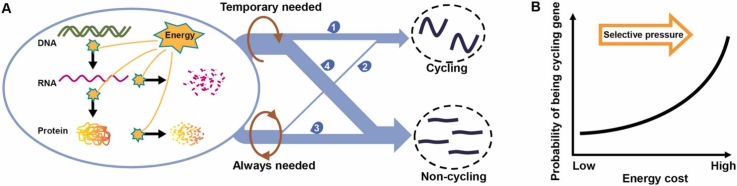
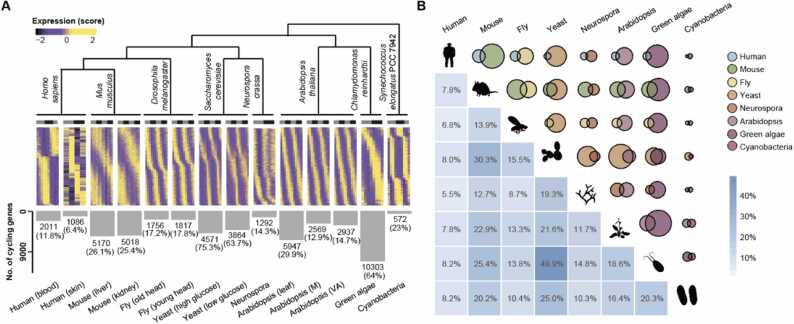
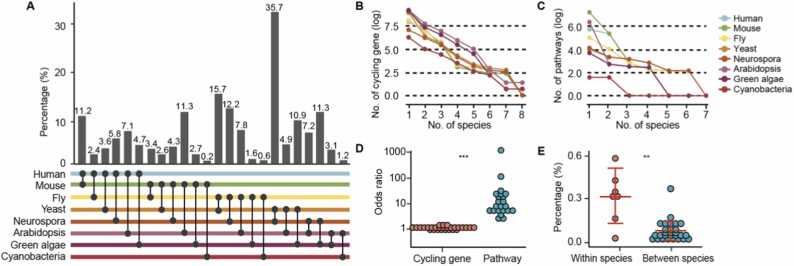
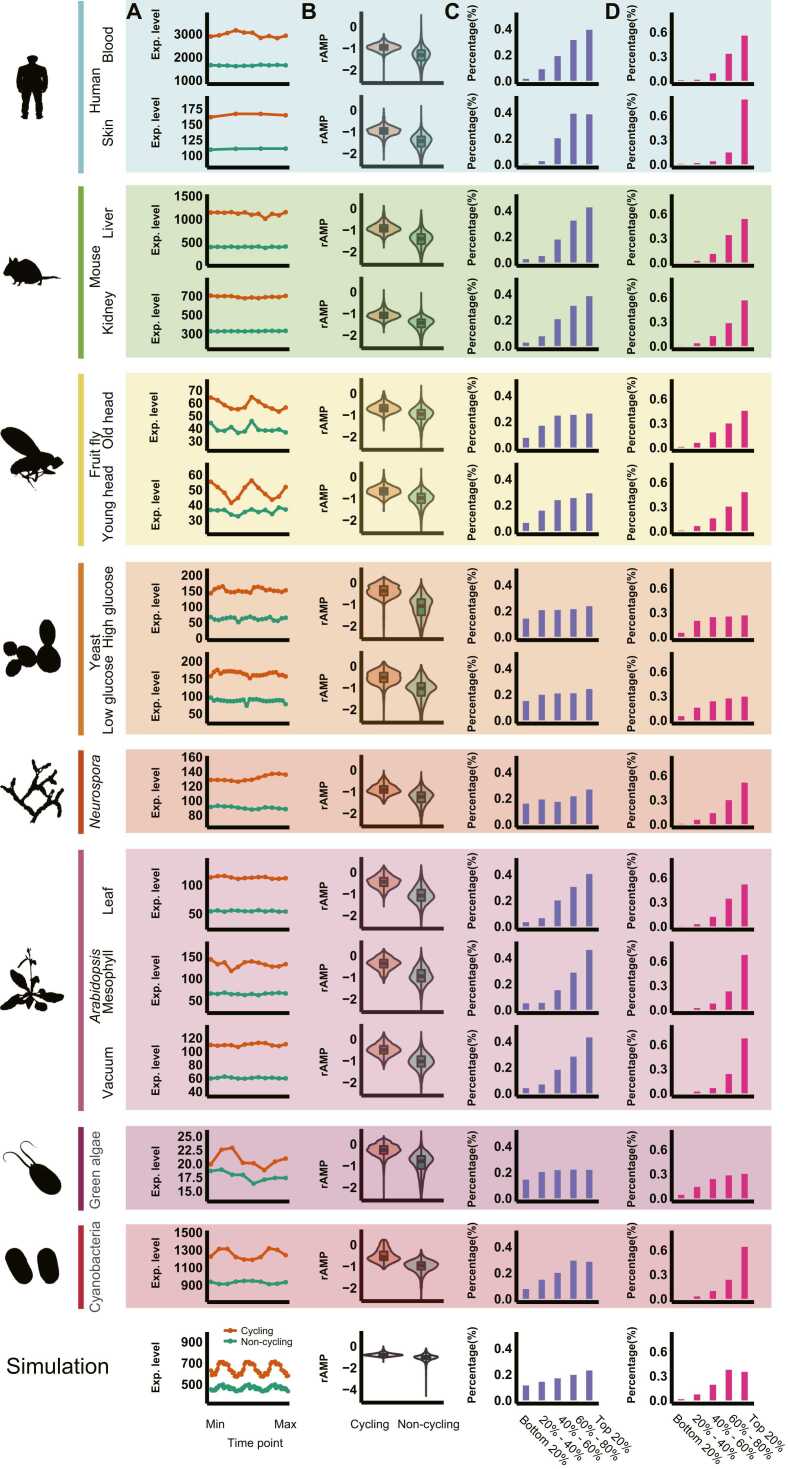
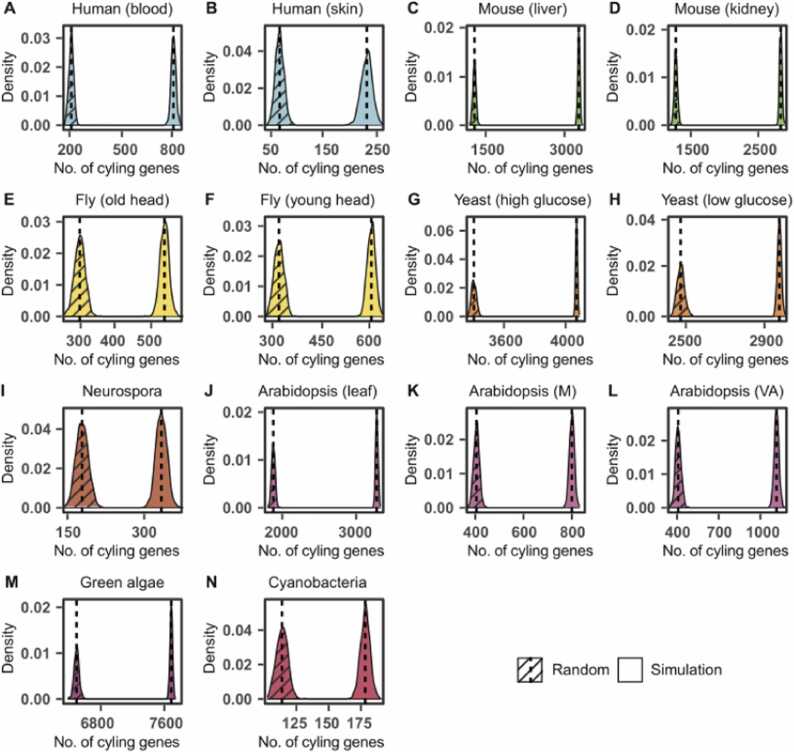
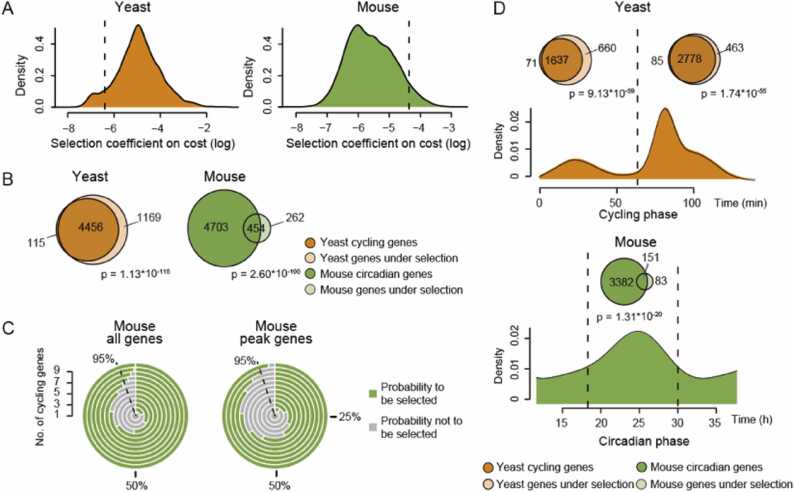
Although the individual transcriptional regulators of the core circadian clock are distinct amongst different organisms, the autoregulatory feedback loops they form are conserved. This unified design principle explains how daily physiological activities oscillate across species. However, whether analogous design principles govern the gene expression output of circadian clocks is unknown. Herein, we performed a comparative analysis of rhythmic gene expression in eight diverse species and captured four common distribution patterns of cycling gene expression across these species. We hypothesized that maintenance of reduced energetic costs constrains the evolution of rhythmic gene expression. Our large-scale computational simulations support this hypothesis by showing that selection against high-energy expenditure completely regenerates all cycling gene patterns. Moreover, we find that the late- and early-phase peaks of rhythmic expression have been subjected to this type of selective pressure. Therefore, energetic costs have constricted the cycling transcriptome throughout evolutionary history.
Overview
The claims and statistics of this paper haven’t been checked yet.
Run the check — free, no account needed. It reads the open-access text and checks the sources it cites.
Integrity signals
Registry
Cites
Statistics
Figures
Verification
Claims the paper makes
The claims and statistics of this paper haven’t been checked yet.
Run the check — free, no account needed. It reads the open-access text and checks the sources it cites.
Self-check
Percentages, sums and reported differences re-computed from the paper’s own numbers.
The self-check needs the paper’s full text.
Citations
Cites
Global quantification of mammalian gene expression control
Schwanhäusser, B., Busse, D., Li, N., Dittmar, G., Schuchhardt, J., Wolf, J., Chen, W., & Selbach, M. (2011) · Nature · doi:10.1038/nature10098 · Cited by 6,566
Research works printed but not linked: 66
- 10.1038/nrg.2016.150 · DOI
- 10.1101/sqb.2015.80.027490 · DOI
- 10.1146/annurev-genet-102209-163432 · DOI
- 2015, TRP channels: a missing bond in the entrainment mechanism of peripheral clocks throughout evolution, Temperature (Austin, 2, 522, 10.1080/23328940.2015.1115803 · DOI
- 10.1038/nrg1633 · DOI
- 10.1038/35088576 · DOI
- 10.1016/S0092-8674(00)80245-7 · DOI · Paper page
- 10.1126/science.1107373 · DOI
- 10.1016/S0092-8674(03)00074-6 · DOI
- Allada, R. , White, N. E. , So, W. V. , Hall, J. C. & Rosbash, M . A mutant Drosophila homolog of mammalian Clock disrupts circadian rhythms and transcription of period and timeless. Cell 93 (1998). · DOI
- 10.1126/science.281.5382.1519 · DOI
- 10.1126/science.1102540 · DOI · Paper page
- 10.1126/science.1061320 · DOI
- 10.1016/S0092-8674(00)81464-6 · DOI
- 10.1016/j.cub.2012.07.025 · DOI
- Boothroyd, C. E. & Young, M. W . The in(put)s and out(put)s of the Drosophila circadian clock. Ann. N. Y. Acad. Sci. 1129, 350–357 (2008). · DOI
- 10.1016/S0092-8674(02)00722-5 · DOI
- 10.1073/pnas.1408886111 · DOI · Paper page
- 10.1126/science.aao0318 · DOI
- 2019, BMAL1-Driven Tissue Clocks Respond Independently to Light to Maintain Homeostasis, Cell, 177, 1436, 10.1016/j.cell.2019.05.009 · DOI
- 10.1016/j.cell.2017.07.035 · DOI
- 10.1073/pnas.0909591106 · DOI · Paper page
- Weger, B. D. et al. Systematic analysis of differential rhythmic liver gene expression mediated by the circadian clock and feeding rhythms. Proc. Natl Acad. Sci. USA 118 (2021). · DOI
- 10.1126/science.1256682 · DOI · Paper page
- 10.1101/gr.128876.111 · DOI
- 10.1073/pnas.1217154110 · DOI · Paper page
- Wu, G. et al. Population-level rhythms in human skin with implications for circadian medicine. Proc. Natl. Acad. Sci. USA 115 (2018). · DOI
- 10.1038/ncomms14529 · DOI
- 2015, Cycling Transcriptional Networks Optimize Energy Utilization on a Genome Scale, Cell Rep, 13, 1868, 10.1016/j.celrep.2015.10.043 · DOI
- 10.1073/pnas.1418963111 · DOI
- 10.1038/nature13919 · DOI
- 2014, Prevalence, evolution, and cis-regulation of diel transcription in Chlamydomonas reinhardtii, G3 (Bethesda), 4, 2461, 10.1534/g3.114.015032 · DOI
- 10.1073/pnas.0902587106 · DOI
- 10.1093/bioinformatics/btw405 · DOI
- 10.1038/75556 · DOI · Paper page
- 10.1093/nar/gkaa1113 · DOI · Paper page
- 10.1093/nar/gky1038 · DOI
- Cheng, Y. , Chi, Y. , Zhang, L. & Wang, G. Z . A single factor dominates the behavior of rhythmic genes in mouse organs. BMC Genomics 20, 879 (2019). · DOI
- 10.1038/nature11088 · DOI
- Hartl, D. L. , Clark, A. G. & Clark, A. G. Principles of population genetics. Vol. 116 (Sinauer associates Sunderland, MA, 1997).
- 10.1093/molbev/msi126 · DOI · Paper page
- 10.1073/pnas.1514974112 · DOI · Paper page
- 2016, Robotic Nudges: The Ethics of Engineering a More Socially Just Human Being, Science and Engineering Ethics, 22, 31, 10.1007/s11948-015-9636-2 · DOI
- Wagner, A . Energy costs constrain the evolution of gene expression. J Exp Zool B Mol. Dev. Evol. 308, 322–324. · DOI
- 10.1101/gr.195404.115 · DOI
- 10.1093/molbev/mss105 · DOI
- 2017, Circadian Reprogramming in the Liver Identifies Metabolic Pathways of Aging, Cell, 170, 664, 10.1016/j.cell.2017.07.042 · DOI
- 2000, Fisher, Medawar, Hamilton and the evolution of aging, Genetics, 156, 927, 10.1093/genetics/156.3.927 · DOI · Paper page
- 10.1038/35041682 · DOI · Paper page
- 2017, Keeping the Rhythm while Changing the Lyrics: Circadian Biology in Aging, Cell, 170, 599, 10.1016/j.cell.2017.07.039 · DOI
- 10.1371/journal.pbio.1000062 · DOI
- 10.1126/science.1226339 · DOI · Paper page
- 10.1016/j.cmet.2012.11.004 · DOI
- 10.1038/ng940 · DOI
- 10.1101/gr.1649303 · DOI
- 10.1101/gr.641103 · DOI
- 10.1016/j.cell.2017.04.015 · DOI
- 10.1186/s13059-015-0721-2 · DOI · Paper page
- 10.1186/s13059-019-1832-y · DOI · Paper page
- 10.1038/nprot.2013.092 · DOI
- 2019, Simphony: simulating large-scale, rhythmic data, PeerJ, 7, e6985, 10.7717/peerj.6985 · DOI
- 10.1073/pnas.0605420103 · DOI · Paper page
- 10.1038/msb.2010.112 · DOI
- Gerashchenko, M. V. , Peterfi, Z. , Yim, S. H. & Gladyshev, V. N . Translation elongation rate varies among organs and decreases with age. Nucleic Acids Res. 49, e9 (2021). · DOI · Paper page
- 10.1038/nature02046 · DOI · Paper page
- 10.1126/science.1158441 · DOI · Paper page
Metadata
- Authors
- Cheng, Y., Chi, Y., Sun, L., & Wang, G.-Z.
- Affiliations
- Shanghai Institute of Nutrition and Health (CN)
- Corresponding author
- Wang, Guang-Zhong
- Venue
- Computational and Structural Biotechnology Journal
- Publisher
- openRxiv
- Published
- 2022-06-15
- Volume
- 21
- Pages
- 4301-4311
- ISSN
- 2001-0370 (ISSN-L)
- PMC
- PMC10492206
- OpenAlex
- W4386385534
- Cited by
- 3
- References
- 1
- Citations by year
- 2025: 3
- FWCI
- 0.45
- Type
- journal article
- Language
- en
- Open access
- gold
- doi.org
- Licence
- cc-by-nc-nd
- Locations
- Computational and Structural Biotechnology Journal (publishedVersion, cc-by-nc-nd)
- bioRxiv (Cold Spring Harbor Laboratory) (acceptedVersion, cc-by-nc-nd)
- PubMed Central (publishedVersion, cc-by-nc-nd)
- PubMed (publishedVersion)
- DOAJ (DOAJ: Directory of Open Access Journals) (submittedVersion, cc-by-sa)
- Funders
- National Natural Science Foundation of China (81827901, 2017SHZDZX01, 31600960, 31871333)
- Shanghai Institutes for Biological Sciences, Chinese Academy of Sciences
- Science and Technology Commission of Shanghai Municipality (2017SHZDZX01)
- Topics
- Life Sciences › Neuroscience › Endocrine and Autonomic Systems › Circadian rhythm and melatonin
- Life Sciences › Agricultural and Biological Sciences › Plant Science › Plant Molecular Biology Research
- Life Sciences › Biochemistry, Genetics and Molecular Biology › Genetics › Evolution and Genetic Dynamics
- Keywords
- circadian clock, rhythmic gene expression, evolutionary constraints, energetic cost, transcriptional regulation, autoregulatory loop, comparative genomics, selection pressure, transcriptome
About these checks
Registry, retraction, Cites and statistics results are computed, not judged, with one exception: a printed reference that no index lists is read once by a model before it counts as a citation error. Claims are extracted by a model and kept only when their quote appears verbatim in the text; each cited source is then checked, with a model’s help, for whether it says what the claim relies on. Those verdicts can be wrong — read the claim’s quote and the cited source before relying on one.
Statistics and arithmetic are recomputed, not judged.
Confidence bands are shown only for fields calibrated on our annotated test set. None is calibrated yet, so no band is shown.
What counts as a claim ›How we measure confidence ›How we check this ›
Are you an author, or do you see a problem with this page? Request a review
How to cite
Cite CoChat for the checks on this page, and the paper for its own findings.
- This page
- CoChat. (2026). Citation check: Dominant constraints on the evolution of rhythmic gene expression. https://app.cochat.ai/papers/10.1101/2022.06.14.496129
- The paper
- Cheng, Y., Chi, Y., Sun, L., & Wang, G.-Z. (2022). Dominant constraints on the evolution of rhythmic gene expression. Computational and Structural Biotechnology Journal. https://doi.org/10.1101/2022.06.14.496129
