

The DOI matches its Crossref record; 27 of the 27 references it cites were found in a registry or an index.
RNA-binding proteins in neurodegeneration: mechanisms in aggregate
Abstract
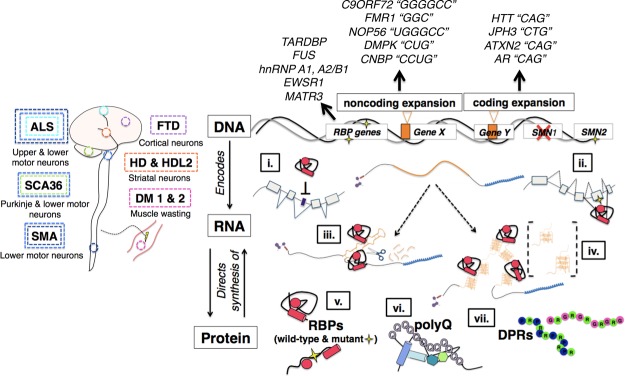
Neurodegeneration is a leading cause of death in the developed world and a natural, albeit unfortunate, consequence of longer-lived populations. Despite great demand for therapeutic intervention, it is often the case that these diseases are insufficiently understood at the basic molecular level. What little is known has prompted much hopeful speculation about a generalized mechanistic thread that ties these disparate conditions together at the subcellular level and can be exploited for broad curative benefit. In this review, we discuss a prominent theory supported by genetic and pathological changes in an array of neurodegenerative diseases: that neurons are particularly vulnerable to disruption of RNA-binding protein dosage and dynamics. Here we synthesize the progress made at the clinical, genetic, and biophysical levels and conclude that this perspective offers the most parsimonious explanation for these mysterious diseases. Where appropriate, we highlight the reciprocal benefits of cross-disciplinary collaboration between disease specialists and RNA biologists as we envision a future in which neurodegeneration declines and our understanding of the broad importance of RNA processing deepens.
Overview
The claims and statistics of this paper haven’t been checked yet.
Run the check — free, no account needed. It reads the open-access text and checks the sources it cites.
Integrity signals
Registry
Cites
Statistics
Figures
Verification
Claims the paper makes
The claims and statistics of this paper haven’t been checked yet.
Run the check — free, no account needed. It reads the open-access text and checks the sources it cites.
Claims other papers make about this one
Each is checked against this paper’s own text: does it say what the citing paper says it does?
In the citing paper
“RBPs themselves can be causal factors in neurodegenerative diseases 18,19 .”
From Tau is an m 6 A-associated RNA binding protein that causes RNA dysregulation in disease (2026) · cites this paper as [18]
Self-check
Percentages, sums and reported differences re-computed from the paper’s own numbers.
The self-check needs the paper’s full text.
Citations
Cites
Ubiquitinated TDP-43 in Frontotemporal Lobar Degeneration and Amyotrophic Lateral Sclerosis
Neumann, M., Sampathu, D. M., Kwong, L. K., Truax, A. C., Micsenyi, M. C., Chou, T. T., Bruce, J., Schuck, T., Grossman, M., Clark, C. M., et al. (2006) · Science · doi:10.1126/science.1134108 · Cited by 6,576
DeJesus-Hernandez, M., Mackenzie, I. R., Boeve, B. F., Boxer, A. L., Baker, M., Rutherford, N. J., Nicholson, A. M., Finch, N. A., Flynn, H., Adamson, J., et al. (2011) · Neuron · doi:10.1016/j.neuron.2011.09.011 · Cited by 4,936 · cited 1×
“Most notable is the GGGGCC hexanucleotide expansion in the previously unstudied gene C9ORF72 (C9), which is by far the most common known cause of ALS and FTD and the best proof for the continuous nature of the two disorders (DeJesus-Hernandez et al. 2011; Renton et al. 2011).”
BackgroundA Hexanucleotide Repeat Expansion in C9ORF72 Is the Cause of Chromosome 9p21-Linked ALS-FTD
Renton, A. E., Majounie, E., Waite, A., Simón-Sánchez, J., Rollinson, S., Gibbs, J. R., Schymick, J. C., Laaksovirta, H., van Swieten, J. C., Myllykangas, L., et al. (2011) · Neuron · doi:10.1016/j.neuron.2011.09.010 · Cited by 4,409
Verkerk, A. J. M. H., Pieretti, M., Sutcliffe, J. S., Fu, Y.-H., Kuhl, D. P. A., Pizzuti, A., Reiner, O., Richards, S., Victoria, M. F., Zhang, F., et al. (1991) · Cell · doi:10.1016/0092-8674(91)90397-h · Cited by 3,481
TDP-43 Mutations in Familial and Sporadic Amyotrophic Lateral Sclerosis
Sreedharan, J., Blair, I. P., Tripathi, V. B., Hu, X., Vance, C., Rogelj, B., Ackerley, S., Durnall, J. C., Williams, K. L., Buratti, E., et al. (2008) · Science · doi:10.1126/science.1154584 · Cited by 2,630
Widespread transcription at neuronal activity-regulated enhancers
Kim, T.-K., Hemberg, M., Gray, J. M., Costa, A. M., Bear, D. M., Wu, J., Harmin, D. A., Laptewicz, M., Barbara-Haley, K., Kuersten, S., et al. (2010) · Nature · doi:10.1038/nature09033 · Cited by 2,450
Azevedo, F. A. C., Carvalho, L. R. B., Grinberg, L. T., Farfel, J. M., Ferretti, R. E. L., Leite, R. E. P., Filho, W. J., Lent, R., & Herculano‐Houzel, S. (2009) · Journal of Comparative Neurology · doi:10.1002/cne.21974 · Cited by 2,337
Kato, M., Han, T. W., Xie, S., Shi, K., Du, X., Wu, L. C., Mirzaei, H., Goldsmith, E. J., Longgood, J., Pei, J., et al. (2012) · Cell · doi:10.1016/j.cell.2012.04.017 · Cited by 2,012
Converging Mechanisms in ALS and FTD: Disrupted RNA and Protein Homeostasis
Ling, S.-C., Polymenidou, M., & Cleveland, D. W. (2013) · Neuron · doi:10.1016/j.neuron.2013.07.033 · Cited by 1,811 · cited 3×
“We also note that a significant class of ALS without TDP-43 pathology is caused by mutations in superoxide dismutase 1 (SOD1), and the mechanism of disease is not believed to involveRBPs or their aggregation (Ling et al. 2013).”
BackgroundInfluentialHITS-CLIP yields genome-wide insights into brain alternative RNA processing
Licatalosi, D. D., Mele, A., Fak, J. J., Ule, J., Kayikci, M., Chi, S. W., Clark, T. A., Schweitzer, A. C., Blume, J. E., Wang, X., et al. (2008) · Nature · doi:10.1038/nature07488 · Cited by 1,352 · cited 1×
“Subsequent CLIP analysis of Nova-2 demonstrated a role in both brain-specific splicing and alternative polyadenylation (Licatalosi et al. 2008).”
Method
Research works printed but not linked: 261
- 10.1007/s00401-012-1022-4 · DOI
- 2011, Voltage-gated sodium channels: mutations, channelopathies and targets, Curr Med Chem, 18, 377, 10.2174/092986711794839133 · DOI
- 10.1016/j.bbrc.2006.10.093 · DOI · Paper page
- Arias M , Quintans B , Garcia-Murias M , Sobrido MJ . 2014. Spinocerebellar ataxia type 36. In GeneReviews (ed. Pagon RA , ), https://www.ncbi.nlm.nih.gov/books/NBK231880 . University of Washington, Seattle, WA.
- 10.1016/j.ymeth.2010.11.006 · DOI
- 10.1016/j.expneurol.2011.12.013 · DOI
- 10.1093/hmg/ddq230 · DOI
- 10.1038/ng0793-244 · DOI
- 10.1016/j.jmb.2005.02.038 · DOI
- 10.1038/emboj.2010.310 · DOI
- 10.1093/nar/26.23.5343 · DOI
- 10.1007/s00335-008-9117-x · DOI
- 10.1186/1750-1326-8-30 · DOI
- 10.1016/0092-8674(91)90514-Y · DOI
- 10.1001/archneurol.2011.2499 · DOI
- 10.1074/jbc.M111.328757 · DOI
- 2015, RNA structures as mediators of neurological diseases and as drug targets, Neuron, 87, 28, 10.1016/j.neuron.2015.06.012 · DOI
- 10.1007/s00401-013-1125-6 · DOI
- 10.1074/jbc.M116.744839 · DOI
- 10.1038/nphys3532 · DOI
- 10.3390/ijms151017493 · DOI
- 10.1016/0092-8674(92)90154-5 · DOI · Paper page
- 10.1126/science.281.5384.1851 · DOI
- 10.1016/0896-6273(93)90077-5 · DOI
- 10.1016/j.brainres.2012.02.031 · DOI
- 10.1007/978-1-62703-411-1_1 · DOI
- 2015, Functional significance of TDP-43 mutations in disease, Adv Genet, 91, 1, 10.1016/bs.adgen.2015.07.001 · DOI
- 10.1093/emboj/20.7.1774 · DOI
- 10.1074/jbc.M505557200 · DOI
- 2014, Brain pathology in myotonic dystrophy: when tauopathy meets spliceopathy and RNAopathy, Front Mol Neurosci, 6, 57
- 10.1038/ng854 · DOI
- 10.1128/MCB.17.8.4667 · DOI
- 10.1038/nrm2777 · DOI · Paper page
- 10.1021/cb200408a · DOI
- 10.1021/cb4007387 · DOI
- 10.1128/MCB.19.1.69 · DOI
- 2017, Structural characteristics of simple RNA repeats associated with disease and their deleterious protein Interactions, Front Cell Neurosci, 11, 97
- 10.1016/j.gde.2014.03.002 · DOI
- 10.1101/gad.267286.115 · DOI
- 2016, ALS mutations disrupt phase separation mediated by α-helical structure in the TDP-43 low-complexity C-terminal domain, Structure, 24, 1537, 10.1016/j.str.2016.07.007 · DOI
- 10.7554/elife.17820 · DOI
- 2017, RNA-binding proteins implicated in neurodegenerative diseases, Wiley Interdiscip Rev RNA, 8, e1397, 10.1002/wrna.1397 · DOI
- 10.1016/j.cell.2009.02.011 · DOI
- 10.1007/s00401-014-1251-9 · DOI
- 2017, A novel mutation of the C-terminal amino acid of FUS (Y526C) strengthens FUS gene as the most frequent genetic factor in aggressive juvenile ALS, Amyotroph Lateral Scler Frontotemporal Degener, 18, 298, 10.1080/21678421.2016.1265564 · DOI
- 10.1136/jmg.2009.071027 · DOI
- 10.1016/j.drudis.2014.02.014 · DOI
- 10.1093/hmg/dds116 · DOI
- 10.1101/gad.1575607 · DOI
- 10.1038/363640a0 · DOI · Paper page
- 10.1093/nar/gkp342 · DOI
- 10.1073/pnas.93.10.4529 · DOI
- 10.1016/S0092-8674(01)00566-9 · DOI · Paper page
- 10.1101/cshperspect.a012286 · DOI
- 10.1083/jcb.200704147 · DOI
- 2017, Neurodegeneration and RNA-binding proteins, Wiley Interdiscip Rev RNA, 8, e1394, 10.1002/wrna.1394 · DOI
- 10.1074/jbc.M116.770768 · DOI
- 10.1093/nar/gkq1323 · DOI
- 10.1074/jbc.M406415200 · DOI
- 10.1093/nar/gkw731 · DOI
- 10.1101/093831 · DOI
- 10.1371/journal.pone.0110846 · DOI
- 10.1146/annurev.bi.62.070193.001445 · DOI
- 10.1038/nature09320 · DOI
- 10.1523/JNEUROSCI.3631-10.2011 · DOI · Paper page
- 10.1038/ncomms5824 · DOI
- 2017, The role of dipeptide repeats in C9ORF72-related ALS–FTD, Front Mol Neurosci, 10, 35
- 10.1073/pnas.91.11.4950 · DOI
- 10.1074/jbc.M110.125039 · DOI
- 10.1016/j.cub.2005.01.058 · DOI
- 10.1523/JNEUROSCI.0783-09.2009 · DOI
- 10.1074/jbc.M111.231209 · DOI
- 2014, C9ORF72 hexanucleotide repeat expansion is a rare cause of schizophrenia, Neurobiol Aging, 35, 1214.e7, 10.1016/j.neurobiolaging.2013.12.004 · DOI · Paper page
- 10.2217/fnl.09.44 · DOI
- 10.1073/pnas.1018213108 · DOI
- 10.1016/S0301-0082(01)00007-7 · DOI
- 2016, RAN translation-What makes it run?, Brain Res, 1647, 30, 10.1016/j.brainres.2016.04.003 · DOI
- 10.1126/science.aaf5371 · DOI
- 10.1016/j.molcel.2015.10.006 · DOI
- 10.1038/nrn.2016.38 · DOI
- 10.1016/j.cell.2012.04.016 · DOI
- 10.1074/jbc.M503495200 · DOI
- 10.1007/s00415-002-0811-4 · DOI
- Harms MM , Miller TM , Baloh RH . 2015. TARDBP-related amyotrophic lateral sclerosis. In GeneReviews (ed. Pagon RA , ), https://www.ncbi.nlm.nih.gov/books/NBK5942 . University of Washington, Seattle, WA.
- 10.1074/jbc.270.36.20871 · DOI
- 10.1038/ng760 · DOI
- 10.1371/journal.pbio.0050073 · DOI
- 10.1038/nature10485 · DOI
- 10.1016/j.celrep.2012.02.001 · DOI · Paper page
- 2017, Quantitative analysis of cryptic splicing associated with TDP-43 depletion, BMC Med Genomics, 10, 38, 10.1186/s12920-017-0274-1 · DOI
- 10.2353/ajpath.2008.080003 · DOI
- 10.1212/WNL.0b013e318260436f · DOI
- 2016, TDP-43 binds and transports G-quadruplex-containing mRNAs into neurites for local translation, Genes Cells, 21, 466, 10.1111/gtc.12352 · DOI
- 10.1093/brain/awh650 · DOI
- 10.1073/pnas.1613181114 · DOI
- 10.1016/S0896-6273(00)80900-9 · DOI · Paper page
- 10.1093/hmg/ddh327 · DOI
- 10.1093/hmg/9.6.901 · DOI
- 10.1016/j.neuron.2007.07.020 · DOI
- 10.1074/jbc.M109.010264 · DOI
- 10.1038/nn.3688 · DOI
- 10.1038/nrn3210 · DOI
- 10.1038/ng.132 · DOI · Paper page
- 10.1126/science.1088583 · DOI · Paper page
- 10.1038/ng1207 · DOI
- 10.1007/s13311-014-0292-z · DOI
- 10.1016/j.neuron.2006.08.021 · DOI
- 10.1038/nature11922 · DOI
- 2016, Interaction of RNA with a C-terminal fragment of the amyotrophic lateral sclerosis-associated TDP43 reduces cytotoxicity, Sci Rep, 6, 19230, 10.1038/srep19230 · DOI
- 2017, Different aggregation states of a nuclear localization signal-tagged 25-kDa C-terminal fragment of TAR RNA/DNA-binding protein 43 kDa, Genes Cells, 22, 521, 10.1111/gtc.12495 · DOI
- 10.1016/S0092-8674(00)81781-X · DOI
- 10.1016/j.ajhg.2011.05.015 · DOI
- 10.1177/0883073807305666 · DOI
- 10.1016/j.molcel.2007.01.031 · DOI
- 10.1002/1531-8249(199912)46:6<842::AID-ANA6>3.0.CO;2-O · DOI
- 10.1093/nar/gkp013 · DOI
- 10.1007/978-3-540-34449-0_7 · DOI
- 10.1126/science.1166066 · DOI
- 10.1038/nn.3230 · DOI
- 10.1038/nrg2748 · DOI
- 10.1038/352077a0 · DOI
- 10.1002/emmm.201303275 · DOI
- 10.1038/ng0797-265 · DOI
- 10.15252/emmm.201607486 · DOI · Paper page
- 10.1074/jbc.M008304200 · DOI
- 10.1073/pnas.0913602107 · DOI
- 10.1083/jcb.201302044 · DOI
- 10.1038/ncomms7183 · DOI
- 10.1016/j.cell.2016.10.003 · DOI
- 10.1073/pnas.1008227107 · DOI
- 10.1126/science.aab0983 · DOI · Paper page
- 10.1126/science.1062125 · DOI
- 10.1371/journal.pone.0013250 · DOI
- 10.1523/JNEUROSCI.2350-13.2014 · DOI
- 2016, Poly(GR) in C9ORF72-related ALS/FTD compromises mitochondrial function and increases oxidative stress and DNA damage in iPSC-derived motor neurons, Neuron, 92, 383, 10.1016/j.neuron.2016.09.015 · DOI
- 10.1016/j.cell.2012.09.012 · DOI
- 10.1038/nsmb.2698 · DOI
- 10.1002/ana.21147 · DOI · Paper page
- 10.1016/S1474-4422(10)70195-2 · DOI
- 10.1016/j.brainres.2016.02.037 · DOI
- 10.1042/BJ20060490 · DOI
- 10.1111/bpa.12427 · DOI
- 10.1101/gad.255737.114 · DOI
- 10.1093/hmg/ddr021 · DOI
- 10.1016/j.neuron.2010.12.032 · DOI
- 10.1093/nar/27.17.3534 · DOI
- 10.1016/j.cell.2015.09.015 · DOI · Paper page
- 2015, Structural evidence of amyloid fibril formation in the putative aggregation domain of TDP-43, J Phys Chem Lett, 6, 2608, 10.1021/acs.jpclett.5b00918 · DOI
- 2016, An amyloid-like pathological conformation of TDP-43 is stabilized by hypercooperative hydrogen bonds, Front Mol Neurosci, 9, 125
- 10.1073/pnas.0505873102 · DOI
- 10.1021/ja106287x · DOI
- 10.1007/s00439-017-1807-6 · DOI
- 10.1021/ja2096255 · DOI
- 10.1016/j.neuron.2015.10.030 · DOI · Paper page
- 10.1093/nar/gkr608 · DOI
- 10.1002/ana.23992 · DOI
- 10.1038/cddis.2013.276 · DOI
- 2017, Competitive regulation of alternative splicing and alternative polyadenylation by hnRNP H and CstF64 determines acetylcholinesterase isoforms, Nucleic Acids Res, 45, 1455
- 10.1093/brain/awp214 · DOI · Paper page
- 10.1186/s40478-016-0358-8 · DOI
- 10.1091/mbc.E06-12-1120 · DOI
- 10.1038/nchem.2519 · DOI
- 2017, Splicing regulation and dysregulation of cholinergic genes expressed at the neuromuscular junction, J Neurochem, 142, 64, 10.1111/jnc.13954 · DOI
- 2017, ISS-N1 makes the first FDA-approved drug for spinal muscular atrophy, Transl Neurosci, 8, 1, 10.1515/tnsci-2017-0001 · DOI
- 10.1016/j.cell.2015.07.047 · DOI · Paper page
- 10.1038/emboj.2010.19 · DOI
- 10.1038/sj.embor.7400941 · DOI
- 2013, Higher-order quadruplex structures, Top Curr Chem, 330, 23
- 10.1126/science.280.5364.737 · DOI
- 10.1074/jbc.M707304200 · DOI
- 2010, Perspectives and diagnostic considerations in spinal muscular atrophy, Genet Med, 12, 145, 10.1097/GIM.0b013e3181c5e713 · DOI
- 10.1038/nn.4065 · DOI
- 10.1038/ng1196-269 · DOI
- 10.1038/ng0693-175 · DOI
- 2017, Single-cell analysis of SMN reveals its broader role in neuromuscular disease, Cell Rep, 18, 1484, 10.1016/j.celrep.2017.01.035 · DOI
- 10.1038/nrm1742 · DOI
- 10.1016/S1474-4422(10)70245-3 · DOI
- 10.1056/NEJM200105313442207 · DOI
- 10.1002/ana.21081 · DOI
- 10.1128/MCB.06077-11 · DOI
- 10.1261/rna.047373.114 · DOI
- 10.1371/journal.pone.0023882 · DOI
- 10.1016/j.ajhg.2009.09.019 · DOI · Paper page
- 10.1016/S0092-8674(00)81782-1 · DOI
- 10.7554/eLife.01749 · DOI · Paper page
- 2013, Molecular genetics and genetic testing in myotonic dystrophy type 1, Biomed Res Int, 2013, 391821
- 10.15252/embj.201592559 · DOI
- 2016, Prevalence of brain and spinal cord inclusions, including dipeptide repeat proteins, in patients with the C9ORF72 hexanucleotide repeat expansion: a systematic neuropathological review, Neuropathol Appl Neurobiol, 42, 547, 10.1111/nan.12284 · DOI
- 10.1038/emboj.2010.21 · DOI
- 2013, Sequestration of DROSHA and DGCR8 by expanded CGG RNA repeats alters microRNA processing in fragile X-associated tremor/ataxia syndrome, Cell Rep, 3, 869, 10.1016/j.celrep.2013.02.004 · DOI
- 2017, Translation of expanded CGG repeats into FMRpolyG is pathogenic and may contribute to fragile X tremor ataxia syndrome, Neuron, 93, 331, 10.1016/j.neuron.2016.12.016 · DOI
- 10.1007/s00018-015-1943-x · DOI
- 10.1073/pnas.1003459107 · DOI
- 2016, Mechanisms of FUS mutations in familial amyotrophic lateral sclerosis, Brain Res, 1647, 65, 10.1016/j.brainres.2016.03.036 · DOI
- 10.1038/ncomms10465 · DOI
- 10.1016/j.neuron.2014.08.040 · DOI
- 10.1038/nchem.2534 · DOI
- 2013, Disease mutations in the prion-like domains of hnRNPA1 and hnRNPA2/B1 introduce potent steric zippers that drive excess RNP granule assembly, Rare Dis, 1, e25200, 10.4161/rdis.25200 · DOI
- 10.1016/j.febslet.2015.05.003 · DOI
- 2016, Is spinal muscular atrophy a disease of the motor neurons only: pathogenesis and therapeutic implications?, Cell Mol Life Sci, 73, 1003, 10.1007/s00018-015-2106-9 · DOI
200 of 261 shown
Cited by
Molecular basis for substrate recruitment to the PRMT5 methylosome
Mulvaney, K. M., Blomquist, C., Acharya, N., Li, R., Ranaghan, M. J., O’Keefe, M., Rodriguez, D. J., Young, M. J., Kesar, D., Pal, D., et al. (2021) · Molecular Cell · doi:10.1016/j.molcel.2021.07.019 · Cited by 93
RNA–Binding Protein HuD as a Versatile Factor in Neuronal and Non–Neuronal Systems
Jung, M., & Lee, E. K. (2021) · Biology · doi:10.3390/biology10050361 · Cited by 39
Tau is an m 6 A-associated RNA binding protein that causes RNA dysregulation in disease
Dixon, G., Keys, A., Rothamel, K., McKetney, J., Jiang, Y. X., Gordon, L. A., Page, M. L., Liu, C., Hou, K., Flanagan, K., et al. (2026) · doi:10.64898/2026.10.26.762095
Metadata
- Authors
- Conlon, E. G., & Manley, J. L.
- Venue
- Genes & Development
- Publisher
- Cold Spring Harbor Laboratory
- Published
- 2017-08-01
- Volume
- 31
- Issue
- 15
- Pages
- 1509-1528
- ISSN
- 0890-9369
- 1549-5477
- PMC
- PMC5630017
- Cited by
- 231
- References
- 27
- Language
- en
- Funders
- National Institutes of Health (R35 GM118136)
About these checks
Registry, retraction, Cites and statistics results are computed, not judged, with one exception: a printed reference that no index lists is read once by a model before it counts as a citation error. Claims are extracted by a model and kept only when their quote appears verbatim in the text; each cited source is then checked, with a model’s help, for whether it says what the claim relies on. Those verdicts can be wrong — read the claim’s quote and the cited source before relying on one.
Statistics and arithmetic are recomputed, not judged.
Confidence bands are shown only for fields calibrated on our annotated test set. None is calibrated yet, so no band is shown.
What counts as a claim ›How we measure confidence ›How we check this ›
Are you an author, or do you see a problem with this page? Request a review
Data sources
Bibliographic data: Semantic Scholar, OpenAlex, Crossref.
Contains information from the Semantic Scholar Academic Graph Datasets, made available under the ODC Attribution License (ODC-BY 1.0).
Semantic Scholar’s data is described in: Kinney, R., et al. (2023). The Semantic Scholar Open Data Platform. arXiv:2301.10140.
