

The DOI matches its Crossref record; 7 of the 7 references it cites were found in a registry or an index.
Social insect genomes exhibit dramatic evolution in gene composition and regulation while preserving regulatory features linked to sociality
Abstract
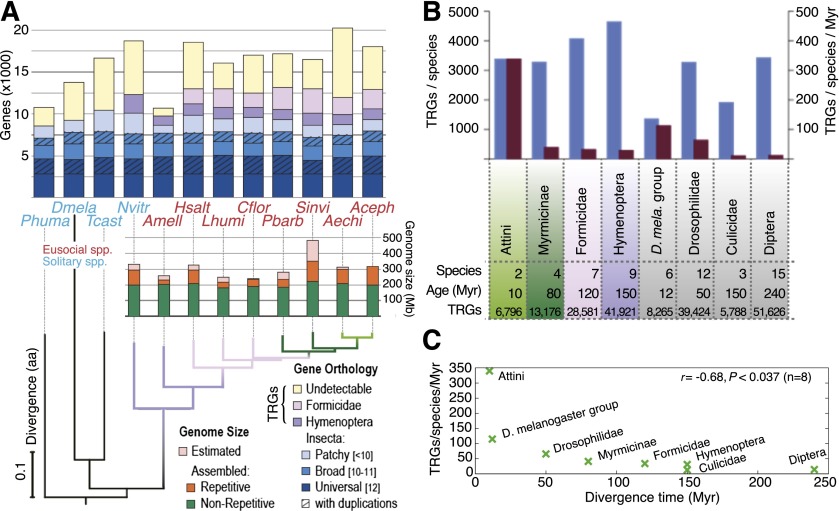
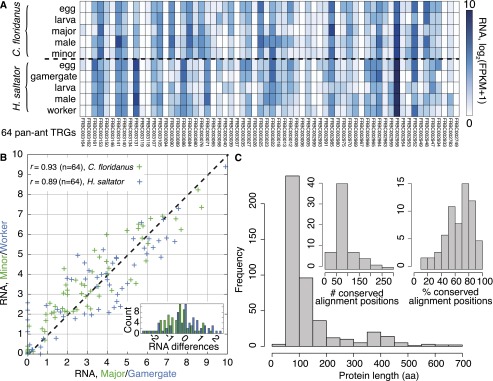
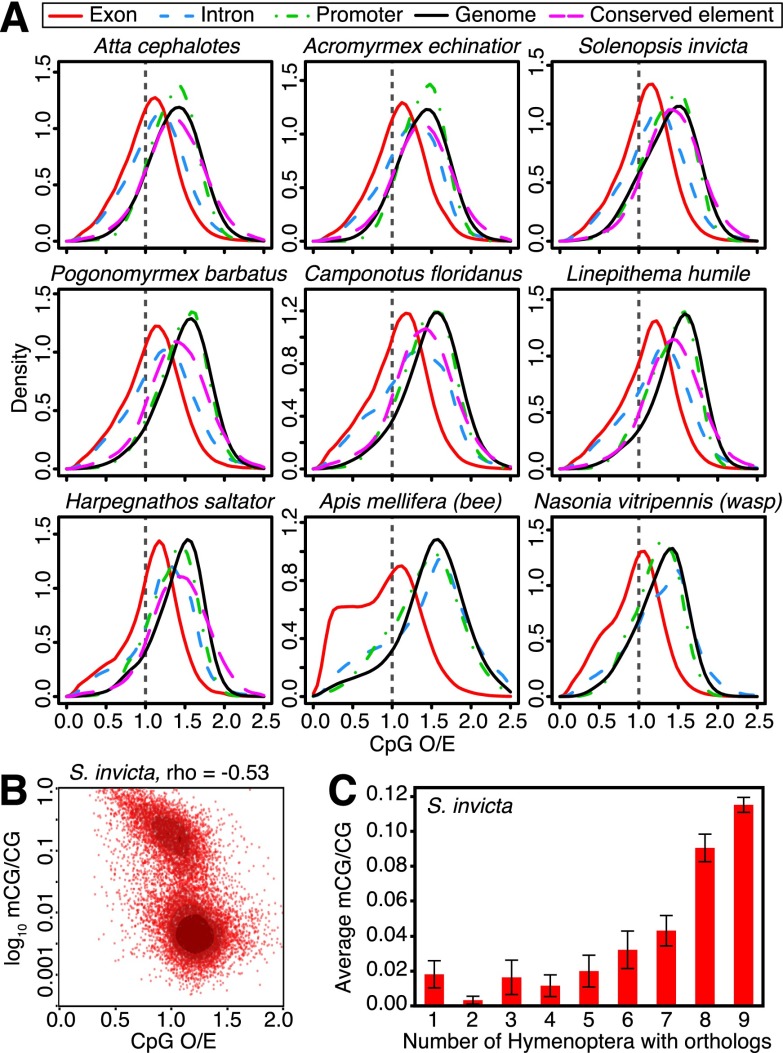
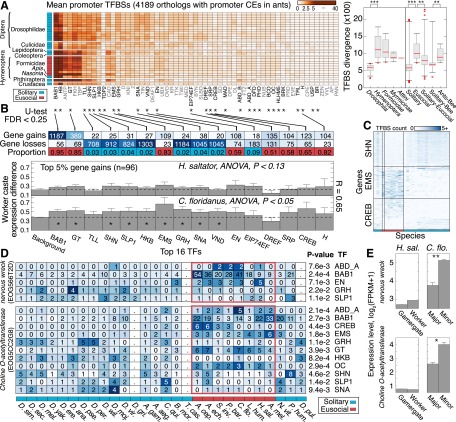
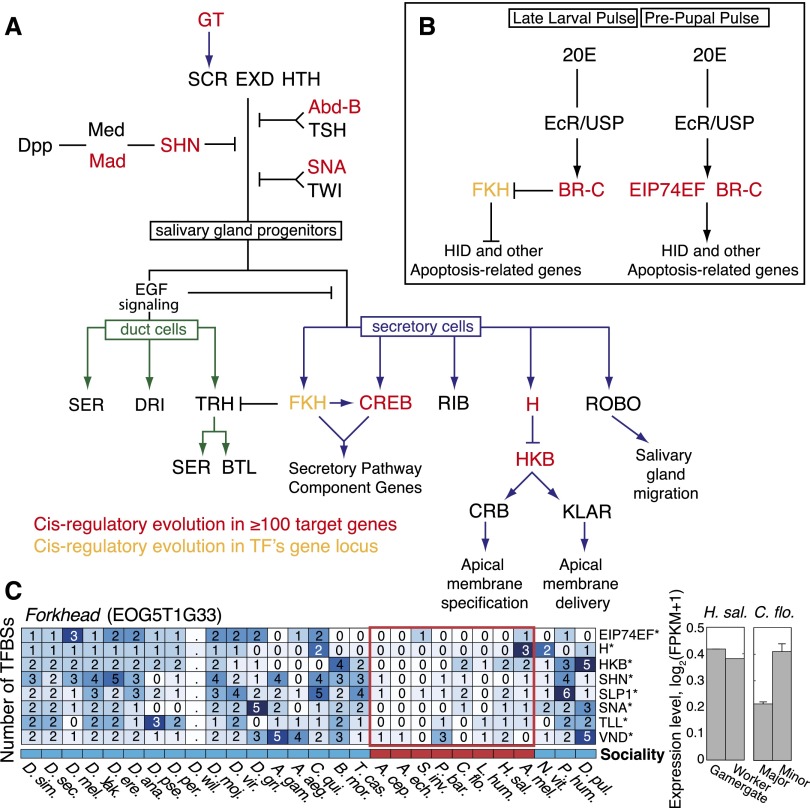
Genomes of eusocial insects code for dramatic examples of phenotypic plasticity and social organization. We compared the genomes of seven ants, the honeybee, and various solitary insects to examine whether eusocial lineages share distinct features of genomic organization. Each ant lineage contains ∼4000 novel genes, but only 64 of these genes are conserved among all seven ants. Many gene families have been expanded in ants, notably those involved in chemical communication (e.g., desaturases and odorant receptors). Alignment of the ant genomes revealed reduced purifying selection compared with Drosophila without significantly reduced synteny. Correspondingly, ant genomes exhibit dramatic divergence of noncoding regulatory elements; however, extant conserved regions are enriched for novel noncoding RNAs and transcription factor–binding sites. Comparison of orthologous gene promoters between eusocial and solitary species revealed significant regulatory evolution in both cis(e.g.,Creb) and trans(e.g.,fork head) for nearly 2000 genes, many of which exhibit phenotypic plasticity. Our results emphasize that genomic changes can occur remarkably fast in ants, because two recently diverged leaf-cutter ant species exhibit faster accumulation of species-specific genes and greater divergence in regulatory elements compared with other ants or Drosophila. Thus, while the “socio-genomes” of ants and the honeybee are broadly characterized by a pervasive pattern of divergence in gene composition and regulation, they preserve lineage-specific regulatory features linked to eusociality. We propose that changes in gene regulation played a key role in the origins of insect eusociality, whereas changes in gene composition were more relevant for lineage-specific eusocial adaptations.
Overview
The claims and statistics of this paper haven’t been checked yet.
Run the check — free, no account needed. It reads the open-access text and checks the sources it cites.
Integrity signals
Registry
Cites
Statistics
Figures
Verification
Claims the paper makes
The claims and statistics of this paper haven’t been checked yet.
Run the check — free, no account needed. It reads the open-access text and checks the sources it cites.
Claims other papers make about this one
Each is checked against this paper’s own text: does it say what the citing paper says it does?
In the citing paper
“These finding and those in refs. 89–91 support the prediction that changes in gene regulation are key features of the evolutionary transition from solitary to social life, at least in the social insects.”
From Behavior-related gene regulatory networks: A new level of organization in the brain (2020) · cites this paper as [91]
Self-check
Percentages, sums and reported differences re-computed from the paper’s own numbers.
The self-check needs the paper’s full text.
Citations
Cites
Guindon, S., Dufayard, J.-F., Lefort, V., Anisimova, M., Hordijk, W., & Gascuel, O. (2010) · Systematic Biology · doi:10.1093/sysbio/syq010 · Cited by 18,376
Trapnell, C., Williams, B. A., Pertea, G., Mortazavi, A., Kwan, G., van Baren, M. J., Salzberg, S. L., Wold, B. J., & Pachter, L. (2010) · Nature Biotechnology · doi:10.1038/nbt.1621 · Cited by 15,556
Evolutionarily conserved elements in vertebrate, insect, worm, and yeast genomes
Siepel, A., Bejerano, G., Pedersen, J. S., Hinrichs, A. S., Hou, M., Rosenbloom, K., Clawson, H., Spieth, J., Hillier, L. W., Richards, S., et al. (2005) · Genome Research · doi:10.1101/gr.3715005 · Cited by 3,971 · cited 3×
“Conserved elements were identified from whole-genome sequence alignments using phastCons (Siepel et al. 2005).”
BackgroundMethodInfluentialWidespread transcription at neuronal activity-regulated enhancers
Kim, T.-K., Hemberg, M., Gray, J. M., Costa, A. M., Bear, D. M., Wu, J., Harmin, D. A., Laptewicz, M., Barbara-Haley, K., Kuersten, S., et al. (2010) · Nature · doi:10.1038/nature09033 · Cited by 2,450
Evolution of genes and genomes on the Drosophila phylogeny
Drosophila 12 Genomes Consortium (2007) · Nature · doi:10.1038/nature06341 · Cited by 2,010
A high-resolution map of human evolutionary constraint using 29 mammals
Broad Institute Sequencing Platform and Whole Genome Assembly Team, Lindblad-Toh, K., Baylor College of Medicine Human Genome Sequencing Center Sequencing Team, Genome Institute at Washington University, Garber, M., Zuk, O., Lin, M. F., Parker, B. J., Washietl, S., Kheradpour, P., et al. (2011) · Nature · doi:10.1038/nature10530 · Cited by 1,108
Self-citationThe evolutionary origin of orphan genes
Tautz, D., & Domazet-Lošo, T. (2011) · Nature Reviews Genetics · doi:10.1038/nrg3053 · Cited by 764
Research works printed but not linked: 58
- 10.1126/science.1071468 · DOI · Paper page
- 10.1242/dev.01863 · DOI
- 10.1126/science.1192428 · DOI
- 10.1016/j.cub.2012.07.042 · DOI
- 2011, The antiquity and evolutionary history of social behavior in bees, PLoS ONE, 66, e21086
- 10.1093/oxfordjournals.molbev.a026334 · DOI · Paper page
- 10.1038/346482a0 · DOI · Paper page
- 10.1016/S0896-6273(04)00016-9 · DOI
- Crozier RH , Pamilo P . 1996. Evolution of social insect colonies: Sex allocation and kin selection. Oxford University Press, New York. · DOI · Paper page
- 10.1073/pnas.0900301106 · DOI · Paper page
- 10.1186/gb-2003-5-1-r1 · DOI · Paper page
- 10.1098/rspb.2009.0184 · DOI
- 10.1186/gb-2013-14-2-r20 · DOI
- 10.1016/j.tig.2011.08.005 · DOI
- 10.1111/j.1365-2583.2011.01092.x · DOI
- 1996, Age-dependent and task-related morphological changes in the brain and the mushroom bodies of the ant Camponotus floridanus, J Exp Biol, 199, 2011, 10.1242/jeb.199.9.2011 · DOI
- 10.1371/journal.pgen.0030197 · DOI · Paper page
- 10.1038/nature05260 · DOI · Paper page
- 10.1093/nar/gkn923 · DOI · Paper page
- 10.1038/nprot.2008.211 · DOI · Paper page
- 10.1073/pnas.0810213106 · DOI
- 10.1186/1471-2164-12-164 · DOI
- 10.1038/nature10093 · DOI · Paper page
- 10.1093/nar/gkf436 · DOI · Paper page
- 10.1016/j.tig.2009.07.006 · DOI · Paper page
- 10.1093/bioinformatics/btr167 · DOI
- 10.1126/science.1153069 · DOI · Paper page
- 10.1093/bioinformatics/btp434 · DOI
- 10.1186/gb-2009-10-3-r25 · DOI · Paper page
- 10.1007/s00335-002-2175-6 · DOI
- 10.1016/S1534-5807(03)00192-8 · DOI
- 2011, Large intergenic non-coding RNA-RoR modulates reprogramming of human induced pluripotent stem cells, Nat Genet, 42, 1113
- 10.1074/jbc.270.16.9340 · DOI
- 10.1007/s10886-009-9695-4 · DOI · Paper page
- 10.1146/annurev.en.14.010169.001503 · DOI · Paper page
- 10.1126/science.1124891 · DOI
- 10.1093/nar/gkq1145 · DOI
- 10.1101/gr.121392.111 · DOI
- 10.1101/gr.112516.110 · DOI
- 10.1038/nrg2904 · DOI
- 10.1016/j.cell.2009.04.020 · DOI
- 10.1126/science.1076781 · DOI · Paper page
- 10.1073/pnas.1105937108 · DOI
- 10.1038/nrg1575 · DOI · Paper page
- 10.1073/pnas.0711024105 · DOI · Paper page
- 2009, Pervasive natural selection in the Drosophila genome?, PLoS Genet, 56, e1000495
- 10.1101/gr.148361.112 · DOI
- 10.1111/j.1558-5646.2010.01170.x · DOI
- 10.1073/pnas.1008617108 · DOI
- 10.1073/pnas.1007901108 · DOI
- 2012, Patterns of DNA methylation in development, division of labor and hybridization in an ant with genetic caste determination, PLoS ONE, 78, e42433
- 10.1371/journal.pgen.1002007 · DOI
- 2004, Temporal patterns of fruit fly Drosophila evolution revealed by mutation clocks, Mol Biol Evol, 21, 36
- 10.1111/j.1420-9101.2010.02020.x · DOI
- 2009, Identifying the transition between single and multiple mating of queens in fungus-growing ants, Proc Biol Sci, 269, 1541
- 10.1093/nar/gkq930 · DOI
- 10.1073/pnas.1009690108 · DOI · Paper page
- 10.1371/journal.pgen.1002930 · DOI
Cited by
Emms, D. M., & Kelly, S. (2015) · Genome Biology · doi:10.1186/s13059-015-0721-2 · Cited by 3,408
Genomic signatures of evolutionary transitions from solitary to group living
Kapheim, K. M., Pan, H., Li, C., Salzberg, S. L., Puiu, D., Magoc, T., Robertson, H. M., Hudson, M. E., Venkat, A., Fischman, B. J., et al. (2015) · Science · doi:10.1126/science.aaa4788 · Cited by 409
Self-citationA framework for studying social complexity
Kappeler, P. M. (2019) · Behavioral Ecology and Sociobiology · doi:10.1007/s00265-018-2601-8 · Cited by 316
Epigenetic (re)programming of caste-specific behavior in the ant Camponotus floridanus
Simola, D. F., Graham, R. J., Brady, C. M., Enzmann, B. L., Desplan, C., Ray, A., Zwiebel, L. J., Bonasio, R., Reinberg, D., Liebig, J., et al. (2016) · Science · doi:10.1126/science.aac6633 · Cited by 242
Self-citationDNA methylation in social insects: how epigenetics can control behavior and longevity
Yan, H., Bonasio, R., Simola, D. F., Liebig, J., Berger, S. L., & Reinberg, D. (2015) · Annual Review of Entomology · doi:10.1146/annurev-ento-010814-020803 · Cited by 183
Self-citation
Metadata
- Authors
- Simola, D. F., Wissler, L., Donahue, G., Waterhouse, R. M., Helmkampf, M., Roux, J., Nygaard, S., Glastad, K. M., Hagen, D. E., Viljakainen, L., Reese, J. T., Hunt, B. G., Graur, D., Elhaik, E., Kriventseva, E. V., Wen, J., Parker, B. J., Cash, E., Privman, E., Childers, C. P., Muñoz-Torres, M. C., Boomsma, J. J., Bornberg-Bauer, E., Currie, C. R., Elsik, C. G., Suen, G., Goodisman, M. A. D., Keller, L., Liebig, J., Rawls, A., Reinberg, D., Smith, C. D., Smith, C. R., Tsutsui, N., Wurm, Y., Zdobnov, E. M., Berger, S. L., & Gadau, J.
- Venue
- Genome Research
- Publisher
- Cold Spring Harbor Laboratory
- Published
- 2013-05-01
- Volume
- 23
- Issue
- 8
- Pages
- 1235-1247
- ISSN
- 1088-9051
- PMC
- PMC3730098
- Cited by
- 240
- References
- 7
- Language
- en
About these checks
Registry, retraction, Cites and statistics results are computed, not judged, with one exception: a printed reference that no index lists is read once by a model before it counts as a citation error. Claims are extracted by a model and kept only when their quote appears verbatim in the text; each cited source is then checked, with a model’s help, for whether it says what the claim relies on. Those verdicts can be wrong — read the claim’s quote and the cited source before relying on one.
Statistics and arithmetic are recomputed, not judged.
Confidence bands are shown only for fields calibrated on our annotated test set. None is calibrated yet, so no band is shown.
What counts as a claim ›How we measure confidence ›How we check this ›
Are you an author, or do you see a problem with this page? Request a review
How to cite
Cite CoChat for the checks on this page, and the paper for its own findings.
- This page
- CoChat. (2026). Citation check: Social insect genomes exhibit dramatic evolution in gene composition and regulation while preserving regulatory features linked to sociality. https://app.cochat.ai/papers/10.1101/gr.155408.113
- The paper
- Simola, D. F., Wissler, L., Donahue, G., Waterhouse, R. M., Helmkampf, M., Roux, J., Nygaard, S., Glastad, K. M., Hagen, D. E., Viljakainen, L., Reese, J. T., Hunt, B. G., Graur, D., Elhaik, E., Kriventseva, E. V., Wen, J., Parker, B. J., Cash, E., Privman, E., . . . Gadau, J. (2013). Social insect genomes exhibit dramatic evolution in gene composition and regulation while preserving regulatory features linked to sociality. Genome Research. https://doi.org/10.1101/gr.155408.113
Data sources
Bibliographic data: Semantic Scholar, OpenAlex, Crossref.
Contains information from the Semantic Scholar Academic Graph Datasets, made available under the ODC Attribution License (ODC-BY 1.0).
Semantic Scholar’s data is described in: Kinney, R., et al. (2023). The Semantic Scholar Open Data Platform. arXiv:2301.10140.
