

The DOI matches its Crossref record; 43 of the 92 references it cites were found in a registry or an index, and 49 are not checked yet; none of the 31 sources its claims cite is checked for support yet.
Generalized Geometric Quantum Speed Limits
Open accessAbstract
Understanding the speed with which a quantum system can evolve between distinguishable states has applications in quantum technology. A new theoretical study demonstrates a general family of quantum speed limits that can be applied to any physical process.
Checked 2026-10-06 · 49 references not checked yet
Overview
AI snapshot
Written from the paper’s full text.
TL;DR
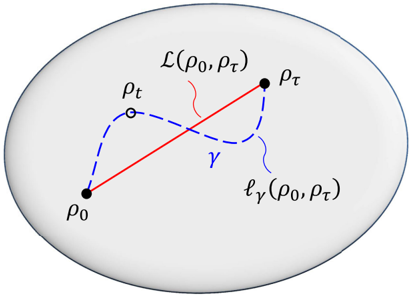
The paper derives an infinite family of geometric quantum speed limits (QSLs) in one-to-one correspondence with contractive Riemannian metrics on quantum state space, valid for unitary and nonunitary evolutions. It shows that the conventional quantum Fisher information metric is only one choice and that the Wigner-Yanase skew information metric can yield tighter bounds for open-system dynamics.
Key findings
- The central result is the family of bounds \(L_f(\rho_0,\rho_\tau) \le l^f_\gamma(\rho_0,\rho_\tau)\), where each contractive Riemannian metric, characterized by a Morozova-Čencov function \(f\), gives a different QSL; the quantum Fisher information metric recovers the QSL of Taddei et al.
- For single-qubit unitary dynamics, the paper proves that the quantum Fisher information metric gives a tighter QSL than the Wigner-Yanase information metric, and conjectures it is tightest among all contractive Riemannian metrics for any one-qubit unitary dynamics.
- For open-system examples, the Wigner-Yanase metric can be tighter: in parallel dephasing it is generally tighter when the frequency \(\omega_0\) is sufficiently small, e.g. for \(\beta=0\) and \(\theta_0=\pi/4\), while quantum Fisher information is slightly tighter for \(\beta=8\).
- For amplitude damping, the Wigner-Yanase QSL is nearly saturated with \(\delta^{\mathrm{WY}}_\gamma \simeq 0\) and tighter than quantum Fisher information in almost the whole parameter space, except a small region near the north pole; for transversal dephasing with a plus state, Wigner-Yanase is tighter at short times for small enough \(\Gamma\) and \(\omega_0\).
Methods
- Theoretical information-geometric derivation: the authors use the Morozova-Čencov-Petz characterization of contractive Riemannian metrics on density operators and the inequality that geodesic length is a lower bound to path length.
- They decompose the metric tensor into population and coherence contributions, \(g^f_{\mu\nu}=F_{\mu\nu}+Q^f_{\mu\nu}\), and define a tightness indicator \(\delta^f_\gamma\) to compare bounds.
- They illustrate the formalism with single-qubit unitary dynamics and nonunitary dephasing and amplitude-damping channels, comparing quantum Fisher information, Wigner-Yanase skew information, and the minimal Morozova-Čencov metric.
Limitations
- The paper states that finding the tightest bound over all Morozova-Čencov functions is a formidable problem, and that only the quantum Fisher information and Wigner-Yanase information metrics have analytically known geodesic lengths for general dynamics.
- The optimization is therefore restricted primarily to those two metrics; the authors leave open whether quantum Fisher information remains tightest for higher-dimensional systems or for other contractive Riemannian metrics.
- The paper states that the family is within MT-like bounds and that extending the geometric approach to ML-like speed limits is left for further study; the experimental investigation is also stated to be reported elsewhere.
- Evident from the text: the concrete examples are single-qubit dynamics, and the comparison is analytical/numerical rather than experimental.
Model-written summary. Check it against the paper before relying on it.
Integrity signals
Registry
Cites
Statistics
Figures
Verification
Claims the paper makes
45 No basis given · 27 Own interpretation · 25 Not checked yet · 17 Own result
The paper states this without a source or data behind it here, so there is nothing to check it against. The quote shows it is in the paper.
In the paper
“Specifically, we establish an infinite family of quantum speed limits valid for unitary and nonunitary evolutions, based on an elegant information geometric formalism.”
- Also stated in: § III. GENERALIZED GEOMETRIC QUANTUM SPEED LIMITS · plain
“We are now ready to present our main result, that is, a family of geometric QSLs that hold for any physical process and are in one-to-one correspondence with the contractive Riemannian metrics defined on the set of quantum states.”
§ Generalized Geometric Quantum Speed Limits > Abstract
plaindirect- Asserted: passes — The authors put it forward as true.
- Checkable: passes — It can be checked against evidence.
- Load-bearing: passes — The paper’s conclusions depend on it.
- Based: passes — The paper gives a reason why it holds.
- The authors state this as an assumption: A Riemannian metric must be contractive under physical maps to be a bona fide measure of distinguishability between quantum states.
- Also stated in: § III. GENERALIZED GEOMETRIC QUANTUM SPEED LIMITS · plain
The paper states this without a source or data behind it here, so there is nothing to check it against. The quote shows it is in the paper.
In the paper
“L f ðρ 0 ; ρ τ Þ ≤ l f γ ðρ 0 ; ρ τ Þ;ð17Þ”
- Also stated in: § III. GENERALIZED GEOMETRIC QUANTUM SPEED LIMITS · boosted
“Equation ( 17) represents the anticipated infinite family of generalized geometric QSLs and is the central result of this paper.”
§ Generalized Geometric Quantum Speed Limits > III. GENERALIZED GEOMETRIC QUANTUM SPEED LIMITS
boosteddirect- Asserted: passes — The authors put it forward as true.
- Checkable: passes — It can be checked against evidence.
- Load-bearing: passes — The paper’s conclusions depend on it.
- Based: passes — The paper gives a reason why it holds.
- The authors state this as an assumption: A Riemannian metric must be contractive under physical maps to be a bona fide measure of distinguishability between quantum states.
- The authors state this as an assumption: The dynamical evolution ρλ depends analytically on each parameter λμ.
- Also stated in: § III. GENERALIZED GEOMETRIC QUANTUM SPEED LIMITS · boosted
The paper states this without a source or data behind it here, so there is nothing to check it against. The quote shows it is in the paper.
In the paper
“τ ≥ ℏ ΔE L QF ðρ 0 ; ρ τ Þ:ð27Þ”
§ Generalized Geometric Quantum Speed Limits > 1. Quantum Fisher information metric
plain- Asserted: passes — The authors put it forward as true.
- Checkable: passes — It can be checked against evidence.
- Load-bearing: passes — The paper’s conclusions depend on it.
- Based: passes — The paper gives a reason why it holds.
- The authors state this as an assumption: A Riemannian metric must be contractive under physical maps to be a bona fide measure of distinguishability between quantum states.
- The authors state this as an assumption: The dynamical evolution ρλ depends analytically on each parameter λμ.
None of the sources cited for this claim have been checked yet.
In the paper
“We are now ready to present our main result, that is, a family of geometric QSLs that hold for any physical process and are in one-to-one correspondence with the contractive Riemannian metrics defined on the set of quantum states.”
- Also stated in: § I. INTRODUCTION · plain
“which is in one-to-one correspondence with the family of contractive Riemannian metrics characterized by the Morozova, Čencov, and Petz theorem.”
§ Generalized Geometric Quantum Speed Limits > III. GENERALIZED GEOMETRIC QUANTUM SPEED LIMITS
plaincorrelational- Asserted: passes — The authors put it forward as true.
- Checkable: passes — It can be checked against evidence.
- Load-bearing: passes — The paper’s conclusions depend on it.
- Based: passes — The paper gives a reason why it holds.
- The authors state this as an assumption: A Riemannian metric must be contractive under physical maps to be a bona fide measure of distinguishability between quantum states.
- Also stated in: § I. INTRODUCTION · plain
The paper states this without a source or data behind it here, so there is nothing to check it against. The quote shows it is in the paper.
In the paper
“g QF μν ≤ 1 2ℏ 2 X j;l ðp j þ p l ÞhjjΔH λ μ jlihljΔH λ ν jji ¼ ℏ -2 C ðΔH λ μ ; ΔH λ ν Þ;ð24Þ”
§ Generalized Geometric Quantum Speed Limits > 1. Quantum Fisher information metric
plain- Asserted: passes — The authors put it forward as true.
- Checkable: passes — It can be checked against evidence.
- Load-bearing: passes — The paper’s conclusions depend on it.
- Based: passes — The paper gives a reason why it holds.
- The authors state this as an assumption: A Riemannian metric must be contractive under physical maps to be a bona fide measure of distinguishability between quantum states.
- The authors state this as an assumption: The dynamical evolution ρλ depends analytically on each parameter λμ.
A result the paper reports from its own data — it cites no other source for it, so there is none to check. The quote shows it is in the paper.
In the paper
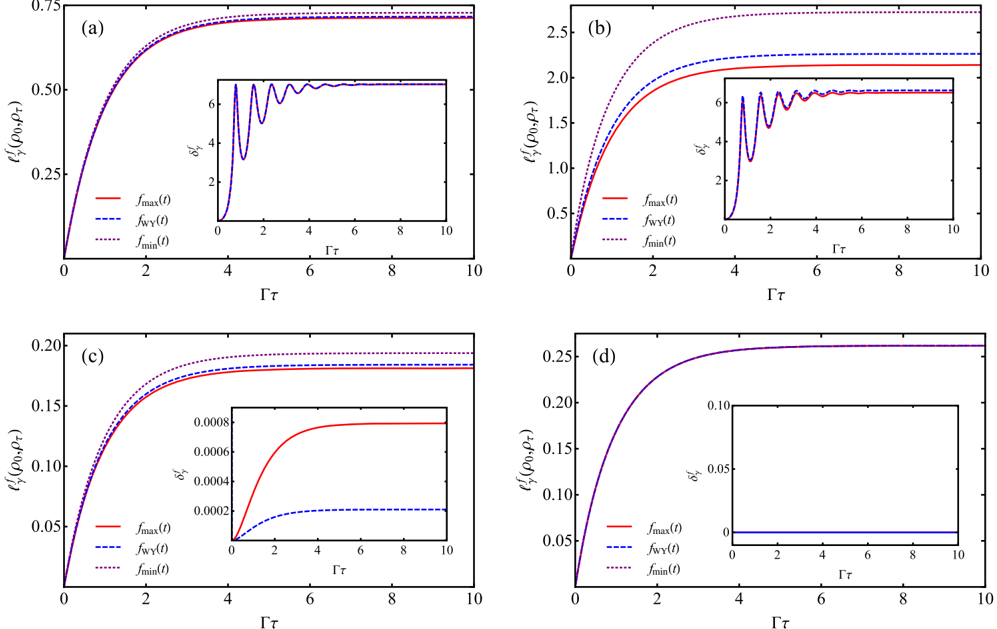
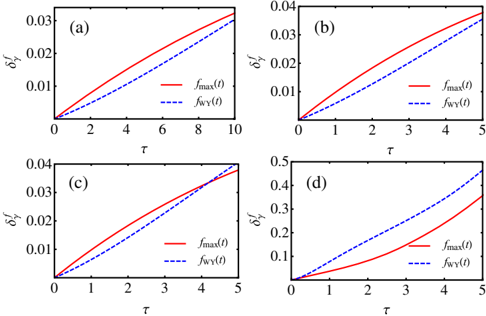
“This analysis is reported in Fig. 4, showing that the Wigner-Yanase information metric does lead, in general, to a tighter QSL when the frequency ω 0 is sufficiently small.”
§ Generalized Geometric Quantum Speed Limits > 1. Parallel and transversal dephasing channels
plaindirect- Asserted: passes — The authors put it forward as true.
- Checkable: passes — It can be checked against evidence.
- Load-bearing: passes — The paper’s conclusions depend on it.
- Based: passes — The paper gives a reason why it holds.
The paper states this without a source or data behind it here, so there is nothing to check it against. The quote shows it is in the paper.
In the paper
“Equation (38), which corresponds to the contribution to g f common to all the MC family, is identically zero for all the initial states such that θ 0 is either 0 or π, which are all the incoherent states lying on the z axis of the Bloch sphere (with density matrices diagonal in the computational basis), which are indeed left unaffected by the parallel dephasing dynamics.”
§ Generalized Geometric Quantum Speed Limits > 1. Parallel and transversal dephasing channels
plain- Asserted: passes — The authors put it forward as true.
- Checkable: passes — It can be checked against evidence.
- Load-bearing: passes — The paper’s conclusions depend on it.
- Based: passes — The paper gives a reason why it holds.
The paper states this without a source or data behind it here, so there is nothing to check it against. The quote shows it is in the paper.
In the paper
“For simplicity, let us again analyze the one-parameter case, where λ ¼ t, H λ μ → H t ¼ -iℏU t ∂ t U † t and C reduces to the skew information Iðρ t ; H t Þ between the evolved state ρ t and the observable H t generating the dynamics of the system.”
§ Generalized Geometric Quantum Speed Limits > 2. Wigner-Yanase information metric
plaindirect- Asserted: passes — The authors put it forward as true.
- Checkable: passes — It can be checked against evidence.
- Load-bearing: unclear — It is unclear whether the paper’s conclusions depend on it.
- Based: passes — The paper gives a reason why it holds.
A result the paper reports from its own data — it cites no other source for it, so there is none to check. The quote shows it is in the paper.
In the paper
“Quite surprisingly, in the next section, we show instead that, for the realistic and more general case of nonunitary dynamics, the hierarchy of the MC functions does not automatically translate anymore into a hierarchy of tightness for the corresponding QSLs, not even in the case of a single qubit.”
§ Generalized Geometric Quantum Speed Limits > 2. Wigner-Yanase information metric
boosted- Asserted: passes — The authors put it forward as true.
- Checkable: passes — It can be checked against evidence.
- Load-bearing: passes — The paper’s conclusions depend on it.
- Based: passes — The paper gives a reason why it holds.
In the paper
“CðΔH λ μ ; ΔH λ ν Þ ≔ -ð1=2ÞTrð½ ffiffiffiffi ffi ρ λ p ;ΔH λ μ ½ ffiffiffiffi ffi ρ λ p ;ΔH λ ν Þ reduces to the skew information between the evolved state and [57].”
§ Generalized Geometric Quantum Speed Limits > 2. Wigner-Yanase information metric
What the sources say
- Not checked yetcites [57] source
plaindirect- Asserted: passes — The authors put it forward as true.
- Checkable: passes — It can be checked against evidence.
- Load-bearing: passes — The paper’s conclusions depend on it.
- Based: passes — The paper gives a reason why it holds.
A result the paper reports from its own data — it cites no other source for it, so there is none to check. The quote shows it is in the paper.
In the paper
“in Appendix A we prove that the geometric QSL corresponding to the quantum Fisher information metric, as expressed directly by Eq. ( 17), is indeed tighter than the one corresponding to the Wigner-Yanase information metric, when considering any singlequbit unitary dynamics.”
§ Generalized Geometric Quantum Speed Limits > 2. Wigner-Yanase information metric
boosteddirect- Asserted: passes — The authors put it forward as true.
- Checkable: passes — It can be checked against evidence.
- Load-bearing: passes — The paper’s conclusions depend on it.
- Based: passes — The paper gives a reason why it holds.
A result the paper reports from its own data — it cites no other source for it, so there is none to check. The quote shows it is in the paper.
In the paper
“First, it can be seen that by fixing the initial purity r 0 (respectively, polar angle θ 0 ), the speed of evolution increases as we increase the initial polar angle θ 0 (respectively, purity r 0 ).”
§ Generalized Geometric Quantum Speed Limits > 1. Parallel and transversal dephasing channels
plaindirect- Asserted: passes — The authors put it forward as true.
- Checkable: passes — It can be checked against evidence.
- Load-bearing: unclear — It is unclear whether the paper’s conclusions depend on it.
- Based: passes — The paper gives a reason why it holds.
A result the paper reports from its own data — it cites no other source for it, so there is none to check. The quote shows it is in the paper.
In the paper
“We can see that, in this case, the Wigner-Yanase information provides a QSL that is almost saturated (in particular, at short times)”
§ Generalized Geometric Quantum Speed Limits > 2. Amplitude damping channel
plaincorrelational- Asserted: passes — The authors put it forward as true.
- Checkable: passes — It can be checked against evidence.
- Load-bearing: passes — The paper’s conclusions depend on it.
- Based: passes — The paper gives a reason why it holds.
A result the paper reports from its own data — it cites no other source for it, so there is none to check. The quote shows it is in the paper.
In the paper
“whereas for β ¼ 0 and θ 0 ¼ π=4, it is instead the Wigner-Yanase information metric that provides us with a slightly tighter lower bound.”
§ Generalized Geometric Quantum Speed Limits > 1. Parallel and transversal dephasing channels
plaindirectSingle case- Asserted: passes — The authors put it forward as true.
- Checkable: passes — It can be checked against evidence.
- Load-bearing: passes — The paper’s conclusions depend on it.
- Based: passes — The paper gives a reason why it holds.
A result the paper reports from its own data — it cites no other source for it, so there is none to check. The quote shows it is in the paper.
In the paper
“On the other hand, when β ¼ 0 and θ 0 ¼ π=2, we have that the QSL is saturated for both metrics”
§ Generalized Geometric Quantum Speed Limits > 1. Parallel and transversal dephasing channels
plaindirect- Asserted: passes — The authors put it forward as true.
- Checkable: passes — It can be checked against evidence.
- Load-bearing: unclear — It is unclear whether the paper’s conclusions depend on it.
- Based: passes — The paper gives a reason why it holds.
A result the paper reports from its own data — it cites no other source for it, so there is none to check. The quote shows it is in the paper.
In the paper
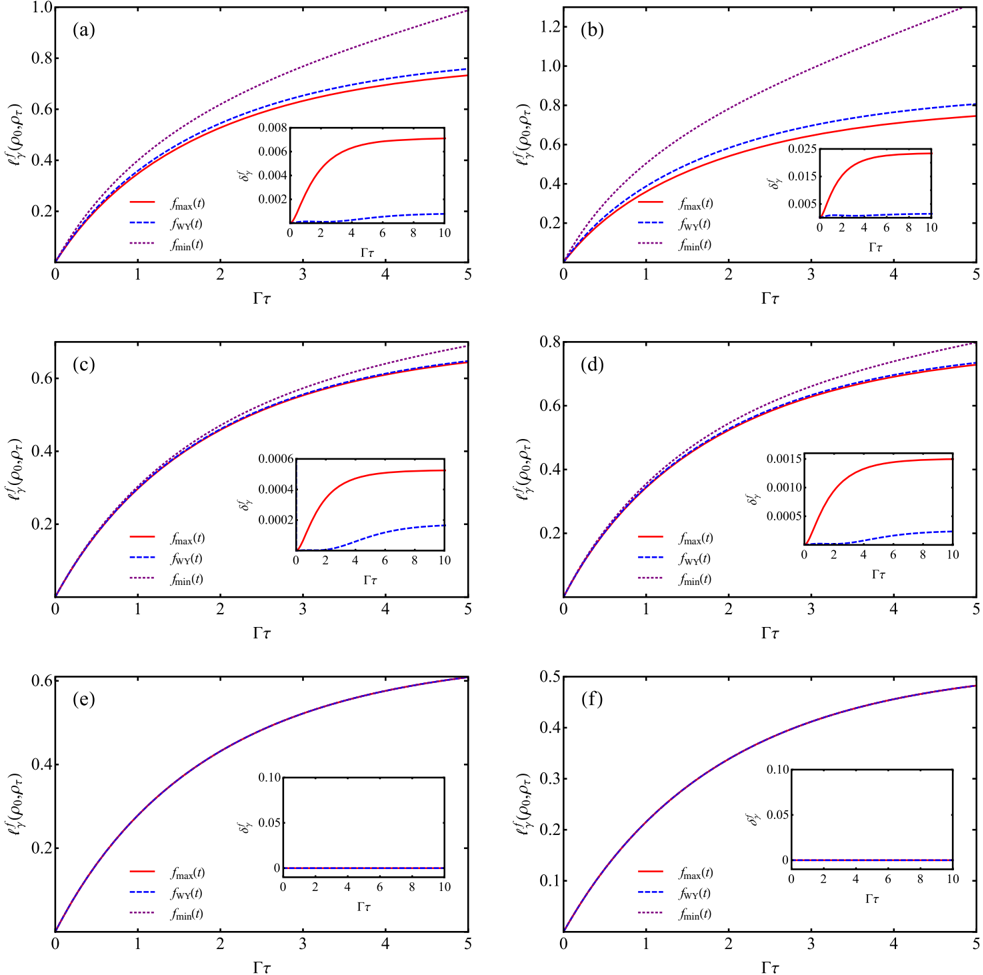
“First, Figs.6(e) and 6(f) exhibit the following behavior: fixing the initial polar angle θ 0 ¼ 0, the speed of evolution decreases as we increase the initial purity r 0 .”
§ Generalized Geometric Quantum Speed Limits > 2. Amplitude damping channel
plaindirect- Asserted: passes — The authors put it forward as true.
- Checkable: passes — It can be checked against evidence.
- Load-bearing: unclear — It is unclear whether the paper’s conclusions depend on it.
- Based: passes — The paper gives a reason why it holds.
The paper states this without a source or data behind it here, so there is nothing to check it against. The quote shows it is in the paper.
In the paper
“Notice that in the case θ 0 ¼ π=2, for initial states lying in the equatorial xy plane, Q f is nonzero only when the frequency ω 0 is also nonzero.”
§ Generalized Geometric Quantum Speed Limits > 1. Parallel and transversal dephasing channels
plaincorrelational- Asserted: passes — The authors put it forward as true.
- Checkable: passes — It can be checked against evidence.
- Load-bearing: unclear — It is unclear whether the paper’s conclusions depend on it.
- Based: passes — The paper gives a reason why it holds.
A result the paper reports from its own data — it cites no other source for it, so there is none to check. The quote shows it is in the paper.
In the paper
“In particular, for parallel and transversal dephasing, as well as amplitude damping dynamics, we defined a tighter quantum speed limit by means of another important but significantly less-studied Riemannian metric, namely, the Wigner-Yanase skew information.”
§ Generalized Geometric Quantum Speed Limits > V. CONCLUSIONS
plaindirect- Asserted: passes — The authors put it forward as true.
- Checkable: passes — It can be checked against evidence.
- Load-bearing: passes — The paper’s conclusions depend on it.
- Based: passes — The paper gives a reason why it holds.
A result the paper reports from its own data — it cites no other source for it, so there is none to check. The quote shows it is in the paper.
In the paper
“In Fig. 5, we can see that, initializing such dynamics with a plus state, for small enough Γ and ω 0 , the Wigner-Yanase information provides a QSL that is tighter (in particular, at short times) than the one corresponding to the quantum Fisher information.”
§ Generalized Geometric Quantum Speed Limits > 1. Parallel and transversal dephasing channels
plaincorrelational- Asserted: passes — The authors put it forward as true.
- Checkable: passes — It can be checked against evidence.
- Load-bearing: passes — The paper’s conclusions depend on it.
- Based: passes — The paper gives a reason why it holds.
The paper states this without a source or data behind it here, so there is nothing to check it against. The quote shows it is in the paper.
In the paper
“In this appendix, we prove that the geometric QSL corresponding to the quantum Fisher information metric is tighter than the one corresponding to the Wigner-Yanase information metric, when considering any single-qubit unitary dynamics.”
- Also stated in: § V. CONCLUSIONS · boosted
“Here, we have shown that the conjecture holds when the optimization is restricted to the quantum Fisher information and the Wigner-Yanase skew information metrics only.”
- Also stated in: § Additional information · plain
“δ QF ≤ δ WY ;ðA1Þ”
§ Generalized Geometric Quantum Speed Limits > Additional information
boosteddirect- Asserted: passes — The authors put it forward as true.
- Checkable: passes — It can be checked against evidence.
- Load-bearing: passes — The paper’s conclusions depend on it.
- Based: passes — The paper gives a reason why it holds.
- Also stated in: § V. CONCLUSIONS · boosted
A result the paper reports from its own data — it cites no other source for it, so there is none to check. The quote shows it is in the paper.
In the paper
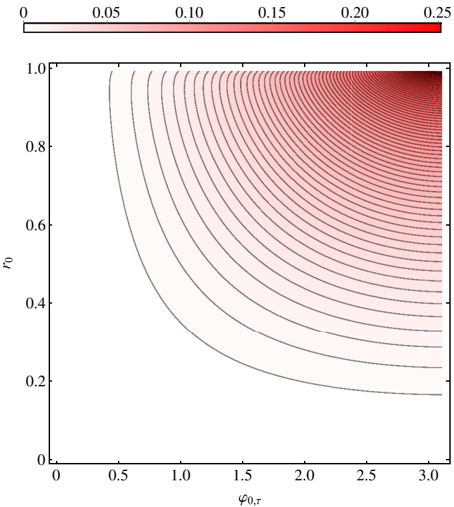
“As it can be easily seen, this difference is always non-negative, i.e., the inequality (A2) is always satisfied.”
- Also stated in: § V. CONCLUSIONS · plain
“The difference between the right-hand side and left-hand side of the above inequality is represented in Fig. 8 as a function of r 0 ∈ ½0; 1½ and φ 0;τ ∈ ½0; π.”
§ Generalized Geometric Quantum Speed Limits > V. CONCLUSIONS
boosted- Asserted: passes — The authors put it forward as true.
- Checkable: passes — It can be checked against evidence.
- Load-bearing: passes — The paper’s conclusions depend on it.
- Based: passes — The paper gives a reason why it holds.
- Also stated in: § V. CONCLUSIONS · plain
The paper states this without a source or data behind it here, so there is nothing to check it against. The quote shows it is in the paper.
In the paper
“In particular, this difference is zero when either r 0 ¼ 0 or r0 • rτ ¼ r 2 0 , i.e., when φ 0;τ ¼ 0, as can be proved by checking that”
§ Generalized Geometric Quantum Speed Limits > V. CONCLUSIONS
plain- Asserted: passes — The authors put it forward as true.
- Checkable: passes — It can be checked against evidence.
- Load-bearing: unclear — It is unclear whether the paper’s conclusions depend on it.
- Based: passes — The paper gives a reason why it holds.
The paper states this without a source or data behind it here, so there is nothing to check it against. The quote shows it is in the paper.
In the paper
“Finally, for the metric corresponding to the minimal MC function, the path length is given by”
§ Generalized Geometric Quantum Speed Limits > Additional information
plain- Asserted: passes — The authors put it forward as true.
- Checkable: passes — It can be checked against evidence.
- Load-bearing: unclear — It is unclear whether the paper’s conclusions depend on it.
- Based: passes — The paper gives a reason why it holds.
The paper states this without a source or data behind it here, so there is nothing to check it against. The quote shows it is in the paper.
In the paper
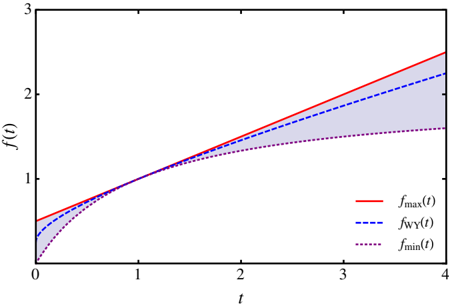
“Finally, when considering the metric corresponding to the minimal MC function, f min ðtÞ ¼ 2t=ð1 þ tÞ, we have that c f ðp þ ; p -Þ ¼ 1=ð2p þ p -Þ, so its path length has the following analytical form:”
§ Generalized Geometric Quantum Speed Limits > Additional information
plain- Asserted: passes — The authors put it forward as true.
- Checkable: passes — It can be checked against evidence.
- Load-bearing: unclear — It is unclear whether the paper’s conclusions depend on it.
- Based: passes — The paper gives a reason why it holds.
The paper states this without a source or data behind it here, so there is nothing to check it against. The quote shows it is in the paper.
In the paper
“Hence, the path length corresponding to the Wigner-Yanase information metric is given by”
§ Generalized Geometric Quantum Speed Limits > APPENDIX B: PARALLEL AND TRANSVERSAL DEPHASING
plain- Asserted: passes — The authors put it forward as true.
- Checkable: passes — It can be checked against evidence.
- Load-bearing: unclear — It is unclear whether the paper’s conclusions depend on it.
- Based: passes — The paper gives a reason why it holds.
The paper states this without a source or data behind it here, so there is nothing to check it against. The quote shows it is in the paper.
In the paper
“c WY ðp 1 ; p 2 Þ ¼ 4 1 þ ffiffiffiffiffiffiffiffiffiffiffiffi 1 -r 2 0 p ;”
§ Generalized Geometric Quantum Speed Limits > V. CONCLUSIONS
plain- Asserted: passes — The authors put it forward as true.
- Checkable: passes — It can be checked against evidence.
- Load-bearing: passes — The paper’s conclusions depend on it.
- Based: passes — The paper gives a reason why it holds.
The paper states this without a source or data behind it here, so there is nothing to check it against. The quote shows it is in the paper.
In the paper
“Similarly to the previous case, we are able to analytically compute both the geodesic distances corresponding to the quantum Fisher information and the Wigner-Yanase information metric by using Eqs.( 5), ( 6), (A12), and (A13) with”
§ Generalized Geometric Quantum Speed Limits > Additional information
plaindirect- Asserted: passes — The authors put it forward as true.
- Checkable: passes — It can be checked against evidence.
- Load-bearing: unclear — It is unclear whether the paper’s conclusions depend on it.
- Based: passes — The paper gives a reason why it holds.
The paper states this without a source or data behind it here, so there is nothing to check it against. The quote shows it is in the paper.
In the paper
“It is possible to provide an analytical expression for the path length corresponding to such a MC function as follows:”
§ Generalized Geometric Quantum Speed Limits > APPENDIX B: PARALLEL AND TRANSVERSAL DEPHASING
hedged- Asserted: passes — The authors put it forward as true.
- Checkable: passes — It can be checked against evidence.
- Load-bearing: passes — The paper’s conclusions depend on it.
- Based: passes — The paper gives a reason why it holds.
None of the sources cited for this claim have been checked yet.
In the paper
“The Morozova, Čencov, and Petz theorem provides us with a characterization of such metrics in the finite-dimensional case, by constructing a one-to-one correspondence between them and the Morozova-Čencov (MC) functions”
§ Generalized Geometric Quantum Speed Limits > II. GEOMETRIC MEASURES OF DISTINGUISHABILITY
What the sources say
- Not checked yetcites [51] source
- Not checked yetcites [52]
plaincorrelational- Asserted: passes — The authors put it forward as true.
- Checkable: passes — It can be checked against evidence.
- Load-bearing: passes — The paper’s conclusions depend on it.
- Based: passes — The paper gives a reason why it holds.
A conclusion the paper draws from its own results — it cites no other source for it, so there is none to check. The quote shows it is in the paper.
In the paper
“Any possible contractive Riemannian metric g f on the quantum-state space, and so any possible bona fide geometric quantifier of distinguishability between quantum states, gives rise to a different QSL.”
§ Generalized Geometric Quantum Speed Limits > III. GENERALIZED GEOMETRIC QUANTUM SPEED LIMITS
plaindirect- Asserted: passes — The authors put it forward as true.
- Checkable: passes — It can be checked against evidence.
- Load-bearing: passes — The paper’s conclusions depend on it.
- Based: passes — The paper gives a reason why it holds.
- The authors state this as an assumption: A Riemannian metric must be contractive under physical maps to be a bona fide measure of distinguishability between quantum states.
A conclusion the paper draws from its own results — it cites no other source for it, so there is none to check. The quote shows it is in the paper.
In the paper
“we show how the Wigner-Yanase skew information metric can systematically produce tighter bounds in a number of situations of practical relevance for quantum information and quantum technologies, in particular, in open system evolutions.”
- Also stated in: § Abstract · boosted
“demonstrating the importance of choosing different information metrics for open system dynamics, as well as clarifying the roles of classical populations versus quantum coherences, in the determination and saturation of the speed limits.”
§ Generalized Geometric Quantum Speed Limits > III. GENERALIZED GEOMETRIC QUANTUM SPEED LIMITS
boosteddirect- Asserted: passes — The authors put it forward as true.
- Checkable: passes — It can be checked against evidence.
- Load-bearing: passes — The paper’s conclusions depend on it.
- Based: passes — The paper gives a reason why it holds.
- The authors state this as an assumption: A Riemannian metric must be contractive under physical maps to be a bona fide measure of distinguishability between quantum states.
- Also stated in: § Abstract · boosted
A conclusion the paper draws from its own results — it cites no other source for it, so there is none to check. The quote shows it is in the paper.
In the paper
“This family of bounds is naturally tailored to the general case of initial mixed states and clearly separates the contribution of the populations of the evolved state and the coherences of its time variation, thus clarifying their individual roles in driving the evolution.”
§ Generalized Geometric Quantum Speed Limits > I. INTRODUCTION
boosteddirect- Asserted: passes — The authors put it forward as true.
- Checkable: passes — It can be checked against evidence.
- Load-bearing: passes — The paper’s conclusions depend on it.
- Based: passes — The paper gives a reason why it holds.
- The authors state this as an assumption: A Riemannian metric must be contractive under physical maps to be a bona fide measure of distinguishability between quantum states.
A conclusion the paper draws from its own results — it cites no other source for it, so there is none to check. The quote shows it is in the paper.
In the paper
“It is worth emphasizing that the bound in Eq. ( 27) applies to arbitrary initial and final mixed states and generic timedependent generators of the dynamics.”
§ Generalized Geometric Quantum Speed Limits > 1. Quantum Fisher information metric
plain- Asserted: passes — The authors put it forward as true.
- Checkable: passes — It can be checked against evidence.
- Load-bearing: passes — The paper’s conclusions depend on it.
- Based: passes — The paper gives a reason why it holds.
- The authors state this as an assumption: A Riemannian metric must be contractive under physical maps to be a bona fide measure of distinguishability between quantum states.
- The authors state this as an assumption: The dynamical evolution ρλ depends analytically on each parameter λμ.
In the paper
“In particular, by restricting to the celebrated quantum Fisher information metric, we recover the QSL introduced in Ref. [31].”
§ Generalized Geometric Quantum Speed Limits > III. GENERALIZED GEOMETRIC QUANTUM SPEED LIMITS
What the sources say
- Not checked yetcites [31] source
plaindirect- Asserted: passes — The authors put it forward as true.
- Checkable: passes — It can be checked against evidence.
- Load-bearing: unclear — It is unclear whether the paper’s conclusions depend on it.
- Based: passes — The paper gives a reason why it holds.
- The authors state this as an assumption: A Riemannian metric must be contractive under physical maps to be a bona fide measure of distinguishability between quantum states.
None of the sources cited for this claim have been checked yet.
In the paper
“In fact, analytic expressions are known only for the geodesic distance related to the quantum Fisher information metric [56],”
- Also stated in: § II. GEOMETRIC MEASURES OF DISTINGUISHABILITY · plain
“and for the one related to the Wigner-Yanase information metric [50]”
§ Generalized Geometric Quantum Speed Limits > II. GEOMETRIC MEASURES OF DISTINGUISHABILITY
plain- Asserted: passes — The authors put it forward as true.
- Checkable: passes — It can be checked against evidence.
- Load-bearing: unclear — It is unclear whether the paper’s conclusions depend on it.
- Based: passes — The paper gives a reason why it holds.
- Also stated in: § II. GEOMETRIC MEASURES OF DISTINGUISHABILITY · plain
A conclusion the paper draws from its own results — it cites no other source for it, so there is none to check. The quote shows it is in the paper.
In the paper
“provides instances of novel bounds that are tighter than any established one based on the conventional quantum Fisher information.”
- Also stated in: § I. INTRODUCTION · plain
“we show explicit instances of QSLs that make use of some particular contractive Riemannian metric such as the Wigner-Yanase skew information and can be provably tighter than the corresponding QSLs obtained with the conventional quantum Fisher information.”
§ Generalized Geometric Quantum Speed Limits > Abstract
plain- Asserted: passes — The authors put it forward as true.
- Checkable: passes — It can be checked against evidence.
- Load-bearing: passes — The paper’s conclusions depend on it.
- Based: passes — The paper gives a reason why it holds.
- The authors state this as an assumption: A Riemannian metric must be contractive under physical maps to be a bona fide measure of distinguishability between quantum states.
- Also stated in: § I. INTRODUCTION · plain
In the paper
“Interestingly, Čencov's theorem states that the Fisher information metric is the only Riemannian metric on the set of probability distributions that is contractive under stochastic maps [47]”
§ Generalized Geometric Quantum Speed Limits > I. INTRODUCTION
What the sources say
- Not checked yetcites [47] source
plain- Asserted: passes — The authors put it forward as true.
- Checkable: passes — It can be checked against evidence.
- Load-bearing: passes — The paper’s conclusions depend on it.
- Based: passes — The paper gives a reason why it holds.
In the paper
“Given that the Wigner-Yanase skew information is experimentally accessible [70], one can readily apply our results to current and future demonstrations to benchmark optimality of controlled quantum dynamics in the presence of such ubiquitous noise mechanisms.”
§ Generalized Geometric Quantum Speed Limits > V. CONCLUSIONS
What the sources say
- Not checked yetcites [70] source
plainconditional- Asserted: passes — The authors put it forward as true.
- Checkable: passes — It can be checked against evidence.
- Load-bearing: passes — The paper’s conclusions depend on it.
- Based: passes — The paper gives a reason why it holds.
A conclusion the paper draws from its own results — it cites no other source for it, so there is none to check. The quote shows it is in the paper.
In the paper
“Finding this minimum is, however, a formidable problem, which is made all the more difficult by the fact that the quantum Fisher information metric and the Wigner-Yanase information metric are the only contractive Riemannian metrics whose geodesic lengths are analytically known for general dynamics”
§ Generalized Geometric Quantum Speed Limits > III. GENERALIZED GEOMETRIC QUANTUM SPEED LIMITS
plaindirect- Asserted: passes — The authors put it forward as true.
- Checkable: passes — It can be checked against evidence.
- Load-bearing: passes — The paper’s conclusions depend on it.
- Based: passes — The paper gives a reason why it holds.
- The authors state this as an assumption: A Riemannian metric must be contractive under physical maps to be a bona fide measure of distinguishability between quantum states.
In the paper
“Therefore, the quantum speed limit for unitary dynamics, when restricting to orthogonal pure states, can be made tighter by combining these two independent results as τ ≥ maxfπℏ=ð2ΔEÞ; πℏ=ð2EÞg [17].”
§ Generalized Geometric Quantum Speed Limits > I. INTRODUCTION
What the sources say
- Not checked yetcites [17] source
plaindirect- Asserted: passes — The authors put it forward as true.
- Checkable: passes — It can be checked against evidence.
- Load-bearing: passes — The paper’s conclusions depend on it.
- Based: passes — The paper gives a reason why it holds.
None of the sources cited for this claim have been checked yet.
In the paper
“The bound is useful in practical scenarios of noisy quantum metrology, especially in the case of transversal dephasing [59,60].”
§ Generalized Geometric Quantum Speed Limits > V. CONCLUSIONS
plain- Asserted: passes — The authors put it forward as true.
- Checkable: passes — It can be checked against evidence.
- Load-bearing: passes — The paper’s conclusions depend on it.
- Based: passes — The paper gives a reason why it holds.
A conclusion the paper draws from its own results — it cites no other source for it, so there is none to check. The quote shows it is in the paper.
In the paper
“The nontrivial contribution to the speed of evolution is, in this case, exclusively due to the term F , which depends solely on the populations p j of the evolved state.”
§ Generalized Geometric Quantum Speed Limits > 2. Amplitude damping channel
plaindirect- Asserted: passes — The authors put it forward as true.
- Checkable: passes — It can be checked against evidence.
- Load-bearing: passes — The paper’s conclusions depend on it.
- Based: passes — The paper gives a reason why it holds.
A conclusion the paper draws from its own results — it cites no other source for it, so there is none to check. The quote shows it is in the paper.
In the paper
“The contractive Riemannian metric g f ¼ F þ Q f can be interpreted as the speed of evolution of ρ t .”
§ Generalized Geometric Quantum Speed Limits > 1. Parallel and transversal dephasing channels
plaincorrelational- Asserted: passes — The authors put it forward as true.
- Checkable: passes — It can be checked against evidence.
- Load-bearing: passes — The paper’s conclusions depend on it.
- Based: passes — The paper gives a reason why it holds.
In the paper
“In a seminal work, Mandelstam and Tamm (MT) [4] reported a QSL for a quantum system that evolves between two distinguishable pure states”
- Also stated in: § I. INTRODUCTION · plain
“The ensuing lower bound on the evolution time is given by τ ≥ ℏ arccosðjhψðτÞjψð0ÞijÞ=ΔE”
§ Generalized Geometric Quantum Speed Limits > I. INTRODUCTION
What the sources say
- Not checked yetcites [4]
plain- Asserted: passes — The authors put it forward as true.
- Checkable: passes — It can be checked against evidence.
- Load-bearing: passes — The paper’s conclusions depend on it.
- Based: passes — The paper gives a reason why it holds.
- Also stated in: § I. INTRODUCTION · plain
In the paper
“L WY ðρ; σÞ ¼ arccos½Aðρ; σÞ;ð6Þ”
- Also stated in: § II. GEOMETRIC MEASURES OF DISTINGUISHABILITY · plain
“where Aðρ; σÞ ¼ Trð ffiffi ffi ρ p ffiffiffi σ p Þ is known as quantum affinity.”
§ Generalized Geometric Quantum Speed Limits > II. GEOMETRIC MEASURES OF DISTINGUISHABILITY
What the sources say
- Not checked yetcites [50] source
plaincorrelational- Asserted: passes — The authors put it forward as true.
- Checkable: passes — It can be checked against evidence.
- Load-bearing: passes — The paper’s conclusions depend on it.
- Based: passes — The paper gives a reason why it holds.
- Also stated in: § II. GEOMETRIC MEASURES OF DISTINGUISHABILITY · plain
In the paper
“As reported by Luo [58], the skew information Iðρ t ; H t Þ is upper bounded by the variance of the observable H t , Iðρ t ; H t Þ ≤ hH 2 t i -hH t i 2”
§ Generalized Geometric Quantum Speed Limits > 2. Wigner-Yanase information metric
What the sources say
- Not checked yetcites Luo [58]
plaincorrelational- Asserted: passes — The authors put it forward as true.
- Checkable: passes — It can be checked against evidence.
- Load-bearing: passes — The paper’s conclusions depend on it.
- Based: passes — The paper gives a reason why it holds.
A conclusion the paper draws from its own results — it cites no other source for it, so there is none to check. The quote shows it is in the paper.
In the paper
“The metric giving rise to the tightest bound is identified as the one whose geodesic is most tailored to the evolution under consideration [see Eq. ( 20)].”
§ Generalized Geometric Quantum Speed Limits > V. CONCLUSIONS
plaincorrelational- Asserted: passes — The authors put it forward as true.
- Checkable: passes — It can be checked against evidence.
- Load-bearing: passes — The paper’s conclusions depend on it.
- Based: passes — The paper gives a reason why it holds.
A conclusion the paper draws from its own results — it cites no other source for it, so there is none to check. The quote shows it is in the paper.
In the paper
“Finally, for all the contractive Riemannian metrics that can be naturally extended to the boundary of pure states, such that fð0Þ ≠ 0, the Fubini-Study metric always appears to be such an extension up to a constant factor, so the nonuniqueness of a contractive Riemannian geometry can only be witnessed when considering quantum mixed states.”
§ Generalized Geometric Quantum Speed Limits > II. GEOMETRIC MEASURES OF DISTINGUISHABILITY
hedgedcorrelational- Asserted: passes — The authors put it forward as true.
- Checkable: passes — It can be checked against evidence.
- Load-bearing: passes — The paper’s conclusions depend on it.
- Based: passes — The paper gives a reason why it holds.
- The authors state this as an assumption: A Riemannian metric must be contractive under physical maps to be a bona fide measure of distinguishability between quantum states.
In the paper
“Several years later, Anandan and Aharanov [7] extended the MT bound to time-dependent Hamiltonians by using a geometric approach that exploits the Fubini-Study metric defined on the space of quantum pure states.”
§ Generalized Geometric Quantum Speed Limits > I. INTRODUCTION
What the sources say
- Not checked yetcites [7] source
plaindirect- Asserted: passes — The authors put it forward as true.
- Checkable: passes — It can be checked against evidence.
- Load-bearing: passes — The paper’s conclusions depend on it.
- Based: passes — The paper gives a reason why it holds.
A conclusion the paper draws from its own results — it cites no other source for it, so there is none to check. The quote shows it is in the paper.
In the paper
“As our various examples show, this is not possible to verify only by considering the standard bound based on quantum Fisher information.”
§ Generalized Geometric Quantum Speed Limits > V. CONCLUSIONS
plain- Asserted: passes — The authors put it forward as true.
- Checkable: passes — It can be checked against evidence.
- Load-bearing: passes — The paper’s conclusions depend on it.
- Based: passes — The paper gives a reason why it holds.
A conclusion the paper draws from its own results — it cites no other source for it, so there is none to check. The quote shows it is in the paper.
In the paper
“The latter QSL strongly resembles the bound expressed in Eq. ( 27) and emerging from the quantum Fisher information metric, with the difference lying in the fact that we are now adopting the Hellinger angle instead of the Bures angle and a ffiffi ffi 2 p factor appears in the denominator.”
§ Generalized Geometric Quantum Speed Limits > 2. Wigner-Yanase information metric
boostedcorrelational- Asserted: passes — The authors put it forward as true.
- Checkable: passes — It can be checked against evidence.
- Load-bearing: unclear — It is unclear whether the paper’s conclusions depend on it.
- Based: passes — The paper gives a reason why it holds.
None of the sources cited for this claim have been checked yet.
In the paper
“Taddei et al. [31] and del Campo et al. [32] were the first to extend the MT bound to any physical process, whether it was unitary or not.”
§ Generalized Geometric Quantum Speed Limits > I. INTRODUCTION
plain- Asserted: passes — The authors put it forward as true.
- Checkable: passes — It can be checked against evidence.
- Load-bearing: unclear — It is unclear whether the paper’s conclusions depend on it.
- Based: passes — The paper gives a reason why it holds.
A conclusion the paper draws from its own results — it cites no other source for it, so there is none to check. The quote shows it is in the paper.
In the paper
“This feature highlights the fact that the north pole of the Bloch sphere is unaffected by the amplitude damping channel.”
§ Generalized Geometric Quantum Speed Limits > 2. Amplitude damping channel
plain- Asserted: passes — The authors put it forward as true.
- Checkable: passes — It can be checked against evidence.
- Load-bearing: unclear — It is unclear whether the paper’s conclusions depend on it.
- Based: passes — The paper gives a reason why it holds.
A conclusion the paper draws from its own results — it cites no other source for it, so there is none to check. The quote shows it is in the paper.
In the paper
“By minimizing the quantity δ f γ over all contractive Riemannian metrics, i.e., over all MC functions f, one has a criterion to identify, in principle, the tightest geometric QSL”
§ Generalized Geometric Quantum Speed Limits > III. GENERALIZED GEOMETRIC QUANTUM SPEED LIMITS
plaindirect- Asserted: passes — The authors put it forward as true.
- Checkable: passes — It can be checked against evidence.
- Load-bearing: passes — The paper’s conclusions depend on it.
- Based: passes — The paper gives a reason why it holds.
- The authors state this as an assumption: A Riemannian metric must be contractive under physical maps to be a bona fide measure of distinguishability between quantum states.
A conclusion the paper draws from its own results — it cites no other source for it, so there is none to check. The quote shows it is in the paper.
In the paper
“Our unifying approach provides a concrete guidance to select the most informative metric in order to derive the tightest bound for some particular dynamics of interest.”
§ Generalized Geometric Quantum Speed Limits > V. CONCLUSIONS
plaindirect- Asserted: passes — The authors put it forward as true.
- Checkable: passes — It can be checked against evidence.
- Load-bearing: passes — The paper’s conclusions depend on it.
- Based: passes — The paper gives a reason why it holds.
A conclusion the paper draws from its own results — it cites no other source for it, so there is none to check. The quote shows it is in the paper.
In the paper
“Based on the fundamental connection between the geometry of quantum states and their statistical distinguishability, we have exploited the fact that more than one privileged Riemannian metric appears in quantum mechanics in order to introduce a new infinite family of geometric quantum speed limits valid for any physical process, being it unitary or not.”
§ Generalized Geometric Quantum Speed Limits > V. CONCLUSIONS
boosteddirect- Asserted: passes — The authors put it forward as true.
- Checkable: passes — It can be checked against evidence.
- Load-bearing: passes — The paper’s conclusions depend on it.
- Based: passes — The paper gives a reason why it holds.
In the paper
“Over half a century after the MT result, Margolus and Levitin (ML) [16] provided a different QSL on the time evolution of a closed system whose Hamiltonian is time independent and evolving between two orthogonal pure states.This bound reads as τ ≥ πℏ=ð2EÞ, where E ¼ hHi is the mean energy.”
§ Generalized Geometric Quantum Speed Limits > I. INTRODUCTION
What the sources say
- Not checked yetcites [16] source
plain- Asserted: passes — The authors put it forward as true.
- Checkable: passes — It can be checked against evidence.
- Load-bearing: passes — The paper’s conclusions depend on it.
- Based: passes — The paper gives a reason why it holds.
A conclusion the paper draws from its own results — it cites no other source for it, so there is none to check. The quote shows it is in the paper.
In the paper
“In other words, the farther the initial state is from the z axis (the larger is its quantum coherence), the faster the corresponding evolution can be.”
§ Generalized Geometric Quantum Speed Limits > 1. Parallel and transversal dephasing channels
plaindirect- Asserted: passes — The authors put it forward as true.
- Checkable: passes — It can be checked against evidence.
- Load-bearing: passes — The paper’s conclusions depend on it.
- Based: passes — The paper gives a reason why it holds.
In the paper
“L QF ðρ; σÞ ¼ arccos½ ffiffiffiffiffiffiffiffiffiffiffiffiffiffi ffi Fðρ; σÞ p ;ð5Þ”
- Also stated in: § II. GEOMETRIC MEASURES OF DISTINGUISHABILITY · plain
“where Fðρ; σÞ ¼ ðTr½ ffiffiffiffiffiffiffiffiffiffiffiffiffiffiffi ffi ffiffi ffi ρ p σ ffiffi ffi ρ p p Þ 2 is the Uhlmann fidelity”
§ Generalized Geometric Quantum Speed Limits > II. GEOMETRIC MEASURES OF DISTINGUISHABILITY
What the sources say
- Not checked yetcites [56] source
plaincorrelational- Asserted: passes — The authors put it forward as true.
- Checkable: passes — It can be checked against evidence.
- Load-bearing: passes — The paper’s conclusions depend on it.
- Based: passes — The paper gives a reason why it holds.
- Also stated in: § II. GEOMETRIC MEASURES OF DISTINGUISHABILITY · plain
- The quote only partly states this claim. 5
- Probably not a substantial claim. 21
- It may state two separate claims as one. 41
The paper states this without a source or data behind it here, so there is nothing to check it against. The quote shows it is in the paper.
In the paper
“By substituting the inequality (24) into Eq.( 17), we get the new bound”
- Also stated in: § 1. Quantum Fisher information metric · plain
“L QF ðρ 0 ; ρ τ Þ ≤ 1 ℏ Z τ 0 dt ffiffiffiffiffiffiffiffiffiffiffiffiffiffiffiffiffiffiffiffiffiffiffiffiffiffiffiffiffiffiffiffiffiffiffiffiffiffiffiffiffiffiffiffiffiffiffiffiffiffiffiffi ffi X r μ;ν¼1 C ðΔH λ μ ; ΔH λ ν Þ dλ μ dt dλ ν dt v u u t :ð25Þ”
§ Generalized Geometric Quantum Speed Limits > 1. Quantum Fisher information metric
plain- Asserted: passes — The authors put it forward as true.
- Checkable: passes — It can be checked against evidence.
- Load-bearing: passes — The paper’s conclusions depend on it.
- Based: passes — The paper gives a reason why it holds.
The quote only partly states this claim.
- The authors state this as an assumption: A Riemannian metric must be contractive under physical maps to be a bona fide measure of distinguishability between quantum states.
- The authors state this as an assumption: The dynamical evolution ρλ depends analytically on each parameter λμ.
- Also stated in: § 1. Quantum Fisher information metric · plain
A result the paper reports from its own data — it cites no other source for it, so there is none to check. The quote shows it is in the paper.
In the paper
“Notice that the Kraus operators satisfy not only P 1 j¼0 K † j K j ¼ I but also P 1 j¼0 K j K † j ¼ I, as such a channel is unital.”
§ Generalized Geometric Quantum Speed Limits > 1. Parallel and transversal dephasing channels
plain- Asserted: passes — The authors put it forward as true.
- Checkable: passes — It can be checked against evidence.
- Load-bearing: fails — The paper’s conclusions may not depend on it.
- Based: passes — The paper gives a reason why it holds.
Probably not a substantial claim. The paper’s conclusions may not depend on it. It may state two separate claims as one.
The paper states this without a source or data behind it here, so there is nothing to check it against. The quote shows it is in the paper.
In the paper
“Interestingly, Q f does not depend on the initial azimuthal angle ϕ 0 as well, even though the eigenstates of the evolved state do depend on ϕ 0 .”
§ Generalized Geometric Quantum Speed Limits > 1. Parallel and transversal dephasing channels
plain- Asserted: passes — The authors put it forward as true.
- Checkable: passes — It can be checked against evidence.
- Load-bearing: unclear — It is unclear whether the paper’s conclusions depend on it.
- Based: passes — The paper gives a reason why it holds.
It may state two separate claims as one.
The paper states this without a source or data behind it here, so there is nothing to check it against. The quote shows it is in the paper.
In the paper
“In this case, it is easy to verify that the evolved state ρ t ¼ P j Kj ρ 0 K † j ¼ ð1=2ÞðI þ rt • σÞ has the following spectral decomposition:”
§ Generalized Geometric Quantum Speed Limits > 2. Amplitude damping channel
plain- Asserted: passes — The authors put it forward as true.
- Checkable: passes — It can be checked against evidence.
- Load-bearing: passes — The paper’s conclusions depend on it.
- Based: passes — The paper gives a reason why it holds.
It may state two separate claims as one.
The paper states this without a source or data behind it here, so there is nothing to check it against. The quote shows it is in the paper.
In the paper
“It is worthwhile noticing that the transversal dephasing channel is also unital; i.e., it leaves the maximally mixed state invariant.”
§ Generalized Geometric Quantum Speed Limits > 1. Parallel and transversal dephasing channels
plaindirect- Asserted: passes — The authors put it forward as true.
- Checkable: passes — It can be checked against evidence.
- Load-bearing: fails — The paper’s conclusions may not depend on it.
- Based: passes — The paper gives a reason why it holds.
Probably not a substantial claim. The paper’s conclusions may not depend on it. It may state two separate claims as one.
The paper states this without a source or data behind it here, so there is nothing to check it against. The quote shows it is in the paper.
In the paper
“By putting the above equations into Eqs.( 15) and ( 16), one obtains, respectively,”
§ Generalized Geometric Quantum Speed Limits > 1. Parallel and transversal dephasing channels
plaindirect- Asserted: passes — The authors put it forward as true.
- Checkable: passes — It can be checked against evidence.
- Load-bearing: passes — The paper’s conclusions depend on it.
- Based: passes — The paper gives a reason why it holds.
Probably not a substantial claim. It may state two separate claims as one.
The paper states this without a source or data behind it here, so there is nothing to check it against. The quote shows it is in the paper.
In the paper
“satisfying only P j K † j Kj ¼ I since this channel is not unital.”
§ Generalized Geometric Quantum Speed Limits > 2. Amplitude damping channel
plaindirect- Asserted: passes — The authors put it forward as true.
- Checkable: passes — It can be checked against evidence.
- Load-bearing: fails — The paper’s conclusions may not depend on it.
- Based: passes — The paper gives a reason why it holds.
Probably not a substantial claim. The paper’s conclusions may not depend on it. It may state two separate claims as one.
The paper states this without a source or data behind it here, so there is nothing to check it against. The quote shows it is in the paper.
In the paper
“Indeed, according to Eq. ( 39), the purely quantum contribution Q f to the metric is equal to zero for θ 0 ¼ π=2 and ω 0 ¼ 0 (β ¼ 0).Thus, the speed of evolution g f is described solely by the term F given in Eq. ( 38) and arising only from the populations of the evolved state.”
§ Generalized Geometric Quantum Speed Limits > 1. Parallel and transversal dephasing channels
plaindirect- Asserted: passes — The authors put it forward as true.
- Checkable: passes — It can be checked against evidence.
- Load-bearing: unclear — It is unclear whether the paper’s conclusions depend on it.
- Based: passes — The paper gives a reason why it holds.
It may state two separate claims as one.
The paper states this without a source or data behind it here, so there is nothing to check it against. The quote shows it is in the paper.
In the paper
“However, when restricting to the relevant case of an initial plus state (which is an optimal probe state for frequency estimation), i.e., ρ 0 ¼ jþihþj with jþi ¼ ðj0i þ j1iÞ= ffiffi ffi 2 p , one obtains the following simple expressions:”
§ Generalized Geometric Quantum Speed Limits > 1. Parallel and transversal dephasing channels
plaincorrelational- Asserted: passes — The authors put it forward as true.
- Checkable: passes — It can be checked against evidence.
- Load-bearing: passes — The paper’s conclusions depend on it.
- Based: passes — The paper gives a reason why it holds.
Probably not a substantial claim. It may state two separate claims as one. The quote only partly states this claim.
- Rests on an assumption: The initial plus state is an optimal probe state for frequency estimation.
The paper states this without a source or data behind it here, so there is nothing to check it against. The quote shows it is in the paper.
In the paper
“By writing the spectral decomposition of the density operator ρ t , we get”
§ Generalized Geometric Quantum Speed Limits > 1. Parallel and transversal dephasing channels
plain- Asserted: passes — The authors put it forward as true.
- Checkable: passes — It can be checked against evidence.
- Load-bearing: passes — The paper’s conclusions depend on it.
- Based: passes — The paper gives a reason why it holds.
It may state two separate claims as one.
None of the sources cited for this claim have been checked yet.
In the paper
“so ffiffiffi ffi I p ≤ ΔE and”
§ Generalized Geometric Quantum Speed Limits > 2. Wigner-Yanase information metric
plaindirect- Asserted: passes — The authors put it forward as true.
- Checkable: passes — It can be checked against evidence.
- Load-bearing: passes — The paper’s conclusions depend on it.
- Based: passes — The paper gives a reason why it holds.
It may state two separate claims as one. The quote only partly states this claim.
The paper states this without a source or data behind it here, so there is nothing to check it against. The quote shows it is in the paper.
In the paper
“Therefore, the bound in Eq. ( 29) turns into”
§ Generalized Geometric Quantum Speed Limits > 2. Wigner-Yanase information metric
plaindirect- Asserted: passes — The authors put it forward as true.
- Checkable: passes — It can be checked against evidence.
- Load-bearing: fails — The paper’s conclusions may not depend on it.
- Based: passes — The paper gives a reason why it holds.
Probably not a substantial claim. The paper’s conclusions may not depend on it.
The paper states this without a source or data behind it here, so there is nothing to check it against. The quote shows it is in the paper.
In the paper
“The effect of amplitude damping consists in shrinking the Bloch sphere towards the north pole, or the state j0i.”
§ Generalized Geometric Quantum Speed Limits > 2. Amplitude damping channel
plaindirect- Asserted: passes — The authors put it forward as true.
- Checkable: passes — It can be checked against evidence.
- Load-bearing: fails — The paper’s conclusions may not depend on it.
- Based: passes — The paper gives a reason why it holds.
Probably not a substantial claim. The paper’s conclusions may not depend on it.
A result the paper reports from its own data — it cites no other source for it, so there is none to check. The quote shows it is in the paper.
In the paper
“We can see that for β ¼ 8, the dynamics does not saturate the bound for either of the two metrics, although the quantum Fisher information metric provides, in general, a slightly tighter QSL.”
§ Generalized Geometric Quantum Speed Limits > 1. Parallel and transversal dephasing channels
plainSingle case- Asserted: passes — The authors put it forward as true.
- Checkable: passes — It can be checked against evidence.
- Load-bearing: unclear — It is unclear whether the paper’s conclusions depend on it.
- Based: passes — The paper gives a reason why it holds.
It may state two separate claims as one.
The paper states this without a source or data behind it here, so there is nothing to check it against. The quote shows it is in the paper.
In the paper
“One can easily see that the evolved state ρ t has the following spectral decomposition:”
§ Generalized Geometric Quantum Speed Limits > 1. Parallel and transversal dephasing channels
boosted- Asserted: passes — The authors put it forward as true.
- Checkable: passes — It can be checked against evidence.
- Load-bearing: passes — The paper’s conclusions depend on it.
- Based: passes — The paper gives a reason why it holds.
It may state two separate claims as one.
The paper states this without a source or data behind it here, so there is nothing to check it against. The quote shows it is in the paper.
In the paper
“The QSL thus becomes”
§ Generalized Geometric Quantum Speed Limits > 2. Wigner-Yanase information metric
plaindirect- Asserted: passes — The authors put it forward as true.
- Checkable: passes — It can be checked against evidence.
- Load-bearing: passes — The paper’s conclusions depend on it.
- Based: passes — The paper gives a reason why it holds.
Probably not a substantial claim.
The paper states this without a source or data behind it here, so there is nothing to check it against. The quote shows it is in the paper.
In the paper
“By putting Eq. ( 28) into the bound in Eq. ( 17), we get”
§ Generalized Geometric Quantum Speed Limits > 2. Wigner-Yanase information metric
plaindirect- Asserted: passes — The authors put it forward as true.
- Checkable: passes — It can be checked against evidence.
- Load-bearing: passes — The paper’s conclusions depend on it.
- Based: passes — The paper gives a reason why it holds.
Probably not a substantial claim.
The paper states this without a source or data behind it here, so there is nothing to check it against. The quote shows it is in the paper.
In the paper
“It is important to remark that the family of speed limits provided in this paper are within the class of MT-like bounds.”
§ Generalized Geometric Quantum Speed Limits > V. CONCLUSIONS
plaincorrelational- Asserted: passes — The authors put it forward as true.
- Checkable: passes — It can be checked against evidence.
- Load-bearing: fails — The paper’s conclusions may not depend on it.
- Based: passes — The paper gives a reason why it holds.
Probably not a substantial claim. The paper’s conclusions may not depend on it.
The paper states this without a source or data behind it here, so there is nothing to check it against. The quote shows it is in the paper.
In the paper
“The effect of parallel dephasing is exactly the same as the one of phase flip and consists in shrinking the Bloch sphere onto the z axis of states diagonal in the computational basis, which are instead left invariant.”
§ Generalized Geometric Quantum Speed Limits > 1. Parallel and transversal dephasing channels
plaindirect- Asserted: passes — The authors put it forward as true.
- Checkable: passes — It can be checked against evidence.
- Load-bearing: unclear — It is unclear whether the paper’s conclusions depend on it.
- Based: passes — The paper gives a reason why it holds.
It may state two separate claims as one.
A result the paper reports from its own data — it cites no other source for it, so there is none to check. The quote shows it is in the paper.
In the paper
“By investigating paradigmatic examples of unitary and noisy physical processes and of contractive Riemannian metrics, we have seen, in fact, how the choice of the quantum Fisher information, corresponding to an extremal metric and being ubiquitous in the existing literature, is only a special case, which does not always provide the tightest lower bound in the realistic case of open system dynamics”
§ Generalized Geometric Quantum Speed Limits > V. CONCLUSIONS
plain- Asserted: passes — The authors put it forward as true.
- Checkable: passes — It can be checked against evidence.
- Load-bearing: passes — The paper’s conclusions depend on it.
- Based: passes — The paper gives a reason why it holds.
It may state two separate claims as one.
The paper states this without a source or data behind it here, so there is nothing to check it against. The quote shows it is in the paper.
In the paper
“The Wigner-Yanase information metric corresponds to the MC function fðtÞ ¼ ð1=4Þð ffiffi t p þ 1Þ 2 , so c f ðx; yÞ ¼ 4=ð ffiffi ffi x p þ ffiffi ffi y p Þ 2 and Eq. ( 21) becomes”
§ Generalized Geometric Quantum Speed Limits > 2. Wigner-Yanase information metric
plaindirect- Asserted: passes — The authors put it forward as true.
- Checkable: passes — It can be checked against evidence.
- Load-bearing: passes — The paper’s conclusions depend on it.
- Based: passes — The paper gives a reason why it holds.
It may state two separate claims as one.
A result the paper reports from its own data — it cites no other source for it, so there is none to check. The quote shows it is in the paper.
In the paper
“For single-qubit evolutions, we showed that the latter is in fact the tightest for the idealized case of unitary dynamics, while our novel bound based on the Wigner-Yanase skew information can instead be significantly tighter in the most common instances of open dynamics, effectively yielding the optimal bound (even among all the other unverifiable Riemannian metrics) for amplitude damping”
§ Generalized Geometric Quantum Speed Limits > V. CONCLUSIONS
boosteddirect- Asserted: passes — The authors put it forward as true.
- Checkable: passes — It can be checked against evidence.
- Load-bearing: passes — The paper’s conclusions depend on it.
- Based: passes — The paper gives a reason why it holds.
It may state two separate claims as one.
The paper states this without a source or data behind it here, so there is nothing to check it against. The quote shows it is in the paper.
In the paper
“By putting the above equations into Eqs.(15) and ( 16) one obtains, respectively,”
§ Generalized Geometric Quantum Speed Limits > 2. Amplitude damping channel
plaindirect- Asserted: passes — The authors put it forward as true.
- Checkable: passes — It can be checked against evidence.
- Load-bearing: fails — The paper’s conclusions may not depend on it.
- Based: passes — The paper gives a reason why it holds.
Probably not a substantial claim. The paper’s conclusions may not depend on it. It may state two separate claims as one.
The paper states this without a source or data behind it here, so there is nothing to check it against. The quote shows it is in the paper.
In the paper
“Although F is a function of the initial purity r 0 and of time, it does not depend on the initial azimuthal angle ϕ 0 since the eigenvalues of the evolved state p j do not depend on ϕ 0 .”
§ Generalized Geometric Quantum Speed Limits > 1. Parallel and transversal dephasing channels
plain- Asserted: passes — The authors put it forward as true.
- Checkable: passes — It can be checked against evidence.
- Load-bearing: unclear — It is unclear whether the paper’s conclusions depend on it.
- Based: passes — The paper gives a reason why it holds.
It may state two separate claims as one.
The paper states this without a source or data behind it here, so there is nothing to check it against. The quote shows it is in the paper.
In the paper
“However, contrarily to the parallel dephasing channel case, here the purely quantum contribution Q f vanishes only for θ 0 ¼ 0; π, whereas the term F vanishes in neither of these cases nor for θ 0 ¼ π=2, as expected due to the fact that now only the north pole, and not the entire z axis of the Bloch sphere, is left invariant by the dynamics.”
§ Generalized Geometric Quantum Speed Limits > 2. Amplitude damping channel
plaindirect- Asserted: passes — The authors put it forward as true.
- Checkable: passes — It can be checked against evidence.
- Load-bearing: passes — The paper’s conclusions depend on it.
- Based: passes — The paper gives a reason why it holds.
It may state two separate claims as one.
The paper states this without a source or data behind it here, so there is nothing to check it against. The quote shows it is in the paper.
In the paper
“Equation (39), which instead describes the truly quantum contribution to the speed of evolution g f and depends on the specific choice of the MC function f, is identically zero for all the incoherent initial states such that θ 0 is either 0 or π.”
§ Generalized Geometric Quantum Speed Limits > 1. Parallel and transversal dephasing channels
plain- Asserted: passes — The authors put it forward as true.
- Checkable: passes — It can be checked against evidence.
- Load-bearing: unclear — It is unclear whether the paper’s conclusions depend on it.
- Based: passes — The paper gives a reason why it holds.
It may state two separate claims as one.
The paper states this without a source or data behind it here, so there is nothing to check it against. The quote shows it is in the paper.
In the paper
“Moreover, according to Eq. ( 59), the purely quantum contribution Q f vanishes identically for θ 0 ¼ 0, and the speed of evolution g and corresponding evolution path length in Eq. ( 17) become independent of the choice of the MC function f.”
§ Generalized Geometric Quantum Speed Limits > 2. Amplitude damping channel
plain- Asserted: passes — The authors put it forward as true.
- Checkable: passes — It can be checked against evidence.
- Load-bearing: unclear — It is unclear whether the paper’s conclusions depend on it.
- Based: passes — The paper gives a reason why it holds.
It may state two separate claims as one.
The paper states this without a source or data behind it here, so there is nothing to check it against. The quote shows it is in the paper.
In the paper
“As in the case of the parallel dephasing channel, neither contribution F or Q f to the speed of evolution g f depends on the initial azimuthal angle ϕ 0 .”
§ Generalized Geometric Quantum Speed Limits > 2. Amplitude damping channel
plain- Asserted: passes — The authors put it forward as true.
- Checkable: passes — It can be checked against evidence.
- Load-bearing: unclear — It is unclear whether the paper’s conclusions depend on it.
- Based: passes — The paper gives a reason why it holds.
It may state two separate claims as one.
The paper states this without a source or data behind it here, so there is nothing to check it against. The quote shows it is in the paper.
In the paper
“However, we also note that this is only true in the onequbit unitary case.If the dimensionality of the system is higher than 2, then Q f becomes a nontrivial sum, as defined in Eq. ( 16), so that the various time-independent coefficients c f ðp j ; p l Þ cannot be extracted from the path integral as we have just done above.”
§ Generalized Geometric Quantum Speed Limits > V. CONCLUSIONS
plain- Asserted: passes — The authors put it forward as true.
- Checkable: passes — It can be checked against evidence.
- Load-bearing: passes — The paper’s conclusions depend on it.
- Based: passes — The paper gives a reason why it holds.
It may state two separate claims as one.
A result the paper reports from its own data — it cites no other source for it, so there is none to check. The quote shows it is in the paper.
In the paper
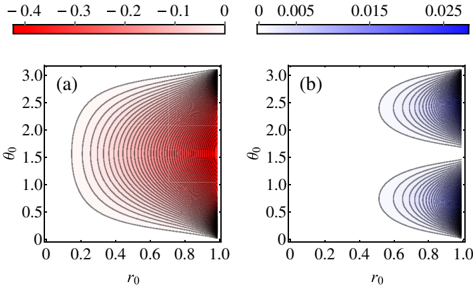
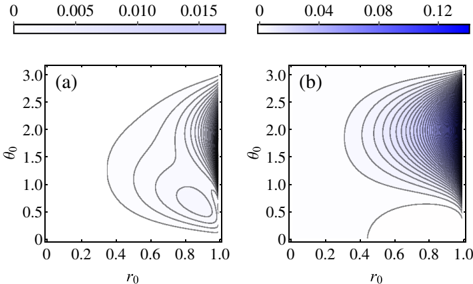
“The QSL constructed with the Wigner-Yanase skew information is nearly globally optimal (as δ WY γ ≃ 0) and tighter than the one constructed with the quantum Fisher information (as indicated by Δδ γ ≥ 0) in almost the whole parameter space, except for a small region in the bottom-right corner (large r 0 , small θ 0 , i.e., around the state j0i) in which the quantum Fisher information bound is margi”
- Also stated in: § Additional information · boosted
“What is more, in Fig. 7 one can see that for almost all initial states, except for a small neighborhood of the north pole (which is the asymptotic state of the amplitude damping channel), δ QF ≥ δ WY and δ WY ≃ 0; i.e., the Wigner-Yanase information metric provides us with a definitely tighter (and nearly saturated) QSL than the quantum Fisher information metric.”
§ Generalized Geometric Quantum Speed Limits > APPENDIX B: PARALLEL AND TRANSVERSAL DEPHASING
boostedcorrelational- Asserted: passes — The authors put it forward as true.
- Checkable: passes — It can be checked against evidence.
- Load-bearing: passes — The paper’s conclusions depend on it.
- Based: passes — The paper gives a reason why it holds.
It may state two separate claims as one.
- Also stated in: § Additional information · boosted
The paper states this without a source or data behind it here, so there is nothing to check it against. The quote shows it is in the paper.
In the paper
“On the other hand, regarding transversal dephasing noise, we are able to analytically compute both the geodesic distances corresponding to the quantum Fisher information and the Wigner-Yanase information metric by using Eqs.(5), ( 6), (A12), and (A13) with”
§ Generalized Geometric Quantum Speed Limits > Additional information
plaindirect- Asserted: passes — The authors put it forward as true.
- Checkable: passes — It can be checked against evidence.
- Load-bearing: fails — The paper’s conclusions may not depend on it.
- Based: passes — The paper gives a reason why it holds.
Probably not a substantial claim. The paper’s conclusions may not depend on it.
The paper states this without a source or data behind it here, so there is nothing to check it against. The quote shows it is in the paper.
In the paper
“For the Wigner-Yanase information metric, the path length is evaluated as”
§ Generalized Geometric Quantum Speed Limits > Additional information
plain- Asserted: passes — The authors put it forward as true.
- Checkable: passes — It can be checked against evidence.
- Load-bearing: fails — The paper’s conclusions may not depend on it.
- Based: passes — The paper gives a reason why it holds.
Probably not a substantial claim. The paper’s conclusions may not depend on it. The quote only partly states this claim.
A result the paper reports from its own data — it cites no other source for it, so there is none to check. The quote shows it is in the paper.
In the paper
“The QSL constructed with the Wigner-Yanase skew information is tighter than (respectively, looser than) the one constructed with the quantum Fisher information when Δδ γ > 0 (resp.Δδ γ < 0), as in panel (b) [resp.(a)].”
§ Generalized Geometric Quantum Speed Limits > APPENDIX B: PARALLEL AND TRANSVERSAL DEPHASING
plaindirect- Asserted: passes — The authors put it forward as true.
- Checkable: passes — It can be checked against evidence.
- Load-bearing: passes — The paper’s conclusions depend on it.
- Based: passes — The paper gives a reason why it holds.
It may state two separate claims as one.
The paper states this without a source or data behind it here, so there is nothing to check it against. The quote shows it is in the paper.
In the paper
“On the one hand, Eq. (A10) can be trivially generalized to any pair of contractive Riemannian metrics g f and g h as follows:”
§ Generalized Geometric Quantum Speed Limits > V. CONCLUSIONS
plain- Asserted: passes — The authors put it forward as true.
- Checkable: passes — It can be checked against evidence.
- Load-bearing: passes — The paper’s conclusions depend on it.
- Based: passes — The paper gives a reason why it holds.
Probably not a substantial claim.
The paper states this without a source or data behind it here, so there is nothing to check it against. The quote shows it is in the paper.
In the paper
“For the quantum Fisher information metric, the analytical expression of the path length is given by”
§ Generalized Geometric Quantum Speed Limits > Additional information
plain- Asserted: passes — The authors put it forward as true.
- Checkable: passes — It can be checked against evidence.
- Load-bearing: unclear — It is unclear whether the paper’s conclusions depend on it.
- Based: passes — The paper gives a reason why it holds.
The quote only partly states this claim.
The paper states this without a source or data behind it here, so there is nothing to check it against. The quote shows it is in the paper.
In the paper
“Since the eigenvalues p 1;2 ¼ ð1 Æ r 0 Þ=2 of the unitarily evolving one-qubit state are time independent, it immediately follows that F ¼ 0;”
§ Generalized Geometric Quantum Speed Limits > V. CONCLUSIONS
boosteddirect- Asserted: passes — The authors put it forward as true.
- Checkable: passes — It can be checked against evidence.
- Load-bearing: passes — The paper’s conclusions depend on it.
- Based: passes — The paper gives a reason why it holds.
It may state two separate claims as one.
A conclusion the paper draws from its own results — it cites no other source for it, so there is none to check. The quote shows it is in the paper.
In the paper
“Our work unifies and generalizes existing results on quantum speed limits and provides instances of novel bounds that are tighter than any established one based on the conventional quantum Fisher information.”
- Also stated in: § II. GEOMETRIC MEASURES OF DISTINGUISHABILITY · plain
“Here, we establish a general family of geometric quantum speed limits with respect to an infinite hierarchy of contractive Riemannian metrics on the space of quantum states, unifying and extending previous results under an information geometry framework.”
§ Generalized Geometric Quantum Speed Limits > Abstract
plaindirect- Asserted: passes — The authors put it forward as true.
- Checkable: passes — It can be checked against evidence.
- Load-bearing: passes — The paper’s conclusions depend on it.
- Based: passes — The paper gives a reason why it holds.
It may state two separate claims as one.
- The authors state this as an assumption: A Riemannian metric must be contractive under physical maps to be a bona fide measure of distinguishability between quantum states.
- Also stated in: § II. GEOMETRIC MEASURES OF DISTINGUISHABILITY · plain
In the paper
“As pointed out by Kubo and Ando [55], among the MC functions, there exists a minimal one, f min ðtÞ ¼ 2t=ð1 þ tÞ, and a maximal one, f max ðtÞ ¼ ð1 þ tÞ=2, such that a generic MC function fðtÞ must satisfy f min ðtÞ ≤ fðtÞ ≤ f max ðtÞ.”
§ Generalized Geometric Quantum Speed Limits > II. GEOMETRIC MEASURES OF DISTINGUISHABILITY
What the sources say
- Not checked yetcites [55] source
plain- Asserted: passes — The authors put it forward as true.
- Checkable: passes — It can be checked against evidence.
- Load-bearing: unclear — It is unclear whether the paper’s conclusions depend on it.
- Based: passes — The paper gives a reason why it holds.
It may state two separate claims as one.
A conclusion the paper draws from its own results — it cites no other source for it, so there is none to check. The quote shows it is in the paper.
In the paper
“Quite remarkably, this restriction will be enough to reveal how the choice of the quantum Fisher information metric, though ubiquitous in the existing literature, is only a special case that does not always provide the tightest lower bound.”
§ Generalized Geometric Quantum Speed Limits > III. GENERALIZED GEOMETRIC QUANTUM SPEED LIMITS
plain- Asserted: passes — The authors put it forward as true.
- Checkable: passes — It can be checked against evidence.
- Load-bearing: passes — The paper’s conclusions depend on it.
- Based: passes — The paper gives a reason why it holds.
It may state two separate claims as one.
- The authors state this as an assumption: A Riemannian metric must be contractive under physical maps to be a bona fide measure of distinguishability between quantum states.
The paper states this without a source or data behind it here, so there is nothing to check it against. The quote shows it is in the paper.
In the paper
“The quantum Fisher information metric corresponds to the MC function fðtÞ ¼ ð1 þ tÞ=2, so c f ðx; yÞ ¼ 2=ðx þ yÞ and Eq. ( 21) becomes”
§ Generalized Geometric Quantum Speed Limits > 1. Quantum Fisher information metric
plaindirect- Asserted: passes — The authors put it forward as true.
- Checkable: passes — It can be checked against evidence.
- Load-bearing: passes — The paper’s conclusions depend on it.
- Based: passes — The paper gives a reason why it holds.
Probably not a substantial claim. It may state two separate claims as one.
- The authors state this as an assumption: A Riemannian metric must be contractive under physical maps to be a bona fide measure of distinguishability between quantum states.
In the paper
“Moreover, we can immediately see that it exactly coincides with the one reported in Ref. [9] and reduces to a MT-like bound, when further restricting to the case of a time-independent generator of the dynamics.”
§ Generalized Geometric Quantum Speed Limits > 1. Quantum Fisher information metric
What the sources say
- Not checked yetcites [9] source
plaindirect- Asserted: passes — The authors put it forward as true.
- Checkable: passes — It can be checked against evidence.
- Load-bearing: unclear — It is unclear whether the paper’s conclusions depend on it.
- Based: passes — The paper gives a reason why it holds.
It may state two separate claims as one.
- The authors state this as an assumption: A Riemannian metric must be contractive under physical maps to be a bona fide measure of distinguishability between quantum states.
- The authors state this as an assumption: The dynamical evolution ρλ depends analytically on each parameter λμ.
A conclusion the paper draws from its own results — it cites no other source for it, so there is none to check. The quote shows it is in the paper.
In the paper
“In this respect, we would like to point out that an experimental investigation of the main results presented here, for both closed and open system dynamics, can be achieved, in particular, using a highly controllable nuclear magnetic resonance setup, with no need for a complete quantum state tomography.”
§ Generalized Geometric Quantum Speed Limits > V. CONCLUSIONS
plain- Asserted: passes — The authors put it forward as true.
- Checkable: passes — It can be checked against evidence.
- Load-bearing: fails — The paper’s conclusions may not depend on it.
- Based: passes — The paper gives a reason why it holds.
Probably not a substantial claim. The paper’s conclusions may not depend on it.
In the paper
“Giovannetti et al. [18] extended the ML QSL to the case of arbitrary mixed states and also showed that entanglement can speed up the dynamical evolution of a closed composite system.”
§ Generalized Geometric Quantum Speed Limits > I. INTRODUCTION
What the sources say
- Not checked yetcites [18] source
plaindirect- Asserted: passes — The authors put it forward as true.
- Checkable: passes — It can be checked against evidence.
- Load-bearing: fails — The paper’s conclusions may not depend on it.
- Based: passes — The paper gives a reason why it holds.
Probably not a substantial claim. The paper’s conclusions may not depend on it. It may state two separate claims as one.
None of the sources cited for this claim have been checked yet.
In the paper
“More precisely, transversal dephasing noise stands as the relevant scenario whereby one can attain a precision in the estimation of the parameter ω 0 that scales superclassically with the number of qubits, even if such noise applies independently to each qubit (while any superclassical advantage is lost in the case of parallel dephasing noise).”
§ Generalized Geometric Quantum Speed Limits > 1. Parallel and transversal dephasing channels
plaindirect- Asserted: passes — The authors put it forward as true.
- Checkable: passes — It can be checked against evidence.
- Load-bearing: passes — The paper’s conclusions depend on it.
- Based: passes — The paper gives a reason why it holds.
It may state two separate claims as one.
A conclusion the paper draws from its own results — it cites no other source for it, so there is none to check. The quote shows it is in the paper.
In the paper
“This highlights the power of our general approach to reach beyond the state of the art.”
§ Generalized Geometric Quantum Speed Limits > 2. Amplitude damping channel
plaindirectSingle case- Asserted: passes — The authors put it forward as true.
- Checkable: fails — It may be too vague to check against evidence.
- Load-bearing: fails — The paper’s conclusions may not depend on it.
- Based: passes — The paper gives a reason why it holds.
Probably not a substantial claim. It may be too vague to check against evidence. The paper’s conclusions may not depend on it.
A conclusion the paper draws from its own results — it cites no other source for it, so there is none to check. The quote shows it is in the paper.
In the paper
“Specifically, each bona fide geometric measure of distinguishability gives rise to a different quantum speed limit which is particularly tailored to the case of initial mixed states and such that the contributions of the populations of the evolved state and of the coherences of its time variation are clearly separated.”
§ Generalized Geometric Quantum Speed Limits > V. CONCLUSIONS
boosteddirect- Asserted: passes — The authors put it forward as true.
- Checkable: passes — It can be checked against evidence.
- Load-bearing: passes — The paper’s conclusions depend on it.
- Based: passes — The paper gives a reason why it holds.
It may state two separate claims as one.
A conclusion the paper draws from its own results — it cites no other source for it, so there is none to check. The quote shows it is in the paper.
In the paper
“However, when the initial and final states commute, we have that the corresponding fidelity and affinity coincide, Fðρ 0 ; ρ τ Þ ¼ Aðρ 0 ; ρ τ Þ, and so the Bures angle is equal to the Hellinger angle, which implies that in this case the bound emerging from the Wigner-Yanase metric is less tight than the one corresponding to the quantum Fisher information by a factor of 1= ffiffi ffi 2 p .”
§ Generalized Geometric Quantum Speed Limits > 2. Wigner-Yanase information metric
plaindirect- Asserted: passes — The authors put it forward as true.
- Checkable: passes — It can be checked against evidence.
- Load-bearing: passes — The paper’s conclusions depend on it.
- Based: passes — The paper gives a reason why it holds.
It may state two separate claims as one.
A conclusion the paper draws from its own results — it cites no other source for it, so there is none to check. The quote shows it is in the paper.
In the paper
“Once more, the present analysis shows that our approach applies straightforwardly to obtain novel, tighter bounds in dynamical cases of interest for quantum technologies, as corroborated here, in particular, for the metrologically relevant case of transversal dephasing noise.”
§ Generalized Geometric Quantum Speed Limits > 1. Parallel and transversal dephasing channels
boosteddirectSingle case- Asserted: passes — The authors put it forward as true.
- Checkable: passes — It can be checked against evidence.
- Load-bearing: passes — The paper’s conclusions depend on it.
- Based: passes — The paper gives a reason why it holds.
It may state two separate claims as one.
A conclusion the paper draws from its own results — it cites no other source for it, so there is none to check. The quote shows it is in the paper.
In the paper
“This is in stark contrast to the case of unitary evolutions, discussed in the previous section, and constitutes a first demonstration of the usefulness of our generalized approach to speed limits in quantum dynamics.”
§ Generalized Geometric Quantum Speed Limits > 1. Parallel and transversal dephasing channels
boosteddirect- Asserted: passes — The authors put it forward as true.
- Checkable: passes — It can be checked against evidence.
- Load-bearing: passes — The paper’s conclusions depend on it.
- Based: passes — The paper gives a reason why it holds.
Probably not a substantial claim. It may state two separate claims as one.
In the paper
“Then, Deffner and Lutz [33] extended the ML bound to open quantum systems by adopting again a geometric approach using the Bures angle.These authors have also introduced a new sort of bound, which is tighter than both the ML and MT ones, and shown that non-Markovianity can speed up the quantum evolution.”
§ Generalized Geometric Quantum Speed Limits > I. INTRODUCTION
What the sources say
- Not checked yetcites [33] source
plaindirect- Asserted: passes — The authors put it forward as true.
- Checkable: passes — It can be checked against evidence.
- Load-bearing: passes — The paper’s conclusions depend on it.
- Based: passes — The paper gives a reason why it holds.
It may state two separate claims as one.
In the paper
“Specifically, the present study allows one to certify that, in a particular implementation, quantum states have been driven at the ultimate speed limit [42] and their evolution cannot be sped up further: This occurs whenever saturation of one of our bounds is demonstrated.”
§ Generalized Geometric Quantum Speed Limits > V. CONCLUSIONS
What the sources say
- Not checked yetcites [42] source
plaindirect- Asserted: passes — The authors put it forward as true.
- Checkable: passes — It can be checked against evidence.
- Load-bearing: passes — The paper’s conclusions depend on it.
- Based: passes — The paper gives a reason why it holds.
It may state two separate claims as one.
A conclusion the paper draws from its own results — it cites no other source for it, so there is none to check. The quote shows it is in the paper.
In the paper
“This reveals another important physical mechanism, distinct from dephasing, in which our generalized analysis leads to significantly tighter bounds than those established in previous literature, which, in this case, is clearly”
§ Generalized Geometric Quantum Speed Limits > Additional information
boosteddirect- Asserted: passes — The authors put it forward as true.
- Checkable: passes — It can be checked against evidence.
- Load-bearing: passes — The paper’s conclusions depend on it.
- Based: unclear — It is unclear why the paper says it holds.
It may state two separate claims as one.
None of the sources cited for this claim have been checked yet.
In the paper
“where the analytical formulas of the fidelity Fðρ 0 ; ρ τ Þ and the affinity Aðρ 0 ; ρ τ Þ for any pair of one-qubit states ρ 0 and ρ τ are the following [29,73,74]:”
§ Generalized Geometric Quantum Speed Limits > V. CONCLUSIONS
What the sources say
plain- Asserted: passes — The authors put it forward as true.
- Checkable: passes — It can be checked against evidence.
- Load-bearing: fails — The paper’s conclusions may not depend on it.
- Based: passes — The paper gives a reason why it holds.
Probably not a substantial claim. The paper’s conclusions may not depend on it.
None of the sources cited for this claim have been checked yet.
In the paper
“In fact, dephasing and amplitude damping are naturally occurring sources of decoherence in such an implementation, and our results can be accessed by means of spin ensemble measurements, which constitute the conventional types of detection in such a technique [71,72].”
§ Generalized Geometric Quantum Speed Limits > V. CONCLUSIONS
What the sources say
- Not checked yetcites [71]
- Not checked yetcites [72] source
plaincorrelational- Asserted: passes — The authors put it forward as true.
- Checkable: passes — It can be checked against evidence.
- Load-bearing: unclear — It is unclear whether the paper’s conclusions depend on it.
- Based: passes — The paper gives a reason why it holds.
It may state two separate claims as one.
A conclusion the paper draws from its own results — it cites no other source for it, so there is none to check. The quote shows it is in the paper.
In the paper
“On the other hand, Eq. (A17) seems hard to generalize to other contractive Riemannian metrics since the analytical expressions of the corresponding geodesic lengths are still unknown.”
§ Generalized Geometric Quantum Speed Limits > V. CONCLUSIONS
hedged- Asserted: passes — The authors put it forward as true.
- Checkable: passes — It can be checked against evidence.
- Load-bearing: fails — The paper’s conclusions may not depend on it.
- Based: passes — The paper gives a reason why it holds.
Probably not a substantial claim. The paper’s conclusions may not depend on it.
The authors state this as an assumption.
A Riemannian metric must be contractive under physical maps to be a bona fide measure of distinguishability between quantum states.
“However, it is also natural to assume that for a Riemannian metric to be bona fide in quantifying the distinguishability between two states, it must be contractive under the physical maps that represent the mathematical counterpart of noise, i.e., stochastic maps in the classical settings and completely positive trace-preserving maps in quantum.”
The authors state this as an assumption.
The dynamical evolution ρλ depends analytically on each parameter λμ.
“in such a way that ρ λ depends analytically on each parameter λ μ (μ ¼ 1; …; r).”
The paper relies on this without support.
The noisy evolution of the single qubit is governed by a master equation of Lindblad form with the specified Hamiltonian and Liouvillian.
“Let us now consider a noisy evolution of this state governed by a master equation of Lindblad form”
“We further consider the Hamiltonian H ¼ ðω 0 =2Þσ 3 , where ω 0 is the unitary frequency, and the Liouvillian”
The paper relies on this without support.
The initial plus state is an optimal probe state for frequency estimation.
“However, when restricting to the relevant case of an initial plus state (which is an optimal probe state for frequency estimation), i.e., ρ 0 ¼ jþihþj with jþi ¼ ðj0i þ j1iÞ= ffiffi ffi 2 p , one obtains the following simple expressions:”
The paper relies on this without support.
The quantum Fisher information and the Wigner-Yanase skew information are the only two metrics admitting known geodesics.
“While such a problem can only be solved in restricted form at present, due to the fact that the quantum Fisher information and the Wigner-Yanase skew information are the only two metrics admitting known geodesics”
Claims other papers make about this one
Each is checked against this paper’s own text: does it say what the citing paper says it does?
In the citing paper
“However, tracing over H B , in general, turns unitary dynamics between jψ 1 i and jψ 2 i into nonunitary dynamics between ρ 1 and ρ 2 [50].Consequently, the Bures metric does not necessarily select geodesics generated by unitary operations, even if ρ 1 and ρ 2 have the same spectrum.”
From Tightening Quantum Speed Limits for Almost All States (2018) · cites this paper as [50]
In the citing paper
“In the eigenbasis of the density matrix ρ, g µν takes the form as [91][92][93] g µν = 1 4 i λ i |dρ|λ i 2 λ i + 1 2 i<j | λ i |dρ|λ j | 2 λ j h(λ i /λ j ) ,(78”
From Quantum Fisher information matrix and multiparameter estimation (2020) · cites this paper as [93]
In the citing paper
“Recently, Pires et al [93] established an infinite family of quantum speed limits based on a contractive Riemannian metric discussed in section 2.4.2.”
From Quantum Fisher information matrix and multiparameter estimation (2020) · cites this paper as [93]
Self-check
Percentages, sums and reported differences re-computed from the paper’s own numbers.
Each contradiction between two passages listed here was confirmed by an independent check.
Rated minor: it would not touch a result — a value no result rests on, a p-value that stays on the same side of the significance level, or a conflict that is clerical, resolved elsewhere in the paper, or outside its own findings.
In the paper
§ Generalized Geometric Quantum Speed Limits > 1. Parallel and transversal dephasing channels
“where p Æ ¼ ð1=2Þð1 þ r 0 ξt Þ and”
§ Generalized Geometric Quantum Speed Limits > II. GEOMETRIC MEASURES OF DISTINGUISHABILITY
“the set of positive semidefinite and trace-one operators over the carrier Hilbert space.”
Rated minor: it would not touch a result — a value no result rests on, a p-value that stays on the same side of the significance level, or a conflict that is clerical, resolved elsewhere in the paper, or outside its own findings.
In the paper
§ Generalized Geometric Quantum Speed Limits > 2. Wigner-Yanase information metric
“when the initial and final states commute, we have that the corresponding fidelity and affinity coincide, Fðρ 0 ; ρ τ Þ ¼ Aðρ 0 ; ρ τ Þ”
§ Generalized Geometric Quantum Speed Limits > II. GEOMETRIC MEASURES OF DISTINGUISHABILITY
“where Fðρ; σÞ ¼ ðTr½ ffiffiffiffiffiffiffiffiffiffiffiffiffiffiffi ffi ffiffi ffi ρ p σ ffiffi ffi ρ p p Þ 2 is the Uhlmann fidelity”
Citations
Cites
Quantum Computation and Quantum Information
Nielsen, M. A., Chuang, I., & Grover, L. K. (2002) · American Journal of Physics · doi:10.1119/1.1463744 · Cited by 21,895
Quantum computation and quantum information
Law, J. (2001) · ACM SIGSOFT Software Engineering Notes · doi:10.1145/505482.505499 · Cited by 20,450
�ber den anschaulichen Inhalt der quantentheoretischen Kinematik und Mechanik
Heisenberg, W. (1927) · Zeitschrift f�r Physik · doi:10.1007/bf01397280 · Cited by 4,278
Giovannetti, V., Lloyd, S., & Maccone, L. (2011) · Nature Photonics · doi:10.1038/nphoton.2011.35 · Cited by 3,894
Statistical distance and the geometry of quantum states
Braunstein, S. L., & Caves, C. M. (1994) · Physical Review Letters · doi:10.1103/physrevlett.72.3439 · Cited by 3,176
Methods of Information Geometry
Амари, Ш.-И., & Nagaoka, H. (2007) · Translations of mathematical monographs · doi:10.1090/mmono/191 · Cited by 2,321
Fidelity for Mixed Quantum States
Jozsa, R. (1994) · Journal of Modern Optics · doi:10.1080/09500349414552171 · Cited by 1,911
Robertson, H. P. (1929) · Physical Review · doi:10.1103/physrev.34.163 · Cited by 1,877
The Quantum Postulate and the Recent Development of Atomic Theory1
BOHR, N. (1928) · Nature · doi:10.1038/121580a0 · Cited by 1,700
Quantum estimation for quantum technology
PARIS, M. G. A. (2009) · International Journal of Quantum Information · doi:10.1142/s0219749909004839 · Cited by 1,632
Research works printed but not linked: 3
- W. Pauli, 1926, Handbuch der Physik
- W. Pauli, 1933, Handbuch der Physik
- L. Mandelstam, 1945, J. Phys. USSR, 9, 249
Cited by
Sorted by citations
Colloquium : Quantum coherence as a resource
Streltsov, A., Adesso, G., & Plenio, M. B. (2017) · Reviews of Modern Physics · doi:10.1103/revmodphys.89.041003 · Cited by 1,878
Self-citationQuantum Fisher information matrix and multiparameter estimation
Liu, J., Yuan, H., Lu, X.-M., & Wang, X. (2020) · Journal of Physics A: Mathematical and Theoretical · doi:10.1088/1751-8121/ab5d4d · Cited by 802
Quantum speed limits: from Heisenberg’s uncertainty principle to optimal quantum control
Deffner, S., & Campbell, S. (2017) · Journal of Physics A: Mathematical and Theoretical · doi:10.1088/1751-8121/aa86c6 · Cited by 585
Enhancing the Charging Power of Quantum Batteries
Campaioli, F., Pollock, F. A., Binder, F. C., Céleri, L., Goold, J., Vinjanampathy, S., & Modi, K. (2017) · Physical Review Letters · doi:10.1103/physrevlett.118.150601 · Cited by 531
Self-citationSpeed Limit for Classical Stochastic Processes
Shiraishi, N., Funo, K., & Saito, K. (2018) · Physical Review Letters · doi:10.1103/physrevlett.121.070601 · Cited by 237
Metadata
- Authors
- Pires, D. P., Cianciaruso, M., Céleri, L. C., Adesso, G., & Soares-Pinto, D. O.
- Affiliations
- Universidade de São Paulo (BR)
- University of Salerno (IT)
- Universidade Federal de Goiás (BR)
- University of Nottingham (GB)
- Corresponding author
- Pires, Diego Paiva
- Venue
- Physical Review X
- Publisher
- American Physical Society (APS)
- Published
- 2016-06-02
- Volume
- 6
- Issue
- 2
- ISSN
- 2160-3308 (ISSN-L)
- OpenAlex
- W2264466972
- Semantic Scholar
- e579c01d9ce8b70d2ff460ab76e23d822d547c56
- Cited by
- 265
- References
- 92
- Citations by year
- 2026: 18 · 2025: 35 · 2024: 22 · 2023: 28 · 2022: 23 · 2021: 41 · 2020: 26 · 2019: 21 · 2018: 22 · 2017: 24 · 2016: 4
- FWCI
- 19.49
- Type
- journal article
- Language
- en
- Open access
- gold
- doi.org
- Licence
- Locations
- Physical Review X (publishedVersion, cc-by)
- arXiv (Cornell University) (publishedVersion)
- Repository@Nottingham (University of Nottingham) (publishedVersion, cc-by)
- Repository@Nottingham (University of Nottingham) (submittedVersion, cc-by)
- DOAJ (DOAJ: Directory of Open Access Journals) (submittedVersion, cc-by-sa)
- Nottingham ePrints (University of Nottingham) (submittedVersion, cc-by)
- arXiv (Cornell University)
- Greater South Information System
- Funders
- Conselho Nacional de Desenvolvimento Científico e Tecnológico (445516/2014-3, 401230/2014-7, 305086/2013-8, 304955/2013-2, 443828/2014-8)
- Coordenação de Aperfeiçoamento de Pessoal de Nível Superior (108/2012)
- European Research Council (637352)
- Brazilian National Institute of Science and Technology
- Topics
- Physical Sciences › Computer Science › Artificial Intelligence › Quantum Computing Algorithms and Architecture
- Physical Sciences › Physics and Astronomy › Atomic and Molecular Physics, and Optics › Quantum Information and Cryptography
- Physical Sciences › Physics and Astronomy › Atomic and Molecular Physics, and Optics › Quantum Mechanics and Applications
- Keywords
- quantum speed limit, quantum state evolution, quantum dynamics, quantum technologies
About these checks
Registry, retraction, Cites and statistics results are computed, not judged, with one exception: a printed reference that no index lists is read once by a model before it counts as a citation error. Claims are extracted by a model and kept only when their quote appears verbatim in the text; each cited source is then checked, with a model’s help, for whether it says what the claim relies on. Those verdicts can be wrong — read the claim’s quote and the cited source before relying on one.
A language model drew the claims from the paper on 2026-10-06, under version 3 of the claim definition (model deepseek-v4.1-flash, prompt extract-v3).
A second model labelled each claim on 2026-10-06 (model jev-1.13-20260917, definition revision gold-guideline-v0.2).
Statistics and arithmetic are recomputed, not judged.
Confidence bands are shown only for fields calibrated on our annotated test set. None is calibrated yet, so no band is shown.
What counts as a claim ›How we measure confidence ›How we check this ›
Are you an author, or do you see a problem with this page? Request a review
