

Talent management and organizational citizenship behavior. Exploring the role of organizational support and age-related differences
Open accessThe DOI matches its Crossref record; 77 of the 78 references it cites were found in a registry or an index; none of the 67 sources its claims cite is checked for support yet.
Abstract
Purpose: Talent management (TM) may play a crucial role in creating strategic success in an organization because of its effects on employees' attitudes and behavior. Though considerable research has been conducted on managing talents, we still know very little about the process through which TM practices can foster employees' organizational citizenship behaviors (OCB). The study presented here aims to determine the impact of TM practices on individual- and organization-directed OCB (OCBI and OCBO, respectively), with the mediating role of perceived organizational support (POS) and the moderating role of age-related differences. Design/methodology/approach: The author surveyed 730 talent pool members and 100 managers from 33 companies, each of which has its own well-developed TM program. Multilevel structural equation modeling was performed to test the hypotheses. Findings: The research results demonstrate that TM practices do not have a direct impact on OCBI and OCBO of talent pool members but rather exert an indirect influence through POS. Additionally, the study found that the age of talent pool members moderates the relationship between POS and OCBI, such that this relationship is stronger among older generations of employees. Originality/value: The present study is one of the very few studies to investigate the psychological mechanism that helps to explain the effect of TM practices on talent pool members' OCB. It also sheds light on the conditioning of this relationship by testing the moderating role of age-related differences.
Overview
CoChat Summary
TL;DR
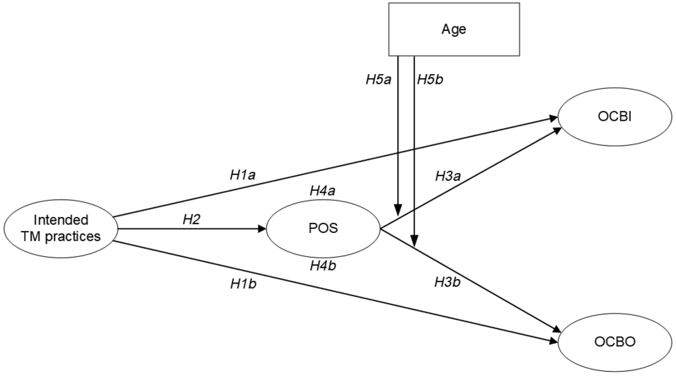
In a multilevel SEM study of 730 talent pool members and 100 managers from 33 Polish companies, talent management (TM) practices had no direct effect on individual- or organization-directed organizational citizenship behavior (OCBI/OCBO); their influence was fully mediated by perceived organizational support (POS). Age moderated the POS–OCBI relationship, which was stronger among older employees, but did not moderate POS–OCBO.
Key findings
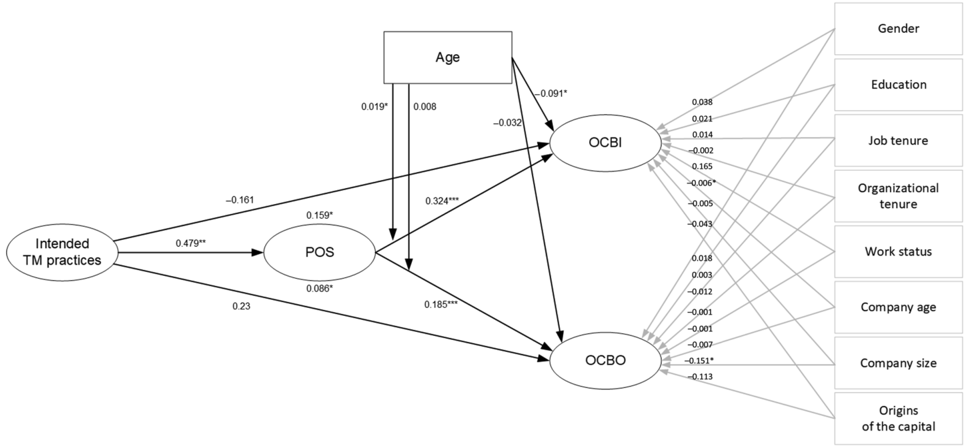
- TM practices significantly predicted POS (b = 0.479, p < 0.01) but were not directly related to OCBI (b = −0.161, n.s.) or OCBO (b = 0.230, n.s.). POS significantly predicted OCBI (b = 0.324, p < 0.001) and OCBO (b = 0.185, p < 0.001).
- POS fully mediated the TM–OCB relationships: indirect effect via POS was 0.155 (p < 0.01) for OCBI and 0.089 (p < 0.01) for OCBO.
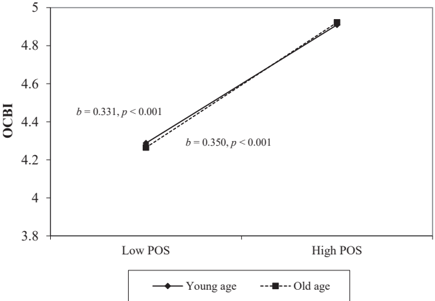
- Age moderated the POS–OCBI relationship (interaction b = 0.019, p < 0.05; age b = −0.091, p < 0.05), with simple slope tests indicating a stronger relationship for older employees; the figure reports slopes of 0.331 and 0.350 (both p < 0.001). Age did not moderate POS–OCBO (interaction b = 0.008, n.s.; age b = −0.032, n.s.).
- Among controls, gender, education, job tenure, organizational tenure, work status, and origin of company capital were not significant for either OCB dimension; company age negatively affected OCBI (b = −0.006, p < 0.05), and company size negatively affected OCBO (b = −0.151, p < 0.05).
Methods
- Online questionnaires were sent to 500 large Polish companies; the final sample comprised 730 talent pool members and 100 managers from 33 companies with well-developed TM programs, using purposive sampling. Data were collected from October 2020 to January 2021.
- TM practices were manager-rated (20 practices, 5-point scale, Cronbach’s alpha = 0.89); OCB was talent-rated using Williams and Anderson’s (1991) OCBI/OCBO scale (7-point, alpha = 0.91); POS was talent-rated using a shortened Survey of Perceived Organizational Support (7-point, alpha = 0.91).
- Multilevel structural equation modeling (Stata GSEM) was used because employees were nested within companies; ICCs were 0.417 for POS, 0.262 for OCBI, and 0.619 for OCBO. Predictors were group-mean centered at the individual level and grand-mean centered at level 2; common method variance was checked with procedural remedies and a common latent factor test.
Limitations
- Stated: all data were gathered at a single point in time, raising common method bias concerns despite procedural remedies and a post-hoc test; the cross-sectional design allows possible reverse causality (e.g., individuals already exhibiting OCB may be more likely to be included in talent pools); unmeasured exogenous variation may exist across companies (business strategies, policies, HRM, supervisor leadership styles); findings are based on large companies in Poland and may not generalize to other institutional or cultural contexts.
- Evident from the text: the sample is restricted to large companies with well-developed TM programs and to talent pool members aged 23–37 (mean 29.76), so results may not extend to SMEs, organizations without formal TM, or older workers outside talent pools.
- Evident from the text: OCB and POS were self-reported by talent pool members, while TM practices were manager-reported; this reduces but does not eliminate common-source concerns for the talent-rated variables.
Model-written summary. Check it against the paper before relying on it.
Integrity signals
Registry
Cites
Statistics
Figures
Verification
Claims the paper makes
0 Valid · 0 Not valid · 50 Not checked · 66 Own results and interpretations
A result the paper reports from its own data — it cites no other source for it, so there is none to check. The quote shows it is in the paper.
In the paper
“The research results demonstrate that TM practices do not have a direct impact on OCBI and OCBO of talent pool members but rather exert an indirect influence through POS.”
§ Talent management and organizational citizenship behavior. Exploring the role of organizational support and age-related differences > Abstract
boostedstates a cause- Asserted: passes — The authors put it forward as true.
- Checkable: passes — It can be checked against evidence.
- Load-bearing: passes — The paper’s conclusions depend on it.
- Based: passes — The paper gives a reason why it holds.
A result the paper reports from its own data — it cites no other source for it, so there is none to check. The quote shows it is in the paper.
In the paper
“It was also established that POS significantly predicts OCBI and OCBO (b 5 0.324, p < 0.001 for OCBI and b 5 0.185, p < 0.001 for OCBO).”
§ Talent management and organizational citizenship behavior. Exploring the role of organizational support and age-related differences > Results
boostedstates a cause- Asserted: passes — The authors put it forward as true.
- Checkable: passes — It can be checked against evidence.
- Load-bearing: passes — The paper’s conclusions depend on it.
- Based: passes — The paper gives a reason why it holds.
A result the paper reports from its own data — it cites no other source for it, so there is none to check. The quote shows it is in the paper.
In the paper
“The results of SEM showed that age and the interaction between POS and age have a statistically significant effect on OCBI (b 5 �0.091, p < 0.05; b 5 0.019, p < 0.05, respectively).”
§ Talent management and organizational citizenship behavior. Exploring the role of organizational support and age-related differences > Results
plainstates an association- Asserted: passes — The authors put it forward as true.
- Checkable: passes — It can be checked against evidence.
- Load-bearing: passes — The paper’s conclusions depend on it.
- Based: passes — The paper gives a reason why it holds.
A result the paper reports from its own data — it cites no other source for it, so there is none to check. The quote shows it is in the paper.
In the paper
“the indirect effect via POS is at the level of 0.155 (p < 0.01).”
§ Talent management and organizational citizenship behavior. Exploring the role of organizational support and age-related differences > Results
plainstates a cause- Asserted: passes — The authors put it forward as true.
- Checkable: passes — It can be checked against evidence.
- Load-bearing: passes — The paper’s conclusions depend on it.
- Based: passes — The paper gives a reason why it holds.
A result the paper reports from its own data — it cites no other source for it, so there is none to check. The quote shows it is in the paper.
In the paper
“the indirect effect via POS is at the level of 0.089 (p < 0.01).”
§ Talent management and organizational citizenship behavior. Exploring the role of organizational support and age-related differences > Results
plainstates a cause- Asserted: passes — The authors put it forward as true.
- Checkable: passes — It can be checked against evidence.
- Load-bearing: passes — The paper’s conclusions depend on it.
- Based: passes — The paper gives a reason why it holds.
60 more claims
Create a free account to see all 116 claims and to verify the 62 references still open.
- It may state two separate claims as one. 32
- Probably not a substantial claim. 24
Self-check
Percentages, sums and reported differences re-computed from the paper’s own numbers.
Each contradiction between two passages listed here was confirmed by an independent check.
Rated minor: it would not touch a result — a value no result rests on, a p-value that stays on the same side of the significance level, or a conflict that is clerical, resolved elsewhere in the paper, or outside its own findings.
In the paper
§ Talent management and organizational citizenship behavior. Exploring the role of organizational support and age-related differences > Data collection and sample characteristics
“They had a mean work experience of 5.93 years (SD 5 2.95).”
§ Talent management and organizational citizenship behavior. Exploring the role of organizational support and age-related differences > Conclusions
“| 10 Experience | 5.93 2.96”
Citations
Cites
Evaluating Structural Equation Models with Unobservable Variables and Measurement Error
Fornell, C., & Larcker, D. F. (1981) · Journal of Marketing Research · doi:10.2307/3151312 · Cited by 109,314
Evaluating structural equation models with unobservable variables and measurement error
Fornell, C., & Larcker, D. F. (1981) · Journal of Marketing Research · doi:10.1177/002224378101800104 · Cited by 109,190
Podsakoff, P. M., MacKenzie, S. B., Lee, J.-Y., & Podsakoff, N. P. (2003) · Journal of Applied Psychology · doi:10.1037/0021-9010.88.5.879 · Cited by 82,194
Exchange and Power in Social Life
Blau, P. M. (2017) · doi:10.4324/9780203792643 · Cited by 15,923
Sources of method bias in social science research and recommendations on how to control it
Podsakoff, P. M., MacKenzie, S. B., & Podsakoff, N. P. (2012) · Annual Review of Psychology · doi:10.1146/annurev-psych-120710-100452 · Cited by 15,744
Perceived organizational support.
Eisenberger, R., Huntington, R., Hutchison, S., & Sowa, D. (1986) · Journal of Applied Psychology · doi:10.1037/0021-9010.71.3.500 · Cited by 10,023
Perceived organizational support: a review of the literature.
Rhoades, L., & Eisenberger, R. (2002) · Journal of Applied Psychology · doi:10.1037/0021-9010.87.4.698 · Cited by 7,592
Williams, L. J., & Anderson, S. E. (1991) · Journal of Management · doi:10.1177/014920639101700305 · Cited by 6,250
Taking time seriously: A theory of socioemotional selectivity.
Carstensen, L. L., Isaacowitz, D. M., & Charles, S. T. (1999) · American Psychologist · doi:10.1037//0003-066x.54.3.165 · Cited by 5,377
Centering predictor variables in cross-sectional multilevel models: A new look at an old issue.
Enders, C. K., & Tofighi, D. (2007) · Psychological Methods · doi:10.1037/1082-989x.12.2.121 · Cited by 4,462
Reciprocation of perceived organizational support.
Eisenberger, R., Armeli, S., Rexwinkel, B., Lynch, P. D., & Rhoades, L. (2001) · Journal of Applied Psychology · doi:10.1037/0021-9010.86.1.42 · Cited by 3,106
Moderation in Management Research: What, Why, When, and How
Dawson, J. F. (2014) · Journal of Business and Psychology · doi:10.1007/s10869-013-9308-7 · Cited by 3,021
Millennials Rising: The Next Great Generation
Howe, N., & Strauss, W. (2000) · Cited by 2,536
Podsakoff, N. P., Whiting, S. W., Podsakoff, P. M., & Blume, B. D. (2009) · Journal of Applied Psychology · doi:10.1037/a0013079 · Cited by 2,356
Organizational Citizenship Behavior: Its Nature, Antecedents, and Consequences
Organ, D., Podsakoff, P., & MacKenzie, S. (2006) · doi:10.4135/9781452231082 · Cited by 1,903
Allen, D. G., Shore, L. M., & Griffeth, R. W. (2003) · Journal of Management · doi:10.1016/s0149-2063(02)00222-2 · Cited by 1,772
Organizational Citizenship Behavior: Its Nature, Antecedents, and Consequences
(2006) · Personnel Psychology · doi:10.1111/j.1744-6570.2006.00043_9.x · Cited by 1,563
The relationship of age to ten dimensions of job performance.
Ng, T. W. H., & Feldman, D. C. (2008) · Journal of Applied Psychology · doi:10.1037/0021-9010.93.2.392 · Cited by 1,224
Chiang, C.-F., & Hsieh, T.-S. (2012) · International Journal of Hospitality Management · doi:10.1016/j.ijhm.2011.04.011 · Cited by 809
Citizenship Behavior and The Creation of Social Capital in Organizations
Bolino, M. C., Turnley, W. H., & Bloodgood, J. M. (2002) · Academy of Management Review · doi:10.5465/amr.2002.7566023 · Cited by 750
Age and work‐related motives: Results of a meta‐analysis
Kooij, D. T. A. M., De Lange, A. H., Jansen, P. G. W., Kanfer, R., & Dikkers, J. S. E. (2011) · Journal of Organizational Behavior · doi:10.1002/job.665 · Cited by 740
Are You Ready for Gen Z in the Workplace?
Schroth, H. (2019) · California Management Review · doi:10.1177/0008125619841006 · Cited by 610
Socioemotional Selectivity Theory: The Role of Perceived Endings in Human Motivation
Carstensen, L. L. (2021) · The Gerontologist · doi:10.1093/geront/gnab116 · Cited by 573
The psychology of talent management: A review and research agenda
Dries, N. (2013) · Human Resource Management Review · doi:10.1016/j.hrmr.2013.05.001 · Cited by 523
The personal norm of reciprocity
Perugini, M., Gallucci, M., Presaghi, F., & Ercolani, A. P. (2003) · European Journal of Personality · doi:10.1002/per.474 · Cited by 497
Kuvaas, B., & Dysvik, A. (2010) · Human Resource Management Journal · doi:10.1111/j.1748-8583.2009.00120.x · Cited by 367
Multilevel models in international business research
Peterson, M. F., Arregle, J.-L., & Martin, X. (2012) · Journal of International Business Studies · doi:10.1057/jibs.2011.59 · Cited by 316
Organizational Citizenship Behaviors: Their Relationship to Organizational Effectiveness
Walz, S. M., & Niehoff, B. P. (2000) · Journal of Hospitality & Tourism Research · doi:10.1177/109634800002400301 · Cited by 305
Talent or Not? Employee Reactions to Talent Identification
Björkman, I., Ehrnrooth, M., Mäkelä, K., Smale, A., & Sumelius, J. (2013) · Human Resource Management · doi:10.1002/hrm.21525 · Cited by 273
Talent management and organisational justice: employee reactions to high potential identification
Gelens, J., Hofmans, J., Dries, N., & Pepermans, R. (2014) · Human Resource Management Journal · doi:10.1111/1748-8583.12029 · Cited by 251
O’Connor, E. P., & Crowley-Henry, M. (2019) · Journal of Business Ethics · doi:10.1007/s10551-017-3543-1 · Cited by 244
Generation Z Within the Workforce and in the Workplace: A Bibliometric Analysis
Benítez-Márquez, M. D., Sánchez-Teba, E. M., Bermúdez-González, G., & Núñez-Rydman, E. S. (2022) · Frontiers in Psychology · doi:10.3389/fpsyg.2021.736820 · Cited by 207
Tatoğlu, E., Glaister, A. J., & Demirbağ, M. (2016) · Journal of World Business · doi:10.1016/j.jwb.2015.11.001 · Cited by 201
Employee reactions to talent management: Assumptions versus evidence
De Boeck, G., Meyers, M. C., & Dries, N. (2018) · Journal of Organizational Behavior · doi:10.1002/job.2254 · Cited by 183
Younas, M., & Bari, M. W. (2020) · Economic Research-Ekonomska Istraživanja · doi:10.1080/1331677x.2020.1748510 · Cited by 169
The role of talent-perception incongruence in effective talent management
Sonnenberg, M., van Zijderveld, V., & Brinks, M. (2014) · Journal of World Business · doi:10.1016/j.jwb.2013.11.011 · Cited by 167
Generativity at work: A meta-analysis
Doerwald, F., Zacher, H., Van Yperen, N. W., & Scheibe, S. (2021) · Journal of Vocational Behavior · doi:10.1016/j.jvb.2020.103521 · Cited by 111
Gain More Insight from Common Latent Factor in Structural Equation Modeling
Afthanorhan, A., Awang, Z., Majid, N. A., Foziah, H., Ismail, I., Halbusi, H. A., & Tehseen, S. (2021) · Journal of Physics Conference Series · doi:10.1088/1742-6596/1793/1/012030 · Cited by 102
Alshaabani, A., Naz, F., Magda, R., & Rudnák, I. (2021) · Sustainability · doi:10.3390/su13147800 · Cited by 98
Afsar, B., & Badir, Y. F. (2016) · Journal of Human Resources in Hospitality & Tourism · doi:10.1080/15332845.2016.1147936 · Cited by 96
Pletzer, J. L. (2021) · Personality and Individual Differences · doi:10.1016/j.paid.2020.110550 · Cited by 92
Employee reactions to talent pool membership
Swailes, S., & Blackburn, M. (2016) · Employee Relations · doi:10.1108/er-02-2015-0030 · Cited by 89
Menezes, D. B. S., Gumashivili, M., & Kiti, K. (2025) · Sustainability · doi:10.3390/su17073277 · Cited by 66
Talent management and organizational commitment: The partial mediating role of pay satisfaction
Luna-Arocas, R., Danvila-Del Valle, I., & Lara, F. J. (2020) · Employee Relations: The International Journal · doi:10.1108/er-11-2019-0429 · Cited by 63
Kao, J.-C., Cho, C.-C., & Kao, R.-H. (2023) · Frontiers in Psychology · doi:10.3389/fpsyg.2023.1082130 · Cited by 56
Santos, R. S., Lousã, E. P., Sá, M. M., & Cordeiro, J. A. (2023) · Behavioral Sciences · doi:10.3390/bs13100811 · Cited by 49
The development and evaluation of a partial talent management structural model
Oehley, A. M. (2010) · Bestuursdinamika · Cited by 48
The impact on the psychological contract of differentiating employees into talent pools
Seopa, N., Wöcke, A., & Leeds, C. (2015) · Career Development International · doi:10.1108/cdi-03-2015-0033 · Cited by 47
Talent management and employee outcomes: A psychological contract fulfilment perspective
Mensah, J. K. (2019) · Public Organization Review · doi:10.1007/s11115-018-0407-9 · Cited by 45
Fan, Q., Wider, W., & Chan, C. K. (2023) · Frontiers in Psychology · doi:10.3389/fpsyg.2023.1181930 · Cited by 37
Tan, L. P., Yap, C. S., Choong, Y. O., Choe, K. L., Rungruang, P., & Li, Z. (2019) · Leadership & Organization Development Journal · doi:10.1108/lodj-04-2019-0160 · Cited by 37
Facing distress in Coronavirus era: The role of maladaptive personality traits and coping strategies
Sica, C., Latzman, R. D., Caudek, C., Cerea, S., Colpizzi, I., Caruso, M., Giulini, P., & Bottesi, G. (2021) · Personality and Individual Differences · doi:10.1016/j.paid.2021.110833 · Cited by 35
Managing talent in the south african public service
Kock, R., & Burke, M. (2008) · Public Personnel Management · doi:10.1177/009102600803700406 · Cited by 30
Wikhamn, W., Asplund, K., & Dries, N. (2021) · Human Resource Management Journal · doi:10.1111/1748-8583.12335 · Cited by 27
Affective commitment of employees designated as talent: Signalling perceived organisational support
Gelens, J., Dries, N., Hofmans, J., & Pepermans, R. (2015) · European J. of International Management · doi:10.1504/ejim.2015.066669 · Cited by 25
Mensah, J. K., & Bawole, J. N. (2018) · International Journal of Manpower · doi:10.1108/ijm-08-2016-0162 · Cited by 24
Ali, Z., Bashir, M., & Mehreen, A. (2019) · Journal of Management Sciences · doi:10.20547/jms.2014.1906105 · Cited by 24
Weng, T.-C., Shen, Y.-H., & Kan, T.-T. (2023) · Sustainability · doi:10.3390/su151813508 · Cited by 23
The basic themes of talent management: Bibliometric analysis and systematic literature review
Hendrawan, R., Rosari, R., & Nastiti, T. (2024) · Cogent Business & Management · doi:10.1080/23311975.2024.2429016 · Cited by 22
Supi, Noermijati, Wirawan Irawanto, D., & Puspaningrum, A. (2023) · Cogent Business & Management · doi:10.1080/23311975.2023.2265089 · Cited by 21
Detnakarin, S., & Rurkkhum, S. (2019) · Journal of Asia-Pacific Business · doi:10.1080/10599231.2019.1647078 · Cited by 19
Pouramini, Z., & Fayyazi, M. (2015) · International Business Research · doi:10.5539/ibr.v8n9p57 · Cited by 18
Linda, M. R., Yonita, R., & Silvia, E. D. (2019) · Padang International Conference on Economics Education, Economics, Business and Management, Accounting and Entrepreneurship (PICEEBA) · doi:10.2991/piceeba-19.2019.76 · Cited by 17
Björk, J. M., Bolander, P., & Forsman, A. K. (2022) · Frontiers in Psychology · doi:10.3389/fpsyg.2022.959559 · Cited by 16
Abu-Darwish, N. J., Al-Kasasbeh, M. M., & Al-Khasawneh, M. M. (2022) · Competitiveness Review: An International Business Journal · doi:10.1108/cr-10-2020-0133 · Cited by 14
Zada, M., Manzoor, S. R., Irtaimeh, E. K., Mannai, A. A. A., Khattak, A., & Salameh, A. A. (2024) · BMC Psychology · doi:10.1186/s40359-024-02225-3 · Cited by 12
Latukha, M., Kriklivetc, A., & Podgainyi, F. (2022) · Journal of East-West Business · doi:10.1080/10669868.2022.2074186 · Cited by 12
Wang, H., Li, X., Zhu, J., & Chen, X. (2024) · Employee Relations: The International Journal · doi:10.1108/er-01-2024-0007 · Cited by 9
Emotional Intelligence and Modes of Conflict Management of Employees of Different Age Groups
Savio, D. (2022) · Studies in Media and Communication · doi:10.11114/smc.v10i2.5723 · Cited by 6
Study on talent management influence on customer satisfaction
Kuntonbutr, C., & Sangperm, N. (2019) · Polish Journal of Management Studies · doi:10.17512/pjms.2019.20.2.28 · Cited by 5
Ardiansyah, A., Hamidah, H., & Susita, D. (2020) · KnE Social Sciences · doi:10.18502/kss.v4i14.7855 · Cited by 5
Employee reactions to perceived ‘non-talent’ designation: A social comparison perspective
Jooss, S., & Krebs, B. P. (2024) · The International Journal of Human Resource Management · doi:10.1080/09585192.2024.2385400 · Cited by 4
Widodo, W., & Ciptaningsih, E. M. S. S. (2023) · International Journal of Educational Methodology · doi:10.12973/ijem.9.3.463 · Cited by 3
Ngwa, M. S., & Bayram, P. (2026) · Humanities and Social Sciences Communications · doi:10.1057/s41599-025-06443-x · Cited by 3
(2002)
(2004) · University Libraries (University of Maryland)
(2001)
Prasittisuk, S. (2024) · University of the Thai Chamber of Commerce · doi:10.14456/fbms.2024.17
Research works printed but not linked: 7
- Boston Consulting Group (2023). Creating people advantage 2023. Set the right people priorities for challenging times. Boston Consulting Group and the World Federation of People Management Associations. Available from: https://web-assets.bcg.com/c6/3e/ a87495e544c4b24061806c9eab92/bcg-creating-people-advantage-2023-nov-2023.pdf
- Chartered Institute of Personnel and Development (2011). Learning and talent development annual survey report. Chartered Institute of Personnel and Development. Available from: http:// www.cipd.co.uk/NR/rdonlyres/BC060DD1-EEA7-4929-9142-1AD7333F95E7/0/5215_ Learning_talent_development_survey_report.pdf
- Deloitte (2020). Trendy HR 2020. Firmy odpowiedzialne w praktyce. Ludzkie oblicze technologii. Deloitte. Available from: https://www2.deloitte.com/content/dam/Deloitte/pl/Documents/ Reports/2020%20Global%20Human%20Capital%20Trends_DELOITTE_20200624.pdf
- Deloitte (2022). The mental health of Gen Zs and Millennials in the new world of work. Deloitte. Available from: https://www2.deloitte.com/content/dam/Deloitte/global/Documents/deloitte- 2022-genz-millennial-mh-whitepaper.pdf
- Kraus, S., Stru_ zyna, J., & Ingram, T. (2007). Human resource management practices in small companies: The evidence from Poland. Organizacja i Kierowanie, 4, 35-50.
- PricewaterhouseCoopers (2022). PwC's 25th annual global CEO survey. Reimagining the outcomes that matter. PricewaterhouseCoopers. Available from: https://www.pwc.com/gx/en/ceo-survey/ 2022/main/content/downloads/25th_CEO_Survey.pdf
- Ulrich, K., Guijarro-Garcia, M., Perez-Ruiz, P., & Hernandez-Gadea, J. (2022). Talent management and financial profitability: An essential binomial in the contemporary company. In Economic and Social Development (Book of Proceedings), 77th International Scientific Conference on Economic and Social Development (pp. 81-85). Varazdin Development and Entrepreneurship Agency and University North.
Cited by
Still being checked.
Metadata
- Authors
- Gajda, D.
- Affiliations
- University of Economics in Katowice (PL)
- Corresponding author
- Gajda, Daniel
- ORCID
- Gajda, Daniel
- Venue
- Central European Management Journal
- Publisher
- Emerald
- Published
- 2026-10-05
- Pages
- 1-21
- ISSN
- 2084-3356 (ISSN-L)
- 2658-0845
- 2658-2430
- OpenAlex
- W7220420980
- Cited by
- 0
- References
- 75
- FWCI
- 0.00
- Type
- journal article
- Language
- en
- Open access
- diamond
- doi.org
- Licence
- Locations
- Central European Management Journal (publishedVersion, cc-by)
- Funders
- Narodowe Centrum Nauki (2018/31/N/HS4/03936)
- Topics
- Social Sciences › Business, Management and Accounting › Organizational Behavior and Human Resource Management › Human Resource and Talent Management
- Social Sciences › Business, Management and Accounting › Organizational Behavior and Human Resource Management › Job Satisfaction and Organizational Behavior
- Social Sciences › Business, Management and Accounting › Organizational Behavior and Human Resource Management › Employee Performance and Management
- Keywords
- talent management, organizational citizenship behavior, perceived organizational support, age differences, mediating effect, moderating effect
About these checks
Registry, retraction, Cites and statistics results are computed, not judged, with one exception: a printed reference that no index lists is read once by a model before it counts as a citation error. Claims are extracted by a model and kept only when their quote appears verbatim in the text; each cited source is then checked, with a model’s help, for whether it says what the claim relies on. Those verdicts can be wrong — read the claim’s quote and the cited source before relying on one.
A language model drew the claims from the paper on 2026-11-22, under version 3 of the claim definition (model deepseek-v4.1-flash, prompt extract-v3).
A second model labelled each claim on 2026-11-22 (model jev-1.13-20260917, definition revision gold-guideline-v0.2).
Statistics and arithmetic are recomputed, not judged.
Confidence bands are shown only for fields calibrated on our annotated test set. None is calibrated yet, so no band is shown.
What counts as a claim ›How we measure confidence ›How we check this ›
Are you an author, or do you see a problem with this page? Request a review
Data sources
Bibliographic data: Semantic Scholar, OpenAlex, Crossref.
Contains information from the Semantic Scholar Academic Graph Datasets, made available under the ODC Attribution License (ODC-BY 1.0).
Semantic Scholar’s data is described in: Kinney, R., et al. (2023). The Semantic Scholar Open Data Platform. arXiv:2301.10140.
