

Business sustainability measurement frameworks: a systematic literature review using a TCCM approach
Open accessThe DOI matches its Crossref record; 120 of the 121 references it cites were found in a registry or an index, and 1 are not checked yet; 9 of the 54 sources its claims cite were checked for support.
Abstract
Purpose This study systematically reviews sustainability measurement frameworks (SMFs) using the TCCM (Theory, Context, Characteristics and Methodology) approach to evaluate their theoretical foundations, contextual relevance, core constructs and methodological robustness across different types of enterprises, including commercial, non-profit and hybrid organisations. Design/methodology/approach A systematic quantitative literature review was conducted following the SPAR-4-SLR protocol. In total, 161 peer-reviewed journal articles published between 1994 and 2024 were analysed. The TCCM framework structured the analysis to synthesise theoretical, contextual and methodological patterns in SMF research. Findings The review found that existing SMFs predominantly rely on traditional theories like Corporate Social Responsibility and Stakeholder Theory and are mainly designed for commercial enterprises. Most SMFs inadequately address the needs of non-profits and hybrid organisations. Research remains heavily concentrated in high-income regions, and there is limited multidimensionality and contextual adaptability in existing frameworks. Research limitations/implications This study uniquely applies the TCCM framework to the SMF literature, highlighting critical theoretical, contextual and methodological gaps. It calls for the development of inclusive, multidimensional and context-sensitive SMFs tailored to diverse enterprise types. Practical implications The findings suggest that policymakers, practitioners and enterprises must critically assess and adapt SMFs to better align with diverse organisational missions, particularly for social enterprises and non-profits, to enhance sustainability measurement effectiveness. Social implications Developing more inclusive and contextually sensitive SMFs can better capture and support the sustainability efforts of mission-driven organisations, promoting broader social equity, environmental stewardship and community well-being. Originality/value This study uniquely applies the TCCM framework to the SMF literature, highlighting critical theoretical, contextual and methodological gaps. It calls for the development of inclusive, multidimensional and context-sensitive SMFs tailored to diverse enterprise types.
Verified 2026-11-25 · 1 reference not checked yet
Overview
CoChat Summary
TL;DR
This systematic quantitative literature review applies SPAR-4-SLR and the TCCM framework to 161 peer-reviewed articles published between 1994 and 2024 on business sustainability measurement frameworks. It finds corporate-centric theoretical foundations, high-income-region concentration, weak multidimensionality, and quantitative methodological dominance, with non-profits, hybrids and social enterprises poorly served.
Key findings
- Theoretical foundations are dominated by CSR (19 mentions), Stakeholder Theory (cited in 12 studies; Table 5 lists 11 occurrences), GRI (9) and RBV (7); no dominant theory explicitly addresses non-profit, hybrid or social-enterprise needs.
- Contextual coverage is skewed: Europe accounts for 45 of 161 studies, the Americas 32, Asia 21, BRICS 20 and Africa 7, limiting applicability to low- and middle-income and mission-driven contexts.
- Construct coverage is uneven: economic and environmental dimensions dominate, governance is most underrepresented, and only 19% of the 161 studies cover all three pillars, while 44% cover two and 37% analyse a single pillar.
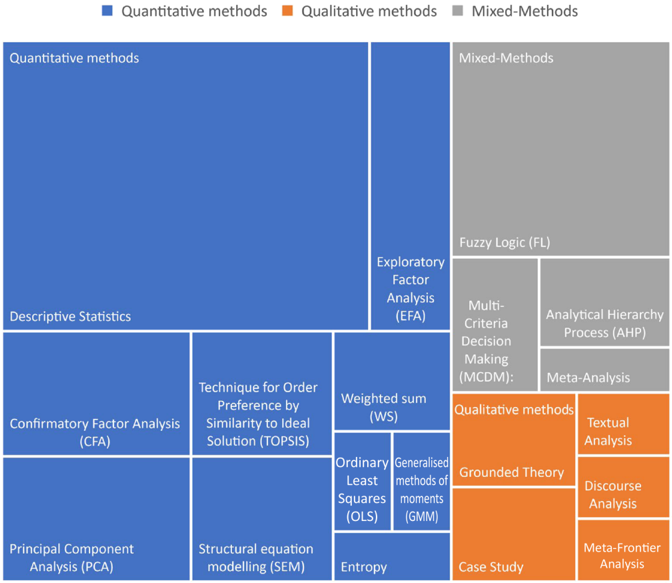
- Methods are overwhelmingly quantitative, including SEM, composite index construction and econometric analysis; qualitative and mixed-methods approaches remain underrepresented.
Methods
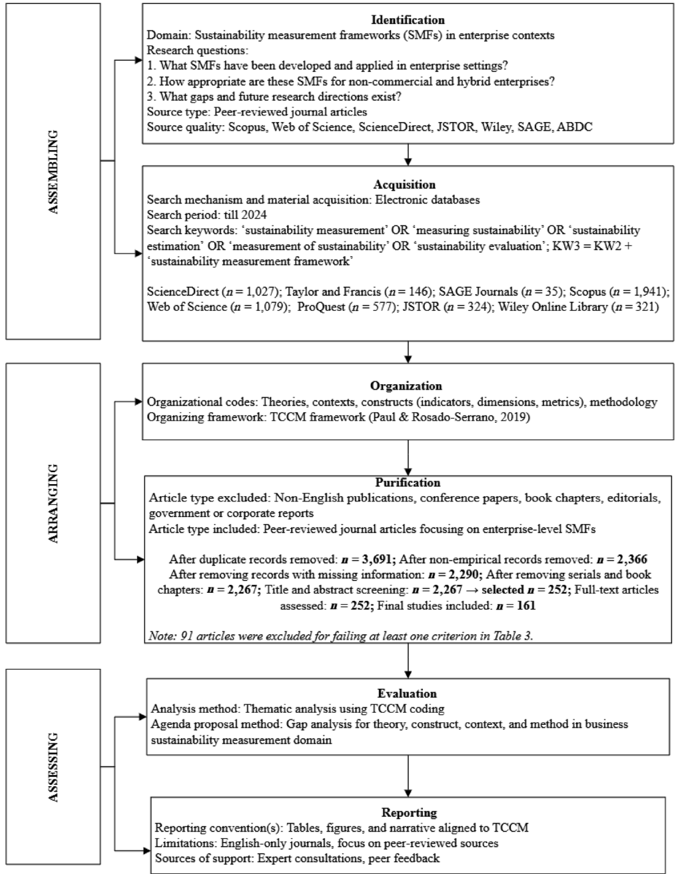
- A systematic quantitative literature review following the SPAR-4-SLR protocol, structured by the TCCM framework, searched eight databases and retained 161 peer-reviewed journal articles published from 1994 to 2024.
- The keyword search returned 5,450 documents; screening removed duplicates, non-empirical publications, non-English articles and non-peer-reviewed materials, leaving 161 articles for synthesis.
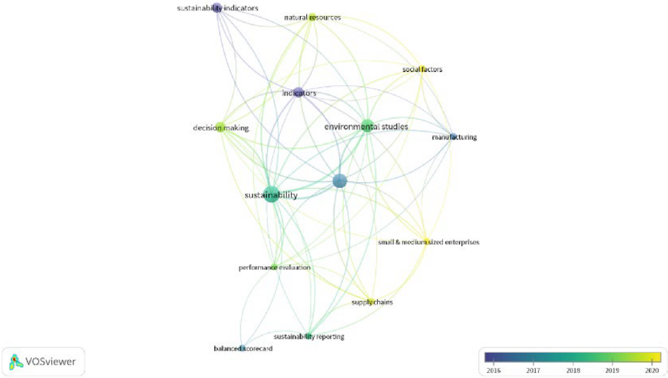
- Two domain experts jointly screened and coded studies; analysis used thematic analysis with open and axial coding, complemented by bibliometric mapping and keyword co-occurrence analysis.
Limitations
- The paper states that the review was restricted to English-language studies, that TCCM’s four-cell structure can obscure the interdisciplinary and multi-scalar character of SMF research, and that keyword-based search strings may overlook studies using different terminology despite iterative keyword expansion and snowballing.
- Evident from the text: reliance on selected databases and peer-reviewed journal articles may omit grey literature, and no formal quality appraisal or meta-analysis is described.
- Evident from the text: some reported counts differ, such as Stakeholder Theory being cited in 12 studies in the narrative while Table 5 lists 11 occurrences.
Model-written summary. Check it against the paper before relying on it.
Integrity signals
Registry
Cites
Statistics
Figures
Verification
Claims the paper makes
7 Valid · 6 Not valid · 29 Not checked · 64 Own results and interpretations
The cited sources support only part of this claim — read each source’s verdict below.
In the paper
“Mio et al., 2022) and indicates a significant imbalance in domain coverage, with limited capacity to capture inclusive governance practices, ethical accountability and stakeholder empowerment, which are particularly critical in non-profit and social enterprise contexts.”
§ Business sustainability measurement frameworks: a systematic literature review using a TCCM approach > 4.3 Characteristics/constructs (C)
What the sources say
- Partly supportedcites Mio et al., 2022 matched to “Performance measurement tools for sustainable business: a systematic literature review on the sustainability balanced scorecard use” (2022) sourceExperimental — accuracy not yet measured
Split into 2 atoms — 0 confirmed, 1 partially supported, 0 disputed, 0 misattributed, 1 unverifiable. Expand the claim to see per-atom verdicts.
hedged- Asserted: passes — The authors put it forward as true.
- Checkable: passes — It can be checked against evidence.
- Load-bearing: passes — The paper’s conclusions depend on it.
- Based: passes — The paper gives a reason why it holds.
- Partly supported
The cited sources support only part of this claim — read each source’s verdict below.
In the paper
“prevailing SMFs lack the nuance required to achieve the sustainability performance of diverse organisational models”
§ Business sustainability measurement frameworks: a systematic literature review using a TCCM approach > 1. Introduction
What the sources say
- Partly supportedcites Gandhi and Raina, 2018 matched to “Social entrepreneurship: the need, relevance, facets and constraints” (2018) sourceExperimental — accuracy not yet measured
The Introduction and ‘Social Entrepreneurship’s stand from the view point of the modern society’ sections say that social enterprises take varied forms and that measuring their social performance is more challenging than measuring traditional businesses’ performance. They do not assess prevailing sustainability measurement frameworks or establish that those frameworks lack the nuance to measure sustainability performance across diverse organisational models. Page numbers are not available in our copy. (LLM, conf=0.83)
plain- Asserted: passes — The authors put it forward as true.
- Checkable: passes — It can be checked against evidence.
- Load-bearing: passes — The paper’s conclusions depend on it.
- Based: passes — The paper gives a reason why it holds.
- Partly supported
The cited sources support only part of this claim — read each source’s verdict below.
In the paper
“These entities prioritise social impact and environmental stewardship alongside or in place of financial goals -priorities not adequately addressed in most conventional frameworks.”
- Also stated in: § 5. Discussion and conclusion · plain
“These entities inherently prioritise social equity, community empowerment and environmental well-being (Crossley et al., 2021;Dato-on and Kalakay, 2016;Salavou and Manolopoulos, 2021)”
§ Business sustainability measurement frameworks: a systematic literature review using a TCCM approach > 4.3 Characteristics/constructs (C)
What the sources say
- Partly supportedcites Crossley et al., 2021 matched to “Sustainability and legitimacy theory: the case of sustainable social and environmental practices of small and medium-sized enterprises” (2021) sourceExperimental — accuracy not yet measured
The Introduction (page unavailable) says the paper examines why SMEs engage in social and environmental practices, and §5.4 describes one business creating social as well as economic profits. The paper does not establish that social enterprises, non-profits and hybrid organisations generally prioritise those goals alongside or instead of financial goals, or that conventional frameworks inadequately address their priorities. (LLM, conf=0.86)
- Not checked — no full text of the sourcecites Dato-on and Kalakay, 2016 matched to “The winding road of social entrepreneurship definitions: a systematic literature review” (2016) source
- Not checked — no full text of the sourcecites Salavou and Manolopoulos, 2021 matched to “Pure and hybrid strategies in social enterprises: an empirical investigation” (2021) source
plain- Asserted: passes — The authors put it forward as true.
- Checkable: passes — It can be checked against evidence.
- Load-bearing: passes — The paper’s conclusions depend on it.
- Based: passes — The paper gives a reason why it holds.
- Also stated in: § 5. Discussion and conclusion · plain
The cited sources that could be checked couldn’t confirm or dispute this claim.
In the paper
“TBL has been criticised for reinforcing this bolt-on logic by placing ecology alongside two competing pillars (Kocmanova et al., 2017;Kudratova et al., 2020;Pranugrahaning et al., 2020)”
§ Business sustainability measurement frameworks: a systematic literature review using a TCCM approach > 4.3.1.2 Environmental dimension.
What the sources say
- Not checked — no full text of the sourcecites Kocmanova et al., 2017 matched to “Corporate sustainability measurement and assessment of Czech manufacturing companies using a composite indicator” (2017) source
- Not checked — no full text of the sourcecites Kudratova et al., 2020 matched to “Corporate sustainability and stakeholder value trade-offs in project selection through optimization modeling: application of investment banking” (2020) source
- Could not verifycites Pranugrahaning et al., 2020 matched to “Corporate sustainability assessments in the information communication technology sector in Malaysia” (2020) sourceExperimental — accuracy not yet measured
Section 4.2 describes measuring environmental, economic and social impacts, and section 5.3 describes integration within corporate sustainability assessments. Neither addresses a criticism of the triple bottom line as bolt-on logic or describes its pillars as competing (searched: TBL, triple bottom line, bolt-on, pillars). (LLM, conf=0.76)
plainstates a cause- Asserted: passes — The authors put it forward as true.
- Checkable: passes — It can be checked against evidence.
- Load-bearing: unclear — It is unclear whether the paper’s conclusions depend on it.
- Based: passes — The paper gives a reason why it holds.
The cited sources support only part of this claim — read each source’s verdict below.
In the paper
“likewise, GRI-based research focus on economic disclosures (GRI 201-203) because they are auditable and investor-driven (Gunawan et al., 2021).”
§ Business sustainability measurement frameworks: a systematic literature review using a TCCM approach > 4.3.1.1 Economic dimension.
What the sources say
- Partly supportedcites Gunawan et al., 2021 matched to “Exploring sustainability and green banking disclosures: a study of banking sector” (2022) sourceExperimental — accuracy not yet measured
Section 4.1 reports that economic disclosures were the most prevalent among the Indonesian banks studied and says listed companies must disclose audited financial performance. The Introduction notes investor demand for both financial and nonfinancial information. Neither passage says GRI-based research focuses on GRI 201–203 or that auditability and investor demand cause such a research focus (page numbers unavailable). (LLM, conf=0.86)
plainstates a cause- Asserted: passes — The authors put it forward as true.
- Checkable: passes — It can be checked against evidence.
- Load-bearing: unclear — It is unclear whether the paper’s conclusions depend on it.
- Based: passes — The paper gives a reason why it holds.
- Partly supported
57 more claims · 2 with their cited sources checked
Create a free account to see all 106 claims and to verify the 2 references still open.
- It may state two separate claims as one. 36
- Probably not a substantial claim. 15
Self-check
Percentages, sums and reported differences re-computed from the paper’s own numbers.
Each contradiction between two passages listed here was confirmed by an independent check.
Rated minor: it would not touch a result — a value no result rests on, a p-value that stays on the same side of the significance level, or a conflict that is clerical, resolved elsewhere in the paper, or outside its own findings.
In the paper
§ Business sustainability measurement frameworks: a systematic literature review using a TCCM approach > 7. Limitations and future research directions
“| SAGE Journals | 141 | 35 | 12 | 7 | 1 | 10 | 5 | 25 | 17 |”
§ Business sustainability measurement frameworks: a systematic literature review using a TCCM approach > 7. Limitations and future research directions
“| | KW1 | KW2 | Duplicates | reviewed | information* | chapters | Total | screening | screening |”
Rated minor: it would not touch a result — a value no result rests on, a p-value that stays on the same side of the significance level, or a conflict that is clerical, resolved elsewhere in the paper, or outside its own findings.
In the paper
§ Business sustainability measurement frameworks: a systematic literature review using a TCCM approach > 4.1 Theories (T)
“the Life Cycle Assessment (LCA), the Institutional Theory and the Neo-classical Economic Theory are all cited in three studies”
§ Business sustainability measurement frameworks: a systematic literature review using a TCCM approach > 7. Limitations and future research directions
“| Neoclassical Economic | Market-based valuation of | 2 | Commercial sectors, economic |”
Rated minor: it would not touch a result — a value no result rests on, a p-value that stays on the same side of the significance level, or a conflict that is clerical, resolved elsewhere in the paper, or outside its own findings.
In the paper
§ Business sustainability measurement frameworks: a systematic literature review using a TCCM approach > 2.2 Arranging stage
“Subsequent title-and abstract-level screenings identified 252 articles for full-text review, and of these 161 met all inclusion criteria and were retained for synthesis.The remaining 91 were excluded”
§ Business sustainability measurement frameworks: a systematic literature review using a TCCM approach > 7. Limitations and future research directions
“| Total | 2,177 | 5,450 | 1,759 | 1,325 | 76 | 23 | 2,267 | 250 | 161 |”
Rated minor: it would not touch a result — a value no result rests on, a p-value that stays on the same side of the significance level, or a conflict that is clerical, resolved elsewhere in the paper, or outside its own findings.
In the paper
§ Business sustainability measurement frameworks: a systematic literature review using a TCCM approach > 2. Methodology: scientific procedures and rationales for systematic literature reviews (SPAR-4-SLR) with TCCM framework
“This study follows the SPAR-4-SLR protocol (Paul et al., 2021b)”
§ Business sustainability measurement frameworks: a systematic literature review using a TCCM approach > References
“Paul, J., Lim, W.M., O'Cass, A., Hao, A.W. and Bresciani, S. (2021a), "Scientific procedures and rationales for systematic literature reviews (SPAR-4-SLR)"”
Rated minor: it would not touch a result — a value no result rests on, a p-value that stays on the same side of the significance level, or a conflict that is clerical, resolved elsewhere in the paper, or outside its own findings.
In the paper
§ Business sustainability measurement frameworks: a systematic literature review using a TCCM approach > 4.1 Theories (T)
“Stakeholder Theory, cited in 12 studies”
§ Business sustainability measurement frameworks: a systematic literature review using a TCCM approach > 7. Limitations and future research directions
“| Stakeholder Theory | Inclusive engagement of | 11 | Corporate governance, non- |”
Citations
Cites
Scientific procedures and rationales for systematic literature reviews (SPAR‐4‐SLR)
Paul, J., Lim, W. M., O’Cass, A., Hao, A. W., & Bresciani, S. (2021) · International Journal of Consumer Studies · doi:10.1111/ijcs.12695 · Cited by 2,364
Shifting paradigms for sustainable development: implications for management theory and research
Gladwin, T. N., Kennelly, J. J., & Krause, T.-S. (1995) · The Academy of Management Review · doi:10.2307/258959 · Cited by 2,336
BRST Cohomology of the Chapline-Manton Model
Barnich, G., Leclercq, S., & Spindel, P. (1997) · Dépôt institutionnel de l'Université libre de Bruxelles (Université Libre de Bruxelles) · doi:10.1023/b · Cited by 2,179
An overview of sustainability assessment methodologies
Singh, R. K., Murty, H. R., Gupta, S. K., & Dikshit, A. K. (2009) · Ecological Indicators · doi:10.1016/j.ecolind.2008.05.011 · Cited by 2,069
Assessing the sustainability performances of industries
Labuschagne, C., Brent, A. C., & van Erck, R. P. G. (2005) · Journal of Cleaner Production · doi:10.1016/j.jclepro.2003.10.007 · Cited by 1,051
Jayal, A. D., Badurdeen, F., Dillon, O. W., & Jawahir, I. S. (2010) · CIRP Journal of Manufacturing Science and Technology · doi:10.1016/j.cirpj.2010.03.006 · Cited by 948
Ameer, R., & Othman, R. (2012) · Journal of Business Ethics · doi:10.1007/s10551-011-1063-y · Cited by 796
The private sector and the SDGs: the need to move beyond business as usual
Scheyvens, R., Banks, G., & Hughes, E. (2016) · Sustainable Development · doi:10.1002/sd.1623 · Cited by 740
Responsible Leadership and Corporate Social Responsibility:
Székely, F., & Knirsch, M. (2005) · European Management Journal · doi:10.1016/j.emj.2005.10.009 · Cited by 689
A framework for strategic sustainable development
Broman, G. I., & Robèrt, K.-H. (2017) · Journal of Cleaner Production · doi:10.1016/j.jclepro.2015.10.121 · Cited by 674
Qiu, L., Jie, X., Wang, Y., & Zhao, M. (2020) · Corporate Social Responsibility and Environmental Management · doi:10.1002/csr.1780 · Cited by 556
Paul, J., Khatri, P., & Kaur Duggal, H. (2024) · Journal of Decision Systems · doi:10.1080/12460125.2023.2197700 · Cited by 533
Business cases for sustainability: a stakeholder theory perspective
Schaltegger, S., Hörisch, J., & Freeman, R. E. (2019) · Organization & Environment · doi:10.1177/1086026617722882 · Cited by 477
A critical review of reductionist approaches for assessing the progress towards sustainability
Gasparatos, A., El-Haram, M., & Horner, M. (2008) · Environmental Impact Assessment Review · doi:10.1016/j.eiar.2007.09.002 · Cited by 416
Leadership, green innovation, and green creativity: a systematic review
Arici, H. E., & Uysal, M. (2022) · The Service Industries Journal · doi:10.1080/02642069.2021.1964482 · Cited by 333
Spangenberg, J. H. (2002) · Ecological Indicators · doi:10.1016/s1470-160x(02)00065-1 · Cited by 325
Sustainable Markets: Motivating Factors, Barriers, and Remedies for Mobilization of Slow Fashion
Ozdamar Ertekin, Z., & Atik, D. (2015) · Journal of Macromarketing · doi:10.1177/0276146714535932 · Cited by 325
Using Indicators to Measure Sustainability Performance at a Corporate and Project Level
Keeble, J. J., Topiol, S., & Berkeley, S. (2003) · Journal of Business Ethics · doi:10.1023/a:1023343614973 · Cited by 323
Writing an impactful review article: What do we know and what do we need to know?
Paul, J., Merchant, A., Dwivedi, Y. K., & Rose, G. (2021) · Journal of Business Research · doi:10.1016/j.jbusres.2021.05.005 · Cited by 318
A Review of Sustainable Supply Chain Management Practices in Canada
Morali, O., & Searcy, C. (2013) · Journal of Business Ethics · doi:10.1007/s10551-012-1539-4 · Cited by 308
Mio, C., Costantini, A., & Panfilo, S. (2022) · Corporate Social Responsibility and Environmental Management · doi:10.1002/csr.2206 · Cited by 300
Sustainability reporting among mining corporations: a constructive critique of the GRI approach
Fonseca, A., McAllister, M. L., & Fitzpatrick, P. (2014) · Journal of Cleaner Production · doi:10.1016/j.jclepro.2012.11.050 · Cited by 292
Klarin, A. (2024) · International Journal of Consumer Studies · doi:10.1111/ijcs.13031 · Cited by 292
Crossley, R. M., Elmagrhi, M. H., & Ntim, C. G. (2021) · Business Strategy and the Environment · doi:10.1002/bse.2837 · Cited by 291
Scope and precision of sustainability assessment approaches to food systems
Schader, C., Grenz, J., Meier, M. S., & Stolze, M. (2014) · Ecology and Society · doi:10.5751/es-06866-190342 · Cited by 286
Environmental management control systems: The role of contextual and strategic factors
Pondeville, S., Swaen, V., & De Rongé, Y. (2013) · Management Accounting Research · doi:10.1016/j.mar.2013.06.007 · Cited by 275
Corporate Sustainable Development: Testing a New Scale Based on the Mainland Chinese Context
Chow, W. S., & Chen, Y. (2012) · Journal of Business Ethics · doi:10.1007/s10551-011-0983-x · Cited by 265
Footprints on the earth: the environmental consequences of modernity
York, R., Rosa, E. A., & Dietz, T. (2003) · American Sociological Review · doi:10.1177/000312240306800205 · Cited by 258
Indicators of sustainable production
Veleva, V, Hart, M., Greiner, T., & Crumbley, C. (2001) · Journal of Cleaner Production · doi:10.1016/s0959-6526(01)00004-x · Cited by 256
Temenos, C., & McCann, E. (2012) · Environment and Planning A: Economy and Space · doi:10.1068/a44314 · Cited by 244
Measurement of sustainability performance in the public sector
A. Adams, C., Muir, S., & Hoque, Z. (2014) · Sustainability Accounting, Management and Policy Journal · doi:10.1108/sampj-04-2012-0018 · Cited by 240
CSR ‘sustainability’ practices and firm performance in an emerging economy
Sardana, D., Gupta, N., Kumar, V., & Terziovski, M. (2020) · Journal of Cleaner Production · doi:10.1016/j.jclepro.2020.120766 · Cited by 238
Clarkson, P., Li, Y., Richardson, G., & Tsang, A. (2019) · Accounting, Auditing & Accountability Journal · doi:10.1108/aaaj-03-2018-3424 · Cited by 234
Steps towards indicators of sustainable development: Linking economic and ecological concepts
Rennings, K., & Wiggering, H. (1997) · Ecological Economics · doi:10.1016/s0921-8009(96)00108-5 · Cited by 233
Hall, J., & Wagner, M. (2012) · Business Strategy and the Environment · doi:10.1002/bse.728 · Cited by 227
Lisi, I. E. (2015) · Management Accounting Research · doi:10.1016/j.mar.2015.06.001 · Cited by 225
Social Entrepreneurship and Sustainability: A Conceptual Framework
Kamaludin, M. F., Xavier, J. A., & Amin, M. (2021) · Journal of Social Entrepreneurship · doi:10.1080/19420676.2021.1900339 · Cited by 223
Are Ethical Banks Different? A Comparative Analysis Using the Radical Affinity Index
San-José, L., Retolaza, J. L., & Goiria, J. G. (2011) · Journal of Business Ethics · doi:10.1007/s10551-011-0774-4 · Cited by 203
Hemphill, L., Berry, J., & McGreal, S. (2004) · Urban Studies · doi:10.1080/0042098042000194089 · Cited by 203
Meta-performance evaluation of sustainability indicators
Ramos, T. B., & Caeiro, S. (2010) · Ecological Indicators · doi:10.1016/j.ecolind.2009.04.008 · Cited by 200
New Tools to Foster Corporate Socially Responsible Behavior
Tencati, A., Perrini, F., & Pogutz, S. (2004) · Journal of Business Ethics · doi:10.1023/b:busi.0000039407.37497.44 · Cited by 196
Does corporate sustainability impact firm profitability? Evidence from India
Bodhanwala, S., & Bodhanwala, R. (2018) · Management Decision · doi:10.1108/md-04-2017-0381 · Cited by 194
Figge, F., Young, W., & Barkemeyer, R. (2014) · Journal of Cleaner Production · doi:10.1016/j.jclepro.2014.01.031 · Cited by 193
Abhayawansa, S., Adams, C. A., & Neesham, C. (2021) · Accounting, Auditing & Accountability Journal · doi:10.1108/aaaj-07-2020-4667 · Cited by 192
A hotel sustainability business model: evidence from Slovenia
Mihalic̆, T., Žabkar, V., & Cvelbar, L. K. (2011) · Journal of Sustainable Tourism · doi:10.1080/09669582.2011.632092 · Cited by 189
Daddi, T., Nucci, B., & Iraldo, F. (2017) · Journal of Cleaner Production · doi:10.1016/j.jclepro.2017.01.090 · Cited by 185
Sustainability measurement system: a reference model proposal
Delai, I., & Takahashi, S. (2011) · Social Responsibility Journal · doi:10.1108/17471111111154563 · Cited by 185
Corporate perspectives on the development and use of sustainability reports
Searcy, C., & Buslovich, R. (2014) · Journal of Business Ethics · doi:10.1007/s10551-013-1701-7 · Cited by 180
Tracking the sustainable development goals: Emerging measurement challenges and further reflections
Dang, H.-A. H., & Serajuddin, U. (2019) · World Development · doi:10.1016/j.worlddev.2019.05.024 · Cited by 171
Ferreira, J. J., Lopes, J. M., Gomes, S., & Rammal, H. G. (2023) · Journal of Cleaner Production · doi:10.1016/j.jclepro.2023.136841 · Cited by 167
Measuring corporate environmental performance: a methodology for sustainable development
Escrig‐Olmedo, E., Muñoz‐Torres, M. J., Fernández‐Izquierdo, M. Á., & Rivera‐Lirio, J. M. (2017) · Business Strategy and the Environment · doi:10.1002/bse.1904 · Cited by 159
Pham, H., & Kim, S.-Y. (2019) · Sustainable Production and Consumption · doi:10.1016/j.spc.2019.05.003 · Cited by 158
A PCA-based method for construction of composite sustainability indicators
Tao, L., Zhang, H., Yuan, C. Y., Liu, Z., & Fan, C. (2012) · The International Journal of Life Cycle Assessment · doi:10.1007/s11367-012-0394-y · Cited by 156
Ali, S. S., Kaur, R., & Khan, S. (2023) · Annals of Operations Research · doi:10.1007/s10479-021-04454-w · Cited by 154
Measuring Enterprise Sustainability
Searcy, C. (2016) · Business Strategy and the Environment · doi:10.1002/bse.1861 · Cited by 152
Sustainability attitude and performance of construction enterprises: a China study
Chang, R.-D., Zuo, J., Zhao, Z.-Y., Soebarto, V., Lu, Y., Zillante, G., & Gan, X.-L. (2018) · Journal of Cleaner Production · doi:10.1016/j.jclepro.2017.10.277 · Cited by 147
Nigri, G., & Del Baldo, M. (2018) · Sustainability · doi:10.3390/su10124499 · Cited by 144
Jiang, Q., Liu, Z., Liu, W., Li, T., Cong, W., Zhang, H., & Shi, J. (2018) · Journal of Cleaner Production · doi:10.1016/j.jclepro.2018.03.255 · Cited by 142
Three Avenues for Social Entrepreneurship Research
Austin, J. E. (2006) · Palgrave Macmillan UK eBooks · doi:10.1057/9780230625655_3 · Cited by 139
Developing classic systematic literature reviews to advance knowledge: Dos and don'ts
Paul, J., & Menzies, J. L. (2023) · European Management Journal · doi:10.1016/j.emj.2023.11.006 · Cited by 130
Enhancing governance for environmental sustainability in sub-Saharan Africa
Asongu, S. A., & Odhiambo, N. M. (2021) · Energy Exploration & Exploitation · doi:10.1177/0144598719900657 · Cited by 127
Strategic stakeholder dialogues: a discursive perspective on relationship building
Susanne Johansen, T., & Ellerup Nielsen, A. (2011) · Corporate Communications: An International Journal · doi:10.1108/13563281111156871 · Cited by 126
Paul, J., & Dhiman, R. (2021) · International Marketing Review · doi:10.1108/imr-12-2020-0295 · Cited by 126
Nicoletti Junior, A., de Oliveira, M. C., & Helleno, A. L. (2018) · Journal of Cleaner Production · doi:10.1016/j.jclepro.2018.04.136 · Cited by 124
Status of corporate sustainability: a content analysis of Fortune 500 companies
Amini, M., Bienstock, C. C., & Narcum, J. A. (2018) · Business Strategy and the Environment · doi:10.1002/bse.2195 · Cited by 120
Debates on sustainable development: towards a holistic view of reality
Osorio, L. A. R., Lobato, M. O., & Castillo, X. Á. D. (2005) · Environment, Development and Sustainability · doi:10.1007/s10668-004-5539-0 · Cited by 118
Social entrepreneurship: the need, relevance, facets and constraints
Gandhi, T., & Raina, R. (2018) · Journal of Global Entrepreneurship Research · doi:10.1186/s40497-018-0094-6 · Cited by 115
Sustainability Performance Indicators for Industrial Enterprise Management
Staniškis, J. K., & Arbačiauskas, V. (2009) · Environmental Research Engineering and Management · doi:10.5755/j01.erem.48.2.13 · Cited by 114
Kalai, M., & Zghidi, N. (2017) · Journal of the Knowledge Economy · doi:10.1007/s13132-017-0460-6 · Cited by 108
Towards sustainability: the innovation paths of social enterprise
PICCIOTTI, A. (2017) · Annals of Public and Cooperative Economics · doi:10.1111/apce.12168 · Cited by 103
Al‐Shaer, H., & Hussainey, K. (2022) · Journal of Environmental Management · doi:10.1016/j.jenvman.2022.114883 · Cited by 103
Krasodomska, J., Michalak, J., & Świetla, K. (2020) · Meditari Accountancy Research · doi:10.1108/medar-06-2019-0504 · Cited by 98
Exploring sustainability and green banking disclosures: a study of banking sector
Gunawan, J., Permatasari, P., & Sharma, U. (2022) · Environment, Development and Sustainability · doi:10.1007/s10668-021-01901-3 · Cited by 92
Asiaei, K., Bontis, N., Barani, O., & Jusoh, R. (2021) · Journal of Management Control · doi:10.1007/s00187-021-00317-4 · Cited by 91
Analyzing the Economic Sustainability of Tourism Development: Evidence from Hong Kong
Zhang, H. Q., Fan, D. X. F., Lyu, J., Lin, P. M. C., & Jenkins, C. L. (2018) · Journal of Hospitality & Tourism Research · doi:10.1177/1096348018777046 · Cited by 85
Consumer well‐being—A systematic literature review and research agenda using TCCM framework
Bhardwaj, P., & Kalro, A. D. (2024) · International Journal of Consumer Studies · doi:10.1111/ijcs.12991 · Cited by 84
Dağıdır, B. D., & Özkan, B. (2023) · Journal of Cleaner Production · doi:10.1016/j.jclepro.2023.140519 · Cited by 83
Passetti, E., & Tenucci, A. (2016) · Journal of Cleaner Production · doi:10.1016/j.jclepro.2016.02.035 · Cited by 82
Measuring corporate sustainability performance–the case of European food and beverage companies
Engida, T. G., Rao, X., Berentsen, P. B. M., & Oude Lansink, A. G. J. M. (2018) · Journal of Cleaner Production · doi:10.1016/j.jclepro.2018.05.095 · Cited by 82
Kleemann, L., & Abdulai, A. (2013) · Ecological Economics · doi:10.1016/j.ecolecon.2013.06.017 · Cited by 81
Goel, P., & Misra, R. (2017) · Vision The Journal of Business Perspective · doi:10.1177/0972262917700996 · Cited by 72
The winding road of social entrepreneurship definitions: a systematic literature review
Conway Dato-on, M., & Kalakay, J. (2016) · Social Enterprise Journal · doi:10.1108/sej-06-2015-0016 · Cited by 71
Sustainability accounting in action: lights and shadows in the Italian context
Passetti, E., Cinquini, L., Marelli, A., & Tenucci, A. (2014) · The British Accounting Review · doi:10.1016/j.bar.2014.05.002 · Cited by 66
Neto, R. D. C. S., de Lima, C. R. M., Basil, D. G., Veras, M. D. O., & Guerra, J. B. S. O. D. A. (2020) · Sustainable Development · doi:10.1002/sd.2049 · Cited by 66
Corporate sustainability assessments: a systematic literature review and conceptual framework
Pranugrahaning, A., Donovan, J. D., Topple, C., & Masli, E. K. (2021) · Journal of Cleaner Production · doi:10.1016/j.jclepro.2021.126385 · Cited by 65
Laurett, R., Paço, A., & Mainardes, E. W. (2021) · Environmental Development · doi:10.1016/j.envdev.2020.100583 · Cited by 55
Alsattar, H. A., Qahtan, S., Zaidan, A. A., Deveci, M., Hajiaghaei–Keshteli, M., Mohammed, R. T., & Alamoodi, A. H. (2023) · Engineering Applications of Artificial Intelligence · doi:10.1016/j.engappai.2023.107609 · Cited by 38
Towards a sustainability indicator for production systems
Ragas, A. M. J., Knapen, M. J., van de Heuvel, P. J. M., Eijkenboom, R. G. F. T. M., Buise, C. L., & van de Laar, B. J. (1995) · Journal of Cleaner Production · doi:10.1016/0959-6526(95)00064-l · Cited by 35
Kocmanová, A., Pavláková Dočekalová, M., & Simanavičienė, Ž. (2017) · Engineering Economics · doi:10.5755/j01.ee.28.1.15323 · Cited by 35
Pinto, L. F. R., Venturini, G. D. F. P., Digiesi, S., Facchini, F., & Oliveira Neto, G. C. D. (2020) · Sustainability · doi:10.3390/su12219232 · Cited by 34
Life cycle indicators for monitoring the environmental performance of European waste management
Manfredi, S., & Goralczyk, M. (2013) · Resources, Conservation and Recycling · doi:10.1016/j.resconrec.2013.09.004 · Cited by 34
Lin, W. L., Lee, C., & Law, S. H. (2021) · Business Strategy and the Environment · doi:10.1002/bse.2662 · Cited by 30
Nuong, B. T., Kim, K.-W., Prathumratana, L., Lee, A., Lee, K.-Y., Kim, T.-H., Yoon, S.-H., Jang, M., & Duong, B. D. (2011) · Geosystem Engineering · doi:10.1080/12269328.2011.10541329 · Cited by 28
Mundra, N., & Mishra, R. P. (2021) · Procedia CIRP · doi:10.1016/j.procir.2021.01.147 · Cited by 26
Mengistu, A. T., & Panizzolo, R. (2021) · Sustainability · doi:10.3390/su13105472 · Cited by 25
Qu, G., Xue, R., Li, T., Qu, W., & Xu, Z. (2020) · International Journal of Environmental Research and Public Health · doi:10.3390/ijerph17062138 · Cited by 24
Almada, L., Borges, R., & Ferreira, B. P. (2022) · Review of Business Management · doi:10.7819/rbgn.v24i3.4185 · Cited by 23
Ceccato, R., Baldassa, A., Orsini, F., Rossi, R., & Gastaldi, M. (2023) · Sustainability · doi:10.3390/su15118690 · Cited by 21
Ibrahim, M., & Vo, X. V. (2020) · The Journal of International Trade & Economic Development · doi:10.1080/09638199.2020.1767682 · Cited by 20
The Business Models of Frugal Enterprises for Sustainable Development in a Constrained Environment
Hossain, M., Shahid, M. S., & Park, S. (2023) · IEEE Transactions on Engineering Management · doi:10.1109/tem.2023.3342440 · Cited by 18
Yusuf, M. F., Mohamad Nasarudin, N. A. I., Sorooshian, S., Fauzi, M. A., & Kasim, N. M. (2023) · Sustainability · doi:10.3390/su15097151 · Cited by 17
Pomerlyan, E., & Belitski, M. (2023) · European Management Journal · doi:10.1016/j.emj.2023.10.003 · Cited by 16
Measuring Social Sustainability in the Italian Agri-Food Sector: Proposed Key Performance Indicators
Briamonte, L., Pergamo, R., Salerno, C., Uliano, A., & Nazzaro, C. (2024) · Foods · doi:10.3390/foods13172849 · Cited by 15
Kudratova, S., Huang, X., Kudratov, K., & Qudratov, S. (2020) · Corporate Social Responsibility and Environmental Management · doi:10.1002/csr.1846 · Cited by 14
Prasanna, A., & Kushwaha, B. P. (2026) · Management Review Quarterly · doi:10.1007/s11301-025-00486-9 · Cited by 11
A conceptual framework for a value‐based sustainability balanced scorecard
Trisyulianti, E., Prihartono, B., Andriani, M., & Suryadi, K. (2022) · Sustainable Development · doi:10.1002/sd.2465 · Cited by 10
Pure and hybrid strategies in social enterprises: an empirical investigation
Salavou, H., & Manolopoulos, D. (2021) · EuroMed Journal of Business · doi:10.1108/emjb-05-2019-0068 · Cited by 10
Wonglimpiyarat, J. (2025) · foresight · doi:10.1108/fs-11-2023-0233 · Cited by 9
Pillai, K. G., Nair, S. R., Zahoor, N., & Khan, Z. (2024) · Management International Review · doi:10.1007/s11575-024-00547-3 · Cited by 8
Corporate sustainability assessments in the information communication technology sector in Malaysia
Pranugrahaning, A., Denis Donovan, J., Topple, C., & Kordi Masli, E. (2020) · Sustainability · doi:10.3390/su12219271 · Cited by 8
Ecological Evaluation of the Sustainability of City Forests
(2023) · doi:10.3390/f14040700 · Cited by 6
Grover, K., & Garima (2024) · International Review on Public and Nonprofit Marketing · doi:10.1007/s12208-024-00415-8 · Cited by 5
Zhao, Y., Cai, B., Zeng, T., He, Z., & Liu, Y. (2024) · Ocean Engineering · doi:10.1016/j.oceaneng.2024.116945 · Cited by 4
Zhang, L.-T., Liu, Y.-Y., Chen, S., Li, H.-B., Li, S.-M., Jiang, K.-J., & Gao, J. (2023) · Advances in Climate Change Research · doi:10.1016/j.accre.2023.11.005 · Cited by 3
Zhang, L., Liu, Y., Chen, S., et al. (2023) · doi:10.2139/ssrn.4531834
Research works printed but not linked: 4
- 28. Ebenezer, A.A., Musah, A. and Ahmed, I.A. (2020), "Determinants of financial sustainability of non- governmental organizations (NGOs) in Ghana", Journal of Accounting and Management, Vol. 10 No. 1, pp. 49-68.
- 47. Initiative, G.R. (2002), Sustainability Reporting Guidelines, GRI, Boston, MA.
- 50. Johansen, S.T. and Nielsen, E.A. (2011a), "Strategic stakeholder dialogues: a discursive perspective on relationship building", Corporate Communications: An International Journal, Vol. 16 No. 3, pp. 204-217, doi: 10.1108/13563281111156871. · DOI · Paper page
- 109. Soete, L., Schwaag Serger, S., Stierna, J. and Hollanders, H. (2021), "European union", in UNESCO Science Report 2021: The Race against Time for Smarter Development, UNESCO, pp. 255-288.
Cited by
Dote-Pardo, J. (2026) · Journal of Documentation · doi:10.1108/jd-03-2026-0114 · Cited by 6
Smart Tourism Research: Where Are We Going: A Science Map of the Field
Thi, T. H. V., & Nguyen, T. H. (2026) · International Journal of Hospitality and Tourism Systems · doi:10.21863/ijhts/2026.19.1.005 · Cited by 4
Green Practices in the Hospitality Industry: Driving Sustainable Behavior and Revisit Intention
Vu, T. D., Vu, P. T., & Ngo, T. S. (2026) · SAGE Open · doi:10.1177/21582440261488103
Vinchurkar, S., & Gaurav, S. (2026) · Climate and Development · doi:10.1080/17565529.2026.2674797
Metadata
- Authors
- Yasmin, F., Saleem, M., Khalid, A., Hafeez, M. H., & Ismail, H.
- Affiliations
- Charles Darwin University (AU)
- University of Wollongong (AU)
- Bahauddin Zakariya University (PK)
- Prince Sultan University (SA)
- The Women University Multan (PK)
- Venue
- Journal of Trade Science
- Publisher
- Emerald
- Published
- 2025-10-28
- Volume
- 13
- Issue
- 4
- Pages
- 299-326
- ISSN
- 2755-3957 (ISSN-L)
- 2815-5793
- OpenAlex
- W4415541522
- Cited by
- 7
- References
- 118
- Citations by year
- 2026: 7
- FWCI
- 1.85
- Type
- journal article
- Language
- en
- Open access
- diamond
- doi.org
- Licence
- Locations
- Journal of Trade Science (publishedVersion, cc-by)
- DOAJ (DOAJ: Directory of Open Access Journals) (submittedVersion, cc-by-sa)
- Topics
- Social Sciences › Business, Management and Accounting › Strategy and Management › Corporate Social Responsibility Reporting
- Social Sciences › Business, Management and Accounting › Management of Technology and Innovation › Sustainability and Innovation in Business
- Social Sciences › Business, Management and Accounting › Organizational Behavior and Human Resource Management › Corporate Social Responsibility and Sustainability
- Keywords
- corporate sustainability, corporate social responsibility, stakeholder theory, nonprofit organizations, social enterprises, hybrid organizations, business entities, research gaps
About these checks
Registry, retraction, Cites and statistics results are computed, not judged, with one exception: a printed reference that no index lists is read once by a model before it counts as a citation error. Claims are extracted by a model and kept only when their quote appears verbatim in the text; each cited source is then checked, with a model’s help, for whether it says what the claim relies on. Those verdicts can be wrong — read the claim’s quote and the cited source before relying on one.
The claim verdicts this report counts are experimental: their accuracy is not yet measured.
A language model drew the claims from the paper on 2026-10-11, under version 3 of the claim definition (model deepseek-v4.1-flash, prompt extract-v3).
A second model labelled each claim on 2026-10-11 (model jev-1.13-20260917, definition revision gold-guideline-v0.2).
Cited sources are checked with a language model’s help (gpt-6-sol).
Statistics and arithmetic are recomputed, not judged.
Confidence bands are shown only for fields calibrated on our annotated test set. None is calibrated yet, so no band is shown.
What counts as a claim ›How we measure confidence ›How we check this ›
Are you an author, or do you see a problem with this page? Request a review
Data sources
Bibliographic data: Semantic Scholar, OpenAlex, Crossref.
Contains information from the Semantic Scholar Academic Graph Datasets, made available under the ODC Attribution License (ODC-BY 1.0).
Semantic Scholar’s data is described in: Kinney, R., et al. (2023). The Semantic Scholar Open Data Platform. arXiv:2301.10140.
