

Modular Multilevel Converters: Recent Achievements and Challenges
Open accessThe DOI matches its Crossref record; 167 of the 167 references it cites were found in a registry or an index; 6 of the 46 sources its claims cite were checked for support.
Abstract
The modular multilevel converter (MMC) is currently one of the power converter topologies which has attracted more research and development worldwide. Its features, such as high quality of voltages and currents, high modularity and high voltage rating, have made the MMC a very good option for several applications including high-voltage dc (HVdc) transmission, static compensators (STATCOMs), and motor drives. However, its unique features such as the large number of submodules, floating capacitor voltages, and circulating currents require a dedicated control system able to manage the terminal variables, as well as the internal variables with high dynamical performance. In this paper, a review of the research and development achieved during the last years on MMCs is shown, focusing on the challenges and proposed solutions for this power converter still faces in terms of modeling, control, reliability, power topologies, and new applications.
Overview
CoChat Summary
TL;DR
This review surveys recent research and development on modular multilevel converters (MMCs), covering modeling, design, control, modulation, fault tolerance, reliability, topologies, and applications. It identifies remaining challenges and prospective solutions, especially for HVdc, motor drives, MVdc grids, and emerging uses.
Key findings
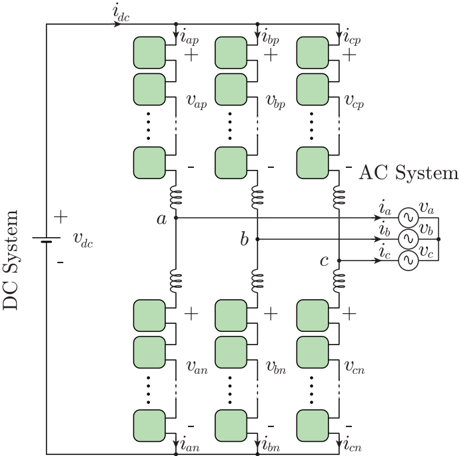
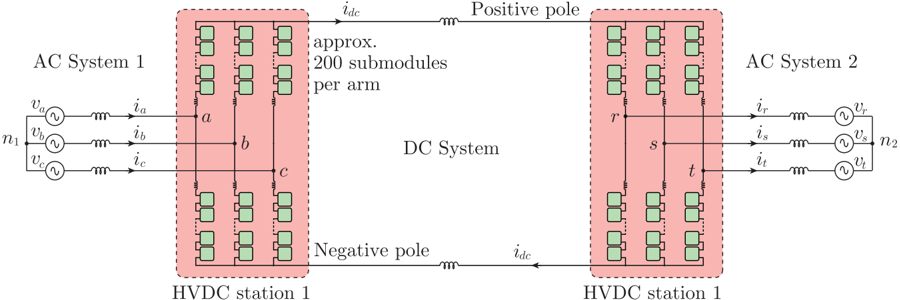
- The MMC has become an important HVdc alternative, with commercial products deployed in China, Europe, and the USA; actual HVdc systems commonly use more than 200 submodules per arm, and industrial MMCs for HVdc range from hundreds of MWs to a few GWs.
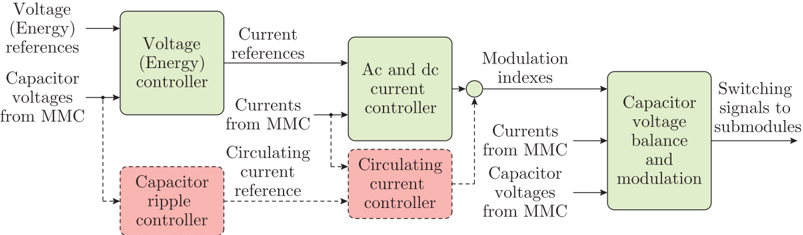
- The paper reviews advances in dynamic modeling, capacitor voltage balancing via sorting algorithms, current/energy control structures, and modulation such as nearest-level modulation combined with PWM; model predictive control is powerful but challenged by the large number of switching states, motivating grouping, clustering, and staged optimization.
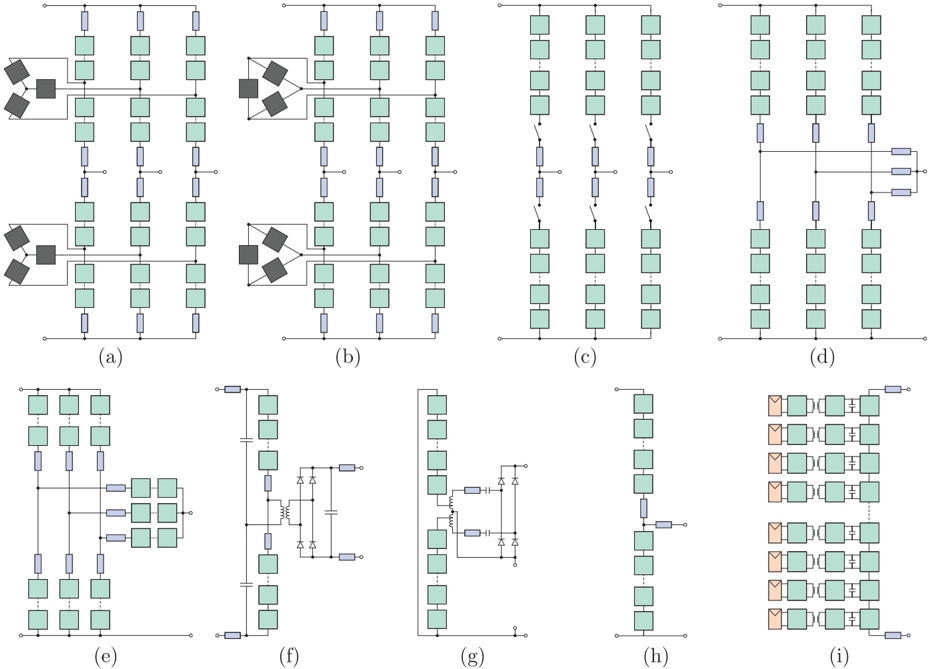
- Fault-tolerant operation is a major theme: dc fault blocking can be achieved when the total voltage of connected submodules along the fault path exceeds the line-to-line ac voltage, with a 50% half-bridge and 50% full-bridge arm as the simplest hybrid example; ac faults can be managed by neutral-point shifting, and submodule failures by redundancy strategies.
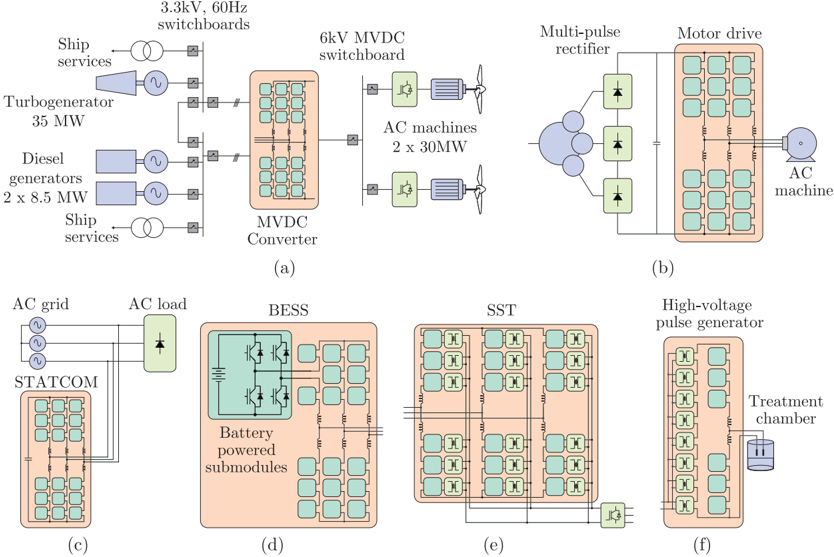
- Emerging applications include MVdc grids, dc-dc conversion, battery energy storage, solid-state transformers, and high-voltage pulse generators; capacitor voltage ripple reduction remains central, and the paper notes that approximately half of a submodule’s volume is the capacitor.
Methods
- Design: narrative review of recent MMC research and development, focusing on challenges and proposed solutions in modeling, control, reliability, power topologies, and new applications.
- Data/sample: published literature and prior studies; no original experimental data, prototype, or simulation dataset is reported.
- Main analysis: qualitative synthesis organized by topic, with comparison tables classifying faults (Table 1), MMC topologies (Table 2), and challenges with prospective solutions (Table 3).
Limitations
- The paper states that several MMC issues remain under research and have not been completely solved, including dc fault management, practical implementation of ac fault neutral-point shifting, and precise tuning of voltage observers.
- Evident from the text: as a narrative review, it does not report a systematic search or selection methodology, quantitative meta-analysis, or new experimental validation; its conclusions are qualitative and based on cited literature.
Model-written summary. Check it against the paper before relying on it.
Integrity signals
Registry
Cites
Statistics
Figures








Verification
Claims the paper makes
6 Valid · 2 Not valid · 27 Not checked · 17 Own results and interpretations
Every source the paper cites for this claim was checked and supports it.
In the paper
“By assigning a reduced nominal voltage to the series valve submodule upon IGBT module failure, the need to install redundant submodules is greatly reduced.”
What the sources say
- Supportedcites [137] [137] J. Guo, J. Liang, X. Zhang, P. D. Judge, X. Wang, and T. C. Green, 'Reliability analysis of MMCs considering submodule designs with individual or series-operated IGBTs,' IEEE Trans. Power Del. , vol. 32, no. 2, pp. 666-677, Apr. 2017. - source
The Series Valve Operation Modes section (p. 3) explains that a submodule can be assigned a lower voltage after enough IGBT modules fail. In the design comparison (p. 9), the series-valve design requires three redundant submodules per arm in normal mode but none with reduced-nominal-voltage operation for the same reliability target. (LLM, conf=0.94)
plainstates a cause- Asserted: passes — The authors put it forward as true.
- Checkable: passes — It can be checked against evidence.
- Load-bearing: passes — The paper’s conclusions depend on it.
- Based: passes — The paper gives a reason why it holds.
- Supported
Every source the paper cites for this claim was checked and supports it.
In the paper
“There is a trade-off between submodule redundancy and cost, which should be evaluated for each project to define redundancy design and operation strategy [139].”
What the sources say
- Supportedcites [139] [139] P. Tu, S. Yang, and P. Wang, 'Reliability- and cost-based redundancy design for modular multilevel converter,' IEEE Trans. Ind. Electron. , vol. 66, no. 3, pp. 2333-2342, Mar. 2019. - source
Section C states that more redundant cells increase reliability but also increase cost. Section D says the suitable design is application dependent and compares active and standby operation for applications with different requirements, supporting project-specific evaluation of design and operating strategy. (LLM, conf=0.94)
plainstates an association- Asserted: passes — The authors put it forward as true.
- Checkable: passes — It can be checked against evidence.
- Load-bearing: unclear — It is unclear whether the paper’s conclusions depend on it.
- Based: passes — The paper gives a reason why it holds.
- Supported
Every source the paper cites for this claim was checked and supports it.
In the paper
“These simulation times are not achievable if the model is based on switching devices [43].”
What the sources say
- Supportedcites [43] [43] U. N. Gnanarathna, A. M. Gole, and R. P. Jayasinghe, 'Efficient modeling of modular multilevel HVDC converters (MMC) on electromagnetic transient simulation programs,' IEEE Trans. Power Del. , vol. 26, no. 1, pp. 316-324, Jan. 2011. - source
Section 6.3.6 estimates that a five-second full-HVDC simulation using the traditional detailed model would take over five days, versus less than 1.5 minutes with the equivalent model. It calls full detailed simulation impractical for systems with roughly 100 or more submodules, supporting the claim about the cited simulation times. (LLM, conf=0.90)
plainstates a cause- Asserted: passes — The authors put it forward as true.
- Checkable: passes — It can be checked against evidence.
- Load-bearing: passes — The paper’s conclusions depend on it.
- Based: passes — The paper gives a reason why it holds.
- Supported
The cited sources support only part of this claim — read each source’s verdict below.
In the paper
“It is found that the reliability of the MMC with series-connected IGBTs is higher for the first few years but then decreases rapidly.”
What the sources say
- Partly supportedcites [137] [137] J. Guo, J. Liang, X. Zhang, P. D. Judge, X. Wang, and T. C. Green, 'Reliability analysis of MMCs considering submodule designs with individual or series-operated IGBTs,' IEEE Trans. Power Del. , vol. 32, no. 2, pp. 666-677, Apr. 2017. - sourceExperimental — accuracy not yet measured
The Conclusion (p. 10) says the series-valve design has higher available arm voltage for the first few years, but its voltage decline then accelerates. The claim calls this a rapid decrease in converter reliability; the Design Comparison (p. 10) instead says the series-valve converter’s failure rate rises more slowly than the individual-device converter’s after five years. (LLM, conf=0.86)
plainstates an association- Asserted: passes — The authors put it forward as true.
- Checkable: passes — It can be checked against evidence.
- Load-bearing: passes — The paper’s conclusions depend on it.
- Based: passes — The paper gives a reason why it holds.
- Partly supported
Every source the paper cites for this claim was checked and supports it.
In the paper
“A capacitor voltage measuring system with reduced number of sensors can be implemented, where the minimum number can be as low as two voltage sensors per arm [131].”
What the sources say
- Supportedcites [131] [131] R. Picas, J. Zaragoza, J. Pou, S. Ceballos, and J. Balcells, 'New measuring technique for reducing the number of voltage sensors in modular multilevel converters,' IEEE Trans. Power Electron. , vol. 31, no. 1, pp. 177-187, Jan. 2016. - source
The Introduction states that the proposed capacitor-voltage measuring technique uses fewer sensors and requires a minimum of two per arm. Section D, “Minimum Number of Sensors,” explains that two sensors per arm provide measurements across the converter’s full operating range; a one-sensor arrangement has a limited range. (LLM, conf=0.95)
plain- Asserted: passes — The authors put it forward as true.
- Checkable: passes — It can be checked against evidence.
- Load-bearing: unclear — It is unclear whether the paper’s conclusions depend on it.
- Based: passes — The paper gives a reason why it holds.
- Supported
17 more claims
Create a free account to see all 52 claims and to verify the 6 references still open.
- It may state two separate claims as one. 17
- Probably not a substantial claim. 17
Self-check
Percentages, sums and reported differences re-computed from the paper’s own numbers.
Each contradiction between two passages listed here was confirmed by an independent check.
Rated minor: it would not touch a result — a value no result rests on, a p-value that stays on the same side of the significance level, or a conflict that is clerical, resolved elsewhere in the paper, or outside its own findings.
In the paper
§ II. POWER TOPOLOGY AND OPERATING PRINCIPLE · p. 3
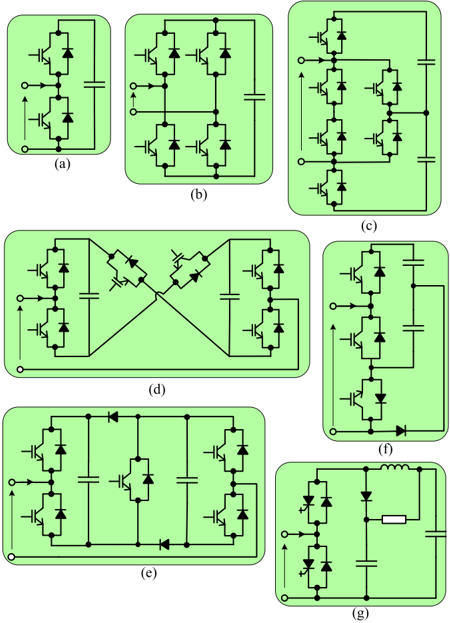
“the IGCT based submodule, shown in Fig. 1(g), features higher efficiency, voltage rating and reliability [24].”
§ II. POWER TOPOLOGY AND OPERATING PRINCIPLE · p. 2
“FIGURE 2. MMC submodules: (a) half-bridge submodule, (b) full-bridge submodule, (c) modified ANPC submodule, (d) cross-connected submodule (CCSM), (e) clamped double submodule (CDSM), (f) single-clamped submodule (SCSM), and (g) IGCT submodule.”
Citations
Cites
An innovative modular multilevel converter topology suitable for a wide power range
Lesnicar, A., & Marquardt, R. (2004) · 2003 IEEE Bologna Power Tech Conference Proceedings, · doi:10.1109/ptc.2003.1304403 · Cited by 2,908 · cited 1×
“To validate the proposed topology and its control, an experimental prototype was implemented and reported [5].”
MethodControl and Experiment of Pulsewidth-Modulated Modular Multilevel Converters
Hagiwara, M., & Akagi, H. (2009) · IEEE Transactions on Power Electronics · doi:10.1109/tpel.2009.2014236 · Cited by 1,565 · cited 1×
“4, has commonly been employed [57], [58].”
Tu, Q., Xu, Z., & Xu, L. (2011) · IEEE Transactions on Power Delivery · doi:10.1109/tpwrd.2011.2115258 · Cited by 1,387
Circuit Topologies, Modeling, Control Schemes, and Applications of Modular Multilevel Converters
Perez, M. A., Bernet, S., Rodriguez, J., Kouro, S., & Lizana, R. (2015) · IEEE Transactions on Power Electronics · doi:10.1109/tpel.2014.2310127 · Cited by 1,346 · cited 1×
“submodules per arm generating a nearly sinusoidal voltage waveform [6].”
BackgroundModular Multilevel Converters for HVDC Applications: Review on Converter Cells and Functionalities
Nami, A., Liang, J., Dijkhuizen, F., & Demetriades, G. D. (2015) · IEEE Transactions on Power Electronics · doi:10.1109/tpel.2014.2327641 · Cited by 1,042 · cited 2×
“Bipolar submodules such as the cross-connected submodule (CCSM) [19] and the clamped”
BackgroundOn dynamics and voltage control of the Modular Multilevel Converter
Antonopoulos, A., Ängquist, L., & Nee, H. (2009) · European Conference on Power Electronics and Applications · Cited by 831
Marquardt, R. (2010) · The 2010 International Power Electronics Conference - ECCE ASIA - · doi:10.1109/ipec.2010.5544594 · Cited by 773
A New AC/AC Multilevel Converter Family
Glinka, M., & Marquardt, R. (2005) · IEEE Transactions on Industrial Electronics · doi:10.1109/tie.2005.843973 · Cited by 772
Gnanarathna, U. N., Gole, A. M., & Jayasinghe, R. P. (2011) · IEEE Transactions on Power Delivery · doi:10.1109/tpwrd.2010.2060737 · Cited by 739
Dekka, A., Wu, B., Fuentes, R. L., Perez, M., & Zargari, N. R. (2017) · IEEE Journal of Emerging and Selected Topics in Power Electronics · doi:10.1109/jestpe.2017.2742938 · Cited by 576
Research works printed but not linked: 4
- [55] S. Allebrod, D. SchmiSchmitt, and R. Marquardt, 'Control structure for modular multilevel converters,' in Proc. Power Convers. Intell. Motion Eur. , 2009, pp. 12-14. -
- [8] M. Callavik, 'HVDC grid for integration of renewable power sources,' in Proc. EPRI HVDC FACTS Conf. , 2010. -
- [7] C. Junzheng and C. Jim, 'HVDC in China,' in Proc. EPRI HVDC FACTS Conf. , pp. 539-557, 2013. -
- [125] G. Li, J. Liang, F. Ma, C. E. Ugalde-Loo, and H. Liang, 'Analysis of single-phase-to-ground faults at the valve-side of HB-MMCs in HVDC systems,' IEEE Trans. Ind. Electron. , vol. 66, no. 3, pp. 2444-2453, Mar. 2019. -
Cited by
Items 301–323 of 323
Soni, A., Burgos, R. P., & Dong, D. (2026) · IEEE Applied Power Electronics Conference and Exposition (APEC) · doi:10.1109/apec51134.2026.11516899
“Moreover, MV SSTs or MMCs [2][4] have multiple switches whose gate drivers need be powered and insulated for the safety of the equipment.”
Short-Circuit Failure Mode Mechanical Readiness of SiC Press-Pack Packages
Abotaleb, Y., Muravleva, E., & Wang, J. (2026) · Conference proceedings/Conference proceedings - IEEE Applied Power Electronics Conference and Exposition · doi:10.1109/apec51134.2026.11516992
“…converter (LCC), two-level voltage source converter (VSC), and the increasingly prevalent modular multilevel converter (MMC)—SCFM at the device or submodule level is essential for fault-tolerant operation, since failure of a single series element can otherwise disable the entire converter [2].”
Hossain, M. S., Islam, M. R., Biswas, S. P., Sutanto, D., Muttaqi, K. M., & Shila, S. (2026) · IEEE Transactions on Industry Applications · doi:10.1109/tia.2026.3696288
“The combination of MMC and DAB technologies enhances system performance by enabling precise control, reducing harmonic distortion, and supporting high-power operation [16], [17].”
Review of power electronics for energy storage systems
Konstantinou, G. S., Jiang, S., Zhu, Y., Poblete, P., Townsend, C. D., & Tafti, H. D. (2026) · Elsevier eBooks · doi:10.1016/b978-0-443-29210-1.00135-7
Self-citationSecond-Order LADRC-Based Dual-Loop Vector Control for MMC-HVDC Systems
Sun, W., Li, W., & Zhao, Y. (2026) · Lecture notes in networks and systems · doi:10.1007/978-3-032-25225-8_6
Mohtat, S., Bongiorno, M., Beza, M., Svensson, J., & Rasmussen, J. (2026) · Electric Power Systems Research · doi:10.1016/j.epsr.2026.113406
China’s HVDC development for large-scale renewable integration: A system-level technology roadmap
Wei, X., & Jiang, T. (2026) · International Journal of Electrical Power & Energy Systems · doi:10.1016/j.ijepes.2026.111932 · Cited by 1
Zhang, J., Wen, C., Wang, D., Chen, Y., Liu, S., Gao, T., & Li, X. (2026) · Electronics · doi:10.3390/electronics15132839 · Cited by 2
Insulation packaging design and verification for a compact 6.5 kV single-chip SiC MOSFET package
Li, W., Wang, Z., Li, X., Li, H., Liu, D., Zhang, W., Yu, L., Zhao, Z., Zhang, X., & Jin, R. (2026) · Materials Science in Semiconductor Processing · doi:10.1016/j.mssp.2026.110934
A Single-Stage Modular Multilevel Reconfigurable Battery for Both AC and DC Microgrids
Yuan, Z., Zeng, Y., Ghias, A. M. Y. M., Ceballos, S., & Pou, J. (2026) · IEEE International Conference on DC Microgrids · doi:10.1109/icdcm67837.2026.11594610
“On the other hand, modular multilevel converters (MMCs) and cascaded-H (CHB) bridge converters have emerged as promising approaches for multilevel dc–ac conversion with integrated BESS [12]–[17], as they can synthesize high-quality sinusoidal voltages while leveraging a modular architecture.”
Self-citationKamizoulis, C., & Zadeh, M. (2026) · IEEE Electrification Magazine · doi:10.1109/mele.2026.3688429
Inductor Design for Multilevel Converters Based on a Waveform-Emulation Iron-Loss Evaluation Method
Saito, Y., & Wada, K. (2026) · International Power Electronics Conference (IPEC) · doi:10.23919/ipec-nagasaki2026-ec64663.2026.11597218
“However, most studies on magnetic losses in such converters rely on numerical or simulation-based estimation [8]–[10], and the experimental influence of multilevel operation on practical inductor design remains unclear [11].”
Green hydrogen production from PV sources integrated into a modular multilevel converter
Barresi, M., Simone, D. D., Ferri, E., & Piegari, L. (2026) · Electric Power Systems Research · doi:10.1016/j.epsr.2026.113633
Submodule Cyclic Control and Its Auxiliary Methods for MMC Capacitor Voltage Balancing
Chao, W., Huang, J., Dai, L., et al. (2026) · Electronics · doi:10.3390/electronics15153440
Staubach, C., & Hildinger, T. (2026) · IEEE Electrical Insulation Conference (EIC) · doi:10.1109/eic68788.2026.11642459
Tham, N. T., Cường, T. H., Thang, T. T., et al. (2026) · International Conference on Green Energy and Applications (ICGEA) · doi:10.1109/icgea69553.2026.11642837
“Several typical multilevel topologies have been reported, such as cascaded H-bridge (CHB), neutral-point-clamped (NPC), flying-capacitor (FC), and modular multilevel converter (MMC) [4]–[7], all of which offer flexible power scalability through the expansion of additional modules.”
Cartiel, O., Beza, M., Sainz, L., Bongiorno, M., & Mesas, J. J. (2026) · Energy Conversion and Management X · doi:10.1016/j.ecmx.2026.102247
Rhondali, M. A., Magri, A. E., Myasse, I. E., Bahatti, L., Mansouri, A., Giri, F., & Kumar, P. (2026) · Energy Conversion and Management X · doi:10.1016/j.ecmx.2026.102221
Fang, Y., Zhu, Y., Hong, J., et al. (2026) · Journal of Physics Conference Series · doi:10.1088/1742-6596/3316/1/012017
Gogoi, D., Dash, J. R., & Agarwal, P. (2026) · IEEE International Conference on Sustainable Energy and Future Electric Transportation (SEFET) · doi:10.1109/sefet69291.2026.11687469
“Alongside these advances, PWM techniques such as Nearest-Level Modulation (NLM), Phase-Shifted PWM (PS-PWM), and Level-Shifted PWM (LS-PWM) have been widely used to synthesize multilevel voltages in MMCs [2], [4].”
Wang, J., Ren, J., Wang, H., Song, Z., & Tu, X. (2026) · IEEE Access · doi:10.1109/access.2026.3736607 · Cited by 1
“The reasons for this preference include their immunity to commutation failures, independent active and reactive power control capabilities, and their ability to supply passive networks [4], [5], [6].”
Casadiegos, A. R., Villalobos, M. A. M., & Rey, J. M. (2026) · IEEE Power Engineering Society General Meeting · doi:10.1109/pesgm58988.2026.11693579
“The number of carriers corresponds to the number of inverter levels minus one, resulting in a waveform closer to a sinusoid with reduced harmonic content and improved DC-bus utilization [7].”
Alhamdi, N., & Albasir, A. (2026) · Journal of Engineering Research (Libya) · doi:10.66411/jer.v41i2.465
“These characteristics have led to widespread deployment of MMCs in High Voltage Direct Current (HVDC) transmission systems, renewable energy integration, Flexible AC Transmission Systems (FACTS), large battery energy storage systems, and high-power motor drives [2].”
Metadata
- Authors
- Perez, M. A., Ceballos, S., Konstantinou, G., Pou, J., & Aguilera, R. P.
- Affiliations
- Tecnalia (ES)
- UNSW Sydney (AU)
- Nanyang Technological University (SG)
- University of Technology Sydney (AU)
- Venue
- IEEE Open Journal of the Industrial Electronics Society
- Published
- 2021
- Volume
- 2
- Pages
- 224-239
- ISSN
- 2644-1284 (ISSN-L)
- OpenAlex
- W3132481093
- Cited by
- 327
- References
- 162
- Citations by year
- 2026: 42 · 2025: 89 · 2024: 70 · 2023: 63 · 2022: 46 · 2021: 17
- FWCI
- 14.39
- Type
- journal article
- Language
- en
- Open access
- gold
- doi.org
- Locations
- IEEE Open Journal of the Industrial Electronics Society (publishedVersion, cc-by)
- UNSWorks (University of New South Wales, Sydney, Australia) (submittedVersion, cc-by-nc-nd)
- DOAJ (DOAJ: Directory of Open Access Journals) (submittedVersion, cc-by-sa)
- DR-NTU (Nanyang Technological University) (submittedVersion)
- TECNALIA Publications (Fundación TECNALIA Research & Innovation) (submittedVersion, cc-by)
- Funders
- Fondecyt (1181839)
- Advanced Center for Electrical and Electronics Engineering AC3E (CONICYT/FB0008)
- SERC Chile (CONICYT/FONDAP/15 110 019)
- ARC DECRA (DE170010370)
- Office of Naval Research Global (N62909-19-1-2081)
- Australian Research Council (DP180100129)
- Spanish Centre for the Development of Industrial Technology (CER-20191002 ENERISLA)
- Topics
- Physical Sciences › Engineering › Electrical and Electronic Engineering › HVDC Systems and Fault Protection
- Physical Sciences › Engineering › Electrical and Electronic Engineering › Multilevel Inverters and Converters
- Physical Sciences › Engineering › Electrical and Electronic Engineering › Advanced DC-DC Converters
- Keywords
- modular multilevel converter, submodules, circulating current, converter control, converter modeling, converter reliability, converter topology, HVDC transmission, STATCOM, motor drives
About these checks
Registry, retraction, Cites and statistics results are computed, not judged, with one exception: a printed reference that no index lists is read once by a model before it counts as a citation error. Claims are extracted by a model and kept only when their quote appears verbatim in the text; each cited source is then checked, with a model’s help, for whether it says what the claim relies on. Those verdicts can be wrong — read the claim’s quote and the cited source before relying on one.
The claim verdicts this report counts are experimental: their accuracy is not yet measured.
A language model drew the claims from the paper on 2026-10-10, under version 3 of the claim definition (model deepseek-v4.1-flash, prompt extract-v3).
A second model labelled each claim on 2026-10-10 (model jev-1.13-20260917, definition revision gold-guideline-v0.2).
Cited sources are checked with a language model’s help (gpt-6-sol).
Statistics and arithmetic are recomputed, not judged.
Confidence bands are shown only for fields calibrated on our annotated test set. None is calibrated yet, so no band is shown.
What counts as a claim ›How we measure confidence ›How we check this ›
Are you an author, or do you see a problem with this page? Request a review
Data sources
Bibliographic data: Semantic Scholar, OpenAlex, Crossref.
Contains information from the Semantic Scholar Academic Graph Datasets, made available under the ODC Attribution License (ODC-BY 1.0).
Semantic Scholar’s data is described in: Kinney, R., et al. (2023). The Semantic Scholar Open Data Platform. arXiv:2301.10140.
