

A Review of Multilevel Inverter Topologies in Electric Vehicles: Current Status and Future Trends
Open accessThe DOI matches its Crossref record; 90 of the 90 references it cites were found in a registry or an index; 9 of the 90 sources its claims cite were checked for support.
Abstract
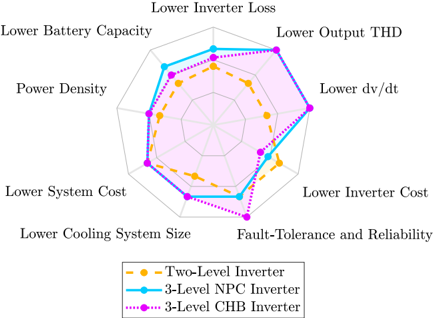
Traction inverter, as a critical component in electrified transportation, has been the subject of many research projects in terms of topologies, modulation, and control schemes. Recently, some of the well-known electric vehicle manufacturers have utilized higher-voltage batteries to benefit from lower current, higher power density, and faster charging times. With the ongoing trend toward higher DC-link voltage in electric vehicles, some multilevel structures have been investigated as a feasible and efficient option for replacing the two-level inverters. Higher efficiency, higher power density, better waveform quality, and inherent fault-tolerance are the foremost advantages of multilevel inverters which make them an attractive solution for this application. This paper presents an investigation of the advantages and disadvantages of higher DC-link voltage in traction inverters, as well as a review of the recent research on multilevel inverter topologies for electrified transportation applications. A comparison of multilevel inverters with their two-level counterpart is conducted in terms of efficiency, cost, power density, power quality, reliability, and fault tolerance. Additionally, a comprehensive comparison of different topologies of multilevel inverters is conducted based on the most important criteria in transportation electrification. Future trends and possible research areas are also discussed.
Overview
CoChat Summary
TL;DR
This review examines multilevel inverter topologies for electric vehicle traction drives as DC-link voltages rise toward 800 V and above, comparing them with conventional two-level inverters. It finds multilevel inverters can improve efficiency, power quality, and fault tolerance, but face cost, capacitor, control, and reliability trade-offs.
Key findings
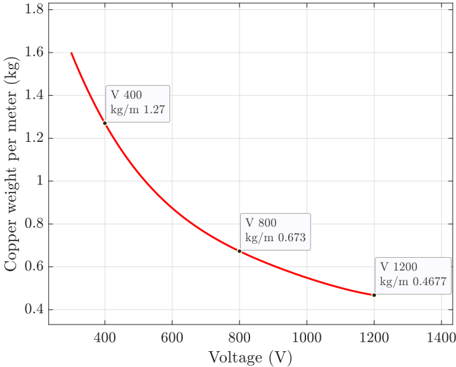
- Moving from 400 V to 1.2 kV in a 150 kW system can reduce copper weight per meter by 63% by lowering current from 375 A to 125 A; Porsche reports a 30 kg reduction in electrical harness weight from doubling battery voltage.
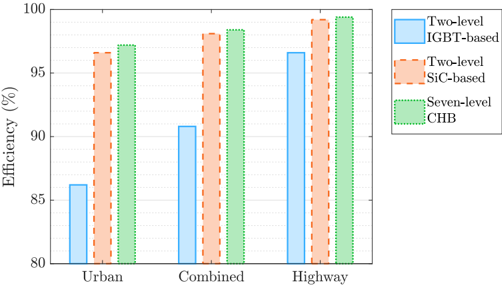
- A Si MOSFET CHB multilevel inverter raised minimum low-speed efficiency from 70% for an IGBT-based two-level inverter to 92%; at higher speeds it remained 2%–3% better, and in urban driving cycles efficiency improved by approximately 10%. An MMC showed 3%–5% efficiency improvement in the constant torque region at 20 kHz maximum switching frequency.
- Cost comparisons show a two-level inverter at 6500.5 versus a 7-level CHB at 6433.3 when battery savings are included, and a two-level inverter at 1726 versus a three-level NPC at 1678, a 3% lower system cost due mainly to reduced filter cost.
- A three-level multilevel inverter can reduce output voltage THD by a factor of 2–3, and a 5-level NPC reduces maximum dv/dt and common-mode voltage by four times at constant switching speed; with one fault-tolerant capability, the reliability gap between two-, three-, and five-level inverters remains below 0.2 for 0–25,000 hours, and multiple fault-tolerant capabilities can make multilevel reliability surpass two-level.
Methods
- Review and comparative study of multilevel inverter topologies for electrified transportation, focusing on traction drives in electric vehicles, buses, trucks, trains, ships, and aircraft.
- Synthesizes literature and market data, including tables of commercial EV battery voltages, traction inverter structures, and comparisons of well-known and new multilevel topologies.
- Compares multilevel versus two-level inverters across efficiency, cost, power density, power quality, reliability, fault tolerance, and cooling, drawing on cited simulation and experimental studies rather than presenting new primary experiments.
Limitations
- The paper states that there are not many studies comparing different aspects of multilevel and two-level inverters specifically for traction applications, and that new multilevel topologies are not mature enough in control, modulation, voltage balancing, fault tolerance, and reliability and have not been implemented and tested for traction.
- The paper states that a comprehensive comparison of different numbers of levels, from 3 to 23, is still required in terms of efficiency, cost, power density, and reliability.
- Evident from the text: as a review, its quantitative comparisons depend on cited studies and their assumptions, and it does not provide a new experimental validation of its own.
Model-written summary. Check it against the paper before relying on it.
Integrity signals
Registry
Cites
Statistics
Figures





Verification
Claims the paper makes
8 Valid · 12 Not valid · 66 Not checked · 67 Own results and interpretations
Every source the paper cites for this claim was checked and supports it.
In the paper
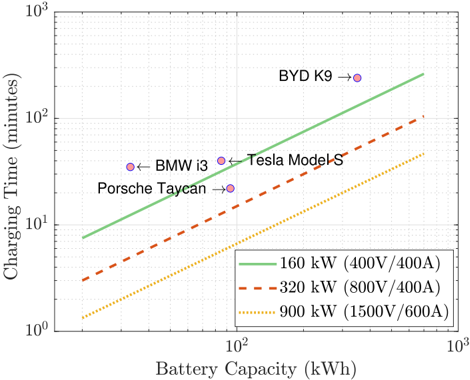
“Besides, employing higher-voltage batteries allows for a reduction in size and weight of the required cables for transferring a certain amount of power [6].”
What the sources say
- Supportedcites [6] [6] H. Tu, H. Feng, S. Srdic, and S. Lukic, 'Extreme fast charging of electric vehicles: A technology overview,' IEEE Trans. Transp. Electrific. , vol. 5, no. 4, pp. 861-878, Dec. 2019. - source
Section II states that high charging current requires larger-diameter cables and that transferring power at higher voltage is one way to reduce cable weight while delivering more power. This supports the claim that higher-voltage batteries can permit smaller, lighter charging cables for a given power transfer. (LLM, conf=0.94)
plainstates a cause- Asserted: passes — The authors put it forward as true.
- Checkable: passes — It can be checked against evidence.
- Load-bearing: unclear — It is unclear whether the paper’s conclusions depend on it.
- Based: passes — The paper gives a reason why it holds.
- Supported
Every source the paper cites for this claim was checked and supports it.
In the paper
“High current in a battery pack can impact pack hardware, busbars, fuses, disconnect switches, and tabs which results in increasing battery pack cost and weight [36].”
What the sources say
- Supportedcites [36] [36] S. Ahmed et al. , 'Enabling fast charging-a battery technology gap assessment,' J. Power Sour. , vol. 367, pp. 250-262, 2017. - source
Section 3.1, “Pack design” (p. 26), says higher current requires more robust pack hardware, including bus bars, tabs, fuses, and disconnect switches, resulting in increased pack weight and cost. This directly supports the attributed claim. (LLM, conf=0.95)
plainstates a cause- Asserted: passes — The authors put it forward as true.
- Checkable: passes — It can be checked against evidence.
- Load-bearing: unclear — It is unclear whether the paper’s conclusions depend on it.
- Based: passes — The paper gives a reason why it holds.
- Supported
Every source the paper cites for this claim was checked and supports it.
In the paper
“Electrolytic capacitors and supercapacitors can effectively reduce the battery RMS losses in this case [73].”
What the sources say
- Supportedcites [73] [73] A. Kersten, O. Theliander, E. A. Grunditz, T. Thiringer, and M. Bongiorno, 'Battery loss and stress mitigation in a cascaded h-bridge multilevel inverter for vehicle traction applications by filter capacitors,' IEEE Trans. Transp. Electrific. , vol. 5, no. 3, pp. 659-671, Sept. 2019. - source
The Drive Cycle Operation section (p. V-A) reports 'With configurations 4 and 8 a reduction of the battery losses by about 40 % is achieved' — configuration 4 being the large electrolytic capacitor and 8 the large supercapacitor — and the Conclusion states that placing the capacitors at the H-bridge inputs 'relieves the battery stress and reduces the battery losses to a great extent'. The Frequency Analysis (Table X) likewise shows both capacitor types cutting the battery current harmonics/RMS stress, with supercapacitors better at the low-speed operating point 1 and electrolytics better at high-frequency operating point 6. The citing phrase 'battery RMS losses' blends the paper's two quantities (drawn battery RMS current and ohmic battery losses), but both reductions are stated for both chemistries in the paper's cascaded H-bridge traction-inverter case, so the paraphrase is supported. (LLM, conf=0.85)
plainstates a cause- Asserted: passes — The authors put it forward as true.
- Checkable: passes — It can be checked against evidence.
- Load-bearing: unclear — It is unclear whether the paper’s conclusions depend on it.
- Based: passes — The paper gives a reason why it holds.
- Supported
Every source the paper cites for this claim was checked and supports it.
In the paper
“A comparison of reliability has been conducted in [80] between FC, NPC, and CHB structures. The large number of capacitors has resulted in the highest failure rate for FC structure, while CHB has the highest reliability between the three.”
What the sources say
- Supportedcites [80] [80] O. Alavi, A. Hooshmand Viki, and S. Shamlou, 'A comparative reliability study of three fundamental multilevel inverters using two different approaches,' Electronics , vol. 5, no. 2, 2016, Art. no. 18. - source
The Conclusions state that CHB is the best choice for reliability among the three inverters studied. Table 7 reports the highest mean time to failure for CHB (65,451 hours), compared with NPC (50,036) and FC (42,245), under the study's conditions. (LLM, conf=0.94)
plain- Asserted: passes — The authors put it forward as true.
- Checkable: passes — It can be checked against evidence.
- Load-bearing: unclear — It is unclear whether the paper’s conclusions depend on it.
- Based: passes — The paper gives a reason why it holds.
- Supported
Every source the paper cites for this claim was checked and supports it.
In the paper
“Generally, the input current of multilevel inverters can have lower current distortion compared to two-level structures [72].”
What the sources say
- Supportedcites [72] [72] R. A. Rana et al. , 'Review of multilevel voltage source inverter topologies and analysis of harmonics distortions in FC-MLI, ' Electron. , vol. 8, no. 11, 2019, Art. no. 1329. - source
Section 2, “Topologies of Multilevel Inverter,” introduces advantages of multilevel inverters over two-level inverters and lists small input current distortion among them. This supports the citing sentence’s qualified comparison. (LLM, conf=0.88)
plainstates a possible cause- Asserted: passes — The authors put it forward as true.
- Checkable: passes — It can be checked against evidence.
- Load-bearing: unclear — It is unclear whether the paper’s conclusions depend on it.
- Based: passes — The paper gives a reason why it holds.
- Supported
62 more claims · 2 with their cited sources checked
Create a free account to see all 153 claims and to verify the 10 references still open.
- Probably not a substantial claim. 55
- It may state two separate claims as one. 54
Self-check
Percentages, sums and reported differences re-computed from the paper’s own numbers.
Rated major: it would touch a result — a value a result rests on, reported and recomputed p-values on opposite sides of the significance level, two passages that conflict with no sign which is right, or a cited work retracted before this paper was published.
In the paper
“| Sum | 1726 | 1678 |”
Reported 1726 · recomputed 1826
Rated major: it would touch a result — a value a result rests on, reported and recomputed p-values on opposite sides of the significance level, two passages that conflict with no sign which is right, or a cited work retracted before this paper was published.
In the paper
“| Sum | 1726 | 1678 |”
Reported 1678 · recomputed 1928
Citations
Cites
Recent Advances and Industrial Applications of Multilevel Converters
Kouro, S., Malinowski, M., Gopakumar, K., Pou, J., Franquelo, L. G., Wu, B., Rodriguez, J., Pérez, M. A., & Leon, J. I. (2010) · IEEE Transactions on Industrial Electronics · doi:10.1109/tie.2010.2049719 · Cited by 3,872 · cited 1×
“propulsion system due to high efficiency and low size, suffer from poor input current quality which will disturb the onboard ship power system [60].”
BackgroundLithium-ion battery fast charging: A review
Tomaszewska, A., Chu, Z., Feng, X., O'Kane, S., Liu, X., Chen, J., Ji, C., Endler, E., Li, R., Liu, L., et al. (2019) · eTransportation · doi:10.1016/j.etran.2019.100011 · Cited by 1,592 · cited 1×
“the biggest challenges which are impeding the fast growth of transportation electrification [3].”
BackgroundHigh‐Power Converters and AC Drives
Wu, B., & Narimani, M. (2017) · doi:10.1002/9781119156079 · Cited by 1,571
Self-citationSchweizer, M., & Kolar, J. W. (2013) · IEEE Transactions on Power Electronics · doi:10.1109/tpel.2012.2203151 · Cited by 1,006
Extreme Fast Charging of Electric Vehicles: A Technology Overview
Tu, H., Feng, H., Srdic, S., & Lukic, S. (2019) · IEEE Transactions on Transportation Electrification · doi:10.1109/tte.2019.2958709 · Cited by 898 · cited 1×
“Besides, employing higher-voltage batteries allows for a reduction in size and weight of the required cables for transferring a certain amount of power [6].”
BackgroundElectrical Motor Drivelines in Commercial All-Electric Vehicles: A Review
de Santiago, J., Bernhoff, H., Ekergård, B., Eriksson, S., Ferhatovic, S., Waters, R., & Leijon, M. (2012) · IEEE Transactions on Vehicular Technology · doi:10.1109/tvt.2011.2177873 · Cited by 669
Teichmann, R., & Bernet, S. (2005) · IEEE Transactions on Industry Applications · doi:10.1109/tia.2005.847285 · Cited by 578 · cited 4×
“Another comparison has been made in [97] between a conventional two-level inverter with a three-level NPC inverter.”
BackgroundInfluentialBabaei, E., Laali, S., & Bayat, Z. (2015) · IEEE Transactions on Industrial Electronics · doi:10.1109/tie.2014.2336601 · Cited by 523
Vidal, C., Malysz, P., Kollmeyer, P., & Emadi, A. (2020) · IEEE Access · doi:10.1109/access.2020.2980961 · Cited by 512
Self-citationHybrid Multilevel Inverter Using Switched Capacitor Units
Babaei, E., & Gowgani, S. S. (2014) · IEEE Transactions on Industrial Electronics · doi:10.1109/tie.2013.2290769 · Cited by 498
Research works printed but not linked: 5
- [33] [K. Wand, 'High performance 800v e-motor for automotive application,' AVL Trimerics GmbH , Nov. 10, 2016. [Online]. Available: https://www.profemag.ch/de/downloads/category/35-awt2016?download=513:2016](https://www.profemag.ch/de/downloads/category/35-awt-2016%7B?}download$=$513) -
- [35] V. Reber, 'New possibilities with 800-volt charging,' Porsche Eng. Mag. , vol. 1, pp. 10-15, 2016. -
- [26] ['Newsroom,' Sep. 2019. [Online]. Available: https://www.delphi. com/newsroom/press-release/delphi-technologies-new-industryleading-800-volt-sic-inverter-cut-ev](https://www.delphi.com/newsroom/press-release/delphi-technologies-new-industry-leading-800-volt-sic-inverter-cut-ev) -
- [42] T. Urban, 'Functional safety-relevant wireless communication in automotive battery management systems,' Texas Instrum. , 2021. [Online]. Available: https://www.ti.com/lit/ug/sluucf5/sluucf5.pdf -
- [41] [T. Vogt, 'Wired vs. wireless communications in EV battery management,' Texas Instrum. , Oct. 2020. [Online]. Available: https://www.ti. com/lit/pdf/SLYY197.](https://www.ti.com/lit/pdf/SLYY197) -
Cited by
Items 201–300 of 415
Özen, F., Kabaoğlu, R. O., & Mumcu, T. V. (2025) · Electronics · doi:10.3390/electronics14193876 · Cited by 2
Verma, P., & Katal, N. (2025) · Measurement · doi:10.1016/j.measurement.2025.119719 · Cited by 2
Design and Development of a Mixed Si-GaN Open-End Winding Inverter for Electric Vehicles
FOTI, S., Baia, G., Campagna, D., et al. (2025) · IEEE Transactions on Transportation Electrification · doi:10.1109/tte.2025.3636205 · Cited by 2
“Standard MLIs such as neutral point clamped (NPC), flying capacitor (FC), T-type, and cascaded H-bridge (CHB) enhance voltage handling capabilities, reduce switching losses, and mitigate electromagnetic interference (EMI) by lowering the voltage slew rate (dv/dt) [9], [10].”
A new 37- level inverter with reduced switches for renewable energy applications
Shukla, S., Goel, V., & Dhanamjayulu, C. (2025) · Scientific Reports · doi:10.1038/s41598-025-31963-6 · Cited by 2
Electric Vehicle Fast Charging Technologies and Grid Integration—A Comprehensive Review
Sharida, A., Kamal, N. F., Bayhan, S., & Abu-Rub, H. (2025) · Proceedings of the IEEE · doi:10.1109/jproc.2026.3677611 · Cited by 7
“There are many other bidirectional multilevel converters, such as modular multilevel converter (MMC), flying capacitor (FC), neutral point clamped (NPC), and active NPC [31].”
Volvo SmartCell: A New Multilevel Battery Propulsion and Power Supply System
Forssell, J., Ekström, M., Singh, A. P., Larsson, T., & Björkholtz, J. (2026) · World Electric Vehicle Journal · doi:10.3390/wevj17040190 · Cited by 2
Dhananjaya, M., Potnuru, D., Satish, R., Alhelou, H. H., & Abdelaziz, A. Y. (2022) · IET Renewable Power Generation · doi:10.1049/rpg2.12533 · Cited by 2
Integrated Magnetics-Based Flux-Rate Controlled Single-Phase Inverter Topology
Mahapatra, R. K., Umanand, L., & Gopakumar, K. (2022) · Proceedings of the Annual Conference of the IEEE Industrial Electronics Society · doi:10.1109/iecon49645.2022.9969118 · Cited by 2
“The Modular multilevel inverters are becoming very popular for these needs and creating immense interest among researchers [1]–[3].”
BackgroundFeslı, U., Bayhan, S., Güler, N., & Kömürcügil, H. (2023) · IEEE International Conference on Compatibility, Power Electronics and Power Engineering · doi:10.1109/cpe-powereng58103.2023.10227484 · Cited by 2
“The development of alternative multilevel inverters has therefore always been a priority [5].”
BackgroundModel Predictive Control of Five-Level Current Source Converter with Optimized Weighting Factors
Chen, M., Yuan, Z., Faraji, F., Ghias, A. M. Y. M., Cha, H., & Vun, N. C. H. (2023) · IEEE International Conference on Industrial Electronics for Sustainable Energy Systems (IESES) · doi:10.1109/ieses53571.2023.10253745 · Cited by 2
“Even though voltage source converters (VSCs) take the dominant share in multilevel converters, current source converters (CSCs) have more advantages in reliability [5], fault-tolerant capability [6], four-quadrant operation [7], and voltage-boost capacity [8] compared with VSCs.”
BackgroundPerformance Assessment of the Adjustable Hybrid Switch Converter for E-mobility Applications
Thekemuriyil, T., Rahimo, M. T. A., Minamisawa, R. A., & Mastellone, S. (2023) · European Conference on Power Electronics and Applications · doi:10.23919/epe23ecceeurope58414.2023.10264282 · Cited by 2
Manivel, M., Kaliappan, L., Palani, L., & Subramani, S. (2023) · Lecture notes in electrical engineering · doi:10.1007/978-981-99-7216-6_11 · Cited by 2
Tresca, G., Formentini, A., Granata, S., Magrini, C., & Zanchetta, P. (2023) · IEEE Energy Conversion Congress and Exposition (ECCE) · doi:10.1109/ecce53617.2023.10362221 · Cited by 2
Toscani, N., Rossi, M., Carli, P. D., Rampoldi, S., Sposito, M., Polastri, A., & Dezza, F. C. (2023) · IEEE International Conference on Metrology for eXtended Reality, Artificial Intelligence and Neural Engineering (MetroXRAINE) · doi:10.1109/metroxraine58569.2023.10405806 · Cited by 2
“…paper aims at showing the first results obtained while studying the control and the thermal performances aimed at the design and the realization of a low-TRL prototype of an 80-kW bi-directional three-phase three-level converter working as an active front end for fast recharges of vehicles [5].”
BackgroundSHE PWM based 21 level inverters with hardware analysis
Theresa, A. A., Selvaraj, M., & Ambikapathy, A. (2024) · International Journal of Power Electronics and Drive Systems/International Journal of Electrical and Computer Engineering · doi:10.11591/ijpeds.v15.i2.pp993-1000 · Cited by 3
Halawa, A., Schuchardt, B., Moon, J., & Lee, W. (2024) · IEEE Transportation Electrification Conference and Expo · doi:10.1109/itec60657.2024.10598882 · Cited by 2
Fault Resilient Ability of Reduced Switches Multi Level Inverter for Off Grid Applications
Chillappagari, P. K., Karthick, N., & Airineni, M. R. (2024) · Iranian Journal of Science and Technology Transactions of Electrical Engineering · doi:10.1007/s40998-024-00749-3 · Cited by 2
“An MLI has significant benefits over its predecessor, including a higher number of output voltage levels, it enhances power quality, reduces the dv/dt stress on the switches, the elimination of filters, and strong electromagnetic compatibility (Poorfakhraei et al. 2021).”
Madhavan, M., Chellammal, N., & Hosseinpour, A. (2024) · IET Power Electronics · doi:10.1049/pel2.12795 · Cited by 2
Deliri, S., Peltoniemi, P., & Aarniovuori, L. (2024) · International Power Electronics and Motion Control Conference (EPE-PEMC) · doi:10.1109/pemc61721.2024.10726330 · Cited by 2
“Three level inverters have higher efficiency in higher output voltage and switching frequency than two level inverters in the cost of more semiconductors in their structures [1, 2].”
BackgroundTechnological Trends for Electrical Machines and Drives Used in Small Wind Power Plants—A Review
Fodorean, D. (2024) · Energies · doi:10.3390/en17246483 · Cited by 3
Design for High Efficiency High Density Flying Capacitor Multilevel Inverter
Huang, C., Dong, J., Zhu, Z., & Wu, X. (2024) · Asia Power and Electrical Technology Conference (APET) · doi:10.1109/apet63768.2024.10882652 · Cited by 2
“But MMC is generally suitable for applications with high power and high voltage, it costs large number of capacitors and requires additional pre-charging circuits for the capacitors, the control strategy is complex [8].”
Evaluation of Possible Traction Inverter Topologies for Heavy-Duty Electric Vehicles
Ayaz, E., Jackson, M., Ghahfarokhi, S. S., Singh, B. P., Norrga, S., & Nee, H. (2024) · IEEE Annual Southern Power Electronics Conference · doi:10.1109/spec62217.2024.10893180 · Cited by 3
“Also, higher DC-link voltages enable megawatt charging, which, in turn, reduces charging time and cable weights [6].”
Islam, M. T., Hossain, M. N., Islam, Z. U., et al. (2024) · International Conference on Sustainable Technologies for Industry 5.0 (STI) · doi:10.1109/sti64222.2024.10951087 · Cited by 2
“Each H-bridge cell requires additional components such as switches, capacitors, and control circuits, raising both material and manufacturing expenses [18].”
Suyal, S., & Yadav, A. K. (2024) · IEEE International Conference on Power Electronics, Drives and Energy Systems · doi:10.1109/pedes61459.2024.10961838 · Cited by 2
“MLI topologies are known to have many desirable features, such as low voltage dv/dt stress on the switches, low EMI, low common-mode voltages, better harmonic performance, etc. [2],[3].”
Multilevel Selective Gate Driver With Real-Time Feedforward Control for SiC Inverters
Wen, L., Yu, W., Geiger, J., & Husain, I. (2025) · IEEE Journal of Emerging and Selected Topics in Power Electronics · doi:10.1109/jestpe.2025.3548598 · Cited by 4
“There have been researches in improving the efficiency and size of the EV powertrain inverter, such as multilevel inverter topology [2], [3], [4], dc-link control [5], [6], and inverter control strategies [7].”
Reconfigurable Switch-Control Scheme for a Multilevel T-Type DAB DC–DC Converter
Stowhas‐Villa, A., Rojas, C. A., Carmona, R., Wilson-Veas, A. H., Marin, J., Alcaide, A. M., Young, H. A., & Kouro, S. (2025) · IEEE Journal of Emerging and Selected Topics in Power Electronics · doi:10.1109/jestpe.2025.3592872 · Cited by 3
“Recent surveys underline the flexibility of these architectures, which are particularly attractive for fast-charging systems [4], [5], [6], [7], on-board systems [8], or both [9].”
Wang, Y., Poorfakhraei, A., Narimani, M., & Emadi, A. (2021) · Annual Conference of the IEEE Industrial Electronics Society (IECON) · doi:10.1109/iecon48115.2021.9589540 · Cited by 3
“The vehicles also benefit from lighter and thinner cables, lower weight, lower manufacturing cost, higher power throughput, faster charging, and more efficient motors [7].”
BackgroundSelf-citationA Novel Sensorless Voltage Multiplier Inverter for Electric Vehicle Application
Azimi, A., Khodaparast, A., Rasouli, M., & Adabi, J. (2022) · Power Electronics, Drive Systems, and Technologies Conference (PEDSTC) · doi:10.1109/pedstc53976.2022.9767479 · Cited by 2
Modified Modular Multilevel Inverter topology for Photovoltaic Applications
Duraisamy, R., & THIYAGARAJAN, V. (2022) · doi:10.1109/iccpc55978.2022.10072123 · Cited by 2
Babkrani, Y., Mourad, G., Naddami, A., et al. (2023) · International Journal of Power Electronics and Drive Systems/International Journal of Electrical and Computer Engineering · doi:10.11591/ijpeds.v14.i3.pp1523-1533 · Cited by 2
“Alternate phase opposition disposition Alternate phase opposition disposition PWM (APOD), all carriers are changing phase 180 degree with its adjacent as shown in Figure 9, Odd carriers are in phase going from 0 to 1, but even carrier waveforms are phase shifted from 0 to -1 with 180 degree [31].”
BackgroundA Five-Phase Induction Motor drive with a GaN-Based Open-end Winding Multilevel Inverter
FOTI, S., Rizzoli, G., Mengoni, M., et al. (2023) · European Conference on Power Electronics and Applications · doi:10.23919/epe23ecceeurope58414.2023.10264319 · Cited by 2
Ramos, H. O., Torquato, H. R., Mendes, M. A. S., Matos, F. F. V., de Sousa, C. V., Silva, W. W. A. G., & Mendes, V. F. (2024) · Computers & Electrical Engineering · doi:10.1016/j.compeleceng.2024.109102 · Cited by 2
Kim, J., Lee, Y., Jin, H., et al. (2024) · Energies · doi:10.3390/en17051038 · Cited by 2
Ponce‐Silva, M., Vargas, O. S., Cortés-García, C., et al. (2024) · Algorithms · doi:10.3390/a17070317 · Cited by 2
“On the other hand, there has also been an increase in works on inverters that power the motors of electric vehicles [2].”
BackgroundMultilevel Inverter for EV Charging via Hybrid Storage Unit (Fuel Cell, Battery, Ultracapacitor)
Fodorean, D., & Gros, I.-C. (2024) · IEEE International Conference on Electrical Systems for Aircraft, Railway, Ship Propulsion and Road Vehicles & International Transportation Electrification Conference (ESARS-ITEC) · doi:10.1109/esars-itec60450.2024.10819920 · Cited by 2
Cittanti, D., Vico, E., Armando, E. G., & Bojoi, R. I. (2022) · International Power Electronics Conference (IPEC) · doi:10.23919/ipec-himeji2022-ecce53331.2022.9807091 · Cited by 4
“, different from the widely adopted two-level voltage-source inverter) [7]–[9] and modern wide bandgap (WBG) semiconductor devices [9]–[11] may play a significant role in the development of next-generation EV drive inverters.”
BackgroundHwang, S.-G., Kudriavskyi, Y., Garud, K. S., & Lee, M. (2023) · Applied Sciences · doi:10.3390/app13053189 · Cited by 1
Selective Harmonic Elimination in Multilevel inverter using Grasshopper Optimization algorithm
Vinayaka, K. U., Naveen, S. B., & Jagadeesha, S. (2024) · International Conference on Smart Systems for Applications in Electrical Sciences (ICSSES) · doi:10.1109/icsses62373.2024.10561308 · Cited by 1
Golestan, S., Barrios, M. A., Golmohamadi, H., et al. (2024) · Electronics · doi:10.3390/electronics13163143 · Cited by 1
Diwan, A. P., Nagarajan, B., & Mahendran, V. (2024) · Engineering Research Express · doi:10.1088/2631-8695/ad8726 · Cited by 1
Three-phase three-level flying capacitor converter with only one capacitor
Hu, B., Qin, X., Meng, B., et al. (2024) · Journal of Power Electronics · doi:10.1007/s43236-024-00951-w · Cited by 1
Veillón, M., Rojas, C. A., Ramírez, H., & Espinosa, E. E. (2024) · IEEE International Conference on Automatica · doi:10.1109/ica-acca62622.2024.10766802 · Cited by 2
Design of a 75kW Three-Level DC/DC GaN Converter for Automotive Fuel-cell Application
Giuffrida, S., Savio, S., Mandrile, F., et al. (2024) · IEEE Energy Conversion Congress and Exposition (ECCE) · doi:10.1109/ecce55643.2024.10861727 · Cited by 1
Shimura, S., & Kusaka, K. (2024) · IEEE Energy Conversion Congress and Exposition (ECCE) · doi:10.1109/ecce55643.2024.10861623 · Cited by 1
“They have attractive features such as high efficiency and low distortion in voltages and currents [2]. voltage and current by increasing the number of levels in the output voltage [3–4].”
Shokrani, M. R., Babaei, E., & Sabahi, M. (2025) · Power Electronics, Drive Systems, and Technologies Conference (PEDSTC) · doi:10.1109/pedstc65486.2025.10911998 · Cited by 1
“The T-Type Neutral Point Clamped (T-NPC) and the PUC inverters are two of the most well-known topologies in this category [3].”
Three-Phase Multilevel Inverter with Minimized Low-Order Harmonics Using Mantis Search Algorithm
Wong, Q. M., Chew, W. T., Ong, S. L., et al. (2025) · IEEE International Colloquium on Signal Processing & Its Applications (CSPA) · doi:10.1109/cspa64953.2025.10933374 · Cited by 1
“MLIs are suitable for medium-to high-power applications due to their enhanced characteristics, such as improved power quality, reduced voltage stress on power switches and lower electromagnetic interference [1].”
A Multilevel Inverter With a Single Battery Source and a High-Frequency Link for Electric Vehicles
Kannan, S., Jagadanand, G., & Sasidharan, N. (2025) · IEEE Access · doi:10.1109/access.2025.3562351 · Cited by 1
Wang, K., Wu, X., Shi, S., Xu, M., Han, Y., Zhu, Z., & Qin, Y. (2025) · Sensors · doi:10.3390/s25092888 · Cited by 2
“The authors of [10] reviewed the current state of vehicle technologies and future trends, highlighting the superior performance of traditional wheeled vehicles on flat terrains.”
Kumar, B., Peddapati, S., & Bonthagorla, P. K. (2025) · IEEE Access · doi:10.1109/access.2025.3593812 · Cited by 1
“Nowadays, multilevel inverters (MLIs) have become increasingly popular after the two-level inverter due to their advantages of lower total harmonic distortion (THD) and higher efficiency [10], [11].”
Hataş, H. (2025) · International Symposium on Innovative Approaches in Smart Technologies (ISAS) · doi:10.1109/isas66241.2025.11101865 · Cited by 1
“Therefore, considering these advantages, their use in high-power applications such as motor drive systems, renewable energy sources and electric vehicles is becoming increasingly widespread [3].”
Optimized Triple‐Boost Switched‐Capacitor Seven‐Level Inverter for Renewable Energy Integration
Sarangi, B., & Singh, V. (2025) · International Journal of Circuit Theory and Applications · doi:10.1002/cta.70122 · Cited by 1
A Control Strategy for Parallel Three-Phase Inverters in Motor Drives
Matthews, P. D., Narm, H. G., Ebrahimi, J., et al. (2025) · IEEE Open Journal of Power Electronics · doi:10.1109/ojpel.2025.3620715 · Cited by 1
“3) The proposed motor drive incorporates output capacitors, which is an uncommon choice in motor drives, which reduces the output voltage and current ripple [21], [22], [23].”
Modulation and Closed-Loop Control of a 6-Phase 3-Level NPC Integrated Inverter/Charger for EVs
Fañanás-Puigjaner, G., Busquets‐Monge, S., García-Rojas, G., et al. (2025) · doi:10.1109/ecce-europe62795.2025.11238817 · Cited by 1
“Previous contributions focus on the use of multilevel converters [3] or multiphase machines [4], but there are few contributions in which the system combines both technologies [5].”
Cataldo, A. D., Aiello, G., Patti, D., Scelba, G., Cacciato, M., & Gennaro, F. (2026) · Electrical Engineering · doi:10.1007/s00202-025-03442-8 · Cited by 1
“They feature a reduced dv/dt stress on the electric load, a reduction of common-mode voltages and a further reduction of the total harmonic distortion (THD) of the output quantities, and they allow reaching higher efficiency and reducing the complexity and size of input/output filters [11–13].”
Chang, C.-W., Spieler, M., EL-Refaie, A. M., Torres, R. A., Burgos, R. P., & Dong, D. (2026) · IEEE Journal of Emerging and Selected Topics in Power Electronics · doi:10.1109/jestpe.2026.3659701 · Cited by 1
“To improve harmonics and alleviate high dv / dt , multilevel topology like 3L TNPC can be adopted, and studies have shown the benefit of it for propulsion systems due to weight reduction of electromagnetic interference (EMI) filters [42], [46], [47], [48].”
A Novel Multi-Source Multilevel Inverter
Espinosa, E. E., Neuman, S., Melín, P., Espinoza, J., Baier, C. R., Hernández, J. C., Serra, F. M., González, O., & Mirzaeva, G. (2025) · IEEE Annual Southern Power Electronics Conference · doi:10.1109/spec64875.2025.11377253 · Cited by 1
“The effort to reduce dependence on fossil fuels and the resulting pollution has driven the current energy transition [1].”
Fesli, U. (2026) · Electronics · doi:10.3390/electronics15071383 · Cited by 1
Opportunities and challenges for polymeric insulation materials in electric vehicles powertrains
Qiang, D., Wale, J. D., Wu, X., Zhou, L., Wang, X., Rimmer, C., & McMahon, R. (2026) · eTransportation · doi:10.1016/j.etran.2026.100590 · Cited by 2
A Reduced Switch Single-Source Multilevel Inverter with GA-Based Selective Harmonic Elimination
Singh, A., Kumari, A., Singh, A. R., Kumar, A., Kumar, P., & Kumar, R. R. (2026) · Power Electronics and Drives · doi:10.2478/pead-2026-0010 · Cited by 1
“A comprehensive overview of MLI structures for EV applications has been presented by Poorfakhraei et al. (2021), highlighting the advantages of MLIs in improving efficiency, reliability and power quality in modern power electronic systems.”
Mayingi, B. A., Thango, B. A., & Okojie, D. (2026) · World Electric Vehicle Journal · doi:10.3390/wevj17050250 · Cited by 1
Experimental validation of a fault diagnostic method in SPWM and SVPWM CHB-MLIs
Raj, N., Anjali Anand, K., Jagadanand, G., et al. (2021) · IEEE International Conference on Condition Assessment Techniques in Electrical Systems (CATCON) · doi:10.1109/catcon52335.2021.9670525 · Cited by 1
GA-Optimized Switching Angles for 13-level Asymmetrical Multilevel Inverter
Chew, W. T., Sea, Y. W., Yong, W. V., Ong, S. L., & Leong, J. H. (2022) · IEEE International Conference on Artificial Intelligence in Engineering and Technology (IICAIET) · doi:10.1109/iicaiet55139.2022.9936854 · Cited by 1
“Recently, multilevel inverter (MLI) has become a potential inverter in several medium/high voltage and highpower applications, such as electric aircraft, traction, hybrid electric vehicle, and renewable energy applications [1-4].”
BackgroundState-Space Modeling of an Open-Loop Conversion Chain in Electric Vehicles
Ajra, Y., Sheikh, H. A., Moubayed, N., & Hoblos, G. (2022) · International Conference on Smart Systems and Power Management (IC2SPM) · doi:10.1109/ic2spm56638.2022.9988929 · Cited by 2
“It also has several advantages, such as the possibility of charging them from stations that produce energy through natural, renewable sources, which contributes to reducing the volume of harmful gases by a greater percentage [1].”
BackgroundCascaded H-Bridges Multilevel Inverter Drive: Active Power Analysis in Frequency Domain
Nevoloso, C., Spataro, C., Miceli, R., Tommaso, A. O. D., Scaglione, G., & Schettino, G. (2022) · IMEKO TC4 International Symposium and International Workshop on ADC and DAC Modelling and Testing (IWADC) · doi:10.21014/tc4-2022.50 · Cited by 1
Design of multilevel inverter with its study on different configurations and applications
Vijayaraja, L., Dhanasekar, R., Sanadhan, S. K., et al. (2023) · International Conference on Computer Communication and Informatics (ICCCI) · doi:10.1109/iccci56745.2023.10128380 · Cited by 1
“These high voltage batteries help in fast charging of EVs and increasing efficiency motors [5].”
BackgroundA NOVEL FAULT TOLERANT ASYMMETRICAL 21-LEVEL INVERTER TOPOLOGY WITH REDUCED COMPONENTS
RAGUL, D., & THIYAGARAJAN, V. (2023) · REVUE ROUMAINE DES SCIENCES TECHNIQUES — SÉRIE ÉLECTROTECHNIQUE ET ÉNERGÉTIQUE · doi:10.59277/rrst-ee.2023.68.2.14 · Cited by 1
17 Level Hybrid Diode Clamped Inverter With Reduced Number of Components
Alsumady, M., Jaber, I., & Nusserat, K. (2023) · Journal of Electronics and Electrical Engineering · doi:10.37256/jeee.2220233266 · Cited by 1
“Due to these advantages, MLIs caught the attention of researchers lately and they are used widely in photovoltaic (PV) systems [4], electric vehicles (EVs) [5], and uninterruptable power supplies (UPS) [6–8].”
BackgroundRipple Ports Arrangements in DAB Assisted Modular Multilevel Converter for Low Voltage Applications
Tarisciotti, L., Villaseca, R. I. A., Pereda-Torres, J., & Bolognesi, P. (2023) · IEEE Energy Conversion Congress and Exposition (ECCE) · doi:10.1109/ecce53617.2023.10362904 · Cited by 1
Sub-Module Voltage Control in DAB Assisted Modular Multilevel Converter for Low Voltage Applications
Aguilar, R., Tarisciotti, L., & Pereda, J. E. (2023) · IEEE Energy Conversion Congress and Exposition (ECCE) · doi:10.1109/ecce53617.2023.10362637 · Cited by 1
“Due to the large capacitances used for the SMs, plus the high number of sensors and measurement system, the classical MMC topology is barely studied for low voltage applications, since the available space, costs and complexity do not compare with the actual solutions for this range [11], [12].”
BackgroundImproved Feedback Quantizer with Discrete Space Vector
Veillón, M., Espinosa, E. E., Melín, P., Mirzaeva, G., Rivera, M. E., Baier, C. R., & Ramírez, R. O. (2024) · Sensors · doi:10.3390/s24010287 · Cited by 1
Li, B., Lu, W., & Xie, Z. (2023) · IEEE International Power Electronics and Application Symposium (PEAS) · doi:10.1109/peas58692.2023.10395755 · Cited by 1
“High power density and low cost are essential to most applications, such as traction inverters [3],[4].”
BackgroundKirubakaran, A., Barzegarkhoo, R., & Liserre, M. (2024) · International Conference on Power, Control and Computing Technologies (ICPC2T) · doi:10.1109/icpc2t60072.2024.10474640 · Cited by 1
“…has led to the government and industries looking at various applications like Electric vehicles, Trans-portations, smart grids, Micro grids and Telecommunication systems etc. Power electronics is a key technology to interface effectively the renewable sources into the power grid [1],[2].”
BackgroundOptimum Torque Operation of a Hybrid Cascaded Multilevel Converter-Fed Electric Vehicle Motor Drive
Sandeep, P. V. S., Chabukswar, A., Vankadari, P., et al. (2023) · IEEE India International Conference on Power Electronics · doi:10.1109/iicpe60303.2023.10474865 · Cited by 1
“These characteristics position multi-level inverters for applications requiring high-quality voltage waveforms such as motor drives, renewable energy systems, and high-power industrial drives [3]–[5].”
BackgroundDevelopment of a Power Electronics Interface between an Energy Storage System and the Power Grid
Faria, J. A., Novo, M., Dias, J., Barros, L. A. M., & Pinto, J. G. O. (2024) · International Young Engineers Forum (YEF-ECE) · doi:10.1109/yef-ece62614.2024.10625091 · Cited by 1
“The NPC also has greater energy storage efficiency because this type of inverter places energy storage components, such as capacitors and inductors, outside the switched power circuit, reducing potential losses [17].”
BackgroundMachine learning in talkative power technology
Mousavi, S. A., Izadi, Z. G., & Khooban, M. H. (2024) · Elsevier eBooks · doi:10.1016/b978-0-443-21432-5.00009-7 · Cited by 1
Modeling and Control of Multi-phase Motor Fed by Multi-level Inverter for Electric Vehicles
Luong-Gia, H., Nguyễn, B., Tran, L. H., Ta, M. C., & Vo–Duy, T. (2024) · IEEE Vehicle Power and Propulsion Conference (VPPC) · doi:10.1109/vppc63154.2024.10755490 · Cited by 1
“In the pursuit of higher efficiency, multi-level inverter configurations have been proposed as an efficient alternative to conventional two-level inverters [9], [10].”
Hassan, A., Aly, M., Rodríguez, J., et al. (2024) · International Middle East Power Systems Conference (MEPCON) · doi:10.1109/mepcon63025.2024.10850270 · Cited by 1
“Additionally, it has a reduced voltage stress (d v/ d t ), which lowers the amount of power losses, results in a longer-than-expected switch lifespan, and has less electromagnetic interference (EMI) [2].”
Maier, J., Ulrich, B., Czerwenka, P., et al. (2024) · IEEE Energy Conversion Congress and Exposition (ECCE) · doi:10.1109/ecce55643.2024.10861597 · Cited by 1
“Multilevel inverters are a promising approach for traction inverters in electric vehicles that allow input voltages higher than the blocking voltage of the individual power switches [1].”
A 13-Level Switched Capacitior Boost MLI With Dual Configurability for EV Applications
Murshid, S., Sundararajan, P., Sahani, M., et al. (2024) · IEEE Annual Southern Power Electronics Conference · doi:10.1109/spec62217.2024.10893243 · Cited by 1
“With an increasing shift towards higher DC-link voltages in electric vehicles (EVs), MLI structures are being explored as a more viable alternative to conventional two level inverters [2].”
Modified five-level LLC resonant inverter for multiple PV string systems
Bughneda, A., Salem, M., Swadi, M., Prabaharan, N., Hossain, E., Ishak, D., & Mohamed, F. A. (2025) · Alexandria Engineering Journal · doi:10.1016/j.aej.2025.02.096 · Cited by 1
Investigation of Multilevel Inverter with MultiCarrier PWM Techniques for E-Vehicle Applications
Abinaya, C., C.Sivaranjani, Gengaraj, M., et al. (2025) · doi:10.1109/ictmim65579.2025.10988009 · Cited by 1
“The primary setback is increased complexity in terms of control and design [12].”
Benagri, I., Haidi, T., Derri, M., Mellouli, E. M., Zahraoui, Y., & Cherrabi, M. (2025) · International Conference on Innovative Research in Applied Science, Engineering and Technology (IRASET) · doi:10.1109/iraset64571.2025.11007983 · Cited by 2
“Certain multilevel topologies have been studied as a possible and effective alternative to two-level inverters due to the continuous tendency regarding higher voltage in the DC link of EVs, as a potential solution to problems with traditional two-level inverter devices [16], [17].”
InfluentialHichri, A., Hajji, M., Mansouri, M. M., Bouzrara, K., Elboughdiri, N. A., & Gasmi, H. (2025) · Applied Energy · doi:10.1016/j.apenergy.2025.126231 · Cited by 2
Su, F., Li, J., Li, F., et al. (2025) · Power System and Green Energy Conference (PSGEC) · doi:10.1109/psgec66102.2025.11151032 · Cited by 1
“…and accurate assessment of converter valve loss is a key link in the design of heat dissipation system, selection of power electronics, etc., and also an important index for assessing the performance of the converter valve, which directly affects the economy and reliability of the project [4-5].”
Review of High Temperature Superconducting Machines and Associated Power Electronics
Shi, C. ‐. R., McCabe, K., Sachs, C., Pearce, M. G. S., & Thrimawithana, D. J. (2025) · Energy Conversion Congress and Expo Europe (ECCE Europe) · doi:10.1109/ecce-europe62795.2025.11238835 · Cited by 2
“In general, multi-level inverters reduce total harmonic distortion (THD), thus reducing higher frequency harmonics and AC loss; the more levels, the lower the THD and AC loss [54, 55].”
Sachs, C., Gliese, F., & Neuburger, M. (2026) · Proceedings in Technology Transfer · doi:10.1007/978-3-032-09384-4_1 · Cited by 1
Divyashree, B., Rao, S. N., & Veerabhadra, J. (2022) · Lecture notes in electrical engineering · doi:10.1007/978-981-19-2281-7_15 · Cited by 2
Design of a Modular GaN-based Three-Phase Three-Level ANPC InverterPreprint
Cataldo, A. D., Aiello, G., Patti, D., Scelba, G., Cacciato, M., & Gennaro, F. (2024) · OSF Preprints (OSF Preprints) · doi:10.31219/osf.io/mvkus · Cited by 1
A novel multilevel inverter with reduced components and minimized voltage unbalance
Kumar, R. R., & Choudhary, J. (2022) · International Journal of Power Electronics and Drive Systems/International Journal of Electrical and Computer Engineering · doi:10.11591/ijpeds.v13.i4.pp2365-2377
“They are broadly used for industrial applications such as motor drivers [2]−[3], micro grid applications [4]–[6], and renewable energy [7]–[9].”
BackgroundPriyadharshini, J., & Archana, N. (2022) · Research Square · doi:10.21203/rs.3.rs-2321741/v1
Meesala, R. E. K., Athikkal, S., Udumula, R. R., et al. (2023) · Lecture notes in electrical engineering · doi:10.1007/978-981-19-7788-6_4
Voltage Regulation for Soft Switching Multiphase IBC Using Fuzzy Logic Controller
Saranya, S., Lakshmi, S., & Prakash, S. (2022) · International Conference on Power, Energy, Control and Transmission Systems (ICPECTS) · doi:10.1109/icpects56089.2022.10047239
“INTRODUCTION Growing concern in environmental set backs impacted by ever increasing energy demands, the focus of many technology breakthroughs has been shifted to renewables, integrated distributed generators and electric propulsion systems [1-5].”
BackgroundState Feedback Controller Stratagem for Permanent Magnet Synchronous Motor Drive
Komma, L., Karlapudy, A. M., & Saraswathi, G. (2022) · IEEE North Karnataka Subsection Flagship International Conference (NKCon) · doi:10.1109/nkcon56289.2022.10126875
“And also by increasing levels, increases the number of switching devices and becomes complicated the analytical calculations [4].”
BackgroundBibliography analysis of Multilevel Inverters (2021-2022)
Janiga, S. R., Tummala, S. K., Al‐Kharsan, I. H., & Faizan, R. (2023) · E3S Web of Conferences · doi:10.1051/e3sconf/202339101173
WIRELESS CHARGING OF ELECTRIC VEHICLES BY ZVS-IPT TOPOLOGY
(2023) · International Journal of Progressive Research in Engineering Management and Science · doi:10.58257/ijprems31740
Choi, J. S., Kim, D. C., Shin, H., et al. (2023) · Journal of Electronic Materials · doi:10.1007/s11664-023-10565-w
Design of Hybrid multi-level inverter for photovoltaic(PV) application
Haq, I., Farooq, A., Ayaz, M. M. A., & Ali, M. (2023) · International Conference on Applied Engineering and Natural Sciences · doi:10.59287/icaens.1027
Simulation of HEV Power System with New Nonoverlapping Induction Starter-Generator
Grachev, P. Y., Tabachinskiy, A., & Fedulov, I. A. (2023) · International Russian Automation Conference (RusAutoCon) · doi:10.1109/rusautocon58002.2023.10272863
“Modern topologies and control strategies of EC ensure the operation of the Starter-Generator at maximum efficiency over a wide range of rotor rotation frequencies [12, 13].”
BackgroundComputation-Efficient Model Predictive Control of a Multilevel Current Source Converter
Chen, M., Yuan, Z., Ghias, A. M. Y. M., & Vun, N. C. H. (2023) · Annual Conference of the IEEE Industrial Electronics Society (IECON) · doi:10.1109/iecon51785.2023.10312447
“…source converters (VSCs) are more commonly used in multilevel converters, current source converters (CSCs) offer several advantages over VSCs, including greater reliability [5], fault-tolerant capability [6], the ability to operate in all four quadrants [7], and a higher voltage-boost capacity [8].”
BackgroundCaruso, M., Tommaso, A. O. D., Frequente, G., Miceli, R., Nevoloso, C., Scaglione, G., & Schettino, G. (2023) · AEIT International Annual Conference · doi:10.23919/aeit60520.2023.10330314
“Therefore, MLIs are applied in many fields such as high-power and high-voltage systems to build Static Synchronous Compensator (STATCOM) [3], in high-voltage DC applications [4] and e-mobility applications [5], [6].”
Method
Metadata
- Authors
- Poorfakhraei, A., Narimani, M., & Emadi, A.
- Affiliations
- McMaster University (CA)
- Venue
- IEEE Open Journal of Power Electronics
- Published
- 2021
- Volume
- 2
- Pages
- 155-170
- ISSN
- 2644-1314 (ISSN-L)
- OpenAlex
- W3134222763
- Cited by
- 424
- References
- 84
- Citations by year
- 2026: 54 · 2025: 102 · 2024: 104 · 2023: 93 · 2022: 53 · 2021: 18
- FWCI
- 19.67
- Type
- journal article
- Language
- en
- Open access
- gold
- doi.org
- Locations
- IEEE Open Journal of Power Electronics (publishedVersion, cc-by)
- DOAJ (DOAJ: Directory of Open Access Journals) (submittedVersion, cc-by-sa)
- Topics
- Physical Sciences › Engineering › Electrical and Electronic Engineering › Multilevel Inverters and Converters
- Physical Sciences › Engineering › Automotive Engineering › Electric and Hybrid Vehicle Technologies
- Physical Sciences › Engineering › Electrical and Electronic Engineering › Electric Motor Design and Analysis
- Keywords
- multilevel inverter, electric vehicle traction inverter, inverter topology, DC bus voltage, two-level inverter, power density, fault tolerance, power quality, inverter efficiency, electric mobility
About these checks
Registry, retraction, Cites and statistics results are computed, not judged, with one exception: a printed reference that no index lists is read once by a model before it counts as a citation error. Claims are extracted by a model and kept only when their quote appears verbatim in the text; each cited source is then checked, with a model’s help, for whether it says what the claim relies on. Those verdicts can be wrong — read the claim’s quote and the cited source before relying on one.
The claim verdicts this report counts are experimental: their accuracy is not yet measured.
A language model drew the claims from the paper on 2026-10-10, under version 3 of the claim definition (model deepseek-v4.1-flash, prompt extract-v3).
A second model labelled each claim on 2026-10-10 (model jev-1.13-20260917, definition revision gold-guideline-v0.2).
Cited sources are checked with a language model’s help (gpt-6-sol and qwen3.8-omni-flash).
Statistics and arithmetic are recomputed, not judged.
Confidence bands are shown only for fields calibrated on our annotated test set. None is calibrated yet, so no band is shown.
What counts as a claim ›How we measure confidence ›How we check this ›
Are you an author, or do you see a problem with this page? Request a review
Data sources
Bibliographic data: Semantic Scholar, OpenAlex, Crossref.
Contains information from the Semantic Scholar Academic Graph Datasets, made available under the ODC Attribution License (ODC-BY 1.0).
Semantic Scholar’s data is described in: Kinney, R., et al. (2023). The Semantic Scholar Open Data Platform. arXiv:2301.10140.
