

The DOI matches its Crossref record; 11 of the 11 references it cites were found in a registry or an index.
Regulation of immunity and allergy by helminth parasites
Abstract
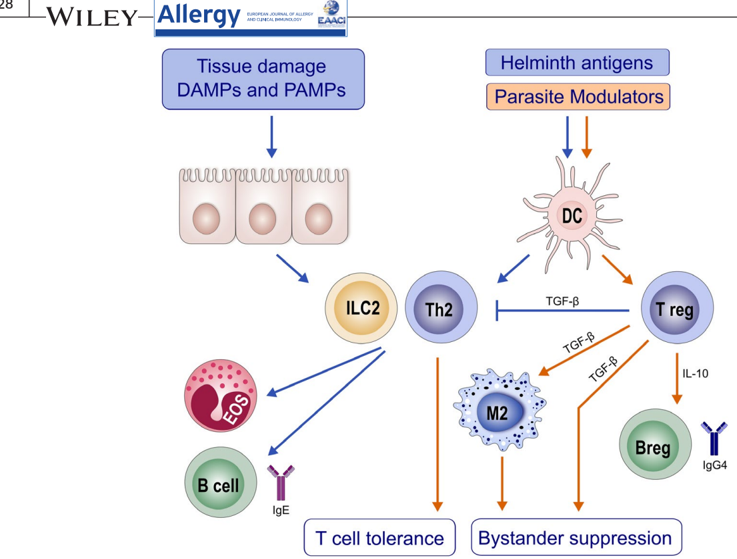
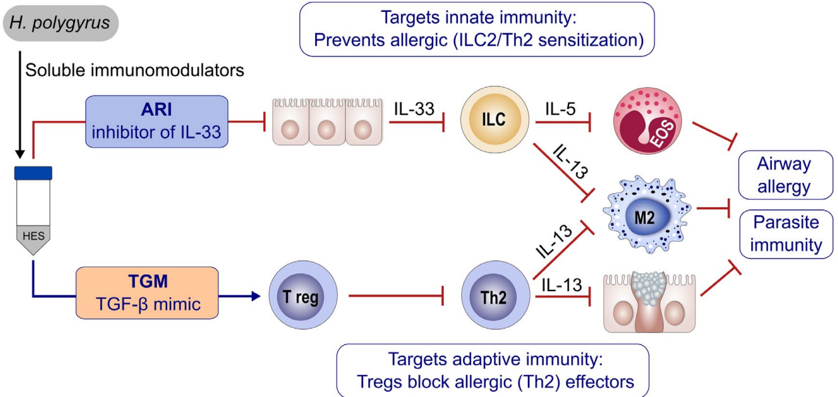
There is increasing interest in helminth parasite modulation of the immune system, both from the fundamental perspective of the “arms race” between host and parasite, and equally importantly, to understand if parasites offer new pathways to abate and control untoward immune responses in humans. This article reviews the epidemiological and experimental evidence for parasite down‐regulation of host immunity and immunopathology, in allergy and other immune disorders, and recent progress towards defining the mechanisms and molecular mediators which parasites exploit in order to modulate their host. Among these are novel products that interfere with epithelial cell alarmins, dendritic cell activation, macrophage function and T‐cell responsiveness through the promotion of an immunoregulatory environment. These modulatory effects assist parasites to establish and survive, while dampening immune reactivity to allergens, autoantigens and microbiome determinants.
Overview
The claims and statistics of this paper haven’t been checked yet.
Run the check — free, no account needed. It reads the open-access text and checks the sources it cites.
Integrity signals
Registry
Cites
Statistics
Figures




Verification
Claims the paper makes
The claims and statistics of this paper haven’t been checked yet.
Run the check — free, no account needed. It reads the open-access text and checks the sources it cites.
Claims other papers make about this one
Each is checked against this paper’s own text: does it say what the citing paper says it does?
In the citing paper
“Conversely, certain parasites, such as Schistosoma mansoni, can modulate the host immune system by inducing regulatory T cells and anti-inflammatory cytokines, thereby reducing allergic inflammation (Layland et al. 2013; Maizels 2020; Stevenson et al. 2022).”
From Parasites and allergies: a complex bidirectional relationship from evolutionary origins to modern therapeutics (2026) · cites this paper as Maizels 2020
In the citing paper
“Some studies suggest that protozoan exposure may, in selected contexts, reduce allergic sensitization by promoting Th1-type immune responses and suppressing Th2-mediated inflammation,however, this should be regarded as context-dependent rather than a predominant or universal effect (Fenoy et al. 2015; Korb et al. 2020; Maizels 2020).”
From Parasites and allergies: a complex bidirectional relationship from evolutionary origins to modern therapeutics (2026) · cites this paper as Maizels 2020
In the citing paper
“It should also be emphasized that none of these hypotheses has been fully confirmed, and current evidence highlights the complexity of interactions between endoparasites, ectoparasites, microorganisms, and the human immune system (Maizels 2020; Perkin and Strachan 2022).”
From Parasites and allergies: a complex bidirectional relationship from evolutionary origins to modern therapeutics (2026) · cites this paper as Maizels 2020
In the citing paper
“Interestingly, parasitic worms can also influence the gut microbiome, which plays a key role in immune health.”
From Parasites and allergies: a complex bidirectional relationship from evolutionary origins to modern therapeutics (2026) · cites this paper as Maizels 2020
In the citing paper
“Contrary to the common belief that all parasites cause dysbiosis (an imbalance in the gut microbiome), some helminths may actually promote a more diverse and balanced microbial environment”
From Parasites and allergies: a complex bidirectional relationship from evolutionary origins to modern therapeutics (2026) · cites this paper as Maizels 2020
In the citing paper
“Beyond specific extracts, studies have also investigated parasite body fluids, which were found to inhibit the development of allergic mucosal inflammation by affecting dendritic cell and macrophage function”
From Parasites and allergies: a complex bidirectional relationship from evolutionary origins to modern therapeutics (2026) · cites this paper as Maizels 2020
Self-check
Percentages, sums and reported differences re-computed from the paper’s own numbers.
The self-check needs the paper’s full text.
Citations
Cites
Hay fever, hygiene, and household size.
Strachan, D. P. (1989) · BMJ · doi:10.1136/bmj.299.6710.1259 · Cited by 5,054
Macrophage biology in development, homeostasis and disease
Wynn, T. A., Chawla, A., & Pollard, J. W. (2013) · Nature · doi:10.1038/nature12034 · Cited by 4,684
Family size, infection and atopy: the first decade of the 'hygiene hypothesis'
Strachan, D. (2000) · Thorax · doi:10.1136/thorax.55.suppl_1.s2 · Cited by 1,183
Diversity and dialogue in immunity to helminths
Allen, J. E., & Maizels, R. M. (2011) · Nature reviews. Immunology · doi:10.1038/nri2992 · Cited by 831
Self-citationAnthony, R. M., Urban, J. F., Alem, F., Hamed, H. A., Rozo, C. T., Boucher, J.-L., Van Rooijen, N., & Gause, W. C. (2006) · Nature Medicine · doi:10.1038/nm1451 · Cited by 522
Grainger, J. R., Smith, K. A., Hewitson, J. P., McSorley, H. J., Harcus, Y., Filbey, K. J., Finney, C. A. M., Greenwood, E. J. D., Knox, D. P., Wilson, M. S., et al. (2010) · Journal of Experimental Medicine · doi:10.1084/jem.20101074 · Cited by 469
Self-citationModulation of Host Immunity by Helminths: The Expanding Repertoire of Parasite Effector Molecules
Maizels, R. M., Smits, H. H., & McSorley, H. J. (2018) · Immunity · doi:10.1016/j.immuni.2018.10.016 · Cited by 435
Self-citationHpARI protein secreted by a helminth parasite suppresses interleukin-33
Osbourn, M., Soares, D. C., Vacca, F., Cohen, E. S., Scott, I. C., Gregory, W. F., Smyth, D. J., Toivakka, M., Kemter, A. M., le Bihan, T., et al. (2017) · Immunity · doi:10.1016/j.immuni.2017.09.015 · Cited by 178
Self-citationMcSorley, H. J., Blair, N. F., Smith, K. A., McKenzie, A. N. J., & Maizels, R. M. (2014) · Mucosal Immunology · doi:10.1038/mi.2013.123 · Cited by 163
Self-citationHookworm recombinant protein promotes regulatory T cell responses that suppress experimental asthma
Navarro, S., Pickering, D. A., Ferreira, I. B., Jones, L., Ryan, S., Troy, S., Leech, A., Hotez, P. J., Zhan, B., Laha, T., et al. (2016) · Science Translational Medicine · doi:10.1126/scitranslmed.aaf8807 · Cited by 139
Research works printed but not linked: 153
- 10.4049/jimmunol.1400927 · DOI
- 10.1016/j.cmi.2016.04.024 · DOI · Paper page
- 10.3389/fimmu.2017.00453 · DOI
- 10.1111/pim.12404 · DOI
- 10.1016/S0140-6736(06)69283-0 · DOI · Paper page
- 10.1002/ibd.20352 · DOI
- 10.2337/diabetes.51.12.3353 · DOI
- Velasquez‐Manoff M, 2013, An Epidemic of Absence: a New Way of Understanding Allergies and Autoimmune Diseases
- 10.1016/S0140-6736(68)90595-3 · DOI
- 10.1038/226266a0 · DOI
- 10.1016/S0140-6736(76)92492-2 · DOI
- 10.1172/JCI34261 · DOI
- 10.1038/nri1183 · DOI
- 10.1371/journal.pntd.0003504 · DOI
- 10.1371/journal.pntd.0000420 · DOI
- 10.1371/journal.pntd.0000442 · DOI · Paper page
- 10.1038/ni.2736 · DOI
- 10.4049/jimmunol.1800101 · DOI
- Ottesen EA, 1977, Specific cellular immune unresponsiveness in human filariasis, Immunology, 33, 413
- 10.1016/0169-4758(91)90093-4 · DOI
- 10.1111/j.1365-2249.1990.tb05492.x · DOI
- Kwan‐Lim G‐E, 1990, Filarial‐specific IgG4 response correlates with active Wuchereria bancrofti infection, J Immunol, 145, 4298, 10.4049/jimmunol.145.12.4298 · DOI
- 10.1016/j.jaci.2013.12.1088 · DOI
- 10.1002/eji.200838193 · DOI
- 10.4269/ajtmh.2007.77.676 · DOI
- 10.1086/586717 · DOI
- 10.1371/journal.pntd.0001655 · DOI
- 10.3389/fimmu.2013.00305 · DOI
- 10.1093/infdis/171.6.1683 · DOI
- 10.1073/pnas.1604570113 · DOI · Paper page
- 10.1016/B978-0-12-387827-4.00003-6 · DOI
- 10.1002/ana.21438 · DOI
- 10.1016/j.jaci.2011.05.012 · DOI · Paper page
- 10.1016/S0140-6736(00)03206-2 · DOI
- 10.1159/000024433 · DOI
- 10.1067/mai.2003.1348 · DOI
- 10.1111/j.1398-9995.2010.02512.x · DOI · Paper page
- 10.3109/02770903.2014.936454 · DOI · Paper page
- 10.1111/pim.12160 · DOI
- 10.1093/bmb/ldl015 · DOI
- 10.1016/j.jaci.2007.06.009 · DOI
- 10.1164/rccm.201706-1222OC · DOI
- 10.1111/all.12818 · DOI
- 10.1111/j.1365-2222.2008.02934.x · DOI
- 10.1128/CMR.00012-07 · DOI
- 10.1086/381767 · DOI · Paper page
- 10.1002/ana.21067 · DOI
- 10.1016/j.jneuroim.2011.01.002 · DOI · Paper page
- 10.4269/ajtmh.2010.10-0410 · DOI
- 10.1371/journal.pone.0019149 · DOI
- 10.1046/j.1365-3024.1999.00213.x · DOI
- 10.1128/IAI.00664-06 · DOI
- 10.1128/IAI.01170-08 · DOI
- 10.1038/mi.2012.71 · DOI
- 10.1016/j.exppara.2007.12.003 · DOI
- 10.4049/jimmunol.0803803 · DOI
- 10.1136/gut.53.1.99 · DOI
- 10.1097/TP.0b013e3182a53f59 · DOI
- 10.1096/fj.14-266239 · DOI
- 10.1093/intimm/dxg012 · DOI
- 10.4049/jimmunol.1501820 · DOI
- 10.1038/mi.2014.23 · DOI
- 10.1016/j.immuni.2017.11.015 · DOI
- 10.1016/j.ijpara.2006.12.009 · DOI
- 10.1128/CMR.05040-11 · DOI · Paper page
- 10.4049/jimmunol.169.6.3284 · DOI
- 10.1084/jem.20042572 · DOI
- 10.1111/j.1365-2222.2009.03290.x · DOI
- 10.1128/IAI.00783-07 · DOI
- 10.1371/journal.pntd.0002379 · DOI · Paper page
- 10.1034/j.1398-9995.2000.03402.x · DOI
- 10.1016/j.jaci.2010.01.018 · DOI
- 10.4049/jimmunol.173.10.6346 · DOI
- 10.1002/eji.200939721 · DOI
- 10.1111/cei.12269 · DOI
- 10.1038/ni.3829 · DOI
- 10.1111/cei.12353 · DOI
- 10.1111/j.1365-2222.2009.03346.x · DOI · Paper page
- 10.1111/j.1365-2222.2008.03027.x · DOI · Paper page
- 10.1016/j.jaci.2014.05.034 · DOI · Paper page
- 10.1016/j.jaci.2014.08.051 · DOI
- 10.1111/pim.12101 · DOI
- 10.1111/pai.12251 · DOI · Paper page
- 10.1016/j.jaci.2015.07.044 · DOI · Paper page
- 10.1016/j.mib.2016.04.004 · DOI
- 10.1126/science.1256942 · DOI
- 10.1126/science.1254517 · DOI
- 10.1038/nm.3568 · DOI · Paper page
- 10.4049/jimmunol.1501432 · DOI · Paper page
- 10.1111/pim.12274 · DOI
- 10.1371/journal.pone.0184719 · DOI
- 10.1126/science.aaf3229 · DOI
- 10.1016/j.pt.2017.04.004 · DOI · Paper page
- 10.1002/ibd.21299 · DOI
- 10.4161/gmic.32155 · DOI
- 10.1093/infdis/jix141 · DOI
- 10.1038/s41385-018-0008-5 · DOI
- 10.1016/j.immuni.2015.09.012 · DOI · Paper page
- 10.1080/21688370.2017.1283385 · DOI
- 10.1016/j.molimm.2014.03.003 · DOI
- 10.1016/j.ijpara.2012.10.016 · DOI · Paper page
- 10.1111/j.1572-0241.2003.07660.x · DOI
- 10.1053/j.gastro.2005.01.005 · DOI · Paper page
- 10.1136/gut.2004.041749 · DOI · Paper page
- 10.1126/scitranslmed.3001500 · DOI
- 10.1111/j.1365-2222.2009.03433.x · DOI · Paper page
- 10.1016/j.jaci.2009.08.006 · DOI
- 10.1177/1352458514568173 · DOI
- 10.1371/journal.pone.0017366 · DOI · Paper page
- 10.1016/j.jaci.2012.05.028 · DOI
- 10.1111/pim.12175 · DOI
- 10.1016/j.pt.2008.11.008 · DOI
- 10.1038/nri2730 · DOI
- 10.1016/j.ijpara.2012.11.011 · DOI
- 10.1111/pim.12192 · DOI · Paper page
- 10.1016/j.pharmthera.2014.02.011 · DOI
- 10.1016/j.pt.2018.05.011 · DOI
- 10.1002/eji.201142161 · DOI
- 10.1002/eji.200425167 · DOI
- 10.1002/eji.200636553 · DOI
- 10.1128/IAI.69.1.288-296.2001 · DOI
- 10.1084/jem.20082462 · DOI
- 10.1084/jem.20111381 · DOI · Paper page
- 10.1074/jbc.M206941200 · DOI · Paper page
- 10.1111/j.1365-2567.2004.01993.x · DOI
- 10.1016/j.molbiopara.2014.03.003 · DOI · Paper page
- 10.1111/j.1365-3024.2006.00926.x · DOI · Paper page
- 10.1136/ard.2007.073502 · DOI
- 10.1016/j.ijpara.2014.05.001 · DOI · Paper page
- 10.3389/fimmu.2018.01016 · DOI · Paper page
- 10.1038/s41598-019-43057-1 · DOI
- 10.4049/jimmunol.180.6.4265 · DOI
- 10.4049/jimmunol.1401217 · DOI · Paper page
- 10.1074/jbc.M109.060368 · DOI · Paper page
- 10.1096/fj.12-213876 · DOI
- 10.1096/fj.201500093R · DOI
- 10.1189/jlb.0808459 · DOI · Paper page
- 10.1126/science.1201475 · DOI
- 10.1096/fj.15-277822 · DOI
- 10.1111/imr.12164 · DOI
- 10.1016/j.coi.2018.05.007 · DOI
- 10.1002/eji.200838871 · DOI
- 10.1038/cti.2017.42 · DOI
- 10.1038/s41467-017-01886-6 · DOI · Paper page
- 10.1038/mi.2015.73 · DOI
- 10.1038/s41467-019-09996-z · DOI
- 10.1126/science.282.5397.2258 · DOI
- 10.1038/nri3349 · DOI
- 10.1038/nature16527 · DOI
- 10.1126/science.aaf1648 · DOI
- 10.1126/science.1204351 · DOI
- 10.1084/jem.20130761 · DOI
- 10.1038/nri3427 · DOI · Paper page
Cited by
Sorted by citations
Packi, K., Świerczewski, D., Klimczak, S., Ochab, D., Gałęziewska, J., Gromek, P., Kruczkowska, W., Płuciennik, E., Kałuzińska-Kołat, Ż., & Kołat, D. (2026) · Antonie van Leeuwenhoek · doi:10.1007/s10482-026-02425-4
Metadata
- Authors
- Maizels, R. M.
- Venue
- Allergy
- Publisher
- Wiley
- Published
- 2019-07-18
- Volume
- 75
- Issue
- 3
- Pages
- 524-534
- ISSN
- 0105-4538
- 1398-9995
- Cited by
- 162
- References
- 11
- Language
- en
- Funders
- Wellcome Trust (106122)
About these checks
Registry, retraction, Cites and statistics results are computed, not judged, with one exception: a printed reference that no index lists is read once by a model before it counts as a citation error. Claims are extracted by a model and kept only when their quote appears verbatim in the text; each cited source is then checked, with a model’s help, for whether it says what the claim relies on. Those verdicts can be wrong — read the claim’s quote and the cited source before relying on one.
Statistics and arithmetic are recomputed, not judged.
Confidence bands are shown only for fields calibrated on our annotated test set. None is calibrated yet, so no band is shown.
What counts as a claim ›How we measure confidence ›How we check this ›
Are you an author, or do you see a problem with this page? Request a review
How to cite
Cite CoChat for the checks on this page, and the paper for its own findings.
- This page
- CoChat. (2026). Citation check: Regulation of immunity and allergy by helminth parasites. https://app.cochat.ai/papers/10.1111/all.13944
- The paper
- Maizels, R. M. (2020). Regulation of immunity and allergy by helminth parasites. Allergy. https://doi.org/10.1111/all.13944
