

The DOI matches its Crossref record; 6 of the 6 references it cites were found in a registry or an index.
A systematic review and a comprehensive approach to PhD students' wellbeing
Abstract
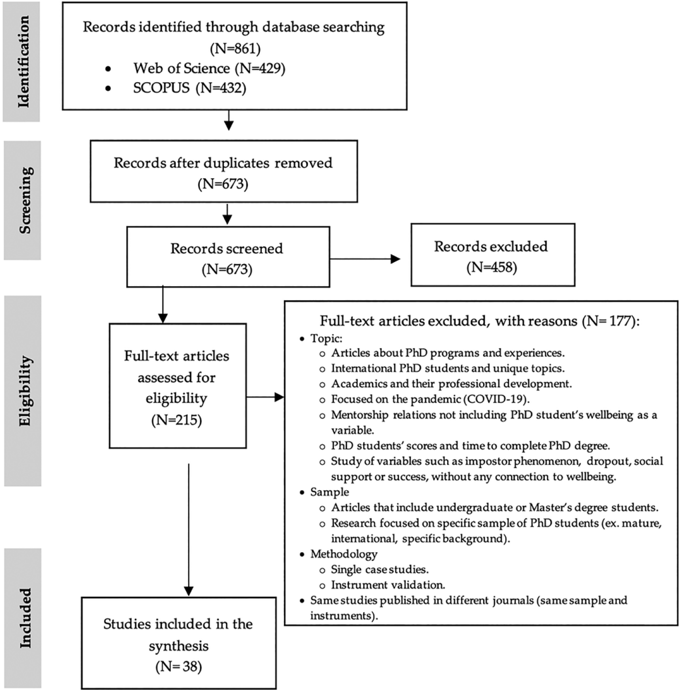
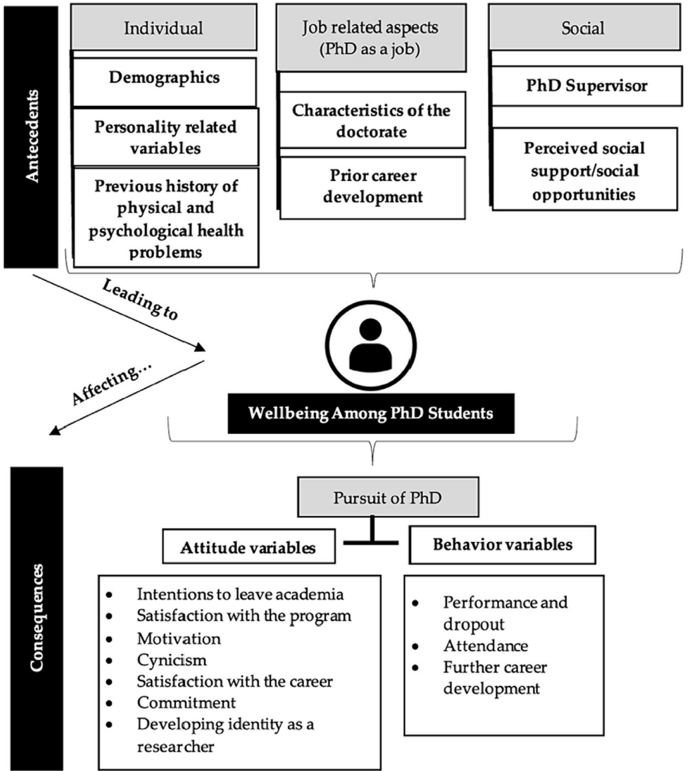
The pursuit of a doctoral degree is a challenging process that can have a negative impact on the wellbeing of PhD students. Therefore, the aim here is to offer a systematic review of the current state of the literature on wellbeing among PhD students and the variables it involves in order to build an integrative model that will enrich future research. The Preferred Reporting Items for Systematic Reviews and Meta‐Analyses (PRISMA) methodology for systematic reviews has been used to lay out the process in a flow diagram. We systematically review studies up to 2021 ( N = 38) published on the Web of Science and SCOPUS databases. The results show the current state of the literature on wellbeing in PhD students, the characteristics of the studies (location, study design, and sample), how the literature defines the concept, the variables involved, the study limitations, and future perspectives to improve the quality of life of doctoral students. Finally, a comprehensive approach to the topic is presented in an integrative model that encompasses all variables identified in the literature and offers a guide for future research.
Overview
The claims and statistics of this paper haven’t been checked yet.
Run the check — free, no account needed. It reads the open-access text and checks the sources it cites.
Integrity signals
Registry
Cites
Statistics
Figures















Verification
Claims the paper makes
The claims and statistics of this paper haven’t been checked yet.
Run the check — free, no account needed. It reads the open-access text and checks the sources it cites.
Claims other papers make about this one
Each is checked against this paper’s own text: does it say what the citing paper says it does?
In the citing paper
“A broader systematic evaluation of other relevant mental health issues remains lacking, including clinically defined syndromes such as social phobia, obsessive-compulsive disorder (OCD), post-traumatic stress disorder (PTSD), attention deficit hyperactivity disorder (ADHD), personality disorders, eating disorders, alcohol and drug abuse, and burnout, as well as common symptoms of psychological”
From Prevalence and severity of mental health problems in early-career researchers: a systematic review and meta-analysis (2026) · cites this paper as [42]
In the citing paper
“Systematic and narrative reviews highlight additional sample-level moderators, including protective and risk factors35–42. These include financial challenges43, self-doubt44, and social and academic loneliness14,45 as risk factors, and suggest social support, a positive and future-oriented mindset, and self-care14 as potential protective factors.”
From Prevalence and severity of mental health problems in early-career researchers: a systematic review and meta-analysis (2026) · cites this paper as [42]
Self-check
Percentages, sums and reported differences re-computed from the paper’s own numbers.
The self-check needs the paper’s full text.
Citations
Cites
Optimizing well-being: The empirical encounter of two traditions.
Keyes, C. L. M., Shmotkin, D., & Ryff, C. D. (2002) · Journal of Personality and Social Psychology · doi:10.1037/0022-3514.82.6.1007 · Cited by 3,322
The World Mental Health Report: Transforming mental health for all
Freeman, M. (2022) · World Psychiatry · doi:10.1002/wps.21018 · Cited by 1,472
Work organization and mental health problems in PhD students
Levecque, K., Anseel, F., De Beuckelaer, A., Van der Heyden, J., & Gisle, L. (2017) · Research Policy · doi:10.1016/j.respol.2017.02.008 · Cited by 1,182
Sverdlik, A., C. Hall, N., McAlpine, L., & Hubbard, K. (2018) · International Journal of Doctoral Studies · doi:10.28945/4113 · Cited by 616
Subjective Well‐Being and Health Behaviors in 2.5 Million Americans
Kushlev, K., Drummond, D. M., & Diener, E. (2020) · Applied Psychology: Health and Well-Being · doi:10.1111/aphw.12178 · Cited by 122
The experienced meaning of working with a PhD thesis
Stubb, J., Pyhältö, K., & Lonka, K. (2012) · Scandinavian Journal of Educational Research · doi:10.1080/00313831.2011.599422 · Cited by 100
Research works printed but not linked: 55
- 10.1108/IJMCE-02-2019-0013 · DOI
- 10.1192/bjo.2021.631 · DOI
- 10.1097/HCM.0000000000000120 · DOI · Paper page
- 10.1108/SGPE-06-2020-0034 · DOI
- 10.1177/0011000008319985 · DOI
- 10.1080/0158037X.2018.1534821 · DOI
- 10.48175/IJARSCT-8345 · DOI
- 10.3390/systems9010017 · DOI
- 10.1037/0033-2909.95.3.542 · DOI · Paper page
- 10.1111/aphw.12090 · DOI
- 10.5502/ijw.v5i2.4 · DOI
- Emmons R. A., 1996, The psychology of action: Linking cognition and motivation to behavior, 313
- Fuentes V., 2015, The thesis and its vicissitudes: Analysis of the experience of doctoral degree candidates in Spain, Opción, 31, 313
- 10.1108/SGPE-07-2020-0045 · DOI
- 10.3390/math8101695 · DOI
- 10.1016/j.jsp.2005.11.001 · DOI · Paper page
- 10.28945/1555 · DOI
- 10.28945/4669 · DOI
- 10.1007/BF00287318 · DOI
- 10.1177/22125868211006206 · DOI
- 10.28945/3396 · DOI
- 10.1080/07448481.2020.1865975 · DOI
- 10.1080/02602938.2011.555816 · DOI
- 10.12738/estp.2019.4.005 · DOI
- 10.1007/978-1-4684-0634-4_2 · DOI
- 10.2147/PRBM.S195131 · DOI · Paper page
- 10.28945/3948 · DOI
- 10.1080/03075079.2020.1744128 · DOI
- 10.1016/j.ijme.2021.100490 · DOI
- 10.1080/07481756.2018.1547619 · DOI
- 10.1371/journal.pmed.1000097 · DOI · Paper page
- 10.1187/cbe.18-09-0198 · DOI · Paper page
- 10.2466/pr0.2001.88.3.759 · DOI
- 10.1016/S1697-2600(13)70007-3 · DOI · Paper page
- 10.1177/1052562920953195 · DOI · Paper page
- 10.1023/A:1006970504138 · DOI
- 10.1037/pac0000450 · DOI
- 10.1080/13548506.2020.1842471 · DOI
- 10.1111/1467-8721.ep10772395 · DOI
- 10.1080/17482631.2018.1508171 · DOI · Paper page
- Szanto Z., 2016, Understanding well‐being. Review of European literature 1995–2014, Journal of Social Research and Policy, 7, 1
- 10.3402/qhw.v9.23059 · DOI
- 10.1177/00207640211032259 · DOI
- 10.1017/SJP.2020.31 · DOI · Paper page
- 10.1080/0158037X.2010.515572 · DOI · Paper page
- 10.1108/SGPE-06-2020-0035 · DOI
- 10.1177/1477971419842887 · DOI
- 10.1080/15236803.2021.1876474 · DOI
- 10.1177/0011000017747548 · DOI
- 10.1016/j.medcli.2010.01.015 · DOI
- 10.1108/HE-11-2020-0112 · DOI
- 10.1037/0033-295x.94.1.3 · DOI · Paper page
- 10.4995/redu.2013.5570 · DOI
- 10.1080/17482631.2019.1598722 · DOI · Paper page
- Yousaf S. U., 2016, Exploring the causes of stress and coping with it amongst doctoral level students: Highlighting the importance of information collection and management, Pakistan Journal of Information Management & Libraries, 18, 12
Cited by
Sorted by citations
Dreisoerner, A., Goetz, V., Frohnmayer, D., Tran, U. S., Voracek, M., & Nater, U. M. (2026) · Nature Human Behaviour · doi:10.1038/s41562-026-02505-5 · Cited by 2
Metadata
- Authors
- Martínez‐García, I., De Witte, H., García‐Martínez, J., & Cano‐García, F. J.
- Venue
- Applied Psychology: Health and Well-Being
- Publisher
- Wiley
- Published
- 2024-04-12
- Volume
- 16
- Issue
- 4
- Pages
- 1565-1583
- ISSN
- 1758-0846
- 1758-0854
- Cited by
- 21
- References
- 6
- Language
- en
About these checks
Registry, retraction, Cites and statistics results are computed, not judged, with one exception: a printed reference that no index lists is read once by a model before it counts as a citation error. Claims are extracted by a model and kept only when their quote appears verbatim in the text; each cited source is then checked, with a model’s help, for whether it says what the claim relies on. Those verdicts can be wrong — read the claim’s quote and the cited source before relying on one.
Statistics and arithmetic are recomputed, not judged.
Confidence bands are shown only for fields calibrated on our annotated test set. None is calibrated yet, so no band is shown.
What counts as a claim ›How we measure confidence ›How we check this ›
Are you an author, or do you see a problem with this page? Request a review
