Cited by 783

The DOI matches its Crossref record; 6 of the 6 references it cites were found in a registry or an index.

Improved base excision repair inhibition and bacteriophage Mu Gam protein yields C:G-to-T:A base editors with higher efficiency and product purity

Komor, Alexis C., Zhao, Kevin T., Packer, Michael S., Gaudelli, Nicole M., Waterbury, Amanda L., Koblan, Luke W., Kim, Y. Bill, Badran, Ahmed H., Liu, David R.·2017·Science Advances

Abstract

Probing base editing outcomes leads to new C:G to T:A base editors with greater efficiency and product purity, and fewer indels.

Overview

The claims and statistics of this paper haven’t been checked yet.

Run the check — free, no account needed. It reads the open-access text and checks the sources it cites.

A few free checks a day · papers already verified open instantly · results are public

Integrity signals

Registry

Crossref · 10.1126/sciadv.aao4774

Cites

6 of 6 references verified0 citation errors · 0 not checkable

Statistics

Figures

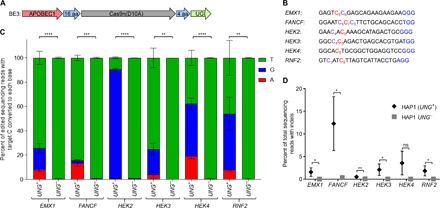
Fig. 1 Effects of knocking out UNG on base editing product purity. (A) Architecture of BE3. (B) Protospacers and PAM (blue) sequences of the genomic loci tested, with the target C’s analyzed in (A) shown in red. (C) HAP1 (UNG+) and HAP1 UNG− cells were treated with BE3, as described in Materials and Methods. The product distribution among edited DNA sequencing reads (reads in which the target C is mutated) is shown. See fig. S1 for C-to-T editing efficiencies, which generally varied between 15 and 45%. (D) Frequency of indel formation following treatment with BE3 in HAP1 or HAP1 UNG− cells. Values and error bars reflect the means and SD of three independent biological replicates performed on different days. ns (not significant), P ≥ 0.05; *P < 0.05; **P < 0.01; ***P < 0.001; ****P < 0.0001, by two-tailed Student’s t test.
Fig. 1 Effects of knocking out UNG on base editing product purity. (A) Architecture of BE3. (B) Protospacers and PAM (blue) sequences of the genomic loci tested, with the target C’s analyzed in (A) shown in red. (C) HAP1 (UNG+) and HAP1 UNG− cells were treated with BE3, as described in Materials and Methods. The product distribution among edited DNA sequencing reads (reads in which the target C is mutated) is shown. See fig. S1 for C-to-T editing efficiencies, which generally varied between 15 and 45%. (D) Frequency of indel formation following treatment with BE3 in HAP1 or HAP1 UNG− cells. Values and error bars reflect the means and SD of three independent biological replicates performed on different days. ns (not significant), P ≥ 0.05; *P < 0.05; **P < 0.01; ***P < 0.001; ****P < 0.0001, by two-tailed Student’s t test.CC BY-NC · PubMed Central
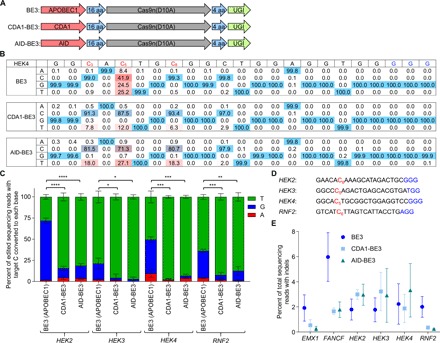
Fig. 2 Effects of multi-C base editing on product purity. (A) Architectures of BE3, CDA1-BE3, and AID-BE3. (B) Representative high-throughput sequencing data of BE3-, CDA1-BE3–, and AID-BE3–treated human HEK293T cells. The sequence of the protospacer is shown at the top, with the PAM in blue and the target C’s in red, with subscripted numbers indicating their position within the protospacer. Underneath each sequence are the percentages of total sequencing reads with the corresponding base. The relative percentage of target C’s that are cleanly edited to T rather than to non-T bases are much higher for cells treated with AID-BE3, which edits three C’s at this locus, than for cells treated with BE3, which edits only one C. (C) HEK293T cells were treated with BE3, CDA1-BE3, and AID-BE3, as described in Materials and Methods. The product distribution among edited DNA sequencing reads (reads in which the target C is mutated) is shown. (D) Protospacers and PAM (blue) sequences of genomic loci studied, with the target C’s analyzed in (B) shown in red. (E) Frequency of indel formation (see Materials and Methods) following the treatment in (A). Values and error bars reflect the means and SD of three independent biological replicates performed on different days. *P < 0.05; **P < 0.01; ***P < 0.001; ****P < 0.0001, by two-tailed Student’s t test.
Fig. 2 Effects of multi-C base editing on product purity. (A) Architectures of BE3, CDA1-BE3, and AID-BE3. (B) Representative high-throughput sequencing data of BE3-, CDA1-BE3–, and AID-BE3–treated human HEK293T cells. The sequence of the protospacer is shown at the top, with the PAM in blue and the target C’s in red, with subscripted numbers indicating their position within the protospacer. Underneath each sequence are the percentages of total sequencing reads with the corresponding base. The relative percentage of target C’s that are cleanly edited to T rather than to non-T bases are much higher for cells treated with AID-BE3, which edits three C’s at this locus, than for cells treated with BE3, which edits only one C. (C) HEK293T cells were treated with BE3, CDA1-BE3, and AID-BE3, as described in Materials and Methods. The product distribution among edited DNA sequencing reads (reads in which the target C is mutated) is shown. (D) Protospacers and PAM (blue) sequences of genomic loci studied, with the target C’s analyzed in (B) shown in red. (E) Frequency of indel formation (see Materials and Methods) following the treatment in (A). Values and error bars reflect the means and SD of three independent biological replicates performed on different days. *P < 0.05; **P < 0.01; ***P < 0.001; ****P < 0.0001, by two-tailed Student’s t test.CC BY-NC · PubMed Central
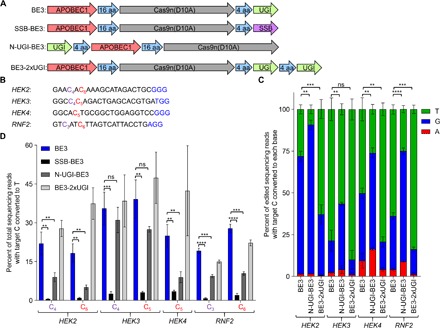
Fig. 3 Effects of changing the architecture of BE3 on C-to-T editing efficiencies and product purities. (A) Architectures of BE3, SSB-BE3, N-UGI-BE3, and BE3-2xUGI. (B) Protospacers and PAM (blue) sequences of genomic loci studied, with the target C’s in (C) shown in purple and red, and the target C’s in (B) shown in red. (C) HEK293T cells were treated with BE3, SSB-BE3, N-UGI-BE3, and BE3-2xUGI, as described in Materials and Methods. The product distribution among edited DNA sequencing reads (reads in which the target C is mutated) is shown for BE3, N-UGI-BE3, and BE3-2xUGI. (D) C-to-T base editing efficiencies. Values and error bars reflect the means and SD of three independent biological replicates performed on different days. ns, P ≥ 0.05; *P < 0.05; **P < 0.01; ***P < 0.001; ****P < 0.0001, by two-tailed Student’s t test.
Fig. 3 Effects of changing the architecture of BE3 on C-to-T editing efficiencies and product purities. (A) Architectures of BE3, SSB-BE3, N-UGI-BE3, and BE3-2xUGI. (B) Protospacers and PAM (blue) sequences of genomic loci studied, with the target C’s in (C) shown in purple and red, and the target C’s in (B) shown in red. (C) HEK293T cells were treated with BE3, SSB-BE3, N-UGI-BE3, and BE3-2xUGI, as described in Materials and Methods. The product distribution among edited DNA sequencing reads (reads in which the target C is mutated) is shown for BE3, N-UGI-BE3, and BE3-2xUGI. (D) C-to-T base editing efficiencies. Values and error bars reflect the means and SD of three independent biological replicates performed on different days. ns, P ≥ 0.05; *P < 0.05; **P < 0.01; ***P < 0.001; ****P < 0.0001, by two-tailed Student’s t test.CC BY-NC · PubMed Central
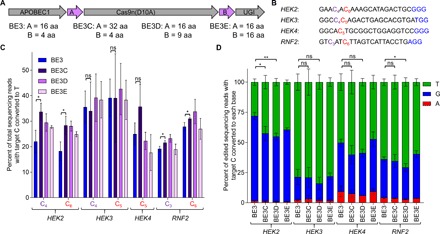
Fig. 4 Effects of linker length variation in BE3 on C-to-T editing efficiencies and product purities. (A) Architecture of BE3, BE3C, BE3D, and BE3E. (B) Protospacers and PAM (blue) sequences of genomic loci studied, with the target C’s in (C) shown in purple and red, and target C’s in (D) shown in red. (C) HEK293T cells were treated with BE3, BE3C, BE3D, or BE3E, as described in Materials and Methods. C-to-T base editing efficiencies are shown. (D) The product distribution among edited DNA sequencing reads (reads in which the target C is mutated) is shown for BE3, BE3C, BE3D, and BE3E. Values and error bars reflect the means and SD of three independent biological replicates performed on different days. ns, P ≥ 0.05; *P < 0.05; **P < 0.01, by two-tailed Student’s t test.
Fig. 4 Effects of linker length variation in BE3 on C-to-T editing efficiencies and product purities. (A) Architecture of BE3, BE3C, BE3D, and BE3E. (B) Protospacers and PAM (blue) sequences of genomic loci studied, with the target C’s in (C) shown in purple and red, and target C’s in (D) shown in red. (C) HEK293T cells were treated with BE3, BE3C, BE3D, or BE3E, as described in Materials and Methods. C-to-T base editing efficiencies are shown. (D) The product distribution among edited DNA sequencing reads (reads in which the target C is mutated) is shown for BE3, BE3C, BE3D, and BE3E. Values and error bars reflect the means and SD of three independent biological replicates performed on different days. ns, P ≥ 0.05; *P < 0.05; **P < 0.01, by two-tailed Student’s t test.CC BY-NC · PubMed Central
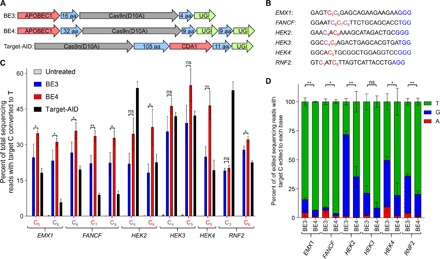
Fig. 5 BE4 increases base editing efficiency and product purities compared to BE3. (A) Architectures of BE3, BE4, and Target-AID. (B) Protospacers and PAM (blue) sequences of genomic loci studied, with the target C’s in (C) shown in purple and red, and the target C’s in (D) shown in red. (C) HEK293T cells were treated with BE3, BE4, or Target-AID, as described in Materials and Methods. C-to-T base editing efficiencies are shown. (D) The product distribution among edited DNA sequencing reads (reads in which the target C is mutated) is shown for BE3 and BE4. Values and error bars reflect the means and SD of three independent biological replicates performed on different days. ns, P ≥ 0.05; *P < 0.05; **P < 0.01, by two-tailed Student’s t test.
Fig. 5 BE4 increases base editing efficiency and product purities compared to BE3. (A) Architectures of BE3, BE4, and Target-AID. (B) Protospacers and PAM (blue) sequences of genomic loci studied, with the target C’s in (C) shown in purple and red, and the target C’s in (D) shown in red. (C) HEK293T cells were treated with BE3, BE4, or Target-AID, as described in Materials and Methods. C-to-T base editing efficiencies are shown. (D) The product distribution among edited DNA sequencing reads (reads in which the target C is mutated) is shown for BE3 and BE4. Values and error bars reflect the means and SD of three independent biological replicates performed on different days. ns, P ≥ 0.05; *P < 0.05; **P < 0.01, by two-tailed Student’s t test.CC BY-NC · PubMed Central
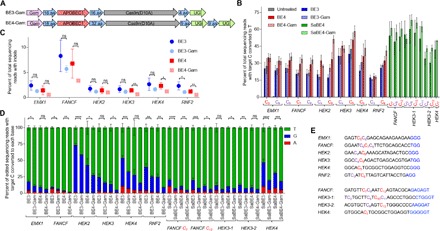
Fig. 6 Fusion with Gam from bacteriophage Mu reduces indel frequencies. (A) Architectures of BE3-Gam and BE4-Gam. (B) HEK293T cells were treated with BE3, BE3-Gam, BE4, BE4-Gam, SaBE3, SaBE3-Gam, SaBE4, or SaBE4-Gam, as described in Materials and Methods. C-to-T base editing efficiencies are shown. (C) Frequency of indel formation (see Materials and Methods) following the treatment in (B). (D) Product distribution among edited DNA sequencing reads (reads in which the target C is mutated). (E) Protospacers and PAM (blue) sequences of genomic loci studied, with the target Cs in (B) shown in purple and red, and the target Cs in (D) shown in red. Values and error bars of BE3-Gam, SaBE3-Gam, BE4-Gam, and SaBE4-Gam reflect the means and SD of three independent biological replicates performed on different days. Values and error bars of BE3, SaBE3, BE4, and SaBE4 reflect the means and SD of six independent biological replicates performed on different days by two different researchers. ns, P ≥ 0.05; *P < 0.05; **P < 0.01; ***P < 0.001; ****P < 0.0001, by two-tailed Student’s t test.
Fig. 6 Fusion with Gam from bacteriophage Mu reduces indel frequencies. (A) Architectures of BE3-Gam and BE4-Gam. (B) HEK293T cells were treated with BE3, BE3-Gam, BE4, BE4-Gam, SaBE3, SaBE3-Gam, SaBE4, or SaBE4-Gam, as described in Materials and Methods. C-to-T base editing efficiencies are shown. (C) Frequency of indel formation (see Materials and Methods) following the treatment in (B). (D) Product distribution among edited DNA sequencing reads (reads in which the target C is mutated). (E) Protospacers and PAM (blue) sequences of genomic loci studied, with the target Cs in (B) shown in purple and red, and the target Cs in (D) shown in red. Values and error bars of BE3-Gam, SaBE3-Gam, BE4-Gam, and SaBE4-Gam reflect the means and SD of three independent biological replicates performed on different days. Values and error bars of BE3, SaBE3, BE4, and SaBE4 reflect the means and SD of six independent biological replicates performed on different days by two different researchers. ns, P ≥ 0.05; *P < 0.05; **P < 0.01; ***P < 0.001; ****P < 0.0001, by two-tailed Student’s t test.CC BY-NC · PubMed Central

Verification

Claims the paper makes

The claims and statistics of this paper haven’t been checked yet.

Run the check — free, no account needed. It reads the open-access text and checks the sources it cites.

A few free checks a day · papers already verified open instantly · results are public

Claims other papers make about this one

Each is checked against this paper’s own text: does it say what the citing paper says it does?

Self-check

Percentages, sums and reported differences re-computed from the paper’s own numbers.

The self-check needs the paper’s full text.

Citations

Cites

Research works printed but not linked: 21

  1. 10.1016/j.cell.2016.10.044 · DOI
  2. A. J. Davis, D. J. Chen, DNA double strand break repair via non-homologous end-joining. Transl. Cancer Res. 2, 130–143 (2013).
  3. M. M. Vilenchik, A. G. Knudson, Endogenous DNA double-strand breaks: Production, fidelity of repair, and induction of cancer. Proc. Natl. Acad. Sci. U.S.A. 100, 12871–12876 (2003). · DOI · Paper page
  4. Y. Miyaoka, J. R. Berman, S. B. Cooper, S. J. Mayerl, A. H. Chan, B. Zhang, G. A. Karlin-Neumann, B. R. Conklin, Systematic quantification of HDR and NHEJ reveals effects of locus, nuclease, and cell type on genome-editing. Sci. Rep. 6, 23549 (2016). · DOI
  5. 10.1038/nbt.3803 · DOI · Paper page
  6. 10.1038/ncomms15790 · DOI · Paper page
  7. 10.1038/nsmb.2019 · DOI
  8. L. H. Pearl, Structure and function in the uracil-DNA glycosylase superfamily. Mutat. Res. 460, 165–181 (2000). · DOI
  9. 10.1038/nmeth.4038 · DOI
  10. 10.1038/nbt.3816 · DOI
  11. Y. Lu, J. K. Zhu, Precise editing of a target base in the rice genome using a modified CRISPR/Cas9 system. Mol. Plant 10, 523–525 (2017). · DOI
  12. Y. Ma, J. Zhang, W. Yin, Z. Zhang, Y. Song, X. Chang, Targeted AID-mediated mutagenesis (TAM) enables efficient genomic diversification in mammalian cells. Nat. Methods 13, 1029–1035 (2016). · DOI
  13. L. Yang, A. W. Briggs, W. L. Chew, P. Mali, M. Guell, J. Aach, D. B. Goodman, D. Cox, Y. Kan, E. Lesha, V. Soundararajan, F. Zhang, G. Church, Engineering and optimising deaminase fusions for genome editing. Nat. Commun. 7, 13330 (2016). · DOI
  14. 10.1038/nbt.3811 · DOI
  15. W. Tang, J. H. Hu, D. R. Liu, Aptazyme-embedded guide RNAs enable ligand-responsive genome editing and transcriptional activation. Nat. Commun. 8, 15939 (2017). · DOI
  16. G. Saraconi, F. Severi, C. Sala, G. Mattiuz, S. G. Conticello, The RNA editing enzyme APOBEC1 induces somatic mutations and a compatible mutational signature is present in esophageal adenocarcinomas. Genome Biol. 15, 417 (2014). · DOI
  17. R. M. Kohli, R. W. Maul, A. F. Guminski, R. L. McClure, K. S. Gajula, H. Saribasak, M. A. McMahon, R. F. Siliciano, P. J. Gearhart, J. T. Stivers, Local sequence targeting in the AID/APOBEC family differentially impacts retroviral restriction and antibody diversification. J. Biol. Chem. 285, 40956–40964 (2010). · DOI
  18. L. Chelico, P. Pham, M. F. Goodman, Stochastic properties of processive cytidine DNA deaminases AID and APOBEC3G. Philos. Trans. R. Soc. Lond. B Biol. Sci. 364, 583–593 (2009). · DOI
  19. E. A. Kouzminova, A. Kuzminov, Patterns of chromosomal fragmentation due to uracil-DNA incorporation reveal a novel mechanism of replication-dependent double-stranded breaks. Mol. Microbiol. 68, 202–215 (2008). · DOI
  20. F. d’Adda di Fagagna, G. R. Weller, A. J. Doherty, S. P. Jackson, The Gam protein of bacteriophage Mu is an orthologue of eukaryotic Ku. EMBO Rep. 4, 47–52 (2003). · DOI
  21. 10.7554/eLife.01222 · DOI

Cited by

Sorted by citations

See all 783

Metadata

Authors
Komor, A. C., Zhao, K. T., Packer, M. S., Gaudelli, N. M., Waterbury, A. L., Koblan, L. W., Kim, Y. B., Badran, A. H., & Liu, D. R.
Affiliations
Department of Chemistry and Chemical Biology, Harvard University, Cambridge, MA 02138, USA.
Venue
Science Advances
Published
2017-08-04
Volume
3
Issue
8
ISSN
2375-2548
Cited by
783
References
6
Language
en
Funders
  • Defense Sciences Office, DARPA (award341255, HR0011-17-2-0049)
  • HHMI (award341256, Liu Investigatorship)
  • NIBIB (award341257, R01 EB022376)
  • NIGMS (award341258, R35 GM118062)

About these checks

Registry, retraction, Cites and statistics results are computed, not judged, with one exception: a printed reference that no index lists is read once by a model before it counts as a citation error. Claims are extracted by a model and kept only when their quote appears verbatim in the text; each cited source is then checked, with a model’s help, for whether it says what the claim relies on. Those verdicts can be wrong — read the claim’s quote and the cited source before relying on one.

Statistics and arithmetic are recomputed, not judged.

Confidence bands are shown only for fields calibrated on our annotated test set. None is calibrated yet, so no band is shown.

What counts as a claim ›How we measure confidence ›How we check this ›

Are you an author, or do you see a problem with this page? Request a review