

Regional and correlative sweat analysis using high-throughput microfluidic sensing patches toward decoding sweat
Open accessThe DOI matches its Crossref record; 49 of the 49 references it cites were found in a registry or an index; 27 of the 56 sources its claims cite were checked for support.
Abstract
], [glucose], and sweat rate in exercise and chemically induced sweat. The patch is demonstrated for investigating regional sweat composition, predicting whole-body fluid/electrolyte loss during exercise, uncovering relationships between sweat metrics, and tracking glucose dynamics to explore sweat-to-blood correlations in healthy and diabetic individuals. By enabling a comprehensive sweat analysis, the presented device is a crucial tool for advancing sweat testing beyond the research stage for point-of-care medical and athletic applications.
Overview
CoChat Summary
## TL;DR
This paper presents a high-throughput, roll-to-roll fabricated wearable microfluidic sweat patch for simultaneous measurement of sweat analytes and sweat rate. Using it, the authors show that regional sweat patterns can help estimate whole-body fluid loss, that sweat sodium and potassium are generally positively correlated within individuals, and that iontophoretic sweat glucose does not robustly predict blood glucose across healthy and diabetic cohorts.
## Key findings
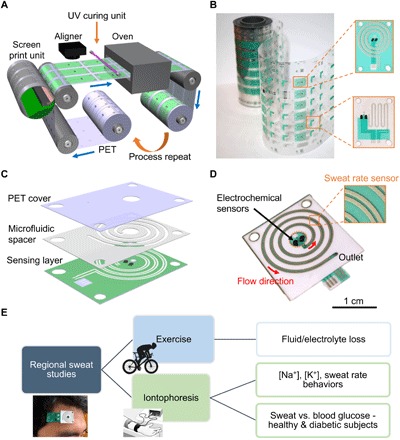
- The patch was fabricated by R2R rotary screen printing and laser cutting, and the authors report production at 60 devices per minute on a 100-m web length.
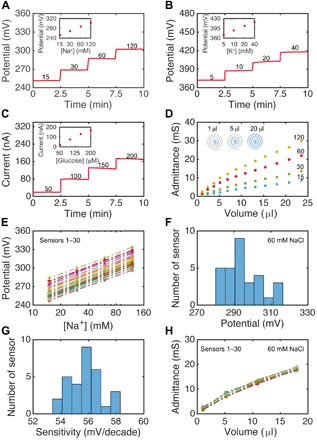
- Functional sensors showed calibration performance of 56.2 mV/decade for Na\+ (with a mean of 55.7 mV/decade, SD 1.1 mV/decade across 30 sensors), 51.3 mV/decade for K\+, and 1.0 nA/μM sensitivity for glucose over 50–200 μM.
- For exercise sweat, sweat [Na\+] and secretion rate were typically positively correlated across regions and subjects; for subject 1, regional sweat rate vs whole-body fluid loss had r = 0.70 (forehead) and r = 0.68 (forearm), with P = 0.012 and 0.014, respectively.
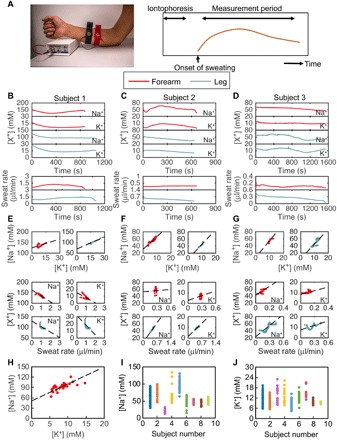
- In iontophoretic sweat, sweat [Na\+] and [K\+] were generally positively correlated within individuals; one subject’s off-body ICP-MS comparison gave Pearson’s r = 0.70.
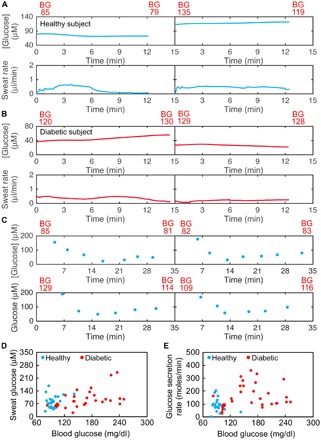
- Across 20 healthy and 28 diabetic subjects, average iontophoretic sweat glucose and blood glucose showed only a mild positive correlation (Pearson’s r = 0.3, P = 0.016); after cohort-wise outlier removal the correlations were 0.28 (healthy, P = 0.167) and 0.42 (diabetic, P = 0.016).
- The authors also report that multiplying sweat glucose by sweat rate gave an even weaker relationship with blood glucose (Pearson’s coefficient = 0.2).
## Methods
- The study combines wearable microfluidic sweat patch design/fabrication with on-body and off-body human sweat measurements. The patch integrates electrochemical sensors for Na\+, K\+, and glucose with an impedance-based sweat rate sensor.
- Human trials included exercise (stationary cycling) and pilocarpine iontophoresis. On-body regional sites included the forehead, underarm, forearm, back, and leg; iontophoresis sweat was collected from the forearm and distal leg.
- Main analyses included sensor calibration in standard solutions, ICP-MS for Na\+ and K\+, HPAEC-PAD / LC for sweat glucose validation, and correlation analyses between regional sweat variables, whole-body fluid loss, and blood glucose.
## Limitations
- The paper states that a simple relation does not seem to exist across healthy and diabetic cohorts for predicting blood glucose from iontophoretic sweat glucose and sweat rate, limiting universal diabetes thresholds.
- The authors explicitly note that their findings do not preclude more complex, individual-specific relations; this means the current analysis is limited by using simple population-level correlations, rather than longitudinal personalized models.
- Evident from the text: some reported findings rely on small numbers of subjects in specific demonstrations (for example, three subjects in some real-time sweat experiments and one-subject examples for certain off-body validations), which limits generalizability.
Model-written summary. Check it against the paper before relying on it.
Integrity signals
Registry
Cites
Statistics
Figures

Verification
Claims the paper makes
16 Valid · 1 Not valid · 6 Not checked · 90 Own results and interpretations
The cited sources support only part of this claim — read each source’s verdict below.
In the paper
“Traditional methods for sweat testing require off-body measurements in specialized settings by trained experts, preventing individuals from monitoring their health status immediately, independently, or routinely (11, 12).”
§ Regional and correlative sweat analysis using high-throughput microfluidic sensing patches toward decoding sweat > INTRODUCTION Sweat is an attractive biofluid for point-of-care health monitoring because it can be locally and noninvasively induced and carries diverse biomolecules ranging from small electrolytes and metabolites to hormones and larger proteins that filter in from deeper in the body (1–5). This ease of access and rich composition give sweat potential to be used to probe the state of the body at a chemical level. Sweat testing has historically been used in applications ranging from medical diagnosis of cystic fibrosis and autonomic neuropathy to assessment of fluid and electrolyte balance in endurance athletes (6–10). Traditional methods for sweat testing require off-body measurements in specialized settings by trained experts, preventing individuals from monitoring their health status immediately, independently, or routinely (11, 12). By taking advantage of flexible and hybrid electronics (13–17), wearable sweat sensors address this limitation by enabling in situ sweat measurements with real-time feedback, creating potential for preventive care, timely diagnosis, and treatment (18–34). Yet, wearable sweat sensor development has stagnated at the experimental and laboratory stage, largely due to an incomplete understanding of sweat dynamics and the physiological information carried in sweat. Sweat behaviors of only a few analytes, including ethanol and chloride, have been extensively investigated and related to blood concentrations or health status (6, 8, 27, 35). Preliminary or small-scale correlation studies have shown promising applications for other analytes such as metabolites and certain neuroimmune biomarkers present in sweat (3, 27–29, 36), including a recent work that shows how exercise sweat glucose of three healthy subjects roughly tracks their blood glucose, making a preliminary case for semiquantitative glucose prediction (29). However, more comprehensive studies are needed to robustly establish the diagnostic utility and limitations of sweat testing in these cases. One of the primary obstacles to conducting the large-scale population studies needed to decode sweat is achieving high-throughput fabrication of sweat sensors with uniform, reliable performance and high yield. This is critical to ensuring that sensors can be deployed with minimal preparatory overhead and produced in large enough quantities to support simultaneous regional sweat measurements in multisubject and longitudinal trials. Roll-to-roll (R2R) rotary screen printing is a promising method for high-throughput and cost-effective fabrication of flexible electronics (37, 38). Laser ablation allows for rapid materials patterning at small scales and is useful for engraving microfluidic channels into flexible plastic substrates (39, 40). These R2R-compatible methods are advantageous over traditional, multistep lithography and etching processes as components can be mass produced on large substrate areas at high speeds using automated systems with minimal human involvement (41). By uniting R2R rotary screen printing of sensing electronics with R2R laser cutting of microfluidic channels, we present a wearable patch that can be mass produced at high yield for simultaneous sweat flow control and electrical/electrochemical sensing. While R2R printing of electrochemical electrodes and microfluidic structures has been previously and independently introduced, the system presented here further demonstrates R2R fabrication of integrated sweat rate sensors and microfluidics, representing a key application-oriented technological advancement that can help decode the rate-dependent modulation of sweat analyte secretion (41, 42). The patch has two aligned layers: The first hosts a patterned electrode system for transducing analyte concentrations and monitoring sweat rate, and the second is a microfluidic adhesive layer with a sweat collection reservoir and a spiral microfluidic channel to guide sweat flow. Encapsulating sweat within the microfluidic facilitates accurate sweat analysis by minimizing evaporation and environmental contamination and providing efficient sweat sampling to reduce mixing and carryover effects. The wearable patch can monitor sweat parameters such as [Na+], [K+], [glucose], and sweat rate simultaneously at diverse regions of the body. We specifically demonstrate its use for applications in exercise physiology and medical health monitoring. Localized sweat behavior is extrapolated to estimate whole-body fluid and electrolyte loss toward dehydration monitoring during exercise. Regional iontophoresis sweat parameters are investigated toward decoding sweat for medical diagnostics, including studying electrolyte relations and the correlation between sweat and blood glucose levels for healthy and diabetic subjects. Through its rapid manufacturability and by enabling diverse analysis of sweat dynamics and composition, the presented device bridges a key gap in our ability to decode sweat toward personalized, point-of-care health and fitness monitoring.
What the sources say
- Not matchedcites [11]
Couldn’t be matched to a paper in Crossref, so it can’t be checked.
- Partly supportedcites [12] sourceExperimental — accuracy not yet measured
The Sweat collection section (page unavailable) describes subjects reporting to a laboratory, and the paper describes subsequent sample analysis with an ion chromatograph. This supports laboratory-based, off-body testing, but the paper does not establish that traditional methods require trained experts or that they prevent immediate, independent, or routine health monitoring. (LLM, conf=0.84)
plainstates a cause- Asserted: passes — The authors put it forward as true.
- Checkable: passes — It can be checked against evidence.
- Load-bearing: passes — The paper’s conclusions depend on it.
- Based: passes — The paper gives a reason why it holds.
- Not matched
The cited sources support only part of this claim — read each source’s verdict below.
In the paper
“These R2R-compatible methods are advantageous over traditional, multistep lithography and etching processes as components can be mass produced on large substrate areas at high speeds using automated systems with minimal human involvement (41).”
§ Regional and correlative sweat analysis using high-throughput microfluidic sensing patches toward decoding sweat > INTRODUCTION Sweat is an attractive biofluid for point-of-care health monitoring because it can be locally and noninvasively induced and carries diverse biomolecules ranging from small electrolytes and metabolites to hormones and larger proteins that filter in from deeper in the body (1–5). This ease of access and rich composition give sweat potential to be used to probe the state of the body at a chemical level. Sweat testing has historically been used in applications ranging from medical diagnosis of cystic fibrosis and autonomic neuropathy to assessment of fluid and electrolyte balance in endurance athletes (6–10). Traditional methods for sweat testing require off-body measurements in specialized settings by trained experts, preventing individuals from monitoring their health status immediately, independently, or routinely (11, 12). By taking advantage of flexible and hybrid electronics (13–17), wearable sweat sensors address this limitation by enabling in situ sweat measurements with real-time feedback, creating potential for preventive care, timely diagnosis, and treatment (18–34). Yet, wearable sweat sensor development has stagnated at the experimental and laboratory stage, largely due to an incomplete understanding of sweat dynamics and the physiological information carried in sweat. Sweat behaviors of only a few analytes, including ethanol and chloride, have been extensively investigated and related to blood concentrations or health status (6, 8, 27, 35). Preliminary or small-scale correlation studies have shown promising applications for other analytes such as metabolites and certain neuroimmune biomarkers present in sweat (3, 27–29, 36), including a recent work that shows how exercise sweat glucose of three healthy subjects roughly tracks their blood glucose, making a preliminary case for semiquantitative glucose prediction (29). However, more comprehensive studies are needed to robustly establish the diagnostic utility and limitations of sweat testing in these cases. One of the primary obstacles to conducting the large-scale population studies needed to decode sweat is achieving high-throughput fabrication of sweat sensors with uniform, reliable performance and high yield. This is critical to ensuring that sensors can be deployed with minimal preparatory overhead and produced in large enough quantities to support simultaneous regional sweat measurements in multisubject and longitudinal trials. Roll-to-roll (R2R) rotary screen printing is a promising method for high-throughput and cost-effective fabrication of flexible electronics (37, 38). Laser ablation allows for rapid materials patterning at small scales and is useful for engraving microfluidic channels into flexible plastic substrates (39, 40). These R2R-compatible methods are advantageous over traditional, multistep lithography and etching processes as components can be mass produced on large substrate areas at high speeds using automated systems with minimal human involvement (41). By uniting R2R rotary screen printing of sensing electronics with R2R laser cutting of microfluidic channels, we present a wearable patch that can be mass produced at high yield for simultaneous sweat flow control and electrical/electrochemical sensing. While R2R printing of electrochemical electrodes and microfluidic structures has been previously and independently introduced, the system presented here further demonstrates R2R fabrication of integrated sweat rate sensors and microfluidics, representing a key application-oriented technological advancement that can help decode the rate-dependent modulation of sweat analyte secretion (41, 42). The patch has two aligned layers: The first hosts a patterned electrode system for transducing analyte concentrations and monitoring sweat rate, and the second is a microfluidic adhesive layer with a sweat collection reservoir and a spiral microfluidic channel to guide sweat flow. Encapsulating sweat within the microfluidic facilitates accurate sweat analysis by minimizing evaporation and environmental contamination and providing efficient sweat sampling to reduce mixing and carryover effects. The wearable patch can monitor sweat parameters such as [Na+], [K+], [glucose], and sweat rate simultaneously at diverse regions of the body. We specifically demonstrate its use for applications in exercise physiology and medical health monitoring. Localized sweat behavior is extrapolated to estimate whole-body fluid and electrolyte loss toward dehydration monitoring during exercise. Regional iontophoresis sweat parameters are investigated toward decoding sweat for medical diagnostics, including studying electrolyte relations and the correlation between sweat and blood glucose levels for healthy and diabetic subjects. Through its rapid manufacturability and by enabling diverse analysis of sweat dynamics and composition, the presented device bridges a key gap in our ability to decode sweat toward personalized, point-of-care health and fitness monitoring.
What the sources say
- Partly supportedcites [41] sourceExperimental — accuracy not yet measured
The Abstract says R2R printing offers high-speed, large-area fabrication advantages over photolithography, and the R2R Gravure Printing section reports producing 150,000 electrodes on a 150 m web in about 30 minutes. The copy does not establish the comparison with etching or the claim that production requires minimal human involvement. Page numbers are not available in the supplied copy. (LLM, conf=0.85)
plainstates a cause- Asserted: passes — The authors put it forward as true.
- Checkable: passes — It can be checked against evidence.
- Load-bearing: passes — The paper’s conclusions depend on it.
- Based: passes — The paper gives a reason why it holds.
- Partly supported
The cited sources support only part of this claim — read each source’s verdict below.
In the paper
“Roll-to-roll (R2R) rotary screen printing is a promising method for high-throughput and cost-effective fabrication of flexible electronics (37, 38).”
§ Regional and correlative sweat analysis using high-throughput microfluidic sensing patches toward decoding sweat > INTRODUCTION Sweat is an attractive biofluid for point-of-care health monitoring because it can be locally and noninvasively induced and carries diverse biomolecules ranging from small electrolytes and metabolites to hormones and larger proteins that filter in from deeper in the body (1–5). This ease of access and rich composition give sweat potential to be used to probe the state of the body at a chemical level. Sweat testing has historically been used in applications ranging from medical diagnosis of cystic fibrosis and autonomic neuropathy to assessment of fluid and electrolyte balance in endurance athletes (6–10). Traditional methods for sweat testing require off-body measurements in specialized settings by trained experts, preventing individuals from monitoring their health status immediately, independently, or routinely (11, 12). By taking advantage of flexible and hybrid electronics (13–17), wearable sweat sensors address this limitation by enabling in situ sweat measurements with real-time feedback, creating potential for preventive care, timely diagnosis, and treatment (18–34). Yet, wearable sweat sensor development has stagnated at the experimental and laboratory stage, largely due to an incomplete understanding of sweat dynamics and the physiological information carried in sweat. Sweat behaviors of only a few analytes, including ethanol and chloride, have been extensively investigated and related to blood concentrations or health status (6, 8, 27, 35). Preliminary or small-scale correlation studies have shown promising applications for other analytes such as metabolites and certain neuroimmune biomarkers present in sweat (3, 27–29, 36), including a recent work that shows how exercise sweat glucose of three healthy subjects roughly tracks their blood glucose, making a preliminary case for semiquantitative glucose prediction (29). However, more comprehensive studies are needed to robustly establish the diagnostic utility and limitations of sweat testing in these cases. One of the primary obstacles to conducting the large-scale population studies needed to decode sweat is achieving high-throughput fabrication of sweat sensors with uniform, reliable performance and high yield. This is critical to ensuring that sensors can be deployed with minimal preparatory overhead and produced in large enough quantities to support simultaneous regional sweat measurements in multisubject and longitudinal trials. Roll-to-roll (R2R) rotary screen printing is a promising method for high-throughput and cost-effective fabrication of flexible electronics (37, 38). Laser ablation allows for rapid materials patterning at small scales and is useful for engraving microfluidic channels into flexible plastic substrates (39, 40). These R2R-compatible methods are advantageous over traditional, multistep lithography and etching processes as components can be mass produced on large substrate areas at high speeds using automated systems with minimal human involvement (41). By uniting R2R rotary screen printing of sensing electronics with R2R laser cutting of microfluidic channels, we present a wearable patch that can be mass produced at high yield for simultaneous sweat flow control and electrical/electrochemical sensing. While R2R printing of electrochemical electrodes and microfluidic structures has been previously and independently introduced, the system presented here further demonstrates R2R fabrication of integrated sweat rate sensors and microfluidics, representing a key application-oriented technological advancement that can help decode the rate-dependent modulation of sweat analyte secretion (41, 42). The patch has two aligned layers: The first hosts a patterned electrode system for transducing analyte concentrations and monitoring sweat rate, and the second is a microfluidic adhesive layer with a sweat collection reservoir and a spiral microfluidic channel to guide sweat flow. Encapsulating sweat within the microfluidic facilitates accurate sweat analysis by minimizing evaporation and environmental contamination and providing efficient sweat sampling to reduce mixing and carryover effects. The wearable patch can monitor sweat parameters such as [Na+], [K+], [glucose], and sweat rate simultaneously at diverse regions of the body. We specifically demonstrate its use for applications in exercise physiology and medical health monitoring. Localized sweat behavior is extrapolated to estimate whole-body fluid and electrolyte loss toward dehydration monitoring during exercise. Regional iontophoresis sweat parameters are investigated toward decoding sweat for medical diagnostics, including studying electrolyte relations and the correlation between sweat and blood glucose levels for healthy and diabetic subjects. Through its rapid manufacturability and by enabling diverse analysis of sweat dynamics and composition, the presented device bridges a key gap in our ability to decode sweat toward personalized, point-of-care health and fitness monitoring.
What the sources say
- Supportedcites [37] source
The Screen Printing subsection (Non-Contact Printing Technologies) states that flatbed and rotary screen assemblies are both used for R2R manufacturing, that rotary screens substitute flatbed screens 'for continuous processing', and that 'relatively high speeds can be achieved by rotary screen as compared to flatbed', while describing screen-printing as adding 'simplicity, affordability, speed and adaptability'. The R2R Printing section lists 'rotary screen-printing' among the favorable candidates for R2R configuration and describes R2R as having 'the potential for a continuous and high throughput process', and Section IV states printing technologies enable large-area electronics and sensors by R2R 'in a cost effective way'. The only qualification is the noted drawback that rotary screens are expensive and hard to clean, which does not contradict the 'promising' framing. (LLM, conf=0.88)
- Partly supportedcites [38] sourceExperimental — accuracy not yet measured
The paper says additive printing can reduce costs and enable high-speed roll-to-roll manufacture on flexible substrates; it also describes screen printing as fast (Abstract, page not provided). It does not specifically discuss roll-to-roll rotary screen printing, and its Methods describe screen printing on PET substrates rather than a rotary roll-to-roll process. (LLM, conf=0.85)
plain- Asserted: passes — The authors put it forward as true.
- Checkable: passes — It can be checked against evidence.
- Load-bearing: passes — The paper’s conclusions depend on it.
- Based: passes — The paper gives a reason why it holds.
- Supported
The cited sources support only part of this claim — read each source’s verdict below.
In the paper
“Sweat behaviors of only a few analytes, including ethanol and chloride, have been extensively investigated and related to blood concentrations or health status (6, 8, 27, 35).”
§ Regional and correlative sweat analysis using high-throughput microfluidic sensing patches toward decoding sweat > INTRODUCTION Sweat is an attractive biofluid for point-of-care health monitoring because it can be locally and noninvasively induced and carries diverse biomolecules ranging from small electrolytes and metabolites to hormones and larger proteins that filter in from deeper in the body (1–5). This ease of access and rich composition give sweat potential to be used to probe the state of the body at a chemical level. Sweat testing has historically been used in applications ranging from medical diagnosis of cystic fibrosis and autonomic neuropathy to assessment of fluid and electrolyte balance in endurance athletes (6–10). Traditional methods for sweat testing require off-body measurements in specialized settings by trained experts, preventing individuals from monitoring their health status immediately, independently, or routinely (11, 12). By taking advantage of flexible and hybrid electronics (13–17), wearable sweat sensors address this limitation by enabling in situ sweat measurements with real-time feedback, creating potential for preventive care, timely diagnosis, and treatment (18–34). Yet, wearable sweat sensor development has stagnated at the experimental and laboratory stage, largely due to an incomplete understanding of sweat dynamics and the physiological information carried in sweat. Sweat behaviors of only a few analytes, including ethanol and chloride, have been extensively investigated and related to blood concentrations or health status (6, 8, 27, 35). Preliminary or small-scale correlation studies have shown promising applications for other analytes such as metabolites and certain neuroimmune biomarkers present in sweat (3, 27–29, 36), including a recent work that shows how exercise sweat glucose of three healthy subjects roughly tracks their blood glucose, making a preliminary case for semiquantitative glucose prediction (29). However, more comprehensive studies are needed to robustly establish the diagnostic utility and limitations of sweat testing in these cases. One of the primary obstacles to conducting the large-scale population studies needed to decode sweat is achieving high-throughput fabrication of sweat sensors with uniform, reliable performance and high yield. This is critical to ensuring that sensors can be deployed with minimal preparatory overhead and produced in large enough quantities to support simultaneous regional sweat measurements in multisubject and longitudinal trials. Roll-to-roll (R2R) rotary screen printing is a promising method for high-throughput and cost-effective fabrication of flexible electronics (37, 38). Laser ablation allows for rapid materials patterning at small scales and is useful for engraving microfluidic channels into flexible plastic substrates (39, 40). These R2R-compatible methods are advantageous over traditional, multistep lithography and etching processes as components can be mass produced on large substrate areas at high speeds using automated systems with minimal human involvement (41). By uniting R2R rotary screen printing of sensing electronics with R2R laser cutting of microfluidic channels, we present a wearable patch that can be mass produced at high yield for simultaneous sweat flow control and electrical/electrochemical sensing. While R2R printing of electrochemical electrodes and microfluidic structures has been previously and independently introduced, the system presented here further demonstrates R2R fabrication of integrated sweat rate sensors and microfluidics, representing a key application-oriented technological advancement that can help decode the rate-dependent modulation of sweat analyte secretion (41, 42). The patch has two aligned layers: The first hosts a patterned electrode system for transducing analyte concentrations and monitoring sweat rate, and the second is a microfluidic adhesive layer with a sweat collection reservoir and a spiral microfluidic channel to guide sweat flow. Encapsulating sweat within the microfluidic facilitates accurate sweat analysis by minimizing evaporation and environmental contamination and providing efficient sweat sampling to reduce mixing and carryover effects. The wearable patch can monitor sweat parameters such as [Na+], [K+], [glucose], and sweat rate simultaneously at diverse regions of the body. We specifically demonstrate its use for applications in exercise physiology and medical health monitoring. Localized sweat behavior is extrapolated to estimate whole-body fluid and electrolyte loss toward dehydration monitoring during exercise. Regional iontophoresis sweat parameters are investigated toward decoding sweat for medical diagnostics, including studying electrolyte relations and the correlation between sweat and blood glucose levels for healthy and diabetic subjects. Through its rapid manufacturability and by enabling diverse analysis of sweat dynamics and composition, the presented device bridges a key gap in our ability to decode sweat toward personalized, point-of-care health and fitness monitoring.
What the sources say
- Not checked — no full text of the sourcecites [6] source
- Not checked — no full text of the sourcecites [8] source
- Partly supportedcites [27] sourceExperimental — accuracy not yet measured
The Significance section (page not provided) describes sweat chloride testing as an established diagnostic measure for cystic fibrosis and reports higher sweat chloride in patients than in healthy subjects. The References list names studies relating sweat ethanol to blood alcohol, but this paper does not establish the broader claim that only a few analytes have been extensively investigated. (LLM, conf=0.83)
- Not checked — no full text of the sourcecites [35] source
plainstates an association- Asserted: passes — The authors put it forward as true.
- Checkable: passes — It can be checked against evidence.
- Load-bearing: passes — The paper’s conclusions depend on it.
- Based: passes — The paper gives a reason why it holds.
The cited sources support only part of this claim — read each source’s verdict below.
In the paper
“As both Na+ and K+ in sweat share Cl− as their primary counter ion, a balance between the cation levels is consistent with the fluid’s overall charge neutrality (21).”
§ Regional and correlative sweat analysis using high-throughput microfluidic sensing patches toward decoding sweat > RESULTS AND DISCUSSION > Iontophoretic sweat relations While understanding the composition of exercise sweat is important for athletic and physiology applications, chemically induced sweat is more useful for medical diagnostics in sedentary conditions (27). For this reason, we further study sweat induced through pilocarpine iontophoresis. Figure 4 explores electrolyte trends in iontophoretic sweat obtained from two locations, the forearm and lower leg. Figure 4 (B to D) shows real-time simultaneous measurement of sweat [Na+], [K+], and secretion rate for three subjects. The time delay for onset of sweating, which is typically within 3 min after the completion of iontophoresis, is adjusted to zero for display purposes. All three subjects show slightly higher [Na+] levels for their arm compared to their leg, with comparable sweat rates in both locations. Here, subject 1 in Figs. 3E and 4E is the same subject. However, the forearm sweat [Na+] shows very different behavior in exercise and iontophoresis sweat as stimulation mechanism for sweat secretion differs. In addition, sweat [Na+] is easily influenced by factors such as sweat secretion rate and hydration status. We also observed considerable amount of variations in sweat concentration and secretion rate on single individual from day to day. All these factors can have possible contributions on observed difference in [Na+]. Figure 4 (E to G) explores the relationship between these parameters in more detail based on data obtained in Fig. 4 (B to D). While subjects 2 and 3 have [Na+] and [K+] increasing with sweat rate, subject 1 consistently shows the opposite trend. For all subjects, [Na+] and [K+] levels are positively correlated. This is corroborated by data from sweat samples collected and tested off-body using a commercial inductively coupled plasma mass spectrometry (ICP-MS) tool, as shown in Fig. 4H, for one subject whose [Na+] and [K+] levels have a Pearson’s correlation coefficient of 0.70. Similar strong correlations are found for other subjects in fig. S6. Over the course of several iontophoresis trials, it is possible to build the range of [Na+] and [K+] in the sweat of each subject. Comparing these ranges across individuals in Fig. 4 (I and J), subjects with relatively higher [Na+] tend to have lower [K+]. As both Na+ and K+ in sweat share Cl− as their primary counter ion, a balance between the cation levels is consistent with the fluid’s overall charge neutrality (21).
What the sources say
- Partly supportedcites [21] sourceExperimental — accuracy not yet measured
The Ions (mM) section identifies Na⁺ and Cl⁻ as abundant sweat ions and says Na⁺ enters the gland lumen to restore charge neutrality. It does not say that a balance between Na⁺ and K⁺ levels maintains neutrality; it instead notes that other anions, including bicarbonate, contribute to sweat’s ionic composition. (LLM, conf=0.84)
plainstates an association- Asserted: passes — The authors put it forward as true.
- Checkable: passes — It can be checked against evidence.
- Load-bearing: unclear — It is unclear whether the paper’s conclusions depend on it.
- Based: passes — The paper gives a reason why it holds.
- Partly supported
59 more claims · 1 with their cited sources checked
Create a free account to see all 113 claims and to verify the 1 reference still open.
- Probably not a substantial claim. 18
- It may state two separate claims as one. 36
Claims other papers make about this one
Each is checked against this paper’s own text: does it say what the citing paper says it does?
The source backs part of the claim, not all of it — or backs it for a different population, condition or comparison.
In the citing paper
“For this reason, most wearable sweat sensors have focused on exercise, thermal, or chemically stimulated sweat produced at rates of 10’s or 100’s of nL min−1 cm−2 or higher10–23.”
From A wearable patch for continuous analysis of thermoregulatory sweat at rest (2021) · cites this paper as [17]
Experimental — accuracy not yet measuredThe cited source says what the claim attributes to it.
In the citing paper
“Another study found a significant correlation in diabetic patients, but not healthy participants (Nyein et al. 2019).”
From Physiological mechanisms determining eccrine sweat composition (2020) · cites this paper as Nyein et al. 2019
The check wasn’t confident either way, so it gives no verdict — never disputed.
In the citing paper
“They are unable to draw low volumes of resting sweat rapidly into the device, limiting real-time assessment.”
From A wearable patch for continuous analysis of thermoregulatory sweat at rest (2021) · cites this paper as [17]
Experimental — accuracy not yet measured
Citations
Cites
Fully integrated wearable sensor arrays for multiplexed in situ perspiration analysis
Gao, W., Emaminejad, S., Nyein, H. Y. Y., Challa, S., Chen, K., Peck, A., Fahad, H. M., Ota, H., Shiraki, H., Kiriya, D., et al. (2016) · Nature · doi:10.1038/nature16521 · Cited by 5,087
Self-citationAn ultra-lightweight design for imperceptible plastic electronics
Kaltenbrunner, M., Sekitani, T., Reeder, J., Yokota, T., Kuribara, K., Tokuhara, T., Drack, M., Schwödiauer, R., Graz, I., Bauer-Gogonea, S., et al. (2013) · Nature · doi:10.1038/nature12314 · Cited by 2,485
Skin electronics from scalable fabrication of an intrinsically stretchable transistor array
Wang, S., Xu, J., Wang, W., Wang, G.-J. N., Rastak, R., Molina-Lopez, F., Chung, J. W., Niu, S., Feig, V. R., Lopez, J., et al. (2018) · Nature · doi:10.1038/nature25494 · Cited by 2,198
Lee, H., Choi, T. K., Lee, Y. B., Cho, H. R., Ghaffari, R., Wang, L., Choi, H. J., Chung, T. D., Lu, N., Hyeon, T., et al. (2016) · Nature Nanotechnology · doi:10.1038/nnano.2016.38 · Cited by 1,802
Gibson, L. E., & Cooke, R. E. (1959) · Pediatrics · doi:10.1542/peds.23.3.545 · Cited by 1,434
Wearable and flexible electronics for continuous molecular monitoring
Yang, Y., & Gao, W. (2019) · Chemical Society Reviews · doi:10.1039/c7cs00730b · Cited by 1,315
Technologies for Printing Sensors and Electronics Over Large Flexible Substrates: A Review
Khan, S., Lorenzelli, L., & Dahiya, R. S. (2015) · IEEE Sensors Journal · doi:10.1109/jsen.2014.2375203 · Cited by 1,225
Highly ordered nanowire arrays on plastic substrates for ultrasensitive flexible chemical sensors
McAlpine, M. C., Ahmad, H., Wang, D., & Heath, J. R. (2007) · Nature Materials · doi:10.1038/nmat1891 · Cited by 959
Imani, S., Bandodkar, A. J., Mohan, A. M. V., Kumar, R., Yu, S., Wang, J., & Mercier, P. P. (2016) · Nature Communications · doi:10.1038/ncomms11650 · Cited by 861
Emaminejad, S., Gao, W., Wu, E., Davies, Z. A., Yin Yin Nyein, H., Challa, S., Ryan, S. P., Fahad, H. M., Chen, K., Shahpar, Z., et al. (2017) · Proceedings of the National Academy of Sciences · doi:10.1073/pnas.1701740114 · Cited by 839
Self-citation
Research works printed but not linked: 1
- L. B. Baker, Sweat testing methodology in the field: Challenges and best practices. Sports Sci. Exchange 28, 1–6 (2016).
Cited by
Items 301–384 of 384
Wearable noninvasive glucose sensors based on graphene and other carbon materials
Antonova, I. V., & Ivanov, A. I. (2023) · Physics-Uspekhi · doi:10.3367/ufne.2023.08.039541 · Cited by 3
cirCAT: Cat Centered Smart Home System and Veterinary Complementary Devices
Sun, S., & Vega, K. (2023) · doi:10.1145/3637882.3637901 · Cited by 3
Design and research of the one-way microsphere valve and the PDMS film electromagnetic micropump
Miao, X., Lu, H., Chen, H., & Liu, S. (2022) · Microfluidics and Nanofluidics · doi:10.1007/s10404-022-02571-x · Cited by 3
Nanosensors for medical diagnosis
Saylan, Y., Akgönüllü, S., & Deni̇zli̇, A. (2021) · Elsevier eBooks · doi:10.1016/b978-0-12-823971-1.00016-7 · Cited by 3
Effects of Sensor Design on the Performance of Wearable Sweat Monitors
Wang, Z., Alwattar, A. A., Quayle, P., Batchelor, J. C., & Casson, A. J. (2022) · Proceedings of IEEE Sensors/Proceedings of IEEE Sensors ... · doi:10.1109/sensors52175.2022.9967139 · Cited by 4
Yin, X., Peri, E., Pelssers, E., den Toonder, J. M. J., & Mischi, M. (2025) · Medical & Biological Engineering & Computing · doi:10.1007/s11517-025-03393-z · Cited by 3
Basumatary, I., Chauhan, S. S., Venuganti, V. V. K., & Sahatiya, P. (2025) · Journal of Materials Chemistry B · doi:10.1039/d5tb00804b · Cited by 2
Inukonda, S. M., & Panda, S. (2025) · npj Flexible Electronics · doi:10.1038/s41528-025-00439-y · Cited by 2
Highly Deformable Microfluidic Sweat Sensors Fabricated via Roll‐to‐Roll Scalable Processes
Kim, S., Davis, N., Qing, N., Gillan, L., Hakola, E., Huttunen, O., Hiitola‐Keinänen, J., Song, Y., Lee, Y., Cho, S., et al. (2025) · Advanced Materials Technologies · doi:10.1002/admt.202501350 · Cited by 4
“Rotary screen printing enables roll-to-roll (R2R) production, providing high throughput large area coverage [ 13–15 ].”
Self-citationMultimodal flexible sensor system toward telediagnosis
Lee, D. H., & Takei, K. (2026) · Proceedings of the Japan Academy Series B · doi:10.2183/pjab.102.004 · Cited by 2
Extracellular Vesicles in Wearable Delivery Systems for Cosmeceutical Applications
Wen, T., Gu, Y., & Liu, G. (2026) · Advanced Healthcare Materials · doi:10.1002/adhm.71379 · Cited by 3
Kim, H.-S., & Suh, J. (2024) · Elsevier eBooks · doi:10.1016/b978-0-323-99147-6.00008-9 · Cited by 4
GluCAT: A Feline Biofluids IoT Hub for Electrochemical Glucose Biosensing
Sun, S., Reagan, K. L., Şeker, E., et al. (2024) · doi:10.1145/3623509.3635250 · Cited by 2
He, A., Wang, X., Zhang, L., Zhang, H., Xu, X., Yu, C., Ma, Y., Wei, W., & Niu, P. (2024) · Nanotechnology and Precision Engineering · doi:10.1063/10.0028758 · Cited by 2
Application of Large-Scale Fabrication Techniques for Development of Electrochemical Biosensors
Cagnani, G. R., & Ibáñez-Redín, G. (2022) · Springer eBooks · doi:10.1007/978-3-030-97921-8_4 · Cited by 3
3D Printed Flexible Photoplethysmography Sensor Array for Tissue Oximetry
Petreikis, M., & Tiwari, M. K. (2022) · IEEE International Conference on Flexible and Printable Sensors and Systems (FLEPS) · doi:10.1109/fleps53764.2022.9781543 · Cited by 2
“temperature [1, 2], pressure [3-5], blood oxygen [6-9] measurements, sweat analysis [10-14], have become increasingly more common both in research and commercial settings in the last ten years.”
BackgroundShielding-Sensing Integrated Multilayer PET–Carbon Nanotube Composites for 5G Applications
Guo, Y., Rosenkranz, A., Xu, Y., et al. (2022) · ACS Applied Electronic Materials · doi:10.1021/acsaelm.2c00951 · Cited by 2
Microscopy-Guided 3-D Reconstruction of Nanodendrites in Biosensors
Fan, S.-Y., Huang, Y.-P., Khuntia, S., Chang, J.-W., Liou, C.-R., Zhang, B., & Tai, L. (2023) · IEEE Sensors Journal · doi:10.1109/jsen.2023.3259420 · Cited by 2
“3259420 [2], [3], [4], [5], [6], [7], [8], [9], [10], [11], [12], [13], [14], [15], [16], the ability to optimize the sensors’ sensitivity via”
Self-citationYeung, S. Y., Lin, H., Li, Y., Fung, C. W., Nyein, H. Y. Y., & Hsing, I. (2025) · bioRxiv (Cold Spring Harbor Laboratory) · doi:10.1101/2025.01.26.630991 · Cited by 4
Self-citationPark, J. H., Park, H. J., Jang, S. T., Kim, J., Yoon, J. H., Lee, K. G., & Choi, B. G. (2025) · Physica Scripta · doi:10.1088/1402-4896/adab3f · Cited by 1
Lv, F., Zhao, R., Chen, Z., Wang, S., Huang, Y., & Wang, L. (2025) · Sensors and Actuators A Physical · doi:10.1016/j.sna.2025.116245 · Cited by 1
Tu, A., Lai, K., Lai, J., He, S., Xiao, L., Aw, K. C., Gao, J., & Jiang, H. (2025) · IEEE Sensors Journal · doi:10.1109/jsen.2025.3567150 · Cited by 2
“Meanwhile, a microfluidic platform was introduced with the help of photolithography [30], and the roll-to-roll (R2R) process [36], in which 30 Na sensors exhibited the electrode reproducibility with their standard potentials within 37 mV and sensitivities tightly distributed around 55.7 mV/decade.”
InfluentialYu, Z., Wang, H., He, Y., Chen, R., Tang, X., & Xiong, B. (2025) · Chemosensors · doi:10.3390/chemosensors13070252 · Cited by 1
Wang, X., Ma, Y., Zeng, M., & Niu, P. (2025) · IEEE Transactions on Biomedical Engineering · doi:10.1109/tbme.2025.3600238 · Cited by 2
“Current wearable sweat sensing systems always collect sweat over relatively large skin areas [7], [8], [16], [17], [19], [20], [21] (several tens of mm 2 ), capturing a pooled sample from multiple eccrine glands.”
Skin of the future? - Decoding electronic skin and a comprehensive review of the latest developments
Sankar, S. D. (2025) · Cosmoderma · doi:10.25259/csdm_123_2025 · Cited by 1
Multimodal flexible sensors for edge AI system
Nakamura, H., Seimiya, N., & Takei, K. (2025) · Applied Physics Express · doi:10.35848/1882-0786/ae1367 · Cited by 2
Zhang, Y., Zhong, B., Yuan, Y., Xu, K., Yu, Y., Lou, Z., & Wang, L. (2026) · Advanced Materials Technologies · doi:10.1002/admt.202502662 · Cited by 3
Sweat components as a promising monitoring tool for systemic diseases
Shi, C., Chen, Z., Zhang, L., Zhang, X., Liang, X., Yan, L., Hao, X., Dong, G., Lu, C., & Huang, L. (2026) · The Journal of Physiological Sciences · doi:10.1016/j.jphyss.2026.100068 · Cited by 2
Umapathi, K. (2026) · Analytical Methods · doi:10.1039/d6ay00459h · Cited by 2
From Materials Design to Device Assembly: Advanced Biosensors for Smart Healthcare
Xiao, Y., Sun, Y., Sun, T., Huang, G., Zhao, Z., & Xuanyong, L. I. U. (2026) · Advanced Functional Materials · doi:10.1002/adfm.75931 · Cited by 7
Ion sensing in body fluids: Recent progress and perspectives
Ling, H., Yan, J., Han, J., (294193), J. C., Guo, J., & Li, D. (2026) · TrAC Trends in Analytical Chemistry · doi:10.1016/j.trac.2026.118955 · Cited by 1
Barazandegan, Y., Kc, D., Iha, R., Tu, N., Ryan, N., Martano, P., Jones, X., Yang, J., Mu, R., & Yang, Q. (2026) · Micromachines · doi:10.3390/mi17060725 · Cited by 1
“Smart tattoos and sweat-based biosensors utilize ion-selective electrodes to detect physiological biomarkers, providing a non-invasive alternative to conventional blood-based diagnostic methods [174,175].”
Fu, L., Lv, Y., Chen, F., Zhao, S., Lin, C., & Karimi-Maleh, H. (2026) · TrAC Trends in Analytical Chemistry · doi:10.1016/j.trac.2026.119022 · Cited by 1
Aerospace biomedical testing and future development
Yang, C., AnYi, L. I., Lv, X., Zhao, L., Zou, Y., Zhe, L. I., Li, X., Zhang, Y., Li, N., Chen, Z., et al. (2023) · Scientia Sinica Technologica · doi:10.1360/sst-2022-0416 · Cited by 1
Lu, D., Yang, C., Chen, L., Cao, C., Xia, W., Li, G., & Wen, D. (2023) · Electroanalysis · doi:10.1002/elan.202300385 · Cited by 1
Wearable Health Monitoring System for Sweat Analysis
Pagar, V., Bhadane, P. K., & Shaligram, A. D. (2024) · Communications in computer and information science · doi:10.1007/978-3-031-54547-4_31 · Cited by 1
Zhou, Y. J., Xiao, W., Tian, G., Zhang, S., Wei, X., & Li, J. (2024) · Microchimica Acta · doi:10.1007/s00604-024-06313-4 · Cited by 1
Shen, T., Chen, Y., Chang, J., et al. (2020) · Sensors · doi:10.3390/s20247062 · Cited by 1
Wei, L., Lv, Z., He, Y., et al. (2022) · SSRN Electronic Journal · doi:10.2139/ssrn.4173992 · Cited by 1
Encapsulation of Hydrogel SensorsPreprint
Huang, X., & Zhang, L. (2023) · SSRN Electronic Journal · doi:10.2139/ssrn.4653615 · Cited by 1
Nagamine, K., & Tokito, S. (2020) · Denki Kagaku · doi:10.5796/denkikagaku.20-fe0031
Cáparra, parada y fonda en la Vía de la Plata
Uceta, A. D. (2003) · La Aventura de la historia
A review of noninvasive methods applied in diabetes management and treatment
Rydosz, A. M. (2022) · Elsevier eBooks · doi:10.1016/b978-0-323-99887-1.00004-2
Jia, H. (2022) · Elsevier eBooks · doi:10.1016/b978-0-323-91369-0.00005-4
Minimally-invasive and non-invasive flexible devices for robust characterizations of deep tissues
Yuan, Y., Tang, W., Wu, H., Chen, S., Ren, X., Hu, B., & Gu, N. (2022) · Scientia Sinica Chimica · doi:10.1360/ssc-2022-0100
Printed Electronics Applications: Sensors, Actuators and Biosensors
(2022) · Royal Society of Chemistry eBooks · doi:10.1039/9781788019699-00516
Printed Organic Transistor-based Biosensors for Non-invasive Daily Personal Health Monitoring
Nagamine, K. (2022) · The Journal of the Institute of Electrical Engineers of Japan · doi:10.1541/ieejjournal.142.568
Chien, J., Tsai, Y.-C., Baker, S. W., Gates, K. V., Arbabian, A., & Soh, H. T. (2023) · doi:10.36227/techrxiv.22223335.v1
Chien, J., Tsai, Y.-C., Baker, S. W., Gates, K. V., Arbabian, A., & Soh, H. T. (2023) · doi:10.36227/techrxiv.22223335
Wearable Health Monitoring System Based on Human Sweat Analysis using Electrochemical Sensors
Pagar, V., Bhadane, P. K., & Shaligram, A. D. (2023) · Romanian Journal of Biophysics · doi:10.59277/rjb.2023.4.02 · Cited by 1
Wenfeng, W., Jin, Y., Yiduo, H., Zihong, Z., Mao, L., Mao, H., Li, R., & Xiong, J. (2024) · SSRN Electronic Journal · doi:10.2139/ssrn.4714062
Sample preparation using microfluidic technologies for non-invasive tests
Oksuz, C., Tarim, E. A., Ozcan, H. A., Koc, S., & Tekin, H. C. (2024) · Elsevier eBooks · doi:10.1016/b978-0-443-15978-7.00038-2 · Cited by 1
Chen, W., Ma, Y., Dai, Z., Zhang, S., Zhao, Y., & Liang, B. (2024) · Proceedings of IEEE Sensors/Proceedings of IEEE Sensors ... · doi:10.1109/sensors60989.2024.10785208
“The lack of correlation between non-invasive CGM and blood glucose leads to poor measurement accuracy [11], causing non-invasive CGM still in the laboratory research stage.”
Self-citationGlucose sensors in medicine: overview
Guati, C., Gómez‐Coma, L., Fallanza, M., & Ortíz, I. (2025) · Physical Sciences Reviews · doi:10.1515/psr-2024-0063
Structure design and application analysis of sweat detection device based on bionic microchannel
Liu, H., Lin, G., Li, W., & Shi, Y. (2025) · Microchemical Journal · doi:10.1016/j.microc.2025.114738
1677 Glucose sensors in medicine: overview
Guati, C., Gomez-Coma, L., Fallanza, M., & Ortíz, I. (2025) · De Gruyter eBooks · doi:10.1515/9783111394558-007
How sweat sensors could play a critical role in monitoring our health
Kim, W., & Kim, T. (2022) · doi:10.64628/aam.av9e3xpdx
Wang, L., Lu, Z., Wu, Q., et al. (2025) · Journal of Advanced Research · doi:10.1016/j.jare.2025.09.007
“224 Na + and Cl − are the primary ionic components in wound exu-date [41].”
Flexible screen-printed graphene oxide-based biosensor for sweat sodium detection
Marini, L., Lekha, P. C., Mahajan, R. L., & Thiyagarajan, D. (2025) · Current Applied Physics · doi:10.1016/j.cap.2025.09.010 · Cited by 1
Ploner, M., Franchin, L., Altana, A., et al. (2025) · IEEE Journal on Flexible Electronics · doi:10.1109/jflex.2025.3628346
“This urgently calls for ultrasensitive wearable biosensors tailored for the detection of biomarkers at the pg / mL scale [4].”
Sun, S., Yon, J., Chen, X., Reagan, K. L., & Vega, K. C. (2025) · International Conference on Animal-Computer Interaction (ACI) · doi:10.1145/3768539.3768543
Microfluidics-Enabled Wearable Biosensing: Materials, Systems, and On-Body Validation
Zhang, Z. (2025) · Journal of Materials Science and Chemical Engineering · doi:10.4236/msce.2025.1312003 · Cited by 1
Duan, X., & Cheng, X. (2026) · Analytical Methods · doi:10.1039/d5ay01904d
A mini review on sweat activation: common and uncommon strategies
Andreev, E. A., Alekseeva, A. I., Lou, B., & Karyakin, A. A. (2026) · Journal of Electroanalytical Chemistry · doi:10.1016/j.jelechem.2026.119873
Wu, Z., Hao, H., Zhang, Y., Li, X., & Liu, Y. (2026) · Transactions in Urban Data Science and Technology · doi:10.1177/27541231261416067
“With the further expansion of the demand for refined diagnosis and treatment, the use goal of wearable sensors has gradually shifted to monitoring pathology and diagnosis and treatment effects, such as patients’ walking ability (Mellema and Gjøvaag, 2022), perspiration (Nyein et al., 2019), etc.”
Wei, N., Cheng, J., Wang, X., Shen, B., Chuai, Y., & Zhang, Y. (2026) · ACS Sensors · doi:10.1021/acssensors.6c00328
Memon, R., Tufani, A., Çelik, S., Niazi, J. H., & Qureshi, A. (2026) · Advanced Materials Technologies · doi:10.1002/admt.70991 · Cited by 2
Liu, H., & Lin, W. (2026) · Analytical Methods · doi:10.1039/d6ay00936k
Naqvi, S. M. Z. A., Qunfeng, N., Tahir, M. N., Jiaqi, N., & Li, W. (2026) · Materials & Design · doi:10.1016/j.matdes.2026.116425
Emerging wearable sweat sensors for monitoring sports health
Wen, H., Huang, F., Gao, Z., Cao, Y., Liu, F., Li, A., Cai, W., Pan, T., & Liu, Q. (2026) · TrAC Trends in Analytical Chemistry · doi:10.1016/j.trac.2026.118977
Latest advances in printable point-of-care devices: Techniques, materials, and applications
Brito‐Pereira, R., Macedo, A. S., del Campo, F. J., Lanceros-Méndez, S., & Cardoso, V. F. (2026) · TrAC Trends in Analytical Chemistry · doi:10.1016/j.trac.2026.118991
Huang, W., Xu, Y., Zhang, H., Li, Q., Li, X., Xiao, F., & Sun, Y. (2026) · Journal of Materials Chemistry A · doi:10.1039/d6ta04607j
Noninvasive measurement of glucose and lactate in thermoregulatory sweat in neonates and adults
Liu, X., Gowers, S. A. N., Gourin, B., McClure, Z. E., Dado, S., Abraham, T., Banerjee, J., & Boutelle, M. G. (2026) · Science Advances · doi:10.1126/sciadv.aec4166 · Cited by 2
“Although some studies have found a correlation between sweat metabolite and blood metabolite levels ( 17 , 24 – 28 ), this relationship remains controversial ( 15 , 29 – 31 ).”
Dabagh, S., Singh, R., Borri, C., Ghorbanpoor, H., Dordinejad, G. G., Bahadoran, M., Ambra, G., Baldini, F., Avcı, H., & Chiavaioli, F. E. (2026) · Intelligent Opto-Electronics · doi:10.67704/ioe.2026.250015
Roy, N., Powers, M., Gonzalez, M., & Cucullo, L. (2026) · Biosensors · doi:10.3390/bios16090477 · Cited by 1
“Regional mapping showed substantial site-and rate-dependent variation, emphasizing that calibration cannot be transferred uncritically across locations or users [87].”
Self-Powered Triboelectric Biofluid Sensors for Early Disease Screening and Diagnosis: A Review
Zhang, Y., Wen, H., Huang, J., & Zhu, Q. (2026) · Nanomaterials · doi:10.3390/nano16171117
“During collection and transport, samples may also be affected by evaporation, environmental contamination, mechanical disturbance, and nonspecific adsorption of proteins or other constituents, which can cause interfacial fouling and signal drift [21–23].”
Microfluidic valves for wearable sweat analysis: a review
Tang, H., Yang, M., & Wang, X. (2026) · Analytical Sciences · doi:10.1007/s44211-026-00964-4
Cheng, X., Tang, Y., & Xu, Z. (2026) · Reviews in Analytical Chemistry · doi:10.1515/revac-2025-0103
Feng, J., Yin, T., Wei, Z., Zhong, H., Zhang, B., Zhang, H., Yin, J., Wan, Y., Lv, J., Yang, X., et al. (2026) · Chemical Communications · doi:10.1039/d6cc04420d
Wearable Electrochemical Sweat Sensors Beyond Snapshots With Long‐Term Stability
Wang, M., Li, C., Yang, H., Yan, Z., Liu, Z., & He, S. (2026) · Advanced Functional Materials · doi:10.1002/adfm.78410 · Cited by 1
Chen, Y., Liu, X., Zhang, K., Wang, P., Xu, K., Lin, L., Gai, J., Wei, X., & You, H. (2026) · Sensors and Actuators B Chemical · doi:10.1016/j.snb.2026.140938
Qi, Q., Duan, J., Lei, Y., Zhou, S., Liu, Q. S., Wang, Q., Gao, N., Sun, W., Zhan, Z., & Wu, Y. (2026) · Biosensors · doi:10.3390/bios16090523
“Wearable sweat electrolyte monitoring therefore depends not only on electrode sensitivity, linear range, and selectivity, but also on whether the whole system preserves the integrity, continuity, and interpretability of electrolyte information under real exercise conditions [11–13].”
Flexible biointegrated multimodal sensing systems for human health, plants and environments
Wang, A., Liu, K., Wang, H., & Ye, C. (2026) · Wearable electronics. · doi:10.1016/j.wees.2026.08.001
Metadata
- Authors
- Nyein, H. Y. Y., Bariya, M., Kivimäki, L., Uusitalo, S., Liaw, T. S., Jansson, E., Ahn, C. H., Hangasky, J. A., Zhao, J., Lin, Y., Happonen, T., Chao, M., Liedert, C., Zhao, Y., Tai, L.-C., Hiltunen, J., & Javey, A.
- Affiliations
- Lawrence Berkeley National Laboratory (US)
- VTT Technical Research Centre of Finland (FI)
- University of California, Berkeley (US)
- QB3 (US)
- Corresponding author
- Javey, Ali
- ORCID
- Venue
- Science Advances
- Published
- 2019-08-02
- Volume
- 5
- Issue
- 8
- Pages
- eaaw9906-eaaw9906
- ISSN
- 2375-2548 (ISSN-L)
- PMC
- PMC6697435
- OpenAlex
- W2966925761
- Cited by
- 388
- References
- 49
- Citations by year
- 2026: 46 · 2025: 57 · 2024: 56 · 2023: 59 · 2022: 71 · 2021: 47 · 2020: 45 · 2019: 6
- FWCI
- 14.87
- Type
- journal article
- Language
- en
- Open access
- gold
- doi.org
- Licence
- cc-by-nc
- Locations
- Science Advances (publishedVersion, cc-by-nc)
- PubMed Central (publishedVersion, cc-by-nc)
- PubMed (publishedVersion)
- eScholarship (California Digital Library) (submittedVersion, cc-by-nc)
- OSTI OAI (U.S. Department of Energy Office of Scientific and Technical Information) (submittedVersion)
- eScholarship (California Digital Library) (submittedVersion)
- Rare & Special e-Zone (The Hong Kong University of Science and Technology) (submittedVersion)
- Funders
- National Science Foundation Nanomanufacturing Systems for Mobile Computing and Mobile Energy Technologies
- Berkeley Sensor and Actuator Center
- Bakar fellowship
- Topics
- Physical Sciences › Engineering › Biomedical Engineering › Advanced Sensor and Energy Harvesting Materials
- Physical Sciences › Chemistry › Analytical Chemistry › Electrochemical sensors and biosensors
- Physical Sciences › Engineering › Biomedical Engineering › Microfluidic and Capillary Electrophoresis Applications
- Keywords
- sweat analysis, high-throughput sensing, sweat glucose, sweat rate, diabetes mellitus, point-of-care testing, athletic performance monitoring
- MeSH terms
- Diabetes Mellitus, Glucose, Humans, Ions, Potassium, Sodium, Sweat, Biosensing Techniques, Microfluidics, High-Throughput Screening Assays
About these checks
Registry, retraction, Cites and statistics results are computed, not judged, with one exception: a printed reference that no index lists is read once by a model before it counts as a citation error. Claims are extracted by a model and kept only when their quote appears verbatim in the text; each cited source is then checked, with a model’s help, for whether it says what the claim relies on. Those verdicts can be wrong — read the claim’s quote and the cited source before relying on one.
The claim verdicts this report counts are experimental: their accuracy is not yet measured.
A language model drew the claims from the paper on 2026-10-10, under version 3 of the claim definition (model deepseek-v4.1-flash, prompt extract-v3).
A second model labelled each claim on 2026-10-10 (model jev-1.13-20260917, definition revision gold-guideline-v0.2).
Cited sources are checked with a language model’s help (gpt-6-sol and qwen3.8-omni-flash).
Statistics and arithmetic are recomputed, not judged.
Confidence bands are shown only for fields calibrated on our annotated test set. None is calibrated yet, so no band is shown.
What counts as a claim ›How we measure confidence ›How we check this ›
Are you an author, or do you see a problem with this page? Request a review
Data sources
Bibliographic data: Semantic Scholar, OpenAlex, Crossref.
Contains information from the Semantic Scholar Academic Graph Datasets, made available under the ODC Attribution License (ODC-BY 1.0).
Semantic Scholar’s data is described in: Kinney, R., et al. (2023). The Semantic Scholar Open Data Platform. arXiv:2301.10140.
