

One-dimensional organic artificial multi-synapses enabling electronic textile neural network for wearable neuromorphic applications
Open accessThe DOI matches its Crossref record; 56 of the 56 references it cites were found in a registry or an index.
Abstract
We developed 1D multi-synaptic device toward the development of an e-textile neutral network for wearable intelligent applications.
Overview
The claims and statistics of this paper haven’t been checked yet.
Free: it reads the open-access text and checks the first 5 claims that cite a source we can check. Create a free account to check every claim.
Integrity signals
Registry
Cites
Statistics
Figures


Verification
Claims the paper makes
The claims and statistics of this paper haven’t been checked yet.
Free: it reads the open-access text and checks the first 5 claims that cite a source we can check. Create a free account to check every claim.
Claims other papers make about this one
Each is checked against this paper’s own text: does it say what the citing paper says it does?
The source backs part of the claim, not all of it — or backs it for a different population, condition or comparison.
In the citing paper
“compared with other flexible or stretchable memristive arrays, the f-MDPE offers advantages in terms of energy efficiency and size (Fig. 6g)15,16,18,57–62.”
From Flexible self-rectifying synapse array for energy-efficient edge multiplication in electrocardiogram diagnosis (2025) · cites this paper as [18]
Experimental — accuracy not yet measured
Self-check
Percentages, sums and reported differences re-computed from the paper’s own numbers.
The self-check needs the paper’s full text.
Citations
Cites
Gradient-based learning applied to document recognition
Lecun, Y., Bottou, L., Bengio, Y., & Haffner, P. (1998) · Proceedings of the IEEE · doi:10.1109/5.726791 · Cited by 58,805
Fully integrated wearable sensor arrays for multiplexed in situ perspiration analysis
Gao, W., Emaminejad, S., Nyein, H. Y. Y., Challa, S., Chen, K., Peck, A., Fahad, H. M., Ota, H., Shiraki, H., Kiriya, D., et al. (2016) · Nature · doi:10.1038/nature16521 · Cited by 5,087
Wearable biosensors for healthcare monitoring
Kim, J., Campbell, A. S., de Ávila, B. E.-F., & Wang, J. (2019) · Nature Biotechnology · doi:10.1038/s41587-019-0045-y · Cited by 3,373 · cited 1×
“In addition to this, we should note here that an additional protecting or shielding layer is required to eliminate expected risks related to their contact with the human body while keeping the electrical function of the devices against various environmental conditions ( 45 ).”
Hannun, A. Y., Rajpurkar, P., Haghpanahi, M., Tison, G. H., Bourn, C., Turakhia, M. P., & Ng, A. Y. (2019) · Nature Medicine · doi:10.1038/s41591-018-0268-3 · Cited by 3,148
1.1 Computing's energy problem (and what we can do about it)
Horowitz, M. (2014) · 2014 IEEE International Solid-State Circuits Conference Digest of Technical Papers (ISSCC) · doi:10.1109/isscc.2014.6757323 · Cited by 2,069
Spike Timing–Dependent Plasticity: A Hebbian Learning Rule
Caporale, N., & Dan, Y. (2008) · Annual Review of Neuroscience · doi:10.1146/annurev.neuro.31.060407.125639 · Cited by 1,997
Short-term plasticity and long-term potentiation mimicked in single inorganic synapses
Ohno, T., Hasegawa, T., Tsuruoka, T., Terabe, K., Gimzewski, J. K., & Aono, M. (2011) · Nature Materials · doi:10.1038/nmat3054 · Cited by 1,793 · cited 2×
“Synaptic characteristics and switching mechanism The 1D organic multi-synapses can implement two essential synaptic functions distinguished by a temporal or persistent change in the synaptic weight: (i) short-term plasticity (STP) and (ii) long-term plasticity (31, 32).”
Abbott, L. F., & Regehr, W. G. (2004) · Nature · doi:10.1038/nature03010 · Cited by 1,684 · cited 5×
“1D) ( 30 , 31 ).”
InfluentialMultifunctional wearable devices for diagnosis and therapy of movement disorders
Son, D., Lee, J., Qiao, S., Ghaffari, R., Kim, J., Lee, J. E., Song, C., Kim, S. J., Lee, D. J., Jun, S. W., et al. (2014) · Nature Nanotechnology · doi:10.1038/nnano.2014.38 · Cited by 1,462 · cited 1×
“Thus, the development of wearable devices with various electronic functionalities and suitability for attachment to the human body is necessary ( 1 – 5 ).”
Conductive Fiber‐Based Ultrasensitive Textile Pressure Sensor for Wearable Electronics
Lee, J., Kwon, H., Seo, J., Shin, S., Koo, J. H., Pang, C., Son, S., Kim, J. H., Jang, Y. H., Kim, D. E., et al. (2015) · Advanced Materials · doi:10.1002/adma.201500009 · Cited by 1,152 · cited 1×
“In this regard, various 1D fiber-based devices have been extensively investigated and demonstrated, including energy harvesters ( 9 , 10 ), sensors ( 11 , 12 ), actuators ( 13 ), light-emitting diodes ( 8 , 14 ), transistors ( 15 ), logic circuits ( 16 ), and memories ( 17 , 18 ).”
Cited by
Flexible Artificial Sensory Systems Based on Neuromorphic Devices
Sun, F., Lu, Q., Feng, S., & Zhang, T. (2021) · ACS Nano · doi:10.1021/acsnano.0c10049 · Cited by 286
Synaptic devices based neuromorphic computing applications in artificial intelligence
Sun, B., Guo, T., Zhou, G., Ranjan, S., Jiao, Y., Wei, L., Zhou, Y. N., & Wu, Y. A. (2021) · Materials Today Physics · doi:10.1016/j.mtphys.2021.100393 · Cited by 275
Flexible Organic Transistors for Biosensing: Devices and Applications
Song, J., Liu, H., Zhao, Z., Lin, P., & Yan, F. (2024) · Advanced Materials · doi:10.1002/adma.202300034 · Cited by 220
He, K., Wang, C., He, Y., Su, J., & Chen, X. (2023) · Chemical Reviews · doi:10.1021/acs.chemrev.3c00527 · Cited by 200
Organic electronic synapses with low energy consumption
Lee, Y., Park, H.-L., Kim, Y., & Lee, T.-W. (2021) · Joule · doi:10.1016/j.joule.2021.01.005 · Cited by 196
An elastic and reconfigurable synaptic transistor based on a stretchable bilayer semiconductor
Shim, H., Ershad, F., Patel, S., Zhang, Y., Wang, B., Chen, Z., Marks, T. J., Facchetti, A., & Yu, C. (2022) · Nature Electronics · doi:10.1038/s41928-022-00836-5 · Cited by 173
Soft Fiber Electronics Based on Semiconducting Polymer
Sun, F., Jiang, H., Wang, H., Zhong, Y., Xu, Y., Xing, Y., Yu, M., Feng, L.-W., Tang, Z., Liu, J., et al. (2023) · Chemical Reviews · doi:10.1021/acs.chemrev.2c00720 · Cited by 164
Self-citationFeng, G., Jiang, J., Li, Y., Xie, D., Tian, B., & Wan, Q. (2021) · Advanced Functional Materials · doi:10.1002/adfm.202104327 · Cited by 163
Shao, L., Zhao, Y. J., & Liu, Y. (2021) · Advanced Functional Materials · doi:10.1002/adfm.202101951 · Cited by 157
Zhang, F., Li, C., Li, Z., Dong, L., & Zhao, J. (2023) · Microsystems & Nanoengineering · doi:10.1038/s41378-023-00487-2 · Cited by 168
Liu, G., Li, Q., Shi, W., Liu, Y., Liu, K., Yang, X., Shao, M., Guo, A., Huang, X., Zhang, F., et al. (2022) · Advanced Functional Materials · doi:10.1002/adfm.202200959 · Cited by 151
Chen, L., Ren, M., Zhou, J., Zhou, X., Liu, F., Di, J., Xue, P., Li, C., Li, Q., Li, Y., et al. (2024) · Proceedings of the National Academy of Sciences · doi:10.1073/pnas.2407971121 · Cited by 147
Liu, L., Xu, W., Ni, Y., Xu, Z., Cui, B., Liu, J., Wei, H., & Xu, W. (2022) · ACS Nano · doi:10.1021/acsnano.1c08482 · Cited by 138
Fibres—threads of intelligence—enable a new generation of wearable systems
Dang, C., Wang, Z., Hughes‐Riley, T., Dias, T., Qian, S., Wang, Z., Wang, X., Liu, M., Yu, S., Liu, R., et al. (2024) · Chemical Society Reviews · doi:10.1039/d4cs00286e · Cited by 143
Zhao, T., Zhao, C., Xu, W., Liu, Y., Gao, H., Mitrović, I. Z., Lim, E. G., Yang, L., & Zhao, C. (2021) · Advanced Functional Materials · doi:10.1002/adfm.202106000 · Cited by 132
Shan, L., Chen, Q., Yu, R., Gao, C., Liu, L., Guo, T., & Chen, H. (2023) · Nature Communications · doi:10.1038/s41467-023-38396-7 · Cited by 118
“However,most ofthecurrent workreported onneuromorphicdevices orsystemsislimitedtoasinglepatternrecognitiontasksuchasMNIST handwritten digit recognition, etc., limiting future advances to a wide range of applications such as prosthetics, robotics, and cyborg systems 18 – 21 .”
Triboelectric nanogenerators for wearable sensing applications: A system level analysis
Bulathsinghala, R. L., Ding, W. K., & Dharmasena, R. D. I. G. (2023) · Nano Energy · doi:10.1016/j.nanoen.2023.108792 · Cited by 120
Yang, C., Wang, H., Yang, J., Yao, H., He, T., Bai, J., Guang, T., Cheng, H., Yan, J., & Qu, L. (2022) · Advanced Materials · doi:10.1002/adma.202205249 · Cited by 111
Nanomaterials for Flexible Neuromorphics
Ding, G., Li, H., Zhao, J., Zhou, K., Zhai, Y., Lv, Z., Zhang, M., Yan, Y., Han, S., & Zhou, Y. (2024) · Chemical Reviews · doi:10.1021/acs.chemrev.4c00369 · Cited by 114
Oh, S., Cho, J., Lee, B. H., Seo, S., Lee, J.-H., Choo, H., Heo, K., Lee, S. Y., & Park, J. (2021) · Science Advances · doi:10.1126/sciadv.abg9450 · Cited by 108
“(27) fabricated a 1D fiber-shaped wearable synapse based on a ferroelectric organic transistor, which exhibited excellent reliability under 6000 repeated input stimuli and mechanical bending stress.”
BackgroundHwang, S., Kang, M., Lee, A., Bae, S., Lee, S., Lee, S. H., Lee, T., Wang, G., & Kim, T. (2022) · Nature Communications · doi:10.1038/s41467-022-30894-4 · Cited by 103
Self-citationFiber-shaped artificial optoelectronic synapses for wearable visual-memory systems
Chen, L., Li, R., Yuan, S., Chen, A., Li, Y., Zhang, T., Wei, L., Zhang, Q., & Li, Q. (2022) · Matter · doi:10.1016/j.matt.2022.12.001 · Cited by 99
Zhang, S., Guo, K., Sun, L., Ni, Y., Liu, L., Xu, W., Yang, L., & Xu, W. (2021) · Advanced Materials · doi:10.1002/adma.202007350 · Cited by 98
Retina‐Inspired Structurally Tunable Synaptic Perovskite Nanocones
Lee, K., Han, H., Kim, Y., Park, J., Jang, S., Lee, H., Lee, S. W., Kim, H., Kim, Y., Kim, T., et al. (2021) · Advanced Functional Materials · doi:10.1002/adfm.202105596 · Cited by 99
Self-citationFerroelectric polymers for neuromorphic computing
Niu, X., Tian, B., Zhu, Q., Dkhil, B., & Duan, C. (2022) · Applied Physics Reviews · doi:10.1063/5.0073085 · Cited by 95
Recent Advances in Flexible Organic Synaptic Transistors
Xu, Y., Liu, W., Huang, Y., Jin, C., Zhou, B., Sun, J., & Yang, J. (2021) · Advanced Electronic Materials · doi:10.1002/aelm.202100336 · Cited by 87
Dang, Z., Guo, F., Duan, H., Zhao, Q., Fu, Y., Jie, W., Jin, K. J., & Hao, J. (2023) · Nano Letters · doi:10.1021/acs.nanolett.3c01687 · Cited by 87
Organic Neuroelectronics: From Neural Interfaces to Neuroprosthetics
Go, G., Lee, Y., Seo, D., & Lee, T. (2022) · Advanced Materials · doi:10.1002/adma.202201864 · Cited by 90
Visualized in-sensor computing
Ni, Y., Liu, J., Han, H., Yu, Q., Yang, L., Xu, Z., Jiang, C., Liu, L., & Xu, W. (2024) · Nature Communications · doi:10.1038/s41467-024-47630-9 · Cited by 90
Zhang, C., Wang, S., Zhao, X., Yang, Y., Tong, Y., Zhang, M., Tang, Q., & Liu, Y. (2020) · Advanced Functional Materials · doi:10.1002/adfm.202007894 · Cited by 79
Dang, Z., Guo, F., Wang, Z., Jie, W., Jin, K. J., Chai, Y., & Hao, J. (2024) · ACS Nano · doi:10.1021/acsnano.4c10231 · Cited by 85
Ferroelectric P(VDF-TrFE) wrapped InGaAs nanowires for ultralow-power artificial synapses
Xie, P., Huang, Y., Wang, W., Meng, Y., Lai, Z., Wang, F., Yip, S., Bu, X., Wang, W., Li, D., et al. (2021) · Nano Energy · doi:10.1016/j.nanoen.2021.106654 · Cited by 77
An ultrasmall organic synapse for neuromorphic computing
Liu, S., Zeng, J., Wu, Z., Hu, H., Xu, A., Huang, X., Chen, W., Chen, Q., Yu, Z., Zhao, Y., et al. (2023) · Nature Communications · doi:10.1038/s41467-023-43542-2 · Cited by 83
Zhang, X., Wu, S., Yu, R., Li, E., Liu, D., Gao, C., Hu, Y., Guo, T., & Chen, H. (2022) · Matter · doi:10.1016/j.matt.2022.06.009 · Cited by 71
Kim, S. J., Jeong, J., Jang, H. W., Yi, H., Yang, H., Ju, H., & Lim, J. A. (2021) · Advanced Materials · doi:10.1002/adma.202100475 · Cited by 70
Artificial organic afferent nerves enable closed-loop tactile feedback for intelligent robot
Chen, S., Zhou, Z., Hou, K., Wu, X., He, Q., Tang, C. G., Li, T., Zhang, X., Jie, J., Gao, Z., et al. (2024) · Nature Communications · doi:10.1038/s41467-024-51403-9 · Cited by 93
“Despite the success of OFETs in emulating neuromorphic functions, a large write bias (~10 V) is usually required for operation, coupled with a limited long state-retention, whichareessential for hardware-based arti fi cial neuralnetworks 32,33 .”
Neuromorphic antennal sensory system
Jiang, C., Xu, H., Yang, L., Liu, J., Li, Y., Takei, K., & Xu, W. (2024) · Nature Communications · doi:10.1038/s41467-024-46393-7 · Cited by 81
Shim, H., Jang, S., Thukral, A., Jeong, S., Jo, H., Kan, B., Patel, S. B., Wei, G., Lan, W., Kim, H., et al. (2022) · Proceedings of the National Academy of Sciences · doi:10.1073/pnas.2204852119 · Cited by 71
“For example, soft synaptic transistors have been demonstrated to achieve brain-inspired computing (28, 29) and artificial nervous systems that are sensitive to touch (30, 31), sound (32), and light stimulation (33).”
BackgroundMethodSelf-citationSun, F., Lu, Q., Hao, M., Wu, Y., Li, Y., Liu, L., Li, L., Wang, Y., & Zhang, T. (2022) · npj Flexible Electronics · doi:10.1038/s41528-022-00202-7 · Cited by 77
Fiber Crossbars: An Emerging Architecture of Smart Electronic Textiles
Zhou, X., Wang, Z., Xiong, T., He, B., Wang, Z., Zhang, H., Hu, D., Liu, Y., Yang, C., Li, Q., et al. (2023) · Advanced Materials · doi:10.1002/adma.202300576 · Cited by 70
Organic High‐Temperature Synaptic Phototransistors for Energy‐Efficient Neuromorphic Computing
Guo, Z., Zhang, J., Yang, B., Li, L., Liu, X., Xu, Y., Wu, Y., Guo, P., Sun, T., Dai, S., et al. (2023) · Advanced Materials · doi:10.1002/adma.202310155 · Cited by 62
Flexible VO2 Films for In‐Sensor Computing with Ultraviolet Light
Li, G., Xie, D., Zhang, Z., Zhou, Q., Zhong, H., Ni, H., Wang, J., Guo, E., He, M., Wang, C., et al. (2022) · Advanced Functional Materials · doi:10.1002/adfm.202203074 · Cited by 60
Li, H., Geng, S., Liu, T., Cao, M., & Su, J. (2023) · ACS Applied Materials & Interfaces · doi:10.1021/acsami.2c19836 · Cited by 62
Choi, Y., Ho, D. H., Kim, S., Choi, Y. J., Roe, D. G., Kwak, C. H., Min, J., Han, H., Gao, W. F., & Cho, J. H. (2023) · Science Advances · doi:10.1126/sciadv.adg5946 · Cited by 62
“Therefore, to take advantage of both STP and LTP in synaptic devices of an ANN and to provide high-order functionalities such as artificial intelligence, ANNs must be repetitively trained with numerous datasets ( 30 , 37 , 40 , 42 , 43 ).”
Jeong, Y., Lee, H. J., Park, J.-K., Lee, S., Jin, H., Park, S., Cho, H., Hong, S., Kim, T., Kim, K., et al. (2022) · npj 2D Materials and Applications · doi:10.1038/s41699-022-00295-8 · Cited by 61
Self-citationPhotoelectroactive artificial synapse and its application to biosignal pattern recognition
Oh, S., Lee, J., Seo, S., Yoo, G., & Park, J. (2021) · npj 2D Materials and Applications · doi:10.1038/s41699-021-00274-5 · Cited by 60
2D Ultrawide Bandgap Semiconductors: Odyssey and Challenges
Yang, W. J., Xin, K., Yang, J., Xu, Q. J., Shan, C., & Wei, Z. (2022) · Small Methods · doi:10.1002/smtd.202101348 · Cited by 54
Scalable Production of Functional Fibers with Nanoscale Features for Smart Textiles
Liu, Y., Chen, L., Li, W., Pu, J., Wang, Z., He, B., Yuan, S., Xin, J., Huang, L., Luo, Z., et al. (2024) · ACS Nano · doi:10.1021/acsnano.4c10111 · Cited by 55
Xie, P., Chen, X., Zeng, Z., Wang, W., Meng, Y., Lai, Z., Quan, Q., Li, D., Wang, W., Bu, X., et al. (2022) · Advanced Functional Materials · doi:10.1002/adfm.202209091 · Cited by 50
Neuromorphic devices for electronic skin applications
Patil, C. S., Ghode, S. B., Kim, J., Kamble, G. U., Kundale, S. S., Mannan, A., Ko, Y., Noman, M. A., Saqib, Q. M., Patil, S. R., et al. (2025) · Materials Horizons · doi:10.1039/d4mh01848f · Cited by 58
An Aquatic Autonomic Nervous System
Cheng, Y., Xu, K., Huang, Y., Xu, J., & Zhao, W. (2024) · Advanced Materials · doi:10.1002/adma.202407654 · Cited by 48
Applications of Carbon Nanotubes in the Internet of Things Era
Pang, J., Bachmatiuk, A., Yang, F. L., Liu, H., Zhou, W., Rümmeli, M. H., & Cuniberti, G. (2021) · Nano-Micro Letters · doi:10.1007/s40820-021-00721-4 · Cited by 50
Proton Conducting Neuromorphic Materials and Devices
Yuan, Y., Patel, R. K., Banik, S., Reta, T. B., Bisht, R. S., Fong, D. D., Sankaranarayanan, S. K. R. S., & Ramanathan, S. (2024) · Chemical Reviews · doi:10.1021/acs.chemrev.4c00071 · Cited by 45
Li, X., Liu, Y., Zhang, J., Wu, F., Hu, M., & Yang, H. (2022) · Advanced Intelligent Systems · doi:10.1002/aisy.202200015 · Cited by 46
Integrated opposite charge grafting induced ionic-junction fiber
Xing, Y., Zhou, M., Si, Y., Yang, C., Feng, L., Wu, Q., Wang, F., Wang, X., Huang, W., Cheng, Y., et al. (2023) · Nature Communications · doi:10.1038/s41467-023-37884-0 · Cited by 49
Self-citationKundale, S. S., Pawar, P. S., Kumbhar, D. D., Devara, I. K. G., Sharma, I., Patil, P. R., Lestari, W. A., Shim, S., Park, J., Dongale, T. D., et al. (2024) · Advanced Science · doi:10.1002/advs.202405251 · Cited by 42
Recent Developments on Novel 2D Materials for Emerging Neuromorphic Computing Devices
Pervez, M. H., Elahi, E., Khan, M. A., Nasim, M., Asim, M., Rehmat, A., Rehman, M. A., Assiri, M. A., Rehman, S., Eom, J., et al. (2024) · Small Structures · doi:10.1002/sstr.202400386 · Cited by 44
Fibre integrated circuits by a multilayered spiral architecture
Wang, Z., Ke, C. H. E. N., Shi, X., Du, Q., Ai, Y., Li, P., Yong, L., Sun, X., Wang, N., Hu, X., et al. (2026) · Nature · doi:10.1038/s41586-025-09974-0 · Cited by 47
Recent Advances in Fiber-Shaped Electronic Devices for Wearable Applications
Kang, M., & Kim, T. (2021) · Applied Sciences · doi:10.3390/app11136131 · Cited by 44
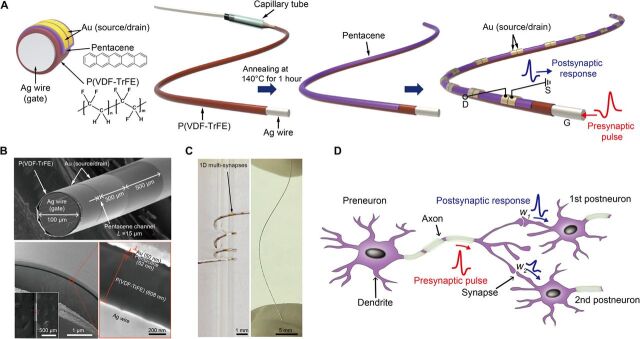
“The 1D artificial synapses were fabricated using P(VDF-TrFE) film dip-coated on a thin Ag wire [45].”
BackgroundMethodInfluentialSelf-citationKim, H., Lee, K., Oh, J. W., Kim, Y., Park, J., Jang, J., Lee, S. W., Lee, S., Koo, C. M., & Park, C. (2022) · Advanced Functional Materials · doi:10.1002/adfm.202210385 · Cited by 43
Self-citationFlexible ionic‐gel synapse devices and their applications in neuromorphic system
Huang, F., Sun, X., Shi, Y., & Pan, L. (2024) · FlexMat. · doi:10.1002/flm2.36 · Cited by 44
Molecular ferroelectric/semiconductor interfacial memristors for artificial synapses
Cai, Y., Zhang, J., Yan, M., Jiang, Y., Jawad, H., Tian, B., Wang, W., Zhan, Y., Qin, Y., Xiong, S., et al. (2022) · npj Flexible Electronics · doi:10.1038/s41528-022-00152-0 · Cited by 41
A Discolorable Flexible Synaptic Transistor for Wearable Health Monitoring
Sun, C., Liu, X., Yao, Q., Jiang, Q., Xia, X., Shen, Y., Ye, X., Tan, H., Gao, R., Zhu, X., et al. (2023) · ACS Nano · doi:10.1021/acsnano.3c08357 · Cited by 40
Optically Modulated Nanofluidic Ionic Transistor for Neuromorphic Functions
Wang, J., Jiang, Y., Xiong, T., Lu, J., He, X., Yu, P., & Mao, L. (2024) · Angewandte Chemie International Edition · doi:10.1002/anie.202418949 · Cited by 37
Flexible artificial synapse with relearning function based on ion gel-graphene FET
Feng, D., Niu, Z., Yang, J., Xu, W. K., Liu, S., Mao, X., & Li, X. (2021) · Nano Energy · doi:10.1016/j.nanoen.2021.106526 · Cited by 35
Yuan, L., Zhao, T., Dai, J., Xue, L., Zhang, X., Peng, C., Wen, P., Liu, H., Hu, H., Chen, L., et al. (2025) · Advanced Functional Materials · doi:10.1002/adfm.202418052 · Cited by 34
Spatiotemporal Modulation of Plasticity in Multi‐Terminal Tactile Synaptic Transistor
Mo, W., Ding, G., Nie, Z., Feng, Z., Zhou, K., Chen, R., Xie, P., Shang, G., Han, S., & Zhou, Y. (2022) · Advanced Electronic Materials · doi:10.1002/aelm.202200733 · Cited by 35
Hwang, Y. H., Kong, S. U., Kim, C. Y., Lee, J., Cho, H., Jeong, S. Y., & Choi, K. C. (2022) · Journal of the Society for Information Display · doi:10.1002/jsid.1164 · Cited by 33
Niu, J., Fang, Z., Liu, G., Zhao, Z., & Yan, X. (2022) · Science China Materials · doi:10.1007/s40843-022-2237-2 · Cited by 32
Emerging AI Technologies Inspiring the Next Generation of E-Textiles
Cleary, F., Srisa‐an, W., Henshall, D. C., & Balasubramaniam, S. (2023) · IEEE Access · doi:10.1109/access.2023.3282184 · Cited by 32
“[53] researched the design and development of a one-dimensional organic artificial multi-synapses enabling electronic textile neural network for wearable neuromorphic applications, where the multi-synapses comprising of ferro-electric organic transistors fabricated on a silver ( Ag ) wire.”
BackgroundLarge-scale high uniform optoelectronic synapses array for artificial visual neural network
Zhang, F., Li, C., Chen, Z., Tan, H., Li, Z., Lv, C., Xiao, S., Wu, L., & Zhao, J. (2025) · Microsystems & Nanoengineering · doi:10.1038/s41378-024-00859-2 · Cited by 41
Advancements in Nanowire-Based Devices for Neuromorphic Computing: A Review
Qiu, J., Li, J., Li, W., Wang, K., Zhang, S., Suk, C. H., Wu, C., Zhou, X., Zhang, Y., Guo, T., et al. (2024) · ACS Nano · doi:10.1021/acsnano.4c10170 · Cited by 33
Self-citationNeuromorphic Computing is Turing-Complete
Date, P., Potok, T. E., Schuman, C. D., & Kay, B. (2022) · International Conference on Neuromorphic Systems (ICONS) · doi:10.1145/3546790.3546806 · Cited by 39
“Because of their low power nature, neuromorphic computers are expected to shine in critical use cases such as autonomous vehicles, robotics, edge computing, internet of things, and wearable technologies [21, 30, 35, 36, 39].”
BackgroundOrganic electrochemical transistors toward synaptic electronics
Zhou, B., Liu, W., Xu, Y., Jin, C., Yang, J., & Sun, J. (2022) · Journal of Physics D Applied Physics · doi:10.1088/1361-6463/ac67b9 · Cited by 34
“OECT devices can be composed of arrays to realize neural network calculation [47, 48].”
Fibrous wearable and implantable bioelectronics
Sadri, B., & Gao, W. F. (2023) · Applied Physics Reviews · doi:10.1063/5.0152744 · Cited by 31
Recent progress of fiber-based transistors: materials, structures and applications
Zhang, H., Wang, Z., Wang, Z., He, B., Chen, M., Qi, M., Liu, Y., Xin, J., & Wei, L. (2022) · Frontiers of Optoelectronics · doi:10.1007/s12200-022-00002-x · Cited by 33
Shen, Z., Yang, Z., Zhou, Y., Ye, Y., Ye, B., Huang, Q., Wu, W., Hong, H., Hong, Z., Meng, Z., et al. (2023) · Journal of Materials Chemistry C · doi:10.1039/d2tc05125g · Cited by 29
Trung, T. Q., Bag, A., Huyen, L. T. N., Meeseepong, M., & Lee, N. (2023) · Advanced Functional Materials · doi:10.1002/adfm.202309378 · Cited by 31
Kim, J., Im, J., Shin, W., Lee, S., Oh, S., Kwon, D., Jung, G., Choi, W. Y., & Lee, J. (2024) · Advanced Science · doi:10.1002/advs.202308460 · Cited by 28
A bioinspired tactile scanner for computer haptics
Li, H., Lin, J., Lin, S., Zhong, H., Jiang, B., Liu, X., Wu, W., Li, W., Iranmanesh, E., Zhou, Z., et al. (2024) · Nature Communications · doi:10.1038/s41467-024-51674-2 · Cited by 36
Zhang, S., Guo, K., Han, H., Yu, H., Wei, H., Gong, J., & Xu, W. (2021) · Advanced Functional Materials · doi:10.1002/adfm.202101917 · Cited by 27
Nearly Panoramic Neuromorphic Vision with Transparent Photosynapses
Dong, X., Chen, C., Pan, K., Li, Y., Zhang, Z., He, Z., Liu, B., Zhou, Z., Wu, Y., Zhang, D., et al. (2023) · Advanced Science · doi:10.1002/advs.202303944 · Cited by 27
Zhang, Y. L., Dong, M., Du, Y., Yang, S., Ren, Y., Guo, Y., Gao, D., Lin, X., Dong, Y., Zhou, G., et al. (2025) · Matter · doi:10.1016/j.matt.2024.101945 · Cited by 27
Electronic Textiles Fabricated with Graphene Oxide-Coated Commercial Textiles
Jang, H., Moon, M. S., & Kim, B. H. (2021) · Coatings · doi:10.3390/coatings11050489 · Cited by 25
“An e-textile can be used for various applications such as gas sensors, supercapacitors, flame/fire sensors, shielding of electromagnetic waves as mentioned before, as well as human health, medicine [4–6], and biology [7].”
BackgroundUltralow‐Power Synaptic Transistors Based on Ta2O5/Al2O3 Bilayer Dielectric for Algebraic Arithmetic
Wang, J., Wang, J., Zhang, J., Huang, W., Wang, X., & Zhang, M. (2022) · Advanced Electronic Materials · doi:10.1002/aelm.202100922 · Cited by 25
Liu, L., Ni, Y., Liu, J., Wang, Y., Jiang, C., & Xu, W. (2022) · Advanced Functional Materials · doi:10.1002/adfm.202210119 · Cited by 27
Recent advancements in implantable neural links based on organic synaptic transistors
Biswas, S., Jang, H.-W., Lee, Y., Choi, H., Kim, Y., Kim, H., & Zhu, Y. (2023) · Exploration · doi:10.1002/exp.20220150 · Cited by 28
Smart Textile Optoelectronics for Human‐Interfaced Logic Systems
Peng, H., Li, H., Tao, G., Xia, L., Xu, W., & Zhai, T. (2023) · Advanced Functional Materials · doi:10.1002/adfm.202308136 · Cited by 30
Wang, Z., Zhou, X., Liu, X., Qiu, A., Gao, C., Yuan, Y., Jing, Y., Zhang, D., Li, W., Luo, H., et al. (2023) · Chip · doi:10.1016/j.chip.2023.100044 · Cited by 26
Xu, Y., Deng, Z., Jin, C., Liu, W., Shi, X., Chang, J., Yu, H., Liu, B., Sun, J., & Yang, J. (2023) · Applied Physics Letters · doi:10.1063/5.0167865 · Cited by 24
Kim, D.-H., Lee, J., Kim, Y., Yoo, H., & Lee, E. K. (2024) · Organic Electronics · doi:10.1016/j.orgel.2024.107076 · Cited by 25
Fibrous MXene Synapse‐Based Biomimetic Tactile Nervous System for Multimodal Perception and Memory
Ren, S., Wang, K., Jia, X., Wang, J., Xu, J., Yang, B., Tian, Z., Xia, R., Yu, D., Jia, Y., et al. (2024) · Small · doi:10.1002/smll.202400165 · Cited by 23
Li, M., Shu, Q., Qing, X., Wu, J., Xiao, Q., Jia, K., Wang, X., & Wang, D. (2023) · Journal of Materials Chemistry C · doi:10.1039/d2tc05426d · Cited by 23
Ultra-large dynamic range synaptic indium gallium zinc oxide transistors
Kwak, T., Kim, M.-J., Lee, W., Kim, E. C., Jang, J., Wang, G., Kim, T., Kim, Y. S., & Park, S. (2022) · Applied Materials Today · doi:10.1016/j.apmt.2022.101648 · Cited by 25
Self-citationFan, S., Wu, E., Cao, M., Xu, T. X., Liu, T., Yang, L., Su, J., & Liu, J. (2023) · Materials Horizons · doi:10.1039/d3mh00759f · Cited by 22
Flexible and stretchable synaptic devices for wearable neuromorphic electronics
Lee, H.-S., Ro, J.-S., Ko, G.-M., & Park, H. (2023) · Flexible and Printed Electronics · doi:10.1088/2058-8585/ad0a37 · Cited by 24
“Pentacene can also be used as a semiconducting layer in a flexible and bendable fiber-shaped synaptic device [103].”
Molecularly Reconfigurable Neuroplasticity of Layered Artificial Synapse Electronics
Kumbhar, D. D., Je, Y., Hong, S., Lee, D., Kim, H., Kwon, M. J., Cho, S., Lee, D., Lim, D., Kim, S., et al. (2024) · Advanced Functional Materials · doi:10.1002/adfm.202311994 · Cited by 20
Lee, Y., Rhee, H., Kim, G., Cheong, W. H., Kim, D. H., Song, H., Kay, S. N., Lee, J., & Kim, K. M. (2025) · Nature Communications · doi:10.1038/s41467-025-59589-2 · Cited by 19
“16 – 18 and Tables 5 and 6).”
InfluentialBiomimic and bioinspired soft neuromorphic tactile sensory system
Kang, K., Kim, K., Baek, J. H., Lee, D. J., & Yu, K. J. (2024) · Applied Physics Reviews · doi:10.1063/5.0204104 · Cited by 21
Perspective on oxide-based three-terminal artificial synapses in physical neural networks
Chen, K., & Chen, J. (2022) · Applied Physics Letters · doi:10.1063/5.0115449 · Cited by 23
Metadata
- Authors
- Ham, S., Kang, M., Jang, S., Jang, J., Choi, S., Kim, T.-W., & Wang, G.
- Affiliations
- Korea University (KR)
- Korea Institute of Science and Technology (KR)
- Jeonbuk National University (KR)
- Corresponding author
- Ham, Seonggil
- Kang, Minji
- Jang, Seonghoon
- Kim, Tae-Wook
- Wang, Gunuk
- Venue
- Science Advances
- Published
- 2020-07-10
- Volume
- 6
- Issue
- 28
- ISSN
- 2375-2548 (ISSN-L)
- PMC
- PMC10662591
- OpenAlex
- W3041554531
- Cited by
- 184
- References
- 56
- Citations by year
- 2026: 24 · 2025: 27 · 2024: 34 · 2023: 36 · 2022: 38 · 2021: 24 · 2020: 1
- FWCI
- 8.49
- Type
- journal article
- Language
- en
- Open access
- gold
- doi.org
- Licence
- Locations
- Science Advances (publishedVersion, cc-by-nc)
- PubMed Central (publishedVersion, cc-by-nc)
- PubMed (publishedVersion)
- Funders
- National Research Foundation of Korea (2019R1A2C2003704, 2019R1A6A3A01095700, 2020R1A2C2010163)
- Samsung Electronics
- the KU-KIST research fund
- Korea University Grant
- Topics
- Physical Sciences › Engineering › Electrical and Electronic Engineering › Advanced Memory and Neural Computing
- Physical Sciences › Engineering › Electrical and Electronic Engineering › Ferroelectric and Negative Capacitance Devices
- Physical Sciences › Engineering › Biomedical Engineering › Advanced Sensor and Energy Harvesting Materials
- Keywords
- smart textiles, cross-point array, MNIST classification
About these checks
Registry, retraction, Cites and statistics results are computed, not judged, with one exception: a printed reference that no index lists is read once by a model before it counts as a citation error. Claims are extracted by a model and kept only when their quote appears verbatim in the text; each cited source is then checked, with a model’s help, for whether it says what the claim relies on. Those verdicts can be wrong — read the claim’s quote and the cited source before relying on one.
Statistics and arithmetic are recomputed, not judged.
Confidence bands are shown only for fields calibrated on our annotated test set. None is calibrated yet, so no band is shown.
What counts as a claim ›How we measure confidence ›How we check this ›
Are you an author, or do you see a problem with this page? Request a review
Data sources
Bibliographic data: Semantic Scholar, OpenAlex, Crossref.
Contains information from the Semantic Scholar Academic Graph Datasets, made available under the ODC Attribution License (ODC-BY 1.0).
Semantic Scholar’s data is described in: Kinney, R., et al. (2023). The Semantic Scholar Open Data Platform. arXiv:2301.10140.
