

One-dimensional organic artificial multi-synapses enabling electronic textile neural network for wearable neuromorphic applications
Open accessThe DOI matches its Crossref record; 56 of the 56 references it cites were found in a registry or an index.
Abstract
We developed 1D multi-synaptic device toward the development of an e-textile neutral network for wearable intelligent applications.
Overview
The claims and statistics of this paper haven’t been checked yet.
Free: it reads the open-access text and checks the first 5 claims that cite a source we can check. Create a free account to check every claim.
Integrity signals
Registry
Cites
Statistics
Figures


Verification
Claims the paper makes
The claims and statistics of this paper haven’t been checked yet.
Free: it reads the open-access text and checks the first 5 claims that cite a source we can check. Create a free account to check every claim.
Claims other papers make about this one
Each is checked against this paper’s own text: does it say what the citing paper says it does?
The source backs part of the claim, not all of it — or backs it for a different population, condition or comparison.
In the citing paper
“compared with other flexible or stretchable memristive arrays, the f-MDPE offers advantages in terms of energy efficiency and size (Fig. 6g)15,16,18,57–62.”
From Flexible self-rectifying synapse array for energy-efficient edge multiplication in electrocardiogram diagnosis (2025) · cites this paper as [18]
Experimental — accuracy not yet measured
Self-check
Percentages, sums and reported differences re-computed from the paper’s own numbers.
The self-check needs the paper’s full text.
Citations
Cites
Gradient-based learning applied to document recognition
Lecun, Y., Bottou, L., Bengio, Y., & Haffner, P. (1998) · Proceedings of the IEEE · doi:10.1109/5.726791 · Cited by 58,805
Fully integrated wearable sensor arrays for multiplexed in situ perspiration analysis
Gao, W., Emaminejad, S., Nyein, H. Y. Y., Challa, S., Chen, K., Peck, A., Fahad, H. M., Ota, H., Shiraki, H., Kiriya, D., et al. (2016) · Nature · doi:10.1038/nature16521 · Cited by 5,087
Wearable biosensors for healthcare monitoring
Kim, J., Campbell, A. S., de Ávila, B. E.-F., & Wang, J. (2019) · Nature Biotechnology · doi:10.1038/s41587-019-0045-y · Cited by 3,373 · cited 1×
“In addition to this, we should note here that an additional protecting or shielding layer is required to eliminate expected risks related to their contact with the human body while keeping the electrical function of the devices against various environmental conditions ( 45 ).”
Hannun, A. Y., Rajpurkar, P., Haghpanahi, M., Tison, G. H., Bourn, C., Turakhia, M. P., & Ng, A. Y. (2019) · Nature Medicine · doi:10.1038/s41591-018-0268-3 · Cited by 3,148
1.1 Computing's energy problem (and what we can do about it)
Horowitz, M. (2014) · 2014 IEEE International Solid-State Circuits Conference Digest of Technical Papers (ISSCC) · doi:10.1109/isscc.2014.6757323 · Cited by 2,069
Spike Timing–Dependent Plasticity: A Hebbian Learning Rule
Caporale, N., & Dan, Y. (2008) · Annual Review of Neuroscience · doi:10.1146/annurev.neuro.31.060407.125639 · Cited by 1,997
Short-term plasticity and long-term potentiation mimicked in single inorganic synapses
Ohno, T., Hasegawa, T., Tsuruoka, T., Terabe, K., Gimzewski, J. K., & Aono, M. (2011) · Nature Materials · doi:10.1038/nmat3054 · Cited by 1,793 · cited 2×
“Synaptic characteristics and switching mechanism The 1D organic multi-synapses can implement two essential synaptic functions distinguished by a temporal or persistent change in the synaptic weight: (i) short-term plasticity (STP) and (ii) long-term plasticity (31, 32).”
Abbott, L. F., & Regehr, W. G. (2004) · Nature · doi:10.1038/nature03010 · Cited by 1,684 · cited 5×
“1D) ( 30 , 31 ).”
InfluentialMultifunctional wearable devices for diagnosis and therapy of movement disorders
Son, D., Lee, J., Qiao, S., Ghaffari, R., Kim, J., Lee, J. E., Song, C., Kim, S. J., Lee, D. J., Jun, S. W., et al. (2014) · Nature Nanotechnology · doi:10.1038/nnano.2014.38 · Cited by 1,462 · cited 1×
“Thus, the development of wearable devices with various electronic functionalities and suitability for attachment to the human body is necessary ( 1 – 5 ).”
Conductive Fiber‐Based Ultrasensitive Textile Pressure Sensor for Wearable Electronics
Lee, J., Kwon, H., Seo, J., Shin, S., Koo, J. H., Pang, C., Son, S., Kim, J. H., Jang, Y. H., Kim, D. E., et al. (2015) · Advanced Materials · doi:10.1002/adma.201500009 · Cited by 1,152 · cited 1×
“In this regard, various 1D fiber-based devices have been extensively investigated and demonstrated, including energy harvesters ( 9 , 10 ), sensors ( 11 , 12 ), actuators ( 13 ), light-emitting diodes ( 8 , 14 ), transistors ( 15 ), logic circuits ( 16 ), and memories ( 17 , 18 ).”
Artificial Muscles: Mechanisms, Applications, and Challenges
Mirvakili, S. M., & Hunter, I. W. (2018) · Advanced Materials · doi:10.1002/adma.201704407 · Cited by 1,077
Polymer electronic memories: Materials, devices and mechanisms
Ling, Q.-D., Liaw, D.-J., Zhu, C., Chan, D. S.-H., Kang, E.-T., & Neoh, K.-G. (2008) · Progress in Polymer Science · doi:10.1016/j.progpolymsci.2008.08.001 · Cited by 985 · cited 1×
“S3) ( 26 – 29 ), exhibiting a potential for wearable and flexible neuromorphic electronics.”
Root, S. E., Savagatrup, S., Printz, A. D., Rodriquez, D., & Lipomi, D. J. (2017) · Chemical Reviews · doi:10.1021/acs.chemrev.7b00003 · Cited by 904
Recent advances in wearable tactile sensors: Materials, sensing mechanisms, and device performance
Yang, T., Xie, D., Li, Z., & Zhu, H. (2017) · Materials Science and Engineering: R: Reports · doi:10.1016/j.mser.2017.02.001 · Cited by 750
Choi, S., Tan, S. H., Li, Z., Kim, Y., Choi, C., Chen, P.-Y., Yeon, H., Yu, S., & Kim, J. (2018) · Nature Materials · doi:10.1038/s41563-017-0001-5 · Cited by 690
Self-citationHeo, J. S., Eom, J., Kim, Y., & Park, S. K. (2018) · Small · doi:10.1002/smll.201703034 · Cited by 631 · cited 3×
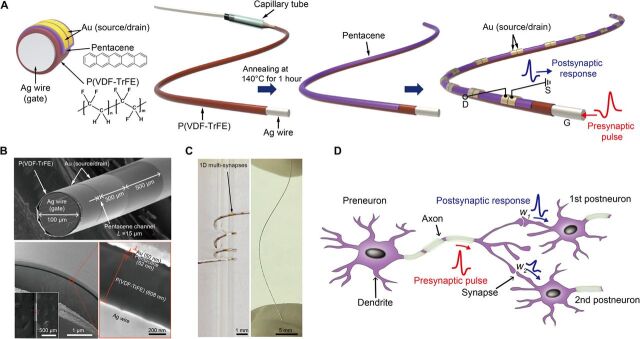
“As a unit for the wearable device, a one-dimensional (1D) fiber based on organic materials is promising for smart electronic textiles (e-textiles) owing to its unique characteristics; e.g., it is soft, light, and flexible and has a simple fabrication process ( 6 – 8 ).”
Fiber-Based Generator for Wearable Electronics and Mobile Medication
Zhong, J., Zhang, Y., Zhong, Q., Hu, Q., Hu, B., Wang, Z. L., & Zhou, J. (2014) · ACS Nano · doi:10.1021/nn501732z · Cited by 612 · cited 1×
“In this regard, various 1D fiber-based devices have been extensively investigated and demonstrated, including energy harvesters ( 9 , 10 ), sensors ( 11 , 12 ), actuators ( 13 ), light-emitting diodes ( 8 , 14 ), transistors ( 15 ), logic circuits ( 16 ), and memories ( 17 , 18 ).”
Organic Nonvolatile Memory Devices Based on Ferroelectricity
Naber, R. C. G., Asadi, K., Blom, P. W. M., de Leeuw, D. M., & de Boer, B. (2010) · Advanced Materials · doi:10.1002/adma.200900759 · Cited by 598 · cited 1×
“This phenomenon might be associated with the deep trapping of the charge carriers at the interface of P(VDF-TrFE) and semiconductor when a high (or repeated) gate electric field was applied (42).”
Yetisen, A. K., Martinez‐Hurtado, J. L., Ünal, B., Khademhosseini, A., & Butt, H. (2018) · Advanced Materials · doi:10.1002/adma.201706910 · Cited by 569
High precision tuning of state for memristive devices by adaptable variation-tolerant algorithm
Alibart, F., Gao, L., Hoskins, B. D., & Strukov, D. B. (2012) · Nanotechnology · doi:10.1088/0957-4484/23/7/075201 · Cited by 557 · cited 1×
“S11 and S12 and table S1) ( 41 , 46 – 49 ).”
ECG Heartbeat Classification: A Deep Transferable Representation
Kachuee, M., Fazeli, S., & Sarrafzadeh, M. (2018) · 2018 IEEE International Conference on Healthcare Informatics (ICHI) · doi:10.1109/ichi.2018.00092 · Cited by 447 · cited 4×
“As a proof of concept, we selected a heartbeat dataset comprising five different arrhythmia ECGs categorized by different waveforms and morphologies ( 54 , 55 ).”
InfluentialInan, O. T., Giovangrandi, L., & Kovacs, G. T. A. (2006) · IEEE Transactions on Biomedical Engineering · doi:10.1109/tbme.2006.880879 · Cited by 402 · cited 1×
“As a proof of concept, we selected a heartbeat dataset comprising five different arrhythmia ECGs categorized by different waveforms and morphologies (54, 55).”
Lee, Y., & Lee, T.-W. (2019) · Accounts of Chemical Research · doi:10.1021/acs.accounts.8b00553 · Cited by 343 · cited 1×
“A brain-inspired computing architecture might be suitable for an e-textile computing platform because of the potential to efficiently process the large amount of unstructured sensing data, including diverse and complex signals from the human body or the surrounding environment ( 20 – 22 ).”
Kim, S., Choi, B., Lim, M., Yoon, J., Lee, J., Kim, H.-D., & Choi, S.-J. (2017) · ACS Nano · doi:10.1021/acsnano.6b07894 · Cited by 338 · cited 6×
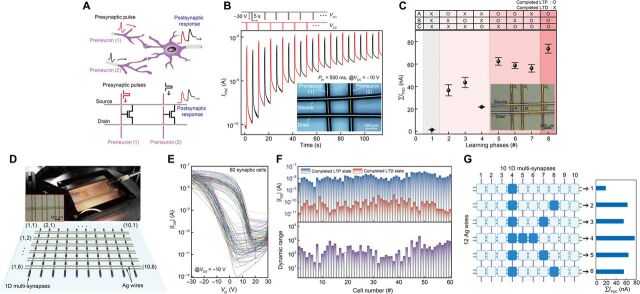
“Owing to its excellent flexibility and multisynaptic channels, our 1D device can be easily extended into a wearable textile array structure, e.g., a NOR-type synaptic array as the ANNs (bottom circuit diagram of Fig.”
InfluentialSelf-citationA Highly Stretchable ZnO@Fiber‐Based Multifunctional Nanosensor for Strain/Temperature/UV Detection
Liao, X., Liao, Q., Zhang, Z., Yan, X., Liang, Q., Wang, Q., Li, M., & Zhang, Y. (2016) · Advanced Functional Materials · doi:10.1002/adfm.201505223 · Cited by 275 · cited 1×
“In this regard, various 1D fiber-based devices have been extensively investigated and demonstrated, including energy harvesters (9, 10), sensors (11, 12), actuators (13), light-emitting diodes (8, 14), transistors (15), logic circuits (16), and memories (17, 18).”
Classification of ECG Arrhythmia using Recurrent Neural Networks
Singh, S., Pandey, S. K., Pawar, U., & Janghel, R. R. (2018) · Procedia Computer Science · doi:10.1016/j.procs.2018.05.045 · Cited by 272
Elastic Moduli of Organic Electronic Materials by the Buckling Method
Tahk, D., Lee, H. H., & Khang, D.-Y. (2009) · Macromolecules · doi:10.1021/ma900137k · Cited by 257
Nonvolatile Memory Materials for Neuromorphic Intelligent Machines
Jeong, D. S., & Hwang, C. S. (2018) · Advanced Materials · doi:10.1002/adma.201704729 · Cited by 242 · cited 1×
“A brain-inspired computing architecture might be suitable for an e-textile computing platform because of the potential to efficiently process the large amount of unstructured sensing data, including diverse and complex signals from the human body or the surrounding environment ( 20 – 22 ).”
Ham, S., Choi, S., Cho, H., Na, S., & Wang, G. (2019) · Advanced Functional Materials · doi:10.1002/adfm.201806646 · Cited by 237 · cited 1×
“S15 and S16 ( 24 , 53 ).”
Self-citationNon-volatile organic memory with sub-millimetre bending radius
Kim, R. H., Kim, H. J., Bae, I., Hwang, S. K., Velusamy, D. B., Cho, S. M., Takaishi, K., Muto, T., Hashizume, D., Uchiyama, M., et al. (2014) · Nature Communications · doi:10.1038/ncomms4583 · Cited by 222 · cited 1×
“S3) ( 26 – 29 ), exhibiting a potential for wearable and flexible neuromorphic electronics.”
A biophysically-based neuromorphic model of spike rate- and timing-dependent plasticity
Rachmuth, G., Shouval, H. Z., Bear, M. F., & Poon, C.-S. (2011) · Proceedings of the National Academy of Sciences · doi:10.1073/pnas.1106161108 · Cited by 214 · cited 3×
“This is regarded as one of the main features of the spike rate– dependent plasticity (SRDP) (34).”
Mimicking Neuroplasticity in a Hybrid Biopolymer Transistor by Dual Modes Modulation
Lv, Z., Chen, M., Qian, F., Roy, V. A. L., Ye, W., She, D., Wang, Y., Xu, Z., Zhou, Y., & Han, S. (2019) · Advanced Functional Materials · doi:10.1002/adfm.201902374 · Cited by 214
A Route Toward Smart System Integration: From Fiber Design to Device Construction
Weng, W., Yang, J., Zhang, Y., Li, Y., Yang, S., Zhu, L., & Zhu, M. (2020) · Advanced Materials · doi:10.1002/adma.201902301 · Cited by 175
Aligned Carbon Nanotube Synaptic Transistors for Large-Scale Neuromorphic Computing
Sanchez Esqueda, I., Yan, X., Rutherglen, C., Kane, A., Cain, T., Marsh, P., Liu, Q., Galatsis, K., Wang, H., & Zhou, C. (2018) · ACS Nano · doi:10.1021/acsnano.8b03831 · Cited by 170 · cited 1×
“4A) ( 41 , 50 – 52 ).”
Kwon, S., Kim, H., Choi, S., Jeong, E. G., Kim, D., Lee, S., Lee, H. S., Seo, Y. C., & Choi, K. C. (2018) · Nano Letters · doi:10.1021/acs.nanolett.7b04204 · Cited by 169 · cited 3×
“In this regard, various 1D fiber-based devices have been extensively investigated and demonstrated, including energy harvesters ( 9 , 10 ), sensors ( 11 , 12 ), actuators ( 13 ), light-emitting diodes ( 8 , 14 ), transistors ( 15 ), logic circuits ( 16 ), and memories ( 17 , 18 ).”
Self-citationUltrathin Conformable Organic Artificial Synapse for Wearable Intelligent Device Applications
Jang, S., Jang, S., Lee, E.-H., Kang, M., Wang, G., & Kim, T. (2018) · ACS Applied Materials & Interfaces · doi:10.1021/acsami.8b12092 · Cited by 160 · cited 1×
“As the switching principle, these synaptic characteristics originated from the change in the polarization (P) of the ferroelectric domains in the P(VDF-TrFE) layer according to the magnitude of the applied VG (33).”
Self-citationChoi, S., Jang, S., Moon, J., Kim, J. C., Jeong, H. Y., Jang, P.-H., Lee, K., & Wang, G. (2018) · NPG Asia Materials · doi:10.1038/s41427-018-0101-y · Cited by 131 · cited 3×
“This undesired leakage could result in the misreading of the IPSC flowing through the designated postneuron, and the learning and memory capability of the array would be severely degraded (24).”
InfluentialSelf-citationA fiber-shaped solar cell showing a record power conversion efficiency of 10%
Fu, X., Sun, H., Xie, S., Zhang, J., Pan, Z., Liao, M., Xu, L., Li, Z., Wang, B., Sun, X., et al. (2017) · Journal of Materials Chemistry A · doi:10.1039/c7ta08637g · Cited by 111 · cited 1×
“In this regard, various 1D fiber-based devices have been extensively investigated and demonstrated, including energy harvesters (9, 10), sensors (11, 12), actuators (13), light-emitting diodes (8, 14), transistors (15), logic circuits (16), and memories (17, 18).”
Ferroelectric-Gate Field Effect Transistor Memories
Park, B.-E., Ishiwara, H., Okuyama, M., Sakai, S., & Yoon, S. (2016) · Topics in applied physics · doi:10.1007/978-94-024-0841-6 · Cited by 97
Impact of Synaptic Device Variations on Pattern Recognition Accuracy in a Hardware Neural Network
Kim, S., Lim, M., Kim, Y., Kim, H.-D., & Choi, S.-J. (2018) · Scientific Reports · doi:10.1038/s41598-018-21057-x · Cited by 92
Self-citationBae, H., Jang, B. C., Park, H., Jung, S., Lee, H. M., Park, J., Jeon, S., Son, G., Tcho, I., Yu, K., et al. (2017) · Nano Letters · doi:10.1021/acs.nanolett.7b03435 · Cited by 78 · cited 1×
“In this regard, various 1D fiber-based devices have been extensively investigated and demonstrated, including energy harvesters ( 9 , 10 ), sensors ( 11 , 12 ), actuators ( 13 ), light-emitting diodes ( 8 , 14 ), transistors ( 15 ), logic circuits ( 16 ), and memories ( 17 , 18 ).”
Self-citationReduced Graphene Oxide‐Based Artificial Synapse Yarns for Wearable Textile Device Applications
Park, Y., Park, M., & Lee, J. (2018) · Advanced Functional Materials · doi:10.1002/adfm.201804123 · Cited by 76 · cited 1×
“(23) fabricated a two-terminal memristor synapse by crossing two yarns coated with reduced graphene oxide (rGO).”
Kim, H. M., Kang, H. W., Hwang, D. K., Lim, H. S., Ju, B., & Lim, J. A. (2016) · Advanced Functional Materials · doi:10.1002/adfm.201504972 · Cited by 71 · cited 2×
“An organic ferroelectric P(VDF-TrFE) film, which functioned as a common gating dielectric layer, was uniformly and directly coated onto the whole surface of the Ag wire via the dip-coating method using a capillary tube equipped with a printing speed controller (15, 25).”
Textile Resistance Switching Memory for Fabric Electronics
Jo, A., Seo, Y., Ko, M., Kim, C., Kim, H., Nam, S., Choi, H., Hwang, C. S., & Lee, M. J. (2017) · Advanced Functional Materials · doi:10.1002/adfm.201605593 · Cited by 63 · cited 1×
“In this regard, various 1D fiber-based devices have been extensively investigated and demonstrated, including energy harvesters ( 9 , 10 ), sensors ( 11 , 12 ), actuators ( 13 ), light-emitting diodes ( 8 , 14 ), transistors ( 15 ), logic circuits ( 16 ), and memories ( 17 , 18 ).”
Kim, C.-H., Lee, S., Woo, S. Y., Kang, W.-M., Lim, S., Bae, J., Kim, J., & Lee, J. (2018) · IEEE Transactions on Electron Devices · doi:10.1109/ted.2018.2817266 · Cited by 63 · cited 2×
“S4) ( 36 ).”
Stuck-at-Fault Tolerant Schemes for Memristor Crossbar Array-Based Neural Networks
Yeo, I., Chu, M., Gi, S.-G., Hwang, H., & Lee, B.-G. (2019) · IEEE Transactions on Electron Devices · doi:10.1109/ted.2019.2914460 · Cited by 55
Low-Voltage Organic Transistor Memory Fiber with a Nanograined Organic Ferroelectric Film
Kang, M., Lee, S., Jang, S., Hwang, S., Lee, S.-K., Bae, S., Hong, J., Lee, S. H., Jeong, K., Lim, J. A., et al. (2019) · ACS Applied Materials & Interfaces · doi:10.1021/acsami.9b03564 · Cited by 54 · cited 2×
“S2) and the electrical short, it would lead to a high operating voltage at the same time ( 25 ).”
Self-citationHigh-performance, color-tunable fiber shaped organic light-emitting diodes
Ko, K., Lee, H. B., Kim, H. M., Lee, G. J., Shin, S.-R., Kumar, N., Song, Y. M., & Kang, J. (2018) · Nanoscale · doi:10.1039/c8nr05120h · Cited by 46 · cited 1×
“In this regard, various 1D fiber-based devices have been extensively investigated and demonstrated, including energy harvesters ( 9 , 10 ), sensors ( 11 , 12 ), actuators ( 13 ), light-emitting diodes ( 8 , 14 ), transistors ( 15 ), logic circuits ( 16 ), and memories ( 17 , 18 ).”
Degradation mechanisms of organic ferroelectric field-effect transistors used as nonvolatile memory
Ng, T. N., Russo, B., & Arias, A. C. (2009) · Journal of Applied Physics · doi:10.1063/1.3253758 · Cited by 33 · cited 1×
“The polarization loss can be accelerated by polarization shielding effects of injected and trapped mobile charges and by the depolarization field inevitably remaining in the ferroelectric film during retention interval ( 39 – 40 ).”
Memory characteristics of silicon nanowire transistors generated by weak impact ionization
Lim, D., Kim, M.-S., Kim, Y., & Kim, S. (2017) · Scientific Reports · doi:10.1038/s41598-017-12347-x · Cited by 32 · cited 1×
“S9) ( 44 ).”
Highly Stretchable Non-volatile Nylon Thread Memory
Kang, T.-K. (2016) · Scientific Reports · doi:10.1038/srep24406 · Cited by 26 · cited 1×
“In this regard, various 1D fiber-based devices have been extensively investigated and demonstrated, including energy harvesters (9, 10), sensors (11, 12), actuators (13), light-emitting diodes (8, 14), transistors (15), logic circuits (16), and memories (17, 18).”
Ashikaga, K., & Ito, T. (1999) · Journal of Applied Physics · doi:10.1063/1.369381 · Cited by 20 · cited 1×
“The polarization loss can be accelerated by polarization shielding effects of injected and trapped mobile charges and by the depolarization field inevitably remaining in the ferroelectric film during retention interval ( 39 – 40 ).”
Electronics and Fabrics: The Development of Garment‐Based Wearables
Pailes‐Friedman, R. (2018) · Advanced Materials Technologies · doi:10.1002/admt.201700307 · Cited by 17
Electrical fatigue in ferroelectric P(VDF-TrFE) copolymer films
Zhu, G., Luo, X., Zhang, J.-H., Gu, Y., & Jiang, Y.-L. (2010) · IEEE Transactions on Dielectrics and Electrical Insulation · doi:10.1109/tdei.2010.5539687 · Cited by 15 · cited 1×
“In addition, space charges can be injected from electrodes into ferroelectrics and trapped at the boundary of crystallites or/and by defects (43).”
Choi, H., Hong, S., Sung, T.-H., & No, K. (2011) · Applied Physics Letters · doi:10.1063/1.3632042 · Cited by 10 · cited 1×
“This phenomenon might have originated from the polarization relaxation of the ferroelectric domain ( 37 – 38 ).”
Markov Chain Hebbian Learning Algorithm With Ternary Synaptic Units
Kim, G., Kornijčuk, V., Kim, D., Kim, I., Kim, J., Woo, H. C., Kim, J. H., Hwang, C. S., & Jeong, D. S. (2019) · IEEE Access · doi:10.1109/access.2018.2890543 · Cited by 6
Cited by
Flexible Artificial Sensory Systems Based on Neuromorphic Devices
Sun, F., Lu, Q., Feng, S., & Zhang, T. (2021) · ACS Nano · doi:10.1021/acsnano.0c10049 · Cited by 286
Synaptic devices based neuromorphic computing applications in artificial intelligence
Sun, B., Guo, T., Zhou, G., Ranjan, S., Jiao, Y., Wei, L., Zhou, Y. N., & Wu, Y. A. (2021) · Materials Today Physics · doi:10.1016/j.mtphys.2021.100393 · Cited by 275
Flexible Organic Transistors for Biosensing: Devices and Applications
Song, J., Liu, H., Zhao, Z., Lin, P., & Yan, F. (2024) · Advanced Materials · doi:10.1002/adma.202300034 · Cited by 220
He, K., Wang, C., He, Y., Su, J., & Chen, X. (2023) · Chemical Reviews · doi:10.1021/acs.chemrev.3c00527 · Cited by 200
Organic electronic synapses with low energy consumption
Lee, Y., Park, H.-L., Kim, Y., & Lee, T.-W. (2021) · Joule · doi:10.1016/j.joule.2021.01.005 · Cited by 196
Metadata
- Authors
- Ham, S., Kang, M., Jang, S., Jang, J., Choi, S., Kim, T.-W., & Wang, G.
- Affiliations
- Korea University (KR)
- Korea Institute of Science and Technology (KR)
- Jeonbuk National University (KR)
- Corresponding author
- Ham, Seonggil
- Kang, Minji
- Jang, Seonghoon
- Kim, Tae-Wook
- Wang, Gunuk
- Venue
- Science Advances
- Published
- 2020-07-10
- Volume
- 6
- Issue
- 28
- ISSN
- 2375-2548 (ISSN-L)
- PMC
- PMC10662591
- OpenAlex
- W3041554531
- Cited by
- 184
- References
- 56
- Citations by year
- 2026: 24 · 2025: 27 · 2024: 34 · 2023: 36 · 2022: 38 · 2021: 24 · 2020: 1
- FWCI
- 8.49
- Type
- journal article
- Language
- en
- Open access
- gold
- doi.org
- Licence
- Locations
- Science Advances (publishedVersion, cc-by-nc)
- PubMed Central (publishedVersion, cc-by-nc)
- PubMed (publishedVersion)
- Funders
- National Research Foundation of Korea (2019R1A2C2003704, 2019R1A6A3A01095700, 2020R1A2C2010163)
- Samsung Electronics
- the KU-KIST research fund
- Korea University Grant
- Topics
- Physical Sciences › Engineering › Electrical and Electronic Engineering › Advanced Memory and Neural Computing
- Physical Sciences › Engineering › Electrical and Electronic Engineering › Ferroelectric and Negative Capacitance Devices
- Physical Sciences › Engineering › Biomedical Engineering › Advanced Sensor and Energy Harvesting Materials
- Keywords
- smart textiles, cross-point array, MNIST classification
About these checks
Registry, retraction, Cites and statistics results are computed, not judged, with one exception: a printed reference that no index lists is read once by a model before it counts as a citation error. Claims are extracted by a model and kept only when their quote appears verbatim in the text; each cited source is then checked, with a model’s help, for whether it says what the claim relies on. Those verdicts can be wrong — read the claim’s quote and the cited source before relying on one.
Statistics and arithmetic are recomputed, not judged.
Confidence bands are shown only for fields calibrated on our annotated test set. None is calibrated yet, so no band is shown.
What counts as a claim ›How we measure confidence ›How we check this ›
Are you an author, or do you see a problem with this page? Request a review
Data sources
Bibliographic data: Semantic Scholar, OpenAlex, Crossref.
Contains information from the Semantic Scholar Academic Graph Datasets, made available under the ODC Attribution License (ODC-BY 1.0).
Semantic Scholar’s data is described in: Kinney, R., et al. (2023). The Semantic Scholar Open Data Platform. arXiv:2301.10140.
