

Expanding and optimizing 3D bioprinting capabilities using complementary network bioinks
Open accessThe DOI matches its Crossref record; 43 of the 43 references it cites were found in a registry or an index.
Abstract
A generalizable strategy enables the expansion of the bioink palette and bioprinting capabilities.
Overview
The claims and statistics of this paper haven’t been checked yet.
Free: it reads the open-access text and checks the first 5 claims that cite a source we can check. Create a free account to check every claim.
Integrity signals
Registry
Cites
Statistics
Figures
Verification
Claims the paper makes
The claims and statistics of this paper haven’t been checked yet.
Free: it reads the open-access text and checks the first 5 claims that cite a source we can check. Create a free account to check every claim.
Claims other papers make about this one
Each is checked against this paper’s own text: does it say what the citing paper says it does?
The cited source says what the claim attributes to it.
In the citing paper
“To this end, considerable efforts were made in developing hydrogel-based inks or printing techniques to enhance 3D stability and shape fidelity, such as printing multimaterial inks with combined nozzle system24, 25, photo-crosslinkable hydrogels17, 26, 27, adding viscosifiers28–30, or printing in sacrificial supporting materials31–33.”
From Fibre-infused gel scaffolds guide cardiomyocyte alignment in 3D-printed ventricles (2023) · cites this paper as [26]
Self-check
Percentages, sums and reported differences re-computed from the paper’s own numbers.
The self-check needs the paper’s full text.
Citations
Cites
Hydrogels with tunable stress relaxation regulate stem cell fate and activity
Chaudhuri, O., Gu, L., Klumpers, D., Darnell, M., Bencherif, S. A., Weaver, J. C., Huebsch, N., Lee, H.-P., Lippens, E., Duda, G. N., et al. (2016) · Nature Materials · doi:10.1038/nmat4489 · Cited by 2,443 · cited 1×
“, spreading, migration, and proliferation) (5, 6) and present an environmental stiffness that is incompatible with cells of soft-tissue origin.”
Hyaluronic Acid Hydrogels for Biomedical Applications
Burdick, J. A., & Prestwich, G. D. (2011) · Advanced Materials · doi:10.1002/adma.201003963 · Cited by 2,139
Self-citation25th Anniversary Article: Engineering Hydrogels for Biofabrication
Malda, J., Visser, J., Melchels, F. P., Jüngst, T., Hennink, W. E., Dhert, W. J. A., Groll, J., & Hutmacher, D. W. (2013) · Advanced Materials · doi:10.1002/adma.201302042 · Cited by 1,901 · cited 2×
“This paradox has resulted in a compressed “biofabrication window” containing a select group of feasible bioinks, with other biomaterial systems requiring major compromises in either printability or biocompatibility ( 7 , 8 ).”
3D bioprinting of collagen to rebuild components of the human heart
Lee, A., Hudson, A. R., Shiwarski, D. J., Tashman, J. W., Hinton, T. J., Yerneni, S., Bliley, J. M., Campbell, P. G., & Feinberg, A. W. (2019) · Science · doi:10.1126/science.aav9051 · Cited by 1,782
Khetan, S., Guvendiren, M., Legant, W. R., Cohen, D. M., Chen, C. S., & Burdick, J. A. (2013) · Nature Materials · doi:10.1038/nmat3586 · Cited by 1,168
Self-citationZaman, M. H., Trapani, L. M., Sieminski, A. L., MacKellar, D., Gong, H., Kamm, R. D., Wells, A., Lauffenburger, D. A., & Matsudaira, P. (2006) · Proceedings of the National Academy of Sciences · doi:10.1073/pnas.0604460103 · Cited by 1,160
Ouyang, L., Yao, R., Zhao, Y., & Sun, W. (2016) · Biofabrication · doi:10.1088/1758-5090/8/3/035020 · Cited by 1,045
Self-citationBilliet, T., Gevaert, E., De Schryver, T., Cornelissen, M., & Dubruel, P. (2014) · Biomaterials · doi:10.1016/j.biomaterials.2013.09.078 · Cited by 1,015
Loessner, D., Meinert, C., Kaemmerer, E., Martine, L. C., Yue, K., Levett, P. A., Klein, T. J., Melchels, F. P. W., Khademhosseini, A., & Hutmacher, D. W. (2016) · Nature Protocols · doi:10.1038/nprot.2016.037 · Cited by 868
Microfluidic Bioprinting of Heterogeneous 3D Tissue Constructs Using Low‐Viscosity Bioink
Colosi, C., Shin, S. R., Manoharan, V., Massa, S., Costantini, M., Barbetta, A., Dokmeci, M. R., Dentini, M., & Khademhosseini, A. (2016) · Advanced Materials · doi:10.1002/adma.201503310 · Cited by 863
Cited by
Chemically Modified Biopolymers for the Formation of Biomedical Hydrogels
Muir, V. G., & Burdick, J. A. (2021) · Chemical Reviews · doi:10.1021/acs.chemrev.0c00923 · Cited by 604
Self-citationZhang, Y. S., Haghiashtiani, G., Hübscher, T., Kelly, D. J., Lee, J. M., Lutolf, M., McAlpine, M. C., Yeong, W. Y., Zenobi-Wong, M., & Malda, J. (2021) · Nature Reviews Methods Primers · doi:10.1038/s43586-021-00073-8 · Cited by 391
Daly, A. C., Prendergast, M. E., Hughes, A. J., & Burdick, J. A. (2021) · Cell · doi:10.1016/j.cell.2020.12.002 · Cited by 332
Self-citationThe rheology of direct and suspended extrusion bioprinting
Cooke, M. E., & Rosenzweig, D. H. (2021) · APL Bioengineering · doi:10.1063/5.0031475 · Cited by 284
Natural-Based Hydrogels for Tissue Engineering Applications
Gomez-Florit, M., Pardo, A., Domingues, R. M. A., Graça, A. L., Babo, P. S., Reis, R. L., & Gomes, M. E. (2020) · Molecules · doi:10.3390/molecules25245858 · Cited by 246
3D Bioprinting of Cell‐Laden Hydrogels for Improved Biological Functionality
Hull, S. M., Brunel, L. G., & Heilshorn, S. C. (2022) · Advanced Materials · doi:10.1002/adma.202103691 · Cited by 240
Soft Bioelectronics Based on Nanomaterials
Cho, K. W., Sunwoo, S.-H., Hong, Y. J., Koo, J. H., Kim, J. H., Baik, S., Hyeon, T., & Kim, D.-H. (2022) · Chemical Reviews · doi:10.1021/acs.chemrev.1c00531 · Cited by 244
Biomaterials / bioinks and extrusion bioprinting
Chen, X. B., Fazel Anvari-Yazdi, A., Duan, X., Zimmerling, A., Gharraei, R., Sharma, N. K., Sweilem, S., & Ning, L. (2023) · Bioactive Materials · doi:10.1016/j.bioactmat.2023.06.006 · Cited by 244
Hydrogels for Tissue Engineering: Addressing Key Design Needs Toward Clinical Translation
Xu, F., Dawson, C., Lamb, M., Mueller, E., Stefanek, E., Akbari, M., & Hoare, T. (2022) · Frontiers in Bioengineering and Biotechnology · doi:10.3389/fbioe.2022.849831 · Cited by 209
“The flow of the hydrogel can be driven by pneumatics (Duarte Campos et al., 2019; Ouyang et al., 2020) or mechanical flow driven by a syringe pump or screw mechanism (Liu et al.”
Background3D printing applications for healthcare research and development
Javaid, M., Haleem, A., Singh, R. P., & Suman, R. (2022) · Global Health Journal · doi:10.1016/j.glohj.2022.11.001 · Cited by 182
Fibre-infused gel scaffolds guide cardiomyocyte alignment in 3D-printed ventricles
Choi, S., Lee, K. Y., Kim, S. L., MacQueen, L. A., Chang, H., Zimmerman, J. F., Jin, Q., Peters, M. M., Ardoña, H. A. M., Liu, X., et al. (2023) · Nature Materials · doi:10.1038/s41563-023-01611-3 · Cited by 212
Wang, J., Wu, Y., Li, G., Zhou, F., Wu, X., Wang, M., Liu, X., Tang, H., Bai, L., Geng, Z., et al. (2024) · Advanced Materials · doi:10.1002/adma.202309875 · Cited by 186
Wei, Q., Zhou, J., An, Y., Li, M., Zhang, J., & Yang, S. (2023) · International Journal of Biological Macromolecules · doi:10.1016/j.ijbiomac.2023.123450 · Cited by 184
Fang, W., Yang, M., Wang, L., Li, W., Liu, M., Jin, Y., Wang, Y., Yang, R., Wang, Y., Zhang, K., et al. (2023) · International Journal of Bioprinting · doi:10.18063/ijb.759 · Cited by 199
“Remarkable hydrogel materials are limited to the application of light-based 3D bioprinting technologies[39-41].”
BackgroundDesign, printing, and engineering of regenerative biomaterials for personalized bone healthcare
Jia, Z., Xu, X., Zhu, D., & Zheng, Y. (2023) · Progress in Materials Science · doi:10.1016/j.pmatsci.2023.101072 · Cited by 176
Fang, Y., Guo, Y., Wu, B., Liu, Z., Ye, M., Xu, Y., Ji, M., Chen, L., Lu, B., Nie, K., et al. (2023) · Advanced Materials · doi:10.1002/adma.202205082 · Cited by 155
Wang, M., Li, W., Hao, J., Gonzales, A. A., Zhao, Z., Flores, R. S., Kuang, X., Mu, X., Ching, T., Tang, G., et al. (2022) · Nature Communications · doi:10.1038/s41467-022-31002-2 · Cited by 168
Responsive biomaterials for 3D bioprinting: A review
Fu, Z., Ouyang, L., Xu, R., Yang, Y., & Sun, W. (2022) · Materials Today · doi:10.1016/j.mattod.2022.01.001 · Cited by 153
Self-citationKim, N., Lee, H., Han, G., Kang, M., Park, S., Kim, D. E., Lee, M., Kim, M., Na, Y., Oh, S., et al. (2023) · Advanced Science · doi:10.1002/advs.202300816 · Cited by 183
Generalizing hydrogel microparticles into a new class of bioinks for extrusion bioprinting
Xin, S., Deo, K. A., Dai, J. H., Pandian, N. K. R., Chimene, D., Möbius, R., Jain, A., Han, A., Gaharwar, A. K., & Alge, D. L. (2021) · Science Advances · doi:10.1126/sciadv.abk3087 · Cited by 152
Digital light processing (DLP)‐based (bio)printing strategies for tissue modeling and regeneration
Li, H., Dai, J., Wang, Z., Zheng, H., Li, W., Wang, M., & Cheng, F. (2022) · Aggregate · doi:10.1002/agt2.270 · Cited by 153
3D printing in biomedical engineering: Processes, materials, and applications
Lai, J., Wang, C., & Wang, M. (2021) · Applied Physics Reviews · doi:10.1063/5.0024177 · Cited by 135
Advances in Translational 3D Printing for Cartilage, Bone, and Osteochondral Tissue Engineering
Wang, S., Zhao, S., Yu, J., Gu, Z., & Zhang, Y. (2022) · Small · doi:10.1002/smll.202201869 · Cited by 141
Fang, Y., Guo, Y., Ji, M., Li, B., Guo, Y., Zhu, J., Zhang, T., & Xiong, Z. (2021) · Advanced Functional Materials · doi:10.1002/adfm.202109810 · Cited by 126
Intelligent Vascularized 3D/4D/5D/6D-Printed Tissue Scaffolds
Han, X., Saiding, Q., Cai, X., Xiao, Y., Wang, P., Cai, Z., Gong, X., Gong, W., Zhang, X., & Cui, W. (2023) · Nano-Micro Letters · doi:10.1007/s40820-023-01187-2 · Cited by 154
4D bioprinting of programmed dynamic tissues
Lai, J., Liu, Y., Lü, G., Yung, P. S., Wang, X., Tuan, R. S., & Li, Z. A. (2024) · Bioactive Materials · doi:10.1016/j.bioactmat.2024.03.033 · Cited by 169
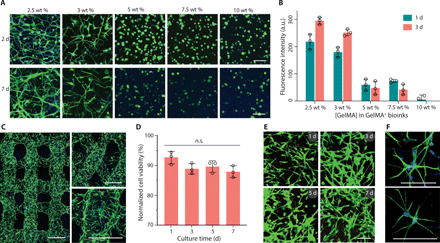
“They found that astrocytes exhibited significant higher viability and more elongated behavior in soft GelMA hydrogels with low-concentrations (2.5% w/v and 3% w/v) than those in stiffer GelMA hydrogels with concentrations higher than 5% (w/v) [183].”
BackgroundInfluentialMicrogels for Cell Delivery in Tissue Engineering and Regenerative Medicine
Xuan, L., Hou, Y., Liang, L., Wu, J., Fan, K., Lian, L., Qiu, J., Miao, Y., Ravanbakhsh, H., Xu, M., et al. (2024) · Nano-Micro Letters · doi:10.1007/s40820-024-01421-5 · Cited by 131
“Recently, many studies have shown that GelMA can be mixed with other materials including biomaterials and nanoparticles [212], to increase its printability and mechanical properties [213].”
BackgroundEngineered assistive materials for 3D bioprinting: support baths and sacrificial inks
Brunel, L. G., Hull, S. M., & Heilshorn, S. C. (2022) · Biofabrication · doi:10.1088/1758-5090/ac6bbe · Cited by 118
“For example, the amount of sacrificial gelatin released from bioinks depended on the primary bioink material type, polymer concentration, and crosslinking density, and the amount of sacrificial gelatin released increased from day 1 to day 15 of culture [96].”
InfluentialSadraei, A., & Naghib, S. M. (2024) · Journal of macromolecular science. Part C, Reviews in macromolecular chemistry and physics/Journal of macromolecular science. Reviews in macromolecular chemistry and physics · doi:10.1080/15583724.2024.2427184 · Cited by 117
Functional Thermoresponsive Hydrogel Molecule to Material Design for Biomedical Applications
Pardeshi, S. R., Damiri, F., Zehravi, M., Joshi, R., Kapare, H. S., Prajapati, M. K., Munot, N. M., Berrada, M., Giram, P. S., Rojekar, S. V., et al. (2022) · Polymers · doi:10.3390/polym14153126 · Cited by 108
Embedded extrusion printing in yield-stress-fluid baths
Wu, Q. H., Song, K., Zhang, D., Ren, B., Sole‐Gras, M., Huang, Y. H., & Yin, J. (2022) · Matter · doi:10.1016/j.matt.2022.09.003 · Cited by 107
Pushing the rheological and mechanical boundaries of extrusion-based 3D bioprinting
Ouyang, L. (2022) · Trends in biotechnology · doi:10.1016/j.tibtech.2022.01.001 · Cited by 104
Self-citationProgramming hydrogels to probe spatiotemporal cell biology
Qazi, T. H., Blatchley, M. R., Davidson, M. D., Yavitt, F. M., Cooke, M. E., Anseth, K. S., & Burdick, J. A. (2022) · Cell stem cell · doi:10.1016/j.stem.2022.03.013 · Cited by 105
Self-citationThe most promising microneedle device: present and future of hyaluronic acid microneedle patch
Kang, H., Zuo, Z., Lin, R., Yao, M., Han, Y., & Han, J. (2022) · Drug Delivery · doi:10.1080/10717544.2022.2125600 · Cited by 100
“(Ouyang et al., 2020) investigated bio-inks represented by MeHA, which can meet the physicochemical requirements of printing and provide an ideal environment for encapsulating cells.”
BackgroundBioprinting microporous functional living materials from protein-based core-shell microgels
Ou, Y., Cao, S., Zhang, Y., Zhu, H., Guo, C., Yan, W., Xin, F., Dong, W., Zhang, Y., Narita, M., et al. (2023) · Nature Communications · doi:10.1038/s41467-022-35140-5 · Cited by 110
Hasany, M., Talebian, S., Sadat, S., Ranjbar, N., Mehrali, M., Wallace, G. G., & Mehrali, M. (2021) · Applied Materials Today · doi:10.1016/j.apmt.2021.101150 · Cited by 109
Multimaterial Multinozzle Adaptive 3D Printing of Soft Materials
Uzel, S. G. M., Weeks, R. D., Eriksson, M., Kokkinis, D., & Lewis, J. A. (2022) · Advanced Materials Technologies · doi:10.1002/admt.202101710 · Cited by 100
Strategies to Promote Vascularization in 3D Printed Tissue Scaffolds: Trends and Challenges
Joshi, A., Choudhury, S., Gugulothu, S. B., Visweswariah, S. S., & Chatterjee, K. (2022) · Biomacromolecules · doi:10.1021/acs.biomac.2c00423 · Cited by 96
Dutta, S. D., Ganguly, K., Randhawa, A., Patil, T. V., Patel, D. K., & Lim, K. (2023) · Biomaterials · doi:10.1016/j.biomaterials.2023.121999 · Cited by 94
Jia, X., Fan, X., Chen, C., Lu, Q., Zhou, H., Zhao, Y., Wang, X., Han, S., Ouyang, L., Yan, H., et al. (2024) · Biomacromolecules · doi:10.1021/acs.biomac.3c01021 · Cited by 102
Self-citationMulti‐Dimensional Printing for Bone Tissue Engineering
Qu, M., Wang, C., Zhou, X., Libanori, A., Jiang, X., Xu, W., Zhu, S., Chen, Q., Sun, W., & Khademhosseini, A. (2021) · Advanced Healthcare Materials · doi:10.1002/adhm.202001986 · Cited by 95
Tailoring bioinks of extrusion-based bioprinting for cutaneous wound healing
Wang, Y., Yuan, X., Yao, B., Zhu, S., Zhu, P., & Huang, S. (2022) · Bioactive Materials · doi:10.1016/j.bioactmat.2022.01.024 · Cited by 106
“was upregulated by the silicon ions released from the bioactive nanoparticles [73].”
BackgroundClick Chemistry Hydrogels for Extrusion Bioprinting: Progress, Challenges, and Opportunities
Mueller, E., Poulin, I., Bodnaryk, W. J., & Hoare, T. R. (2022) · Biomacromolecules · doi:10.1021/acs.biomac.1c01105 · Cited by 90
Hyaluronan as a Prominent Biomolecule with Numerous Applications in Medicine
Valachová, K., & Šoltés, L. (2021) · International Journal of Molecular Sciences · doi:10.3390/ijms22137077 · Cited by 90
3D Printing of Self‐Assembling Nanofibrous Multidomain Peptide Hydrogels
Farsheed, A. C., Thomas, A. J., Pogostin, B. H., & Hartgerink, J. D. (2023) · Advanced Materials · doi:10.1002/adma.202210378 · Cited by 84
Photocrosslinked methacrylated natural macromolecular hydrogels for tissue engineering: A review
Yang, X., Li, X., Wu, Z., & Cao, L. (2023) · International Journal of Biological Macromolecules · doi:10.1016/j.ijbiomac.2023.125570 · Cited by 83
Analytical device miniaturization for the detection of circulating biomarkers
Natalia, A., Zhang, L., Sundah, N. R., Zhang, Y., & Shao, H. (2023) · Nature Reviews Bioengineering · doi:10.1038/s44222-023-00050-8 · Cited by 84
Liu, S., Zhang, H., Ahlfeld, T., Kilian, D., Liu, Y., Gelinsky, M., & Hu, Q. (2022) · Bio-Design and Manufacturing · doi:10.1007/s42242-022-00194-3 · Cited by 76
“This technique has been widely applied in tissue engineering and regenerative medicine [1, 2].”
MethodYang, M. Y., Chu, L., Zhuang, Y., Cheng, Q., Meng, S., Liu, Z., & Kong, T. (2024) · Advanced Functional Materials · doi:10.1002/adfm.202316456 · Cited by 75
Overflow Control for Sustainable Development by Superwetting Surface with Biomimetic Structure
Zhou, S., Jiang, L., & Dong, Z. (2022) · Chemical Reviews · doi:10.1021/acs.chemrev.1c00976 · Cited by 73
Tuning the Degradation Rate of Alginate-Based Bioinks for Bioprinting Functional Cartilage Tissue
Barceló, X., Eichholz, K. F., Garcia, O., & Kelly, D. J. (2022) · Biomedicines · doi:10.3390/biomedicines10071621 · Cited by 81
Riffe, M. B., Davidson, M. D., Seymour, G., Dhand, A. P., Cooke, M. E., Zlotnick, H. M., McLeod, R. R., & Burdick, J. A. (2024) · Advanced Materials · doi:10.1002/adma.202309026 · Cited by 73
Self-citationBiomedical potentials of alginate via physical, chemical, and biological modifications
Li, Q., Xu, D., Dong, Q.-W., Song, X., Chen, Y., & Cui, Y. (2024) · International Journal of Biological Macromolecules · doi:10.1016/j.ijbiomac.2024.134409 · Cited by 80
Multimaterial cryogenic printing of three-dimensional soft hydrogel machines
Li, J., Cao, J., Bian, R., Wan, R., Zhu, X., Lu, B., & Gu, G. (2025) · Nature Communications · doi:10.1038/s41467-024-55323-6 · Cited by 72
3D bioprinting of cell-laden constructs for regenerative medicine
Li, C., & Cui, W. (2021) · Engineered Regeneration · doi:10.1016/j.engreg.2021.11.005 · Cited by 70
Miksch, C. E., Skillin, N. P., Kirkpatrick, B. E., Hach, G. K., Rao, V. V., White, T. J., & Anseth, K. S. (2022) · Small · doi:10.1002/smll.202200951 · Cited by 74
Yang, Y., Xu, R., Wang, C., Guo, Y., Sun, W., & Ouyang, L. (2022) · International Journal of Bioprinting · doi:10.18063/ijb.v8i4.611 · Cited by 69
“Too stiff hydrogel has been demonstrated to hinder cell activity, while too soft hydrogel might face challenges in supporting prolonged cell growth[35,36].”
BackgroundSelf-citationQiu, W., Gehlen, J., Bernero, M., Gehre, C., Schädli, G. N., Müller, R., & Qin, X. (2023) · Advanced Functional Materials · doi:10.1002/adfm.202214393 · Cited by 72
Dynamic hydrogels for biofabrication: A review
Xu, R., Ooi, H. S., Bian, L., Ouyang, L., & Sun, W. (2025) · Biomaterials · doi:10.1016/j.biomaterials.2025.123266 · Cited by 72
Self-citationFabrication of Thermoresponsive Hydrogel Scaffolds with Engineered Microscale Vasculatures
Li, S., Wang, W., Li, W., Xie, M., Deng, C., Sun, X., Wang, C., Liu, Y., Shi, G., Xu, Y., et al. (2021) · Advanced Functional Materials · doi:10.1002/adfm.202102685 · Cited by 73
Tunable Microgel‐Templated Porogel (MTP) Bioink for 3D Bioprinting Applications
Ouyang, L., Wojciechowski, J. P., Tang, J., Guo, Y., & Stevens, M. M. (2022) · Advanced Healthcare Materials · doi:10.1002/adhm.202200027 · Cited by 71
Self-citationBiobridge: An Outlook on Translational Bioinks for 3D Bioprinting
Gu, Y., Forget, A., & Shastri, V. P. (2021) · Advanced Science · doi:10.1002/advs.202103469 · Cited by 66
Anindita, S. N., Conti, R., Zauchner, D., Paunović, N., Qiu, W., Buzhor, M. G., Krivitsky, A., Luo, Z., Müller, R., Grützmacher, H., et al. (2023) · Aggregate · doi:10.1002/agt2.368 · Cited by 63
Double network laminarin-boronic/alginate dynamic bioink for 3D bioprinting cell-laden constructs
Amaral, A. J. R., Gaspar, V. M., Lavrador, P., & Mano, J. F. (2021) · Biofabrication · doi:10.1088/1758-5090/abfd79 · Cited by 59
3D bioprinting of conductive hydrogel for enhanced myogenic differentiation
Wang, Y., Wang, Q., Luo, S., Chen, Z., Zheng, X., Kankala, R. K., Chen, A., & Wang, S. (2021) · Regenerative Biomaterials · doi:10.1093/rb/rbab035 · Cited by 59
Regulable Supporting Baths for Embedded Printing of Soft Biomaterials with Variable Stiffness
Li, Q., Ma, L., Gao, Z., Yin, J., Liu, P., Yang, H., Shen, L., & Zhou, H. (2022) · ACS Applied Materials & Interfaces · doi:10.1021/acsami.2c09221 · Cited by 60
Lai, Y., Xiao, X., Huang, Z., Duan, H., Yang, L., Yang, Y.-C., Li, C., & Feng, L. (2024) · International Journal of Molecular Sciences · doi:10.3390/ijms252312567 · Cited by 64
“Although this requires a longer reaction time, these printed scaffolds exhibit improved biological performance.”
Bioinspired Processing: Complex Coacervates as Versatile Inks for 3D Bioprinting
Khoonkari, M., Sayed, J. E., Oggioni, M., Amirsadeghi, A., Dijkstra, P., Parisi, D., Kruyt, F. A. E., van Rijn, P., Włodarczyk‐Biegun, M. K., & Kamperman, M. (2023) · Advanced Materials · doi:10.1002/adma.202210769 · Cited by 57
Characterization of Biocompatibility of Functional Bioinks for 3D Bioprinting
Kim, J. (2023) · Bioengineering · doi:10.3390/bioengineering10040457 · Cited by 61
Emerging granular hydrogel bioinks to improve biological function in bioprinted constructs
Tuftee, C., Alsberg, E., Ozbolat, I. T., & Rizwan, M. (2023) · Trends in biotechnology · doi:10.1016/j.tibtech.2023.09.007 · Cited by 54
Multiple Crosslinking Hyaluronic Acid Hydrogels with Improved Strength and 3D Printability
Wan, T., Fan, P., Zhang, M., Shi, K., Chen, X. D., Yang, H., Liu, X., Xu, W., & Zhou, Y. (2021) · ACS Applied Bio Materials · doi:10.1021/acsabm.1c01141 · Cited by 52
Jongprasitkul, H., Parihar, V. S., Turunen, S., & Kellomäki, M. (2023) · ACS Applied Materials & Interfaces · doi:10.1021/acsami.3c02961 · Cited by 52
Recent Developments in 3D Bio-Printing and Its Biomedical Applications
Assad, H., Assad, A., & Kumar, A. (2023) · Pharmaceutics · doi:10.3390/pharmaceutics15010255 · Cited by 57
Birman, T., & Seliktar, D. (2021) · Advanced Functional Materials · doi:10.1002/adfm.202100628 · Cited by 50
Click chemistry for 3D bioprinting
Nie, L., Sun, Y., Okoro, O. V., Deng, Y., Jiang, G., & Shavandi, A. (2023) · Materials Horizons · doi:10.1039/d3mh00516j · Cited by 49
Armstrong, J. P. K., Pchelintseva, E., Treumuth, S., Campanella, C., Meinert, C., Klein, T. J., Hutmacher, D. W., Drinkwater, B. W., & Stevens, M. M. (2022) · Advanced Healthcare Materials · doi:10.1002/adhm.202200481 · Cited by 51
Self-citationHafeez, S., Decarli, M. C., Aldana, A., Ebrahimi, M., Ruiter, F. A. A., Duimel, H., van Blitterswijk, C., Pitet, L. M., Moroni, L., & Baker, M. B. (2023) · Advanced Materials · doi:10.1002/adma.202301242 · Cited by 48
3D bioprinted scaffolds for osteochondral regeneration: advancements and applications
Lu, J., Gao, Y. P., Cao, C., Wang, H., Ruan, Y., Qin, K., Liu, H., Wang, Y., Yang, P., Liu, Y., et al. (2025) · Materials Today Bio · doi:10.1016/j.mtbio.2025.101834 · Cited by 75
“Biomaterials serve as the primary components in bioink formulations, making the development of alternative biomaterials a critical research focus in the field [55,56].”
Progress in 3D printing for bone tissue engineering: a review
Lan, W., Huang, X., Huang, D., Wei, X., & Chen, W. (2022) · Journal of Materials Science · doi:10.1007/s10853-022-07361-y · Cited by 53
“[82] Ouyang L, Armstrong JPK, Lin Y et al (2020) Expanding and optimizing 3D bioprinting capabilities using comple-”
BackgroundThree-dimensional bioprinting of artificial blood vessel: Process, bioinks, and challenges
Hou, Y., Cui, X., Qin, Z., Su, C., Zhang, G., Tang, J., Li, J., & Zhang, J. (2023) · International Journal of Bioprinting · doi:10.18063/ijb.740 · Cited by 48
“5 wt% GelMA confers better properties to the printed bone tissue[90].”
Magnetically driven formation of 3D freestanding soft bioscaffolds
Xie, R., Cao, Y., Sun, R., Wang, R., Morgan, A., Kim, J., Callens, S. J. P., Xie, K., Zou, J., Lin, J., et al. (2024) · Science Advances · doi:10.1126/sciadv.adl1549 · Cited by 50
“DexMA was prepared following an existing protocol ( 47 ).”
Self-citationCell-guiding microporous hydrogels by photopolymerization-induced phase separation
Müller, M. Z., Bernero, M., Xie, C., Qiu, W., Oggianu, E., Rabut, L., Michaels, T. C. T., Style, R. W., Müller, R., & Qin, X. (2025) · Nature Communications · doi:10.1038/s41467-025-60113-9 · Cited by 57
“Besides VP, the PIPS hydrogels may fi nd applications in other light-based 3D printing, such as digital light processing (DLP) 41,42 , extrusion printing 43,44 , and two-photon direct laser writing 22,27,45 .”
Yuan, T., Fu, X., Hu, R., Zheng, X., Jiang, D., Jing, L., Kuang, X., Guo, Z., Xu, L., Liu, Y., et al. (2024) · Trends in biotechnology · doi:10.1016/j.tibtech.2024.06.007 · Cited by 52
Fabrication of Biomaterials and Biostructures Based On Microfluidic Manipulation
Zheng, W.-C., Xie, R., Liang, X., & Liang, Q. (2022) · Small · doi:10.1002/smll.202105867 · Cited by 48
Lai, J., Wang, C., Liu, J. S., Chen, S., Liu, C., Huang, X., Wu, J., Pan, Y., Xie, Y., & Wang, M. (2022) · Biofabrication · doi:10.1088/1758-5090/ac84b0 · Cited by 47
“On the contrary, nat-ural polymeric hydrogels such as sodium alginate and gelatin-methacryloyl (GelMA) are often used to load cells to fabricate cell-laden constructs, however, their weak mechanical strength restricts their further application in regenerating bone in load-bearing regions [27–30].”
Current Biomedical Applications of 3D-Printed Hydrogels
Barcena, A. J. R., Dhal, K., Patel, P., Ravi, P., Kundu, S., & Tappa, K. K. (2023) · Gels · doi:10.3390/gels10010008 · Cited by 50
“It has also been used to fabricate 3D-printed cell culture scaffolds [25,76,77] and novel delivery systems [78,79].”
BackgroundMethodInfluentialDavern, J. W., Hipwood, L., Bray, L. J., Meinert, C., & Klein, T. J. (2024) · APL Bioengineering · doi:10.1063/5.0166206 · Cited by 46
Wang, H., Yang, L., Yang, Y., Zhang, D., & Hao, G. (2025) · Carbohydrate Polymers · doi:10.1016/j.carbpol.2025.123458 · Cited by 47
Biologically Enhanced Starch Bio‐Ink for Promoting 3D Cell Growth
Zhuang, P., Greenberg, Z., & He, M. (2021) · Advanced Materials Technologies · doi:10.1002/admt.202100551 · Cited by 44
Li, C., Zheng, Z., Jia, J., Zhang, W., Qin, L., Zhang, W., & Lai, Y. (2022) · Journal of Materials Chemistry B · doi:10.1039/d2tb00548d · Cited by 44
Photocross-linked silk fibroin/hyaluronic acid hydrogel loaded with hDPSC for pulp regeneration
Wang, L., Zhang, Y., Xia, Y., Xu, C., Meng, K., Lian, J., Zhang, X., Xu, J., Wang, C., & Zhao, B. (2022) · International Journal of Biological Macromolecules · doi:10.1016/j.ijbiomac.2022.06.087 · Cited by 44
Imam, S. S., Hussain, A., Altamimi, M. A., & Alshehri, S. (2021) · Polymers · doi:10.3390/polym13213858 · Cited by 49
Gelatin Methacryloyl Hydrogels for Musculoskeletal Tissue Regeneration
Kim, Y., Dawson, J. I., Oreffo, R. O. C., Tabata, Y., Kumar, D., Aparicio, C., & Mutreja, I. (2022) · Bioengineering · doi:10.3390/bioengineering9070332 · Cited by 47
The fabrication of the chitosan-based bioink for in vitro tissue repair and regeneration: A review
Zhang, X., Feng, C., Islam, M. R., & Li, H. (2023) · International Journal of Biological Macromolecules · doi:10.1016/j.ijbiomac.2023.128504 · Cited by 48
3D printing for tissue/organ regeneration in China
He, C., He, J., Wu, C., Ruan, C., Gu, Q., Hao, Y., Wu, Y. B., Bai, S., Han, X., Ouyang, L., et al. (2025) · Bio-Design and Manufacturing · doi:10.1631/bdm.2400309 · Cited by 48
Self-citationSoft Hydrogel Shapeability via Supportive Bath Matching in Embedded 3D Printing
Lei, I. M., Zhang, D., Gu, W., Liu, J., Zi, Y., & Huang, Y. Y. S. (2023) · Advanced Materials Technologies · doi:10.1002/admt.202300001 · Cited by 47
Reynolds, D. S., de Lázaro, I., Blache, M. L., Liu, Y., Jeffreys, N. C., Doolittle, R. M., Grandidier, E., Olszewski, J. D., Dacus, M. T., Mooney, D. J., et al. (2023) · Advanced Materials · doi:10.1002/adma.202210748 · Cited by 44
Rahimnejad, M., Rezvaninejad, R., Rezvaninejad, R., & França, R. (2021) · Biomedical Physics & Engineering Express · doi:10.1088/2057-1976/ac21ab · Cited by 43
“Recently, Ouyang et al studied various biopolymers to improve the properties of the scaffold and optimized GelMA and gelatin-based bioink for bone tissue regeneration ( Ouyang et al 2020 ) .”
Liu, Y., Zhang, Y., An, Z., Zhao, H., Zhang, L., Cao, Y., Mansoorianfar, M., Liu, X., & Pei, R. (2021) · ACS Applied Bio Materials · doi:10.1021/acsabm.1c01052 · Cited by 41
Wang, Q., Karadaş, Ö., Rosenholm, J. M., Xu, C., Näreoja, T., & Wang, X. (2024) · Advanced Functional Materials · doi:10.1002/adfm.202400431 · Cited by 39
Metadata
- Authors
- Ouyang, L., Armstrong, J. P. K., Lin, Y., Wojciechowski, J. P., Lee-Reeves, C., Hachim, D., Zhou, K., Burdick, J. A., & Stevens, M. M.
- Affiliations
- Imperial College London (GB)
- University of Pennsylvania (US)
- Corresponding author
- Stevens, Molly M.
- ORCID
- Venue
- Science Advances
- Published
- 2020-09-18
- Volume
- 6
- Issue
- 38
- ISSN
- 2375-2548 (ISSN-L)
- PMC
- PMC7500929
- OpenAlex
- W3087699589
- Cited by
- 293
- References
- 43
- Citations by year
- 2026: 30 · 2025: 59 · 2024: 49 · 2023: 59 · 2022: 54 · 2021: 40 · 2020: 2
- FWCI
- 12.14
- Type
- journal article
- Language
- en
- Open access
- gold
- doi.org
- Licence
- Locations
- Science Advances (publishedVersion, cc-by-nc)
- PubMed Central (publishedVersion, cc-by-nc)
- PubMed (publishedVersion)
- Explore Bristol Research (submittedVersion, cc-by-nc)
- Spiral (Imperial College London) (submittedVersion, other-oa)
- Spiral (Imperial College London) (submittedVersion, cc-by)
- Funders
- H2020 Marie Skłodowska-Curie Actions (No 839111)
- Medical Research Council (MR/S00551X/1)
- Engineering and Physical Sciences Research Council (EP/P001114/1, No 1975740)
- UK Regenerative Medicine Platform (MR/R015651/1)
- Topics
- Physical Sciences › Engineering › Biomedical Engineering › 3D Printing in Biomedical Research
- Physical Sciences › Materials Science › Biomaterials › Hydrogels: synthesis, properties, applications
- Life Sciences › Biochemistry, Genetics and Molecular Biology › Cell Biology › Cellular Mechanics and Interactions
- Keywords
- 3D bioprinting, bioinks, photocrosslinkable polymers, hydrogels, tissue engineering, chitosan, alginate, heparin, dextran, chondroitin sulfate, hyaluronic acid, polyethylene glycol, natural and synthetic polymers
About these checks
Registry, retraction, Cites and statistics results are computed, not judged, with one exception: a printed reference that no index lists is read once by a model before it counts as a citation error. Claims are extracted by a model and kept only when their quote appears verbatim in the text; each cited source is then checked, with a model’s help, for whether it says what the claim relies on. Those verdicts can be wrong — read the claim’s quote and the cited source before relying on one.
Statistics and arithmetic are recomputed, not judged.
Confidence bands are shown only for fields calibrated on our annotated test set. None is calibrated yet, so no band is shown.
What counts as a claim ›How we measure confidence ›How we check this ›
Are you an author, or do you see a problem with this page? Request a review
Data sources
Bibliographic data: Semantic Scholar, OpenAlex, Crossref.
Contains information from the Semantic Scholar Academic Graph Datasets, made available under the ODC Attribution License (ODC-BY 1.0).
Semantic Scholar’s data is described in: Kinney, R., et al. (2023). The Semantic Scholar Open Data Platform. arXiv:2301.10140.
