

Hallucinating symmetric protein assemblies
Open accessPublished version of a preprint
The DOI matches its Crossref record; 65 of the 65 references it cites were found in a registry or an index.
Abstract
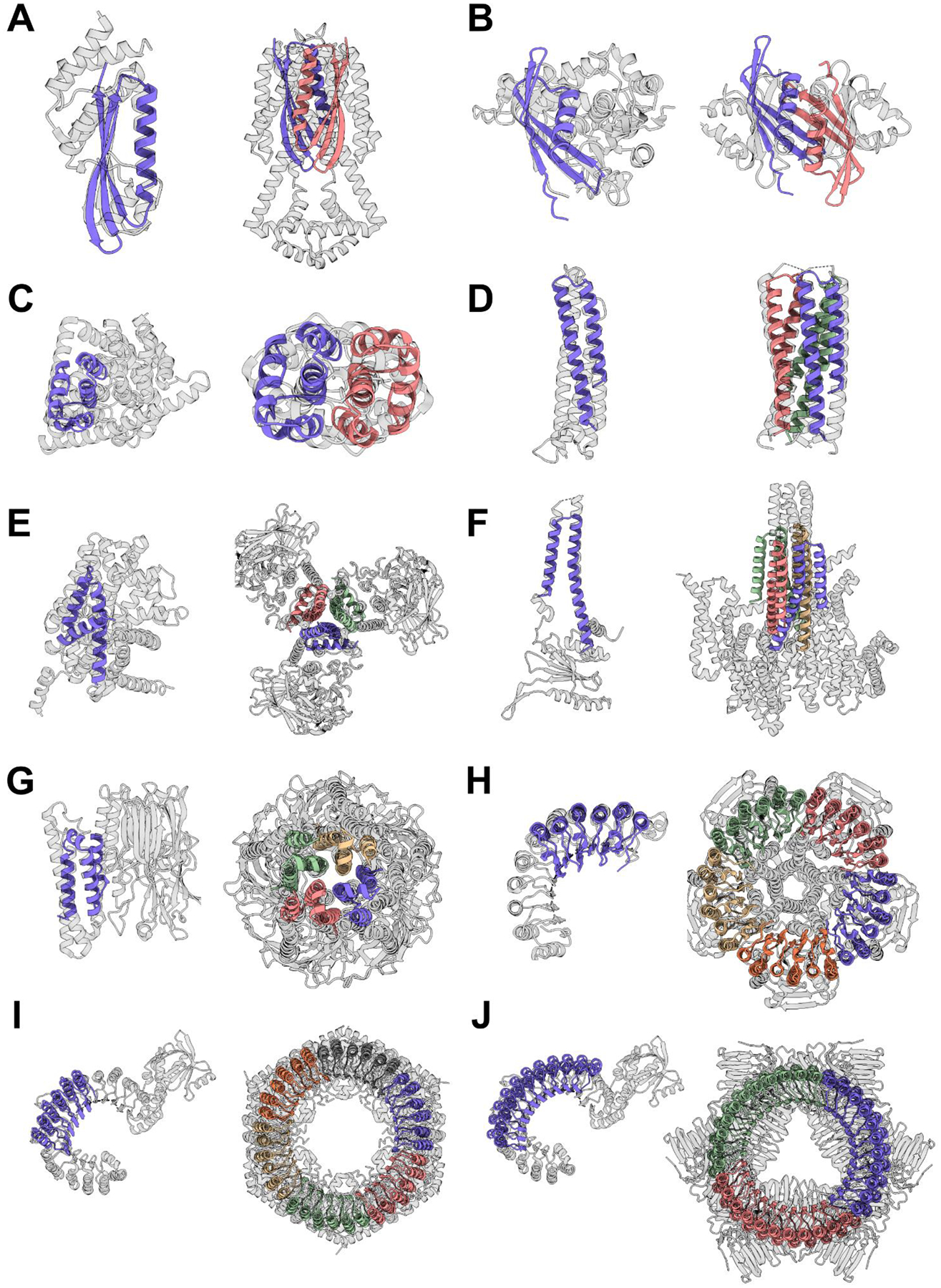
Deep learning generative approaches provide an opportunity to broadly explore protein structure space beyond the sequences and structures of natural proteins. Here, we use deep network hallucination to generate a wide range of symmetric protein homo-oligomers given only a specification of the number of protomers and the protomer length. Crystal structures of seven designs are very similar to the computational models (median root mean square deviation: 0.6 angstroms), as are three cryo–electron microscopy structures of giant 10-nanometer rings with up to 1550 residues and C 33 symmetry; all differ considerably from previously solved structures. Our results highlight the rich diversity of new protein structures that can be generated using deep learning and pave the way for the design of increasingly complex components for nanomachines and biomaterials.
Overview
The claims and statistics of this paper haven’t been checked yet.
Free: it reads the open-access text and checks the first 5 claims that cite a source we can check. Create a free account to check every claim.
Integrity signals
Registry
Cites
Statistics
Figures


Verification
Claims the paper makes
The claims and statistics of this paper haven’t been checked yet.
Free: it reads the open-access text and checks the first 5 claims that cite a source we can check. Create a free account to check every claim.
Claims other papers make about this one
Each is checked against this paper’s own text: does it say what the citing paper says it does?
The source backs part of the claim, not all of it — or backs it for a different population, condition or comparison.
In the citing paper
“This measure of in silico success has been found to correlate with experimental success4,7,26 and is significantly more stringent than template modelling (TM)-score-based metrics used elsewhere5,16,27–29”
From De novo design of protein structure and function with RFdiffusion (2023) · cites this paper as [7]
Experimental — accuracy not yet measuredThe source backs part of the claim, not all of it — or backs it for a different population, condition or comparison.
In the citing paper
“Cyclic oligomers have been designed using structure prediction networks with an adaptation of Hallucination that searches for sequences predicted to fold to the desired cyclic symmetry, but this approach fails for higher-order dihedral, tetrahedral, octahedral and icosahedral symmetries, probably in part because of the much lower representation of such structures in the PDB7.”
From De novo design of protein structure and function with RFdiffusion (2023) · cites this paper as [7]
Experimental — accuracy not yet measured
Self-check
Percentages, sums and reported differences re-computed from the paper’s own numbers.
The self-check needs the paper’s full text.
Citations
Cites
Highly accurate protein structure prediction with AlphaFold
Jumper, J., Evans, R., Pritzel, A., Green, T., Figurnov, M., Ronneberger, O., Tunyasuvunakool, K., Bates, R., Žídek, A., Potapenko, A., et al. (2021) · Nature · doi:10.1038/s41586-021-03819-2 · Cited by 43,764
Coot : model-building tools for molecular graphics
Emsley, P., & Cowtan, K. (2004) · Acta Crystallographica Section D Biological Crystallography · doi:10.1107/s0907444904019158 · Cited by 30,571
PHENIX : a comprehensive Python-based system for macromolecular structure solution
Adams, P. D., Afonine, P. V., Bunkóczi, G., Chen, V. B., Davis, I. W., Echols, N., Headd, J. J., Hung, L.-W., Kapral, G. J., Grosse-Kunstleve, R. W., et al. (2010) · Acta Crystallographica Section D Biological Crystallography · doi:10.1107/s0907444909052925 · Cited by 23,716
Phaser crystallographic software
McCoy, A. J., Grosse-Kunstleve, R. W., Adams, P. D., Winn, M. D., Storoni, L. C., & Read, R. J. (2007) · Journal of Applied Crystallography · doi:10.1107/s0021889807021206 · Cited by 20,612
Kabsch, W. (2010) · Acta Crystallographica Section D Biological Crystallography · doi:10.1107/s0907444909047337 · Cited by 16,463
Kabsch, W., & Sander, C. (1983) · Biopolymers · doi:10.1002/bip.360221211 · Cited by 15,320
Refinement of Macromolecular Structures by the Maximum-Likelihood Method
Murshudov, G. N., Vagin, A. A., & Dodson, E. J. (1997) · Acta Crystallographica Section D Biological Crystallography · doi:10.1107/s0907444996012255 · Cited by 14,742
Overview of the CCP 4 suite and current developments
Winn, M. D., Ballard, C. C., Cowtan, K. D., Dodson, E. J., Emsley, P., Evans, P. R., Keegan, R. M., Krissinel, E. B., Leslie, A. G. W., McCoy, A., et al. (2011) · Acta Crystallographica Section D Biological Crystallography · doi:10.1107/s0907444910045749 · Cited by 12,353
cryoSPARC: algorithms for rapid unsupervised cryo-EM structure determination
Punjani, A., Rubinstein, J. L., Fleet, D. J., & Brubaker, M. A. (2017) · Nature Methods · doi:10.1038/nmeth.4169 · Cited by 11,626
MotionCor2: anisotropic correction of beam-induced motion for improved cryo-electron microscopy
Zheng, S. Q., Palovcak, E., Armache, J.-P., Verba, K. A., Cheng, Y., & Agard, D. A. (2017) · Nature Methods · doi:10.1038/nmeth.4193 · Cited by 7,777
Cited by
Items 101–200 of 265
De novo design of high-affinity protein binders to bioactive helical peptides
Vázquez Torres, S., Leung, P. J. Y., Lutz, I. D., Venkatesh, P., Watson, J. L., Hink, F., Huynh, H.-H., Yeh, A. H.-W., Juergens, D., Bennett, N. R., et al. (2022) · doi:10.1101/2022.12.10.519862 · Cited by 22
Self-citationKao, H.-W., Lu, W.-L., Ho, M., Lin, Y., Hsieh, Y.-J., Ko, T., Hsu, S. D., & Wu, K. (2023) · ACS Synthetic Biology · doi:10.1021/acssynbio.3c00042 · Cited by 22
What can molecular assembly learn from catalysed assembly in living organisms?
Lei, Z., Wang, X., Yang, L., Qu, H., Sun, Y., Yang, Y., Li, W., Zhang, W., Cao, X., Fan, C., et al. (2024) · Chemical Society Reviews · doi:10.1039/d3cs00634d · Cited by 22
Reengineering of a flavin‐binding fluorescent protein using ProteinMPNN
Nikolaev, A., Kuzmin, A., Markeeva, E., Kuznetsova, E., Ryzhykau, Y. L., Semenov, O., Anuchina, A. A., Remeeva, A., & Gushchin, I. (2024) · Protein Science · doi:10.1002/pro.4958 · Cited by 22
Parametrically guided design of beta barrels and transmembrane nanopores using deep learning
Kim, D. E., Watson, J. L., Juergens, D., Majumder, S., Sonigra, R., Gerben, S. R., Kang, A., Bera, A. K., Li, X., & Baker, D. (2025) · Proceedings of the National Academy of Sciences · doi:10.1073/pnas.2425459122 · Cited by 21
Self-citationKim, K., Kang, M., Cho, S.-H., Yoo, E., Kim, U.-G., Cho, S., Palsson, B. Ø., & Cho, B. (2022) · Computational and Structural Biotechnology Journal · doi:10.1016/j.csbj.2022.12.042 · Cited by 21
Peptide-based nanomaterials: Building back better & beyond
Conticello, V. P. (2023) · Current Opinion in Solid State and Materials Science · doi:10.1016/j.cossms.2023.101066 · Cited by 21
Synthetic promoter design in Escherichia coli based on multinomial diffusion model
Du, Q., Poon, M. N., Zeng, X., Zhang, P., Wei, Z., Wang, H., Wang, Y., Wei, L., & Wang, X. (2024) · iScience · doi:10.1016/j.isci.2024.111207 · Cited by 21
Galindo, G., Maejima, D., DeRoo, J., Burlingham, S. R., Fixen, G. M., Morisaki, T., Febvre, H. P., Hasbrook, R., Zhao, N., Ghosh, S., et al. (2026) · Science Advances · doi:10.1126/sciadv.adx8352 · Cited by 21
AI in cellular engineering and reprogramming
Capponi, S., & Wang, S. (2024) · Biophysical Journal · doi:10.1016/j.bpj.2024.04.001 · Cited by 20
A suite of designed protein cages using machine learning and protein fragment-based protocols
Meador, K., Castells-Graells, R., Aguirre, R., Sawaya, M. R., Arbing, M. A., Sherman, T., Senarathne, C., & Yeates, T. O. (2024) · Structure · doi:10.1016/j.str.2024.02.017 · Cited by 19
Chen, Z., Yu, S., Liu, J., Guo, L., Wu, T., Duan, P., Yan, D., Huang, C., & Huo, Y. (2024) · Advanced Science · doi:10.1002/advs.202310215 · Cited by 19
Laakko, T., Korkealaakso, A., Yildirir, B. F., Batys, P., Liljeström, V., Hokkanen, A. P., Nonappa, N., Penttilä, M. E., Laukkanen, A., Miserez, A., et al. (2024) · Advanced Materials · doi:10.1002/adma.202312299 · Cited by 19
Fang, M., Wang, C., Shi, J., Lian, F., Jin, Q., Wang, Z., Zhang, Y., Chen, P., Cui, Z., Wang, Y., et al. (2025) · bioRxiv (Cold Spring Harbor Laboratory) · doi:10.1101/2025.11.08.686881 · Cited by 20
Hall, D. M., Stevens, M. J., & Grason, G. M. (2023) · Soft Matter · doi:10.1039/d2sm01371a · Cited by 18
Computational design of bifaceted protein nanomaterials
Rankovic, S., Carr, K. D., Decarreau, J., Skotheim, R., Kibler, R. D., Ols, S., Lee, S., Chun, J.-H., Tooley, M. R., Dauparas, J., et al. (2025) · Nature Materials · doi:10.1038/s41563-025-02295-7 · Cited by 17
Self-citationNow What Sequence? Pre-trained Ensembles for Bayesian Optimization of Protein SequencesPreprint
Yang, Z., Milas, K. A., & White, A. D. (2022) · bioRxiv (Cold Spring Harbor Laboratory) · doi:10.1101/2022.08.05.502972 · Cited by 17
Engineering complexity into protein-based biomaterials for biomedical applications
Gregorio, N. E., Haas, C. M., King, N. P., & DeForest, C. A. (2025) · Nature Reviews Materials · doi:10.1038/s41578-025-00861-8 · Cited by 16
Design of pseudosymmetric protein hetero-oligomers
Kibler, R. D., Lee, S., Kennedy, M. A., Wicky, B. I. M., Lai, S. M., Kostelic, M. M., Carr, A., Li, X., Chow, C. M., Nguyen, T. K., et al. (2024) · Nature Communications · doi:10.1038/s41467-024-54913-8 · Cited by 16
Self-citationDe Novo Design of Integrin α5β1 Modulating Proteins to Enhance Biomaterial Properties
Wang, X., Guillem‐Marti, J., Kumar, S., Lee, D. S., Cabrerizo‐Aguado, D., Werther, R. A., Alamo, K. A. E., Zhao, Y. T., Nguyen, A., Kopyeva, I., et al. (2025) · Advanced Materials · doi:10.1002/adma.202500872 · Cited by 16
Self-citationHallucination of closed repeat proteins containing central pockets
An, L., Hicks, D. R., Zorine, D., Dauparas, J., Wicky, B. I. M., Milles, L. F., Courbet, A., Bera, A. K., Nguyen, H., Kang, A., et al. (2023) · Nature Structural & Molecular Biology · doi:10.1038/s41594-023-01112-6 · Cited by 15
Self-citationHaas, C. M., Jasti, N., Dosey, A. M., Allen, J. D., Gillespie, R. A., McGowan, J., Leaf, E. M., Crispin, M., DeForest, C. A., Kanekiyo, M., et al. (2025) · Proceedings of the National Academy of Sciences · doi:10.1073/pnas.2409566122 · Cited by 15
Growing ecosystem of deep learning methods for modeling protein–protein interactions
Rogers, J. R., Nikolényi, G., & AlQuraishi, M. (2023) · Protein Engineering Design and Selection · doi:10.1093/protein/gzad023 · Cited by 15
Wang, Y., Zhu, C., Zhang, S., Xiang, C., Gao, Z., Zhu, G., Sun, J. F., Ding, X., Li, B., & Shen, X. (2025) · Advanced Science · doi:10.1002/advs.202413805 · Cited by 14
Yang, S., Ren, J., Gao, W., Cao, L., & Ling, S. (2025) · npj Soft Matter · doi:10.1038/s44431-025-00005-6 · Cited by 14
Lan, T., Su, S., Ping, P., Hutvágner, G., Liu, T., Pan, Y. F., & Li, J. (2024) · Nature Machine Intelligence · doi:10.1038/s42256-024-00803-z · Cited by 14
Scientists are using AI to dream up revolutionary new proteins
Callaway, E. (2022) · Nature · doi:10.1038/d41586-022-02947-7 · Cited by 14
Accurate single-domain scaffolding of three nonoverlapping protein epitopes using deep learning
Castro, K. M., Watson, J. L., Wang, J., Southern, J., Ayardulabi, R., Georgeon, S., Rosset, S., Baker, D., & Correia, B. E. (2026) · Nature Chemical Biology · doi:10.1038/s41589-025-02083-z · Cited by 13
Self-citationDe novo design of a protein binder against Staphylococcus enterotoxin B
Ming, K., Xing, B., Hu, Y., Mei, M., Huang, W., Hu, X., & Wei, Z. (2023) · International Journal of Biological Macromolecules · doi:10.1016/j.ijbiomac.2023.128666 · Cited by 13
Charalampidou, A., Nehls, T., Meyners, C., Gandhesiri, S., Pomplun, S. J., Pentelute, B. L., Lermyte, F., & Hausch, F. (2024) · ACS Central Science · doi:10.1021/acscentsci.3c01283 · Cited by 13
Optimisation strategies for directed evolution without sequencing
James, J., Towers, S., Foerster, J., & Steel, H. (2024) · PLoS Computational Biology · doi:10.1371/journal.pcbi.1012695 · Cited by 13
Machine learning for biomaterials design
Xia, X., Leng, T., García, A. J., & de la Fuente‐Núñez, C. (2026) · Nature Reviews Bioengineering · doi:10.1038/s44222-026-00476-w · Cited by 13
Nucleases in gene-editing technologies: past and prologue
Li, D., Li, L.-Q., & Liu, J. (2023) · National Science Open · doi:10.1360/nso/20220067 · Cited by 13
AI tools are designing entirely new proteins that could transform medicine
Callaway, E. (2023) · Nature · doi:10.1038/d41586-023-02227-y · Cited by 13
Alphafold2 refinement improves designability of large de novo proteinsPreprint
Frank, C., Schiwietz, D., Fuss, L., Ovchinnikov, S., & Dietz, H. (2024) · bioRxiv (Cold Spring Harbor Laboratory) · doi:10.1101/2024.11.21.624687 · Cited by 13
Single-chain dimers from de novo immunoglobulins as robust scaffolds for multiple binding loops
Roel‐Touris, J., Nadal, M., & Marcos, E. (2023) · Nature Communications · doi:10.1038/s41467-023-41717-5 · Cited by 12
Designing Multifunctional Biomaterials via Protein Self‐Assembly
Solomonov, A. V., Kozell, A., & Shimanovich, U. (2024) · Angewandte Chemie · doi:10.1002/ange.202318365 · Cited by 12
Machine learning-driven innovation design of clustered tensegrity continuum robot
Shi, X., Yang, Q., Hu, K., Lian, B., Song, Y., Kang, R., & Sun, T. (2025) · Mechanism and Machine Theory · doi:10.1016/j.mechmachtheory.2025.106155 · Cited by 11
Computational de novo protein design: From secondary to primary, then toward tertiary structures
Quan, L., Wu, T., & Lyu, Q. (2023) · Chem · doi:10.1016/j.chempr.2023.06.010 · Cited by 11
Efficient protein structure generation with sparse denoising models
Jendrusch, M., & Korbel, J. O. (2025) · Nature Machine Intelligence · doi:10.1038/s42256-025-01100-z · Cited by 10
Lin, H., Zhu, C., Shang, T., Zhu, N., Lin, K., Zhang, C., Shao, X., Wang, X., & Duan, H. (2025) · Journal of Medicinal Chemistry · doi:10.1021/acs.jmedchem.5c00896 · Cited by 10
Designing novel solenoid proteins with in silico evolution
(2025) · doi:10.1038/s42004-025-01817-3 · Cited by 10
Hoffnagle, A. M., Herold, R. A., Tsai, C.-Y., Shiau, A. A., Britt, R. D., & Tezcan, F. A. (2025) · Journal of the American Chemical Society · doi:10.1021/jacs.5c13813 · Cited by 10
Yang, W., Wang, Y., & Wang, Y. (2026) · Biophysics Reviews · doi:10.1063/5.0273394 · Cited by 10
How Do Particles with Complex Interactions Self-Assemble?
Koehler, L., Ronceray, P., & Lenz, M. (2024) · Physical Review X · doi:10.1103/physrevx.14.041061 · Cited by 10
Improving Inverse Folding models at Protein Stability Prediction without additional Training or DataPreprint
Dutton, O., Bottaro, S., Invernizzi, M., Redl, I., Chung, A., Hoffmann, F., Henderson, L. D., Ruschetta, S., Airoldi, F., Owens, B. M. J., et al. (2024) · bioRxiv (Cold Spring Harbor Laboratory) · doi:10.1101/2024.06.15.599145 · Cited by 10
Natural Language Prompts Guide the Design of Novel Functional Protein SequencesPreprint
Praljak, N., Yeh, H., Moore, M., Socolich, M., Ranganathan, R., & Ferguson, A. L. (2024) · bioRxiv (Cold Spring Harbor Laboratory) · doi:10.1101/2024.11.11.622734 · Cited by 10
Diversifying de novo TIM barrels by hallucination
Beck, J., Shanmugaratnam, S., & Höcker, B. (2024) · Protein Science · doi:10.1002/pro.5001 · Cited by 9
Generative AI techniques for conformational diversity and evolutionary adaptation of proteins
Brownless, A.-L. R., Yehorova, D., Welsh, C. L., & Kamerlin, S. C. L. (2025) · Current Opinion in Structural Biology · doi:10.1016/j.sbi.2025.103135 · Cited by 9
Generative Artificial Intelligence-Assisted Protein Design Must Consider Repurposing Potential
Ekins, S., Brackmann, M., Invernizzi, C. F., & Lentzos, F. (2023) · GEN Biotechnology · doi:10.1089/genbio.2023.0025 · Cited by 9
HighMPNN: A Graph Neural Network Approach for Structure-Constrained Cyclic Peptide Sequence Design
Xu, W., Zhang, C., Shang, T., Mao, Q., Guo, J., & Duan, H. (2026) · IEEE Journal of Biomedical and Health Informatics · doi:10.1109/jbhi.2025.3620163 · Cited by 8
Protein design and optimization for synthetic cells
Frohn, B. P., Kohyama, S., & Schwille, P. (2025) · Nature Reviews Bioengineering · doi:10.1038/s44222-025-00318-1 · Cited by 8
Connecting the dots: Computational network analysis for disease insight and drug repurposing
Siminea, N., Czeizler, E., Popescu, V., Petre, I., & Păun, A. (2024) · Current Opinion in Structural Biology · doi:10.1016/j.sbi.2024.102881 · Cited by 8
Advances in designed bionanomolecular assemblies for biotechnological and biomedical applications
Snoj, J., Zhou, W., Ljubetič, A., & Jerala, R. (2025) · Current Opinion in Biotechnology · doi:10.1016/j.copbio.2024.103256 · Cited by 8
Geometric Tuning of Cytokine Receptor Association Modulates Synthetic Agonist SignalingPreprint
Expòsit, M., Abedi, M. H., Krishnakumar, A., Jain, S., Yu, T.-Y., Hercus, T. R., Mathew, D., Gray-Gaillard, S. L., Chen, Z., Grubbe, W. S., et al. (2025) · bioRxiv (Cold Spring Harbor Laboratory) · doi:10.1101/2025.10.12.681819 · Cited by 8
Self-citationThe rise of AlphaFold in drug design
Stecuła, A., Paul, R., Litchfield, K., Dalton, S. E., Low, C. M. R., Reis, C. R., & Congreve, M. (2025) · Progress in medicinal chemistry · doi:10.1016/bs.pmch.2025.09.002 · Cited by 7
Fast non-autoregressive inverse folding with discrete diffusionPreprint
Yang, J. J., Yim, J., Barzilay, R., & Jaakkola, T. (2023) · arXiv (Cornell University) · doi:10.48550/arxiv.2312.02447 · Cited by 7
Advanced Deep Learning Methods for Protein Structure Prediction and DesignPreprint
Zhang, Y., Deng, N., Song, X., Bi, Z., Wang, T., Yao, Z., Chen, K., Li, M., Niu, Q., Liu, J., et al. (2025) · arXiv (Cornell University) · doi:10.48550/arxiv.2503.13522 · Cited by 7
A self-assembled protein β-helix as a self-contained biofunctional motif
Dondi, C., Garcia-Ruiz, J., Hasan, E. A., Rey, S. A., Noble, J. E., Hoose, A., Briones, A., Kepiro, I. E., Faruqui, N., Aggarwal, P., et al. (2025) · Nature Communications · doi:10.1038/s41467-025-59873-1 · Cited by 6
Gardiner, S., Dollinger, P., Kovačić, F., Pietruszka, J., Ess, D. H., Jaeger, K., Schroeder, G. F., & Corte, D. D. (2025) · PLoS ONE · doi:10.1371/journal.pone.0332409 · Cited by 6
Sequence-free landscape inference for directed evolution
Towers, S., James, J., Steel, H., & Kempf, I. (2026) · PLoS Computational Biology · doi:10.1371/journal.pcbi.1014713 · Cited by 6
Protein Language Model Supervised Precise and Efficient Protein Backbone Design MethodPreprint
Zhang, B., Liu, K., Zheng, Z., Liu, Y., Mu, J., Wei, T., & Chen, H. (2023) · bioRxiv (Cold Spring Harbor Laboratory) · doi:10.1101/2023.10.26.564121 · Cited by 6
Programmed mineralization of metal-oxides by de novo designed protein templatesPreprint
Saragovi, A., Pyles, H., Huddy, E. B., Borst, A. J., Hanikel, N., Kwon, P. S., Dávila-Hernández, F. A., Li, X., Courbet, A., Kibler, R. D., et al. (2024) · bioRxiv (Cold Spring Harbor Laboratory) · doi:10.1101/2024.06.24.600095 · Cited by 6
Self-citationTriangle Multiplication Is All You Need For Biomolecular Structure RepresentationsPreprint
Ouyang-Zhang, J., Murugan, P., Diaz, D. J., Scarpellini, G., Bowen, R. S., Gruver, N., Klivans, A. R., Krähenbühl, P., Faust, A., & Al-Shedivat, M. (2025) · arXiv (Cornell University) · doi:10.48550/arxiv.2510.18870 · Cited by 6
Limitations of the refolding pipeline for de novo protein design
Korbeld, K. T., Viliuga, V., & Fürst, M. J. L. J. (2026) · Protein Science · doi:10.1002/pro.70613 · Cited by 5
Computational Bioprospecting of Enzymes
Xiang, R., Martinez-Sugrañes, M., Muñoz‐Tafalla, R., Floor, M., & Guallar, V. (2025) · Wiley Interdisciplinary Reviews Computational Molecular Science · doi:10.1002/wcms.70037 · Cited by 5
Multimodal diffusion for joint design of protein sequence and structure
Zhu, S., Gulati, S., Liu, Y., Kotnis, S., Sun, Q. H., & Shen, Y. (2025) · Protein Science · doi:10.1002/pro.70340 · Cited by 5
Lin, X., Chen, Z., Li, Y. G., Ma, Z., Fan, C., Cao, Z., Feng, S., Zhang, J., & Gao, Y. Q. (2025) · Chemical Science · doi:10.1039/d5sc02055g · Cited by 5
Cerebra: A computationally efficient framework for accurate protein structure prediction
Hu, J., Wang, W., Zhang, B., Cao, Y., & Gong, H. (2026) · Protein Science · doi:10.1101/2024.02.02.578551 · Cited by 5
Gomari, M. M., Alidadi, M., Rostami, N., & Bencherif, S. A. (2025) · Advanced NanoBiomed Research · doi:10.1002/anbr.202500017 · Cited by 5
Challenges, Risks, and Opportunities: Marxist Political Economy Review of AIGC
Chen, D., & Tian, Y. (2023) · International Society for the Study of Information Summit (IS4SI Summit) · doi:10.3390/cmsf2023008080 · Cited by 5
Thermodynamic Stabilization of Human FrataxinPreprint
Núñez‐Franco, R., Torres-Mozas, Á., Navo, C. D., Schedlbauer, A., Azkargorta, M., Iloro, I., Elortza, F., Ortega, G., Millet, Ó., Peccati, F., et al. (2023) · bioRxiv (Cold Spring Harbor Laboratory) · doi:10.1101/2023.09.08.556816 · Cited by 5
Kim, T. D., Pretorius, D., Murray, J. W., & Cardona, T. (2025) · Physiologia Plantarum · doi:10.1111/ppl.70284 · Cited by 4
Protein Design Meets Single-Molecule Detection: Towards Programmable Nanopore Sensors
Liu, X., & Xu, C. (2025) · International Journal of Molecular Sciences · doi:10.3390/ijms262110561 · Cited by 4
Gupta, A. K., Esih, H., Gradišar, H., & Jerala, R. (2025) · Materials Advances · doi:10.1039/d5ma00792e · Cited by 4
In Cellulo Fabrication of Supramolecular Protein Assemblies
Yang, H., Song, C. W., Lu, J., & Lin, D. (2026) · Chemical Reviews · doi:10.1021/acs.chemrev.5c01095 · Cited by 4
Synergizing genome editing and artificial intelligence for predictive crop design
Gao, Z., Zhu, J., & Xie, C. (2026) · Molecular Plant · doi:10.1016/j.molp.2026.04.007 · Cited by 4
Zhang, X., Zhong, T., Huang, H., Zhang, D., Zhuang, S., Han, S., Lai, P., & Liu, H. (2026) · Nature Communications · doi:10.1038/s41467-026-72304-z · Cited by 5
Fan, Z. (2026) · Cancer Letters · doi:10.1016/j.canlet.2026.218578 · Cited by 4
Zhang, S., Han, Y., Ding, Y., Lin, X., Yuan, Z., Sun, X., Yuan, Q., Liu, Z., & Zhang, Y. (2026) · Nature Communications · doi:10.1038/s41467-026-74506-x · Cited by 4
The structural chemistry and biosynthesis of chlorophylls
Hunter, C. N., & Morey-Burrows, F. S. (2026) · RSC Chemical Biology · doi:10.1039/d6cb00082g · Cited by 4
Being Creative with a Non-Human: The Use of Generative Artificial Intelligence in Art
Gregor, S. D. (2025) · AJIS. Australasian journal of information systems/AJIS. Australian journal of information systems/Australian journal of information systems · doi:10.3127/ajis.v29.5857 · Cited by 4
Heme‐Enzymatic Biocatalysis for C−C or C−N Bond Formation
Weng, H., & Huang, M. (2024) · ChemCatChem · doi:10.1002/cctc.202400598 · Cited by 4
De novo design of alpha-beta repeat proteinsPreprint
Zorine, D., & Baker, D. A. (2024) · bioRxiv (Cold Spring Harbor Laboratory) · doi:10.1101/2024.06.15.590358 · Cited by 4
Self-citationGeneralization vs. HallucinationPreprint
Zhang, X., Huang, H., Zhang, D., Zhuang, S., Han, S., Lai, P., & Liu, H. (2024) · arXiv (Cornell University) · doi:10.48550/arxiv.2411.02893 · Cited by 4
Feldman, D., Sims, J. N., Li, X., Johnson, R. S., Gerben, S., Kim, D. E., Richardson, C., Koepnick, B., Eisenach, H. E., Hicks, D. R., et al. (2025) · bioRxiv (Cold Spring Harbor Laboratory) · doi:10.1101/2025.02.24.639402 · Cited by 4
Self-citationBackbone Conditional Protein Sequence Design
Dauparas, J. (2025) · Cold Spring Harbor Perspectives in Biology · doi:10.1101/cshperspect.a041517 · Cited by 4
Self-citationProtein language model supervised motif-scaffolding design with GPDL
Zhang, B., Liu, K., Zheng, Z., Zhu, J., Li, Z., Liu, Y., Mu, J., Wei, T., & Chen, H. (2025) · International Journal of Biological Macromolecules · doi:10.1016/j.ijbiomac.2025.148441 · Cited by 4
Zhang, J., Zhou, W., Yu, J., Yan, C., & Liu, J. (2025) · Briefings in Bioinformatics · doi:10.1093/bib/bbaf582 · Cited by 3
Computational Peptide Design for Diverse Structures and Functions
Rettie, S., Juergens, D., & Bhardwaj, G. (2025) · Peptide Science · doi:10.1002/9781119824701.ch05 · Cited by 3
Translational potential of AI-driven de novo protein binders for crop protection and improvement
Rifat, M. H., Tai, L., Wang, Y., Deng, Q., Pan, R., & Feng, Y. (2026) · Crop Design · doi:10.1016/j.cropd.2026.100133 · Cited by 4
Applications of machine learning in plant biotechnology
Ogra, I. O., Silué, Y., Fawole, O. A., Aremu, A. O., & Opara, U. L. (2026) · Discover Artificial Intelligence · doi:10.1007/s44163-026-01166-7 · Cited by 3
Generative Protein Design: From Deep Learning Algorithms to Translational Applications
Luo, S., & Zhou, B. (2026) · International Journal of Molecular Sciences · doi:10.3390/ijms27093917 · Cited by 3
Mapping AAV capsid sequences to functions through function-guided in silico evolution
Guo, B., Zheng, H., Lin, X., Jiang, H., Mo, A., Wei, H., Zhang, R., Yuan, Y., Wu, Y., Li, H., et al. (2026) · Cell Press Blue · doi:10.1016/j.cpblue.2026.100016 · Cited by 3
De novo design of a macrocycle-induced dimerization system for cellular control
Hanna, S., Salveson, P. J., Wicky, B. I. M., Kennedy, M., Hicks, D. R., Möller, C., Cheng, S., Li, X., Abedi, M. H., Coventry, B., et al. (2026) · Nature Communications · doi:10.1038/s41467-026-71345-8 · Cited by 4
Self-citationA De Novo CO 2 Reductase Featuring a Cysteine-Ligated Cobalt Porphyrin Cofactor
Radley, E., Andrews, A., Kalvet, I., Deng, Y., Bell, E. L., Levy, C., Ortmayer, M., Heyes, D. J., Megarity, C. F., Núñez‐Franco, R., et al. (2026) · Journal of the American Chemical Society · doi:10.1021/jacs.6c07615 · Cited by 3
Self-citationApplications and limitations of AI tools in enzyme design
Teijeiro-Juiz, R., Egeler, N., Jamróg, G., Ringel, M., Brück, T., Geronimo, B. D., & Loll, B. (2026) · Protein Science · doi:10.1002/pro.70698 · Cited by 3
Recent advances in the integration of protein mechanics and machine learning
Chen, Y., & Chang, S. (2024) · Extreme Mechanics Letters · doi:10.1016/j.eml.2024.102236 · Cited by 3
A De Novo Design Strategy to Convert FAcD from Dimer to Active MonomerPreprint
Chen, K.-W., Wang, C., Huang, H.-S., Wu, X., Chen, J., Qiu, J.-H., Hoi, K. K., Sun, T., Wang, J., & Wu, Y. (2025) · bioRxiv (Cold Spring Harbor Laboratory) · doi:10.1101/2025.01.11.632520 · Cited by 3
Design of overlapping genes using deep generative models of protein sequencesPreprint
Byeon, G. W., Expòsit, M., Baker, D. A., & Seelig, G. (2025) · bioRxiv (Cold Spring Harbor Laboratory) · doi:10.1101/2025.05.06.652464 · Cited by 3
Self-citation
Metadata
- Authors
- Wicky, B. I. M., Milles, L. F., Courbet, A., Ragotte, R. J., Dauparas, J., Kinfu, E., Tipps, S., Kibler, R. D., Baek, M., DiMaio, F., Li, X., Carter, L., Kang, A., Nguyen, H., Bera, A. K., & Baker, D.
- Affiliations
- University of Washington (US)
- Howard Hughes Medical Institute (US)
- Corresponding author
- Baker, D.
- ORCID
- Venue
- Science
- Published
- 2022-10-07
- Volume
- 378
- Issue
- 6615
- Pages
- 56-61
- ISSN
- 0036-8075 (ISSN-L)
- 1095-9203
- PMC
- PMC9724707
- OpenAlex
- W4296031103
- Cited by
- 240
- References
- 58
- Citations by year
- 2026: 46 · 2025: 72 · 2024: 62 · 2023: 52 · 2022: 8
- FWCI
- 15.84
- Type
- journal article
- Language
- en
- Open access
- green
- doi.org
- Licence
- cc-by-nc-nd
- Locations
- Science (publishedVersion)
- bioRxiv (Cold Spring Harbor Laboratory) (acceptedVersion, cc-by-nc-nd)
- PubMed (publishedVersion)
- PubMed Central (acceptedVersion, cc-by)
- Funders
- National Science Foundation (P30 GM124165, P30 CA015704, CA015704, DE-AC02–06CH11357, P41-GM103311, 1629214)
- Howard Hughes Medical Institute
- U.S. Department of Energy (DE‐ AC02‐06CH11357, Contract No. DE-AC02-06CH11357., AC02‐06CH11357, P30 GM124165, 06CH11357, No. DE-AC02-06CH11357, DE-AC02-)
- Alfred P. Sloan Foundation (g-2021-16899)
- University of Washington (DE-AC02-06CH11357, P30 CA015704)
- Open Philanthropy Project
- National Institutes of Health (S10 OD032290, DE-AC02–06CH11357, GM124165, CA015704)
- Office of Science (Contract No. DE-AC02-06CH11357, AC02‐06CH11357, DE-AC02, No. DE-AC02-06CH11357., 06CH11357, DE-AC02-06CH11357)
- University of California, San Francisco (NIH P41-GM103311, P41-GM103311)
- National Cancer Institute (P30CA015704)
- National Institute of General Medical Sciences (GM103311, P41GM103311, P41GM103533, DE-AC02-06CH11357, NIH P41-GM103311, 103533, GM124165, P30GM124165)
- Division of Chemistry (1629214, CHE 1629214)
- Argonne National Laboratory (DE- AC02-06-CH11357, DE-AC02, AC02–06CH11357, No. DE-AC02-06CH11357, 06CH11357, Contract No. DE-AC02-06CH11357., P30 GM124165)
- Topics
- Life Sciences › Biochemistry, Genetics and Molecular Biology › Molecular Biology › Protein Structure and Dynamics
- Life Sciences › Biochemistry, Genetics and Molecular Biology › Structural Biology › Enzyme Structure and Function
- Life Sciences › Biochemistry, Genetics and Molecular Biology › Molecular Biology › Machine Learning in Bioinformatics
- Keywords
- protein structure design, homo-oligomers, nanorobots, biomaterials
- MeSH terms
- Deep Learning, Biocompatible Materials, Models, Molecular, Protein Conformation, Protein Engineering, Cryoelectron Microscopy, Protein Subunits
About these checks
Registry, retraction, Cites and statistics results are computed, not judged, with one exception: a printed reference that no index lists is read once by a model before it counts as a citation error. Claims are extracted by a model and kept only when their quote appears verbatim in the text; each cited source is then checked, with a model’s help, for whether it says what the claim relies on. Those verdicts can be wrong — read the claim’s quote and the cited source before relying on one.
Statistics and arithmetic are recomputed, not judged.
Confidence bands are shown only for fields calibrated on our annotated test set. None is calibrated yet, so no band is shown.
What counts as a claim ›How we measure confidence ›How we check this ›
Are you an author, or do you see a problem with this page? Request a review
Data sources
Bibliographic data: Semantic Scholar, OpenAlex, Crossref.
Contains information from the Semantic Scholar Academic Graph Datasets, made available under the ODC Attribution License (ODC-BY 1.0).
Semantic Scholar’s data is described in: Kinney, R., et al. (2023). The Semantic Scholar Open Data Platform. arXiv:2301.10140.
