

Review of health information technology usability study methodologies
Open accessThe DOI matches its Crossref record; 77 of the 78 references it cites were found in a registry or an index.
Abstract
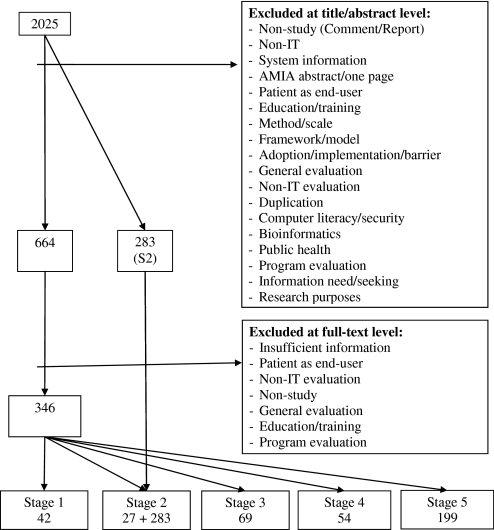
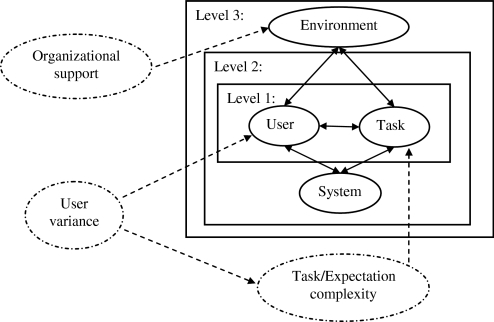
Usability factors are a major obstacle to health information technology (IT) adoption. The purpose of this paper is to review and categorize health IT usability study methods and to provide practical guidance on health IT usability evaluation. 2025 references were initially retrieved from the Medline database from 2003 to 2009 that evaluated health IT used by clinicians. Titles and abstracts were first reviewed for inclusion. Full-text articles were then examined to identify final eligibility studies. 629 studies were categorized into the five stages of an integrated usability specification and evaluation framework that was based on a usability model and the system development life cycle (SDLC)-associated stages of evaluation. Theoretical and methodological aspects of 319 studies were extracted in greater detail and studies that focused on system validation (SDLC stage 2) were not assessed further. The number of studies by stage was: stage 1, task-based or user-task interaction, n=42; stage 2, system-task interaction, n=310; stage 3, user-task-system interaction, n=69; stage 4, user-task-system-environment interaction, n=54; and stage 5, user-task-system-environment interaction in routine use, n=199. The studies applied a variety of quantitative and qualitative approaches. Methodological issues included lack of theoretical framework/model, lack of details regarding qualitative study approaches, single evaluation focus, environmental factors not evaluated in the early stages, and guideline adherence as the primary outcome for decision support system evaluations. Based on the findings, a three-level stratified view of health IT usability evaluation is proposed and methodological guidance is offered based upon the type of interaction that is of primary interest in the evaluation.
Overview
The claims and statistics of this paper haven’t been checked yet.
Free: it reads the open-access text and checks the first 5 claims that cite a source we can check. Create a free account to check every claim.
Integrity signals
Registry
Cites
Statistics
Figures
Verification
Claims the paper makes
The claims and statistics of this paper haven’t been checked yet.
Free: it reads the open-access text and checks the first 5 claims that cite a source we can check. Create a free account to check every claim.
Claims other papers make about this one
Each is checked against this paper’s own text: does it say what the citing paper says it does?
The cited source says what the claim attributes to it.
In the citing paper
“Usability challenges present a major barrier to health information technology adoption 29”
From A chatbot for hypertension self-management support: user-centered design, development, and usability testing (2023) · cites this paper as [29]
Self-check
Percentages, sums and reported differences re-computed from the paper’s own numbers.
The self-check needs the paper’s full text.
Citations
Cites
Perceived usefulness, perceived ease of use, and user acceptance of information technology
Davis, F. D. (1989) · MIS Quarterly · doi:10.2307/249008 · Cited by 68,483
(1993) · Cited by 9,879
Nielsen, J. (1995) · Conference companion on Human factors in computing systems - CHI '95 · doi:10.1145/223355.223730 · Cited by 2,620
IBM computer usability satisfaction questionnaires: Psychometric evaluation and instructions for use
Lewis, J. R. (1995) · International Journal of Human-Computer Interaction · doi:10.1080/10447319509526110 · Cited by 2,429
Development of an instrument measuring user satisfaction of the human-computer interface
Chin, J. P., Diehl, V. A., & Norman, L. K. (1988) · Proceedings of the SIGCHI conference on Human factors in computing systems - CHI '88 · doi:10.1145/57167.57203 · Cited by 1,609
Participatory Design: Principles and Practices
(2017) · CRC Press eBooks · doi:10.1201/9780203744338 · Cited by 1,500 · cited 1×
“Although we found only one theoretical framework and one method not covered in our review, approaches such as participatory design and ethnography provide overall frameworks that link sets of methods together in a manner that is greater than the sum of their parts.(79) Therefore, a review that included searches of add…”
MethodA Practical Guide to Usability Testing
Dumas, J. F., & Redish, J. C. (1993) · Cited by 1,335
Poissant, L. (2005) · Journal of the American Medical Informatics Association · doi:10.1197/jamia.m1700 · Cited by 901 · cited 4×
“Rahimi and Vimar-lund 10 reviewed general methods used to evaluate health IT.”
MethodInfluentialBiomedical Informatics: Computer Applications in Health Care and Biomedicine
(2024) · Biomedical Informatics: Computer Applications in Health Care and Biomedicine · doi:10.33029/9704-8204-9-bin-2024-1-744 · Cited by 777
Cognitive and usability engineering methods for the evaluation of clinical information systems.
Kushniruk, A. W., & Patel, V. L. (2004) · Journal of Biomedical Informatics · doi:10.1016/j.jbi.2004.01.003 · Cited by 760 · cited 1×
“Kushniruk and Patel 8 provided a methodological review for cognitive and usability engineering methods.”
Research works printed but not linked: 3
- Rubin J Handbook Of Usability Testing. New York: John Wiley & Sons, 1993
- Hyun S Johnson SB Bakken S User-centered approaches for eliciting functional requirements and designing user interfaces: a nursing documentation case study. J Biomed Inform 2008; In press.
- Lewis C Using the “Think Aloud” Method in Cognitive Interface Design. New York: IBM, 1982
Cited by
Items 301–400 of 457
Studying usability of public health surveillance maps through framework based heuristic evaluation
Shah, H. A., Househ, M., Schneider, J., Al-Thani, D. A., & Agus, M. (2024) · Computer Methods and Programs in Biomedicine Update · doi:10.1016/j.cmpbup.2024.100143 · Cited by 2
Williams, A. M., Davis, C. L., Bjoring, M. C., Blackstone, K., Barros, A. J., & Enfield, K. B. (2024) · ACI Open · doi:10.1055/s-0044-1782604 · Cited by 2
“19,32,40 The bene fi ts and drawbacks of the Bundle Board will also be signi fi cantly complemented by further patient outcomes analysis, such as its impact on hospital-acquired infections and venous thromboembolism rates.”
Digital-based Living Lab intervention to promote healthy dietary behaviours in adolescents
Lee, J., Lee, H., Lee, H., Konlan, K. D., & Shim, S. Y. (2025) · European Journal of Public Health · doi:10.1093/eurpub/ckaf129 · Cited by 2
A new method for automated olfactory threshold testing
Surakka, V., Björkbacka, M., Lylykangas, J., Rantala, J., Salpavaara, T., Verho, J. A., Špakov, O., Kamppari, V., Müller, P., Vehkaoja, A. T., et al. (2025) · Chemical Senses · doi:10.1093/chemse/bjaf029 · Cited by 2
“To ensure the successful adoption of novel health technology applications, it is necessary to acknowledge their usability, bearing in mind the intended users, tasks, and operating environments (Yen and Bakken 2012).”
The Impact of 5G Technology on Interactive Mobile Applications A Case Study of Smart Cities
Tavui, S., & Vakalalabure, L. (2025) · Journal Mobile Technologies (JMS) · doi:10.59431/jms.v3i2.544 · Cited by 2
“A comparative analysis (Table 2) highlights how methodological adaptation improved precision, relevance, and validity relative to the standard framework proposed by Yen and Bakken (2012).”
InfluentialThe waiting room of uncertainty: digital patient support for potentially bad news—a scoping review
Kellermann, M., Wetterauer, C., Kullak-Ublick, G. A., & Cheetham, M. (2025) · Frontiers in Digital Health · doi:10.3389/fdgth.2025.1706839 · Cited by 2
Kawasaki, G., Kawabe, M., Suzuki, M., & Sugihara, T. (2026) · Journal of Cross-Cultural Gerontology · doi:10.1007/s10823-026-09563-2 · Cited by 2
Brin, M., Caraballo, P. B., Ramírez, S., Guzman, L. Z., Castro, Y. E., Kuhn, L., Halpern, M., Wright, J. D., Scherr, T. F., Stonbraker, S., et al. (2026) · BMC Public Health · doi:10.1186/s12889-026-27029-5 · Cited by 2
Szplit, D., Czyżewski, A., Graff, B., Szyndler, A., Pałczyński, P., Siemiński, M., Glaner, N., Stefaniak, T., Bogdan, J., Słomińska, K., et al. (2026) · Scientific Reports · doi:10.1038/s41598-026-50490-6 · Cited by 2
Mousavi, A. S., Honarvar, E. J., Haghighi, A. A., Daryaee, S. G., Granfar, M., & Baigi, S. F. M. (2026) · Health Science Reports · doi:10.1002/hsr2.72669 · Cited by 2
“Poor usability can lead to delayed task completion, user frustration, increased training needs, medical errors, and ultimately system abandonment [24–29].”
Bozan, K., & Datta, P. M. (2016) · Healthcare delivery in the information age · doi:10.1007/978-3-319-25973-4_7 · Cited by 2
Abahussin, A. A., West, R. M., Allsop, M. J., Wong, D., & Ziegler, L. E. (2020) · IEEE International Conference on Healthcare Informatics (ICHI) · doi:10.1109/ichi48887.2020.9374388 · Cited by 2
“Indeed, poor usability is the main obstacle to health information technology adoption, which can interrupt workflow and cause delays and errors [32].”
BackgroundLaserterapia no tratamento da disfunção temporomandibular
Bellini, M. E. C. M., Fortaleza, V. G., & Gomes, A. V. S. F. (2022) · Research Society and Development · doi:10.33448/rsd-v11i5.28008 · Cited by 2
Design, Implementation, and Usability of the Electronic Medical Record Search Engine (EMERSE) Tool.
Reyes, C. N., Zheng, K., & Hanauer, D. A. (2022) · PubMed Central · Cited by 2
Bustin, D. J., Simmons, R. G., Galdo, J., Kucek, M. E., Logan, L., Cohn, R. D., & Smith, H. (2024) · JAMIA Open · doi:10.1093/jamiaopen/ooae071 · Cited by 2
“35 The survey has shown construct and predictive validity through confirmatory factor analysis, exploratory factor analysis, and structural equation modeling by the tool’s creators and has been externally validated in multiple use cases.”
BackgroundMethodUsability Test for a Smart Glass–Based Application to Support Nurses' Hospital Admission Tasks
Kagawa, S., & Iijima, S. (2026) · CIN Computers Informatics Nursing · doi:10.1097/cin.0000000000001295 · Cited by 2
Heinonen, T., & Mykkänen, M. (2018) · Theseus (Ammattikorkeakoulujen) · Cited by 2
Scherf, J., Mentler, T., & Herczeg, M. (2020) · IEEE International Conference on Healthcare Informatics (ICHI) · doi:10.1109/ichi48887.2020.9374392 · Cited by 2
“Although previous research has shown that UIMs are not always suitable or insufficient for usability testing [10] – [12] — depending on the interactive system and its context of use — they are frequently chosen for usability assessment of healthcare applications [13] – [21].”
MethodAssessing Clinical Software User Needs for Improved Clinical Decision Support Tools
Denney, K. (2015) · ScholarWorks (Walden University) · Cited by 2
A Framework for Evaluating Technology-Mediated Collaborative Workflow
Bondy, C. (2021) · RIT Scholar Works (Rochester Institute of Technology) · Cited by 2
Teaching Educators About Acquired Brain Injury: A Usability Study Evaluating the Teach-ABI Module
Saly, L. (2021) · TSpace (University of Toronto) · Cited by 2
Assessing and teaching radiotherapy contouring
Duke, S. L. (2021) · Nottingham ePrints (University of Nottingham) · Cited by 2
Rheumatology 2.0 : empowering patients by eHealth
van der Vaart, R. (2013) · doi:10.3990/1.9789036535335 · Cited by 2
SOCKOLOW, P. S., & Yang, Y. (2021) · CIN Computers Informatics Nursing · doi:10.1097/cin.0000000000000782 · Cited by 1
Yingta, N., Abdelnour-Nocera, J., Brew, O., & Rehman, I. U. (2021) · Lecture notes in computer science · doi:10.1007/978-3-030-85607-6_37 · Cited by 1
“The proposed goals address these aspects and are contributions to the literature on mHealth by advancing knowledge on the user-centred design of this genre of apps, focusing on healthcare workers [16, 22].”
BackgroundMobile Interface Theory: A Conceptual Tool for Identifying Digital Rhetoric in a Mobile Context
Campbell, J. L. (2021) · ACM International Conference on Design of Communication (SIGDOC) · doi:10.1145/3472714.3473620 · Cited by 1
Bondy, C., Chen, L., Grover, P., & Shi, P. (2022) · doi:10.31038/jppr.2022513 · Cited by 1
“This approach will allow patients to gain additional relative advantage by adding in additional telehealth capability into an already familiar framework that they are comfortable with [43,83].”
BackgroundDesai, N., Ravindra, N., Hall, B., Alshaykh, H. A., Lemke, L. K., Eken, E., Cicali, E. J., Wiisanen, K., Cavallari, L. H., & Nguyen, K. A. (2024) · Frontiers in Pharmacology · doi:10.3389/fphar.2024.1377132 · Cited by 1
“(Yen and Bakken, 2011) “ The other list, the pre-populated one, is not reliable at all.”
BackgroundInfluentialRe-visioning of a Nursing Informatics Course With Translational Pedagogy
DeGrande, H., & Perez, M. (2024) · CIN Computers Informatics Nursing · doi:10.1097/cin.0000000000001193 · Cited by 1
IoT-based System for The Stroke Survivor Feature Needs: A Qualitative Analysis
Setyonugroho, W., Utami, S. S., Islami, M. Z., Amanu, D. A., Kirana, I. A., & Fathiya, A. H. (2024) · International Conference on Informatics and Computing (ICIC) · doi:10.1109/icic64337.2024.10957003 · Cited by 1
“Technology adoption measures how well technology can fulfill user requirements and enhance patients' health [37], [38].”
Torres-Silva, E. A., Gaviria, J., Pereira-Montiel, E., Arenas, D. A. M., & Florez-Arango, J. F. (2025) · JMIR Formative Research · doi:10.2196/58909 · Cited by 1
“This reinforces the importance of iterative usability evaluations early in the system development XSL • FO RenderX life cycle to ensure alignment with user needs and task requirements [23].”
Toy, K., Lee, R. C., Mattie, J., Laskin, J., Mortenson, W. B., & Borisoff, J. (2025) · Disability and Rehabilitation Assistive Technology · doi:10.1080/17483107.2025.2552407 · Cited by 1
“Qualitative and quantitative data were collected to examine usability and determine overall product satisfaction [13].”
Artificial Intelligence in Colorectal Cancer Supportive Care: A Scoping Review
Kantabanlang, Y., Hwang, M., Krauss, J. C., & Jiang, Y. (2025) · Seminars in Oncology Nursing · doi:10.1016/j.soncn.2025.152079 · Cited by 1
Equity risks in usability evaluations of health technologies: A failure modes and effects analysis
Tjhie, R., Cafazzo, J. A., & Montague, E. N. H. (2026) · Human Factors in Healthcare · doi:10.1016/j.hfh.2026.100124 · Cited by 1
Crane, S. M., Rogith, D., Hellsten, M. B., Miller, A., Castillo, J., Boeger, B., Vidaurre, S., Pieper, S., Nguyen, C., Huynh, D. A. T., et al. (2026) · JMIR Formative Research · doi:10.2196/87821 · Cited by 1
“Next, usability testing was conducted on the prototypes developed during the co-design phase [43].”
Santos, F. C. D., Mclnerney, S., Tate, M. C., Rana, A., Batey, D. S., & Schnall, R. (2026) · Applied Clinical Informatics · doi:10.1055/a-2786-0291 · Cited by 1
“…heuristic evaluation, using Nielsen ’ s 10 usability principles with scores ranging from 0 (not a usability problem) to 4 (usability catastrophe) 16 and (2) end-user acceptability was measured using the 16-item Post-Study System Usability Questionnaire (PSSUQ) with scores ranging from 1…”
Chrimes, D., Thomo, A., Kuo, M.-H., Borycki, E. M., & Kushniruk, A. W. (2026) · JMIR Human Factors · doi:10.2196/86076 · Cited by 1
“It includes subscales for measuring PU, PEOU, and user control, among others [37].”
Nasser, A., Ferik, S. E., & Baslyman, M. (2026) · Frontiers in Digital Health · doi:10.3389/fdgth.2026.1867488 · Cited by 1
“Initially, data categories were predefined based on prior literature and domain knowledge relevant to non-invasive stress technologies [9, 10].”
Braga, R. D., Monteiro, A. L. N., Mota, F. C. S., de Lucena, F. N., & Ribeiro‐Rotta, R. F. (2013) · LA Referencia (Red Federada de Repositorios Institucionales de Publicaciones Científicas) · Cited by 1
Bozan, K. (2014) · OhioLink ETD Center (Ohio Library and Information Network) · Cited by 1
Parthasarathy, R. (2017) · Digital Commons-DePaul (DePaul University) · Cited by 1
Kwok, M. Y., Henry, S. B., Pusic, M. V., York, D. V., Pahalyants, V., Ye, C., Javed, K., & Dayan, P. S. (2018) · Pediatric Emergency Care · doi:10.1097/pec.0000000000001630 · Cited by 1
A Qualitative Assessment of an Ambient Display to Support In-Home Medication of Older Adults
Rodríguez, M. D., Zárate-Bravo, E., Garćıa-Vázquez, J. P., Andrade, Á. G., Navarro, R. F., Torres-Cervantes, E., & Ponce, G. (2018) · International Conference on Ubiquitous Computing and Ambient Intelligence (UCAmI) · doi:10.3390/proceedings2191248 · Cited by 1
“It is based on the premise that system usability is evaluated throughout its development life cycle [21].”
BackgroundMethodIncorporating user feedback in the design of a genetics analysis tool: A two-part approach
Swaminathan, A., Shirts, B. H., & Chen, A. (2019) · Journal of Biomedical Informatics · doi:10.1016/j.jbi.2019.103204 · Cited by 1
Registered Nurses' Intention To Use Electronic Documentation Systems: A Mixed Methods Study
Ibrahim, S. (2019) · Scholarship@Western (Western University) · Cited by 1
Combining end-user recruitment methods for usability testing of eTriage Service
Ylilehto, M. H., Saarivesi, E., Reponen, J., & Liljamo, P. (2019) · Finnish Journal of eHealth and eWelfare · doi:10.23996/fjhw.82596 · Cited by 1
“2019 FinJeHeW 2019;11(4) 313 According to current literature, there is no single methodology for performing usability testing for health information technology solutions: the methods chosen vary between the technologies being tested [17,21,22].”
MethodMoghimi, H., Wickramasinghe, N. S., & Adya, M. P. (2019) · Healthcare delivery in the information age · doi:10.1007/978-3-030-17347-0_11 · Cited by 1
A Detailed Examination of User Interactions with Two Different Data Interfaces
Wang, R., & Babaian, T. (2020) · Lecture notes in computer science · doi:10.1007/978-3-030-50020-7_12 · Cited by 1
Doughikola, H. M. N., Arpacı, İ., Katigari, M. R., VahidAfshar, T., & Barzegari, S. (2022) · Lecture notes in networks and systems · doi:10.1007/978-3-031-16865-9_36 · Cited by 1
Keniston, A., McCreight, M. S., Burden, M. A., Moore, S. L., Haugen, H. A., Rice, J. D., & Battaglia, C. T. (2023) · Journal of Nursing Care Quality · doi:10.1097/ncq.0000000000000738 · Cited by 1
“25 Our work addresses the evidence gap for applying validated conceptual models, frameworks, or theories (NPT) to advance the design, implementation, and evaluation of HIT in clinical settings.”
BackgroundA Tool to Identify and Engage Patients on Risky Opioid Regimens
Griffin, A. C., Perez, T., Avoundjian, T., Becker, W. C., & Midboe, A. M. (2023) · Applied Clinical Informatics · doi:10.1055/s-0043-1777126 · Cited by 1
“23”
Patient-Oriented Workflow Approach
Ozkaynak, M., Ponnala, S., & Werner, N. E. (2025) · Cognitive informatics in biomedicine and healthcare · doi:10.1007/978-3-031-82971-0_11 · Cited by 1
Griffith, B. C. H. (2015) · Open University of Cape Town (University of Cape Town) · Cited by 1
Semenov, B. F. (1979) · PubMed · Cited by 1
Oliveros, N. V. (2017) · Tesis Doctorals en Xarxa (Consorci de Serveis Universitaris de Catalunya) · Cited by 1
Lauricella, L. L. (2018) · Digital Library of Theses and Dissertations (Universidade de São Paulo) · doi:10.11606/t.5.2018.tde-21022018-094401 · Cited by 1
Clinical Decision Support: Design Strategies and Quality Outcomes in Primary Care
Brunner, J. (2018) · eScholarship (California Digital Library) · Cited by 1
Työvuorosuunnittelusovellusten käytettävyys terveydenhuollossa : Scoping review
Koskivirta, A. (2019) · UTUPub (University of Turku) · Cited by 1
Online structured education for people newly diagnosed with type 2 diabetes
Poduval, S. (2019) · UCL Discovery (University College London) · Cited by 1
Evaluating Digital Health Technologies to Advance Parkinson's Disease Care
Dominey, T. (2019) · PEARL (University of Plymouth) · doi:10.24382/770 · Cited by 1
Technostress among health professionals: The blame game between health professionals and technology
Golz, C. (2023) · Research Publications (Maastricht University) · doi:10.26481/dis.20230309cg · Cited by 1
Celebrating Suzanne Bakken, 2023 Morris F. Collen Award winner and pioneer in health equity
Stead, W. W., & Brennan, P. F. (2023) · Journal of the American Medical Informatics Association · doi:10.1093/jamia/ocad189 · Cited by 1
A Systems Engineering Analysis of Opportunities for Pharmacists on Diabetes Care Teams
Jahn, M. A. (2019) · Figshare · doi:10.25394/pgs.7866161 · Cited by 1
Erandathi, M. (2024) · Research Commons (University of Waikato) · Cited by 1
Sroge, R. A. (2023) · ORCA Online Research @Cardiff (Cardiff University) · Cited by 1
Manning, J. B. (2023) · UCL Discovery (University College London) · Cited by 1
MOSES, M., Praise, N., Xu, D. R., & Wu, D. (2026) · Research Square · doi:10.21203/rs.3.rs-9868832/v1 · Cited by 1
Jenal, S. (2014) · Digital Library of Theses and Dissertations (Universidade de São Paulo) · doi:10.11606/t.22.2014.tde-20052014-191142
The Usability Testing of the Web Accessible Population Pharmacokinetics Service- Hemophilia
Barghash, I. (2015) · MacSphere (McMaster University) · doi:10.71548/9263
Moghimi, H., & Wickramasinghe, N. S. (2016) · Healthcare delivery in the information age · doi:10.1007/978-3-319-25973-4_23
Overby, C. L., Thompkins, P., Lehmann, H. P., Chute, C. G., & Sheffield, J. S. (2017) · PubMed
Moshtaghi, S., Zakerian, S. A., Osqueizadeh, R., Rezasoltani, P., Amouzadeh, E., Shahedi, S., & Jamshidzad, M. (2018) · Journal of Ergonomics · doi:10.4172/2165-7556.1000234
Gomis‐Pastor, M., Rodriguez-Murphy, E., Feliu, A., Ontiveros, G., Garcia-Cuy�s, F., Salazar, A., Roig, E. S., & Mangues, M. A. (2018) · JMIR Formative Research · doi:10.2196/10283
Bolle, S. R. (2018) · UvA-DARE (University of Amsterdam)
A survey of state of the art in physical activity intervention and coaching systems
Pratiwi, P. S. (2018) · QUT ePrints (Queensland University of Technology)
Pais, S. (2018) · Tuwhera (Auckland University of Technology)
Faure, C., Inness, E. L., Lamontagne, M., Sirois, G., Edwards, G., McFadyen, B. J., & Zabjek, K. (2019) · Cogent Medicine · doi:10.1080/2331205x.2019.1605722
Spooner, A. J. (2018) · Griffith Research Online · doi:10.25904/1912/3732
Usability Study Methodologies of Electronic Health Record Systems: A Systematic Review
Protasowicki, S. (2015) · Carolina Digital Repository (University of North Carolina at Chapel Hill) · doi:10.17615/gqwd-rv02
Patient’s Utilization of Health Information Technologies for Disease Self-Management
Altawalbih, M. (2019) · Digital USD (University of San Diego) · doi:10.22371/07.2019.027
Reducing Errors with Blood Administration Transfusion Systems
Stevens, K. D. (2019) · ScholarWorks (Walden University)
Pohjola, M. (2019) · Theseus (Ammattikorkeakoulujen)
Quality Evaluation Tool for Clinician Online Continuing Medical Education
Rosen, B. L., Kreps, G. L., Bishop, J. M., & McDonald, S. (2019) · Health Behavior Research · doi:10.4148/2572-1836.1044
“The theory/models indicator was evaluated by examining whether there was an explicit statement that a theory or model was used to develop the intervention (score ranging from 0-1; Cummins et al., 2003; Evers et al., 2003; Yen & Bakken, 2012).”
MethodInforming the design of a LoRa™-based digital bracelet for the timely assistance of indigents
Andrade, Á. G., Ramírez, J. M., & Rodríguez, M. D. (2020) · Journal of Ambient Intelligence and Humanized Computing · doi:10.1007/s12652-020-01732-6
Medical Information System Development: Practical Aspects.
Ялова, К. М., Яшина, К. В., & Savina, N. B. (2020)
Cao, H., Zhang, Z., Evans, R. D., Dai, W., Bi, Q., Zhu, Z., & Shen, L. (2020) · JMIR Medical Informatics · doi:10.2196/18382
Examining the Design and Usability of Telemedicine Communications: A Mixed-methods Study
Campbell, J. L. (2020) · STARS (University of Central Florida)
Gholamzadeh, M., Abtahi, H., Amini, S., & Gharabaghi, M. A. (2020) · doi:10.21203/rs.3.rs-25364/v1
“Through the think-aloud strategy, users are asked 107 to express aloud their suggestions when they are working with the system [22, 23].”
BackgroundAnalysis an Electronic Health Record based on Hedonic and Pragmatic Aspect of the User Experience
Alves, D. S., Times, V. C., Filho, A. S. D. C., Ferreira, F., da Silva, É. M. A., & Novaes, M. D. A. (2020) · IEEE International Conference on Bioinformatics and Biomedicine (BIBM) · doi:10.1109/bibm49941.2020.9313226
“However, although all evaluations exceed the midline, there is still room to plan and assess the need for increasing these evaluations [17], [18].”
BackgroundInfluentialHow can Increased Electronic Health Record Interoperability be Achieved through the use of APIs?
Alexis, M. A. G. (2019) · Carolina Digital Repository (University of North Carolina at Chapel Hill) · doi:10.17615/dv5h-4b87
Ezekiel, L. (2020) · Radar (Oxford Brookes University) · doi:10.24384/2zdw-pz12
Knowledge Translation Tools for Cancer Symptom Management by Home Care Nurses
Nichol, K. (2014) · uO Research (University of Ottawa) · doi:10.20381/ruor-3696
Usability evaluation of mHealth Apps for the elderly: A scoping review (Preprint)Preprint
Wang, Q., Liu, J., Chen, X., Zhang, W., Tian, J., Wang, H., Zhou, W., Gao, Y., & Zhou, L. (2021) · doi:10.2196/preprints.34557
Rodríguez, M. D., Garćıa-Vázquez, J. P., & Andrade, Á. G. (2019) · doi:10.2196/preprints.16500
Cao, H., Bi, Q., Evans, R. D., & Shen, L. (2020) · doi:10.2196/preprints.18382
Schoen, M. W., Basch, E., Hudson, L. L., Chung, A. E., Mendoza, T. R., Mitchell, S. A., Germain, D. S., Baumgartner, P., Sit, L., Rogak, L. J., et al. (2018) · doi:10.2196/preprints.10070
Metadata
- Authors
- Yen, P.-Y., & Bakken, S.
- Affiliations
- The Ohio State University (US)
- Corresponding author
- Yen, Po-Yin
- ORCID
- Yen, Po-Yin
- Venue
- Journal of the American Medical Informatics Association
- Publisher
- Oxford University Press (OUP)
- Published
- 2011-08-09
- Volume
- 19
- Issue
- 3
- Pages
- 413-422
- ISSN
- 1067-5027 (ISSN-L)
- 1527-974X
- PMC
- PMC3341772
- OpenAlex
- W2121431887
- Semantic Scholar
- 9e355b8a884bed1c649b029c0ca2e6fdbeb6f0b6
- Cited by
- 390
- References
- 78
- Citations by year
- 2026: 17 · 2025: 29 · 2024: 26 · 2023: 31 · 2022: 31 · 2021: 36 · 2020: 40 · 2019: 23 · 2018: 35 · 2017: 32 · 2016: 16 · 2015: 29 · 2014: 17 · 2013: 22 · 2012: 2
- FWCI
- 2.03
- Type
- journal article
- Language
- en
- Open access
- hybrid
- doi.org
- Licence
- cc-by-nc-nd
- Locations
- Journal of the American Medical Informatics Association (publishedVersion, cc-by-nc-nd)
- Europe PMC (PubMed Central) (publishedVersion, cc-by-nc)
- PubMed Central (publishedVersion, cc-by-nc)
- PubMed (publishedVersion)
- Funders
- National Institute of Nursing Research (P30NR010677)
- Topics
- Health Sciences › Health Professions › Health Information Management › Electronic Health Records Systems
- Physical Sciences › Computer Science › Human-Computer Interaction › Usability and User Interface Design
- Social Sciences › Decision Sciences › Information Systems and Management › Technology Adoption and User Behaviour
- Keywords
- health information technology, usability evaluation, usability model, system development life cycle, task-based assessment, decision support system, methodological recommendations
- MeSH terms
- Humans, Medical Informatics, Models, Theoretical, Research Design, Technology Assessment, Biomedical, User-Computer Interface
About these checks
Registry, retraction, Cites and statistics results are computed, not judged, with one exception: a printed reference that no index lists is read once by a model before it counts as a citation error. Claims are extracted by a model and kept only when their quote appears verbatim in the text; each cited source is then checked, with a model’s help, for whether it says what the claim relies on. Those verdicts can be wrong — read the claim’s quote and the cited source before relying on one.
Statistics and arithmetic are recomputed, not judged.
Confidence bands are shown only for fields calibrated on our annotated test set. None is calibrated yet, so no band is shown.
What counts as a claim ›How we measure confidence ›How we check this ›
Are you an author, or do you see a problem with this page? Request a review
Data sources
Bibliographic data: Semantic Scholar, OpenAlex, Crossref.
Contains information from the Semantic Scholar Academic Graph Datasets, made available under the ODC Attribution License (ODC-BY 1.0).
Semantic Scholar’s data is described in: Kinney, R., et al. (2023). The Semantic Scholar Open Data Platform. arXiv:2301.10140.
