

Review of health information technology usability study methodologies
Open accessThe DOI matches its Crossref record; 77 of the 78 references it cites were found in a registry or an index.
Abstract
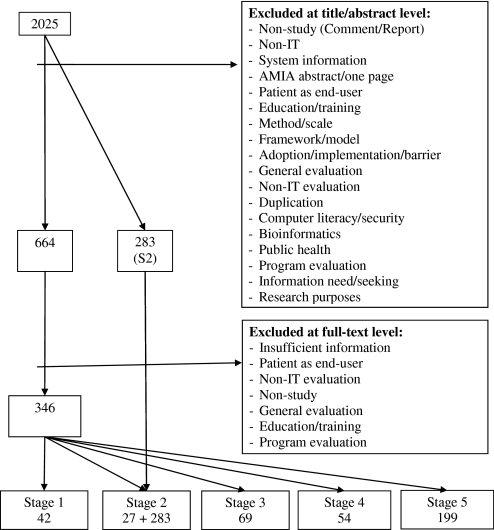
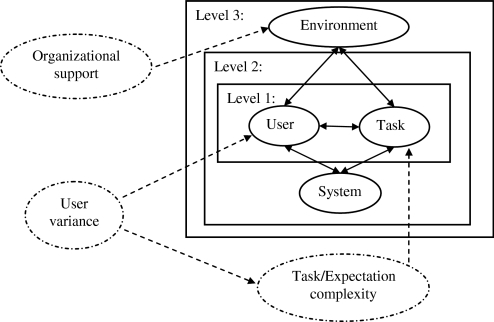
Usability factors are a major obstacle to health information technology (IT) adoption. The purpose of this paper is to review and categorize health IT usability study methods and to provide practical guidance on health IT usability evaluation. 2025 references were initially retrieved from the Medline database from 2003 to 2009 that evaluated health IT used by clinicians. Titles and abstracts were first reviewed for inclusion. Full-text articles were then examined to identify final eligibility studies. 629 studies were categorized into the five stages of an integrated usability specification and evaluation framework that was based on a usability model and the system development life cycle (SDLC)-associated stages of evaluation. Theoretical and methodological aspects of 319 studies were extracted in greater detail and studies that focused on system validation (SDLC stage 2) were not assessed further. The number of studies by stage was: stage 1, task-based or user-task interaction, n=42; stage 2, system-task interaction, n=310; stage 3, user-task-system interaction, n=69; stage 4, user-task-system-environment interaction, n=54; and stage 5, user-task-system-environment interaction in routine use, n=199. The studies applied a variety of quantitative and qualitative approaches. Methodological issues included lack of theoretical framework/model, lack of details regarding qualitative study approaches, single evaluation focus, environmental factors not evaluated in the early stages, and guideline adherence as the primary outcome for decision support system evaluations. Based on the findings, a three-level stratified view of health IT usability evaluation is proposed and methodological guidance is offered based upon the type of interaction that is of primary interest in the evaluation.
Overview
The claims and statistics of this paper haven’t been checked yet.
Free: it reads the open-access text and checks the first 5 claims that cite a source we can check. Create a free account to check every claim.
Integrity signals
Registry
Cites
Statistics
Figures
Verification
Claims the paper makes
The claims and statistics of this paper haven’t been checked yet.
Free: it reads the open-access text and checks the first 5 claims that cite a source we can check. Create a free account to check every claim.
Claims other papers make about this one
Each is checked against this paper’s own text: does it say what the citing paper says it does?
The cited source says what the claim attributes to it.
In the citing paper
“Usability challenges present a major barrier to health information technology adoption 29”
From A chatbot for hypertension self-management support: user-centered design, development, and usability testing (2023) · cites this paper as [29]
Self-check
Percentages, sums and reported differences re-computed from the paper’s own numbers.
The self-check needs the paper’s full text.
Citations
Cites
Perceived usefulness, perceived ease of use, and user acceptance of information technology
Davis, F. D. (1989) · MIS Quarterly · doi:10.2307/249008 · Cited by 68,483
(1993) · Cited by 9,879
Nielsen, J. (1995) · Conference companion on Human factors in computing systems - CHI '95 · doi:10.1145/223355.223730 · Cited by 2,620
IBM computer usability satisfaction questionnaires: Psychometric evaluation and instructions for use
Lewis, J. R. (1995) · International Journal of Human-Computer Interaction · doi:10.1080/10447319509526110 · Cited by 2,429
Development of an instrument measuring user satisfaction of the human-computer interface
Chin, J. P., Diehl, V. A., & Norman, L. K. (1988) · Proceedings of the SIGCHI conference on Human factors in computing systems - CHI '88 · doi:10.1145/57167.57203 · Cited by 1,609
Participatory Design: Principles and Practices
(2017) · CRC Press eBooks · doi:10.1201/9780203744338 · Cited by 1,500 · cited 1×
“Although we found only one theoretical framework and one method not covered in our review, approaches such as participatory design and ethnography provide overall frameworks that link sets of methods together in a manner that is greater than the sum of their parts.(79) Therefore, a review that included searches of add…”
MethodA Practical Guide to Usability Testing
Dumas, J. F., & Redish, J. C. (1993) · Cited by 1,335
Poissant, L. (2005) · Journal of the American Medical Informatics Association · doi:10.1197/jamia.m1700 · Cited by 901 · cited 4×
“Rahimi and Vimar-lund 10 reviewed general methods used to evaluate health IT.”
MethodInfluentialBiomedical Informatics: Computer Applications in Health Care and Biomedicine
(2024) · Biomedical Informatics: Computer Applications in Health Care and Biomedicine · doi:10.33029/9704-8204-9-bin-2024-1-744 · Cited by 777
Cognitive and usability engineering methods for the evaluation of clinical information systems.
Kushniruk, A. W., & Patel, V. L. (2004) · Journal of Biomedical Informatics · doi:10.1016/j.jbi.2004.01.003 · Cited by 760 · cited 1×
“Kushniruk and Patel 8 provided a methodological review for cognitive and usability engineering methods.”
Research works printed but not linked: 3
- Rubin J Handbook Of Usability Testing. New York: John Wiley & Sons, 1993
- Hyun S Johnson SB Bakken S User-centered approaches for eliciting functional requirements and designing user interfaces: a nursing documentation case study. J Biomed Inform 2008; In press.
- Lewis C Using the “Think Aloud” Method in Cognitive Interface Design. New York: IBM, 1982
Cited by
Items 401–457 of 457
(Preprint)Preprint
Dixit, R., & Myneni, S. (2018) · doi:10.2196/preprints.12279
Latulippe, K., Guay, M., �thier, S., S�vigny, A., Dub, V., Provencher, V., Poulin, V., Giguere, A. M. C., Tremblay, M., Carignan, M., et al. (2018) · doi:10.2196/preprints.11634
Towards an Interaction Design Framework for IoT Healthcare Systems
Monroy-Rodríguez, G., Sánchez-Adame, L. M., Mendoza, S., Valdespin-Garcia, I. G., & Decouchant, D. (2023) · Lecture notes in computer science · doi:10.1007/978-3-031-34668-2_7
Medical errors in Orthopedics: Causes and preventions.
Joshi, A. D. (2023) · Nepal Orthopaedic Association Journal · doi:10.59173/noaj.20230902j
Cetkin, H. E., & Çavdar, İ. (2024) · Turkiye Klinikleri Journal of Nursing Sciences · doi:10.5336/nurses.2023-99006
Arthurs, N., Browne, S., Boardman, R., O’Donnell, S., Doyle, G., Kechadi, T., Shahid, A., Tully, L., & O’Malley, G. (2024) · Computational and Structural Biotechnology Journal · doi:10.1016/j.csbj.2024.06.034
“Qualitative methods such as interviews and observation are useful in gathering detailed information on users ’ experiences, usage and behaviors which other approaches, including surveys or system logs cannot evaluate [23].”
BackgroundMethodPharmacogenomics Implementation: From Concept to Practice
(2024) · Frontiers research topics · doi:10.3389/978-2-8325-5164-6
DEVELOPMENT OF A SMART KOS METER PROTOTYPE FOR RECORDING ELECTRICITY AND WATER BILLS BASED ON IoT
Ashari, H., Vitalocca, D., & Hamris, H. (2024) · Jurnal Media Elektrik · doi:10.59562/metrik.v22i1.5756
Thate, J., Rossetti, S. C., Yen, P., Dykes, P. C., Schnock, K. O., & Cato, K. (2025) · Cognitive informatics in biomedicine and healthcare · doi:10.1007/978-3-031-82971-0_10
Self-citationA demonstration system suitable for blended learning and mentoring modes
Wang, X., Liu, X., & Zhang, G. (2024) · International Conference on Information Education and Artificial Intelligence (ICIEAI) · doi:10.1145/3724504.3724612
Sahu, V. K., & Dave, S. (2025) · Saudi Journal of Business and Management Studies · doi:10.36348/sjbms.2025.v10i05.002
Langendorf, L. N., Rønnebæk, E. H., Hansson, J. B., Barfod, A. G., Kronback, M., & Khalid, M. S. (2025) · European Conference on e-Learning · doi:10.34190/ecel.24.1.4029
Zamberg, I., Nicola, S. L., Schoettker, P., Schwarz, T., Cramer, T., Schiffer, E. R. C., & Schwengel, D. A. (2025) · JMIR Formative Research · doi:10.2196/86677
Evaluating the role of visit audio recordings in triadic dementia care: study protocol
Barr, P. J., Martinez‐Pereira, A., O’Malley, A. J., Carpenter-Song, E. A., BRUCE, M. L., Jacobson, N. C., Morgan, B. E., Lee, Y. S., Fernandez, G., Onsando, W. M., et al. (2025) · BMC Geriatrics · doi:10.1186/s12877-025-06611-3
“While user centered design is recommended for the development of new health technology [83], it is often overlooked, resulting in poor usability [84, 85] and low satisfaction [86].”
Hornal, L., Willing, E. J., Dawson, P., Hobbs, M., Marek, L., McIntyre, P. B., & Young, A. (2025) · Health Education Journal · doi:10.1177/00178969251392138
“A survey was developed based on the literature around usability of health information technology (Yen and Bakken, 2012) and input from the research team (including Māori healthcare research academics, a pharmacist and a developer of Expect Maternity software).”
Julkaew, S., Damkliang, K., Sudkhaw, T., Jankao, T., & Thitagarn, W. (2025) · doi:10.1109/incit66780.2025.11276109
“For example, a project in a healthcare usability study showed that aligning development with SDLC phases enhances process clarity and supports methodical evaluation especially when engaging diverse stakeholders to refine requirements and iteratively test system usability [12].”
Moghimi, F. H. (2014) · RMIT Research Repository (RMIT University Library) · doi:10.25439/rmt.27340311
Dabliz, R., Poon, S. K.-S., Ritchie, A., Burke, R. A., & Penm, J. H.-D. (2021) · Figshare · doi:10.6084/m9.figshare.13534433
Kirst, S. (2023) · edoc Publication server (Humboldt University of Berlin) · doi:10.18452/25977
Usability Evaluation of an Urgent Care Telemedicine Intervention
Liu, S. (2019) · Carolina Digital Repository (University of North Carolina at Chapel Hill) · doi:10.17615/jg6e-qc95
Rocha, R. D. D. S. (2016) · Portuguese National Funding Agency for Science, Research and Technology (RCAAP Project by FCT) · doi:10.34626/7avd-6e52
DiTA: a diagnostic test accuracy evidence database for physiotherapists
Kaizik, M. A. (2024) · UNSWorks (UNSW Sydney) · doi:10.26190/unsworks/30448
REHCE MSc Health Informatics curriculum review
Verbeke, F., Nyssen, M., & Wright, G. (2020) · Figshare · doi:10.6084/m9.figshare.13274810
Antibiotic Stewardship: Clinical decision support systems to improve antibiotic use in hospitals
Akhloufi, H. (2021) · RePub (Erasmus University Rotterdam)
Improvement in clinical practice using mHealth technology
Gomis‐Pastor, M. (2020) · LA Referencia (Red Federada de Repositorios Institucionales de Publicaciones Científicas)
Savings and investment habits of Estonians - SEB Estonia internet bank and app usability case study
Lasisi, Y. A. (2024) · DSpace repository (University of Tartu)
\nImproving patient-centered information provision in fertility care
Sparidaens, E. M. (2023) · Radboud Repository (Radboud University)
Design and development of digital health platforms
Schmitz, L. (2024) · Opin vísindi (Opin vísindi)
Rytkönen, J. (2020) · UEF eRepo (University of Eastern Finland)
BlueEyes: using beacon and smart phone for visually impaired / blind people
Thaker, H. B. (2019) · Portuguese National Funding Agency for Science, Research and Technology (RCAAP Project by FCT)
Evaluating academic library applications through usability and benchmarking: a comparative study
Benaida, M., Alam, T., Alkhodre, A. B., & Aljohani, N. F. (2025) · Journal of Electronic Resources Librarianship · doi:10.1080/1941126x.2025.2518894
“However, another definition defined from the angle of the interaction between users and computer, states it is “The capability of the software product to be understood, learned, used and attractive to the user, when used under specified conditions” (Yen & Bakken, 2012).”
User experiences of DiTA (dita.org.au): A database of studies of diagnostic test accuracy
Kaizik, M. A., Downie, A., Hancock, M. J., & Herbert, R. (2025) · Brazilian Journal of Physical Therapy · doi:10.1016/j.bjpt.2025.101568
“The primary aims of the study were investigated using a usability study design 23 of a representative group of typical users of the DiTA database website.”
Tekoälyavusteinen ohjelmistokehitys Suomen terveydenhuollossa
Kärkkäinen, A.-K. (2025) · UTUPub (University of Turku)
ML-Based Decision Support in Point-Of-Care Testing Devices: Revolutionising Rural Healthcare
Hajari, V. R. (2025) · International Journal of Basic and Applied Sciences · doi:10.14419/rns2ce84
Tinam-isan, M. A. C., Naga, J. F., Sala, E. L., Abdulazis, I., & Albiso, A. H. (2026) · Lecture notes in networks and systems · doi:10.1007/978-3-032-10827-2_6
Rebouças, P. D. (2023) · LA Referencia (Red Federada de Repositorios Institucionales de Publicaciones Científicas)
An Exploration of Equity in Usability Evaluation Methodology
Tjhie, R. (2025) · TSpace (University of Toronto)
Souza, C. S. D. S., Barbosa, R. A., & Fully, R. M. P. (2026) · Seven Editora eBooks · doi:10.56238/sevened2026.008-215
Chen, S. Y., Zeng, P., Chen, Y., Zhu, Y., Gong, Z., Lin, Y., Xie, R., Chen, Z., Shi, M., & Chen, Z. (2026) · Clinical Oral Investigations · doi:10.1007/s00784-026-06892-x
“The usability evaluation revealed a promising balance between effectiveness, efficiency, and user satisfaction [ 16, 17].”
Human Factors, Ergonomics (HFE), and Systems Thinking
Asan, O., Wang, B., & Zhang, L. (2026) · Health informatics · doi:10.1007/978-3-032-16657-9_8
Cho, H., Yao, Y., Lee, T., Bian, J., & Keenan, G. M. (2026) · Studies in health technology and informatics · doi:10.3233/shti260599
“First, it adopts the stratified view of health IT usability, which conceptualizes usability across the system/interface, user–task interaction, and socio-technical context, ensuring that expert, end-user, contextual perspectives are represented across both phases of evaluation [9].”
Systematic reviews on hot methods topics
Henry, S. B. (2026) · Journal of the American Medical Informatics Association · doi:10.1093/jamia/ocag072
PERCEPÇÕES SOBRE TECNOLOGIAS DE MONITORAMENTO NA ADMINISTRAÇÃO PÚBLICA
Fully, R. M. P., de Azevedo, R. B., & Souza, C. S. D. S. (2026) · Revista de Geopolítica · doi:10.56238/revgeov17n5-103
Roussilhes, S., Chaput, B., Lopez, R., Joly, E. L., Lupon, E. L., & Gandolfi, S. (2026) · Annales de Chirurgie Plastique Esthétique · doi:10.1016/j.anplas.2026.04.008
Digital Innovations in Disaster Response: Bridging Gaps and Saving Lives
(2026) · Frontiers research topics · doi:10.3389/978-2-8325-7870-4
Ramos, M. L. L. L. (2026) · International Journal of Research Publications · doi:10.47119/ijrp1001981620269233
Ikonen, J. (2026) · Aaltodoc (Aalto University)
Richards, B., & Rodgers, L. (2026) · Lund University Publications Student Papers (Lund University)
Technostress and Burnout: The New Reality for Healthcare Professionals Amid Digital Change
Jakkula, V. R., & Vemula, L. P. (2026) · Telangana journal of IMA. · doi:10.4103/tjima.tjima_15_26
Ogundairo, D. A., Juengst, S. B., Modi, A. C., Wade, S. L., & Schmidt, M. (2026) · JMIR Human Factors · doi:10.2196/90379
“Minimal consideration of contextual or educational dimensions has similarly been noted in health IT evaluations [34] and in health care education specifically, where most mobile app usability studies relied on checklists and surveys, rarely assessing whether tools effectively supported learning or…”
Damalie, E., Suomi, R., & Mahmoud, M. (2026) · JMIR Medical Informatics · doi:10.2196/84820
Health information technology in pharmacy: A concept-mapping approach to evaluation
Ogundipe, A., Sim, T. F., & Emmerton, L. (2026) · Elsevier eBooks · doi:10.1016/b978-0-443-44607-8.00017-0
Usability of Two Clinical Registry Data-Entry Interfaces: A Randomized Crossover Study
Nakamura, K., Kasahara, Y., Miura, G., Kinoshita, A., & Asao, T. (2026) · Informatics · doi:10.3390/informatics13100171
Kumprasert, S., Thura, P., Pinta-Ay, S., Reunjaikaen, J., Chainakul, T., Chalortham, N., & Kitikannakorn, N. (2021) · Thai Journal of Pharmacy Practice
การออกแบบระบบปฏิสัมพันธ์ระหว่างมนุษย์กับคอมพิวเตอร์ ที่เป็นมิตรกับผู้สูงอายุ
Sangsawang, A., & Daengmak, S. (2025) · Journal of Industrial Business Administration
Clinical Decision Support System for Chronic Pain Management in Primary Care: Usability Testing
Malaekeh, S. R. (2013) · MacSphere (McMaster University) · doi:10.71548/10265
Metadata
- Authors
- Yen, P.-Y., & Bakken, S.
- Affiliations
- The Ohio State University (US)
- Corresponding author
- Yen, Po-Yin
- ORCID
- Yen, Po-Yin
- Venue
- Journal of the American Medical Informatics Association
- Publisher
- Oxford University Press (OUP)
- Published
- 2011-08-09
- Volume
- 19
- Issue
- 3
- Pages
- 413-422
- ISSN
- 1067-5027 (ISSN-L)
- 1527-974X
- PMC
- PMC3341772
- OpenAlex
- W2121431887
- Semantic Scholar
- 9e355b8a884bed1c649b029c0ca2e6fdbeb6f0b6
- Cited by
- 390
- References
- 78
- Citations by year
- 2026: 17 · 2025: 29 · 2024: 26 · 2023: 31 · 2022: 31 · 2021: 36 · 2020: 40 · 2019: 23 · 2018: 35 · 2017: 32 · 2016: 16 · 2015: 29 · 2014: 17 · 2013: 22 · 2012: 2
- FWCI
- 2.03
- Type
- journal article
- Language
- en
- Open access
- hybrid
- doi.org
- Licence
- cc-by-nc-nd
- Locations
- Journal of the American Medical Informatics Association (publishedVersion, cc-by-nc-nd)
- Europe PMC (PubMed Central) (publishedVersion, cc-by-nc)
- PubMed Central (publishedVersion, cc-by-nc)
- PubMed (publishedVersion)
- Funders
- National Institute of Nursing Research (P30NR010677)
- Topics
- Health Sciences › Health Professions › Health Information Management › Electronic Health Records Systems
- Physical Sciences › Computer Science › Human-Computer Interaction › Usability and User Interface Design
- Social Sciences › Decision Sciences › Information Systems and Management › Technology Adoption and User Behaviour
- Keywords
- health information technology, usability evaluation, usability model, system development life cycle, task-based assessment, decision support system, methodological recommendations
- MeSH terms
- Humans, Medical Informatics, Models, Theoretical, Research Design, Technology Assessment, Biomedical, User-Computer Interface
About these checks
Registry, retraction, Cites and statistics results are computed, not judged, with one exception: a printed reference that no index lists is read once by a model before it counts as a citation error. Claims are extracted by a model and kept only when their quote appears verbatim in the text; each cited source is then checked, with a model’s help, for whether it says what the claim relies on. Those verdicts can be wrong — read the claim’s quote and the cited source before relying on one.
Statistics and arithmetic are recomputed, not judged.
Confidence bands are shown only for fields calibrated on our annotated test set. None is calibrated yet, so no band is shown.
What counts as a claim ›How we measure confidence ›How we check this ›
Are you an author, or do you see a problem with this page? Request a review
Data sources
Bibliographic data: Semantic Scholar, OpenAlex, Crossref.
Contains information from the Semantic Scholar Academic Graph Datasets, made available under the ODC Attribution License (ODC-BY 1.0).
Semantic Scholar’s data is described in: Kinney, R., et al. (2023). The Semantic Scholar Open Data Platform. arXiv:2301.10140.
