

The DOI matches its Crossref record; 70 of the 70 references it cites were found in a registry or an index.
Occurrence of mental health symptoms and disorders in current and former elite athletes: a systematic review and meta-analysis
Open accessAbstract
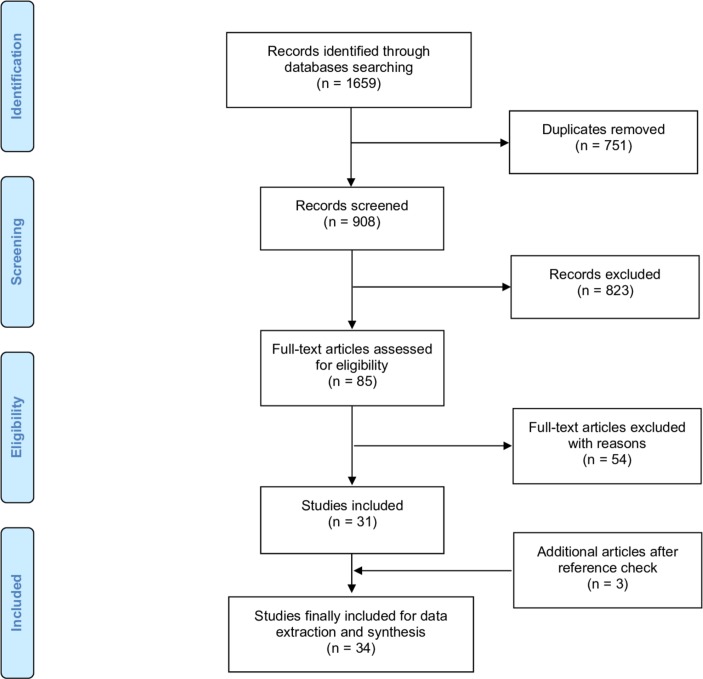
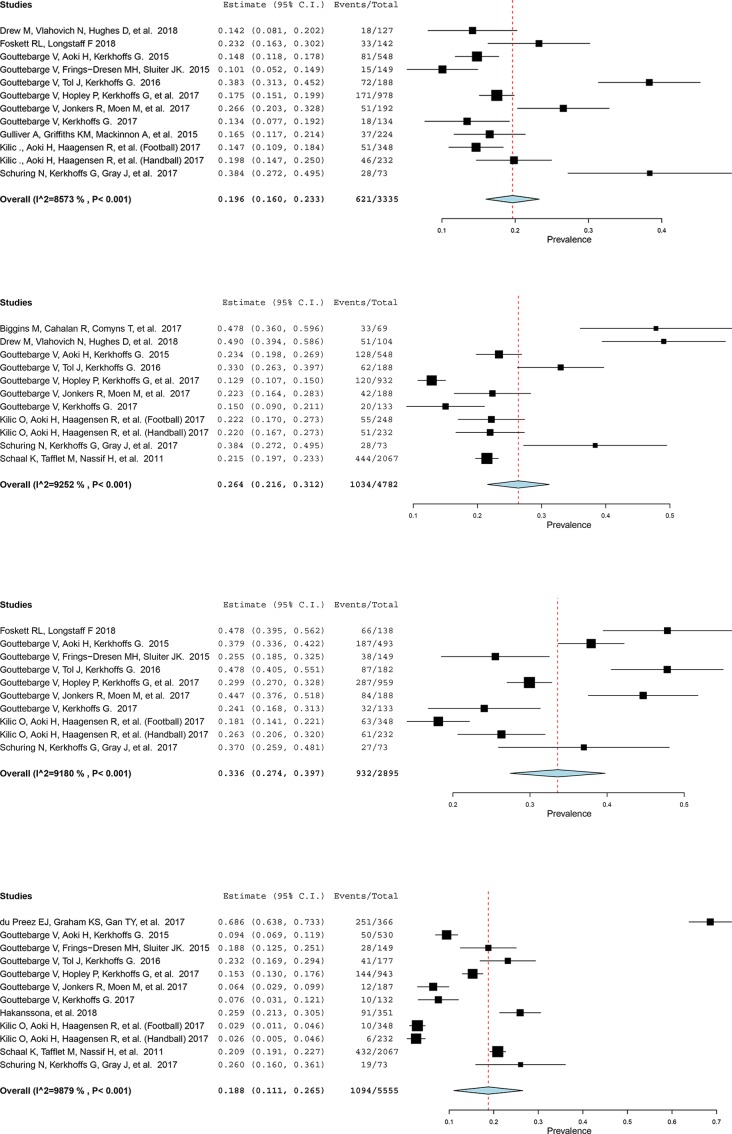
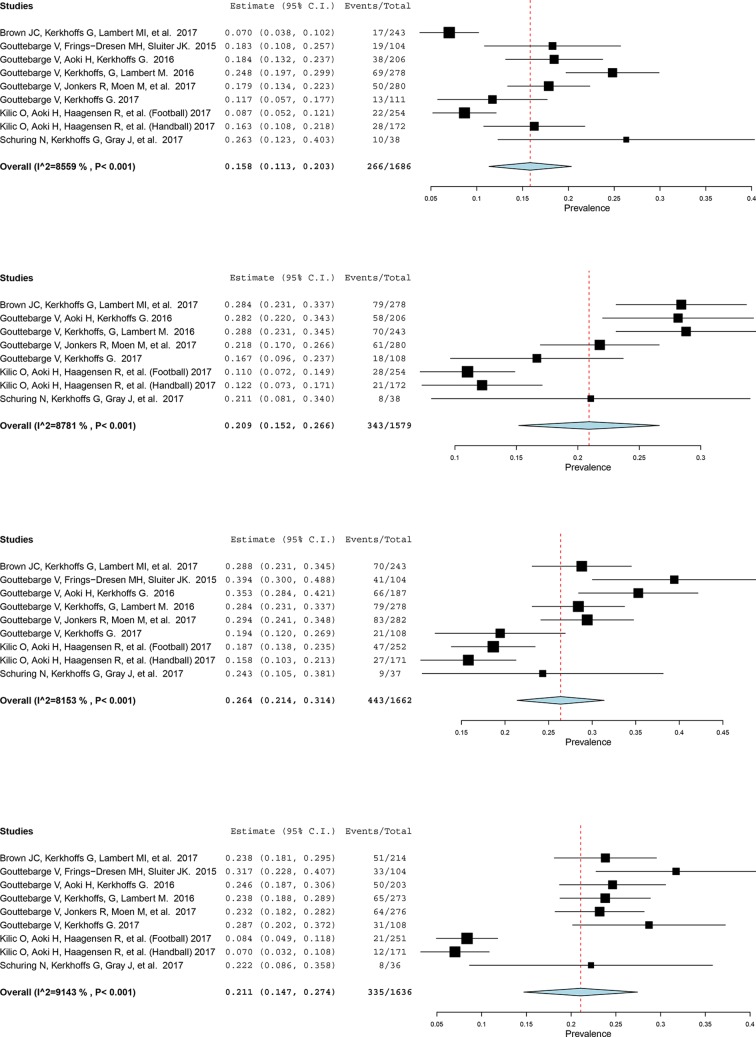
Objectives: To present an overview of the existing epidemiological evidence regarding the occurrence of mental health symptoms and disorders among current and former elite athletes. Design: Systematic review and meta-analysis. Data sources: Five electronic databases were searched from inception to November 2018: PubMed (MEDLINE), SportDiscus via EBSCO, PSycINFO via ProQuest, Scopus and Cochrane. Eligibility criteria for selecting studies: We included original quantitative studies that were written in English, were conducted exclusively among current or former elite athletes, and presented incidence or prevalence rates of symptoms of mental disorders. Results: Twenty-two relevant original studies about mental health symptoms and disorders among current elite athletes were included: they presented data especially on symptoms of distress, sleep disturbance, anxiety/depression and alcohol misuse. Meta-analyses comprising 2895 to 5555 current elite athletes showed that the prevalence of mental health symptoms and disorders ranged from 19% for alcohol misuse to 34% for anxiety/depression. Fifteen relevant original studies about mental health symptoms and disorders among former elite athletes were included: they similarly presented data especially about symptoms of distress, sleep disturbance, anxiety/depression and alcohol misuse. Meta-analyses comprising 1579 to 1686 former elite athletes showed that the prevalence of mental health symptoms and disorders ranged from 16% for distress to 26% for anxiety/depression. Conclusions: Our meta-analyses showed that the prevalence of mental health symptoms and disorders ranged from 19% for alcohol misuse to 34% for anxiety/depression for current elite athletes, and from 16% for distress to 26% for anxiety/depression for former elite athletes.
Overview
The claims and statistics of this paper haven’t been checked yet.
Run the check — free, no account needed. It reads the open-access text and checks the sources it cites.
Integrity signals
Registry
Cites
Statistics
Figures
Verification
Claims the paper makes
The claims and statistics of this paper haven’t been checked yet.
Run the check — free, no account needed. It reads the open-access text and checks the sources it cites.
Claims other papers make about this one
Each is checked against this paper’s own text: does it say what the citing paper says it does?
The cited source says what the claim attributes to it.
In the citing paper
“To date, research has primarily examined the mental health outcomes of elite athletes [15–18], with comparatively less research focusing on understanding these psychological experiences among coaches [19].”
From The Mental Health of Elite-Level Coaches: A Systematic Scoping Review (2024) · cites this paper as [15]
Self-check
Percentages, sums and reported differences re-computed from the paper’s own numbers.
The self-check needs the paper’s full text.
Citations
Cites
Diagnostic and Statistical Manual of Mental Disorders
American Psychiatric Association (2013) · doi:10.1176/appi.books.9780890425596 · Cited by 116,369
Preferred Reporting Items for Systematic Reviews and Meta-Analyses: the PRISMA statement
Moher, D., Liberati, A., Tetzlaff, J., Altman, D. G., & for the PRISMA Group (2009) · BMJ · doi:10.1136/bmj.b2535 · Cited by 83,823
Preferred reporting items for systematic reviews and meta-analyses: the PRISMA Statement.
(2009) · PubMed Central · Cited by 44,859
Meta-analysis in clinical trials
DerSimonian, R., & Laird, N. (1986) · Controlled Clinical Trials · doi:10.1016/0197-2456(86)90046-2 · Cited by 39,552
The Need for a New Medical Model: A Challenge for Biomedicine
Engel, G. L. (1977) · Science · doi:10.1126/science.847460 · Cited by 12,887
Diagnostic and Statistical Manual of Mental Disorders(DSM)
Leong, F. T. L. (2008) · Sage eBooks · doi:10.4135/9781412963978.n182 · Cited by 10,861
The global prevalence of common mental disorders: a systematic review and meta-analysis 1980–2013
Steel, Z., Marnane, C., Iranpour, C., Chey, T., Jackson, J. W., Patel, V., & Silove, D. (2014) · International Journal of Epidemiology · doi:10.1093/ije/dyu038 · Cited by 2,846 · cited 2×
“A recent systematic review and meta-analysis study performed across 155 general populations in 59 countries indicated that 20% experienced a mental disorder within a 12-month period.(4) In other studies, prevalence of anxiety/depression was found to range from 13% to 19% in Australia (general population), from 17% to…”
BackgroundMethodHoy, D., Brooks, P., Woolf, A., Blyth, F., March, L., Bain, C., Baker, P., Smith, E., & Buchbinder, R. (2012) · Journal of Clinical Epidemiology · doi:10.1016/j.jclinepi.2011.11.014 · Cited by 2,555
Guskiewicz, K. M., Marshall, S. W., Bailes, J. E., McCrea, M., Cantu, R. C., RANDOLPH, C. C., & Jordan, B. D. (2005) · Neurosurgery · doi:10.1093/neurosurgery/57.4.719 · Cited by 1,226
The Mental Health of Elite Athletes: A Narrative Systematic Review
Rice, S. M., Purcell, R., De Silva, S., Mawren, D., McGorry, P. D., & Parker, A. G. (2016) · Sports Medicine · doi:10.1007/s40279-016-0492-2 · Cited by 1,205 · cited 1×
“Single studies show that the prevalence of mental health symptoms and disorders among both current and former elite athletes seems substantial and similar to the prevalence in the general population.(5) A professional or elite sport career is characterised by more than 640 distinct stressors that could induce mental h…”
BackgroundSelf-citation
Cited by
Sorted by citations
Items 401–500 of 603
Sport-Life imbalance and athlete burnout: The moderating role of perceived athlete-team fit
Ji, Y., McLeod, C. M., & Chun, Y. (2025) · International Journal of Sports Science & Coaching · doi:10.1177/17479541251390843 · Cited by 1
Early warning analysis of mental health based on spatial density and rapid clustering
Gao, J., & Shi, G. (2021) · International Conference on Measuring Technology and Mechatronics Automation (ICMTMA) · doi:10.1109/icmtma52658.2021.00110 · Cited by 1
Mental Health Concerns in Athletes
Putukian, M. (2021) · Springer eBooks · doi:10.1007/978-3-030-66321-6_34 · Cited by 1
Sink or swim: innovations in aquatic health
Hill, L., Mountjoy, M. L., Miller, J. W., & Burr, J. F. (2021) · The Journal of Sports Medicine and Physical Fitness · doi:10.23736/s0022-4707.21.12697-0 · Cited by 1
KANDA, R., & Takehiko, S. A. N. O. (2021) · Journal of Japan Society of Sports Industry · doi:10.5997/sposun.31.3_307 · Cited by 1
Mental Health Literacy and Confidence in a Sample of Student Athletic Therapists
Sullivan, P., & Tennant, L. (2021) · Journal of Clinical Sport Psychology · doi:10.1123/jcsp.2021-0005 · Cited by 1
Analysis and Comparison of Motion Biomechanics Characteristics of Squat Jump and Half-Squat Jump
Zhao, M., & Zhang, J. (2022) · Mobile Information Systems · doi:10.1155/2022/4304216 · Cited by 2
“+e results show that the limited squat has a smaller knee flexion angle than the unrestricted squat; smaller ankle dorsiflexion angle: larger hip flexion angle and larger trunk anteversion angle [20], which proves that limiting the forward movement of knee joint will lead to the change of kinematic indexes of lower li…”
BackgroundRetractedYamazaki, M., Toussaint, J., & Antero, J. (2022) · Journal of Experimental Neurology · doi:10.33696/neurol.3.058
The person behind the contact lens
Retallic, N. (2021) · Optician · doi:10.12968/opti.2021.9.8715 · Cited by 1
The Killing of a Sacred Veneer: Depressive Symptoms in Athletes
Tahtinen, R. E. (2021) · Liverpool John Moores University · doi:10.24377/ljmu.t.00014387 · Cited by 1
Case Studies in Sports Psychiatry
Runswick, O. R. (2021) · Journal of Mental Health · doi:10.1080/09638237.2021.1952957 · Cited by 1
Psychiatric Medications and Cardiovascular Performance
Tso, J., & Pelliccia, A. (2022) · JACC Case Reports · doi:10.1016/j.jaccas.2022.08.004 · Cited by 1
“Alarmingly, depression may be even more prevalent in athletes than in the general population, with 34% of active athletes and 26% of former athletes reporting symptoms of depression or anxiety.(2) Inasmuch as mental health conditions are clearly a relevant issue for all clinicians, cardiologists who care for athletes…”
BackgroundPeters, L., & Klatt, S. (2023) · Zeitschrift für Sportpsychologie · doi:10.1026/1612-5010/a000400 · Cited by 1
Yamaguchi, T., Kitahara, A., Sato, K., & Mimura, M. (2023) · Research Square · doi:10.21203/rs.3.rs-3674168/v1 · Cited by 1
Rogers, T., Larkin, J., & Cavaday, N. (2020) · Cambridge University Press eBooks · doi:10.1017/9781108767187.012
Athletics: Energy Levels, Exercise Addiction and Disordered Eating
Dudgeon, E., McGregor, R., & Robinson, R. (2020) · Cambridge University Press eBooks · doi:10.1017/9781108767187.004
American Football: Cognitive Impairment
McCabe, T., Stewart, W., Pandya, M. A., Kasper, J., & Sanders, S. (2020) · Cambridge University Press eBooks · doi:10.1017/9781108767187.003
Football: Alcohol and Barriers to Support
Mistry, A., Peters, S., Chatterjee, R., & Cotterill, D. (2020) · Cambridge University Press eBooks · doi:10.1017/9781108767187.008
Golf: Alcohol, Anxiety and Sleep Problems
Creado, S., Hopley, P., Murray, A., & Hull, M. (2020) · Cambridge University Press eBooks · doi:10.1017/9781108767187.009
Cricket: Mental Health Emergencies
Mahmood, H., Hopley, P., & Foster, P. (2020) · Cambridge University Press eBooks · doi:10.1017/9781108767187.006
Johnston, A., Al-Dawoud, M., & Pattinson, C. (2020) · Cambridge University Press eBooks · doi:10.1017/9781108767187.005
Rugby: Concussion and Mental Health Symptoms
McCabe, T., Lester, C., Kemp, S. P. T., & Vickerman, R. (2020) · Cambridge University Press eBooks · doi:10.1017/9781108767187.010
Addressing the context and make up of mental health issues in high-performing athletes
Lebrun, F. (2020) · CLOK (University of Central Lancashire)
The Flexible Mind Approach: What Is It, and What Does It Offer?
White, R. G., Bethell, A., Charnock, L., Leckey, S., & Penpraze, V. (2021) · Springer eBooks · doi:10.1007/978-3-030-64942-5_1
Yang, H. (2021) · E3S Web of Conferences · doi:10.1051/e3sconf/202127103021
Therapy Dog Intervention Decreases Stress and Increases Arousal in College Students
Cacolice, P. A., & Ebbs, C. M. (2021) · International Journal of Athletic Therapy & Training · doi:10.1123/ijatt.2020-0108
Sanders, L. (2021) · NC Digital Online Collection of Knowledge and Scholarship (The University of North Carolina at Greensboro)
Appendix: International Society for Sports Psychiatry Curriculum 2018
Mistry, A. D., McCabe, T., & Currie, A. (2020) · Cambridge University Press eBooks · doi:10.1017/9781108767187.013
Mistry, A. D., McCabe, T., & Currie, A. (2020) · Cambridge University Press eBooks · doi:10.1017/9781108767187.015
Mistry, A. D., McCabe, T., & Currie, A. (2020) · Cambridge University Press eBooks · doi:10.1017/9781108767187.001
Mistry, A. D., McCabe, T., & Currie, A. (2020) · Cambridge University Press eBooks · doi:10.1017/9781108767187.002
Salvioli, S., Innocenti, T., Giardulli, B., & Testa, M. (2022) · MetArXiv (OSF Preprints) · doi:10.31222/osf.io/pwrjv
Mistry, A. D., McCabe, T., & Currie, A. (2020) · Cambridge University Press eBooks · doi:10.1017/9781108767187.014
Karunakaran, B., & Kaleeswaran, P. (2022) · International Journal of Health Sciences · doi:10.53730/ijhs.v6ns8.11592
SAÚDE MENTAL NO ATLETA DE ALTO RENDIMENTO: REVISÃO INTEGRATIVA
Colagrai, A. C., Nascimento, F. T., & Fernandes, P. T. (2022) · Instituto Scientia eBooks · doi:10.55232/1083002.66
All‐star team: Sport and exercise medicine meets emergency medicine
Rogan, A., & Matthews, A. (2022) · Emergency Medicine Australasia · doi:10.1111/1742-6723.14074
“Alcohol misuse, anxiety, sleeping and eating disorders are highly prevalent.(41,42) Another caveat all clinicians must consider in management of the high-performance athlete is safe prescribing – Trist and Carrigan discuss relevant resources in this edition.”
BackgroundFirst Trial of the Player Development Program by the Japan Rugby Football Playersʼ Association
KAWAMURA, S., Horiguchi, M., ONUMA, K., YAMASHITA, S., & Ojio, Y. (2022) · Journal of Japan Society of Sports Industry · doi:10.5997/sposun.32.4_481
Saúde Mental no Desporto de Alta Competição
Gomes, E., Andrade, R., Valente, C., & Espregueira‐Mendes, J. (2022) · Revista de Medicina Desportiva informa · doi:10.23911/saude_mental_desporto_2022_nov
Factors related to Sense of Coherence in Japanese university athletes
Sonobe, Y. (2022) · Scientific Journal of Sport and Performance · doi:10.55860/rqbu8329
“The importance of mental health management is continuously increasing (Walker et al., 2022) and research indicates that depression and anxiety incidence in elite athletes is approximately 34%, higher when compared to the general population (Gouttebarge et al., 2019).”
BackgroundTransitioning out of Elite Sport
Gouttebarge, V. (2022) · Springer eBooks · doi:10.1007/978-3-031-08364-8_19
Self-citationMental Health in Paralympic Athletes
Swartz, L. M. (2022) · Springer eBooks · doi:10.1007/978-3-031-08364-8_23
Sleep Disorders and Sleep Concerns
Grandner, M. A. (2022) · Springer eBooks · doi:10.1007/978-3-031-08364-8_5
The effect of the COVID-19 pandemic on the mental status of health workers at sports clubs
Denerel, N., & Öçal, O. Y. (2023) · Turkish Journal of Sports Medicine · doi:10.47447/tjsm.0736 · Cited by 1
Bobby, G. (2018) · International Journal of Yogic Human Movement and Sports Sciences · doi:10.22271/yogic.2018.v3.i2p.1413
“According to a number of studies, athletes are generally less depressed and worried than the general population, and they are also better at handling stress and have higher levels of self-esteem and positive body images (Rice et al.,2016; Gouttebarge et al.,2019) [13, 4].”
BackgroundMental Health as a Human Right
Fuller, S., Potts, S., Kamyuka, D., Jefferson, M., Parsons, M., Pinalto, C., Salladin, C., & Sichel, J. (2023) · Globalisation, comparative education and policy research · doi:10.1007/978-3-031-38457-8_8
Helping the Athlete with Depression
Currie, A., & Rogers, T. (2023) · Springer eBooks · doi:10.1007/978-3-031-36864-6_12
Presenteeism in Athletes and the Research Potential in Japan
Sakai, T., & Amemiya, R. (2023) · Japanese Journal of Sport Psychology · doi:10.4146/jjspopsy.2023-2208
Sport(art)spezifische psychische Probleme, Belastungen und Erkrankungen
Ströhle, A. (2023) · Springer eBooks · doi:10.1007/978-3-662-66208-3_18
Suhas, S., Pai, N. M., Manjunatha, N., Math, S. B., Kumar, C. N., Madhukar, B. R., & Nanjegowda, R. B. (2023) · Journal of Psychiatry Spectrum · doi:10.4103/jopsys.jopsys_18_23
Geiger, S., Esser, A. J., Marsall, M., Muehlbauer, T., Skoda, E., Teufel, M., & Bäuerle, A. (2024) · Research Square · doi:10.21203/rs.3.rs-3821619/v1
Called up: calling to social justice action (SJA) and mental health of athletes
Tran, A. G. T. T. (2024) · Sport in Society · doi:10.1080/17430437.2023.2300427 · Cited by 1
“Review studies estimate prevalence rates of 19% (alcohol misuse) to 34% (anxiety/depression) for current elite athletes and 16% (distress) to 26% (anxiety/depression) for former elite athletes (Gouttebarge et al. 2019).”
The Physiology of Injury and Recovery
Rimer, E., & Petway, A. J. (2023) · Springer eBooks · doi:10.1007/978-3-642-36801-1_301-1
An analysis of mental health service usage and injuries among NCAA Division I collegiate athletes
Fawver, B. J., Larson, J., Kim, J., Parameswaran, U., & Kosbab, E. (2024) · Journal for the Study of Sports and Athletes in Education · doi:10.1080/19357397.2024.2321822
“Evidence suggests up to one-third of collegiate athletes report clinically-relevant levels of anxiety or depression (Gouttebarge et al., 2019), with those engaged in individual-sports believed to be particularly vulnerable (Nixdorf et al., 2016).”
Using imagery to foster coping efficacy
Moritz, S. E., & Castaneda, C. L. (2024) · Journal of Imagery Research in Sport and Physical Activity · doi:10.1515/jirspa-2024-0004
Solmaz, S., & Yarayan, Y. E. (2024) · Research Square · doi:10.21203/rs.3.rs-4202525/v1
RetractedGraeme, L. G., Hall, K., OLIVE, L. S., Greenwood, C. J., Couston, N., Mattingley, S., Francis, L. M., Hoare, E., Rice, S., Bos, J., et al. (2024) · BMJ Open Sport & Exercise Medicine · doi:10.1136/bmjsem-2023-001799
“1 4 Despite this difference, little research has examined healthy development in athletes in the phase between community and elite sport, that is, those in talent development programmes.”
BackgroundSelf-citationSolmaz, S., & Yarayan, Y. E. (2024) · Research Square · doi:10.21203/rs.3.rs-4330955/v1
RetractedDoorley, J. D., Kaneko, Y. A., Jenkins, J., Choukas, N. R., & Ginsburg, R. D. (2024) · Elsevier eBooks · doi:10.1016/b978-0-443-11844-9.00088-6
Variables and instruments for assessing mental health in competitive swimmers: A narrative review
Trinidad, A. (2023) · F1000Research · doi:10.12688/f1000research.140504.3
Saito, Y., SASAKI, K., TAKESHITA, S., & MORITA, K. (2024) · Open Access Journal of Nursing · doi:10.22259/2639-1783.0701004
Mind or Medal: Elite Athletes’ Mental Health Management in Sports Events
Tsai, C.-H. K., & Steinmeyer, S. A. (2024) · Journal of Hospitality & Tourism Cases · doi:10.1177/21649987241241902 · Cited by 1
“Athletes are not immune to burnout, anguish, anxiety, depression, eating disorders, insomnia, and alcohol or drug abuse (Gouttebarge et al., 2019).”
Loneliness and Emotional Blunting in Elite Sport
Gorczynski, P. F., Aron, C. M., & Reardon, C. L. (2024) · Advances in Psychiatry and Behavioral Health · doi:10.1016/j.ypsc.2024.05.007 · Cited by 1
Self-citationSleep and mental health in athletes
Kim, K. N., Emert, S. E., Huskey, A., Athey, A. B., & Taylor, D. J. (2024) · Elsevier eBooks · doi:10.1016/b978-0-12-822969-9.00008-0
Beyond Sports Injuries: Mental Health Symptoms in Elite Athletes
Gouttebarge, V., Kerkhoffs, G. M. M. J., & Mountjoy, M. L. (2024) · Springer eBooks · doi:10.1007/978-3-642-36801-1_303-1
Self-citationHealth status of senior netball players, their medication use and attitudes towards doping
de Abreu, M., Nolte, K., van Rensburg, D. C. J., & Swart, X. (2024) · Frontiers in Sports and Active Living · doi:10.3389/fspor.2024.1436080
Yamaguchi, T., Kitahara, A., Sato, K., & Mimura, M. (2024) · Open Access Journal of Sports Medicine · doi:10.2147/oajsm.s472643 · Cited by 1
Analysis of fencers’ post-injury adjustment: confirmatory factor analysis
Ningrum, N. R., Sukamti, E. R., Kurniawan, F., Fauzi, ., Nugroho, A., Karyono, T. H., Susanto, N., Putra, M. E., & Ryepko, O. A. (2024) · Health sport rehabilitation · doi:10.58962/hsr.2024.10.3.39-52
“In addition, the occurrence of poor mental health is also affected by injury, causing pain and possible decreased performance in athletes[13,14].”
BackgroundBesson, L., & Édouard, P. (2024) · Journal de Traumatologie du Sport · doi:10.1016/j.jts.2024.08.006 · Cited by 1
Caviedes, P. F. S. (2024) · Springer eBooks · doi:10.1007/978-3-031-70043-9_9
Rodrigues, A. F. D. A., Sampaio, M. A. L., de Moraes, M. A. M., Coêlho, M. A., & Filho, K. H. D. A. (2024) · Debates em Psiquiatria · doi:10.25118/2763-9037.2024.v14.1266
Körperliche Aktivität, Training und Sport
Pekker, J., & Augustin, N. (2024) · Elsevier eBooks · doi:10.1016/b978-3-437-15091-3.00001-8
Nurhidayah, D., Prasetyo, Y., Sutapa, P., Suhartini, B., Nanda, F. A., & Kartini, K. (2024) · doi:10.56984/8zg020c5cun
Collegiate Student-Athletes' Psychological Distress and Counseling Use during COVID-19
Slavin, L. E. (2022) · University of North Texas Digital Library (University of North Texas) · doi:10.12794/metadc1944247
The Mental Health Screening of Student Athletes by NCAA Athletic Departments
Drew, M. (2021) · University of North Texas Digital Library (University of North Texas) · doi:10.12794/metadc1808358
Ojio, Y., & Kawamura, S. (2025) · Discover Mental Health · doi:10.1007/s44192-025-00162-0
Karababa, B., Şeran, B., & Canyurt, F. (2025) · Avrasya Spor Bilimleri ve Eğitim Dergisi · doi:10.47778/ejsse.1517960
“A recent meta-analysis study found that 26% of current elite athletes had significant stress/distress, 26% had sleep disturbance, and 34% had anxiety and depression (Gouttebarge et al., 2019).”
Roberts, C. E., Oseni, D., Bohle-Frankel, B., & Reardon, C. L. (2025) · Current Psychiatry Reports · doi:10.1007/s11920-025-01598-5 · Cited by 2
Self-citationMental Health Symptoms and Disorders in Elite Paralympic Athletes
Zhang, A. (2025) · Advances in Psychiatry and Behavioral Health · doi:10.1016/j.ypsc.2025.02.002 · Cited by 1
The Physiology of Injury and Recovery
Rimer, E., & Petway, A. J. (2025) · Springer eBooks · doi:10.1007/978-3-031-58351-3_301
Beyond Sports Injuries: Mental Health Symptoms in Elite Athletes
Gouttebarge, V., Kerkhoffs, G. M. M. J., & Mountjoy, M. L. (2025) · Springer eBooks · doi:10.1007/978-3-031-58351-3_303
Self-citationЧерепєхіна, О. А., & Рудченко, В. (2025) · Молодий вчений · doi:10.32839/2304-5809/2025-2-133-6 · Cited by 6
“Mental health is a crucial factor determining the effectiveness of athletic performance, particularly under high physical and psychological demands [1; 2].”
Reese, M. L., Eggleston, B. A., Smith, A. M., Young, A. J., Mazur, A., & Hartwell, M. L. (2025) · Journal of Osteopathic Medicine · doi:10.1515/jom-2025-0008
“Departing from their habitual routine of diet, exercise, and sleep, as well as the close community of their team, may lead to decreased self-worth [2].”
InfluentialPost, D., Baker, A., Milanese, S., Freegard, S., & Parfitt, G. (2025) · Journal of Military Social Work and Behavioral Health Services · doi:10.1080/28367472.2025.2517020
Hashimoto, R., Yamaguchi, T., Suzuki, K., 関口, 邦., Tanaka, M., Eda, K., Tomori, A., Kamahara, K., Dohi, M., Machidori, K., et al. (2025) · Cureus · doi:10.7759/cureus.86583
“Surveys on the prevalence of mental health problems among athletes have shown rates that are comparable to or even higher than those in the general population [1-3].”
Mental health in Para athletes—interaction with physical health problems in prospective monitoring
Busch, A., Meidl, V., Leonhart, R., Bretthauer, B., Dallmann, P., Kubosch, E. J., & Hirschmüller, A. (2025) · Frontiers in Psychology · doi:10.3389/fpsyg.2025.1628494 · Cited by 1
Neurophysiology of Mindfulness in Sports—From Performance to Rehabilitation
Friedman, A. L., Jump, R., & Chaoul, A. (2025) · Springer eBooks · doi:10.1007/978-3-031-44270-4_15 · Cited by 1
Joseph, P., & Pennington, C. G. (2025) · Journal of Sports and Physical Activity · doi:10.64268/jospa.v1i2.6
Dempsey, R. C., Lyons, D., & Clarke, P. (2025) · PLOS mental health. · doi:10.1371/journal.pmen.0000258
McLoughlin, E., & Arnold, R. (2025) · Psychology of sport and exercise · doi:10.1016/j.psychsport.2025.103017
A influência da ansiedade e do autojulgamento no surgimento de transtornos alimentares em atletas
Leite, B. R. D. P., & Santos, A. C. D. C. P. (2025) · Research Society and Development · doi:10.33448/rsd-v14i11.50058 · Cited by 1
Ding, J., Fan, C., Li, Y., Zhang, J., Hu, J., & Wang, J. (2025) · Journal of Membrane Science · doi:10.1016/j.memsci.2025.124979
Grandner, M. A., & Athey, A. B. (2025) · Elsevier eBooks · doi:10.1016/b978-0-443-13954-3.00052-8
Bagheri, S. (2025) · Physical Activity in Children · doi:10.61882/pach.2025.528401.1052
Economou, P. J., Gamble, A. M., Nathan, L. E., & Maher, C. A. (2025) · Journal of Sport Psychology in Action · doi:10.1080/21520704.2025.2513029
“The underlying assumption within the organization (i.e., intercollegiate athletics) is that to effectively address the diverse needs of stakeholders, a comprehensive service portfolio of multifaceted services is required (Cosh et al., 2024; Gouttebarge et al., 2019).”
Metadata
- Authors
- Gouttebarge, V., Castaldelli-Maia, J. M., Gorczynski, P., Hainline, B., Hitchcock, M. E., Kerkhoffs, G. M., Rice, S. M., & Reardon, C. L.
- Affiliations
- Amsterdam University Medical Centers (NL)
- University of Portsmouth (GB)
- National Collegiate Athletic Association (US)
- University of Wisconsin–Madison (US)
- Amsterdam UMC Location University of Amsterdam (NL)
- The University of Melbourne (AU)
- University of Wisconsin System (US)
- Corresponding author
- Gouttebarge, Vincent
- ORCID
- Venue
- British Journal of Sports Medicine
- Publisher
- BMJ
- Published
- 2019-05-16
- Volume
- 53
- Issue
- 11
- Pages
- 700-706
- ISSN
- 0306-3674 (ISSN-L)
- 1473-0480
- PMC
- PMC6579497
- OpenAlex
- W2944177380
- Cited by
- 604
- References
- 68
- Citations by year
- 2026: 119 · 2025: 107 · 2024: 111 · 2023: 77 · 2022: 80 · 2021: 58 · 2020: 44 · 2019: 7
- FWCI
- 10.09
- Type
- journal article
- Language
- en
- Open access
- hybrid
- doi.org
- Licence
- cc-by
- Locations
- British Journal of Sports Medicine (publishedVersion, cc-by)
- Europe PMC (PubMed Central) (publishedVersion, cc-by-nc)
- PubMed Central (publishedVersion, cc-by-nc)
- PubMed (publishedVersion)
- Pure Amsterdam UMC (publishedVersion, cc-by)
- Amsterdam UMC (VU Amsterdam) - Institutional Repository (publishedVersion, other-oa)
- Minerva Access (University of Melbourne) (submittedVersion, cc-by-nc)
- Data Archiving and Networked Services (DANS) (submittedVersion, other-oa)
- HighWire Press Open Archive (submittedVersion)
- Data Archiving and Networked Services (DANS) (submittedVersion, cc-by-nc)
- Funders
- International Olympic Committee
- Topics
- Social Sciences › Psychology › Developmental and Educational Psychology › Sport Psychology and Performance
- Social Sciences › Psychology › Clinical Psychology › Psychological Treatments and Assessments
- Health Sciences › Medicine › Psychiatry and Mental health › Mental Health Treatment and Access
- Keywords
- mental health, elite athletes, former athletes, anxiety, depression, alcohol abuse, sleep disorders, psychological distress, prevalence, mental illness
- MeSH terms
- Anxiety, Mental Disorders, Depression, Humans, Sleep Wake Disorders, Incidence, Prevalence, Alcohol-Related Disorders, Athletes
About these checks
Registry, retraction, Cites and statistics results are computed, not judged, with one exception: a printed reference that no index lists is read once by a model before it counts as a citation error. Claims are extracted by a model and kept only when their quote appears verbatim in the text; each cited source is then checked, with a model’s help, for whether it says what the claim relies on. Those verdicts can be wrong — read the claim’s quote and the cited source before relying on one.
Statistics and arithmetic are recomputed, not judged.
Confidence bands are shown only for fields calibrated on our annotated test set. None is calibrated yet, so no band is shown.
What counts as a claim ›How we measure confidence ›How we check this ›
Are you an author, or do you see a problem with this page? Request a review
