

Resistance training prescription for muscle strength and hypertrophy in healthy adults: a systematic review and Bayesian network meta-analysis.
Open accessThe DOI matches its Crossref record; 84 of the 86 references it cites were found in a registry or an index, and 2 are not checked yet.
Abstract
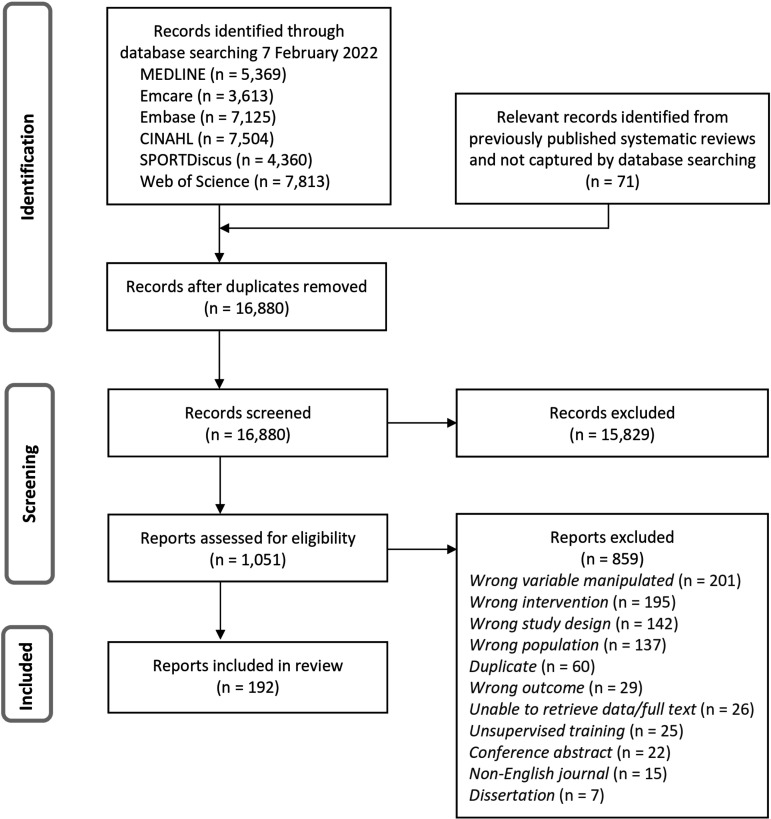
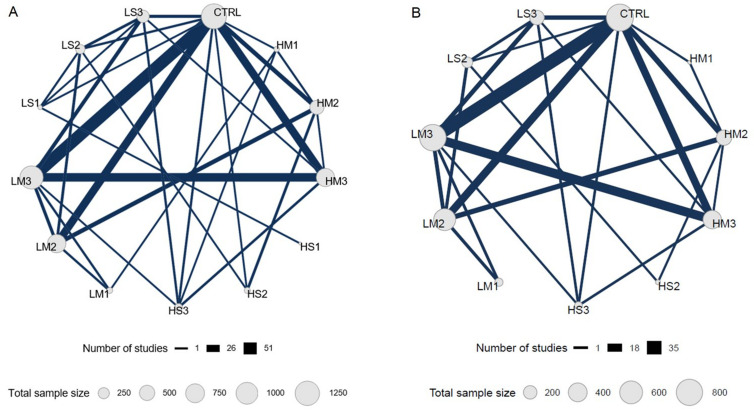
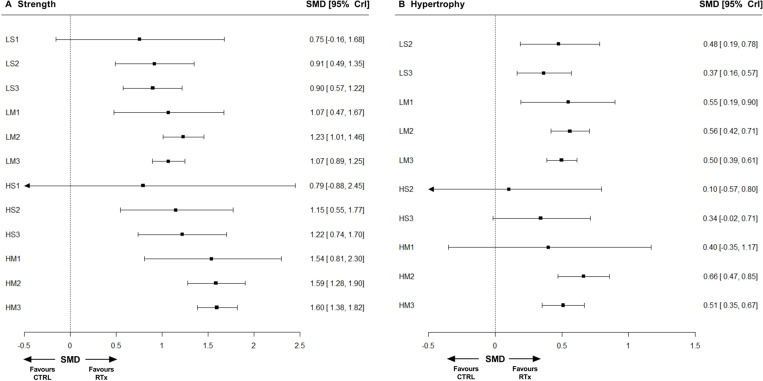
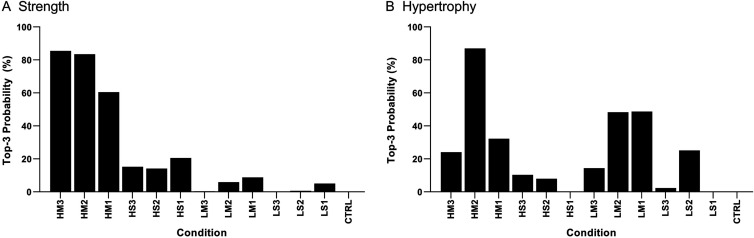
Objective: To determine how distinct combinations of resistance training prescription (RTx) variables (load, sets and frequency) affect muscle strength and hypertrophy. Data sources: MEDLINE, Embase, Emcare, SPORTDiscus, CINAHL, and Web of Science were searched until February 2022. Eligibility criteria: Randomised trials that included healthy adults, compared at least 2 predefined conditions (non-exercise control (CTRL) and 12 RTx, differentiated by load, sets and/or weekly frequency), and reported muscle strength and/or hypertrophy were included. Analyses: Systematic review and Bayesian network meta-analysis methodology was used to compare RTxs and CTRL. Surface under the cumulative ranking curve values were used to rank conditions. Confidence was assessed with threshold analysis. Results: The strength network included 178 studies (n=5097; women=45%). The hypertrophy network included 119 studies (n=3364; women=47%). All RTxs were superior to CTRL for muscle strength and hypertrophy. Higher-load (>80% of single repetition maximum) prescriptions maximised strength gains, and all prescriptions comparably promoted muscle hypertrophy. While the calculated effects of many prescriptions were similar, higher-load, multiset, thrice-weekly training (standardised mean difference (95% credible interval); 1.60 (1.38 to 1.82) vs CTRL) was the highest-ranked RTx for strength, and higher-load, multiset, twice-weekly training (0.66 (0.47 to 0.85) vs CTRL) was the highest-ranked RTx for hypertrophy. Threshold analysis demonstrated these results were extremely robust. Conclusion: All RTx promoted strength and hypertrophy compared with no exercise. The highest-ranked prescriptions for strength involved higher loads, whereas the highest-ranked prescriptions for hypertrophy included multiple sets. PROSPERO registration number: CRD42021259663 and CRD42021258902.
Overview
The claims and statistics of this paper haven’t been checked yet.
Free: it reads the open-access text and checks the first 5 claims that cite a source we can check. Create a free account to check every claim.
Integrity signals
Registry
Cites
Statistics
Figures
Verification
Claims the paper makes
The claims and statistics of this paper haven’t been checked yet.
Free: it reads the open-access text and checks the first 5 claims that cite a source we can check. Create a free account to check every claim.
Claims other papers make about this one
Each is checked against this paper’s own text: does it say what the citing paper says it does?
The source backs part of the claim, not all of it — or backs it for a different population, condition or comparison.
In the citing paper
“Clearly, one set is superior to zero sets (CTRL), and two sets are superior to one set (17,24,88–93,128,131–133), but the exact number of sets required to optimize adaptations cannot be ascertained.”
From American College of Sports Medicine Position Stand. Resistance Training Prescription for Muscle Function, Hypertrophy, and Physical Performance in Healthy Adults: An Overview of Reviews (2026) · cites this paper as [17]
Experimental — accuracy not yet measuredThe source backs part of the claim, not all of it — or backs it for a different population, condition or comparison.
In the citing paper
“Load (often used synonymously with intensity) has repeatedly been shown to impact strength more than other RT adaptations (17,83,184).”
From American College of Sports Medicine Position Stand. Resistance Training Prescription for Muscle Function, Hypertrophy, and Physical Performance in Healthy Adults: An Overview of Reviews (2026) · cites this paper as [17]
Experimental — accuracy not yet measuredThe source backs part of the claim, not all of it — or backs it for a different population, condition or comparison.
In the citing paper
“Research into resistance training variables shows that load, volume, frequency, and rest intervals, influence the amount of skeletal muscle hypertrophy induced [33–35].”
From Effects of Skeletal Muscle Hypertrophy on Fat Mass and Glucose Homeostasis in Humans and Animals: A Narrative Review with Systematic Literature Search (2025) · cites this paper as [35]
Experimental — accuracy not yet measuredThe cited source says what the claim attributes to it.
In the citing paper
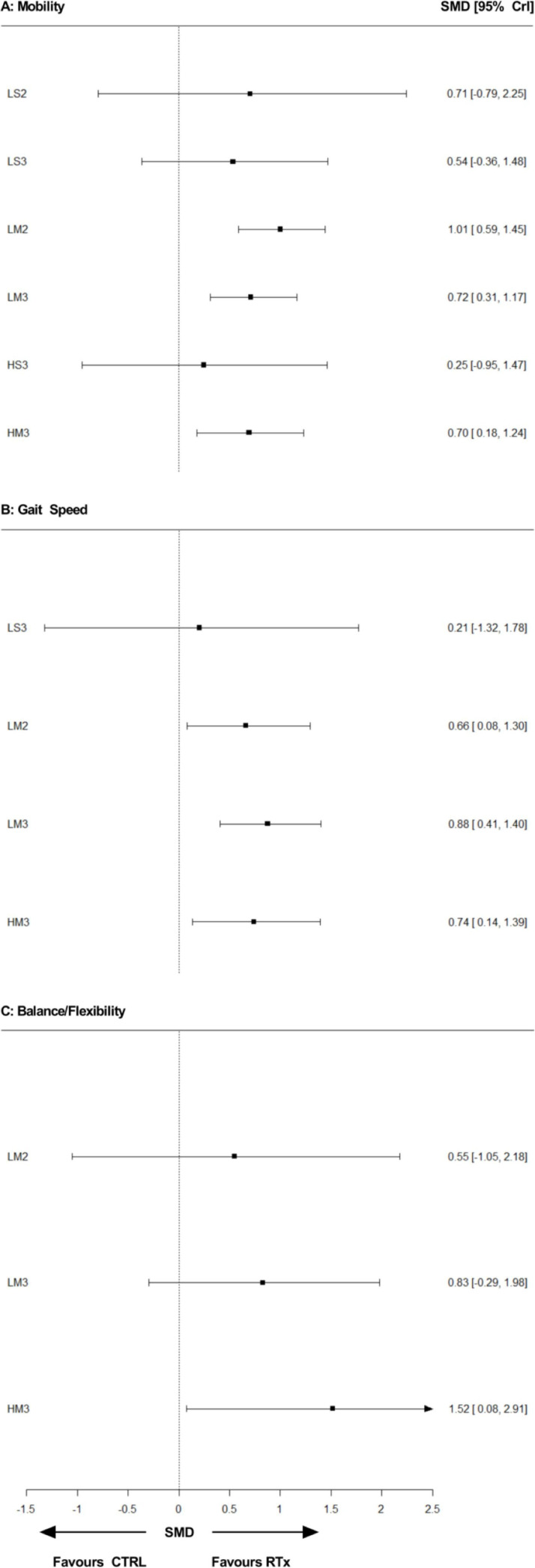
“Compared with no exercise (control), RT significantly improved muscle strength, size (hypertrophy), power, endurance, contraction velocity, gait speed, balance, and multiple physical function outcomes.”
The cited source says what the claim attributes to it.
In the citing paper
“Compared with CTRL, muscle hypertrophy was positively affected by standard RT (17,24,30,32,33,37,38,40,42–47,50,127), circuit RT (57,58), and elastic band RT (60,62).”
7 more claims about this paper
Create a free account to see every claim other papers make about this one.
Self-check
Percentages, sums and reported differences re-computed from the paper’s own numbers.
The self-check needs the paper’s full text.
Citations
Cites
RoB 2: a revised tool for assessing risk of bias in randomised trials
Sterne, J. A. C., Savović, J., Page, M. J., Elbers, R. G., Blencowe, N. S., Boutron, I., Cates, C. J., Cheng, H.-Y., Corbett, M. S., Eldridge, S. M., et al. (2019) · BMJ · doi:10.1136/bmj.l4898 · Cited by 34,787 · cited 1×
“All records underwent title/abstract screening by two independent reviewers, with discrepancies resolved by a third reviewer.”
Conducting Meta-Analyses in R with the metafor Package
Viechtbauer, W. (2010) · Journal of Statistical Software · doi:10.18637/jss.v036.i03 · Cited by 20,464
mice: Multivariate Imputation by Chained Equations in R
Buuren, S. V., & Groothuis-Oudshoorn, K. (2011) · Journal of Statistical Software · doi:10.18637/jss.v045.i03 · Cited by 13,870
Hutton, B., Salanti, G., Caldwell, D. M., Chaimani, A., Schmid, C. H., Cameron, C., Ioannidis, J. P. A., Straus, S., Thorlund, K., Jansen, J. P., et al. (2015) · Annals of Internal Medicine · doi:10.7326/m14-2385 · Cited by 8,269
How to perform a meta-analysis with R: a practical tutorial
Balduzzi, S., Rücker, G., & Schwarzer, G. (2019) · Evidence Based Mental Health · doi:10.1136/ebmental-2019-300117 · Cited by 5,827 · cited 1×
“40 44 To account for within-trial correlations in multi-arm trials (≥3 conditions), the SE in the base/reference arm was calculated as the square root of the covariance between calculated effects, 45 assuming a correlation of 0.5 between effect sizes.”
InfluentialExercise and Physical Activity for Older Adults
Chodzko-Zajko, W. J., Proctor, D. N., Fiatarone Singh, M. A., Minson, C. T., Nigg, C. R., Salem, G. J., & Skinner, J. S. (2009) · Medicine & Science in Sports & Exercise · doi:10.1249/mss.0b013e3181a0c95c · Cited by 5,153
Progression Models in Resistance Training for Healthy Adults
(2009) · Medicine & Science in Sports & Exercise · doi:10.1249/mss.0b013e3181915670 · Cited by 4,332 · cited 1×
“Any disagreement was resolved by consensus (BSC and JCM).”
Wickham, H. (2011) · WIREs Computational Statistics · doi:10.1002/wics.147 · Cited by 4,304 · cited 1×
“Figures were created with multinma , 47 metafor 60 ggplot2 , 61 and GraphPad Prism (V.9.1.0 for Windows, GraphPad Software, San Diego, California, USA, www.graphpad.com).”
InfluentialChecking consistency in mixed treatment comparison meta-analysis
Dias, S., Welton, N. J., Caldwell, D. M., & Ades, A. E. (2010) · Statistics in Medicine · doi:10.1002/sim.3767 · Cited by 2,521 · cited 1×
“51 Local inconsistency was assessed with the node-splitting method, 52 and inconsistency was considered to be detected when the Bayesian p value 0.05.”
InfluentialSelf-citationCombination of direct and indirect evidence in mixed treatment comparisons
Lu, G., & Ades, A. E. (2004) · Statistics in Medicine · doi:10.1002/sim.1875 · Cited by 2,166 · cited 1×
“30 Additionally, NMA permits the rank-ordering of all included treatments and the incorporation of data from multi-arm trials.”
CINeMA: an approach for assessing confidence in the results of a network meta-analysis
Nikolakopoulou, A., Higgins, J. P. T., Papakonstantinou, T., Chaimani, A., Del Giovane, C., Egger, M., & Salanti, G. (2020) · PLOS Medicine · doi:10.1371/journal.pmed.1003082 · Cited by 1,935
Puhan, M. A., Schunemann, H. J., Murad, M. H., Li, T., Brignardello-Petersen, R., Singh, J. A., Kessels, A. G., Guyatt, G. H., & for the GRADE Working Group (2014) · BMJ · doi:10.1136/bmj.g5630 · Cited by 1,812
Fragala, M. S., Cadore, E. L., Dorgo, S., Izquierdo, M., Kraemer, W. J., Peterson, M. D., & Ryan, E. D. (2019) · Journal of Strength and Conditioning Research · doi:10.1519/jsc.0000000000003230 · Cited by 1,290 · cited 1×
“Threshold analysis results for strength and hypertrophy are shown in online supplemental appendix 10.”
Dias, S., Sutton, A. J., Ades, A. E., & Welton, N. J. (2013) · Medical Decision Making · doi:10.1177/0272989x12458724 · Cited by 1,207 · cited 2×
“Any disagreement was resolved by consensus (BSC and JCM).”
Self-citationPollock, M. L., Franklin, B. A., Balady, G. J., Chaitman, B. L., Fleg, J. L., Fletcher, B., Limacher, M., Piña, I. L., Stein, R. A., Williams, M., et al. (2000) · Circulation · doi:10.1161/01.cir.101.7.828 · Cited by 1,058
Schoenfeld, B. J., Grgic, J., Ogborn, D., & Krieger, J. W. (2017) · Journal of Strength and Conditioning Research · doi:10.1519/jsc.0000000000002200 · Cited by 851 · cited 2×
“…support these recommendations and should not deter practitioners from promoting existing guidelines to improve strength and hypertrophy, nor do these results contradict the effectiveness of guidelines incorporating additional RTx variables, such as rest intervals and contraction type and velocity.”
Advances in the GRADE approach to rate the certainty in estimates from a network meta-analysis
Brignardello-Petersen, R., Bonner, A., Alexander, P. E., Siemieniuk, R. A., Furukawa, T. A., Rochwerg, B., Hazlewood, G. S., Alhazzani, W., Mustafa, R. A., Murad, M. H., et al. (2018) · Journal of Clinical Epidemiology · doi:10.1016/j.jclinepi.2017.10.005 · Cited by 753
Demystifying trial networks and network meta-analysis
Mills, E. J., Thorlund, K., & Ioannidis, J. P. A. (2013) · BMJ · doi:10.1136/bmj.f2914 · Cited by 742 · cited 1×
“29 NMA leverages direct and indirect evidence to produce enhanced effect estimates between all treatments, even when some comparisons have never been tested in randomised trials.”
Dias, S., Welton, N. J., Sutton, A. J., Caldwell, D. M., Lu, G., & Ades, A. E. (2013) · Medical Decision Making · doi:10.1177/0272989x12455847 · Cited by 728
Self-citationApproaches to interpreting and choosing the best treatments in network meta-analyses
Mbuagbaw, L., Rochwerg, B., Jaeschke, R., Heels-Andsell, D., Alhazzani, W., Thabane, L., & Guyatt, G. H. (2017) · Systematic Reviews · doi:10.1186/s13643-017-0473-z · Cited by 693 · cited 1×
“67 Personal preferences, including disliking higher loads or time constraints, including an inability to train more than once weekly, can be observed while still bene-fiting from RT.”
Schoenfeld, B. J., Ogborn, D., & Krieger, J. W. (2017) · Journal of Sports Sciences · doi:10.1080/02640414.2016.1210197 · Cited by 671 · cited 2×
“21 64–66 The probability of each condition ranking in the top three was calculated because the top-ranked RTx does not necessarily reflect the best intervention for all individuals.”
Bird, S. P., Tarpenning, K. M., & Marino, F. E. (2005) · Sports Medicine · doi:10.2165/00007256-200535100-00002 · Cited by 533
Dias, S., Sutton, A. J., Welton, N. J., & Ades, A. E. (2013) · Medical Decision Making · doi:10.1177/0272989x13485157 · Cited by 466
Self-citationHandling Complex Meta-analytic Data Structures Using Robust Variance Estimates: a Tutorial in R
Tanner-Smith, E. E., Tipton, E., & Polanin, J. R. (2016) · Journal of Developmental and Life-Course Criminology · doi:10.1007/s40865-016-0026-5 · Cited by 390 · cited 1×
“63 84 Increasingly, within-subject models are used due to their increased statistical power.”
Understanding and interpreting confidence and credible intervals around effect estimates
Hespanhol, L., Vallio, C. S., Costa, L. M., & Saragiotto, B. T. (2019) · Brazilian Journal of Physical Therapy · doi:10.1016/j.bjpt.2018.12.006 · Cited by 390
Dose-Response Relationship of Resistance Training in Older Adults: A Meta-Analysis
STEIB, S., SCHOENE, D., & PFEIFER, K. (2010) · Medicine & Science in Sports & Exercise · doi:10.1249/mss.0b013e3181c34465 · Cited by 378 · cited 1×
“⇒ Since all protocols increased strength and hypertrophy, rather than determining an ‘optimal’ protocol, future work could determine minimal ‘doses’ of resistance exercise and practices to promote engagement and adherence in this health-promoting form of exercise”
Grgic, J., Schoenfeld, B. J., Davies, T. B., Lazinica, B., Krieger, J. W., & Pedisic, Z. (2018) · Sports Medicine · doi:10.1007/s40279-018-0872-x · Cited by 365 · cited 1×
“14 Indeed, various meta-analyses have provided seminal evidence on the univariate impact of load, 15–18 sets 19–22 or frequency 23–27 to improve muscle strength, mass and physical function.”
LOPEZ, P., RADAELLI, R., TAAFFE, D. R., NEWTON, R. U., GALVÃO, D. A., TRAJANO, G. S., TEODORO, J. L., KRAEMER, W. J., HÄKKINEN, K., & PINTO, R. S. (2021) · Medicine & Science in Sports & Exercise · doi:10.1249/mss.0000000000002585 · Cited by 340 · cited 2×
“⇒ Since all protocols increased strength and hypertrophy, rather than determining an ‘optimal’ protocol, future work could determine minimal ‘doses’ of resistance exercise and practices to promote engagement and adherence in this health-promoting form of exercise”
Network Meta‐Analysis for Decision Making
Dias, S., Ades, A. E., Welton, N. J., Jansen, J. P., & Sutton, A. J. (2018) · Wiley eBooks · doi:10.1002/9781118951651 · Cited by 333
Self-citationNaci, H., Salcher-Konrad, M., Dias, S., Blum, M. R., Sahoo, S. A., Nunan, D., & Ioannidis, J. P. A. (2019) · British Journal of Sports Medicine · doi:10.1136/bjsports-2018-099921 · Cited by 326 · cited 1×
“Convergence was evaluated by visual inspection of trace plots 48 and the potential scale reduction factor.”
Schoenfeld, B. J., Ogborn, D., & Krieger, J. W. (2016) · Sports Medicine · doi:10.1007/s40279-016-0543-8 · Cited by 308
Nunes, E. A., Colenso‐Semple, L., McKellar, S. R., Yau, T., Ali, M. U., Fitzpatrick‐Lewis, D., Sherifali, D., Gaudichon, C., Tomé, D., Atherton, P. J., et al. (2022) · Journal of Cachexia, Sarcopenia and Muscle · doi:10.1002/jcsm.12922 · Cited by 280 · cited 1×
“43 When multiple studies compared two conditions, random-effects pairwise meta-analyses were conducted to identify comparison-level heterogeneity, publication bias, outliers and influential cases.”
Self-citationSingle vs. multiple sets of resistance exercise for muscle hypertrophy: a meta-analysis.
Krieger, J. W. (2010) · Journal of Strength and Conditioning Research · doi:10.1519/jsc.0b013e3181d4d436 · Cited by 276 · cited 1×
“⇒ Since all protocols increased strength and hypertrophy, rather than determining an ‘optimal’ protocol, future work could determine minimal ‘doses’ of resistance exercise and practices to promote engagement and adherence in this health-promoting form of exercise”
Momma, H., Kawakami, R., Honda, T., & Sawada, S. S. (2022) · British Journal of Sports Medicine · doi:10.1136/bjsports-2021-105061 · Cited by 265
Peterson, M. D., Rhea, M. R., & Alvar, B. A. (2004) · The Journal of Strength and Conditioning Research · doi:10.1519/r-12842.1 · Cited by 259
Resistance Exercise Training as a Primary Countermeasure to Age-Related Chronic Disease
Mcleod, J. C., Stokes, T., & Phillips, S. M. (2019) · Frontiers in Physiology · doi:10.3389/fphys.2019.00645 · Cited by 254
Self-citationCsapo, R., & Alegre, L. M. (2016) · Scandinavian Journal of Medicine & Science in Sports · doi:10.1111/sms.12536 · Cited by 239 · cited 1×
“14 Indeed, various meta-analyses have provided seminal evidence on the univariate impact of load, 15–18 sets 19–22 or frequency 23–27 to improve muscle strength, mass and physical function.”
Prescription of Resistance Training for Healthy Populations
Hass, C. J., Feigenbaum, M. S., & Franklin, B. A. (2001) · Sports Medicine · doi:10.2165/00007256-200131140-00001 · Cited by 230
The Effect of Weekly Set Volume on Strength Gain: A Meta-Analysis
Ralston, G. W., Kilgore, L., Wyatt, F. B., & Baker, J. S. (2017) · Sports Medicine · doi:10.1007/s40279-017-0762-7 · Cited by 221
Grgic, J., Schoenfeld, B. J., Orazem, J., & Sabol, F. (2022) · Journal of Sport and Health Science · doi:10.1016/j.jshs.2021.01.007 · Cited by 206 · cited 2×
“63 84 Increasingly, within-subject models are used due to their increased statistical power.”
Figueiredo, V. C., de Salles, B. F., & Trajano, G. S. (2018) · Sports Medicine · doi:10.1007/s40279-017-0793-0 · Cited by 194
Resistance Training and Type 2 Diabetes
Eves, N. D., & Plotnikoff, R. C. (2006) · Diabetes Care · doi:10.2337/dc05-1981 · Cited by 191
Schoenfeld, B. J., Grgic, J., & Krieger, J. (2019) · Journal of Sports Sciences · doi:10.1080/02640414.2018.1555906 · Cited by 183 · cited 1×
“14 Indeed, various meta-analyses have provided seminal evidence on the univariate impact of load, 15–18 sets 19–22 or frequency 23–27 to improve muscle strength, mass and physical function.”
Network meta-analysis explained
Dias, S., & Caldwell, D. M. (2019) · Archives of Disease in Childhood - Fetal and Neonatal Edition · doi:10.1136/archdischild-2018-315224 · Cited by 172
Fyfe, J. J., Hamilton, D. L., & Daly, R. M. (2022) · Sports Medicine · doi:10.1007/s40279-021-01605-8 · Cited by 172 · cited 4×
“28 Within exercise science, NMA has been used to compare different types of exercise 31–34 ; within RT, NMA has only been used to compare different load doses.”
InfluentialUncomplicated Resistance Training and Health-Related Outcomes: Evidence for a Public Health Mandate
Phillips, S. M., & Winett, R. A. (2010) · Current Sports Medicine Reports · doi:10.1249/jsr.0b013e3181e7da73 · Cited by 157
Self-citationBayesian Measures of Model Complexity and Fit
Spiegelhalter, D. J., Best, N. G., Carlin, B. P., & Van Der Linde, A. (2002) · Journal of the Royal Statistical Society Series B: Statistical Methodology · doi:10.1111/1467-9868.00353 · Cited by 151 · cited 1×
“49 50 Heterogeneity was assessed by examining the between-study SD ( τ ) and 95% credible intervals (95% CrI).”
LIM, C., NUNES, E. A., CURRIER, B. S., MCLEOD, J. C., THOMAS, A. C. Q., & PHILLIPS, S. M. (2022) · Medicine & Science in Sports & Exercise · doi:10.1249/mss.0000000000002929 · Cited by 142
Self-citationSchoenfeld, B., Fisher, J., Grgic, J., Haun, C., Helms, E., Phillips, S., Steele, J., & Vigotsky, A. (2021) · International Journal of Strength and Conditioning · doi:10.47206/ijsc.v1i1.81 · Cited by 124 · cited 3×
“Physical function results are reported in the online supplemental appendix 13.”
InfluentialSelf-citationCarvalho, L., Junior, R. M., Barreira, J., Schoenfeld, B. J., Orazem, J., & Barroso, R. (2022) · Applied Physiology, Nutrition, and Metabolism · doi:10.1139/apnm-2021-0515 · Cited by 116 · cited 1×
“21 64–66 The probability of each condition ranking in the top three was calculated because the top-ranked RTx does not necessarily reflect the best intervention for all individuals.”
MacInnis, M. J., McGlory, C., Gibala, M. J., & Phillips, S. M. (2017) · Applied Physiology, Nutrition, and Metabolism · doi:10.1139/apnm-2016-0645 · Cited by 111 · cited 1×
“85 To our knowledge, however, no methods are available to account for the additional correlation when including within-subject and between-subject comparisons in NMA.”
Self-citationLai, C.-C., Tu, Y.-K., Wang, T.-G., Huang, Y.-T., & Chien, K.-L. (2018) · Age and Ageing · doi:10.1093/ageing/afy009 · Cited by 109
Weekly training frequency effects on strength gain: a meta-analysis.
Ralston, G. W., Kilgore, L., Wyatt, F. B., Buchan, D., & Baker, J. S. (2018) · Sports Medicine - Open · doi:10.1186/s40798-018-0149-9 · Cited by 109
QUANTITATIVE ANALYSIS OF SINGLE- VS. MULTIPLE-SET PROGRAMS IN RESISTANCE TRAINING
WOLFE, B. L., LEMURA, L. M., & COLE, P. J. (2004) · Journal of Strength and Conditioning Research · doi:10.1519/00124278-200402000-00005 · Cited by 102
Training for strength and hypertrophy: an evidence-based approach.
Morton, R. W., Colenso-Semple, L., & Phillips, S. M. (2019) · Current Opinion in Physiology · doi:10.1016/j.cophys.2019.04.006 · Cited by 100
Self-citationStrength Training: In Search of Optimal Strategies to Maximize Neuromuscular Performance
Duchateau, J., Stragier, S., Baudry, S., & Carpentier, A. (2020) · Exercise and Sport Sciences Reviews · doi:10.1249/jes.0000000000000234 · Cited by 98
Resistance Training and Mortality Risk: A Systematic Review and Meta-Analysis
Shailendra, P., Baldock, K. L., Li, L. S. K., Bennie, J. A., & Boyle, T. (2022) · American Journal of Preventive Medicine · doi:10.1016/j.amepre.2022.03.020 · Cited by 98
Joanisse, S., Lim, C., McKendry, J., Mcleod, J. C., Stokes, T., & Phillips, S. M. (2020) · F1000Research · doi:10.12688/f1000research.21588.1 · Cited by 92
Self-citationPedder, H., Dias, S., Bennetts, M., Boucher, M., & Welton, N. J. (2019) · Research Synthesis Methods · doi:10.1002/jrsm.1351 · Cited by 91 · cited 1×
“80 81 Several acute RT variables were not factored into the included RT prescriptions (eg, inter-set rest, time under tension, repetition velocity, volitional fatigue, tempo); where possible, NMR was used to explore if these factors improved model fit and altered effects.”
Self-citationAccounting for correlation in network meta‐analysis with multi‐arm trials
Franchini, A. J., Dias, S., Ades, A. E., Jansen, J. P., & Welton, N. J. (2012) · Research Synthesis Methods · doi:10.1002/jrsm.1049 · Cited by 89 · cited 1×
“40 44 To account for within-trial correlations in multi-arm trials (≥3 conditions), the SE in the base/reference arm was calculated as the square root of the covariance between calculated effects, 45 assuming a correlation of 0.5 between effect sizes.”
InfluentialSelf-citationWackerhage, H., & Schoenfeld, B. J. (2021) · Sports Medicine · doi:10.1007/s40279-021-01495-w · Cited by 87 · cited 1×
“14 Indeed, various meta-analyses have provided seminal evidence on the univariate impact of load, 15–18 sets 19–22 or frequency 23–27 to improve muscle strength, mass and physical function.”
Chang, Y., Yang, H.-Y., & Shun, S. (2021) · International Journal of Obesity · doi:10.1038/s41366-021-00767-9 · Cited by 79 · cited 2×
“28 Within exercise science, NMA has been used to compare different types of exercise 31–34 ; within RT, NMA has only been used to compare different load doses.”
The Health Benefits of Resistance Exercise: Beyond Hypertrophy and Big Weights
Abou Sawan, S., Nunes, E. A., Lim, C., McKendry, J., & Phillips, S. M. (2023) · Exercise, Sport and Movement · doi:10.1249/esm.0000000000000001 · Cited by 76
Self-citationUsing multiple imputation to estimate missing data in meta‐regression
Ellington, E. H., Bastille‐Rousseau, G., Austin, C., Landolt, K. N., Pond, B. A., Rees, E. E., Robar, N., & Murray, D. L. (2015) · Methods in Ecology and Evolution · doi:10.1111/2041-210x.12322 · Cited by 75
Phillippo, D. M., Dias, S., Welton, N. J., Caldwell, D. M., Taske, N., & Ades, A. E. (2019) · Annals of Internal Medicine · doi:10.7326/m18-3542 · Cited by 72
Self-citationSibley, K. M., Thomas, S. M., Veroniki, A. A., Rodrigues, M., Hamid, J. S., Lachance, C. C., Cogo, E., Khan, P. A., Riva, J. J., Thavorn, K., et al. (2020) · Experimental Gerontology · doi:10.1016/j.exger.2020.111151 · Cited by 66 · cited 2×
“28 Within exercise science, NMA has been used to compare different types of exercise 31–34 ; within RT, NMA has only been used to compare different load doses.”
Cannon, J., & Marino, F. E. (2010) · Journal of Sports Sciences · doi:10.1080/02640414.2010.517544 · Cited by 65 · cited 1×
“37 Cohorts randomised separately but reported together (eg, young and old 39 ) were analysed independently.”
Morze, J., Rücker, G., Danielewicz, A., Przybyłowicz, K., Neuenschwander, M., Schlesinger, S., & Schwingshackl, L. (2021) · Obesity Reviews · doi:10.1111/obr.13218 · Cited by 55
Lacio, M., Vieira, J. G., Trybulski, R., Campos, Y., Santana, D., Filho, J. E., Novaes, J., Vianna, J., & Wilk, M. (2021) · International Journal of Environmental Research and Public Health · doi:10.3390/ijerph182111237 · Cited by 55 · cited 2×
“62 Network meta-regression for exercise ‘failure’ (fatigue) did not improve model fit nor substantially alter network estimates, suggesting that lifting to fatigue does not suitably explain the observed hypertrophic response.”
Sensitivity of Treatment Recommendations to Bias in Network Meta-Analysis
Phillippo, D., Dias, S., Ades, A. E., Didelez, V., & Welton, N. J. (2017) · Journal of the Royal Statistical Society Series A (Statistics in Society) · doi:10.1111/rssa.12341 · Cited by 52 · cited 1×
“…in R V.4.0.4 using the packages: ‘esc’, 58 to calculate SMD; ‘dmetar’, 40 to conduct pairwise meta-analyses and assess comparison-level heterogeneity; ‘multinma’, 47 to conduct NMA, NMR and consistency testing; ‘nmathresh’, 54 to perform thresholding; and ‘mice’, 59 to perform multiple imputation.”
InfluentialSelf-citationA Bayesian dose–response meta-analysis model: A simulations study and application
Hamza, T., Cipriani, A., Furukawa, T. A., Egger, M., Orsini, N., & Salanti, G. (2021) · Statistical Methods in Medical Research · doi:10.1177/0962280220982643 · Cited by 51
Tavares, L. D., de Souza, E. O., Ugrinowitsch, C., Laurentino, G. C., Roschel, H., Aihara, A. Y., Cardoso, F. N., & Tricoli, V. (2017) · European Journal of Sport Science · doi:10.1080/17461391.2017.1298673 · Cited by 48 · cited 1×
“72 Furthermore, 127 of the 161 direct comparisons would need to change by more than four SDs to alter HM2 as the top recommendation for hypertrophy.”
Grgic, J. (2020) · Journal of Human Kinetics · doi:10.2478/hukin-2020-0013 · Cited by 45 · cited 1×
“The lack of importance of load for hypertrophy is supported by other analyses, 16 17 35 62 but performing RT to momentary muscular failure (fatigue) has been posited as a key component for RT-induced hypertrophy with lower loads.”
Orwoll, E. S., Peters, K. E., Hellerstein, M., Cummings, S. R., Evans, W. J., & Cawthon, P. M. (2020) · The Journals of Gerontology: Series A · doi:10.1093/gerona/glaa064 · Cited by 40
Equating Resistance-Training Volume Between Programs Focused on Muscle Hypertrophy
Nunes, J. P., Kassiano, W., Costa, B. D. V., Mayhew, J. L., Ribeiro, A. S., & Cyrino, E. S. (2021) · Sports Medicine · doi:10.1007/s40279-021-01449-2 · Cited by 35
Multiple Comparisons within a Study
(2009) · Introduction to Meta‐Analysis · doi:10.1002/9780470743386.ch25 · Cited by 34 · cited 1×
“Any disagreement was resolved by consensus (BSC and JCM).”
Kneffel, Z., Murlasits, Z., Reed, J., & Krieger, J. (2021) · Journal of Sports Sciences · doi:10.1080/02640414.2020.1822595 · Cited by 29
(1984) · National Strength & Conditioning Association Journal · doi:10.1519/0744-0049(1984)006<0060:mbor>2.3.co;2 · Cited by 29
A Bayesian dose-response meta-analysis model: A simulations study and application.
Hamza, T., Cipriani, A., Furukawa, T. A., Egger, M., Orsini, N., & Salanti, G. (2021) · doi:10.48350/151952 · Cited by 23
Internal validity in resistance training research: a systematic review.
Makaruk, H., Starzak, M., Płaszewski, M., & Winchester, J. B. (2022) · Journal of Sports Science and Medicine · doi:10.52082/jssm.2022.308 · Cited by 13
Meta-Analysis in the Physical and Biological Sciences
Hedges, L. V., & Olkin, I. (1985) · Elsevier eBooks · doi:10.1016/b978-0-08-057065-5.50020-8 · Cited by 9
Meta‐Regression for Relative Treatment Effects
Dias, S., Ades, A. E., Welton, N. J., Jansen, J. P., & Sutton, A. J. (2018) · doi:10.1002/9781118951651.ch8 · Cited by 9
Self-citationFigueiredo, V. C., de Salles, B. F., & Trajano, G. S. (2018) · Sports Medicine · doi:10.1007/s40279-018-0866-8 · Cited by 6 · cited 1×
“21 64–66 The probability of each condition ranking in the top three was calculated because the top-ranked RTx does not necessarily reflect the best intervention for all individuals.”
Hackney, A. C., Deutsch, D. T., & Gilliam, T. B. (1984) · PubMed · Cited by 5
Newton, H. (1984) · National Strength & Conditioning Association Journal · doi:10.1519/0744-0049(1984)006<0004:tspmts>2.3.co;2 · Cited by 4
(2004) · doi:10.1519/1533-4287(2004)018
Cited by
Neuromuscular adaptations to resistance training in elite versus recreational athletes
Aslam, S., Habyarimana, J. D. D., & Bin, S. Y. (2025) · Frontiers in Physiology · doi:10.3389/fphys.2025.1598149 · Cited by 122
CURRIER, B. S., D’SOUZA, A. C., SINGH, M. A. F., LOWISZ, C. V., RAWSON, E. S., SCHOENFELD, B. J., SMITH-RYAN, A. E., STEEN, J. P., THOMAS, G. A., TRIPLETT, N. T., et al. (2026) · Medicine & Science in Sports & Exercise · doi:10.1249/mss.0000000000003897 · Cited by 105
“Compared with CTRL, multicomponent function was impacted by standard RT (17,24,42,45,159), elastic band RT (60,61), and home-based RT (64).”
InfluentialSelf-citationBiomarkers of aging: from molecules and surrogates to physiology and function
Furrer, R., & Handschin, C. (2025) · Physiological Reviews · doi:10.1152/physrev.00045.2024 · Cited by 74
Marzuca-Nassr, G. N., Alegría-Molina, A., SanMartín-Calísto, Y., Artigas-Arias, M., Huard, N., SAPUNAR, J., Salazar, L. A., Verdijk, L. B., & van Loon, L. J. C. (2023) · International Journal of Sport Nutrition and Exercise Metabolism · doi:10.1123/ijsnem.2023-0087 · Cited by 75
Thomas, A. C. Q., Stead, C. A., Burniston, J. G., & Phillips, S. M. (2024) · Free Radical Biology and Medicine · doi:10.1016/j.freeradbiomed.2024.08.010 · Cited by 64
Self-citation
Metadata
- Authors
- Currier, B. S., Mcleod, J. C., Banfield, L., Beyene, J., Welton, N. J., D'Souza, A. C., Keogh, J. A. J., Lin, L., Coletta, G., Yang, A., Colenso-Semple, L., Lau, K. J., Verboom, A., & Phillips, S. M.
- Affiliations
- McMaster University (CA)
- University of Bristol (GB)
- Corresponding author
- Phillips, Stuart M
- ORCID
- Venue
- British Journal of Sports Medicine
- Publisher
- BMJ
- Published
- 2023-07-06
- Volume
- 57
- Issue
- 18
- Pages
- 1211-1220
- ISSN
- 0306-3674 (ISSN-L)
- 1473-0480
- PMC
- PMC10579494
- OpenAlex
- W4383337711
- Cited by
- 179
- References
- 82
- Citations by year
- 2026: 72 · 2025: 59 · 2024: 42 · 2023: 6
- FWCI
- 9.89
- Type
- journal article
- Language
- en
- Open access
- hybrid
- doi.org
- Licence
- Locations
- British Journal of Sports Medicine (publishedVersion, cc-by-nc)
- PubMed Central (publishedVersion, cc-by-nc)
- PubMed (publishedVersion)
- Bristol Research (University of Bristol) (publishedVersion, cc-by-nc)
- HighWire Press Open Archive (submittedVersion)
- Explore Bristol Research (submittedVersion, cc-by-nc)
- Funders
- Canada Research Chairs
- NHS Foundation Trust
- Natural Sciences and Engineering Research Council (RGPIN-2020-06346)
- NIHR Bristol Biomedical Research Centre
- Topics
- Health Sciences › Medicine › Orthopedics and Sports Medicine › Sports Performance and Training
- Health Sciences › Medicine › Physiology (medical) › Cardiovascular and exercise physiology
- Health Sciences › Nursing › Nutrition and Dietetics › Muscle metabolism and nutrition
- Keywords
- resistance training prescription, muscle strength, muscle hypertrophy, training load, sets, exercise frequency, healthy adults
- MeSH terms
- Network Meta-Analysis, Adult, Bayes Theorem, Female, Humans, Hypertrophy, Muscle, Skeletal, Muscle Strength, Resistance Training, Prescriptions
About these checks
Registry, retraction, Cites and statistics results are computed, not judged, with one exception: a printed reference that no index lists is read once by a model before it counts as a citation error. Claims are extracted by a model and kept only when their quote appears verbatim in the text; each cited source is then checked, with a model’s help, for whether it says what the claim relies on. Those verdicts can be wrong — read the claim’s quote and the cited source before relying on one.
Statistics and arithmetic are recomputed, not judged.
Confidence bands are shown only for fields calibrated on our annotated test set. None is calibrated yet, so no band is shown.
What counts as a claim ›How we measure confidence ›How we check this ›
Are you an author, or do you see a problem with this page? Request a review
Data sources
Bibliographic data: Semantic Scholar, OpenAlex, Crossref.
Contains information from the Semantic Scholar Academic Graph Datasets, made available under the ODC Attribution License (ODC-BY 1.0).
Semantic Scholar’s data is described in: Kinney, R., et al. (2023). The Semantic Scholar Open Data Platform. arXiv:2301.10140.
