

The DOI matches its Crossref record; 24 of the 24 references it cites were found in a registry or an index.
Elapsed time since BNT162b2 vaccine and risk of SARS-CoV-2 infection: test negative design study
Open accessPublished version of a preprint
Abstract
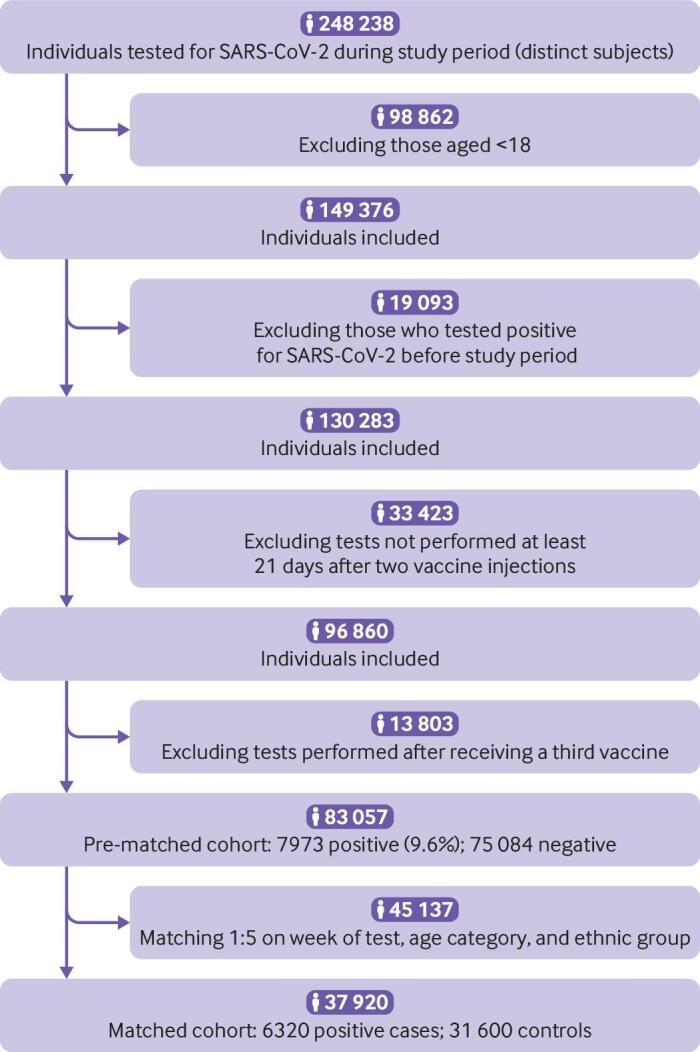
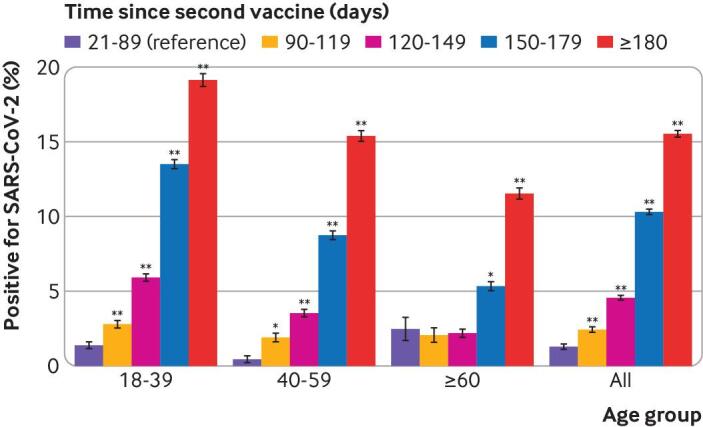
Objectives: To determine whether time elapsed since the second injection of the Pfizer-BioNTech BNT162b2 mRNA vaccine was significantly associated with the risk of covid-19 infection after vaccination in people who received two vaccine injections. Design: Test negative design study. Setting: Electronic health records of a large state mandated healthcare organisation, Israel. Participants: Adults aged ≥18 years who had received a reverse transcription polymerase chain reaction (RT-PCR) test between 15 May 2021 and 17 September 2021, at least three weeks after their second vaccine injection, had not received a third vaccine injection, and had no history of covid-19 infection. Main outcome measures: Positive result for the RT-PCR test. Individuals who tested positive for SARS-CoV-2 and controls were matched for week of testing, age category, and demographic group (ultra-orthodox Jews, individuals of Arab ancestry, and the general population). Conditional logistic regression was adjusted for age, sex, socioeconomic status, and comorbid conditions. Results: 83 057 adults received an RT-PCR test for SARS-CoV-2 during the study period and 9.6% had a positive result. Time elapsed since the vaccine injection was significantly longer in individuals who tested positive (P<0.001). Adjusted odds ratio for infection at time intervals >90 days since vaccination were significantly increased compared with the reference of <90 days: 2.37 (95% confidence interval 1.67 to 3.36) for 90-119 days, 2.66 (1.94 to 3.66) for 120-149 days, 2.82 (2.07 to 3.84) for 150-179 days, and 2.82 (2.07 to 3.85) for ≥180 days (P<0.001 for each 30 day interval). Conclusions: In this large population of adults tested for SARS-CoV-2 by RT-PCR after two doses of mRNA BNT162b2 vaccine, a gradual increase in the risk of infection was seen for individuals who received their second vaccine dose after at least 90 days.
Overview
The claims and statistics of this paper haven’t been checked yet.
Run the check — free, no account needed. It reads the open-access text and checks the sources it cites.
Integrity signals
Registry
Cites
Statistics
Figures
Verification
Claims the paper makes
The claims and statistics of this paper haven’t been checked yet.
Run the check — free, no account needed. It reads the open-access text and checks the sources it cites.
Claims other papers make about this one
Each is checked against this paper’s own text: does it say what the citing paper says it does?
The cited source says what the claim attributes to it.
In the citing paper
“protection against infection starts to wane within a few months of administration.8–11”
From Protection of the third-dose and fourth-dose mRNA vaccines against SARS-CoV-2 Omicron subvariant: a systematic review and meta-analysis (2023) · cites this paper as [8]
Self-check
Percentages, sums and reported differences re-computed from the paper’s own numbers.
The self-check needs the paper’s full text.
Citations
Cites
Safety and Efficacy of the BNT162b2 mRNA Covid-19 Vaccine
Polack, F. P., Thomas, S. J., Kitchin, N., Absalon, J., Gurtman, A., Lockhart, S., Perez, J. L., Pérez Marc, G., Moreira, E. D., Zerbini, C., et al. (2020) · New England Journal of Medicine · doi:10.1056/nejmoa2034577 · Cited by 14,592
Khoury, D. S., Cromer, D., Reynaldi, A., Schlub, T. E., Wheatley, A. K., Juno, J. A., Subbarao, K., Kent, S. J., Triccas, J. A., & Davenport, M. P. (2021) · Nature Medicine · doi:10.1038/s41591-021-01377-8 · Cited by 3,742
Antibody resistance of SARS-CoV-2 variants B.1.351 and B.1.1.7
Wang, P., Nair, M. S., Liu, L., Iketani, S., Luo, Y., Guo, Y., Wang, M., Yu, J., Zhang, B., Kwong, P. D., et al. (2021) · Nature · doi:10.1038/s41586-021-03398-2 · Cited by 2,312
Perineuronal nets stabilize the grid cell network
Christensen, A. C., Lensjø, K. K., Lepperød, M. E., Dragly, S.-A., Sutterud, H., Blackstad, J. S., Fyhn, M., & Hafting, T. (2021) · Nature Communications · doi:10.1038/s41467-020-20241-w · Cited by 1,865
Evolution of antibody immunity to SARS-CoV-2
Gaebler, C., Wang, Z., Lorenzi, J. C. C., Muecksch, F., Finkin, S., Tokuyama, M., Cho, A., Jankovic, M., Schaefer-Babajew, D., Oliveira, T. Y., et al. (2021) · Nature · doi:10.1038/s41586-021-03207-w · Cited by 1,674
Antibody Status and Incidence of SARS-CoV-2 Infection in Health Care Workers
Lumley, S. F., O’Donnell, D., Stoesser, N. E., Matthews, P. C., Howarth, A., Hatch, S. B., Marsden, B. D., Cox, S., James, T., Warren, F., et al. (2021) · New England Journal of Medicine · doi:10.1056/nejmoa2034545 · Cited by 940
Cutting edge: long-term B cell memory in humans after smallpox vaccination
Crotty, S., Felgner, P., Davies, H., Glidewell, J., Villarreal, L., & Ahmed, R. (2003) · The Journal of Immunology · doi:10.4049/jimmunol.171.10.4969 · Cited by 695
Looking beyond COVID-19 vaccine phase 3 trials
Kim, J. H., Marks, F., & Clemens, J. D. (2021) · Nature Medicine · doi:10.1038/s41591-021-01230-y · Cited by 601
Bajaj, V., Gadi, N., Spihlman, A. P., Wu, S. C., Choi, C. H., & Moulton, V. R. (2021) · Frontiers in Physiology · doi:10.3389/fphys.2020.571416 · Cited by 476
Evolution of immune responses to SARS-CoV-2 in mild-moderate COVID-19
Wheatley, A. K., Juno, J. A., Wang, J. J., Selva, K. J., Reynaldi, A., Tan, H.-X., Lee, W. S., Wragg, K. M., Kelly, H. G., Esterbauer, R., et al. (2021) · Nature Communications · doi:10.1038/s41467-021-21444-5 · Cited by 351
Research works printed but not linked: 1
- 10.1101/2021.08.19.21262111 · DOI
Cited by
Sorted by citations
Effectiveness of COVID-19 vaccines against the Omicron (B.1.1.529) variant of concern
Andrews, N., Stowe, J., Kirsebom, F., Toffa, S., Rickeard, T., Gallagher, E., Gower, C., Kall, M., Groves, N., O’Connell, A.-M., et al. (2021) · doi:10.1101/2021.12.14.21267615 · Cited by 2,420
mRNA vaccines induce durable immune memory to SARS-CoV-2 and variants of concern
Goel, R. R., Painter, M. M., Apostolidis, S. A., Mathew, D., Meng, W., Rosenfeld, A. M., Lundgreen, K. A., Reynaldi, A., Khoury, D. S., Pattekar, A., et al. (2021) · Science · doi:10.1126/science.abm0829 · Cited by 873
Waning of BNT162b2 Vaccine Protection against SARS-CoV-2 Infection in Qatar
Chemaitelly, H., Tang, P., Hasan, M. R., AlMukdad, S., Yassine, H. M., Benslimane, F. M., Al Khatib, H. A., Coyle, P., Ayoub, H. H., Al Kanaani, Z., et al. (2021) · New England Journal of Medicine · doi:10.1056/nejmoa2114114 · Cited by 831
Duration of Protection against Mild and Severe Disease by Covid-19 Vaccines
Andrews, N., Tessier, E., Stowe, J., Gower, C., Kirsebom, F., Simmons, R., Gallagher, E., Thelwall, S., Groves, N., Dabrera, G., et al. (2022) · New England Journal of Medicine · doi:10.1056/nejmoa2115481 · Cited by 807
Pouwels, K. B., Pritchard, E., Matthews, P. C., Stoesser, N., Eyre, D. W., Vihta, K.-D., House, T., Hay, J., Bell, J. I., Newton, J. N., et al. (2021) · doi:10.1101/2021.08.18.21262237 · Cited by 543
Metadata
- Authors
- Israel, A., Merzon, E., Schäffer, A. A., Shenhar, Y., Green, I., Golan-Cohen, A., Ruppin, E., Magen, E., & Vinker, S.
- Affiliations
- Leumit Health Services, Tel Aviv, Israel
- Tel Aviv University (IL)
- National Institutes of Health (US)
- Ben-Gurion University of the Negev (IL)
- Corresponding author
- Israel, Ariel
- ORCID
- Venue
- BMJ
- Publisher
- BMJ
- Published
- 2021-11-24
- Volume
- 375
- Pages
- e067873
- ISSN
- 1756-1833 (ISSN-L)
- PMC
- PMC9083235
- OpenAlex
- W3216422624
- Cited by
- 170
- References
- 24
- Citations by year
- 2026: 5 · 2025: 13 · 2024: 19 · 2023: 30 · 2022: 73 · 2021: 30
- FWCI
- 12.04
- Type
- journal article
- Language
- en
- Open access
- hybrid
- doi.org
- Licence
- Locations
- BMJ (publishedVersion, cc-by-nc)
- medRxiv (acceptedVersion, cc-by-nc-nd)
- PubMed Central (publishedVersion, cc-by-nc)
- PubMed (publishedVersion)
- PubMed Central (submittedVersion, cc-by-nc-nd)
- Funders
- U.S. Department of Health and Human Services
- National Institutes of Health
- National Cancer Institute
- Topics
- Health Sciences › Medicine › Infectious Diseases › SARS-CoV-2 and COVID-19 Research
- Social Sciences › Health › Vaccine Coverage and Hesitancy
- Physical Sciences › Mathematics › Modeling and Simulation › COVID-19 epidemiological studies
- Keywords
- BNT162b2, mRNA vaccines, COVID-19 pandemic, waning vaccine effectiveness, breakthrough infection, vaccine protection duration, ultra-Orthodox Jews, Arab ancestry, Israel
About these checks
Registry, retraction, Cites and statistics results are computed, not judged, with one exception: a printed reference that no index lists is read once by a model before it counts as a citation error. Claims are extracted by a model and kept only when their quote appears verbatim in the text; each cited source is then checked, with a model’s help, for whether it says what the claim relies on. Those verdicts can be wrong — read the claim’s quote and the cited source before relying on one.
Statistics and arithmetic are recomputed, not judged.
Confidence bands are shown only for fields calibrated on our annotated test set. None is calibrated yet, so no band is shown.
What counts as a claim ›How we measure confidence ›How we check this ›
Are you an author, or do you see a problem with this page? Request a review
