

The DOI matches its Crossref record; 160 of the 163 references it cites were found in a registry or an index.
Effect of lower sodium intake on health: systematic review and meta-analyses
Open accessAbstract
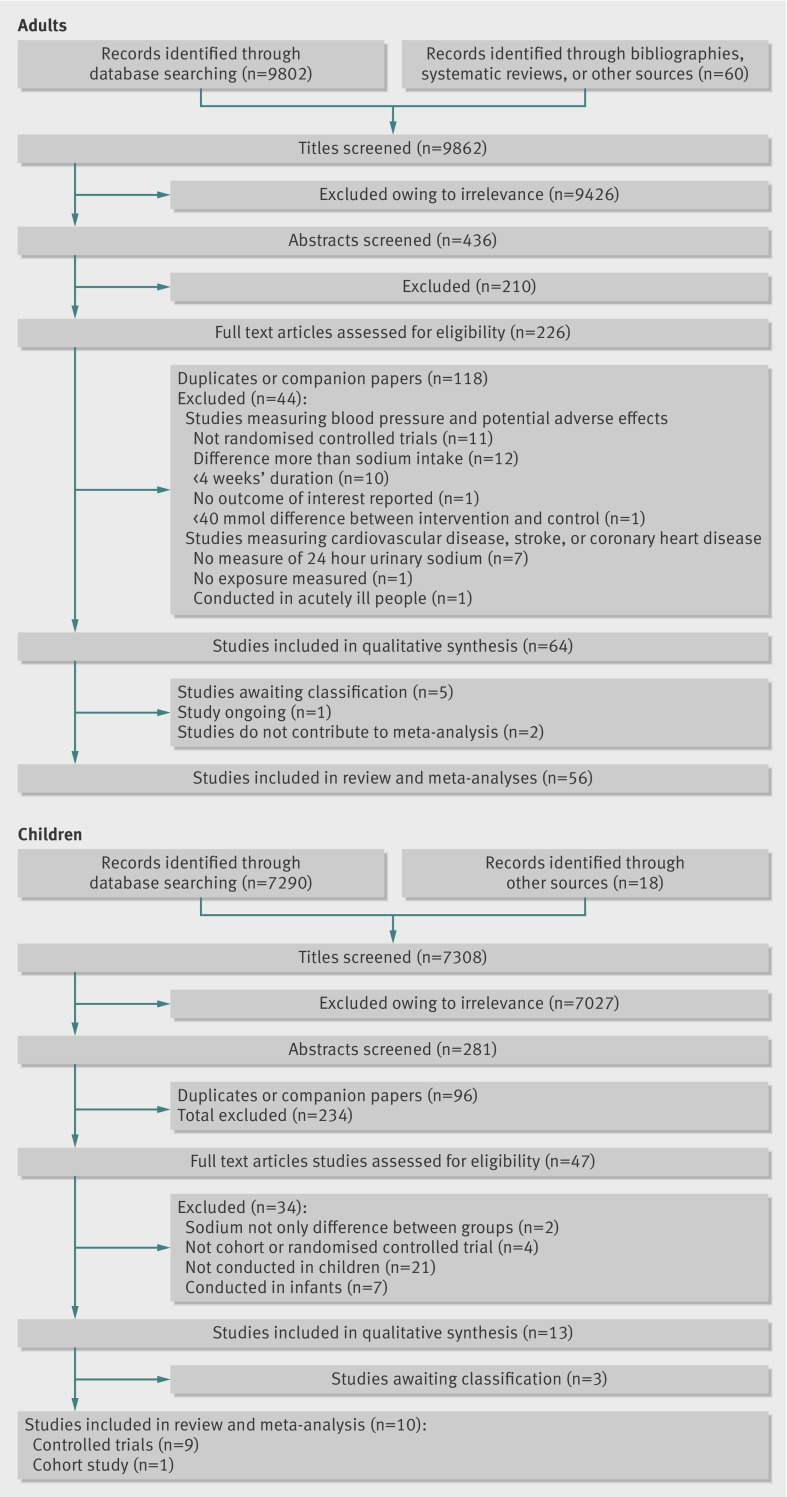
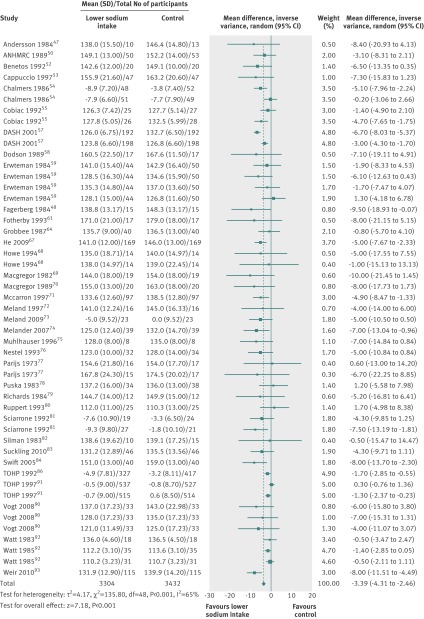
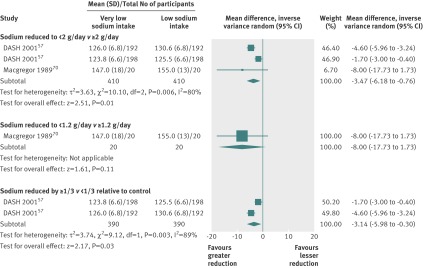
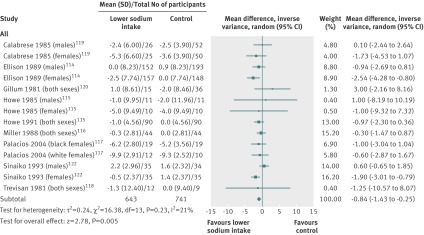
OBJECTIVE: To assess the effect of decreased sodium intake on blood pressure, related cardiovascular diseases, and potential adverse effects such as changes in blood lipids, catecholamine levels, and renal function. DESIGN: Systematic review and meta-analysis. DATA SOURCES: Cochrane Central Register of Controlled Trials, Medline, Embase, WHO International Clinical Trials Registry Platform, the Latin American and Caribbean health science literature database, and the reference lists of previous reviews. STUDY SELECTION: Randomised controlled trials and prospective cohort studies in non-acutely ill adults and children assessing the relations between sodium intake and blood pressure, renal function, blood lipids, and catecholamine levels, and in non-acutely ill adults all cause mortality, cardiovascular disease, stroke, and coronary heart disease. STUDY APPRAISAL AND SYNTHESIS: Potential studies were screened independently and in duplicate and study characteristics and outcomes extracted. When possible we conducted a meta-analysis to estimate the effect of lower sodium intake using the inverse variance method and a random effects model. We present results as mean differences or risk ratios, with 95% confidence intervals. RESULTS: We included 14 cohort studies and five randomised controlled trials reporting all cause mortality, cardiovascular disease, stroke, or coronary heart disease; and 37 randomised controlled trials measuring blood pressure, renal function, blood lipids, and catecholamine levels in adults. Nine controlled trials and one cohort study in children reporting on blood pressure were also included. In adults a reduction in sodium intake significantly reduced resting systolic blood pressure by 3.39 mm Hg (95% confidence interval 2.46 to 4.31) and resting diastolic blood pressure by 1.54 mm Hg (0.98 to 2.11). When sodium intake was <2 g/day versus ≥ 2 g/day, systolic blood pressure was reduced by 3.47 mm Hg (0.76 to 6.18) and diastolic blood pressure by 1.81 mm Hg (0.54 to 3.08). Decreased sodium intake had no significant adverse effect on blood lipids, catecholamine levels, or renal function in adults (P>0.05). There were insufficient randomised controlled trials to assess the effects of reduced sodium intake on mortality and morbidity. The associations in cohort studies between sodium intake and all cause mortality, incident fatal and non-fatal cardiovascular disease, and coronary heart disease were non-significant (P>0.05). Increased sodium intake was associated with an increased risk of stroke (risk ratio 1.24, 95% confidence interval 1.08 to 1.43), stroke mortality (1.63, 1.27 to 2.10), and coronary heart disease mortality (1.32, 1.13 to 1.53). In children, a reduction in sodium intake significantly reduced systolic blood pressure by 0.84 mm Hg (0.25 to 1.43) and diastolic blood pressure by 0.87 mm Hg (0.14 to 1.60). CONCLUSIONS: High quality evidence in non-acutely ill adults shows that reduced sodium intake reduces blood pressure and has no adverse effect on blood lipids, catecholamine levels, or renal function, and moderate quality evidence in children shows that a reduction in sodium intake reduces blood pressure. Lower sodium intake is also associated with a reduced risk of stroke and fatal coronary heart disease in adults. The totality of evidence suggests that most people will likely benefit from reducing sodium intake.
Overview
The claims and statistics of this paper haven’t been checked yet.
Run the check — free, no account needed. It reads the open-access text and checks the sources it cites.
Integrity signals
Registry
Cites
Statistics
Figures
Verification
Claims the paper makes
The claims and statistics of this paper haven’t been checked yet.
Run the check — free, no account needed. It reads the open-access text and checks the sources it cites.
Claims other papers make about this one
Each is checked against this paper’s own text: does it say what the citing paper says it does?
In the citing paper
“Nearly all observational studies demonstrate a positive association between very high sodium intakes (e.g., 4000+ mg/d) and CVD events, in particular stroke.305-307”
From Dietary and Policy Priorities for Cardiovascular Disease, Diabetes, and Obesity: A Comprehensive Review (2016) · cites this paper as [305]
In the citing paper
“In meta-analyses of longitudinal studies, high sodium intakes associate with incident total stroke, stroke mortality, and CHD mortality (Figure 7).305-307”
From Dietary and Policy Priorities for Cardiovascular Disease, Diabetes, and Obesity: A Comprehensive Review (2016) · cites this paper as [306]
In the citing paper
“In meta-analyses of prospective observational studies, the lowest mean intakes associated with lower risk of CVD events ranged from 1787 to 2391 mg/d.305”
From Dietary and Policy Priorities for Cardiovascular Disease, Diabetes, and Obesity: A Comprehensive Review (2016) · cites this paper as [305]
In the citing paper
“Nearly all observational studies demonstrate a positive association between very high sodium intakes (e.g., 4000+ mg/d) and CVD events, in particular stroke.305-307”
From Dietary and Policy Priorities for Cardiovascular Disease, Diabetes, and Obesity: A Comprehensive Review (2016) · cites this paper as [306]
In the citing paper
“In meta-analyses of longitudinal studies, high sodium intakes associate with incident total stroke, stroke mortality, and CHD mortality (Figure 7).305-307”
From Dietary and Policy Priorities for Cardiovascular Disease, Diabetes, and Obesity: A Comprehensive Review (2016) · cites this paper as [305]
In the citing paper
“Meta-analyses of CVD event trials did not report a significant reduction in CVD with lower sodium intake, but the included trials were underpowered to detect moderate risk reductions (258).”
From Food Consumption and its Impact on Cardiovascular Disease: Importance of Solutions Focused on the Globalized Food System (2015) · cites this paper as [258]
Self-check
Percentages, sums and reported differences re-computed from the paper’s own numbers.
The self-check needs the paper’s full text.
Citations
Cites
2 retracted
Reduced dietary salt for the prevention of cardiovascular disease
Taylor, R. S., Ashton, K. E., Moxham, T., Hooper, L., & Ebrahim, S. B. J. (2013) · Cochrane Database of Systematic Reviews · doi:10.1002/14651858.cd009217.pub2 · Cited by 311
Self-citationRetractedReduced dietary salt for the prevention of cardiovascular disease
Taylor, R. S., Ashton, K. E., Moxham, T., Hooper, L., & Ebrahim, S. B. J. (2011) · Cochrane Database of Systematic Reviews · doi:10.1002/14651858.cd009217 · Cited by 223
Self-citationRetractedMeasuring inconsistency in meta-analyses
Higgins, J. P. T., Thompson, S. G., Deeks, J. J., & Altman, D. G. (2003) · BMJ · doi:10.1136/bmj.327.7414.557 · Cited by 63,139
Quantifying heterogeneity in a meta‐analysis
Higgins, J. P. T., & Thompson, S. G. (2002) · Statistics in Medicine · doi:10.1002/sim.1186 · Cited by 36,763
Liberati, A., Altman, D. G., Tetzlaff, J., Mulrow, C., Gøtzsche, P. C., Ioannidis, J. P. A., Clarke, M., Devereaux, P. J., Kleijnen, J., & Moher, D. (2009) · PLoS Medicine · doi:10.1371/journal.pmed.1000100 · Cited by 28,164
GRADE: an emerging consensus on rating quality of evidence and strength of recommendations
Guyatt, G. H., Oxman, A. D., Vist, G. E., Kunz, R., Falck-Ytter, Y., Alonso-Coello, P., & Schünemann, H. J. (2008) · BMJ · doi:10.1136/bmj.39489.470347.ad · Cited by 23,305
Liberati, A., Altman, D. G., Tetzlaff, J., Mulrow, C., Gotzsche, P. C., Ioannidis, J. P. A., Clarke, M., Devereaux, P. J., Kleijnen, J., & Moher, D. (2009) · BMJ · doi:10.1136/bmj.b2700 · Cited by 17,648
Liberati, A., Altman, D. G., Tetzlaff, J., Mulrow, C., Gøtzsche, P. C., Ioannidis, J. P. A., Clarke, M., Devereaux, P. J., Kleijnen, J., & Moher, D. (2009) · Annals of Internal Medicine · doi:10.7326/0003-4819-151-4-200908180-00136 · Cited by 10,349
Global status report on noncommunicable diseases 2010.
Alwan, A. (2011) · Cited by 8,494
Research works printed but not linked: 5
- [36]Stamler J, Elliott P, Chan Q, for the INTERMAP Research Group. Intermap appendix tables. J Hum Hyper 2003; 17: 665-758.
- [39]Swift PA, Markandu ND, Sagnella GA, MacGregor GA. A double blind randomised control trial of modest salt reduction in black people with normal blood pressure. J Am Soc Nephrol 2006; 17: 657A.
- [41]Miller JA, Wong F, Dionne J. Dietary sodium modulates renal vasomotor tone in normal humans. J Am Soc Nephrol 1993; 4: 583.
- [105]Tunstall-Pedoe H, Woodward M, Tavandale R, Brook R, McCluskey MK. Comparison of the prediction by 27 different factors of coronary heart disease and death in men and women of the Scottish heart health study: cohort study. BMJ 1997; 315: 722-9. 9314758 PMC2127508
- [115]Howe PR, Jureidini KF, Smith RM. Sodium and blood pressure in children—a short-term dietary intervention study. Proc Nutr Soc Aust 1985; 10: 121-4.
Cited by
Sorted by citations
Heart Disease and Stroke Statistics—2017 Update: A Report From the American Heart Association
Benjamin, E. J., Blaha, M. J., Chiuve, S. E., Cushman, M., Das, S. R., Deo, R., de Ferranti, S. D., Floyd, J., Fornage, M., Gillespie, C., et al. (2017) · Circulation · doi:10.1161/cir.0000000000000485 · Cited by 12,591
2018 ESC/ESH Guidelines for the management of arterial hypertension
Williams, B., Mancia, G., Spiering, W., Agabiti Rosei, E., Azizi, M., Burnier, M., Clement, D. L., Coca, A., de Simone, G., Dominiczak, A., et al. (2018) · European Heart Journal · doi:10.1093/eurheartj/ehy339 · Cited by 10,286
Whelton, P. K., Carey, R. M., Aronow, W. S., Casey, D. E., Collins, K. J., Dennison Himmelfarb, C., DePalma, S. M., Gidding, S., Jamerson, K. A., Jones, D. W., et al. (2018) · Hypertension · doi:10.1161/hyp.0000000000000065 · Cited by 7,391
Heart disease and stroke statistics-2018 update: a report from the american heart association
Benjamin, E. J., Virani, S. S., Callaway, C. W., Chamberlain, A. M., Chang, A. R., Cheng, S., Chiuve, S. E., Cushman, M., Delling, F. N., Deo, R., et al. (2018) · Circulation · doi:10.1161/cir.0000000000000558 · Cited by 7,146
Heart Disease and Stroke Statistics—2016 Update: A Report From the American Heart Association
Mozaffarian, D., Benjamin, E. J., Go, A. S., Arnett, D. K., Blaha, M. J., Cushman, M., Das, S. R., de Ferranti, S., Després, J.-P., Fullerton, H. J., et al. (2016) · Circulation · doi:10.1161/cir.0000000000000350 · Cited by 6,596
Metadata
- Authors
- Aburto, N. J., Ziolkovska, A., Hooper, L., Elliott, P., Cappuccio, F. P., & Meerpohl, J. J.
- Affiliations
- World Health Organization (CH)
- University of East Anglia (GB)
- Imperial College London (GB)
- University of Warwick (GB)
- University Medical Center Freiburg (DE)
- Corresponding author
- Aburto, N. J.
- Venue
- BMJ
- Publisher
- BMJ
- Published
- 2013-04-03
- Volume
- 346
- Issue
- apr03 3
- Pages
- f1326-f1326
- ISSN
- 1756-1833 (ISSN-L)
- PMC
- PMC4816261
- OpenAlex
- W2167945952
- Cited by
- 1,242
- References
- 163
- Citations by year
- 2026: 26 · 2025: 54 · 2024: 74 · 2023: 80 · 2022: 106 · 2021: 101 · 2020: 115 · 2019: 128 · 2018: 101 · 2017: 110 · 2016: 95 · 2015: 99 · 2014: 106 · 2013: 39
- FWCI
- 12.76
- Type
- journal article
- Language
- en
- Open access
- hybrid
- doi.org
- Licence
- cc-by-nc
- Locations
- BMJ (publishedVersion, cc-by-nc)
- Europe PMC (PubMed Central) (publishedVersion, cc-by-nc)
- PubMed Central (publishedVersion, cc-by-nc)
- PubMed (publishedVersion)
- UEA Digital Repository (University of East Anglia) (acceptedVersion, cc-by-nc)
- UCL Discovery (University College London) (submittedVersion)
- Funders
- National Institute for Health and Care Research (NF-SI-0611-10136)
- National Institute of Diabetes and Digestive and Kidney Diseases (T32DK007734)
- Topics
- Health Sciences › Nursing › Nutrition and Dietetics › Sodium Intake and Health
- Health Sciences › Medicine › Cardiology and Cardiovascular Medicine › Blood Pressure and Hypertension Studies
- Health Sciences › Medicine › Public Health, Environmental and Occupational Health › Nutritional Studies and Diet
- Keywords
- low sodium intake, dietary sodium reduction, blood pressure, cardiovascular disease, stroke, coronary artery disease, all-cause mortality, serum lipids, catecholamines, renal function, children, hypertension prevention, salt reduction interventions, sodium reduction
- MeSH terms
- Blood Pressure, Cardiovascular Diseases, Catecholamines, Diet, Sodium-Restricted, Female, Humans, Hypertension, Kidney, Male, Prospective Studies, Public Health, Randomized Controlled Trials as Topic, Sodium Chloride, Dietary, Lipid Metabolism
About these checks
Registry, retraction, Cites and statistics results are computed, not judged, with one exception: a printed reference that no index lists is read once by a model before it counts as a citation error. Claims are extracted by a model and kept only when their quote appears verbatim in the text; each cited source is then checked, with a model’s help, for whether it says what the claim relies on. Those verdicts can be wrong — read the claim’s quote and the cited source before relying on one.
Statistics and arithmetic are recomputed, not judged.
Confidence bands are shown only for fields calibrated on our annotated test set. None is calibrated yet, so no band is shown.
What counts as a claim ›How we measure confidence ›How we check this ›
Are you an author, or do you see a problem with this page? Request a review
