

The DOI matches its Crossref record; 75 of the 77 references it cites were found in a registry or an index.
Methylphenidate for attention-deficit/hyperactivity disorder in children and adolescents: Cochrane systematic review with meta-analyses and trial sequential analyses of randomised clinical trials
Open accessAbstract
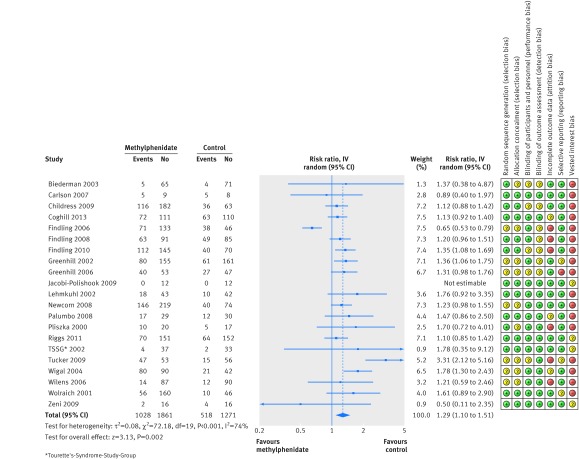
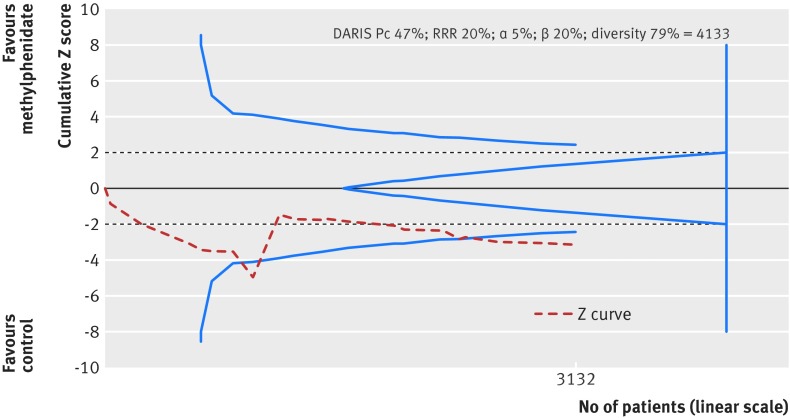
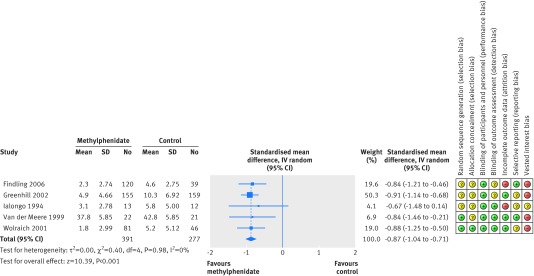
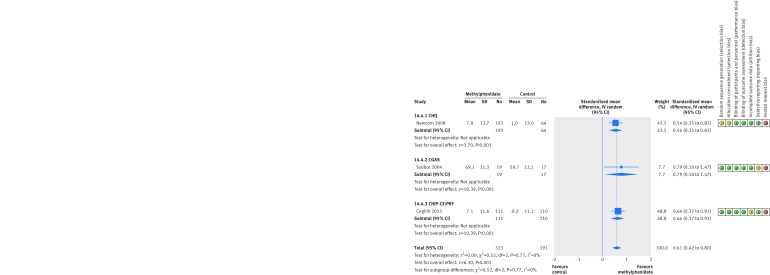
STUDY QUESTION: Is methylphenidate beneficial or harmful for the treatment of attention-deficit/hyperactivity disorder (ADHD) in children and adolescents? METHODS: Electronic databases were searched up to February 2015 for parallel and crossover randomised clinical trials comparing methylphenidate with placebo or no intervention in children and adolescents with ADHD. Meta-analyses and trial sequential analyses (TSA) were conducted. Quality was assessed using GRADE. Teachers, parents, and observers rated ADHD symptoms and general behaviour. STUDY ANSWER AND LIMITATIONS: The analyses included 38 parallel group trials (n=5111, median treatment duration 49 days) and 147 crossover trials (n=7134, 14 days). The average age across all studies was 9.7 years. The analysis suggested a beneficial effect of methylphenidate on teacher rated symptoms in 19 parallel group trials (standardised mean difference (SMD) -0.77, n=1698), corresponding to a mean difference of -9.6 points on the ADHD rating scale. There was no evidence that methylphenidate was associated with an increase in serious adverse events (risk ratio 0.98, nine trials, n=1532; TSA adjusted intervention effect RR 0.91). Methylphenidate was associated with an increased risk of non-serious adverse events (1.29, 21 trials, n=3132; TSA adjusted RR 1.29). Teacher rated general behaviour seemed to improve with methylphenidate (SMD -0.87, five trials, n=668) A change of 7 points on the child health questionnaire (CHQ) has been deemed a minimal clinically relevant difference. The change reported in a meta-analysis of three trials corresponds to a mean difference of 8.0 points on the CHQ (range 0-100 points), which suggests that methylphenidate may improve parent reported quality of life (SMD 0.61, three trials, n=514). 96.8% of trials were considered high risk of bias trials according to the Cochrane guidelines. All outcomes were assessed very low quality according to GRADE. WHAT THIS STUDY ADDS: The results suggest that among children and adolescents with a diagnosis of ADHD, methylphenidate may improve teacher reported symptoms of ADHD and general behaviour and parent reported quality of life. However, given the risk of bias in the included studies, and the very low quality of outcomes, the magnitude of the effects is uncertain. Methylphenidate is associated with an increased risk of non-serious but not serious adverse events. FUNDING, COMPETING INTERESTS, DATA SHARING: Region Zealand Research Foundation and Copenhagen Trial Unit. Competing interests are given in the full paper on bmj.com. Full data are available in the version of this review published in The Cochrane Library.
Overview
The claims and statistics of this paper haven’t been checked yet.
Run the check — free, no account needed. It reads the open-access text and checks the sources it cites.
Integrity signals
Registry
Cites
Statistics
Figures
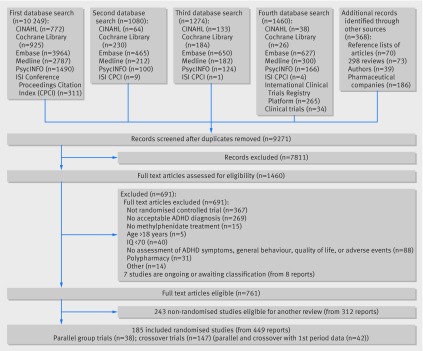
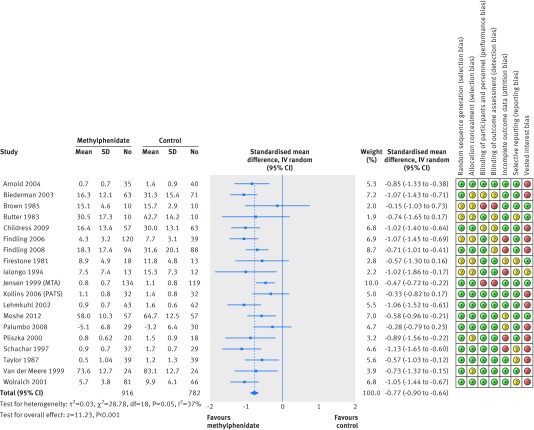
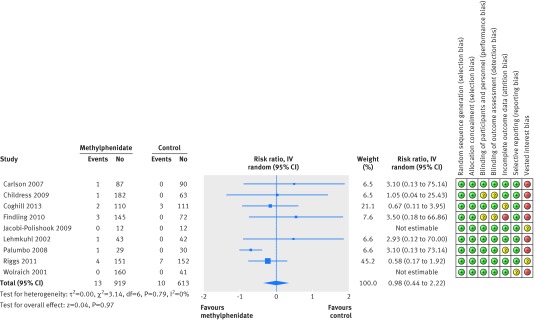
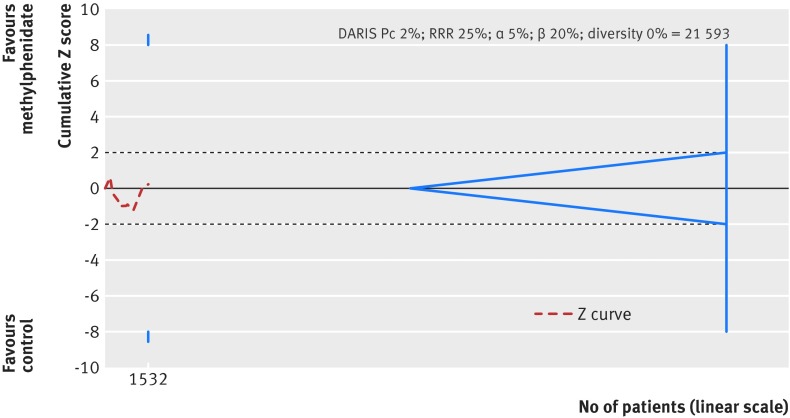
Verification
Claims the paper makes
The claims and statistics of this paper haven’t been checked yet.
Run the check — free, no account needed. It reads the open-access text and checks the sources it cites.
Claims other papers make about this one
Each is checked against this paper’s own text: does it say what the citing paper says it does?
The source backs part of the claim, not all of it — or backs it for a different population, condition or comparison.
In the citing paper
“The most common prescribed drug for treatment of ADHD is methylphenidate (MPH) and it is believed that it can improve cognitive function through a dopaminergic effect (Storebø et al. 2015).”
From Crocus sativus L. Versus Methylphenidate in Treatment of Children with Attention-Deficit/Hyperactivity Disorder: A Randomized, Double-Blind Pilot Study (2019) · cites this paper as Storebø et al. 2015
Experimental — accuracy not yet measured
Self-check
Percentages, sums and reported differences re-computed from the paper’s own numbers.
The self-check needs the paper’s full text.
Citations
Cites
2 retracted
Immediate-release methylphenidate for attention deficit hyperactivity disorder (ADHD) in adults
Epstein, T., Patsopoulos, N. A., & Weiser, M. (2014) · Cochrane Database of Systematic Reviews · doi:10.1002/14651858.cd005041.pub2 · Cited by 65
RetractedImmediate-release methylphenidate for attention deficit hyperactivity disorder (ADHD) in adults
Epstein, T., Patsopoulos, N. A., & Weiser, M. (2016) · Cochrane Database of Systematic Reviews · doi:10.1002/14651858.cd005041.pub3 · Cited by 62
RetractedPreferred Reporting Items for Systematic Reviews and Meta-Analyses: the PRISMA statement
Moher, D., Liberati, A., Tetzlaff, J., Altman, D. G., & for the PRISMA Group (2009) · BMJ · doi:10.1136/bmj.b2535 · Cited by 83,823
Preferred reporting items for systematic reviews and meta-analyses: the PRISMA Statement.
(2009) · PubMed Central · Cited by 44,859
Preferred reporting items for systematic reviews and meta-analyses: The PRISMA statement
Moher, D., Liberati, A., Tetzlaff, J., Altman, D. G., & the PRISMA Group* (2009) · Annals of Internal Medicine · doi:10.7326/0003-4819-151-4-200908180-00135 · Cited by 37,554
PRISMA-P Group, Moher, D., Shamseer, L., Clarke, M., Ghersi, D., Liberati, A., Petticrew, M., Shekelle, P., & Stewart, L. A. (2015) · Systematic Reviews · doi:10.1186/2046-4053-4-1 · Cited by 26,223
Preferred Reporting Items for Systematic Reviews and Meta-Analyses: The PRISMA Statement
Moher, D., Liberati, A., Tetzlaff, J., & Altman, D. G. (2009) · Journal of Clinical Epidemiology · doi:10.1016/j.jclinepi.2009.06.005 · Cited by 19,575
Liberati, A., Altman, D. G., Tetzlaff, J., Mulrow, C., Gotzsche, P. C., Ioannidis, J. P. A., Clarke, M., Devereaux, P. J., Kleijnen, J., & Moher, D. (2009) · BMJ · doi:10.1136/bmj.b2700 · Cited by 17,648
Liberati, A., Altman, D. G., Tetzlaff, J., Mulrow, C., Gøtzsche, P. C., Ioannidis, J. P. A., Clarke, M., Devereaux, P. J., Kleijnen, J., & Moher, D. (2009) · Annals of Internal Medicine · doi:10.7326/0003-4819-151-4-200908180-00136 · Cited by 10,349
Cochrane Handbook for Systematic Reviews of Interventions
Higgins, J. P. T., Green, S., & Ben Van Den, A. (2020) · International Coaching Psychology Review · doi:10.53841/bpsicpr.2020.15.2.123 · Cited by 5,670
Schulz (1995) · doi:10.1001/jama.1995.03520290060030 · Cited by 5,634
Polanczyk, G. V., Salum, G. A., Sugaya, L. S., Caye, A., & Rohde, L. A. (2015) · Journal of Child Psychology and Psychiatry · doi:10.1111/jcpp.12381 · Cited by 3,990
Moher, D., Pham, B., Jones, A., Cook, D. J., Jadad, A. R., Moher, M., Tugwell, P., & Klassen, T. P. (1998) · The Lancet · doi:10.1016/s0140-6736(98)01085-x · Cited by 3,560
Wood, L., Egger, M., Gluud, L. L., Schulz, K. F., Jüni, P., Altman, D. G., Gluud, C., Martin, R. M., Wood, A. J. G., & Sterne, J. A. C. (2008) · BMJ · doi:10.1136/bmj.39465.451748.ad · Cited by 2,538
Self-citationGluud, L. L., Villumsen, J., & Gluud, C. N. (2001) · Annals of Internal Medicine · doi:10.7326/0003-4819-135-11-200112040-00010 · Cited by 2,266
Self-citationTrial sequential analysis may establish when firm evidence is reached in cumulative meta-analysis
Wetterslev, J., Thorlund, K., Brok, J., & Gluud, C. (2008) · Journal of Clinical Epidemiology · doi:10.1016/j.jclinepi.2007.03.013 · Cited by 1,881
Self-citationIndustry sponsorship and research outcome
Lundh, A., Lexchin, J., Mintzes, B., Schroll, J. B., & Bero, L. (2017) · Cochrane Database of Systematic Reviews · doi:10.1002/14651858.mr000033.pub3 · Cited by 1,697
Andrews, J., Guyatt, G., Oxman, A. D., Alderson, P., Dahm, P., Falck-Ytter, Y., Nasser, M., Meerpohl, J., Post, P. N., Kunz, R., et al. (2013) · Journal of Clinical Epidemiology · doi:10.1016/j.jclinepi.2012.03.013 · Cited by 1,416
Brok, J. S., Thorlund, K., Gluud, C. N., & Wetterslev, J. (2008) · Journal of Clinical Epidemiology · doi:10.1016/j.jclinepi.2007.10.007 · Cited by 1,118
Self-citationSavović, J., Jones, H. E., Altman, D. G., Harris, R. J., Jüni, P., Pildal, J., Als-Nielsen, B., Balk, E. M., Gluud, C., Gluud, L. L., et al. (2012) · Annals of Internal Medicine · doi:10.7326/0003-4819-157-6-201209180-00537 · Cited by 1,049
Self-citationEstimating required information size by quantifying diversity in random-effects model meta-analyses
Wetterslev, J., Thorlund, K., Brok, J. S., & Gluud, C. N. (2009) · BMC Medical Research Methodology · doi:10.1186/1471-2288-9-86 · Cited by 936
Self-citationBrok, J. S., Thorlund, K., Wetterslev, J., & Gluud, C. N. (2008) · International Journal of Epidemiology · doi:10.1093/ije/dyn188 · Cited by 913
Self-citationCan trial sequential monitoring boundaries reduce spurious inferences from meta-analyses?
Thorlund, K., Devereaux, P. J., Wetterslev, J., Guyatt, G. H., Ioannidis, J. P. A., Thabane, L., Gluud, L. L., Als-Nielsen, B. E. T., & Gluud, C. N. (2008) · International Journal of Epidemiology · doi:10.1093/ije/dyn179 · Cited by 834
Self-citationSavović, J., Jones, H., Altman, D., Harris, R., Jűni, P., Pildal, J., Als-Nielsen, B., Balk, E., Gluud, C., Gluud, L., et al. (2012) · Health Technology Assessment · doi:10.3310/hta16350 · Cited by 668
Self-citationIndustry sponsorship and research outcome
Lundh, A., Sismondo, S., Lexchin, J., Busuioc, O. A., & Bero, L. (2012) · Cochrane Database of Systematic Reviews · doi:10.1002/14651858.mr000033.pub2 · Cited by 605
Epidemiology of Adhd in School-Age Children
Scahill, L., & Schwab‐Stone, M. (2000) · Child and Adolescent Psychiatric Clinics of North America · doi:10.1016/s1056-4993(18)30106-8 · Cited by 531
Charach, A., Yeung, E., Climans, T., & Lillie, E. (2011) · Journal of the American Academy of Child & Adolescent Psychiatry · doi:10.1016/j.jaac.2010.09.019 · Cited by 482
(2001) · Europe PMC (PubMed Central) · Cited by 393
Faraone, S. V., & Glatt, S. J. (2010) · The Journal of Clinical Psychiatry · doi:10.4088/jcp.08m04902pur · Cited by 387
Methylphenidate for children and adolescents with attention deficit hyperactivity disorder (ADHD)
Storebø, O. J., Ramstad, E., Krogh, H. B., Nilausen, T. D., Skoog, M., Holmskov, M., Rosendal, S., Groth, C., Magnusson, F. L., Moreira-Maia, C. R., et al. (2015) · Cochrane Database of Systematic Reviews · doi:10.1002/14651858.cd009885.pub2 · Cited by 347
Self-citationder Oord, S. V., Prins, P. J. M., Oosterlaan, J., & Emmelkamp, P. M. G. (2007) · Clinical Psychology Review · doi:10.1016/j.cpr.2007.10.007 · Cited by 337
Newcorn, J. H., Kratochvil, C. J., Allen, A. J., Casat, C. D., Ruff, D. D., Moore, R. J., Michelson, D., & Atomoxetine/Methylphenidate Comparative Study Group (2008) · American Journal of Psychiatry · doi:10.1176/appi.ajp.2007.05091676 · Cited by 336
Thompson, M., den Bruel, A. V., Verbakel, J. Y. J., Lakhanpaul, M., Haj-Hassan, T. A., Stevens, R., Moll, H. A., Buntinx, F., Berger, M. Y., Aertgeerts, B., et al. (2012) · Health Technology Assessment · doi:10.3310/hta16150 · Cited by 324
Storebø, O. J., Pedersen, N., Ramstad, E., Kielsholm, M. L., Nielsen, S. S., Krogh, H. B., Moreira-Maia, C. R., Magnusson, F. L., Holmskov, M., Gerner, T., et al. (2018) · Cochrane Database of Systematic Reviews · doi:10.1002/14651858.cd012069.pub2 · Cited by 321
Self-citationBloch, M. H., Panza, K. E., Landeros-Weisenberger, A., & Leckman, J. F. (2009) · Journal of the American Academy of Child & Adolescent Psychiatry · doi:10.1097/chi.0b013e3181b26e9f · Cited by 270
Zhang, S., Faries, D. E., Vowles, M., & Michelson, D. (2005) · International Journal of Methods in Psychiatric Research · doi:10.1002/mpr.7 · Cited by 257
Comparing the efficacy of medications for ADHD using meta-analysis.
(2006) · PubMed Central · Cited by 230
ICH harmonized tripartite guideline: Guideline for Good Clinical Practice.
(2001) · PubMed · Cited by 222
Taylor, E. A., Schachar, R. J., Thorley, G., Wieselberg, H. M., Everitt, B. J., & Rutter, M. L. (1987) · Psychological Medicine · doi:10.1017/s0033291700013039 · Cited by 210
Nelson, E. A., O’Meara, S., Craig, D., Iglesias, C., Golder, S., Dalton, J., Claxton, K., Bell-Syer, S. E., Jude, E. B., Dowson, C. G., et al. (2006) · Health Technology Assessment · doi:10.3310/hta10120 · Cited by 200
King, S., Griffin, S. C., Hodges, Z., Weatherly, H. L. A., Asseburg, C., Richardson, G. A., Golder, S., Taylor, E., Drummond, M., & Riemsma, R. P. (2006) · Health Technology Assessment · doi:10.3310/hta10230 · Cited by 188
Ca-125: A Useful Marker to Distinguish Pulmonary Tuberculosis from Other Pulmonary Infections
Fortün, J., Martín‐Dávila, P., Méndez, R., Martínez, M. C. A., Norman, F., Rubi, J., Pallares, E., Gómez-Mampaso, E., & Moreno, S. (2009) · The Open Respiratory Medicine Journal · doi:10.2174/1874306400903010123 · Cited by 179
Interventions for Preschool Children at High Risk for ADHD: A Comparative Effectiveness Review
Charach, A., Carson, P., Fox, S. W., Ali, M. U., Beckett, J., & Lim, C. G. (2013) · PEDIATRICS · doi:10.1542/peds.2012-0974 · Cited by 177
Industry sponsorship and research outcome
Lundh, A., Lexchin, J., Sismondo, S., Busuioc, O. A., & Bero, L. A. (2011) · Cochrane Database of Systematic Reviews · doi:10.1002/14651858.mr000033 · Cited by 166
Clonidine for Attention-Deficit/Hyperactivity Disorder: I. Efficacy and Tolerability Outcomes
Palumbo, D. R., Sallee, F. R., Pelham, W. E., Bukstein, O. G., Daviss, W. B., & McDermott, M. (2008) · Journal of the American Academy of Child & Adolescent Psychiatry · doi:10.1097/chi.0b013e31815d9af7 · Cited by 140
Hanwella, R., Senanayake, M., & de Silva, V. (2011) · BMC Psychiatry · doi:10.1186/1471-244x-11-176 · Cited by 137
Reichow, B., Volkmar, F. R., & Bloch, M. H. (2013) · Journal of Autism and Developmental Disorders · doi:10.1007/s10803-013-1793-z · Cited by 134
Martínez-Raga, J., Knecht, C., Szerman, N., & Martínez, M. (2012) · CNS Drugs · doi:10.1007/s40263-012-0019-9 · Cited by 131
Developmental psychopathology: Attention Deficit Hyperactivity Disorder (ADHD)
Schmidt, S., & Petermann, F. (2009) · BMC Psychiatry · doi:10.1186/1471-244x-9-58 · Cited by 129
The knowledge system underpinning healthcare is not fit for purpose and must change
Roberts, I., Ker, K., Edwards, P. J., Beecher, D., Manno, D., & Sydenham, E. (2015) · BMJ · doi:10.1136/bmj.h2463 · Cited by 126
Modeling Rater Disagreement for ADHD: Are Parents or Teachers Biased?
Hartman, C. A., Rhee, S. H., Willcutt, E. G., & Pennington, B. F. (2007) · Journal of Abnormal Child Psychology · doi:10.1007/s10802-007-9110-y · Cited by 122
FINDLING, R. L., SHORT, E. J., McNAMARA, N. K., DEMETER, C. A., STANSBREY, R. J., GRACIOUS, B. L., WHIPKEY, R., MANOS, M. J., & CALABRESE, J. R. (2007) · Journal of the American Academy of Child & Adolescent Psychiatry · doi:10.1097/chi.0b013e31814b8d3b · Cited by 120
Pearson, D. A., Santos, C. W., Aman, M. G., Arnold, L. E., Casat, C. D., Mansour, R., Lane, D. M., Loveland, K. A., Bukstein, O. G., Jerger, S. W., et al. (2013) · Journal of Child and Adolescent Psychopharmacology · doi:10.1089/cap.2012.0096 · Cited by 120
Meta‐analysis combining parallel and cross‐over clinical trials. III: The issue of carry‐over
Curtin, F., Elbourne, D. R., & Altman, D. G. (2002) · Statistics in Medicine · doi:10.1002/sim.1207 · Cited by 120
Murray, D. W., Kollins, S. H., Hardy, K. K., Abikoff, H., Swanson, J. M., Cunningham, C. E., Vitiello, B., Riddle, M. A., Davies, M., Greenhill, L. L., et al. (2007) · Journal of Child and Adolescent Psychopharmacology · doi:10.1089/cap.2007.0060 · Cited by 112
Oesterheld, J. R., Kofoed, L., Tervo, R. C., Fogas, B. S., WILSON, A., & Fiechtner, H. B. (1998) · Journal of Child and Adolescent Psychopharmacology · doi:10.1089/cap.1998.8.39 · Cited by 111
Faraone, S. V. (2009) · PubMed · Cited by 107
Faraone, S. V., Biederman, J., & Roe, C. (2002) · Journal of Clinical Psychopharmacology · doi:10.1097/00004714-200210000-00005 · Cited by 91
Rentz, A. M., Matza, L. S., Secnik, K., Swensen, A. R., & Revicki, D. A. (2005) · Quality of Life Research · doi:10.1007/s11136-004-0832-9 · Cited by 81
Smith, B. H., Pelham, W. E., Evans, S. W., Gnagy, E. M., Molina, B. S. G., Bukstein, O. G., Greiner, A. R., Myak, C., Presnell, M., & Willoughby, M. T. (1998) · Experimental and Clinical Psychopharmacology · doi:10.1037/1064-1297.6.2.187 · Cited by 70
Kambeitz, J., Romanos, M., & Ettinger, U. (2014) · The Pharmacogenomics Journal · doi:10.1038/tpj.2013.9 · Cited by 64
Long-Term Efficacy of Methylphenidate Immediate-Release for the Treatment of Childhood ADHD
Maia, C. R. M., Cortese, S., Caye, A., Deakin, T. K., Polanczyk, G. V., Polanczyk, C. A., & Rohde, L. A. (2014) · Journal of Attention Disorders · doi:10.1177/1087054714559643 · Cited by 63
Szobot, C. M., Rohde, L. A., Katz, B., Ruaro, P., Schaefer, T., Walcher, M., Bukstein, O., & Pechansky, F. (2008) · Brazilian Journal of Medical and Biological Research · doi:10.1590/s0100-879x2008005000011 · Cited by 51
Green, T., Weinberger, R., Diamond, A. D., Berant, M., Hirschfeld, L., Frisch, A., Zarchi, O., Weizman, A., & Gothelf, D. (2011) · Journal of Child and Adolescent Psychopharmacology · doi:10.1089/cap.2011.0042 · Cited by 46
Evaluating Parental Disagreement in ADHD Diagnosis: Can We Rely on a Single Report From Home?
Caye, A., Machado, J. D., & Rohde, L. A. (2013) · Journal of Attention Disorders · doi:10.1177/1087054713504134 · Cited by 44
Carlson, G. A., Dunn, D., Kelsey, D. K., Ruff, D. D., Ball, S. G., Ahrbecker, L. M., & Allen, A. J. (2007) · Child and Adolescent Psychiatry and Mental Health · doi:10.1186/1753-2000-1-10 · Cited by 44
Searching for unpublished data for Cochrane reviews: cross sectional study
Schroll, J. B., Bero, L., & Gotzsche, P. C. (2013) · BMJ · doi:10.1136/bmj.f2231 · Cited by 43
Punja, S., Zorzela, L., Hartling, L., Urichuk, L., & Vohra, S. (2013) · BMJ Open · doi:10.1136/bmjopen-2012-002312 · Cited by 40
Lavigne, J. V., Dulcan, M. K., LeBailly, S. A., & Binns, H. J. (2012) · Journal of Developmental & Behavioral Pediatrics · doi:10.1097/dbp.0b013e31824afea1 · Cited by 37
Tucker, J. D., Suter, W., Petibone, D. M., Thomas, R. A., Bailey, N. L., Zhou, Y., Zhao, Y., Muniz, R., & Kumar, V. (2009) · Mutation Research/Genetic Toxicology and Environmental Mutagenesis · doi:10.1016/j.mrgentox.2009.05.005 · Cited by 32
Efstratopoulou, M., Simons, J., & Janssen, R. (2012) · Journal of Attention Disorders · doi:10.1177/1087054711431698 · Cited by 27
Methylphenidate for attention deficit hyperactivity disorder (ADHD) in children and adolescents
Storebø, O. J., Rosendal, S., Skoog, M., Groth, C., Bille, T., Rasmussen, K. B., Simonsen, E. H., & Gluud, C. N. (2012) · Cochrane Database of Systematic Reviews · doi:10.1002/14651858.cd009885 · Cited by 17
Self-citationStorebø, O. J., Pedersen, N. B., Ramstad, E., Krogh, H. B., Maia, C. R. M., Magnusson, F. L., Holmskov, M., Nilausen, T. D., Skoog, M., Rosendal, S., et al. (2016) · Cochrane Database of Systematic Reviews · doi:10.1002/14651858.cd012069 · Cited by 10
Self-citationInterventions for Preschool Children at High Risk for ADHD: A Comparative Effectiveness Review
Charach, A., Carson, P., Fox, S., Ali, M. U., Beckett, J., & Lim, C. G. (2019) · American Academy of Pediatrics eBooks · doi:10.1542/9781610024129-part02-interventions · Cited by 9
Kort om ADHD hos barn och vuxna En sammanfattning av Socialstyrelsens kunskapsöversikt
Mossler, K., Kadesjö, B., & Hellgren, L. (2014) · Socialmedicinsk tidskrift · doi:10.62607/smt.v81i2.45752 · Cited by 4
Research works printed but not linked: 2
- [27]Storebø O, Pedersen N, Krogh H, et al. Methylphenidate for attention deficit hyperactivity disorder (ADHD) in children and adolescents—assessment of harms in observational studies. Cochrane Database Syst Rev 2015; (In press). PMC6494554 29744873
- [59]Gluud C, Nikolova D, Klingenberg SL. Cochrane Hepato-Biliary About the Cochrane Collaboration (Cochrane Review Groups (CRGs). Cochrane Rev Groups 2015;1(Art.No:LIVER). www.cochranelibrary.com/about/cochrane-review-groups.html.
Cited by
Sorted by citations
ADHD in Children and Young People: Prevalence, Care Pathways, and Service Provision
Sayal, K., Prasad, V., Daley, D., Ford, T., & Coghill, D. (2018) · The Lancet Psychiatry · doi:10.1016/s2215-0366(17)30167-0 · Cited by 1,223
Catalá-López, F., Hutton, B., Núñez-Beltrán, A., Page, M. J., Ridao, M., Macías Saint-Gerons, D., Catalá, M. A., Tabarés-Seisdedos, R., & Moher, D. (2017) · PLOS ONE · doi:10.1371/journal.pone.0180355 · Cited by 396
Treatment strategies for ADHD: an evidence-based guide to select optimal treatment
Caye, A., Swanson, J. M., Coghill, D., & Rohde, L. A. (2019) · Molecular Psychiatry · doi:10.1038/s41380-018-0116-3 · Cited by 303
EEG power spectral slope differs by ADHD status and stimulant medication exposure in early childhood
Robertson, M. M., Furlong, S., Voytek, B., Donoghue, T., Boettiger, C. A., & Sheridan, M. A. (2019) · Journal of Neurophysiology · doi:10.1152/jn.00388.2019 · Cited by 205
“…that were medication naive, we next tested whether our observed electrophysiological group differences were modified by treatment with stimulant medications, which improve behavioral symptoms in children with ADHD and are the most common medicinal treatment for the disorder (Storebø et al. 2015).”
BackgroundCoghill, D., Banaschewski, T., Cortese, S., Asherson, P., Brandeis, D., Buitelaar, J., Daley, D., Danckaerts, M., Dittmann, R. W., Doepfner, M., et al. (2023) · European Child & Adolescent Psychiatry · doi:10.1007/s00787-021-01871-x · Cited by 180
Metadata
- Authors
- Storebø, O. J., Krogh, H. B., Ramstad, E., Moreira-Maia, C. R., Holmskov, M., Skoog, M., Nilausen, T. D., Magnusson, F. L., Zwi, M., Gillies, D., Rosendal, S., Groth, C., Rasmussen, K. B., Gauci, D., Kirubakaran, R., Forsbøl, B., Simonsen, E., & Gluud, C.
- Affiliations
- University of Southern Denmark (DK)
- Region Zealand (DK)
- Copenhagen University Hospital (DK)
- Whittington Hospital (GB)
- Western Sydney Local Health District (AU)
- Capital Region of Denmark (DK)
- Herlev Hospital (DK)
- Ministry for Health (MT)
- Christian Medical College, Vellore (IN)
- University of Copenhagen (DK)
- Corresponding author
- Storebø, Ole Jakob
- ORCID
- Venue
- BMJ
- Publisher
- BMJ
- Published
- 2015-11-25
- Volume
- 351
- Pages
- h5203
- ISSN
- 1756-1833 (ISSN-L)
- PMC
- PMC4659414
- OpenAlex
- W2179260900
- Cited by
- 209
- References
- 77
- Citations by year
- 2026: 8 · 2025: 8 · 2024: 11 · 2023: 14 · 2022: 17 · 2021: 24 · 2020: 16 · 2019: 18 · 2018: 25 · 2017: 36 · 2016: 28 · 2015: 4
- FWCI
- 4.27
- Type
- journal article
- Language
- en
- Open access
- hybrid
- doi.org
- Licence
- Locations
- BMJ (publishedVersion, cc-by-nc)
- Europe PMC (PubMed Central) (publishedVersion, cc-by-nc)
- PubMed (publishedVersion)
- Research at the University of Copenhagen (University of Copenhagen) (publishedVersion, cc-by-nc)
- OAR@UM (University of Malta) (submittedVersion, other-oa)
- University of Southern Denmark Research Portal (University of Southern Denmark) (submittedVersion, cc-by-nc)
- Funders
- Gentofte Hospital
- Syddansk Universitet
- Region Sjælland
- Copenhagen Trial Unit, Centre for Clinical Intervention Research
- Topics
- Health Sciences › Medicine › Psychiatry and Mental health › Attention Deficit Hyperactivity Disorder
- Social Sciences › Psychology › Developmental and Educational Psychology › Behavioral and Psychological Studies
- Health Sciences › Medicine › Pediatrics, Perinatology and Child Health › Pharmaceutical studies and practices
- Keywords
- methylphenidate, attention deficit hyperactivity disorder, children, adolescents, ADHD symptoms, quality of life, adverse events, stimulant medication, teacher ratings, parent ratings, trial sequential analysis, risk of bias, quality of evidence, minimal clinically important difference, Child Health Questionnaire
- MeSH terms
- Adolescent, Central Nervous System Stimulants, Attention Deficit Disorder with Hyperactivity, Child, Drug Administration Schedule, Humans, Methylphenidate, Quality of Life, Randomized Controlled Trials as Topic, Treatment Outcome, Cross-Over Studies
About these checks
Registry, retraction, Cites and statistics results are computed, not judged, with one exception: a printed reference that no index lists is read once by a model before it counts as a citation error. Claims are extracted by a model and kept only when their quote appears verbatim in the text; each cited source is then checked, with a model’s help, for whether it says what the claim relies on. Those verdicts can be wrong — read the claim’s quote and the cited source before relying on one.
Statistics and arithmetic are recomputed, not judged.
Confidence bands are shown only for fields calibrated on our annotated test set. None is calibrated yet, so no band is shown.
What counts as a claim ›How we measure confidence ›How we check this ›
Are you an author, or do you see a problem with this page? Request a review
